
Patient no 1 A 45 years old male
- Slides: 13
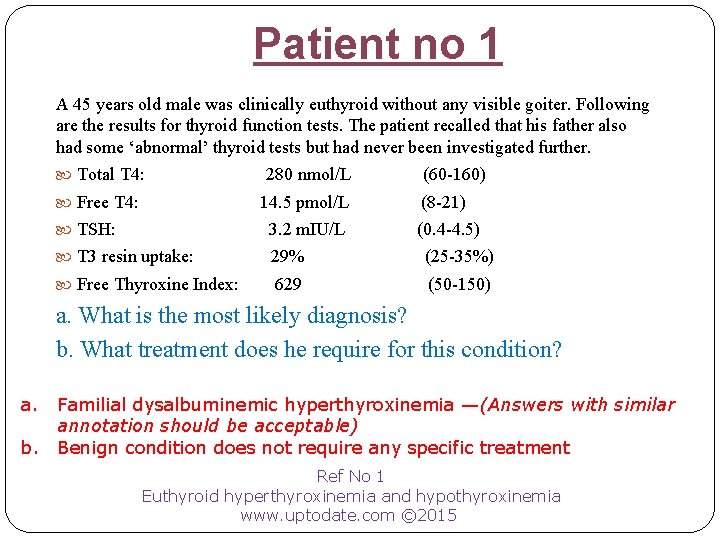
Patient no 1 A 45 years old male was clinically euthyroid without any visible goiter. Following are the results for thyroid function tests. The patient recalled that his father also had some ‘abnormal’ thyroid tests but had never been investigated further. Total T 4: 280 nmol/L (60 -160) Free T 4: 14. 5 pmol/L (8 -21) TSH: 3. 2 m. IU/L (0. 4 -4. 5) T 3 resin uptake: 29% (25 -35%) Free Thyroxine Index: 629 (50 -150) a. What is the most likely diagnosis? b. What treatment does he require for this condition? a. Familial dysalbuminemic hyperthyroxinemia —(Answers with similar annotation should be acceptable) b. Benign condition does not require any specific treatment Ref No 1 Euthyroid hyperthyroxinemia and hypothyroxinemia www. uptodate. com © 2015
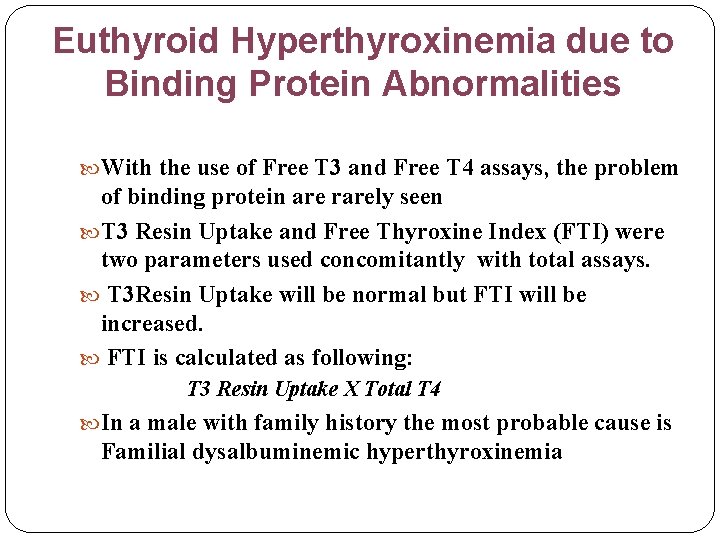
Euthyroid Hyperthyroxinemia due to Binding Protein Abnormalities With the use of Free T 3 and Free T 4 assays, the problem of binding protein are rarely seen T 3 Resin Uptake and Free Thyroxine Index (FTI) were two parameters used concomitantly with total assays. T 3 Resin Uptake will be normal but FTI will be increased. FTI is calculated as following: T 3 Resin Uptake X Total T 4 In a male with family history the most probable cause is Familial dysalbuminemic hyperthyroxinemia
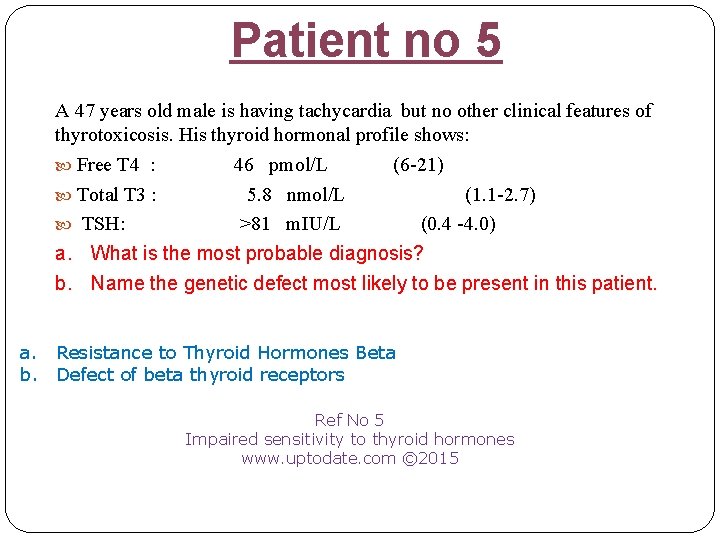
Patient no 5 A 47 years old male is having tachycardia but no other clinical features of thyrotoxicosis. His thyroid hormonal profile shows: Free T 4 : 46 pmol/L (6 -21) Total T 3 : 5. 8 nmol/L (1. 1 -2. 7) TSH: >81 m. IU/L (0. 4 -4. 0) a. What is the most probable diagnosis? b. Name the genetic defect most likely to be present in this patient. a. Resistance to Thyroid Hormones Beta b. Defect of beta thyroid receptors Ref No 5 Impaired sensitivity to thyroid hormones www. uptodate. com © 2015
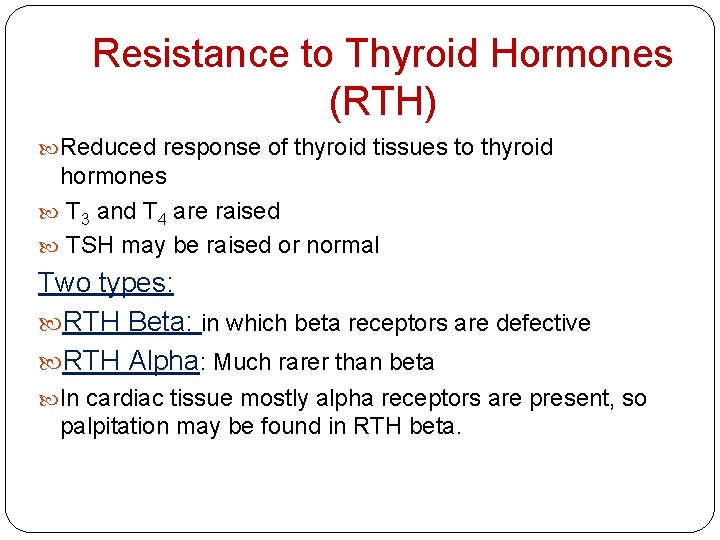
Resistance to Thyroid Hormones (RTH) Reduced response of thyroid tissues to thyroid hormones T 3 and T 4 are raised TSH may be raised or normal Two types: RTH Beta: in which beta receptors are defective RTH Alpha: Much rarer than beta In cardiac tissue mostly alpha receptors are present, so palpitation may be found in RTH beta.
Patient no 3 A 3 days old infant underwent newborn screening in a developed country with following result: TSH: 3. 3 m. IU/L After first month he developed symptoms and signs suggestive of Hypothyroidism and later investigations confirmed it. a. What is the most probable reason of failure to detect this hypothyroidism by the screening programme? (No lab errors assumed). b. What improvement you will suggest in the screening programme to avoid this failure. a. Central Hypothyroidism b. TSH and T 4 measurement simultaneous Ref No 3 Clinical features and detection of congenital hypothyroidism WWW. Up. To. Date. com 2015
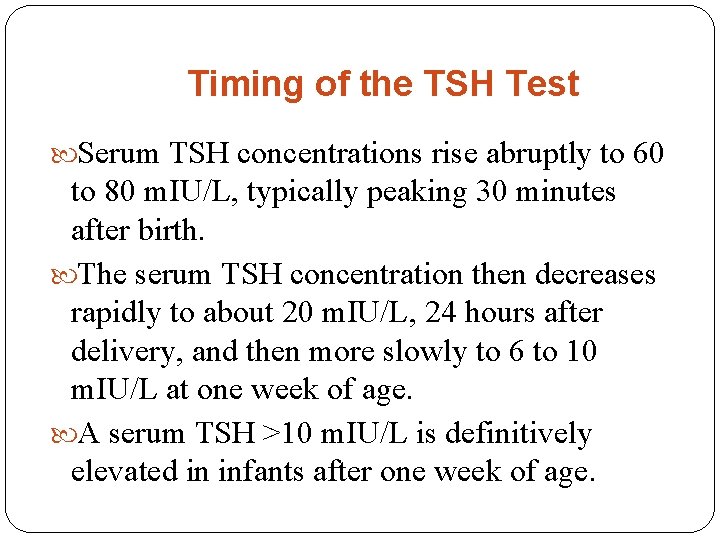
Patient no 4 A newborn was tested for Serum TSH 12 hours after birth in a country where “Newborn Screening Proogramme” does not exist. The result was: Serum TSH: 33. 3 m. IU/L The Paediatrician immediately started replacement therapy with an appropriate dose of thyroxine to avoid developmental loss of IQ. Thyroid function tests carried out a month later indicated severe hyperthyoridism in the baby i. e. Very Low TSH and high T 4. Baby became alright on stopping the replacement therapy. Write TWO important causes of this discrepancy. (No analytical error assumed) a. During first 24 h of life TSH can be normally very high b. Transient hypothyroidism Ref No 3 Clinical features and detection of congenital hypothyroidism WWW. Up. To. Date. com 2015
Congenital Hypothyroidism (CH) Congenital hypothyroidism, is one of the most common preventable causes of intellectual disability (mental retardation). There is an inverse relationship between age at clinical diagnosis and treatment initiation and intelligence quotient (IQ) later in life, so that the longer the condition goes undetected, the lower the IQ
Approaches of Newborn Screening for CH Two approaches for Newborn Screening of CH: o T 4/follow-up TSH o TSH/follow-up T 4 Major disadvantage of T 4/follow-up TSH approach is missing of Sub-clinical Hypothyroidism which is quite common So more institutes are adopting TSH/follow-up T 4 now
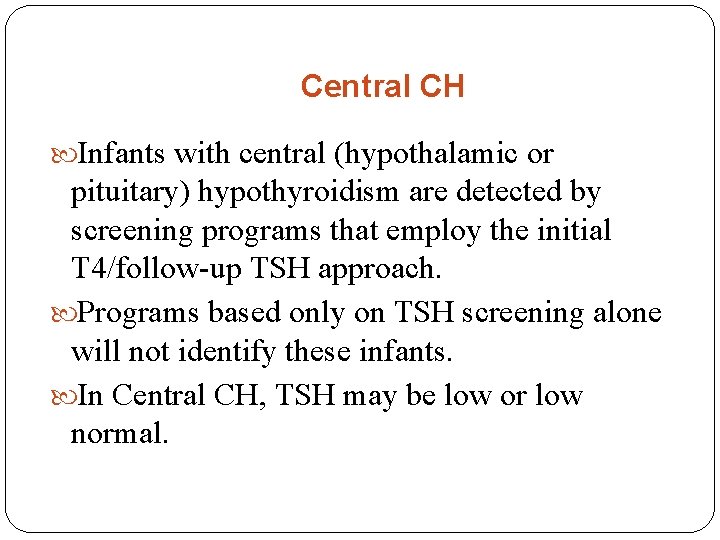
Central CH Infants with central (hypothalamic or pituitary) hypothyroidism are detected by screening programs that employ the initial T 4/follow-up TSH approach. Programs based only on TSH screening alone will not identify these infants. In Central CH, TSH may be low or low normal.
Timing of the TSH Test Serum TSH concentrations rise abruptly to 60 to 80 m. IU/L, typically peaking 30 minutes after birth. The serum TSH concentration then decreases rapidly to about 20 m. IU/L, 24 hours after delivery, and then more slowly to 6 to 10 m. IU/L at one week of age. A serum TSH >10 m. IU/L is definitively elevated in infants after one week of age.
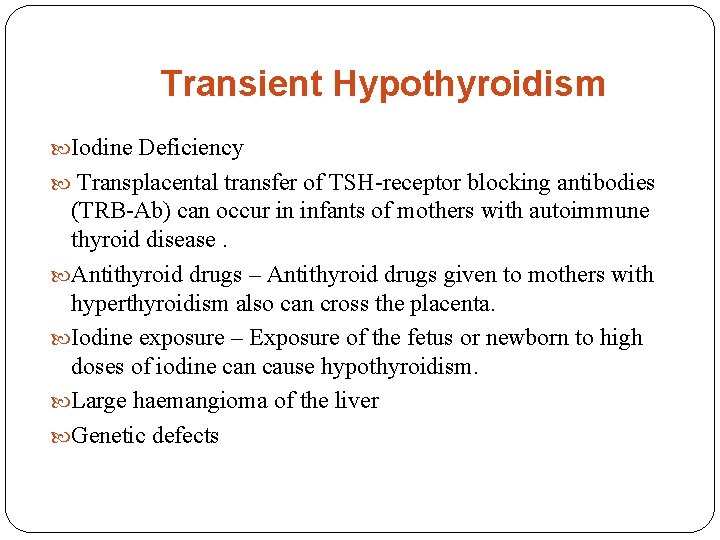
Transient Hypothyroidism Iodine Deficiency Transplacental transfer of TSH-receptor blocking antibodies (TRB-Ab) can occur in infants of mothers with autoimmune thyroid disease. Antithyroid drugs – Antithyroid drugs given to mothers with hyperthyroidism also can cross the placenta. Iodine exposure – Exposure of the fetus or newborn to high doses of iodine can cause hypothyroidism. Large haemangioma of the liver Genetic defects
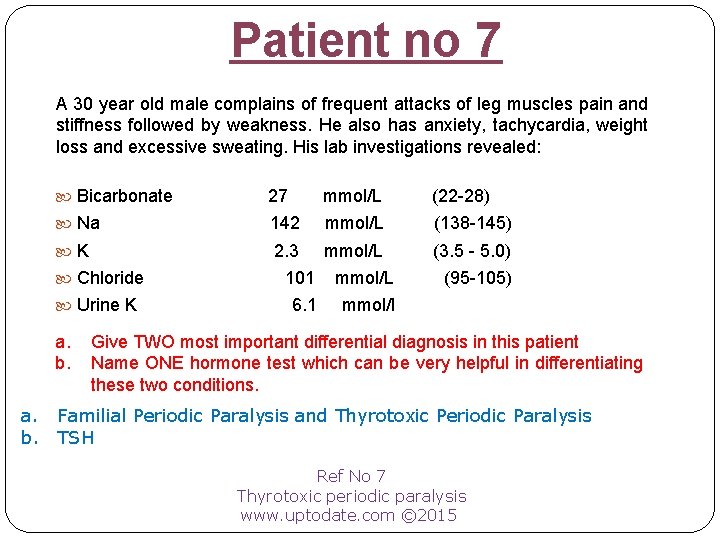
Patient no 7 A 30 year old male complains of frequent attacks of leg muscles pain and stiffness followed by weakness. He also has anxiety, tachycardia, weight loss and excessive sweating. His lab investigations revealed: Bicarbonate 27 mmol/L (22 -28) Na 142 mmol/L (138 -145) K 2. 3 mmol/L (3. 5 - 5. 0) Chloride Urine K a. b. 101 mmol/L (95 -105) 6. 1 mmol/l Give TWO most important differential diagnosis in this patient Name ONE hormone test which can be very helpful in differentiating these two conditions. a. Familial Periodic Paralysis and Thyrotoxic Periodic Paralysis b. TSH Ref No 7 Thyrotoxic periodic paralysis www. uptodate. com © 2015
Periodic Paralysis Hereditary (Familial) Periodic Paralysis and Thyrotoxic Periodic Paralysis The prevalence of thyrotoxic PP is high in Asian males Increases sodium-potassium ATPase activity on the skeletal muscle membrane is at possible cause Hyperinsulinaemia due to insulin resistance is also reported in thyrotoxic PP.