
Patient Journey Optimization using a Multiagent Approach Victor






- Slides: 32
Patient Journey Optimization using a Multi-agent Approach Victor Choi Supervisor: Dr. William Cheung Co-supervisor: Prof. Jiming Liu 1
Agenda �Introduction �Patient scheduling problem in Hong Kong �Proposed scheduling framework �Experiments �Conclusions and future works 2
INTRODUCTION 3
Objective �To improve patient journey by reducing undesired waiting times for patients 4
How to achieve our objective �With limited medical resources, we need to schedule patients in a way such that the resources could be utilized in a more efficient manner 5
Reasons of using a multi-agent approach �It is found that hospitals have a decentralized structure, a multi-agent approached is proposed since it favors geographically distributed entities to be coordinated 6
Related works of using a multiagent approach for patient scheduling � T. O. Paulussen, I. S. Dept, K. S. Decker, A. Heinzl, and N. R. Jennings. Distributed patient scheduling in hospitals. In Coordination and Agent Technology in Value Networks. GITO, pages 1224– 1232. Morgan Kaufmann, 2003. The use of health state as an utility function has been challenged � I. Vermeulen, S. Bohte, K. Somefun, and H. La Poutre. Improving patient activity schedules by multi-agent pareto appointment exchanging. In CEC-EEE ’ 06: Proceedings of the The 8 th IEEE International Conference on E-Commerce Technology and The 3 rd IEEE International Conference on Enterprise Computing, E-Commerce, and E-Services, page 9, Temporal constraints between Washington, DC, USA, 2006. IEEE Computer Society. treatment operations are not considered 7
PATIENT SCHEDULING PROBLEM IN HONG KONG 8
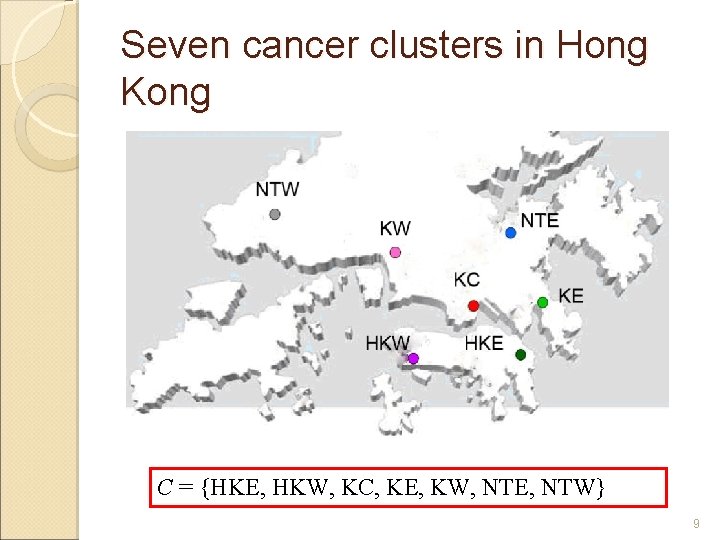
Seven cancer clusters in Hong Kong C = {HKE, HKW, KC, KE, KW, NTE, NTW} 9
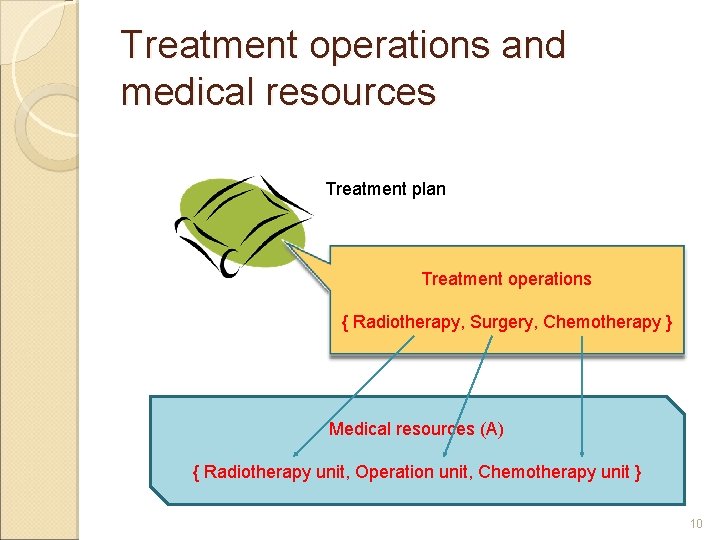
Treatment operations and medical resources Treatment plan Treatment operations { Radiotherapy, Surgery, Chemotherapy } Medical resources (A) { Radiotherapy unit, Operation unit, Chemotherapy unit } 10
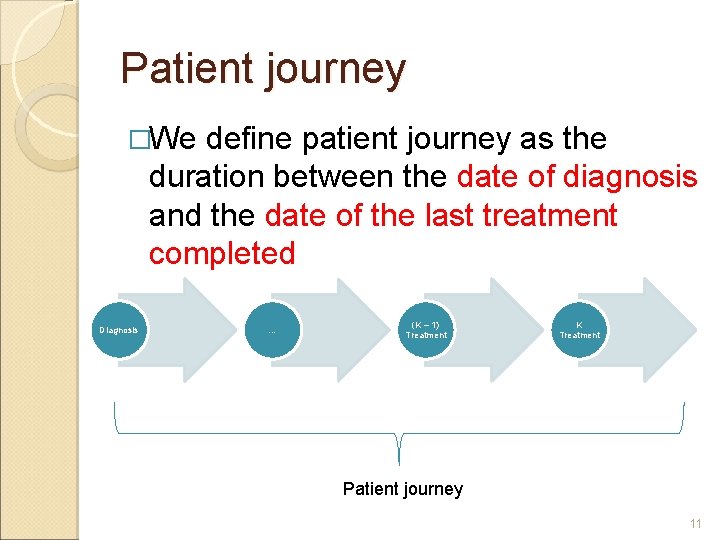
Patient journey �We define patient journey as the duration between the date of diagnosis and the date of the last treatment completed Diagnosis … (K – 1) Treatment K Treatment Patient journey 11
PROPOSED SCHEDULING FRAMEWORK 12
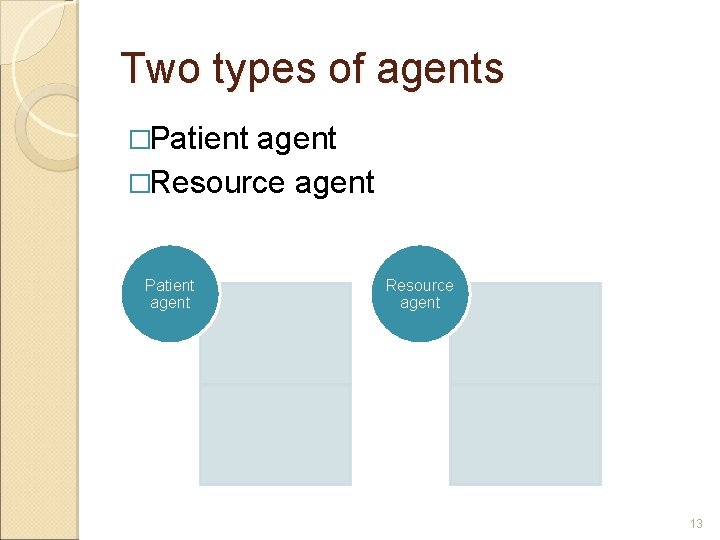
Two types of agents �Patient agent �Resource agent Patient agent Resource agent 13
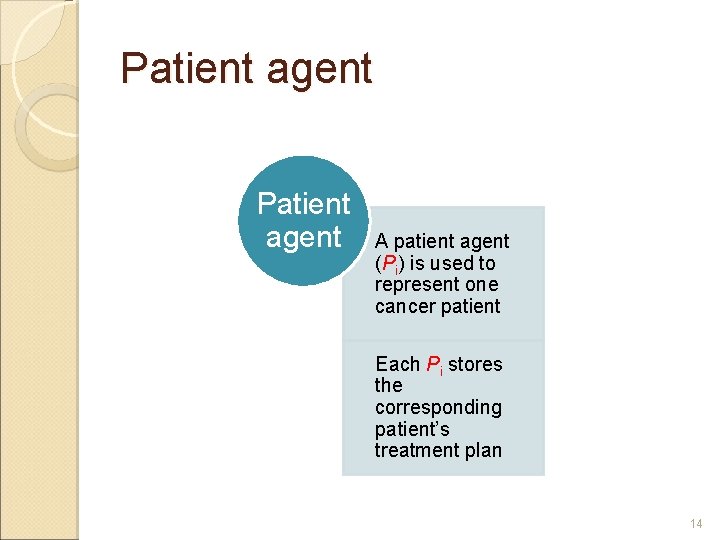
Patient agent A patient agent (Pi) is used to represent one cancer patient Each Pi stores the corresponding patient’s treatment plan 14
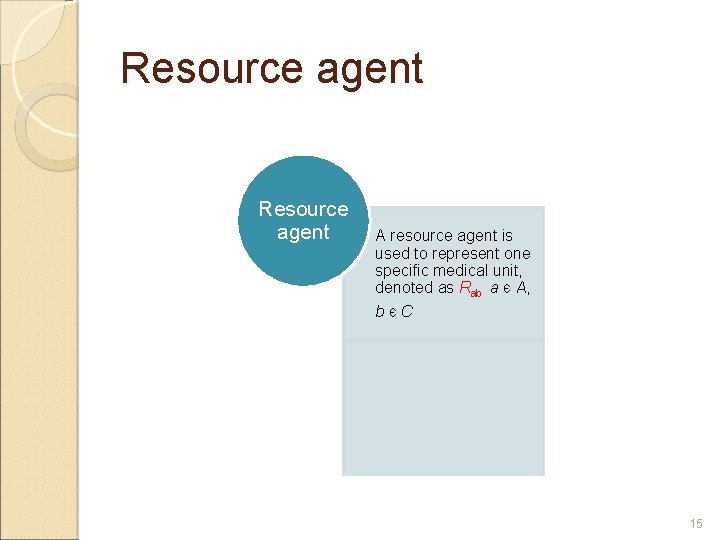
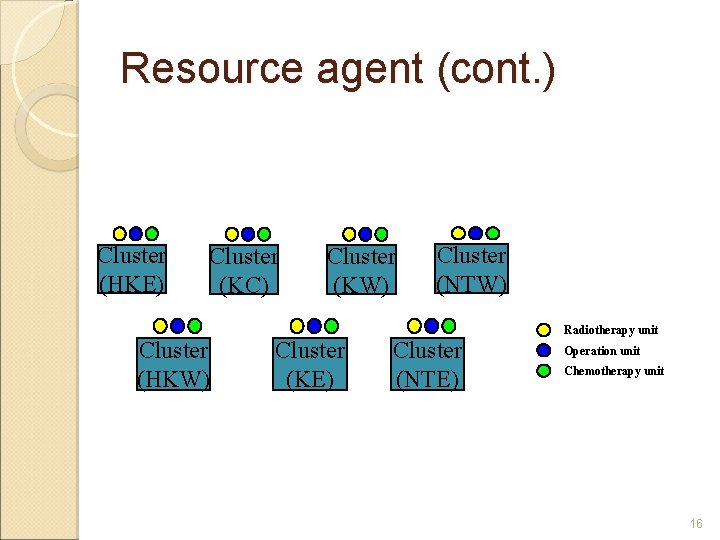
Resource agent A resource agent is used to represent one specific medical unit, denoted as Rab a є A, bєC 15
Resource agent (cont. ) Cluster (HKE) Cluster (KC) Cluster (KW) Cluster (NTW) Radiotherapy unit Cluster (HKW) Cluster (KE) Cluster (NTE) Operation unit Chemotherapy unit 16
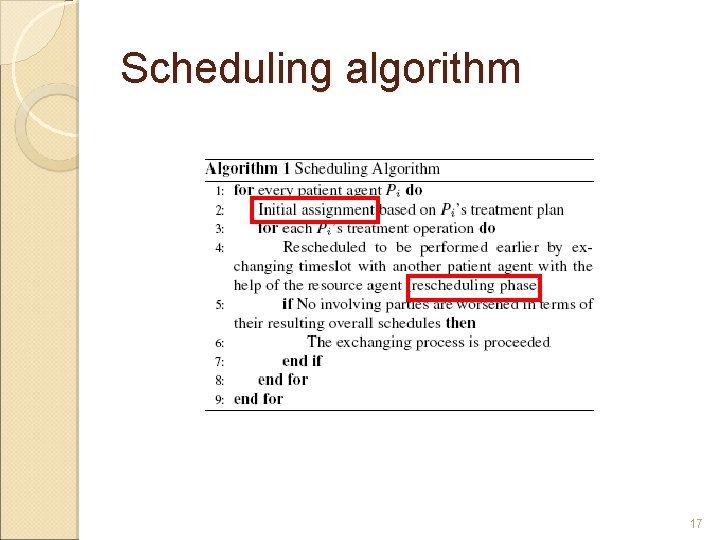
Scheduling algorithm 17
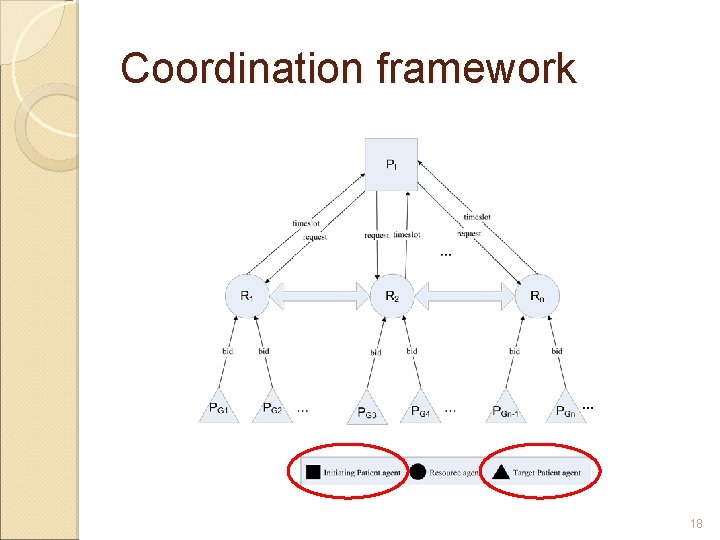
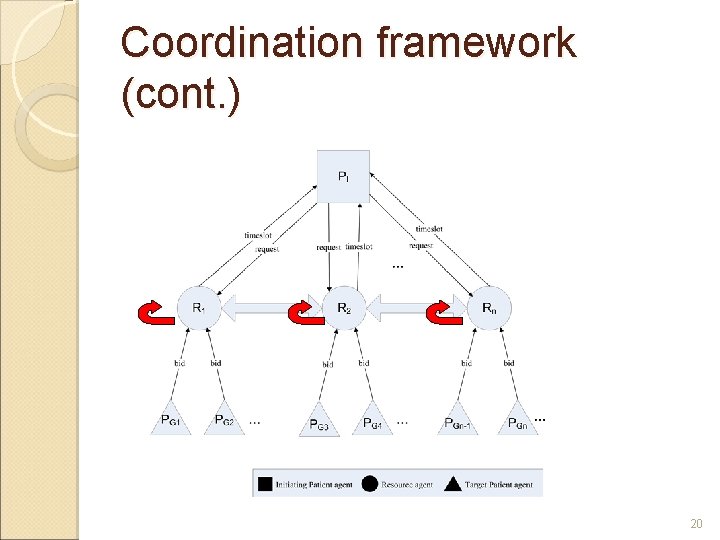
Coordination framework 18
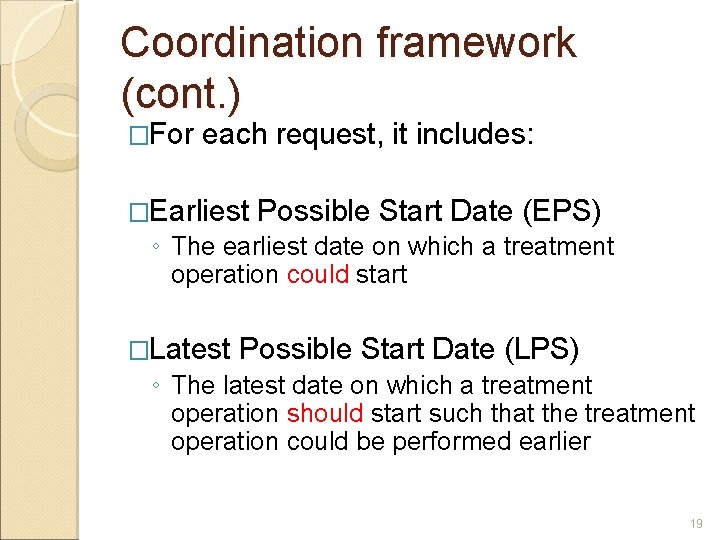
Coordination framework (cont. ) �For each request, it includes: �Earliest Possible Start Date (EPS) ◦ The earliest date on which a treatment operation could start �Latest Possible Start Date (LPS) ◦ The latest date on which a treatment operation should start such that the treatment operation could be performed earlier 19
Coordination framework (cont. ) 20
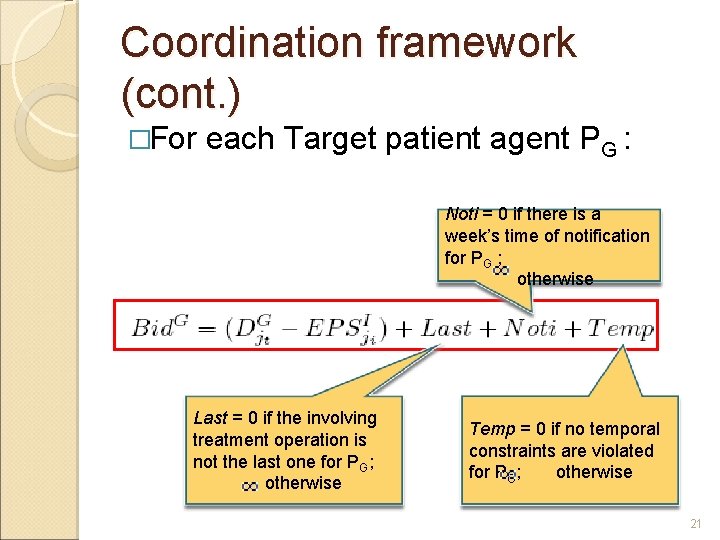
Coordination framework (cont. ) �For each Target patient agent PG : Noti = 0 if there is a week’s time of notification for PG ; otherwise Last = 0 if the involving treatment operation is not the last one for PG; otherwise Temp = 0 if no temporal constraints are violated for PG; otherwise 21
EXPERIMENTS 22
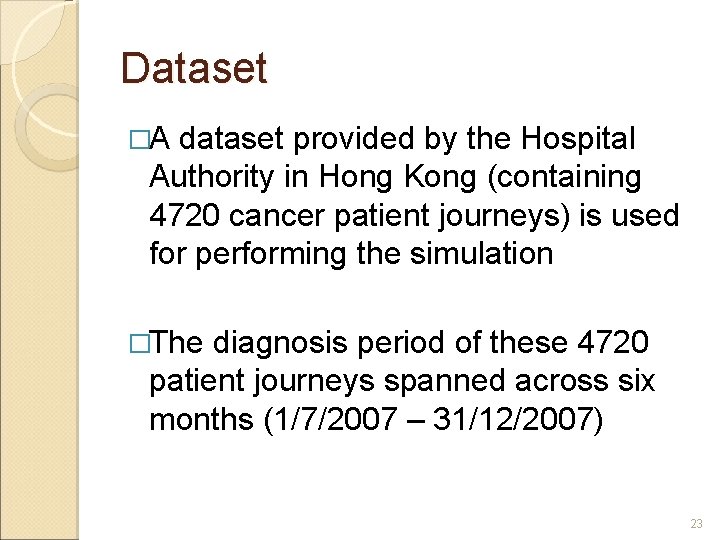
Dataset �A dataset provided by the Hospital Authority in Hong Kong (containing 4720 cancer patient journeys) is used for performing the simulation �The diagnosis period of these 4720 patient journeys spanned across six months (1/7/2007 – 31/12/2007) 23
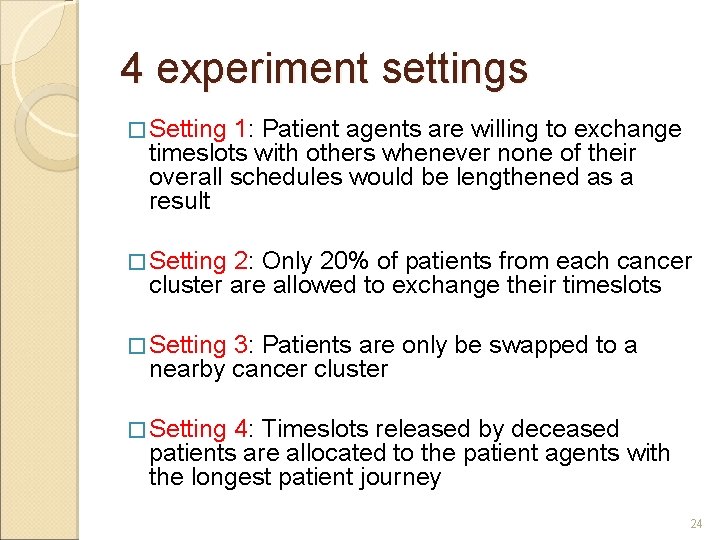
4 experiment settings � Setting 1: Patient agents are willing to exchange timeslots with others whenever none of their overall schedules would be lengthened as a result � Setting 2: Only 20% of patients from each cancer cluster are allowed to exchange their timeslots � Setting 3: Patients are only be swapped to a nearby cancer cluster � Setting 4: Timeslots released by deceased patients are allocated to the patient agents with the longest patient journey 24
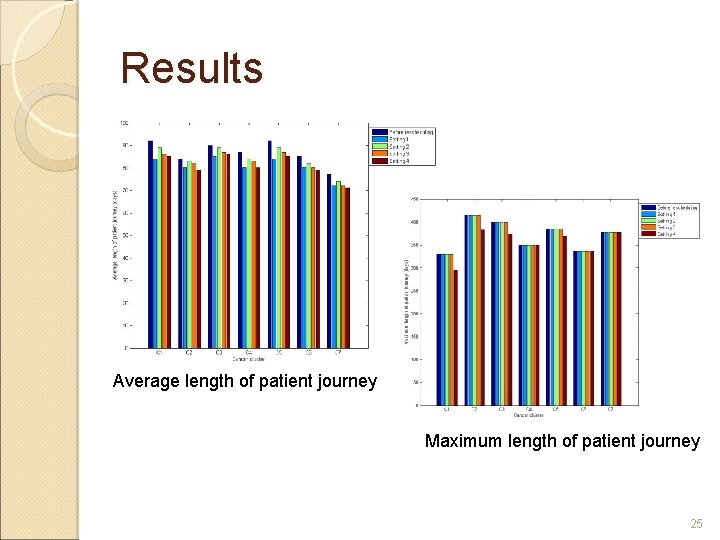
Results Average length of patient journey Maximum length of patient journey 25
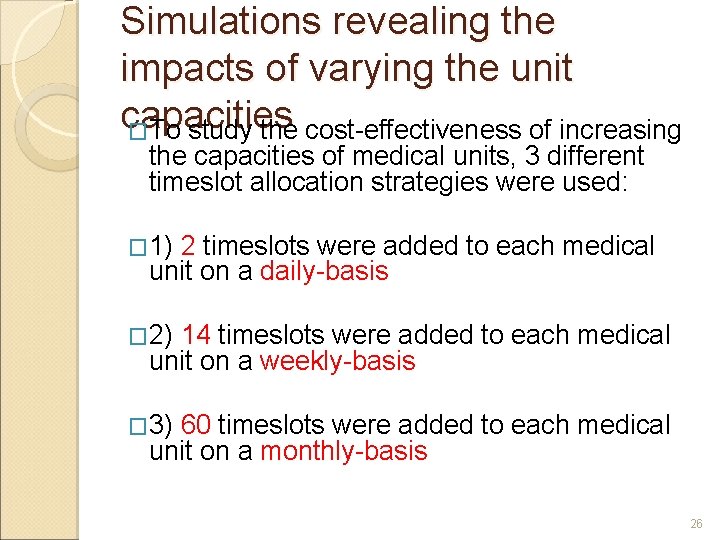
Simulations revealing the impacts of varying the unit capacities �To study the cost-effectiveness of increasing the capacities of medical units, 3 different timeslot allocation strategies were used: � 1) 2 timeslots were added to each medical unit on a daily-basis � 2) 14 timeslots were added to each medical unit on a weekly-basis � 3) 60 timeslots were added to each medical unit on a monthly-basis 26
Simulations revealing the impacts of varying the unit capacities - Results Average length of patient journey Maximum length of patient journey 27
CONCLUSIONS AND FUTURE WORKS 28
Conclusions and future works �A multi-agent framework had been proposed for patient scheduling �While no temporal constraints are violated for any single patient, no patients will get a lengthened overall schedule 29
Conclusions and future works (cont. ) �Experiments showed that even with a fixed amount of medical resources, the average length of patient journey could be shortened by about a week’s time �In the near future, rather than routinely allocate a fixed amount of additional timeslots to each cancer cluster, we are going to assess how resources (or timeslots) should be allocated to cancer clusters in a more sophisticated way such that the overall patient journey could be shortened in a greater extent. 30
THE END 31
Q&A 32