
Patient Enablement Instrument Useful Evaluation Tool for Measuring
Patient Enablement Instrument: Useful Evaluation Tool for Measuring Relationship Centered Care Competency In Family Medicine Residents? Julie Dostal, MD Debra Baker, MA Nyann Biery, MS Department of Family Medicine Lehigh Valley Hospital 1
2 OPERATIONAL DEFINTION • Relationship Centered Care: – emphasizes that patient care is really about relationships – in residency, guidelines are taught that characterize methods for developing strong relationships with patients – explores the difference between disease and illness from a patient perspective and how the physician and patient reach common ground • Enablement: – Describes the effect of the clinical encounter to a patient’s ability to cope w/ & understand his/her illness
OBJECTIVE 3 • To explore if the Patient Enablement Instrument (PEI) serves as a useful tool for the development of competency in RCC during a Family Medicine Residency Program. • To be useful, the PEI would possess the following characteristics – acceptable to patients – easy to administer and analyze – ability to detect improvement in a resident’s PEI score over time during residency.

METHODS 4 • Design – Longitudinal quantitative study exploring change in RCC skills over time in Family Medicine residents – PEI’s completed by 10 patients per resident, 3 times during residency – Data collected at 12 (T 1), 24 (T 2), and 36 (T 3) months of residency training for graduating classes of 2004, 2005, & 2006. • Instrument Patient Enablement Instrument (Howie, et al. 1998)

METHODS 5 • Setting and Participants – Study completed at The Family Health Center (FHC), Allentown, PA. – Patients of the FHC completed PEI on voluntary basis. – Discharge nurse distributed survey following patient’s clinical encounter with resident. • Analysis – Non-Parametric Analyses to see if any significant changes seen based on year in residency. • Combining all classes (2004 -2006) • Between class, based on PGY • Within-each class
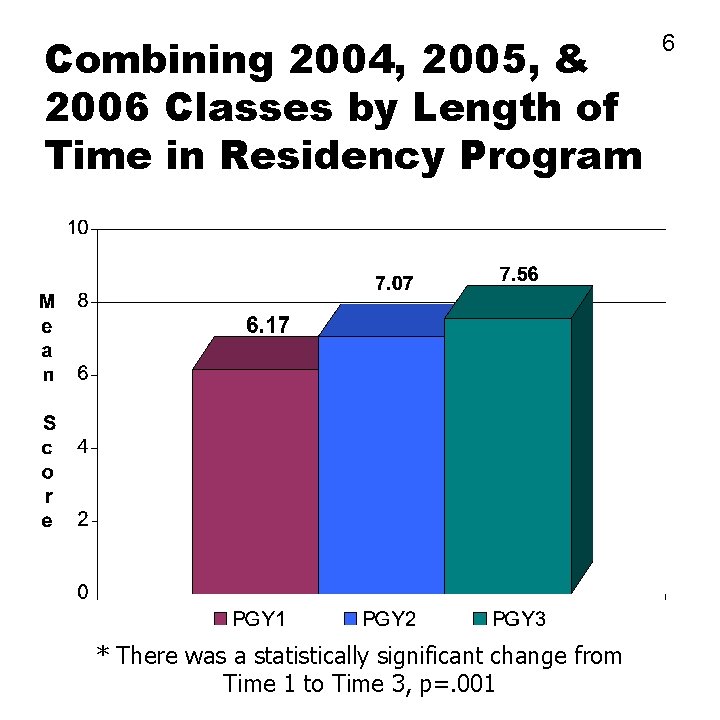
Combining 2004, 2005, & 2006 Classes by Length of Time in Residency Program * There was a statistically significant change from Time 1 to Time 3, p=. 001 6
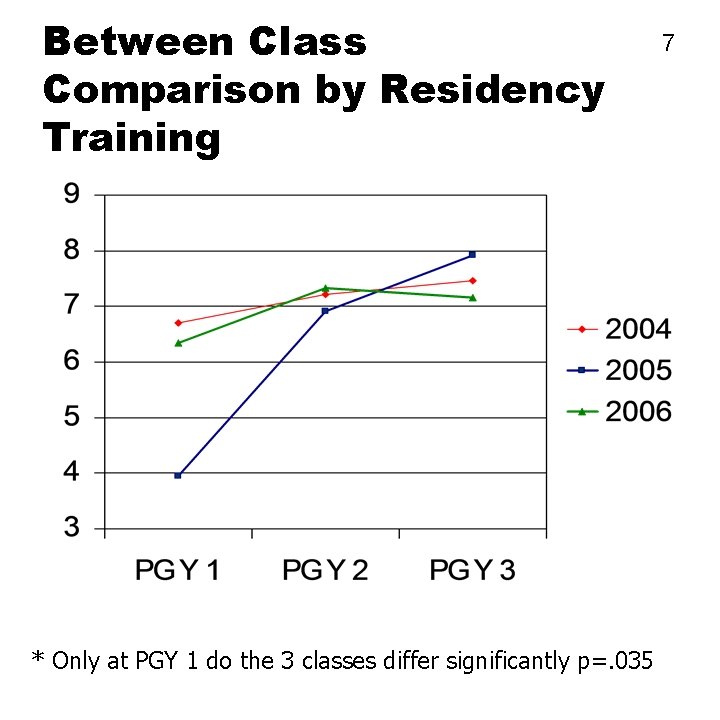
Between Class Comparison by Residency Training * Only at PGY 1 do the 3 classes differ significantly p=. 035 7
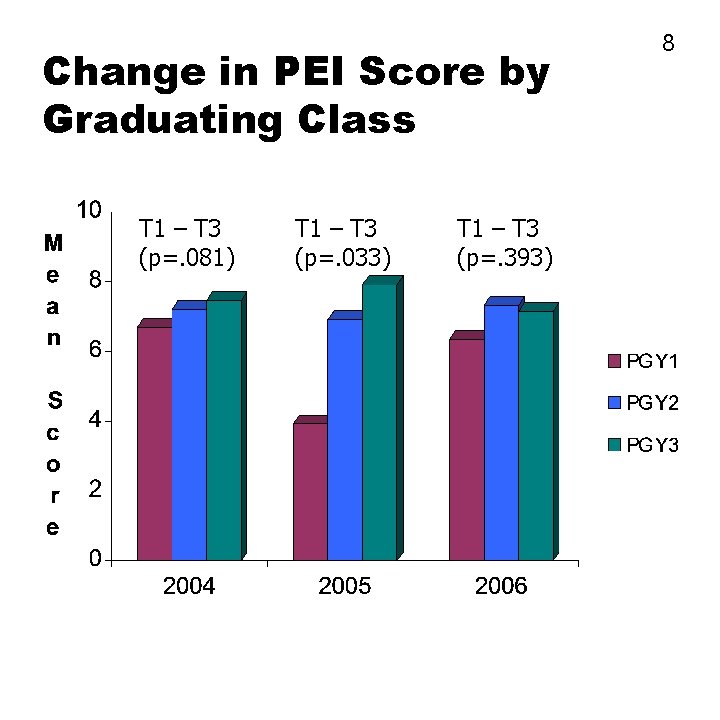
Change in PEI Score by Graduating Class T 1 – T 3 (p=. 081) T 1 – T 3 (p=. 033) T 1 – T 3 (p=. 393) 8
CONCLUSIONS • The results of this study suggests that the PEI meets the initial criteria for an evaluation tool. • It is easy to administer and analyze • It is acceptable and useful to patients • It shows a significant change in residents average scores over time during their residency. 9
LIMITATIONS 10 • Small Sample Size • Lack of Comparison Group • PEI has not been validated as a marker for RCC behaviors
CONTINUING RESEARCH 11 • Add additional baseline data point for future classes, for 4 data points: T 0 (1 -3 months training), T 1 (12 months of training), T 2 (24 months of training), T 3 (36 months of training) • Identify a comparison group • Continue to collect PEI scores on current and future residents to increase sample size • Further analysis of PEI instrument sensitivity, reproducibility, and inter rater reliability
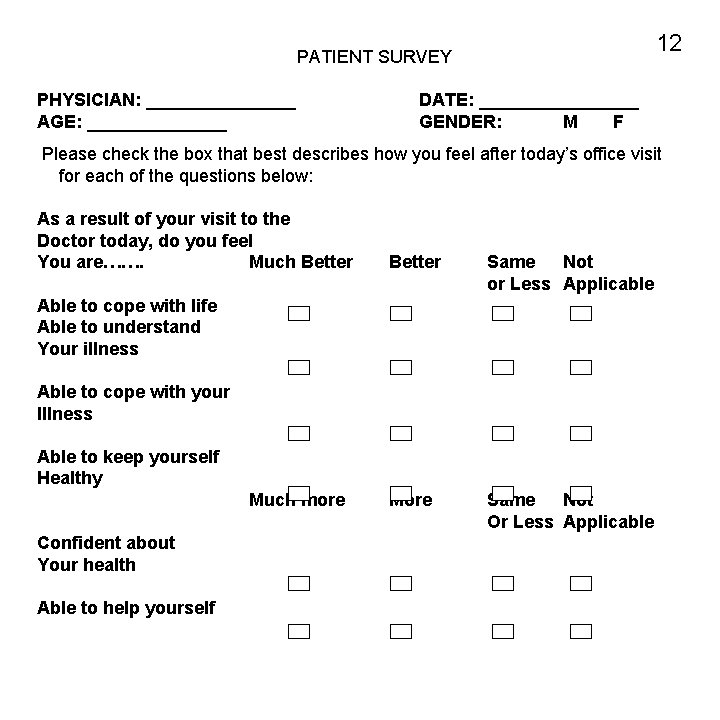
12 PATIENT SURVEY PHYSICIAN: ________ AGE: _______ DATE: ________ GENDER: M F Please check the box that best describes how you feel after today’s office visit for each of the questions below: As a result of your visit to the Doctor today, do you feel You are……. Much Better Same Not or Less Applicable More Same Not Or Less Applicable Able to cope with life Able to understand Your illness Able to cope with your Illness Able to keep yourself Healthy Much more Confident about Your health Able to help yourself
- Slides: 12