
PATIENT EDUCATION AND SAFETY HOW TO BUILD A
PATIENT EDUCATION AND SAFETY/ HOW TO BUILD A COLLABORATIVE ENVIRONMENT OF QUALITY CARE NURS 230/Spring 2014/week 5
Standards for Patient Education � � � The Joint Commission sets standards for patient and family education. Successful accomplishment of standards requires collaboration among health care professionals. All state Nurse Practice Acts recognize that patient teaching falls within the scope of nursing practice.

Virginia Board of Nursing � http: //www. dhp. virginia. gov/nursing_laws_ regs. htm
Purposes of Patient Education � � To help individuals, families, or communities achieve optimal levels of health Patient education includes: � Maintenance and promotion of health and illness prevention � Restoration of health � Coping with impaired functioning
Teaching and Learning � Teaching � An � interactive process that promotes learning Learning � The purposeful acquisition of knowledge, skills, behaviors, and attitudes
Teaching as Communication � � � Closely parallels the communication process. Depends in part on effective interpersonal communication. The learning objective describes what the learner will be able to accomplish after instruction is given
Role of the Nurse in Teaching and Learning Teach information that the patient and the family need to make informed decisions regarding their care. Determine what patients need to know. Identify when patients are ready to learn.
TJC’s Speak Up Tips � � � � Speak up if you have questions or concerns. Pay attention to the care you get. Educate yourself about your illness. Ask a trusted family member or friend to be your advocate. Know which medicines you take and why. Use a health care organization that has been carefully evaluated. Participate in all decisions about your treatment.
Domains of Learning � � � Cognitive: Includes all intellectual behaviors and requires thinking Affective: Deals with expression of feelings and acceptance of attitudes, opinions, or values Psychomotor: Involves acquiring skills that require integration of mental and muscular activity
Domains of Learning � � Different teaching methods are appropriate for each domain of learning. Cognitive: discussion (one-on-one or group), lecture, question-and-answer session, role play, discovery, independent project, field experience Affective: role play, discussion (one-on-one or group) Psychomotor: demonstration, practice, return demonstration, independent projects, games
Basic Learning Principles � � � Motivation to learn: Addresses the client’s desire or willingness to learn Ability to learn: Depends on physical and cognitive abilities, developmental level, physical wellness, thought processes Learning environment: Allows a person to attend to instruction
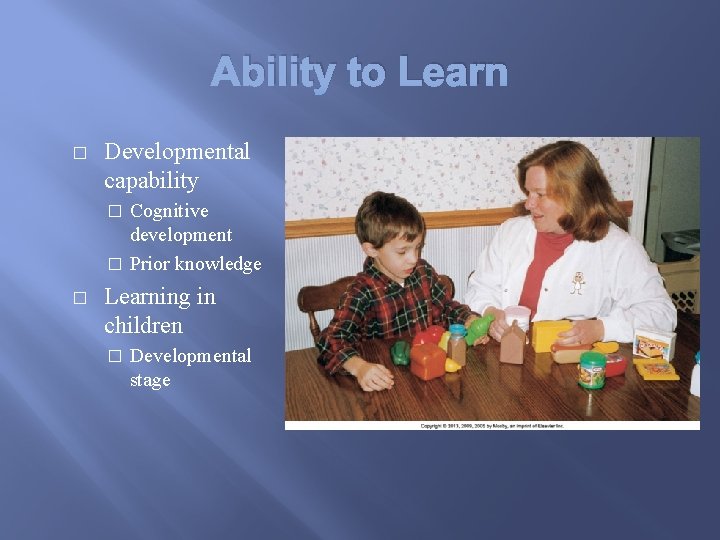
Ability to Learn � Developmental capability Cognitive development � Prior knowledge � � Learning in children � Developmental stage
Ability to Learn (cont’d) � Adult learning � Self-directed � Patient-centered � Physical capability � Level of personal development � Physical health � Fatigue
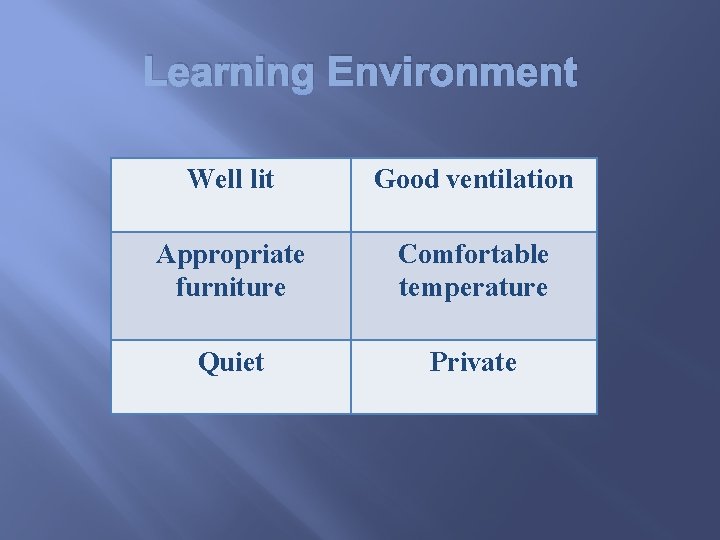
Learning Environment Well lit Good ventilation Appropriate furniture Comfortable temperature Quiet Private
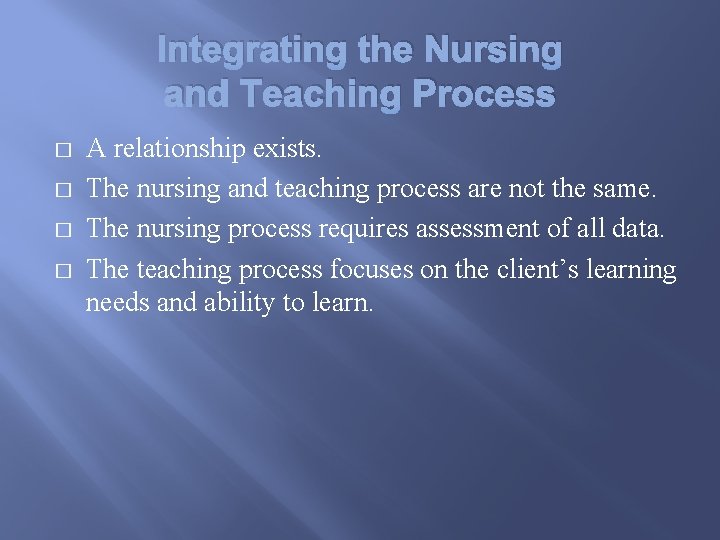
Integrating the Nursing and Teaching Process � � A relationship exists. The nursing and teaching process are not the same. The nursing process requires assessment of all data. The teaching process focuses on the client’s learning needs and ability to learn.
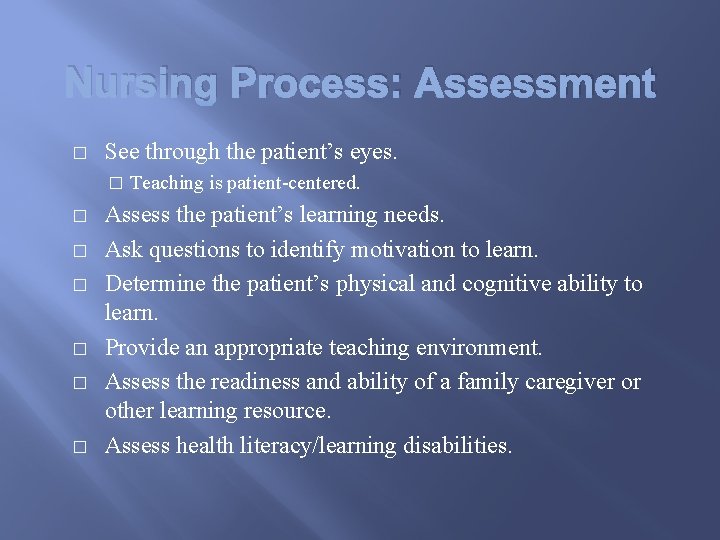
Nursing Process: Assessment � See through the patient’s eyes. � � � � Teaching is patient-centered. Assess the patient’s learning needs. Ask questions to identify motivation to learn. Determine the patient’s physical and cognitive ability to learn. Provide an appropriate teaching environment. Assess the readiness and ability of a family caregiver or other learning resource. Assess health literacy/learning disabilities.
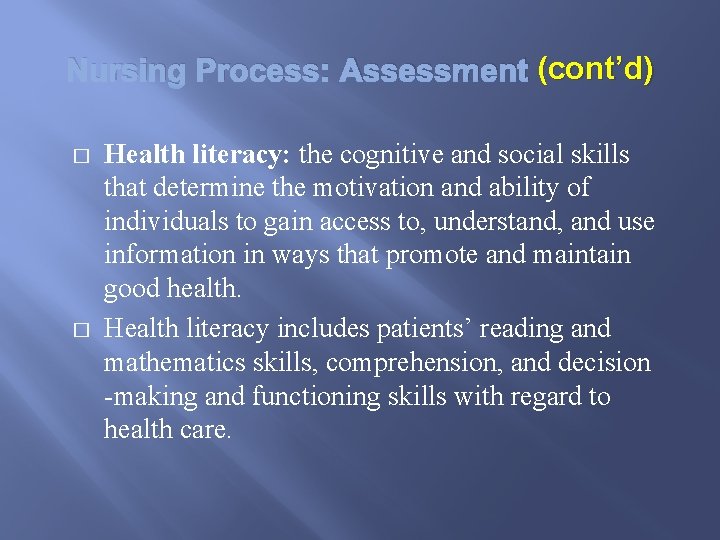
Nursing Process: Assessment (cont’d) � � Health literacy: the cognitive and social skills that determine the motivation and ability of individuals to gain access to, understand, and use information in ways that promote and maintain good health. Health literacy includes patients’ reading and mathematics skills, comprehension, and decision -making and functioning skills with regard to health care.
Nursing Process: Nursing Diagnosis � Nursing diagnoses for patient education � Deficient knowledge (affective, cognitive, psychomotor) � Ineffective health maintenance � Impaired home maintenance � Ineffective family therapeutic regimen management � Ineffective self-health management � Noncompliance (with medications)
Nursing Diagnosis � � Select the nursing diagnosis that reflects the client’s learning needs after the assessment is completed. Clarifying the diagnosis by domain helps the nurse focus on the subject matter and teaching methods.
Planning � Determine goals and expected outcomes that guide the choice of teaching strategies and approaches with a client: Patient Centered � Set priorities- specifically depends on what the patient perceives is the most important � Select timing to teach/when is there a right time to teach? – plan when the patient is most alert, receptive and attentive � Organize the teaching material. Start from simple and progress to complex- textbook page 376
Implementation � � � � � Maintain learning attention and participation. Build on existing knowledge. Select teaching approach. Incorporate teaching with nursing care. Select appropriate instructional methods. Illiteracy and other disabilities. Cultural diversity. Using different teaching tools. Special needs of children and older adults.
Evaluation � � � Necessary to determine whether the client has learned the material Helps to reinforce correct behavior and change an incorrect behavior Success depends on the client’s performance of expected outcomes
Case Scenarios � � � � Group work: 1. Identify and assess the learning needs or knowledge deficits of the patient. 2. Discuss what would be the best teaching strategies for this patient and why 3. What methods or tools would you use to support the teaching strategies you choose and why? 4. Pick one nursing diagnosis to support the assessment/ cognitive, affective, or psychomotor domains. 5. How would you evaluate the effectiveness of the patient teaching? 6. What are some collaborative health care indicators here? 7. What are the patient safety implications if #3 and #4 are not correctly utilized?
Case Study #1/ Mr. Smith � � Mr. Smith is a 80 year old African American male. Admitted to the Woodland with an exacerbation of CHF, asthma, and status post surgical procedure for defibrillator placement. Mr. Smith has an 8 th grade reading level. Mr. Smith lives alone and is a retired handyman. The doctor has ordered patient education: Teach patient to check his radial pulse, provide education for a low salt and low fat diet. Teach signs and symptoms of CHF. Answer questions 1 -7
Case Study #2/ Miss Green � � On a busy and hectic Friday night Miss Green is a 20 year old college student brought to the ED by her boyfriend. He states she had too much to drink at a party and fell. Upon assessment she has a bump on the back of her head and her blood alcohol level (BAL) is 2 x greater than the legal limit in Virginia (0. 8%). She is given IV fluids and the results of the CT scan are negative for a concussion. She has been cleared by the ED doctor for d/c. You are assigned to review the discharge paperwork with the boyfriend. Answer questions 1 -7
Case Study #3/Baby girl Maria � � Baby girl Maria is being discharged after a three day hospital stay for URI (upper respiratory infection). She will be discharged to the care of her parents who are of Mexican origin. The doctor has ordered Ampicillin liquid (500 mg)one (1) teaspoon by mouth every 4 hours until medication is completed. No follow-up clinic appointment has been made. You are charged with discharge instructions for medication administration. Answer questions 1 -7
Case Study #4/ Boy Aaron � � Aaron is a three old boy admitted to the pediatric unit at Southside Hospital for an exacerbation of his asthmatic condition. His mom, 19 year old Mary is with Aaron at the time of admission. Mary states she attends night school 3 x a week as she works towards her GED. She dropped out of high school at the age of 16. Mary says she has at least one more year of night school before she is eligible to take the GED test. Aaron is left with his 41 year old grandmother on these nights. Aaron’s grandmother smokes. This is Aaron’s first admission to the pediatric unit for an asthma exacerbation. Answer questions 1 -7
5/Mrs. Brown Case Study #5/Mrs. � � Ms. Brown is a 67 year old widowed white female. She has two daughters both live out of state. She is admitted to The Woodland for physical therapy following a right total hip replacement. Her anticipated LOS is 3 weeks. She is a newly diagnosed insulin dependant diabetic. Mrs. Brown has a bachelor’s degree in music and recently retired from the public school system. The doctor has ordered patient teaching of glucometer use and insulin administration. Answer the questions: 1 -7
Collaboration: Collaboration occurs when multiple health workers from different professional background work together with patients, families, careers, and communities to deliver the highest quality of care”. (WHO, 2010: 13). http: //www. msnbc. msn. com/id/43529641/ns/health_care/t/nurses-suicide-highlights-twintragedies-medical-errors/ �
Quality and Safety Education for Nurses (QSEN) � � � Future nurses need knowledge, skills, and attitudes to promote safety. Continuous improvement is essential. QSEN minimizes risk of harm to patients and providers by � System effectiveness � Individual performance
Patient Centered Care � � Based on Communication Health Care Team Collaboration Involved both the patient and family in all care decisions Empowers the patient to participate- does this lend itself then to patient education?
Critical Thinking � � � In patient safety, critical thinking is an ongoing process. Standards have been developed by American Nurses Association and The Joint Commission. Use of the nursing process when planning care promotes safety.
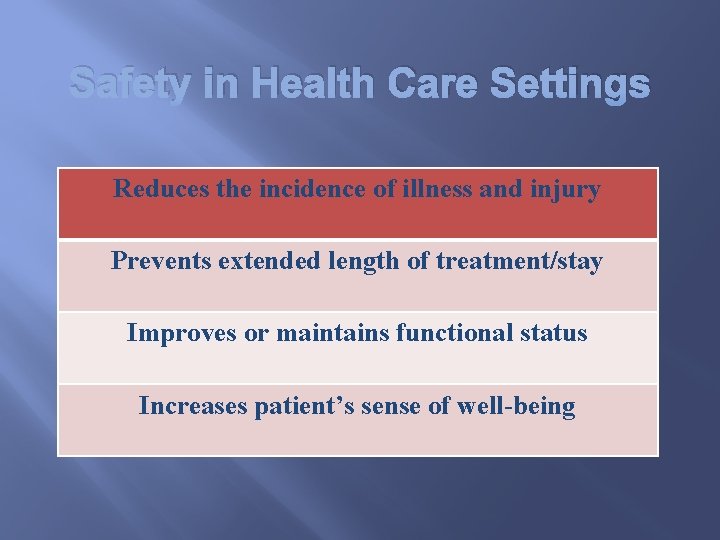
Safety in Health Care Settings Reduces the incidence of illness and injury Prevents extended length of treatment/stay Improves or maintains functional status Increases patient’s sense of well-being
A Safe Environment � � � Includes meeting patients’ physical and psychosocial needs Applies to all places where patients receive care Includes patients’ and health care providers’ well-being Reduces risk of injury and transmission of pathogens Maintains sanitation and reduces pollution
Basic Human Needs Oxygen Temperature �Low �Normal concentration �High concentration �Carbon monoxide Nutrition �Proper storage �Proper refrigeration �Preparation area �Hyperthermia �Hypothermia
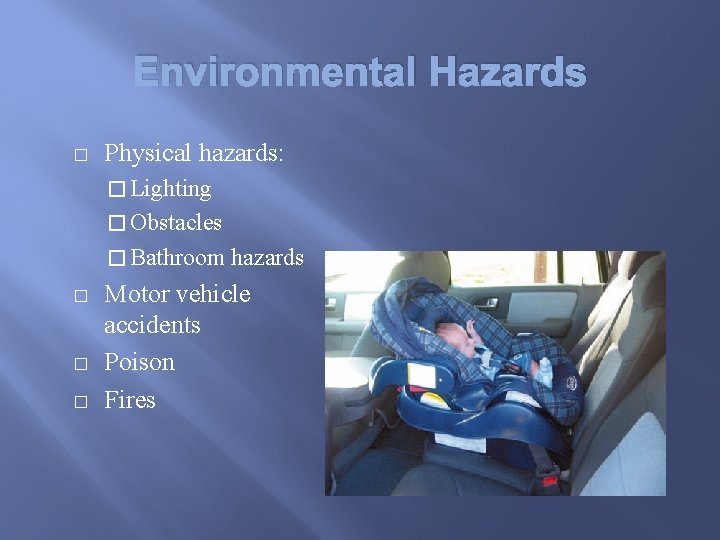
Environmental Hazards � Physical hazards: � Lighting � Obstacles � Bathroom � � � hazards Motor vehicle accidents Poison Fires
Environmental Hazards � � Falls Transmission of pathogens Pollution Disasters � Natural � Man-made
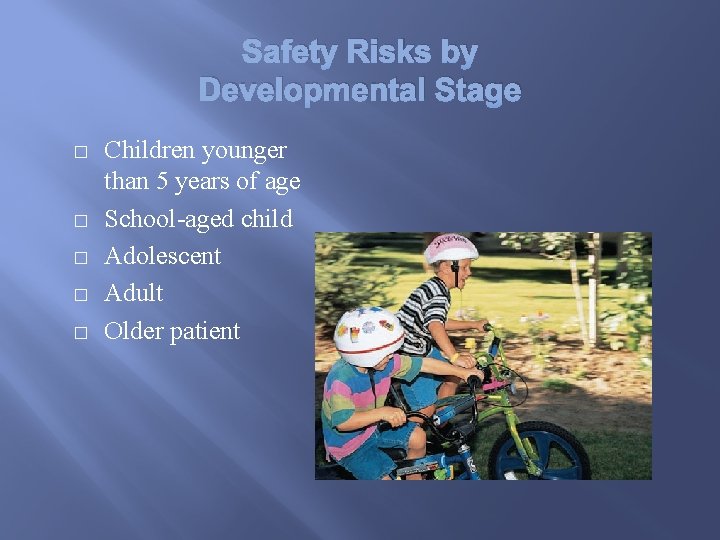
Safety Risks by Developmental Stage � � � Children younger than 5 years of age School-aged child Adolescent Adult Older patient
Nursing Knowledge Base � Factors influencing safety: � Developmental stages � Individual risk factors Mobility, sensory, and cognitive status Impaired mobility Lifestyle choices Lack of safety awareness � Risks in the health care agency
CMS list of “Never Events” � � � “Never events” should never occur. The Centers for Medicare and Medicaid Services (CMS) now denies hospitals higher payments resulting from or complicated by a “never event. ” Many hospital-acquired conditions are nurse sensitive indicators.
Risks in Health Care Agencies � � Chemical use (Material Safety Data Sheets [MSDSs]) Medical errors � Medication errors � Infection � Bed sores � Failure to diagnose and treat in time � Falls
Risks in Health Care Agency (cont’d) � Classification of health care agency accidents: � Patient-inherent accidents � Procedure-related accidents � Equipment-related accidents
Safety and the Nursing Process � Assessment � Through the patient’s eyes � Patient’s home environment � Assessment questions Activity and exercise Medication history History of falls Home maintenance and safety � Nursing history
Safety and the Nursing Process (cont’d) � Assessment (cont’d) � Health care environment Risks in immediate environment Risk for falls Risk for medication errors Disaster preparedness
Diagnosis Nursing diagnoses for patients with safety risk: � � � � Risk for falls Impaired home maintenance Risk for injury Deficient knowledge Risk for poisoning Risk for suffocation Risk for trauma
Safety and the Nursing Process: Planning � Goals and outcomes � Prevent and minimize safety threats � Are measurable and realistic � May include active patient participation � � Setting priorities Teamwork and collaboration
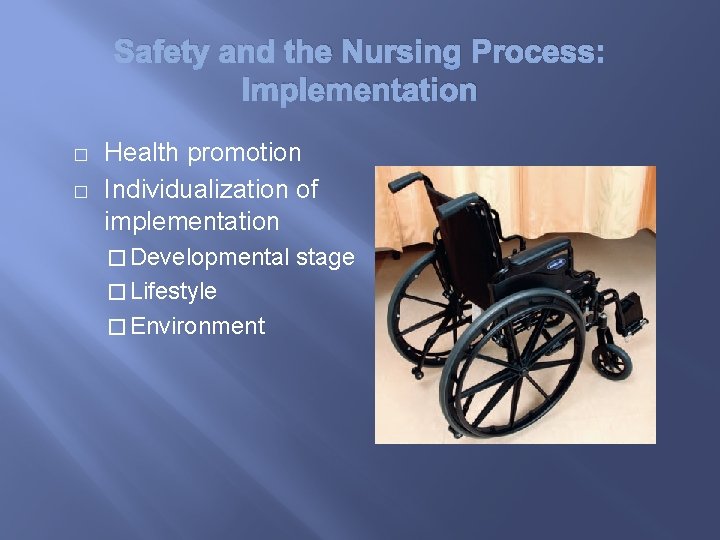
Safety and the Nursing Process: Implementation � � Health promotion Individualization of implementation � Developmental � Lifestyle � Environment stage
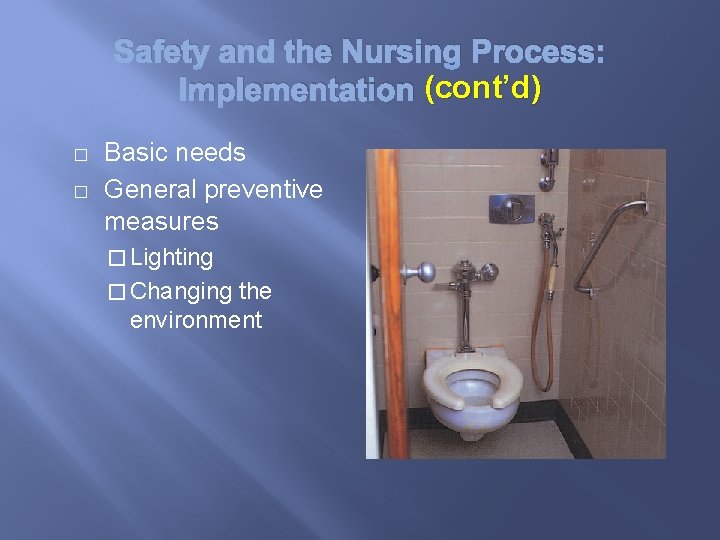
Safety and the Nursing Process: Implementation (cont’d) � � Basic needs General preventive measures � Lighting � Changing the environment
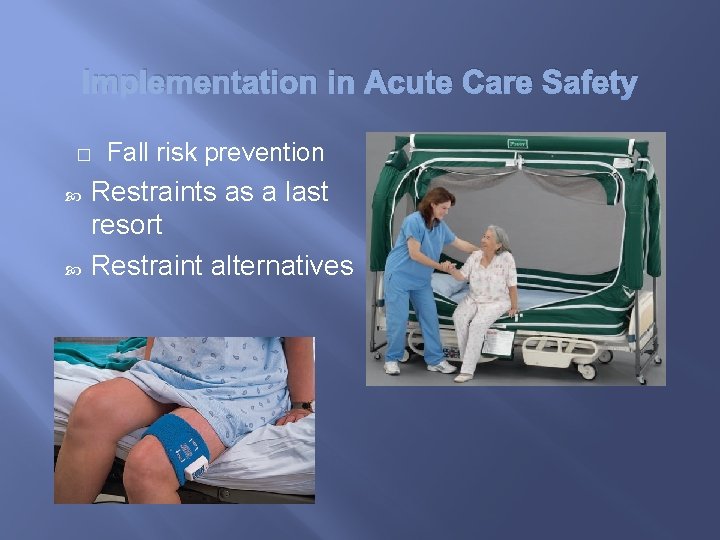
Implementation in Acute Care Safety � Fall risk prevention Restraints as a last resort Restraint alternatives
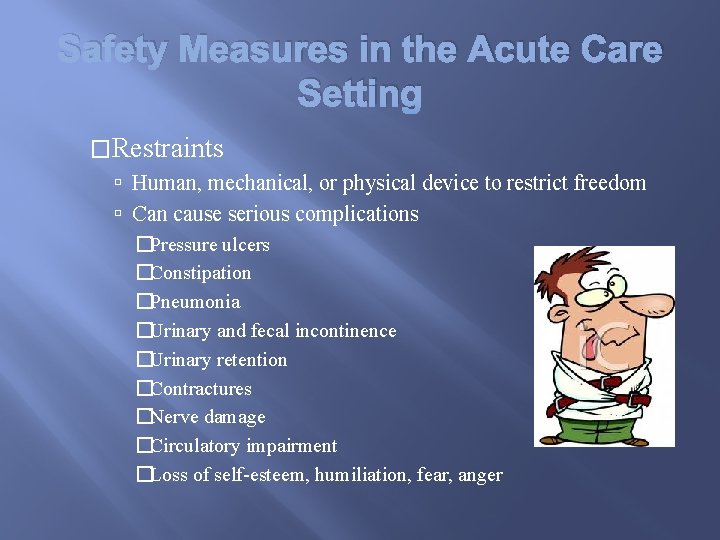
Safety Measures in the Acute Care Setting �Restraints Human, mechanical, or physical device to restrict freedom Can cause serious complications �Pressure ulcers �Constipation �Pneumonia �Urinary and fecal incontinence �Urinary retention �Contractures �Nerve damage �Circulatory impairment �Loss of self-esteem, humiliation, fear, anger
Restraints Physicians order is required based on face-to-face assessment of client �Order must state type of restraint �Must have limited time factor �Orders need to be renewed in specific time frame according to facility’s policy �No PRN orders �Ongoing assessments are necessary �Must be periodically removed and need reassessed
Types of Restraints � � � Side rails on beds Bed restraint Jacket: vest or chest Belt or waist Extremity: mitt, hand, wrist, ankle, elbow
Alternatives to Restraints � � � Orient client and families to surroundings Encourage constant companions for pt Assign pts to rooms near nursing station Provide meaningful audio/visual stimuli Eliminate bothersome therapies Use relaxation techniques Institute exercise & ambulation schedules Maintain toileting routines Consult with PT and OT for ADLs Evaluate all client medications Conduct ongoing assessment & evaluation
Safety and the Nursing Process: Implementation � Acute care safety � Seizures � Poisoning � Electrical hazards � Radiation � Disasters � Hospitals must have an emergency management plan.
Isolation Precautions � � Airborne precautions Droplet precautions Contact precautions Protective Isolation � i. e. Neutropenic precautions
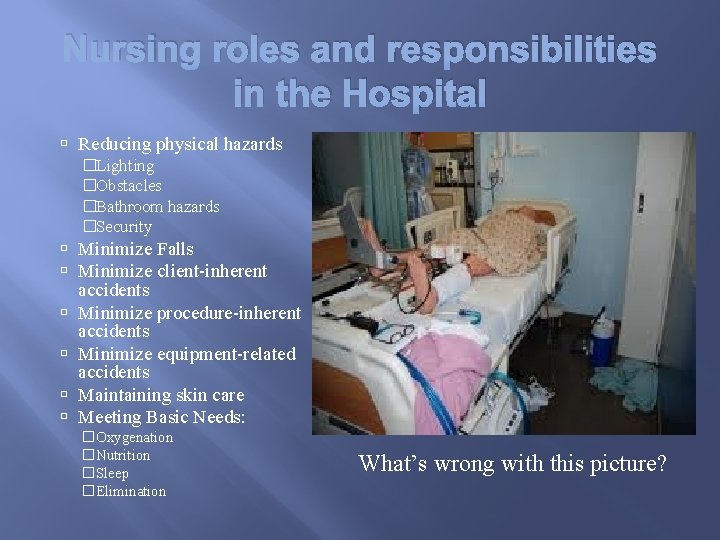
Nursing roles and responsibilities in the Hospital Reducing physical hazards �Lighting �Obstacles �Bathroom hazards �Security Minimize Falls Minimize client-inherent accidents Minimize procedure-inherent accidents Minimize equipment-related accidents Maintaining skin care Meeting Basic Needs: �Oxygenation �Nutrition �Sleep �Elimination What’s wrong with this picture?
Safety and the Nursing Process: Evaluation � Through the patient’s eyes � Are the patient’s expectations met? � Are the family’s expectations met? � Patient outcomes � Monitor care by the health care team. � Measure outcomes for each diagnosis. � Continually assess needs for additional support.
Expected Outcomes � � A safe physical environment A patient whose expectations have been met A patient who is knowledgeable about safety factors and precautions A patient free of injury

Questions?
- Slides: 59