
Patient Counseling DMC Pharmacy Department Competency Dale Tucker


- Slides: 28
Patient Counseling DMC Pharmacy Department Competency Dale Tucker RPh, BCPS Terry Dunn Pharm. D. Albert Bajjoka Pharm. D. , BCPS July 2005
Goals and Objectives n n Goal: To review with the pharmacist the steps and importance of effective patient counseling Objective: To obtain actual practice in counseling patients in order for the pharmacist to become a more effective counselor 2
Outline n n n WHO should be counseled? WHY should counseling be performed? HOW should counseling be performed? 3
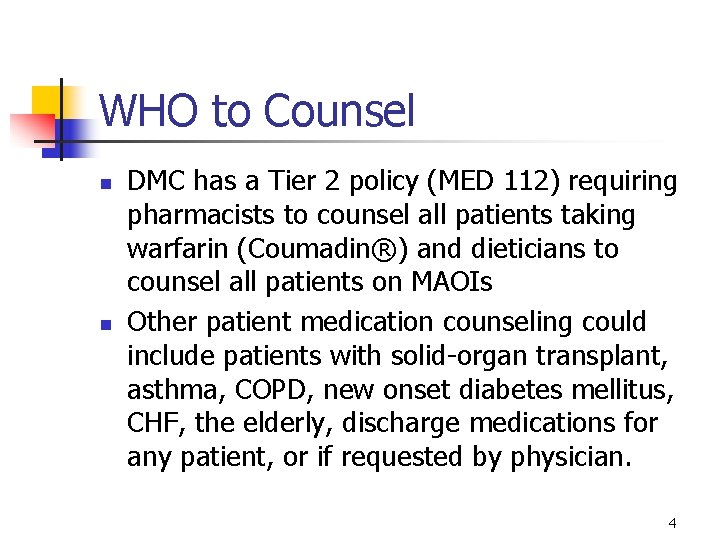
WHO to Counsel n n DMC has a Tier 2 policy (MED 112) requiring pharmacists to counsel all patients taking warfarin (Coumadin®) and dieticians to counsel all patients on MAOIs Other patient medication counseling could include patients with solid-organ transplant, asthma, COPD, new onset diabetes mellitus, CHF, the elderly, discharge medications for any patient, or if requested by physician. 4
Outline n n n WHO should be counseled? WHY should counseling be performed? HOW should counseling be performed? 5
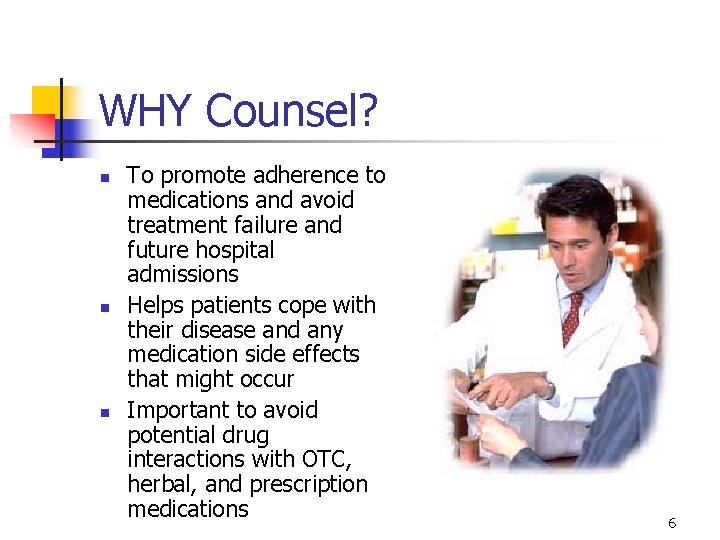
WHY Counsel? n n n To promote adherence to medications and avoid treatment failure and future hospital admissions Helps patients cope with their disease and any medication side effects that might occur Important to avoid potential drug interactions with OTC, herbal, and prescription medications 6
Outline n n n WHO should be counseled? WHY should counseling be performed? HOW should counseling be performed? 7
HOW to Counsel n Be aware of barriers to counseling n n n n Disease state: dementia, stroke Language: verify primary language Hearing/vision problems Environmental: noise, lack of privacy Educational level (reading ability) Patient motivation: disinterest in learning Lack of pharmacist training/time 8
Minimize Barriers: Effective Communication Skills n Proper environment n Private, quiet n n Free of distractions, e. g. , patient should have pain controlled, ask patient to lower volume on the TV etc. Introduce yourself n n n Greet the patient Explain your purpose Ask the patient’s permission to counsel 9
Minimize Barriers: Effective Communication Skills n Know your audience n n n Educational level: tailor talk for understanding Use appropriate language Religious or ethnic beliefs n e. g. need to avoid blood products or specific foods 10
Minimize Barriers: Effective Communication Skills n Be specific n n n Name of medication (brand/generic), dose, dosage form, schedule List precautions: e. g. , use sunscreen, avoid milk How to administer (Sub-Q, PO, IM etc. ) Special directions and precautions Necessary lab tests 11
Minimize Barriers: Effective Communication Skills n Be selective n n n n Cover major / common side effects Cover major / common drug interactions Cover patient specific indication Emphasize benefits of medication What to do if dose(s) missed Duration of therapy Provide written information Summarize key points 12
Minimize Barriers: Effective Communication Skills n Be sensitive/empathetic n n n Listen to the patient Speak distinctly and clearly Return later if patient indisposed, not alert, distracted, has visitors etc. 13
Minimize Barriers: Effective Communication Skills n Elicit feedback to assess understanding n n n Improves coping if side effects occur Increases adherence to improve health Verifies patient’s comprehension Ask open ended questions Ask if any final questions 14
Assess Patient’s Understanding “Just to make sure I did not leave anything out, could you tell me…[examples] n n n What is the medication used for? ” When are you going to take the medication? ” What side effects might you experience? ” What will you do if that occurs? ” What will you do if you miss a dose? ” 15
Example: Warfarin Counseling n DO n n Address patients formally Ask what the patient knows about warfarin or Coumadin® n DON’T n n Address patients by their first names Assume the patient knows all or nothing about the drug 16
Example: Warfarin Counseling n DO n n Explain that warfarin is used to slow the blood clotting process to prevent unwanted blood clots Ask patients to call their doctor if they notice bleeding that they don’t normally have n DON’T n n Explain that warfarin is an anticoagulant Explain that warfarin works by inhibiting the vitamin K dependent clotting factors and that it is an emergency situation if they see any blood 17
Example: Warfarin Counseling n DO n Identify the specific reason the patient is taking it and how long they might be expected to take it n DON’T n List every reason anyone might be on warfarin 18
Example: Warfarin Counseling n DO n Explain the signs and symptoms of bleeding such as bloody nose, blood in the urine, a stool that changes color or darkens, bruises that never go away or increase in size n DON’T n Give the patient the impression that they are going to bleed to death 19
Example: Warfarin Counseling n DO n Ask the patient to tell all their doctor/ dentist etc. all the medications they are taking including nonprescription ones (e. g. , pain medications, vitamins, herbal products) n DON’T n Assume the patient realizes the need to notify all health care providers concerning all the medications they are on; OTCs are often not considered medications 20
Example: Warfarin Counseling n DO n n Ask the patient to avoid taking OTC pain medications such as aspirin, Aleve®, Motrin®, or Advil® unless they have discussed it first with their physician Recommend Tylenol® as the OTC pain reliever of choice with their physician’s knowledge as well n DON’T n Indicate that the only good pain medications are those found on prescription 21
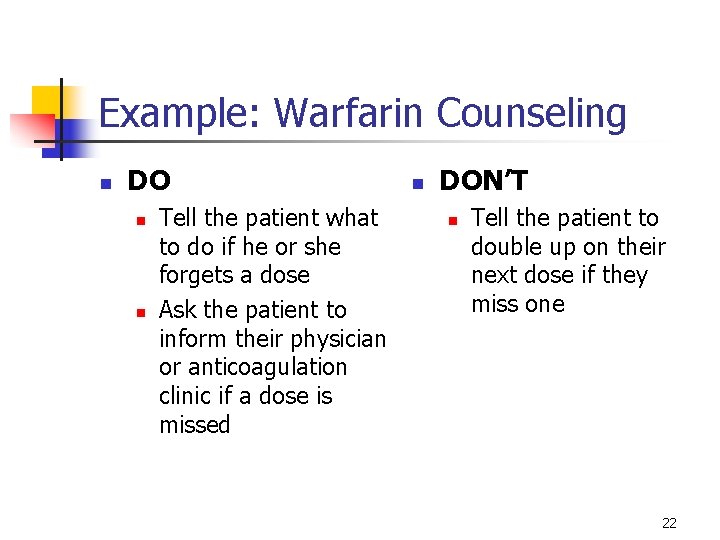
Example: Warfarin Counseling n DO n n Tell the patient what to do if he or she forgets a dose Ask the patient to inform their physician or anticoagulation clinic if a dose is missed n DON’T n Tell the patient to double up on their next dose if they miss one 22
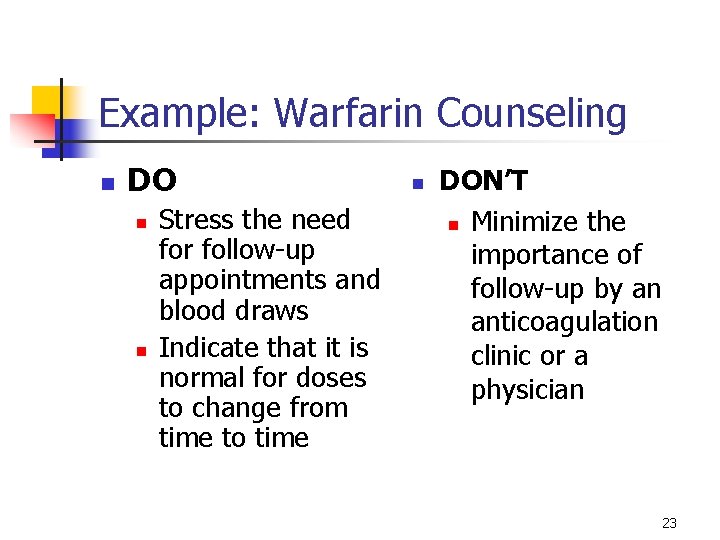
Example: Warfarin Counseling n DO n n Stress the need for follow-up appointments and blood draws Indicate that it is normal for doses to change from time to time n DON’T n Minimize the importance of follow-up by an anticoagulation clinic or a physician 23
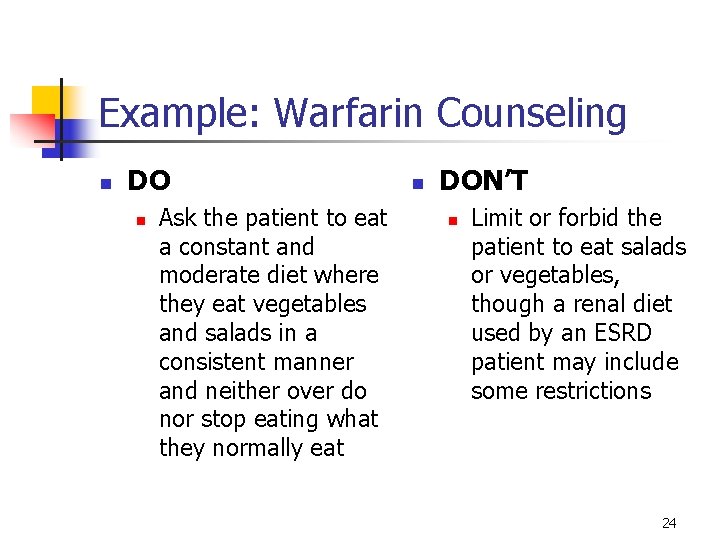
Example: Warfarin Counseling n DO n Ask the patient to eat a constant and moderate diet where they eat vegetables and salads in a consistent manner and neither over do nor stop eating what they normally eat n DON’T n Limit or forbid the patient to eat salads or vegetables, though a renal diet used by an ESRD patient may include some restrictions 24
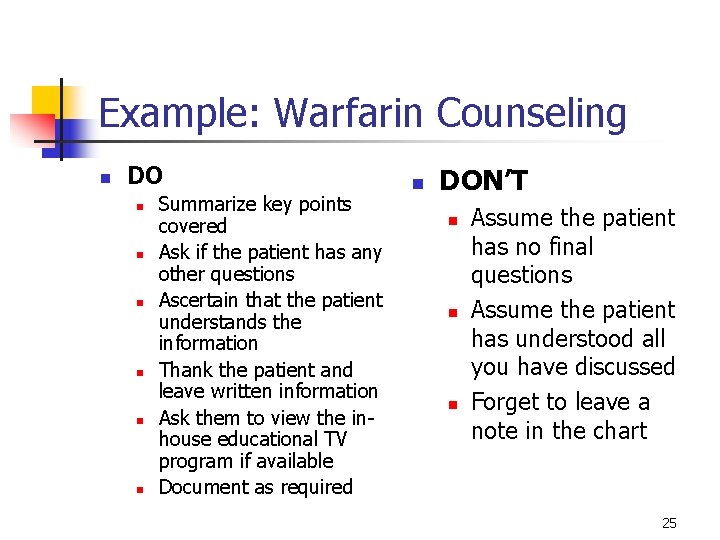
Example: Warfarin Counseling n DO n n n Summarize key points covered Ask if the patient has any other questions Ascertain that the patient understands the information Thank the patient and leave written information Ask them to view the inhouse educational TV program if available Document as required n DON’T n n n Assume the patient has no final questions Assume the patient has understood all you have discussed Forget to leave a note in the chart 25
Warfarin Counseling Summary n n n n Reason for being on anticoagulation Side Effects ( major and minor with expected frequency) Signs of major bleeding Anticipated duration of therapy Adding or discontinuing medications Dietary considerations Arrangements for future blood draws 26
Documentation of Counseling Session n When counseling is completed n n Write note or use counseling sticker in progress note. Include assessment of patient and/or care giver understanding. 27
Summary n n n n n Prepare prior to counseling Introduce yourself and your topic Use language the patient understands Present information in logical order Summarize key points Verify patients’ understanding Allow final questions from patient Give written information to patient Place a note in the chart 28