
Patient Assessment Vital Signs Copyright The Mc GrawHill
- Slides: 29
Patient Assessment: Vital Signs Copyright © The Mc. Graw-Hill Companies, Inc.
Vital Signs � There 1. 2. 3. 4. 5. are 5 main vital signs that we look at to assess a patient’s health: Pulse rate Respirations Temperature Blood pressure O 2 saturation Normal ranges of measurements of these vital signs change with the person’s age and medical condition. Chapter 9 Copyright © The Mc. Graw-Hill Companies, Inc. 2
When to assess vital signs: � On client's admission to a health care facility � In a hospital, according to a physician’s order or standards of practice � When assessing client’s during a home visit � Before and after surgery or other invasive procedures � When the client’s physical condition changes (lose consciousness, increased pain…etc. ) � When client reports symptoms of distress (e. g. , feeling “funny” or “different” Copyright © The Mc. Graw-Hill Companies, Inc. 3
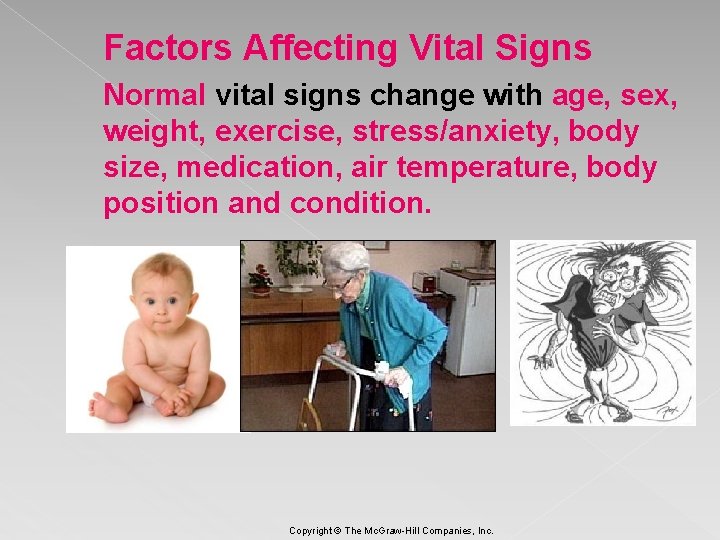
Factors Affecting Vital Signs Normal vital signs change with age, sex, weight, exercise, stress/anxiety, body size, medication, air temperature, body position and condition. Copyright © The Mc. Graw-Hill Companies, Inc.
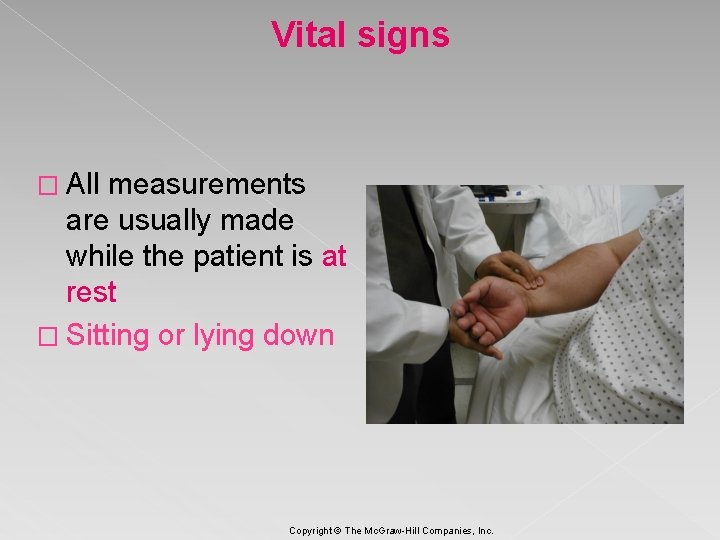
Vital signs � All measurements are usually made while the patient is at rest � Sitting or lying down Copyright © The Mc. Graw-Hill Companies, Inc.
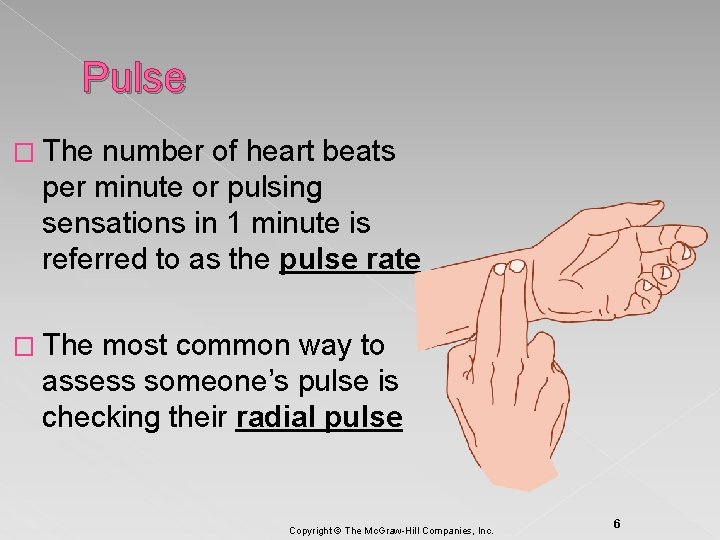
Pulse � The number of heart beats per minute or pulsing sensations in 1 minute is referred to as the pulse rate � The most common way to assess someone’s pulse is checking their radial pulse Copyright © The Mc. Graw-Hill Companies, Inc. 6
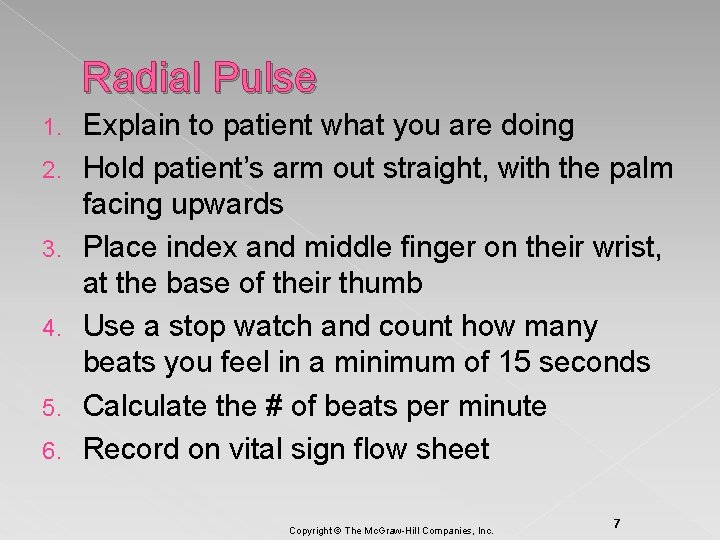
Radial Pulse 1. 2. 3. 4. 5. 6. Explain to patient what you are doing Hold patient’s arm out straight, with the palm facing upwards Place index and middle finger on their wrist, at the base of their thumb Use a stop watch and count how many beats you feel in a minimum of 15 seconds Calculate the # of beats per minute Record on vital sign flow sheet Copyright © The Mc. Graw-Hill Companies, Inc. 7
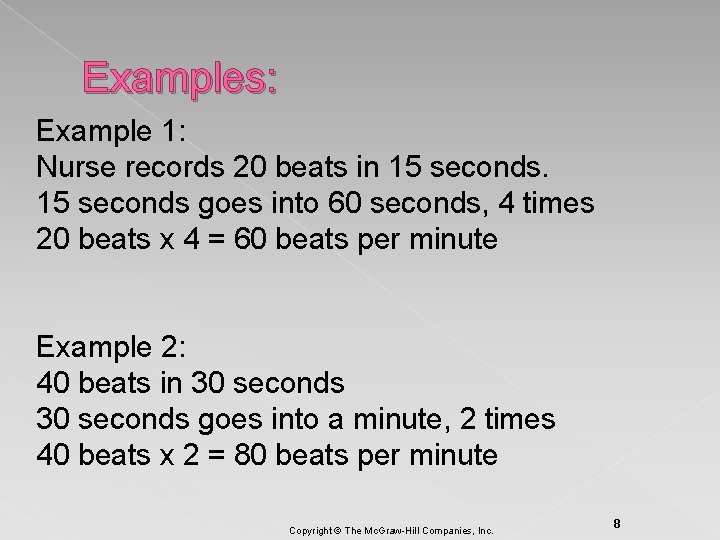
Examples: Example 1: Nurse records 20 beats in 15 seconds goes into 60 seconds, 4 times 20 beats x 4 = 60 beats per minute Example 2: 40 beats in 30 seconds goes into a minute, 2 times 40 beats x 2 = 80 beats per minute Copyright © The Mc. Graw-Hill Companies, Inc. 8
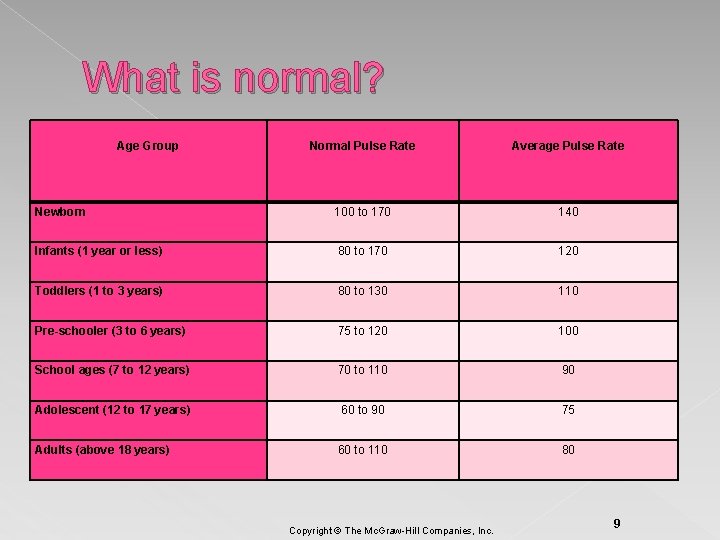
What is normal? Age Group Normal Pulse Rate Average Pulse Rate Newborn 100 to 170 140 Infants (1 year or less) 80 to 170 120 Toddlers (1 to 3 years) 80 to 130 110 Pre-schooler (3 to 6 years) 75 to 120 100 School ages (7 to 12 years) 70 to 110 90 Adolescent (12 to 17 years) 60 to 90 75 Adults (above 18 years) 60 to 110 80 Copyright © The Mc. Graw-Hill Companies, Inc. 9
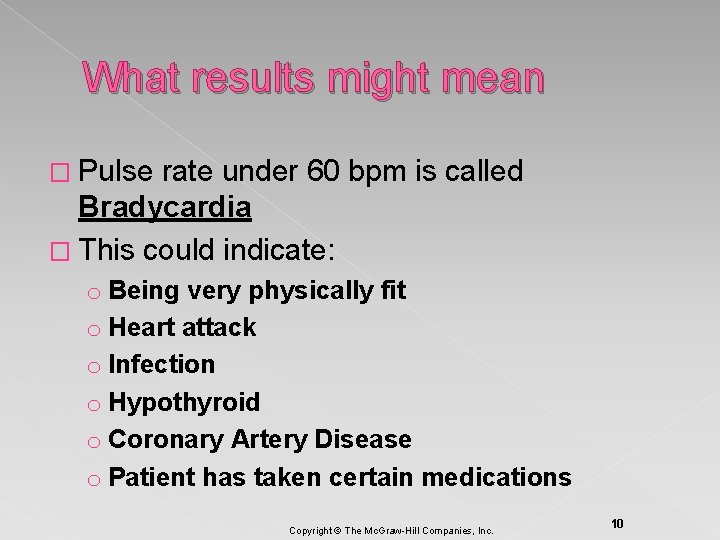
What results might mean � Pulse rate under 60 bpm is called Bradycardia � This could indicate: o Being very physically fit o Heart attack o Infection o Hypothyroid o Coronary Artery Disease o Patient has taken certain medications Copyright © The Mc. Graw-Hill Companies, Inc. 10
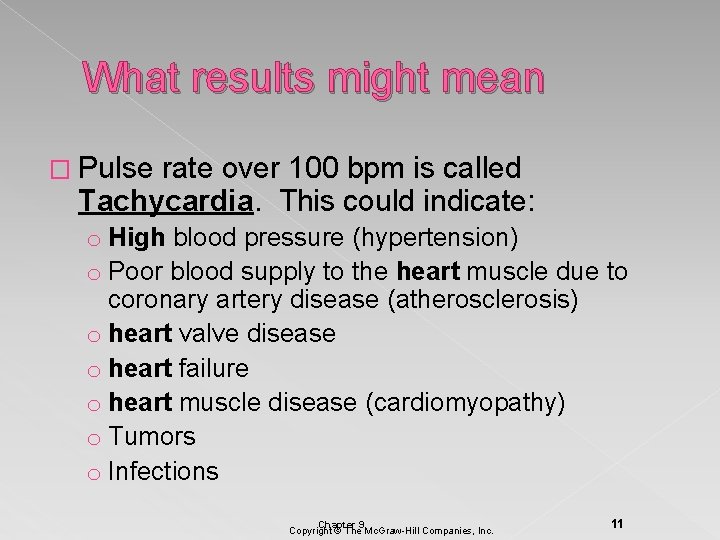
What results might mean � Pulse rate over 100 bpm is called Tachycardia. This could indicate: o High blood pressure (hypertension) o Poor blood supply to the heart muscle due to coronary artery disease (atherosclerosis) o heart valve disease o heart failure o heart muscle disease (cardiomyopathy) o Tumors o Infections Chapter 9 Copyright © The Mc. Graw-Hill Companies, Inc. 11
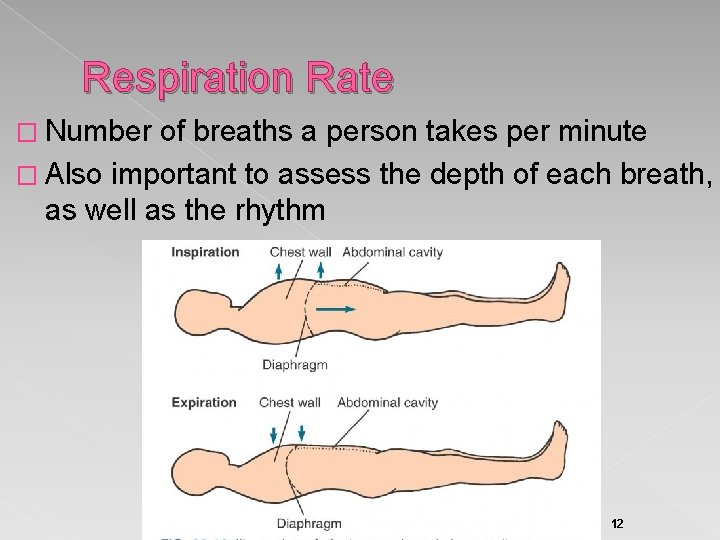
Respiration Rate � Number of breaths a person takes per minute � Also important to assess the depth of each breath, as well as the rhythm Copyright © The Mc. Graw-Hill Companies, Inc. 12
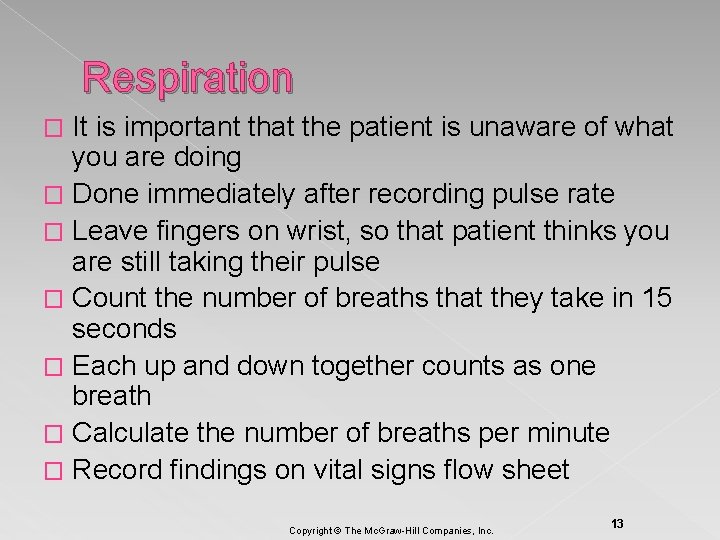
Respiration It is important that the patient is unaware of what you are doing � Done immediately after recording pulse rate � Leave fingers on wrist, so that patient thinks you are still taking their pulse � Count the number of breaths that they take in 15 seconds � Each up and down together counts as one breath � Calculate the number of breaths per minute � Record findings on vital signs flow sheet � Copyright © The Mc. Graw-Hill Companies, Inc. 13
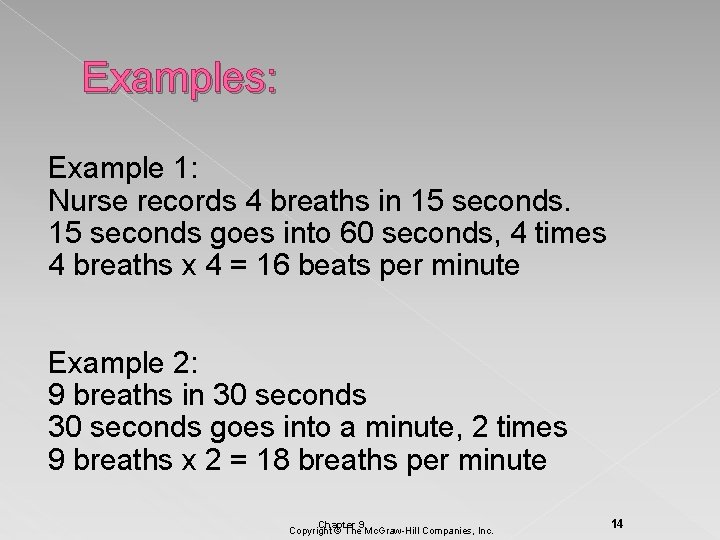
Examples: Example 1: Nurse records 4 breaths in 15 seconds goes into 60 seconds, 4 times 4 breaths x 4 = 16 beats per minute Example 2: 9 breaths in 30 seconds goes into a minute, 2 times 9 breaths x 2 = 18 breaths per minute Chapter 9 Copyright © The Mc. Graw-Hill Companies, Inc. 14
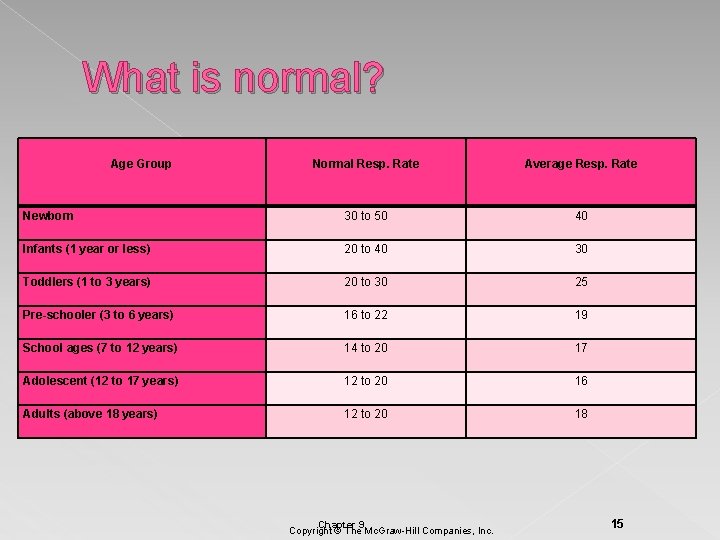
What is normal? Age Group Normal Resp. Rate Average Resp. Rate Newborn 30 to 50 40 Infants (1 year or less) 20 to 40 30 Toddlers (1 to 3 years) 20 to 30 25 Pre-schooler (3 to 6 years) 16 to 22 19 School ages (7 to 12 years) 14 to 20 17 Adolescent (12 to 17 years) 12 to 20 16 Adults (above 18 years) 12 to 20 18 Chapter 9 Copyright © The Mc. Graw-Hill Companies, Inc. 15
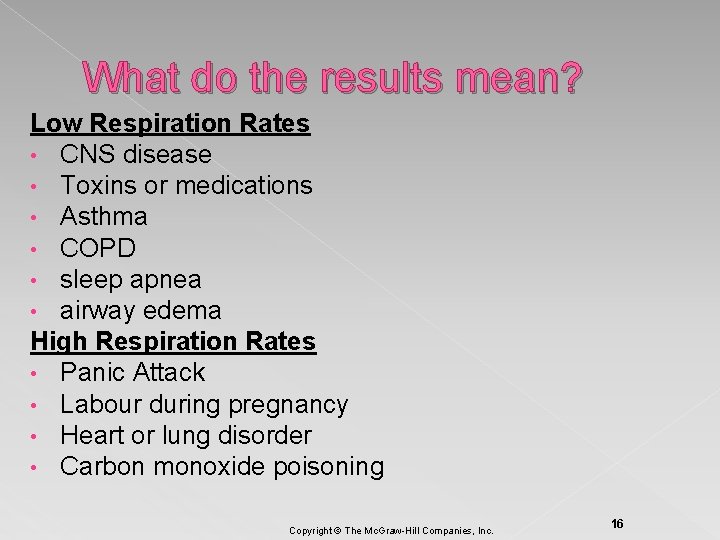
What do the results mean? Low Respiration Rates • CNS disease • Toxins or medications • Asthma • COPD • sleep apnea • airway edema High Respiration Rates • Panic Attack • Labour during pregnancy • Heart or lung disorder • Carbon monoxide poisoning Copyright © The Mc. Graw-Hill Companies, Inc. 16
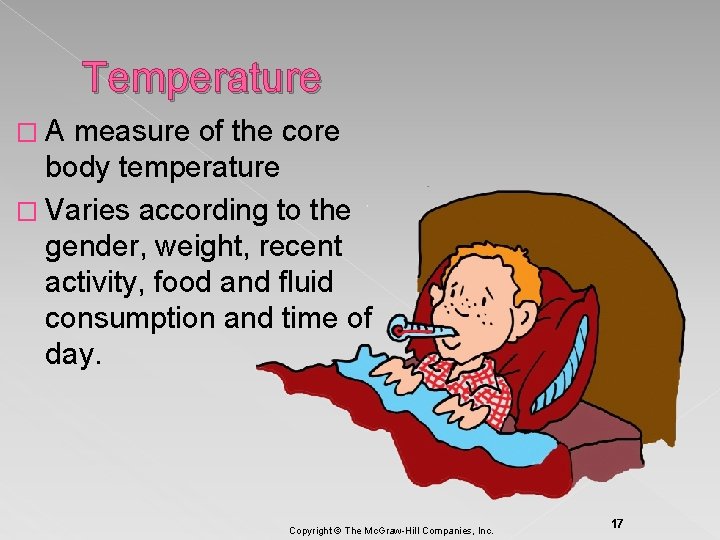
Temperature �A measure of the core body temperature � Varies according to the gender, weight, recent activity, food and fluid consumption and time of day. Copyright © The Mc. Graw-Hill Companies, Inc. 17
Temperature � Seniors, people with disabilities, babies and young children typically feel more comfortable at higher temperatures. Copyright © The Mc. Graw-Hill Companies, Inc.
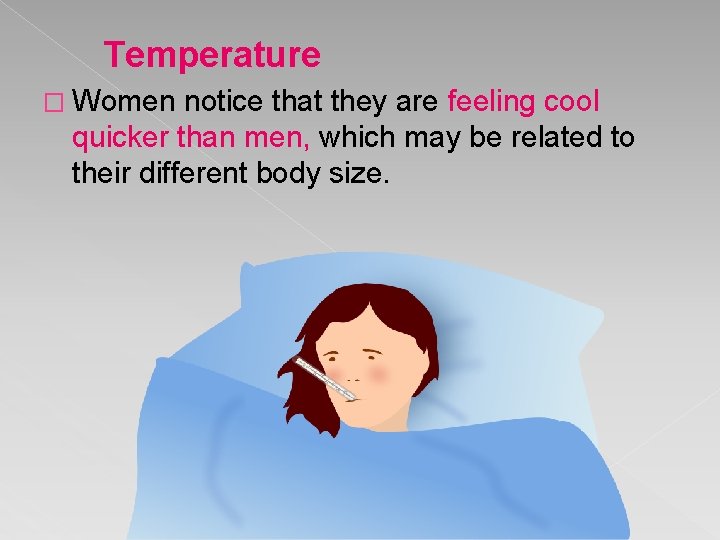
Temperature � Women notice that they are feeling cool quicker than men, which may be related to their different body size. Copyright © The Mc. Graw-Hill Companies, Inc.
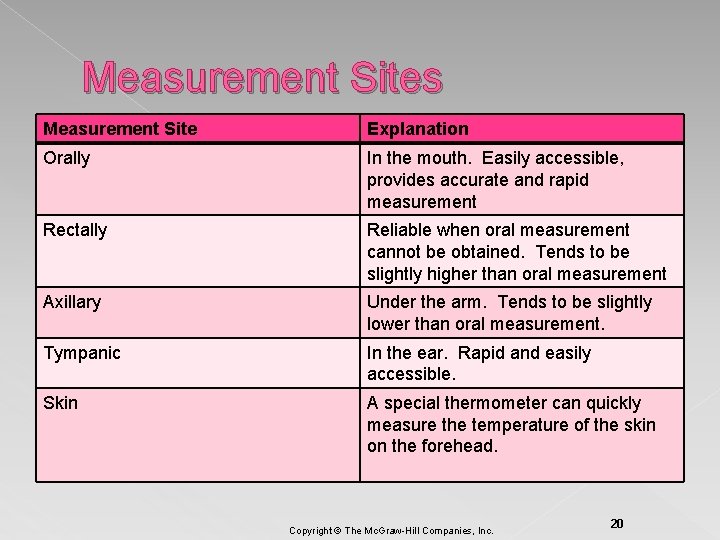
Measurement Sites Measurement Site Explanation Orally In the mouth. Easily accessible, provides accurate and rapid measurement Rectally Reliable when oral measurement cannot be obtained. Tends to be slightly higher than oral measurement Axillary Under the arm. Tends to be slightly lower than oral measurement. Tympanic In the ear. Rapid and easily accessible. Skin A special thermometer can quickly measure the temperature of the skin on the forehead. Copyright © The Mc. Graw-Hill Companies, Inc. 20
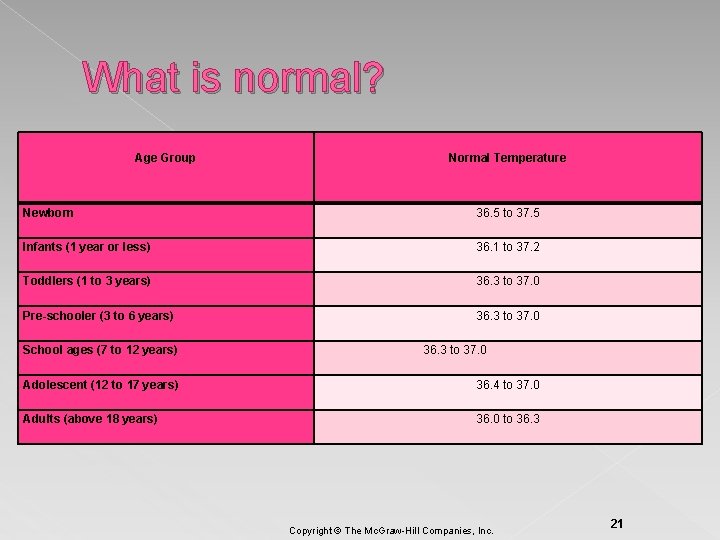
What is normal? Age Group Normal Temperature Newborn 36. 5 to 37. 5 Infants (1 year or less) 36. 1 to 37. 2 Toddlers (1 to 3 years) 36. 3 to 37. 0 Pre-schooler (3 to 6 years) 36. 3 to 37. 0 School ages (7 to 12 years) 36. 3 to 37. 0 Adolescent (12 to 17 years) 36. 4 to 37. 0 Adults (above 18 years) 36. 0 to 36. 3 Copyright © The Mc. Graw-Hill Companies, Inc. 21
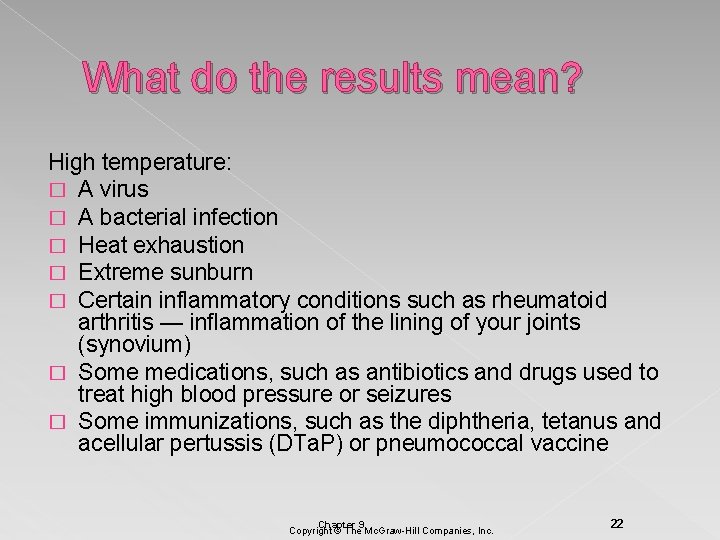
What do the results mean? High temperature: � A virus � A bacterial infection � Heat exhaustion � Extreme sunburn � Certain inflammatory conditions such as rheumatoid arthritis — inflammation of the lining of your joints (synovium) � Some medications, such as antibiotics and drugs used to treat high blood pressure or seizures � Some immunizations, such as the diphtheria, tetanus and acellular pertussis (DTa. P) or pneumococcal vaccine Chapter 9 Copyright © The Mc. Graw-Hill Companies, Inc. 22
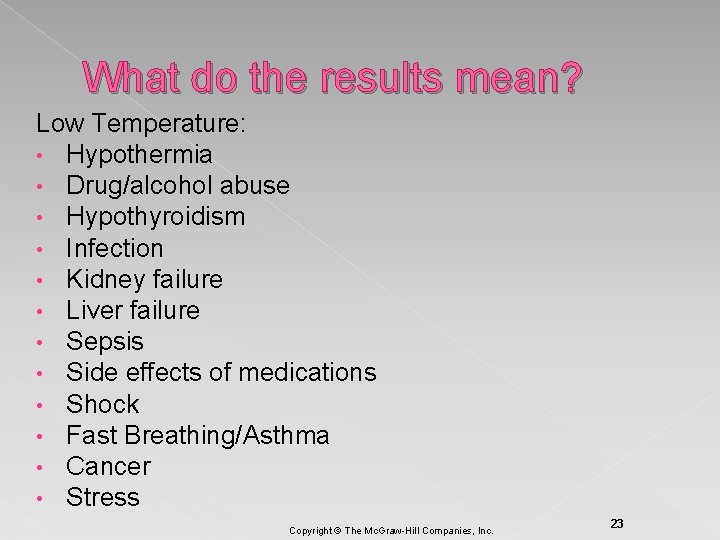
What do the results mean? Low Temperature: • Hypothermia • Drug/alcohol abuse • Hypothyroidism • Infection • Kidney failure • Liver failure • Sepsis • Side effects of medications • Shock • Fast Breathing/Asthma • Cancer • Stress Copyright © The Mc. Graw-Hill Companies, Inc. 23
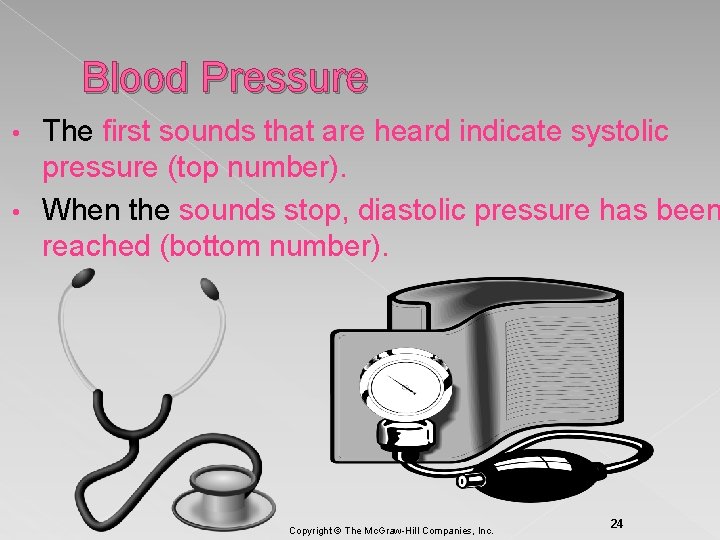
Blood Pressure The first sounds that are heard indicate systolic pressure (top number). • When the sounds stop, diastolic pressure has been reached (bottom number). • Copyright © The Mc. Graw-Hill Companies, Inc. 24
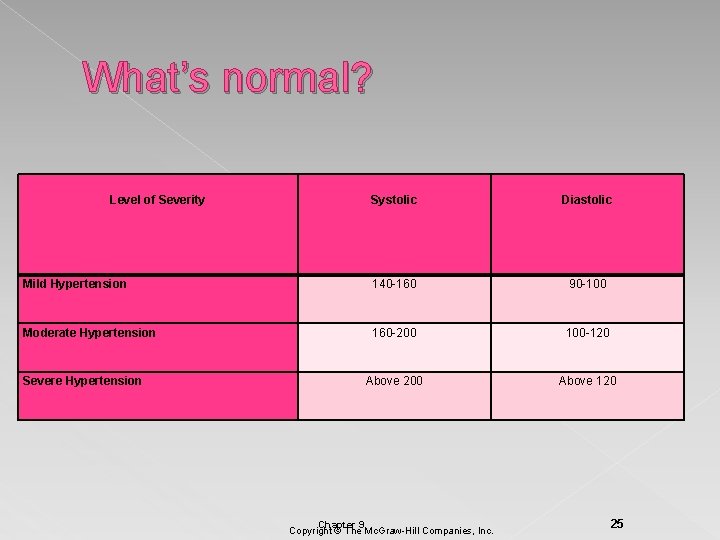
What’s normal? Level of Severity Systolic Diastolic Mild Hypertension 140 -160 90 -100 Moderate Hypertension 160 -200 100 -120 Above 200 Above 120 Severe Hypertension Chapter 9 Copyright © The Mc. Graw-Hill Companies, Inc. 25
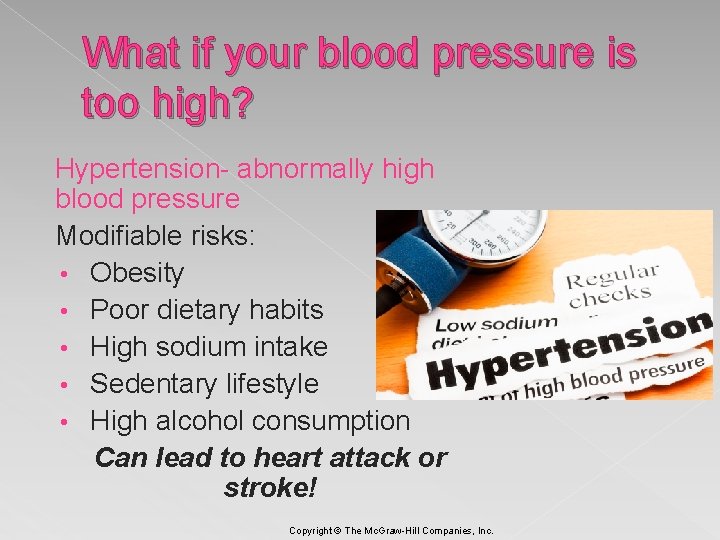
What if your blood pressure is too high? Hypertension- abnormally high blood pressure Modifiable risks: • Obesity • Poor dietary habits • High sodium intake • Sedentary lifestyle • High alcohol consumption Can lead to heart attack or stroke! Copyright © The Mc. Graw-Hill Companies, Inc.
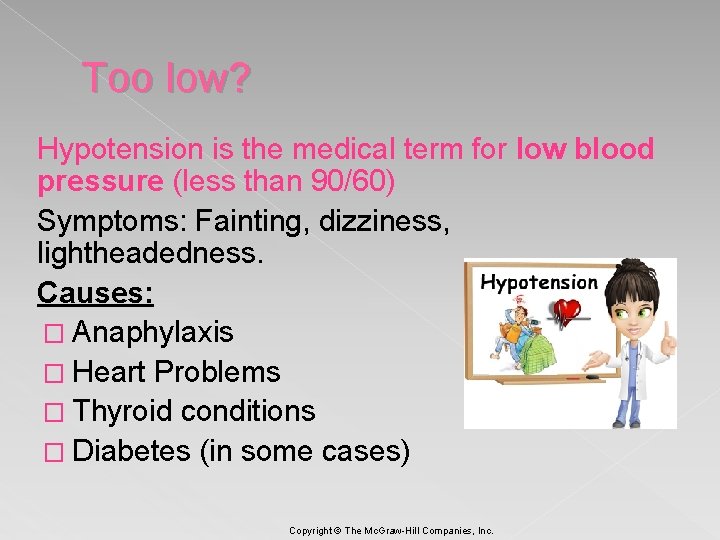
Too low? Hypotension is the medical term for low blood pressure (less than 90/60) Symptoms: Fainting, dizziness, lightheadedness. Causes: � Anaphylaxis � Heart Problems � Thyroid conditions � Diabetes (in some cases) Copyright © The Mc. Graw-Hill Companies, Inc.
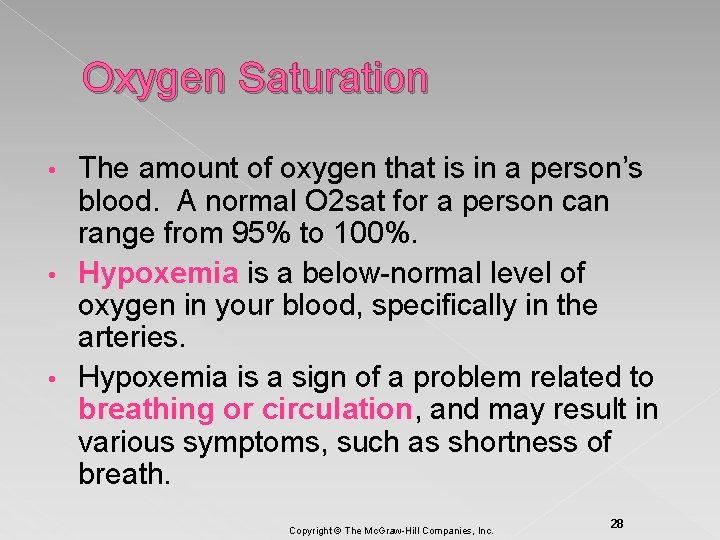
Oxygen Saturation The amount of oxygen that is in a person’s blood. A normal O 2 sat for a person can range from 95% to 100%. • Hypoxemia is a below-normal level of oxygen in your blood, specifically in the arteries. • Hypoxemia is a sign of a problem related to breathing or circulation, and may result in various symptoms, such as shortness of breath. • Copyright © The Mc. Graw-Hill Companies, Inc. 28
Documenting and Reporting � common abbreviations: › VS (vital signs) › T P R BP (temperature, pulse, respiratory rate, blood pressure) › RR (respiratory rate) › Sa. O 2 (oxygen saturation) Copyright © The Mc. Graw-Hill Companies, Inc.