
Patient Assessment Scene Size Up Scene safety BSI
Patient Assessment

Scene Size - Up • Scene safety / BSI • Mechanism of injury / Nature of the illness • Number of patients • Consider need for additional manpower or specialized resources

Primary Survey • Goal of primary assessment – To identify and initiate treatment of immediate or potentially life threatening problems – Whether the patient’s Chief Complaint is trauma or medical related we begin with the primary assessment.

Primary Assessment Steps • Form a general impression • Introduce yourself and ask for patients chief complaint • Determine patients Level of Consciousness – Conscious unaltered LOC – Conscious with altered LOC – Unconscious • AVPU • Glascow Coma Scale
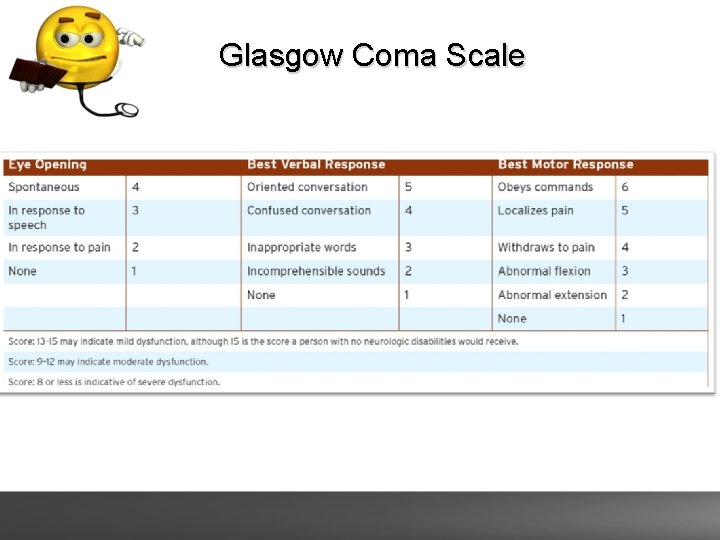
Glasgow Coma Scale
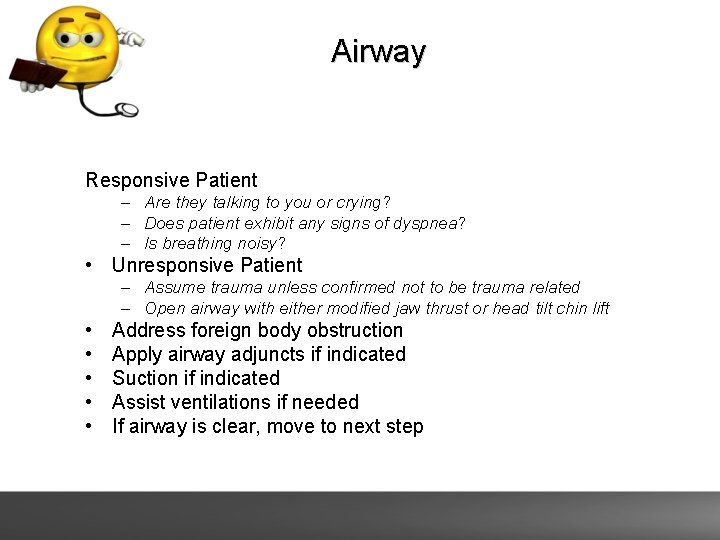
Airway Responsive Patient – Are they talking to you or crying? – Does patient exhibit any signs of dyspnea? – Is breathing noisy? • Unresponsive Patient – Assume trauma unless confirmed not to be trauma related – Open airway with either modified jaw thrust or head tilt chin lift • • • Address foreign body obstruction Apply airway adjuncts if indicated Suction if indicated Assist ventilations if needed If airway is clear, move to next step
Breathing • Is spontaneous breathing present? • Is breathing adequate or inadequate? – How do we tell the difference?
Circulation • Does patient have a pulse – – Carotid Radial Brachial (pediatric) Femoral • Any bleeding that needs to be controlled • Skin condition
Decision Time • After primary assessment we decide – – – Does this patient have a medical problem? Does this patient have trauma injuries? Does this patient have both? Is this patient a load and go? Do we need ALS support
Load and Go Patients • Rapid trauma assessment – Head to toe exam while maintaining C spine stabilization – Note any obvious findings – Assess any areas that will be inaccessible after immobilization (Neck / Back) – Support and treat any life threats
Assessment Acronyms • • • DCAP BLS TIC OPQRST SAMPLE FAST GEMS Diamond
Assessment Tools • • BP Cuff Stethoscope Pulse Oximeter Pen light Glucometer AED Senses – Look listen and feel

Trauma Patient • Once loaded and enroute start secondary assessment – – – Head to toe using DCAP BLS TIC Assess any previous treatments performed Bandaging and splinting Note any abnormal findings Notify medical command of assessment and ETA
Key Point • Trauma patients may have an underlying medical problem that is exacerbated by the injury OR • A Medical problem may have resulted in a traumatic injury
The Medical Patient • Focus assessment on chief complaint – – Cardiac Respiratory Abdominal complaints Neurological complaints • Perform interventions as indicated • Notify medical command of findings, treatment, and ETA
Reassessment • Every 5 minute for unstable patients • Every 15 minute for stable patients
Changes in Condition • Check previous interventions • Start over with primary assessment
Assessment Challenges • Geriatrics • Pediatrics • Special needs patients • Language barrier • Multiple patients
Skills Practice • Review hands on assessments both medical and trauma using WVOEMS approved skills sheets as a guide
- Slides: 19