
PATIENT ASSESSMENT EMERGENCY MEDICAL TECHNICIAN BASIC 1 INTRODUCTION
PATIENT ASSESSMENT EMERGENCY MEDICAL TECHNICIAN - BASIC 1

INTRODUCTION • What is Patient Assessment? • Why is Patient Assessment important? 2
INTRODUCTION • What are the phases of patient assessment? – Review of Dispatch Information – Scene Survey – Initial Assessment – Focused History and Physical Exam – Detailed Physical Exam – Ongoing Assessment – Communication – Documentation 3
INTRODUCTION • Why is the order of Patient Assessment important? • Why is it necessary to develop a method of assessment and use that method on all patients? 4
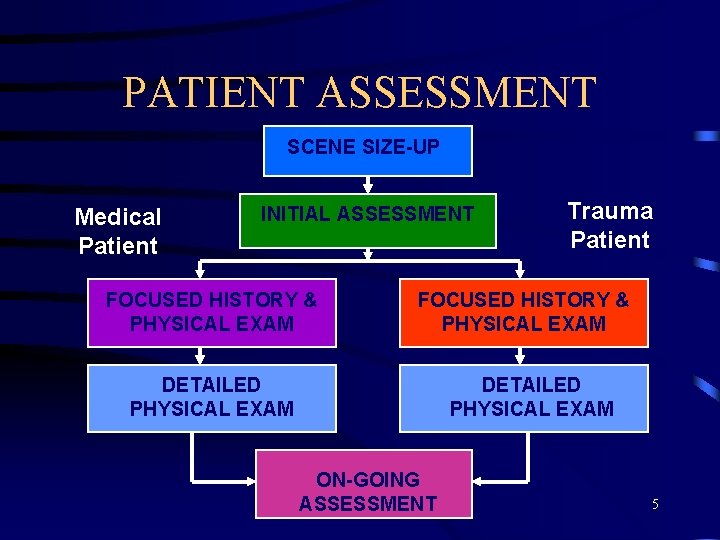
PATIENT ASSESSMENT SCENE SIZE-UP Medical Patient INITIAL ASSESSMENT FOCUSED HISTORY & PHYSICAL EXAM Trauma Patient FOCUSED HISTORY & PHYSICAL EXAM DETAILED PHYSICAL EXAM ON-GOING ASSESSMENT 5

Scene Size Up • Begin with receipt of call – Location – Incident – Injured/Injuries 6

Scene Size Up • Continue En Route – Further info from dispatcher – Observe • • Smoke? Fire? High line wires? Railroads? Water? Industry? Other Public Safety units? 7
Scene Size Up • Upon Arrival – Observe • Overall scene • Location of victim(s) • Possible Mechanisms of Injury 8
Scene Size Up • Upon Arrival – Observe • Hazards – – – – – Crowds Haz. Mat Electricity Gas Fire Glass Jagged metal Stability of environment Traffic Environment 9
Scene Size Up – Ensure Safety • • Yourself Partner Other rescuers/Bystanders Patient 10
Scene Size Up – Call for assistance • • • Other EMS Units Law Enforcement Fire Department Haz. Mat Negotiating Team etc. 11
Scene Safety & Personal Protection • Body Substance Isolation – Hand washing – Gloves & eye protection – Mask & gown 12
Scene Safety & Personal Protection • Protective Clothing – Cold weather clothing • Dress in layers – Turnout gear • Provides head-to-toe protection – Gloves • Use proper gloves for job being performed 13
Scene Safety & Personal Protection • Protective Clothing (Cont. ) – Helmets • Must be worn in any fall zone – Boots • Should protect your feet, fit well, be flexible 14
Scene Safety & Personal Protection • Protective Clothing (Cont. ) – Eye & ear protection • Should be used on rescue operations – Sin protection • Use sun block when working outdoors 15

Scene Safety & Personal Protection • Violent Situation – Civil disturbances – Domestic disputes – Crime scenes – Large gatherings 16
Scene Safety & Personal Protection • Behavioral Emergencies – Determinants of violence • • Past History Posture Vocal Activity Physical activity 17
Scene Safety & Personal Protection • Immunizations – Tetanus-Diphtheria – Measles vaccine – Rubella Vaccine – Mumps Vaccine – Flu vaccine – Hepatitis vaccine 18
Scene Safety & Personal Protection • Your personal safety is of the utmost importance. You must understand the risks of each environment you enter! 19

Initial Assessment • Purpose – To rapidly identify & correct life threats – To identify those patients who need rapid evacuation • Minimum Time on scene - Maximum Care En Route 20

Initial Assessment • General Impression – Using the facts gathered to this point, what is your first impression of the patient’s condition? • Chief Complaint 21
Initial Assessment • Mental Status (Level of Consciousness) – A - Alert – V - Verbal – P - Painful – U - Unresponsive 22
Initial Assessment • Identify Life Threats – Airway • Control C-spine (If trauma suspected) • Open-Clear-Maintain 23

Initial Assessment – Breathing • • Look Listen Feel Bare chest if respiratory distress apparent 24
Initial Assessment – Circulation • Major Bleeding • Pulse (Rapid/Slow : Weak/Bounding) – Radial >80 systolic – Femoral >70 systolic – Carotid >60 systolic 25

Initial Assessment – Circulation (cont. ) • Capillary Refill • Skin Color – – – Pale Ashen Cyanotic Mottled Red 26
Initial Assessment – Circulation (cont. ) • Skin Temperature – Hot (warm) – Cool • Skin Condition – Moist – Dry – Skin Turgor 27
Initial Assessment – Disability – Expose • Head/Neck • Chest • Abdomen 28

Initial Assessment • Rapid Evacuation – Consider ALS intercept – If, during the Initial Assessment, you encounter a life-threatening condition that your intervention cannot alleviate, you should rapidly evacuate to someone who can. 29
Criteria for Rapid Evacuation – Poor General Impression – Unresponsive - no gag or cough reflex – Responsive - unable to follow commands – Cannot establish / maintain patent airway – Difficulty breathing / Resp. distress 30
Criteria for Rapid Evacuation – Poor perfusion – Uncontrolled bleeding – Severe pain in any part of the body – Severe chest pain – Inability to move any part of body 31
Criteria for Rapid Evacuation – Complicated childbirth – High body temp (above 104° F) – Signs of generalized hypothermia – Severe allergic reaction (anaphylaxsis) – Poisoning or overdose of unknown nature 32
Focused History & Physical Exam - Trauma • Purpose – Obtain Chief Complaint • What happened to the patient? – Evaluate Chief Complaint • What circumstances surround this incident? • Is the Mechanism of Injury a high risk for injury? – Conduct Physical Exam – Obtain Baseline Vital Signs 33
Focused History & Physical Exam - Trauma • Re-evaluate Mechanism of Injury (MOI) – Significant MOI? Yes/No – Is patient unresponsive or disoriented? • Can they participate in examination? – Is the patient under the influence of drugs or alcohol? • Can they participate in examination? 34

Patients with Significant MOI • RAPID TRAUMA ASSESSMENT – Head-to-Toe Physical Exam – Palpation – Auscultation – Other Senses 35

Patients with Significant MOI • ` RAPID TRAUMA ASSESSMENT – DCAP-BTLS • • D - Deformities C - Contusions A - Abrasions P - Punctures/Penetrations B - Burns T - Tenderness L - Lacerations S - Swelling 36

Patients with Significant MOI • Baseline Vital Signs – More than one set – Look for “trending” 37
Patients with Significant MOI • History S-A-M-P-L-E – S - Signs & Symptoms – A - Allergies • Medications • Foods • Environment 38
Patients with Significant MOI – M - Medications • • • Are you taking any? When did you last take your medication? What are they for? May I see them? May we take them with us? 39
Patients with Significant MOI – P - Previous Medical History • Pertinent • Related to this complaint • Complicating factor 40
Patients with Significant MOI – L - Last Oral Intake • Food and/or Drink? • What? • When? 41
Patients with Significant MOI – E - Events leading up to the incident • What happened? • When? 42
Patients with NO Significant MOI • Assess Chief Complaint • Focused Assessment • Baseline Vitals • SAMPLE History 43
Focused History & Physical Exam - Medical • Patient Responsive? Yes/No • AVPU – A - Alert – V - Verbal – P - Painful – U -Unresponsive 44
Responsive Patients - Medical • Assess Chief Complaint • Signs & Symptoms – O - Onset • When & How did the symptom begin? – P - Provokes • What makes the symptom worse? 45
Responsive Patients - Medical • Signs & Symptoms (cont. ) – Q - Quality • How would describe the pain? /What does the pain feel like? • DO NOT lead the patient – R - Region/Radiation • Where is the pain? • Does the pain travel anywhere else? 46
Responsive Patients - Medical • Signs & Symptoms (cont. ) – S - Severity • How bad is the pain? – T - Time • How long have you had the symptom? 47
Responsive Patients - Medical • SAMPLE History • • • Focused Medical Assessment Baseline Vital Signs Transport Decision Detailed Physical Exam Ongoing Assessment 48
Unresponsive Patients - Medical • Rapid Medical Assessment • Baseline Vital Signs • SAMPLE History – Family, co-workers, bystanders • Transport • Ongoing assessment 49
Detailed Physical Exam • More detailed Head-to-Toe examination • Time sensitive – Usually performed en-route 50
Detailed Physical Exam • Required for any unresponsive patient – If the patient cannot communicate what is wrong, you must seek out the problem(s) • Required for any multi-trauma patient – Victims of multiple trauma must be assessed for less obvious or “masked” injuries 51
Detailed Physical Exam • Required for any Patient with significant mechanism of injury – If the mechanism of injury could have caused serious injuries, the EMT must actively assess for additional injuries 52
On-Going Assessment • Purpose – Determine if there any changes in the patient’s condition – Identify any missed injuries or conditions – Assess the effectiveness of treatment given and adjust if necessary 53
On-Going Assessment • Performed on both the trauma or medical patient • Procedure – Repeat Initial Assessment – Reassess Vital Signs – Repeat Focused Assessment – Check Interventions 54
- Slides: 54