
Patient Aligned Care Team VHAs implementation of the
- Slides: 30
Patient Aligned Care Team VHA’s implementation of the Patient Centered Medical Home David A. Hunsinger, MD, MSHA Medical Director, Binghamton VA Outpatient Clinic 1
Statement on the PCMH: President Obama “I support the concept of a patientcentered medical home, and as part of my health care plan, I will encourage and provide appropriate payment for providers who implement the medical home model, including physiciandirected, interdisciplinary teams, care management and care coordination programs, quality assurance mechanisms, and health IT systems which collectively will help to improve care. ” President Barack Obama 2
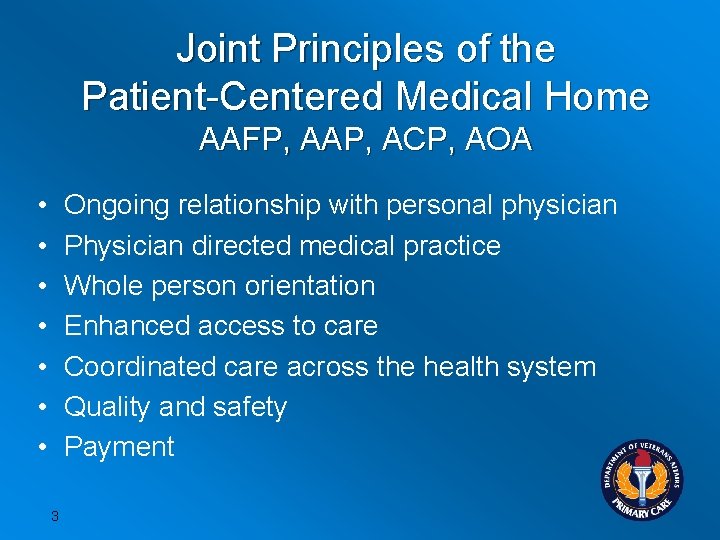
Joint Principles of the Patient-Centered Medical Home AAFP, AAP, ACP, AOA • • Ongoing relationship with personal physician Physician directed medical practice Whole person orientation Enhanced access to care Coordinated care across the health system Quality and safety Payment 3
Principle 1 Personal Physician (Provider) • Every patient has a designated primary care provider. • Relationship is ongoing – continuous over time • Patient choice • Each physician has a “Panel” of patients 4
Principle 2 Physician (Provider) Directed • Provide clinical direction – Shared-Decision making • Team-based care, leading the team • Flattening the hierarchical structures – Equal Value, Different Roles • Championing principles of Medical Home – Example: Facilitating Care Coordination 5
Principle 3 Whole Person Orientation • Health as a focus, not just Health Care • Personal preferences of the patient drive care interventions • Patient self-management skills and education • Culturally relevant and sensitive • Shared goal setting with health care team • Health literacy and numeracy • Family engaged in care • Mental Health and Primary Care Integration 6
Principle 4 Enhanced Access to Care • Open Access principles (ACA) • Ready and timely access to non face-to-face care – Telephone, Messaging, Secure e-mail – Web-based access to scheduling, information, records, labs • System Redesign 7
Principle 5 Coordinating Care • Transitions within and without • Identifying and managing highest risk – Chronic Disease Management – Population-based Health Care • Predicative Modeling • Health Risk Assessment Tools • Patient/Disease Registries 8
Principle 6 Quality and Safety • Clinical performance – Value = Quality/Cost • Medication reconciliation • Quality and Safety are outcomes – – Effectively managing transitions Team dynamic drives performance Effective implementation of Medical Home Data driven, team-based, system redesign • Continuous improvement 9
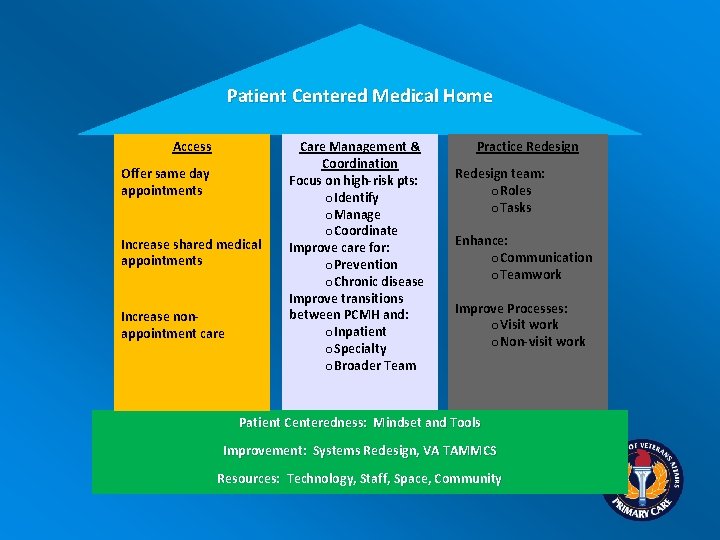
Patient Centered Medical Home Access Offer same day appointments Increase shared medical appointments Increase nonappointment care Care Management & Coordination Focus on high-risk pts: o. Identify o. Manage o. Coordinate Improve care for: o. Prevention o. Chronic disease Improve transitions between PCMH and: o. Inpatient o. Specialty o. Broader Team Practice Redesign team: o. Roles o. Tasks Enhance: o. Communication o. Teamwork Improve Processes: o. Visit work o. Non-visit work Patient Centeredness: Mindset and Tools Improvement: Systems Redesign, VA TAMMCS Resources: Technology, Staff, Space, Community
Primary Care – Mental Health Integration • PC-MHI embodies the principles and focus of the Patient Centered Medical Home • Work on PC-MHI implementation facilitates PACT implementation 11
Principles of the Patient-Centered Medical Home • • 12 Ongoing relationship with personal physician Physician directed medical practice Whole person orientation Enhanced access to care Coordinated care across the health system Quality and safety Payment
Mental Health and Primary Care A Natural Fit • 26% of Veterans who use VA health care also being treated for a mental health diagnosis • 20% currently receive some or all of that care in a specialty Mental Health setting • Patients initially bring their mental health concerns to Primary Care • Screening for mental health problems takes place in primary care [Clinical Reminders] • Referrals from Primary Care to Specialty Mental Health result in a high rate of no-shows 13
True Integration Features of PC-MHI • • • 14 Completely integrated within primary care Occupy the same space Share the same resources Participate in Team Meetings Share responsibility for care of the whole patient
Patient Aligned Care Team: Objective To improve patient satisfaction, clinical quality, safety and efficiencies by becoming a national leader in the delivery of primary care services through transformation to a medical home model of health care delivery. 15
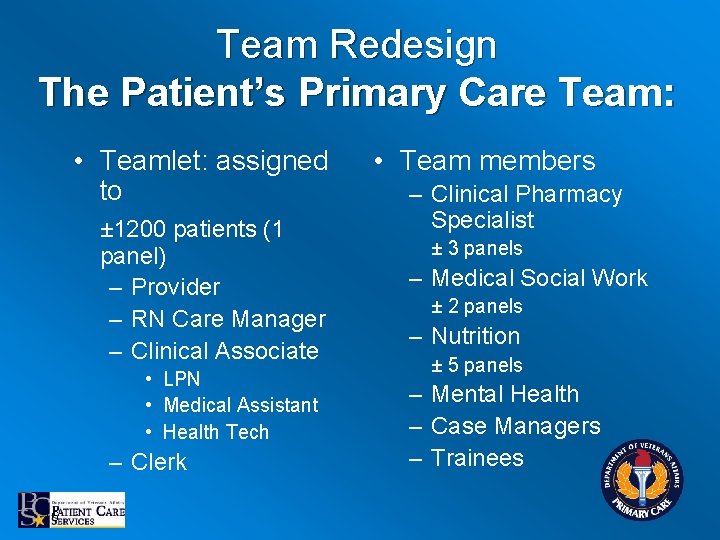
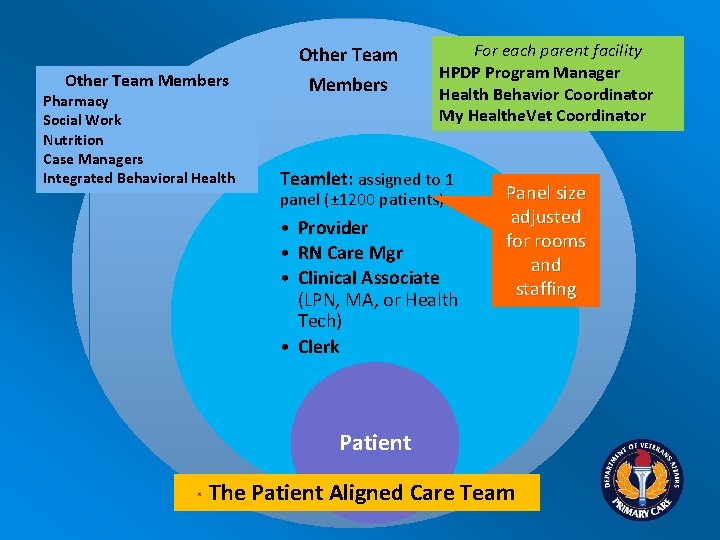
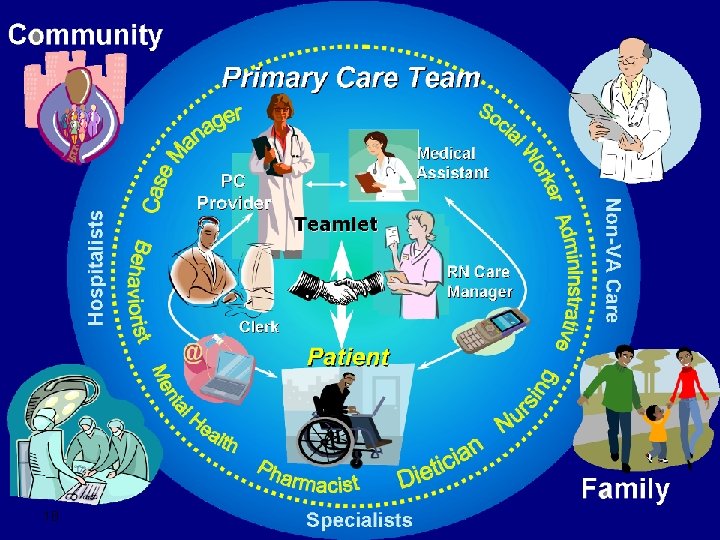
Team Redesign The Patient’s Primary Care Team: • Teamlet: assigned to ± 1200 patients (1 panel) – Provider – RN Care Manager – Clinical Associate • LPN • Medical Assistant • Health Tech – Clerk 16 • Team members – Clinical Pharmacy Specialist ± 3 panels – Medical Social Work ± 2 panels – Nutrition ± 5 panels – Mental Health – Case Managers – Trainees
Other Team Members Pharmacy Social Work Nutrition Case Managers Integrated Behavioral Health Members For each parent facility HPDP Program Manager Health Behavior Coordinator My Healthe. Vet Coordinator Teamlet: assigned to 1 panel (± 1200 patients) • Provider • RN Care Mgr • Clinical Associate (LPN, MA, or Health Tech) • Clerk Panel size adjusted for rooms and staffing Patient * The Patient Aligned Care Team
18 18
Essential Transformational Elements Patient Aligned Care Team • Delivering “health” in addition to “disease care” • Veteran as a partner in the team – – Empowered with education Focus on health promotion and disease prevention Self-management skills Patient Advisory Board • Efficient Access – Visits – Non face-to-face 19 • • Telephone Secure messaging Telemedicine Others? 19
Essential Transformational Elements • Care coordination – Optimizes hand-offs between inpatient and outpatient care – Facilitates interface with specialty care – Seamless co-management (Dual Care) with outside providers – Incorporates tele-health, and HBPC services – Emphasizes home care & rural health 20
Essential Transformational Elements • Care Management/ Panel Management – Disease management and interface with specialty care • • – – – 21 Chronic Care Model Disease registries Identification of outliers Team RN partnering closely with providers Veterans at high risk for adverse outcomes Pain management Returning combat veteran care Depression Substance abuse
Essential Transformational Elements • Improve technological clinician support – Decision support – Predictive modeling – CPRS user-friendliness – Information processing • Develop new measurement and evaluation tools – Patient Satisfaction – Staff satisfaction – Processes of care – Manager and Provider Report Cards – Continuity and comprehensiveness 22 22
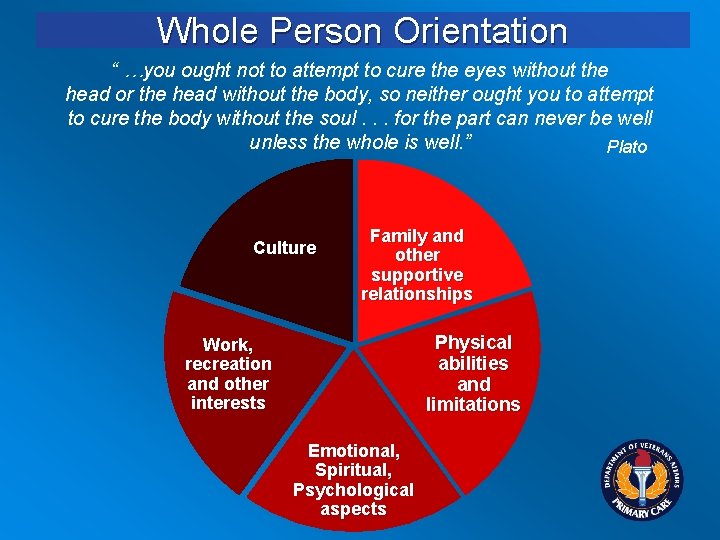
Whole Person Orientation “ …you ought not to attempt to cure the eyes without the head or the head without the body, so neither ought you to attempt to cure the body without the soul. . . for the part can never be well unless the whole is well. ” Plato Culture Family and other supportive relationships Physical abilities and limitations Work, recreation and other interests Emotional, Spiritual, Psychological aspects
Mental Health is an Integral Part of Overall Health • Physical problems can be risk factors for mental health problems • Mental health problems can be risk factors for physical health problems • Patient Centeredness means a holistic view of the Veteran, recognizing the interrelationships of all health problems and how they individually and interactively affect quality of life 24
Expectations of the PC-MHI Team – Proficiency in Motivational Interviewing – Participate in appropriate Team activities • Huddles & Team Meetings • Frequent non-face-to-face phone contact – Keep entire Teamlet in the loop – Coordinate care with other VHA resources (i. e. CCHT, HBPC, ADHC, etc as appropriate) – Educate Primary Care Team on MH issues 25
Shared Medical Appointments • Potential new role for the co-located Mental Health provider • Provides patient-care in a group setting • Mental Health provider often assists with group management 26
Shared Medical Appointments • Have a component of education, but… • Alternative to the traditional face to face, 1: 1 doctor: patient interaction in an office. • This doctor: patient interaction is in a group setting (“ 1: 1 with onlookers”).
Shared Medical Appointments • One-on-one care with observers • 15 -20 patients in 90 – 120 min. • Patients learn from staff and from each other • Commonly facilitated by a Behavioral Health provider • Appeals to about ½ of those offered option
Conclusion • Patient Aligned Care Teams strive to provide patient-centered, whole person health care and seek to work with the Veteran to coordinate and manage all aspects of their care 29
Conclusion • Primary Care - Mental Health Integration is and will continue to be an essential component of the team delivery of effective care 30