
Patient Activation Measure A vital sign for valuebased
Patient Activation Measure®: A vital sign for value-based care Associate Professor Michael Greco Chief Executive CFEP Surveys (Australia and the UK) michael. greco@cfepsurveys. com. au 3 rd June, 2020 Copyright © 2019 Insignia Health 1
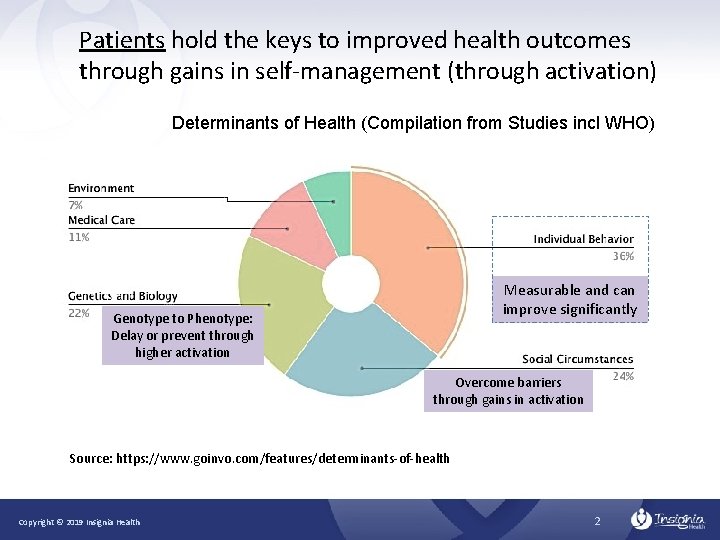
Patients hold the keys to improved health outcomes through gains in self-management (through activation) Determinants of Health (Compilation from Studies incl WHO) Measurable and can improve significantly Genotype to Phenotype: Delay or prevent through higher activation Overcome barriers through gains in activation Source: https: //www. goinvo. com/features/determinants-of-health Copyright © 2019 Insignia Health 2

What is PAM? The PAM is a tool that can reliably predict patient behaviour such as: • unnecessary ED visits, hospital admissions and re-admissions • medication adherence • undertaking prevention strategies • likelihood of developing further chronic conditions Copyright © 2019 Insignia Health 3

PAM® measures a persons underlying self-management ability or activation w Three key domains are assessed -- Knowledge, Skills, Confidence, to understand a person’s self-management ability w Two key metrics – score on a 100 point scale and four levels of activation w Validated versions for carers, parents and clinicians w More than 225 healthcare organisations using PAM in a dozen countries w UK - Activation & Personalisation integral to NHS 10 Year Plan w USA- working with CMS to support 5 million people initially through alternative payment design programs w Globally validated with 525+ published studies, 40+ translations available “ Copyright © 2019 Insignia Health 4

Four activation levels reside along an empirically derived, equal interval scale 100 -point scale Level 1 Overwhelmed, disengaged, struggling Very high A&E/ED visits, very high risk of readmits Segmentation 15 -20% 10 90 20 Level 2 Level 3 More self-aware, but still struggling, starting to build confidence High A&E/ED visits, high risk of readmits Taking action. Able to achieve guideline behaviours 20 -30% 30 -35% 30 40 Low A&E/ED use. Low readmission risk 50 4 Level Maintaining behaviours and pushing further Very low A&E/ED use. Very low readmission risk 20 -25% 60 70 80 The value of a single point change in PAM score is significant and well understood, as is the shift between PAM Levels Copyright © 2019 Insignia Health 5

The Value of a Single Point Change PAM® Survey Produces a PAM® Score from 1 - 100 10 30 20 40 50 60 70 90 80 • Empirically derived, interval level measurement • The value of a single point change in PAM® score is significant and understood with precision, as is the shift between PAM® Levels HIV Patient Study Diabetes Patient Study % change for a 1 point change in PAM score Hospitalization 1. 7% decline Good A 1 c Control (Hg. A 1 c<8%) 1. 8% gain A 1 c testing LDL-c testing 3. 4% gain 17% decrease Likelihood of hospitalization 18% greater likelihood of good glycemic control 34% improvement in testing Source: Is Patient Activation Associated with Future Health Outcomes and Healthcare Utilization Among Patients with Diabetes? Journal of Ambulatory Care Management, Nov 2009 Copyright © 2019 Insignia Health % change for a 1 point change in PAM score 10 point gain impact 54 (L 2) to 64 (L 3) CD 4 count > 200 1. 9% 21% Medication Adherence ^ 2. 8% 32% Viral Suppression ^ 1. 6% 17% Source: Patient Activation and Improved Outcomes in HIV-infected Patients. Journal of General Internal Medicine, 2013 May; 28(5): 668 -74 6
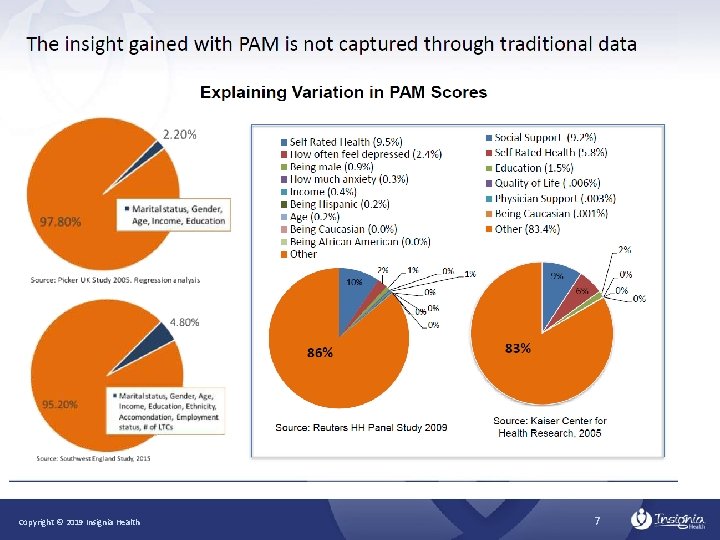
Copyright © 2019 Insignia Health 7

PAM-Based Behavioural Activation Model Three core functions or uses of PAM: 1. Predictive - improves risk identification & resource allocation 2. Tailor support to PAM Levels (1 -4) 3. Measure impact over time (using PAM Scores 0 -100) Copyright © 2019 Insignia Health 8

PAM Score Change Results UK organisations 2018 Patients low in activation consistently see the greatest increases in activation Average change in PAM~ % Patients seeing change in PAM score Decline Unchanged Improved Level 1 9. 3* 12% 18% 69% Level 2 6. 6 15% 28% 57% Level 3 2. 5 20% 41% 39% Level 4 -3. 5** 35% 45% 20% Source: 2018 results. All UK client organizations * Most Level 1 patients move to Level 2 ** Most Level 4 patients remain in Level 4 ~ average of 5 months between baseline and last PAM Copyright © 2019 Insignia Health 9
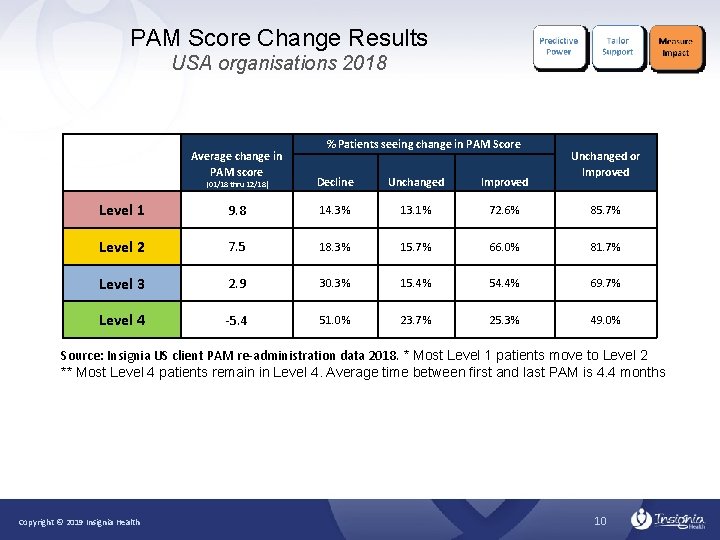
PAM Score Change Results USA organisations 2018 Average change in PAM score % Patients seeing change in PAM Score Unchanged or Improved (01/18 thru 12/18) Decline Unchanged Improved Level 1 9. 8 14. 3% 13. 1% 72. 6% 85. 7% Level 2 7. 5 18. 3% 15. 7% 66. 0% 81. 7% Level 3 2. 9 30. 3% 15. 4% 54. 4% 69. 7% Level 4 -5. 4 51. 0% 23. 7% 25. 3% 49. 0% Source: Insignia US client PAM re-administration data 2018. * Most Level 1 patients move to Level 2 ** Most Level 4 patients remain in Level 4. Average time between first and last PAM is 4. 4 months Copyright © 2019 Insignia Health 10
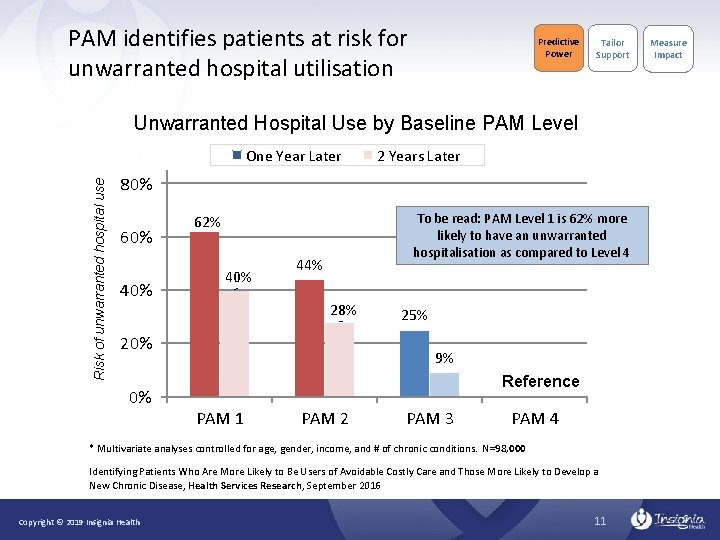
PAM identifies patients at risk for unwarranted hospital utilisation Predictive Power Tailor Support Unwarranted Hospital Use by Baseline PAM Level Risk of unwarranted hospital use One Year Later 2 Years Later 80% 60% 40% To be read: PAM Level 1 is 62% more likely to have an unwarranted hospitalisation as compared to Level 4 62% 40% 44% 28% 20% 0% 25% 9% Reference PAM 1 PAM 2 PAM 3 PAM 4 * Multivariate analyses controlled for age, gender, income, and # of chronic conditions. N=98, 000 Identifying Patients Who Are More Likely to Be Users of Avoidable Costly Care and Those More Likely to Develop a New Chronic Disease, Health Services Research, September 2016 Copyright © 2019 Insignia Health 11 Measure Impact
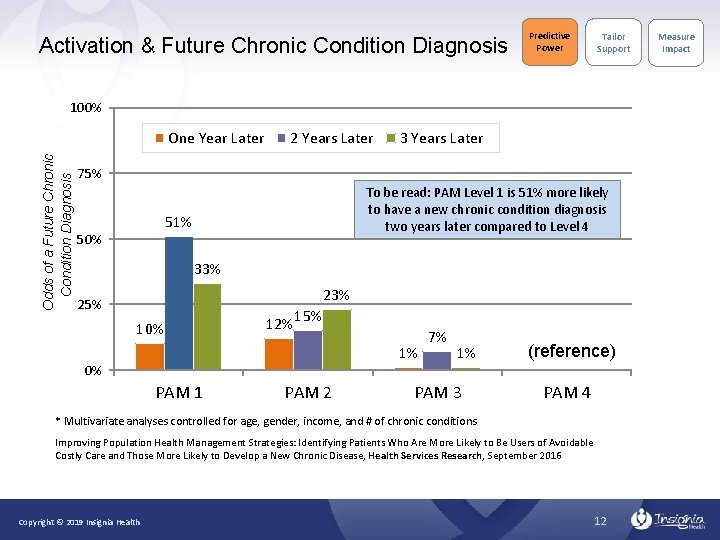
Activation & Future Chronic Condition Diagnosis Predictive Power Tailor Support 100% Odds of a Future Chronic Condition Diagnosis One Year Later 2 Years Later 3 Years Later 75% To be read: PAM Level 1 is 51% more likely to have a new chronic condition diagnosis two years later compared to Level 4 51% 50% 33% 25% 10% 12% 15% 1% 0% PAM 1 PAM 2 7% 1% PAM 3 (reference) PAM 4 * Multivariate analyses controlled for age, gender, income, and # of chronic conditions Improving Population Health Management Strategies: Identifying Patients Who Are More Likely to Be Users of Avoidable Costly Care and Those More Likely to Develop a New Chronic Disease, Health Services Research, September 2016 Copyright © 2019 Insignia Health 12 Measure Impact
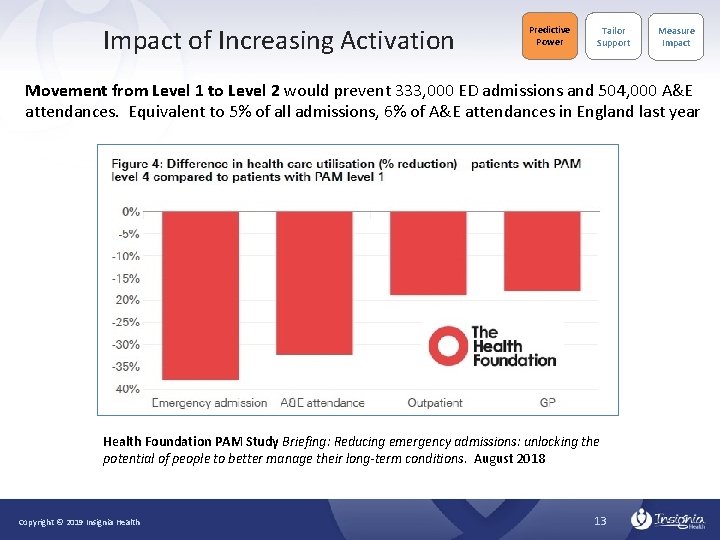
Impact of Increasing Activation Predictive Power Tailor Support Measure Impact Movement from Level 1 to Level 2 would prevent 333, 000 ED admissions and 504, 000 A&E attendances. Equivalent to 5% of all admissions, 6% of A&E attendances in England last year Health Foundation PAM Study Briefing: Reducing emergency admissions: unlocking the potential of people to better manage their long-term conditions. August 2018 Copyright © 2019 Insignia Health 13
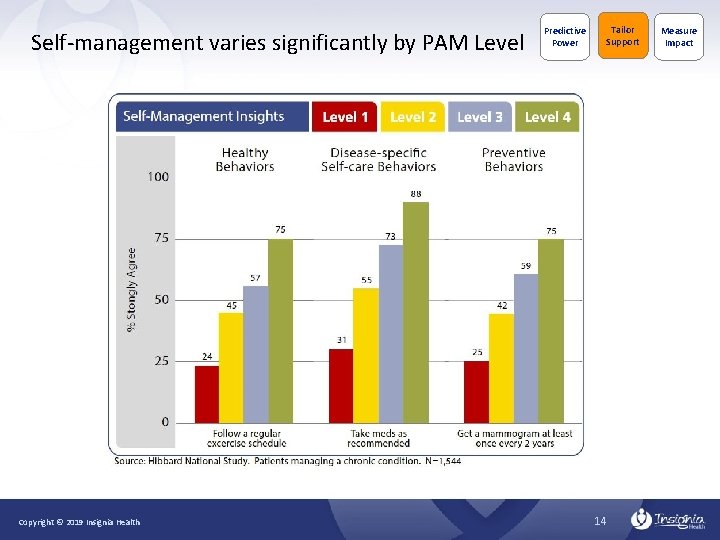
Self-management varies significantly by PAM Level Copyright © 2019 Insignia Health Predictive Power Tailor Support 14 Measure Impact
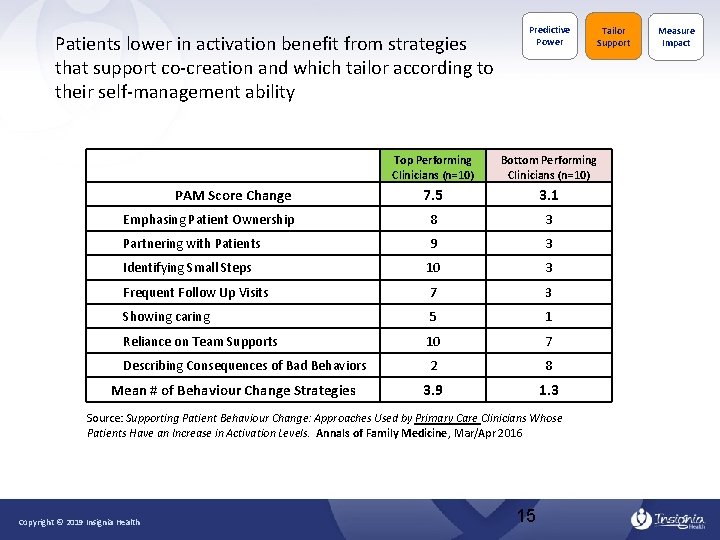
Patients lower in activation benefit from strategies that support co-creation and which tailor according to their self-management ability Predictive Power Tailor Support Top Performing Clinicians (n=10) Bottom Performing Clinicians (n=10) 7. 5 3. 1 Emphasing Patient Ownership 8 3 Partnering with Patients 9 3 Identifying Small Steps 10 3 Frequent Follow Up Visits 7 3 Showing caring 5 1 Reliance on Team Supports 10 7 Describing Consequences of Bad Behaviors 2 8 3. 9 1. 3 PAM Score Change Mean # of Behaviour Change Strategies Source: Supporting Patient Behaviour Change: Approaches Used by Primary Care Clinicians Whose Patients Have an Increase in Activation Levels. Annals of Family Medicine, Mar/Apr 2016 Copyright © 2019 Insignia Health 15 Measure Impact
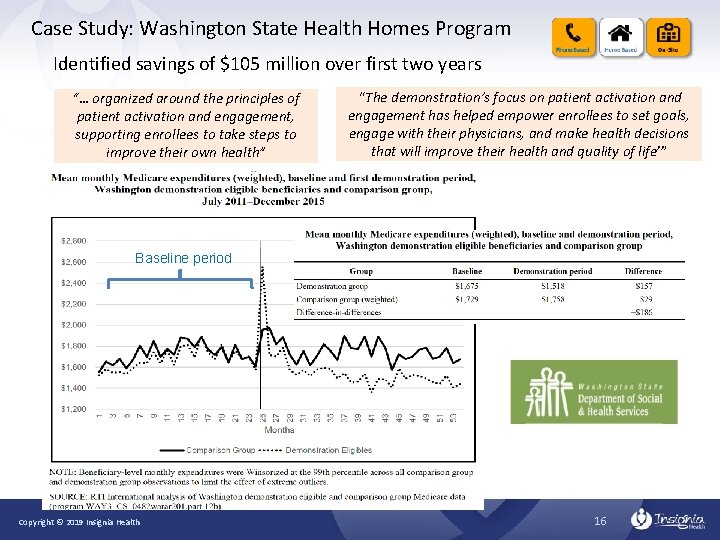
Case Study: Washington State Health Homes Program Identified savings of $105 million over first two years “… organized around the principles of patient activation and engagement, supporting enrollees to take steps to improve their own health” “The demonstration’s focus on patient activation and engagement has helped empower enrollees to set goals, engage with their physicians, and make health decisions that will improve their health and quality of life’” Baseline period Copyright © 2019 Insignia Health 16
For further information regarding PAM and its implementation: Michael. greco@cfepsurveys. com. au Copyright © 2019 Insignia Health 17
- Slides: 17