
Pathways Tracking Progress at Wymondham High KS 2
- Slides: 13
Pathways Tracking Progress at Wymondham High • • KS 2 Standardised Scores School Accountability: Progress 8 The Year 7 Curriculum GCSE Reform: 9 -1 grades Pathways Setting Benchmarks: FFT Aspire etc Tracking Progress: Go 4 Schools Welcome Presentation to Y 7 Parents January 2018
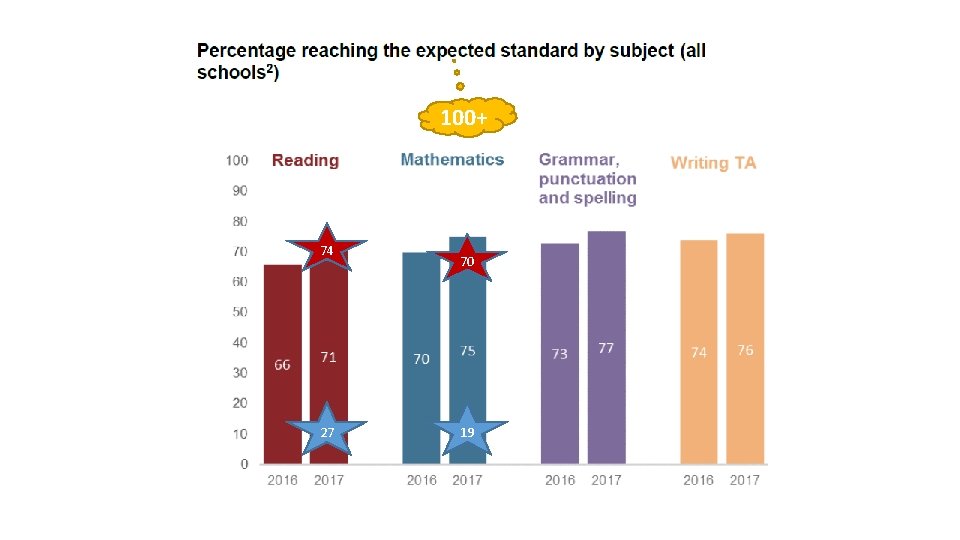
100+ 74 27 70 19
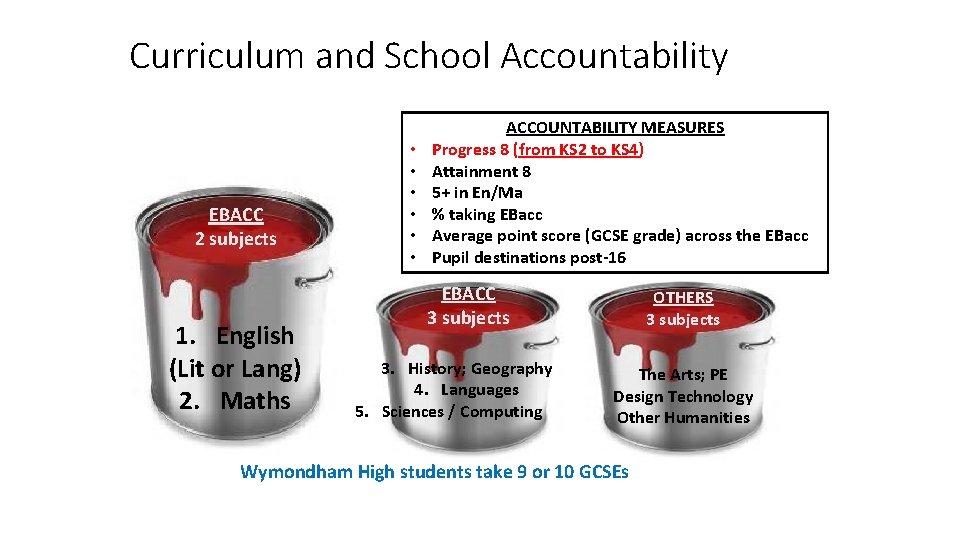
Curriculum and School Accountability EBACC 2 subjects 1. English (Lit or Lang) 2. Maths • • • ACCOUNTABILITY MEASURES Progress 8 (from KS 2 to KS 4) Attainment 8 5+ in En/Ma % taking EBacc Average point score (GCSE grade) across the EBacc Pupil destinations post-16 EBACC 3 subjects 3. History; Geography 4. Languages 5. Sciences / Computing OTHERS 3 subjects The Arts; PE Design Technology Other Humanities Wymondham High students take 9 or 10 GCSEs
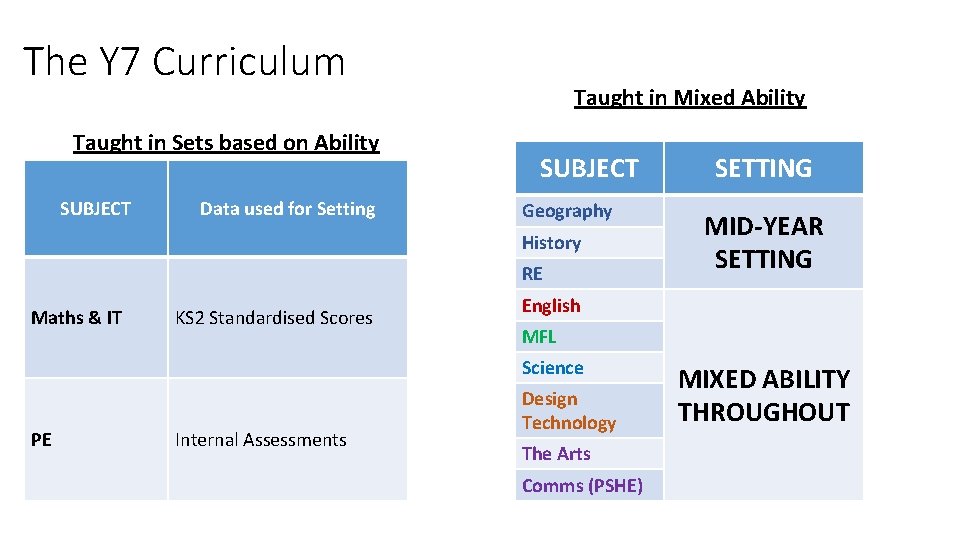
The Y 7 Curriculum Taught in Sets based on Ability SUBJECT Data used for Setting Taught in Mixed Ability SUBJECT Geography History RE Maths & IT KS 2 Standardised Scores Internal Assessments MID-YEAR SETTING English MFL Science PE SETTING Design Technology The Arts Comms (PSHE) MIXED ABILITY THROUGHOUT
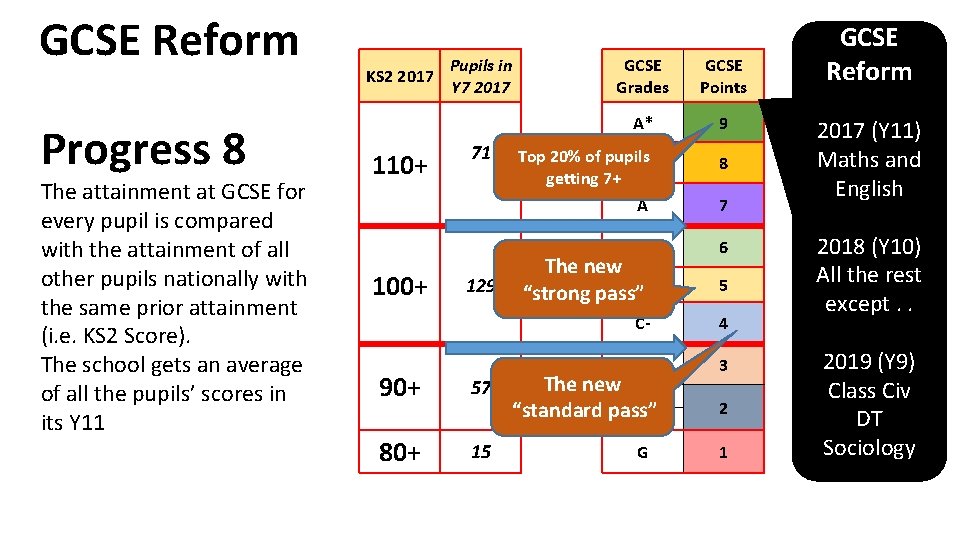
GCSE Reform Progress 8 The attainment at GCSE for every pupil is compared with the attainment of all other pupils nationally with the same prior attainment (i. e. KS 2 Score). The school gets an average of all the pupils’ scores in its Y 11 KS 2 2017 110+ 100+ Pupils in Y 7 2017 71 129 90+ 57 80+ 15 GCSE Grades GCSE Points A* 9 Top 20% of pupils A+ getting 7+ 8 A 7 B+ 6 The new C+ / B“strong pass” 5 C- 4 D 3 The new E “standard pass” F G 2 1 GCSE Reform 2017 (Y 11) Maths and English 2018 (Y 10) All the rest except. . 2019 (Y 9) Class Civ DT Sociology
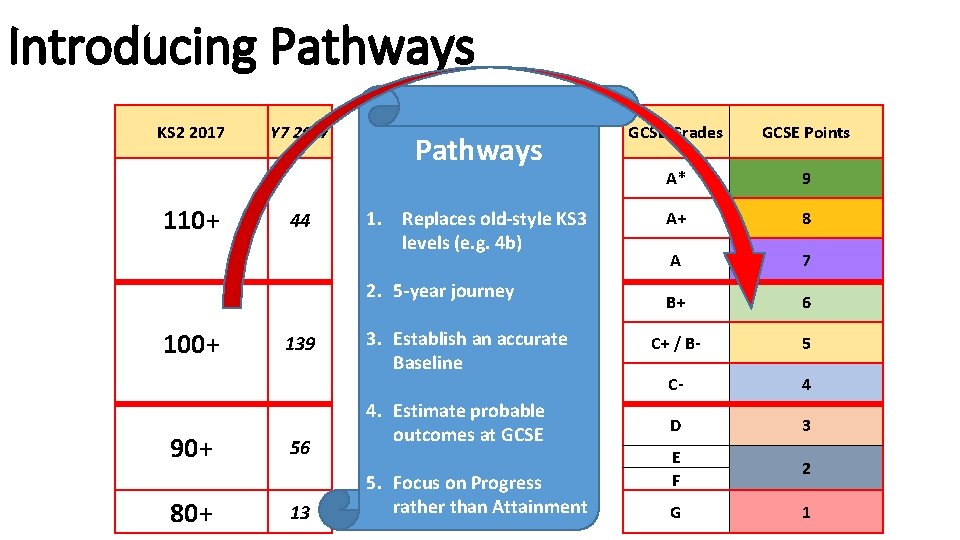
Introducing Pathways KS 2 2017 110+ Y 7 2017 44 Pathways GCSE Grades GCSE Points A* 9 1. Replaces old-style KS 3 levels (e. g. 4 b) A+ 8 A 7 B+ 6 C+ / B- 5 C- 4 D 3 E F 2 G 1 2. 5 -year journey 100+ 90+ 80+ 139 56 13 3. Establish an accurate Baseline 4. Estimate probable outcomes at GCSE 5. Focus on Progress rather than Attainment
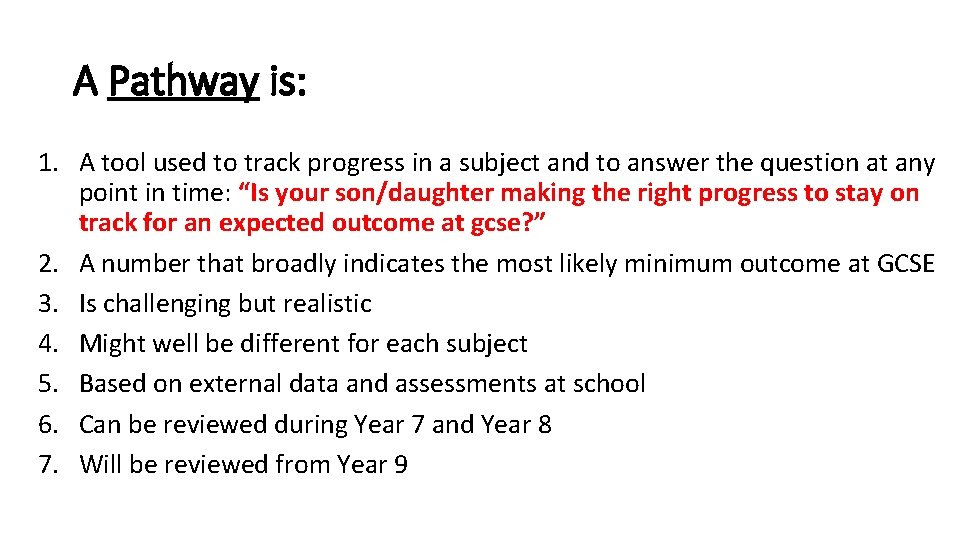
A Pathway is: 1. A tool used to track progress in a subject and to answer the question at any point in time: “Is your son/daughter making the right progress to stay on track for an expected outcome at gcse? ” 2. A number that broadly indicates the most likely minimum outcome at GCSE 3. Is challenging but realistic 4. Might well be different for each subject 5. Based on external data and assessments at school 6. Can be reviewed during Year 7 and Year 8 7. Will be reviewed from Year 9
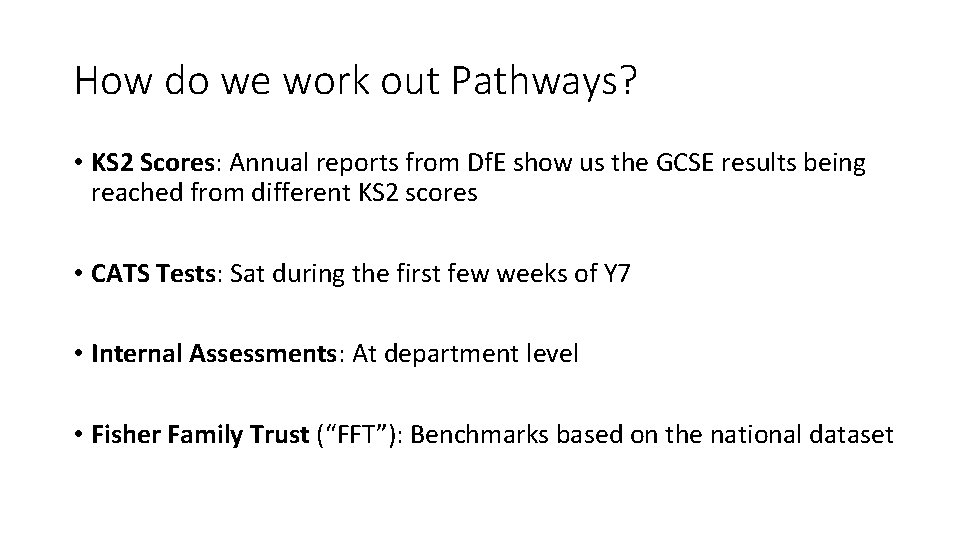
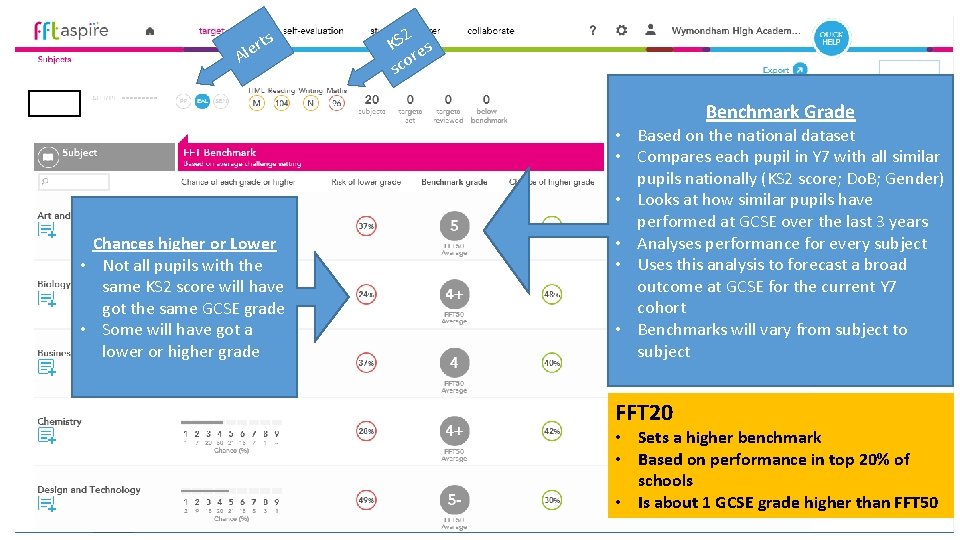
How do we work out Pathways? • KS 2 Scores: Annual reports from Df. E show us the GCSE results being reached from different KS 2 scores • CATS Tests: Sat during the first few weeks of Y 7 • Internal Assessments: At department level • Fisher Family Trust (“FFT”): Benchmarks based on the national dataset
rt e l A s 2 KS es r sco Benchmark Grade Chances higher or Lower • Not all pupils with the same KS 2 score will have got the same GCSE grade • Some will have got a lower or higher grade • Based on the national dataset • Compares each pupil in Y 7 with all similar pupils nationally (KS 2 score; Do. B; Gender) • Looks at how similar pupils have performed at GCSE over the last 3 years • Analyses performance for every subject • Uses this analysis to forecast a broad outcome at GCSE for the current Y 7 cohort • Benchmarks will vary from subject to subject FFT 20 • Sets a higher benchmark • Based on performance in top 20% of schools • Is about 1 GCSE grade higher than FFT 50
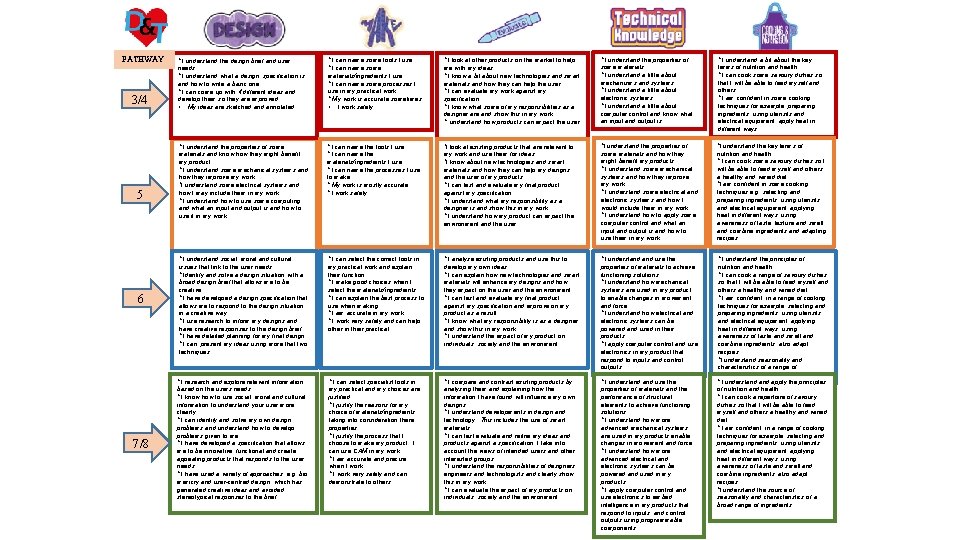
PATHWAY 3/4 5 6 7/8 * I understand the design brief and user needs. * I understand what a design. specification is and how to write a basic one. * I can come up with 4 different ideas and develop them so they are improved. • My ideas are sketched annotated. * I can name some tools I use. * I can name some materials/ingredients I use. * I can name some processes I use in my practical work. * My work is accurate sometimes • I work safely. * I look at other products on the market to help me with my ideas. * I know a bit about new technologies and smart materials and how they can help the user. * I can evaluate my work against my specification. * I know what some of my responsibilities as a designer are and show this in my work. * understand how products can impact the user. * I understand the properties of some materials. * I understand a little about mechanisms and systems. * I understand a little about electronic systems. * I understand a little about computer control and know what an input and output is. * I understand a bit about the key terms of nutrition and health. * I can cook some savoury dishes so that I will be able to feed myself and others. * I am confident in some cooking techniques for example, preparing ingredients, using utensils and electrical equipment, apply heat in different ways. * I understand the properties of some materials and know how they might benefit my product. * I understand some mechanical systems and how they improve my work. *I understand some electrical systems and how I may include them in my work. * I understand how to use some computing and what an input and output is and how to use it in my work. * I can name the tools I use. * I can name the materials/ingredients I use * I can name the processes I use to make. * My work is mostly accurate. * I work safely. *I look at existing products that are relevant to my work and use them for ideas. *I know about new technologies and smart materials and how they can help my designs and the user of my products. * I can test and evaluate my final product against my specification. * I understand what my responsibility as a designer is and show this in my work. * I understand how my product can impact the environment and the user. *I understand the properties of some materials and how they might benefit my products. * I understand some mechanical systems and how they improve my work. * I understand some electrical and electronic systems and how I would include them in my work. * I understand how to apply some computer control and what an input and output is and how to use them in my work. *I understand the key terms of nutrition and health. * I can cook some savoury dishes so I will be able to feed myself and others a healthy and varied diet. *I am confident in some cooking techniques e. g. selecting and preparing ingredients, using utensils and electrical equipment, applying heat in different ways, using awareness of taste, texture and smell and combine ingredients and adapting recipes. * I understand social, moral and cultural issues that link to the user needs. * Identify and solve a design situation with a broad design brief that allows me to be creative. * I have developed a design specification that allows me to respond to the design situation in a creative way. * I use research to inform my designs and have creative responses to the design brief. * I have detailed planning for my final design. * I can present my ideas using more that two techniques. * I can select the correct tools in my practical work and explain their function. * I make good choices when I select the materials/ingredients. * I can explain the best process to use when making * I am accurate in my work. * I work very safely and can help other in their practical. * I analyse existing products and use this to develop my own ideas. * I can explain how new technologies and smart materials will enhance my designs and how they impact on the user and the environment. * I can test and evaluate my final product against my specification and improve on my product as a result. * I know what my responsibility is as a designer and show this in my work. * I understand the impact of my product on individuals, society and the environment. * I understand use the properties of materials to achieve functioning solutions. * I understand how mechanical systems are used in my product to enable changes in movement and force. * I understand how electrical and electronic systems can be powered and used in their products. * I apply computer control and use electronics in my product that respond to inputs and control outputs. * I research and explore relevant information based on the users needs. * I know how to use social, moral and cultural information to understand your user more clearly. * I can identify and solve my own design problems and understand how to develop problems given to me. * I have developed a specification that allows me to be innovative, functional and create appealing products that responds to the user needs. * I have used a variety of approaches, e. g. bio mimicry and user-centred design, which has generated creative ideas and avoided stereotypical responses to the brief * I can select specialist tools in my practical and my choices are justified. * I justify the reasons for my choice of materials/ingredients taking into consideration there properties. * I justify the process that I choose to make my product. I can use CAM in my work. * I am accurate and precise when I work. * I work very safely and can demonstrate to others. * I compare and contrast existing products by analysing them and explaining how the information I have found will influence my own designs. * I understand developments in design and technology. This includes the use of smart materials. * I can test evaluate and refine my ideas and products against a specification, I take into account the views of intended users and other interested groups. * I understand the responsibilities of designers, engineers and technologists and clearly show this in my work. * I can evaluate the impact of my products on individuals, society and the environment. * I understand use the properties of materials and the performance of structural elements to achieve functioning solutions. * I understand how more advanced mechanical systems are used in my products enable changes in movement and force. * I understand how more advanced electrical and electronic systems can be powered and used in my products. * I apply computer control and use electronics to embed intelligence in my products that respond to inputs, and control outputs using programmable components. * I understand the principles of nutrition and health. * I can cook a range of savoury dishes so that I will be able to feed myself and others a healthy and varied diet. * I am confident in a range of cooking techniques for example, selecting and preparing ingredients, using utensils and electrical equipment, applying heat in different ways, using awareness of taste and smell and combine ingredients, also adapt recipes. *I understand seasonality and characteristics of a range of ingredients. * I understand apply the principles of nutrition and health. * I can cook a repertoire of savoury dishes so that I will be able to feed myself and others a healthy and varied diet. * I am confident in a range of cooking techniques for example, selecting and preparing ingredients, using utensils and electrical equipment, applying heat in different ways, using awareness of taste and smell and combine ingredients, also adapt recipes. *I understand the source of seasonality and characteristics of a broad range of ingredients.
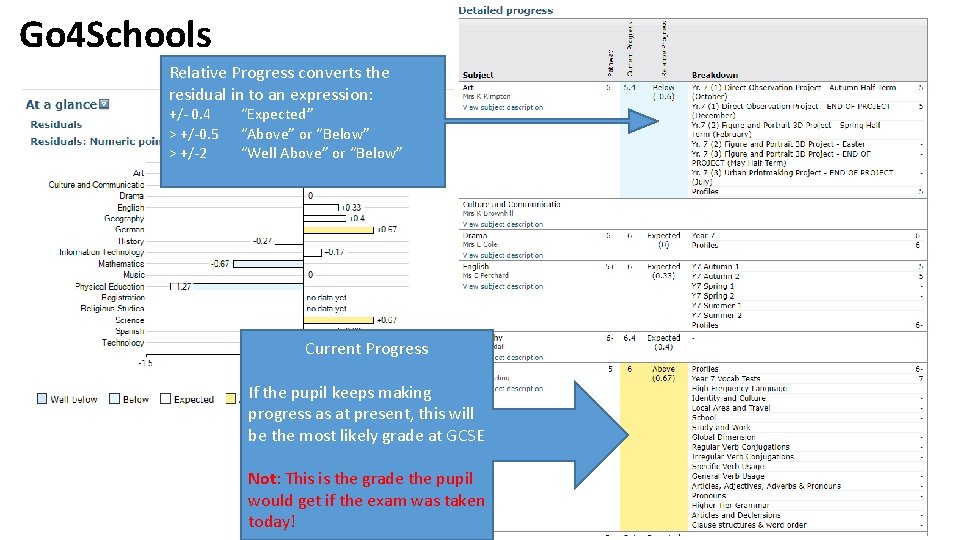
Go 4 Schools Relative Progress converts the residual in to an expression: +/- 0. 4 > +/-0. 5 > +/-2 “Expected” “Above” or “Below” “Well Above” or “Below” Current Progress If the pupil keeps making progress as at present, this will be the most likely grade at GCSE Not: This is the grade the pupil would get if the exam was taken today!
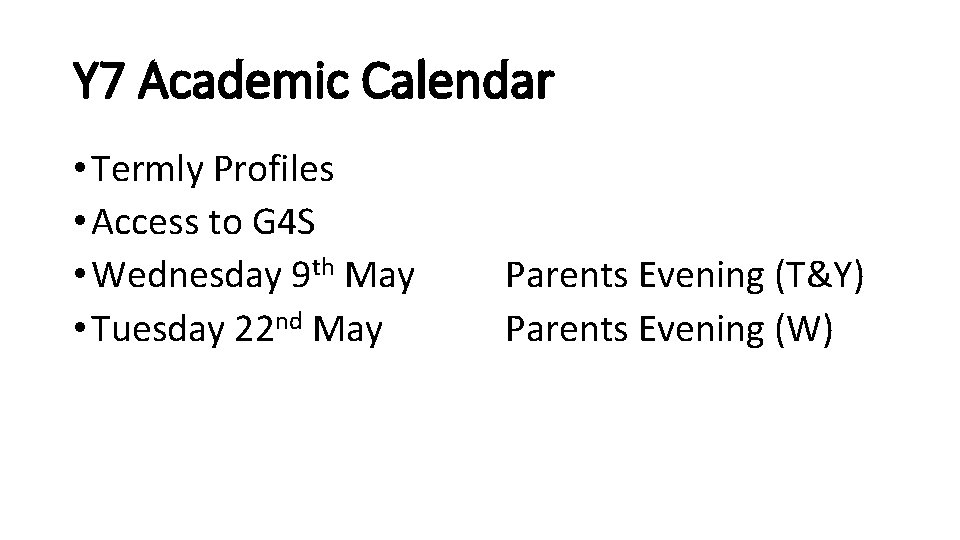
Y 7 Academic Calendar • Termly Profiles • Access to G 4 S • Wednesday 9 th May • Tuesday 22 nd May Parents Evening (T&Y) Parents Evening (W)