
Pathways to Evidence Informed Policy Iqbal Dhaliwal Director
Pathways to Evidence Informed Policy Iqbal Dhaliwal Director of Policy, J-PAL Department of Economics, MIT iqbald@mit. edu / www. povertyactionlab. org 3 ie, Mexico, June 16, 2011
Outline We recognize that: (a) There are many channels to inform policy, though focus here on those used by J-PAL (b) There is no “one size fits all” strategy to use impact evaluations to inform policy (example of four different scale up models) 1. Generate Evidence More Likely to Influence Policy I. Promote policy relevant evaluations II. Intensive partnering in the field to improve program design III. Replicate evaluations 2. Use Evidence Effectively to Influence Policy 3. Adapt Policy Outreach to Organizations 2
I. Promote Policy Relevant Evaluations J-PAL tries to increase feedback of policy into research priorities via multiple channels: (a) Matchmaking Conferences to facilitate dialogue between researchers and policymakers (e. g. ATAI) (b) Research Initiatives to identify gaps in knowledge and direct resources there (e. g. Governance Initiative) (c) Joint Commissions to identify country’s most pressing problems and design evaluations (e. g. Government of Chile-JPAL Commission, 2010) (d) Innovation Funds to provide rapid financing for innovative programs and their evaluations (e. g. Government of France Youth Experimentation Fund, 2011) 3
II. Partnerships in the Field • Evaluations by J-PAL affiliates are done in partnership with implementing organizations, and start long before any data is collected • Generally begins with extensive discussion of underlying problem and various possible solutions, and researchers can share results of previous research • In pilot phase, feedback from the field can help refine the program further • Helps build capacity in partner organization, potentially increasing their ability to generate and consume evidence on other projects • Qualitative methods including logbooks to inform “why” programs work or not • Structure of a partnership can have a significant effect on resulting evidence, how it can be used • Close enough partnership to understand relevant questions and implementation, autonomous enough to be independent 4
III. Replicate Evaluations • Even when evaluations test fundamental questions, may encounter difficulty in using evidence from one region or country to inform policy in other areas • Resistance to using evidence from poorer or more marginalized areas • Worries that program success will not generalize to their context • Replicating evaluations in new contexts or testing variations to the program can helps strengthen initial evidence • Strengthens understanding of fundamental question being tested • Demonstrates generalizability beyond one specific context • Provides critical information (process, cost, impacts) for rapid scale up 5
Outline 1. Generate Evidence More Likely to Influence Policy 2. Use Evidence Effectively to Influence Policy I. III. IV. V. VII. Build Capacity of Policymakers to Consume and Generate Evidence Make research results accessible to a wider audience Synthesize policy lessons from multiple evaluations Cost-effectiveness analysis Disseminate evidence Build partnerships Scale up successful programs 3. Adapt Outreach to Organizations 6
I. Build Capacity of Policymakers to Consume and Generate Evidence • Consumers: Stimulate demand for evidence by explaining the value of evidence, and how it can be incorporated into decisionmaking processes • Executive Education: In 2010 ran five executive education courses on four continents, training 188 people from governments, NGOs, and foundations • Explain the pros and cons of different types of impact evaluations (RCTs, Regression Discontinuity, Difference in Differences, Matching) • Give concrete examples of how evaluations can be structured, and evidence can be used to inform decision-making • Generators: Partner with organizations to institutionalize culture of evidence based policy • Government of Haryana Education Department: Build internal capacity with an Evaluation Unit, partnering on evaluation projects with J-PAL 7
II. Make Research Results Accessible to Policy Audience • Results of impact evaluations most often presented in working papers and journals, in technical language which limits potential audience • Policy staff write evaluation summaries, a two-page synopsis of the relevant policy questions, the program being evaluated, and the results of the evaluation • Collaborate with study PIs for best possible understanding of the evaluation • Targeted at non-academic audiences, useful to convey information about an individual evaluation, or to put together packets on all evaluations in a region or thematic area • Make these tools available to researchers to support their own outreach work • Particularly relevant evaluations turned into longer printed “Briefcases”, usually around six pages long • Printed and mailed to key policymakers, allowing it to reach a broader audience 8
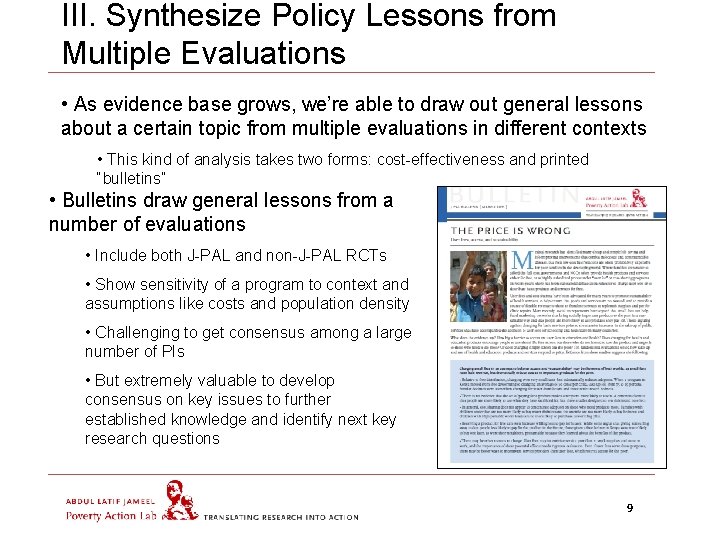
III. Synthesize Policy Lessons from Multiple Evaluations • As evidence base grows, we’re able to draw out general lessons about a certain topic from multiple evaluations in different contexts • This kind of analysis takes two forms: cost-effectiveness and printed “bulletins” • Bulletins draw general lessons from a number of evaluations • Include both J-PAL and non-J-PAL RCTs • Show sensitivity of a program to context and assumptions like costs and population density • Challenging to get consensus among a large number of PIs • But extremely valuable to develop consensus on key issues to further established knowledge and identify next key research questions 9
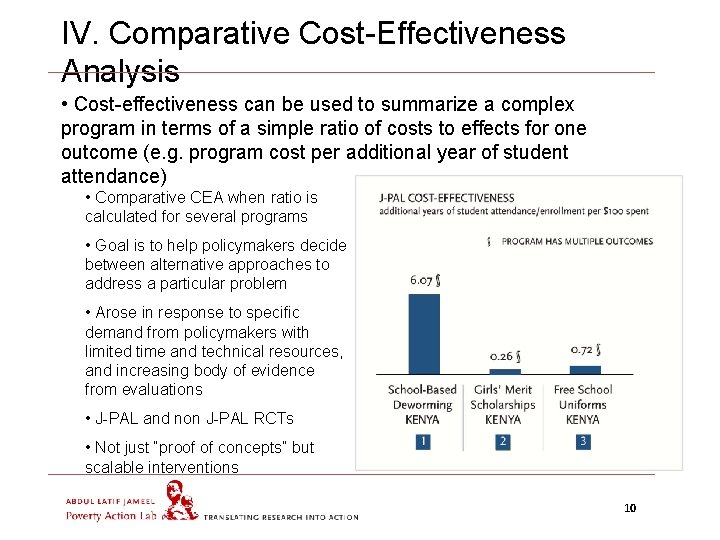
IV. Comparative Cost-Effectiveness Analysis • Cost-effectiveness can be used to summarize a complex program in terms of a simple ratio of costs to effects for one outcome (e. g. program cost per additional year of student attendance) • Comparative CEA when ratio is calculated for several programs • Goal is to help policymakers decide between alternative approaches to address a particular problem • Arose in response to specific demand from policymakers with limited time and technical resources, and increasing body of evidence from evaluations • J-PAL and non J-PAL RCTs • Not just “proof of concepts” but scalable interventions 10
V. Disseminate Evidence to Policymakers (a) J-PAL runs a website that serves as a clearinghouse for evidence generated by J-PAL researchers, and provides policy lessons that have been drawn from that evidence base: • Evaluation Database: Summary pages for more than 250 evaluations and data • Policy Lessons: Cost-effectiveness analyses, bulletins • Scale-Ups: Pages outlining specific instances where evidence has contributed to a change in policy (b) Targeted evidence workshops, organized around a particular geographic region or research theme. 11
VI. Build Long-Term Partnerships • Increasing Returns to Scale of Building long-term relationships by: • Dissemination of Evidence • Capacity building of the staff to consume and generate evidence • Evaluation of field programs • Scale ups • Identifying organizations to build partnerships with is both opportunistic (key contacts) and strategic (extent and salience of problem in that area, policy relevance of completed studies to that context, availability of funding due to donors’ regional or thematic priorities) • Examples include Government of Chile, State Government in India (Bihar, Haryana) 12
VII. Scale-Ups (a) Leveraging Evidence by implementing organization to expand existing programs and get more funding (e. g. Pratham) (b) Independent organizations can use evidence to replicate or scale-up programs found to be highly cost-effective, and/or simple to implement (e. g. Deworm the World) (c) Governments evaluate their pilot programs to demonstrate usefulness to public, gather support for their expansion and learn lessons to make it more effective (e. g. Progresa) (d) If an evaluation helps provide evidence on a very policy relevant and salient topic, it gets a huge amount of traction very easily (e. g. Pricing) 13
Outline 1. Generating Evidence More Likely to Influence Policy 2. Using Evidence to Influence Policy 3. Adapting Outreach to Organizations 14
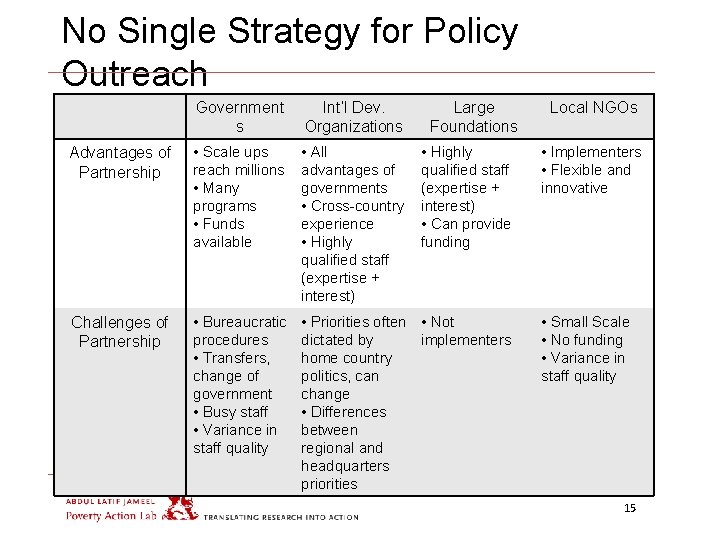
No Single Strategy for Policy Outreach Government s Int’l Dev. Organizations Large Foundations Advantages of Partnership • Scale ups reach millions • Many programs • Funds available • All advantages of governments • Cross-country experience • Highly qualified staff (expertise + interest) Challenges of Partnership • Bureaucratic procedures • Transfers, change of government • Busy staff • Variance in staff quality • Priorities often • Not dictated by implementers home country politics, can change • Differences between regional and headquarters priorities • Highly qualified staff (expertise + interest) • Can provide funding Local NGOs • Implementers • Flexible and innovative • Small Scale • No funding • Variance in staff quality 15
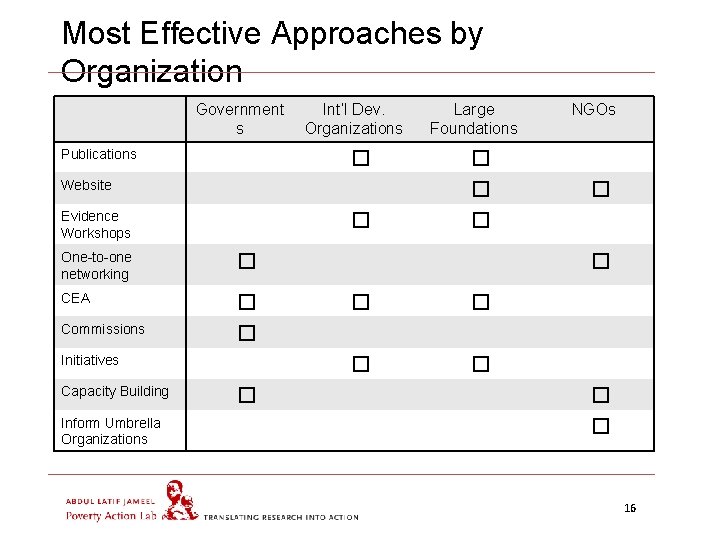
Most Effective Approaches by Organization Government s Publications Int’l Dev. Organizations � Website � One-to-one networking � CEA � Commissions � Initiatives Inform Umbrella Organizations � NGOs � � Evidence Workshops Capacity Building Large Foundations � � � � � 16
Summary • There a number of roadblocks from impact evaluations to impacting policy, but we feel they can be overcome • A priori, ensure policy relevant evidence generated by asking the right questions, providing feedback on initial program design and replications • Matchmaking Conferences, Research Initiatives, Joint Commissions, Innovation Funds • Many strategies to make existing evidence available to policymakers –others could be equally effective, but only highlighted J-PAL’s today: • Capacity building, making research accessible, synthesizing information from multiple evaluations, cost-effectiveness analysis, dissemination of evidence, building partnerships, and scale ups. • There is no “one size fits all” strategy to use impact evaluations to inform policy – need to tailor to organization and context 17
Factors that Help or Hinder the Use of Evidence in Policymaking Iqbal Dhaliwal Director of Policy, J-PAL Department of Economics, MIT iqbald@mit. edu / www. povertyactionlab. org 3 ie, Mexico, June 17, 2011
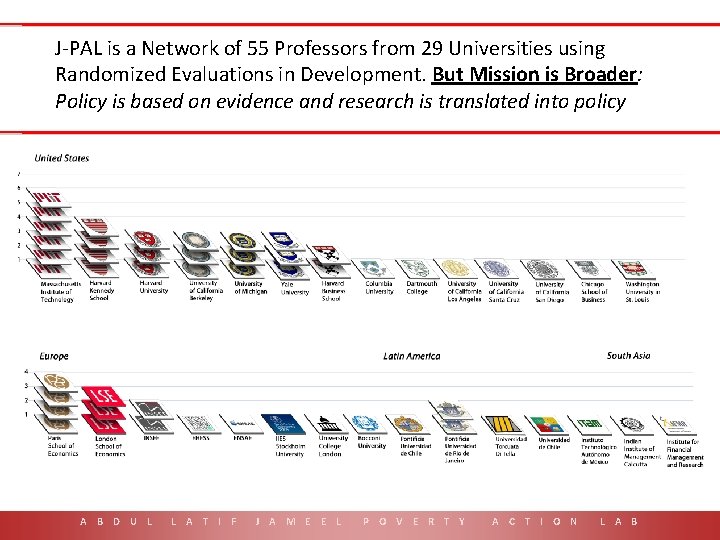
J-PAL is a Network of 55 Professors from 29 Universities using Randomized Evaluations in Development. But Mission is Broader: Policy is based on evidence and research is translated into policy A B D U L L A T I F J A M E E L P O V E R T Y A C T I O N L A B 19
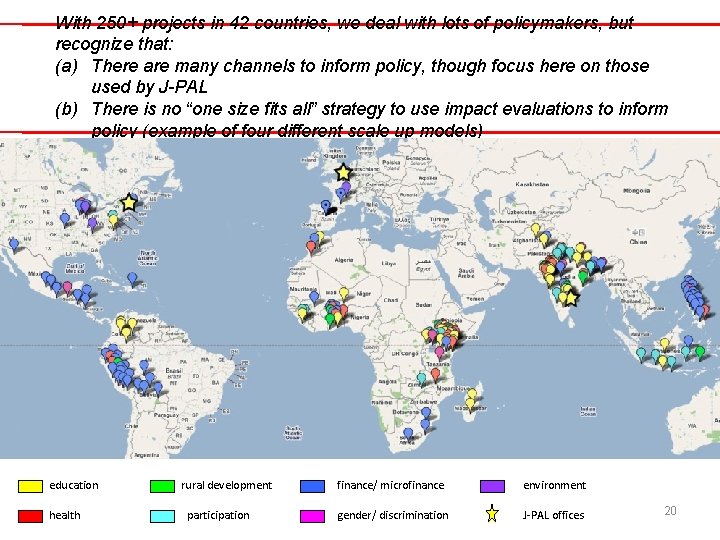
With 250+ projects in 42 countries, we deal with lots of policymakers, but recognize that: (a) There are many channels to inform policy, though focus here on those used by J-PAL (b) There is no “one size fits all” strategy to use impact evaluations to inform policy (example of four different scale up models) Fields include Agriculture, Education, Environment, Governance, Health, Microfinance… education health rural development participation finance/ microfinance environment gender/ discrimination J-PAL offices 20
Outline 1. What sort of evidence would you want as a policy maker? 2. Factors that Help or Hinder the use of Evidence in Policy (How could these cases have had more policy influence) 3. Is it the job of researchers to influence policy? 4. Do governments only want to evaluate programs they think work? 21
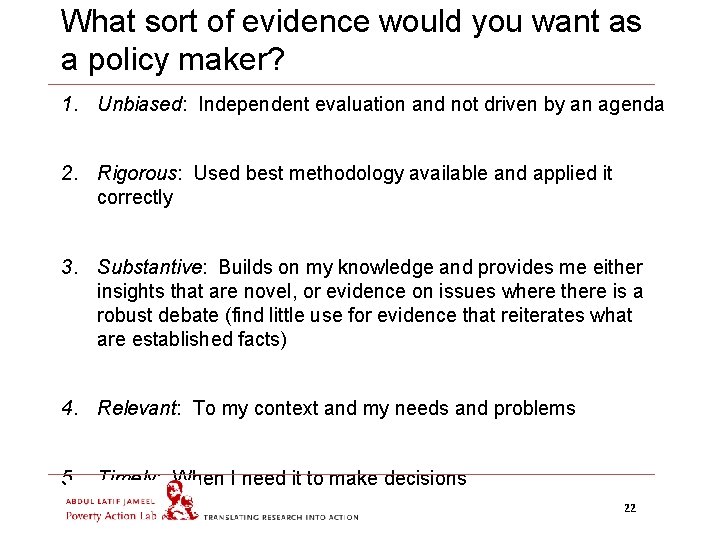
What sort of evidence would you want as a policy maker? 1. Unbiased: Independent evaluation and not driven by an agenda 2. Rigorous: Used best methodology available and applied it correctly 3. Substantive: Builds on my knowledge and provides me either insights that are novel, or evidence on issues where there is a robust debate (find little use for evidence that reiterates what are established facts) 4. Relevant: To my context and my needs and problems 5. Timely: When I need it to make decisions 22
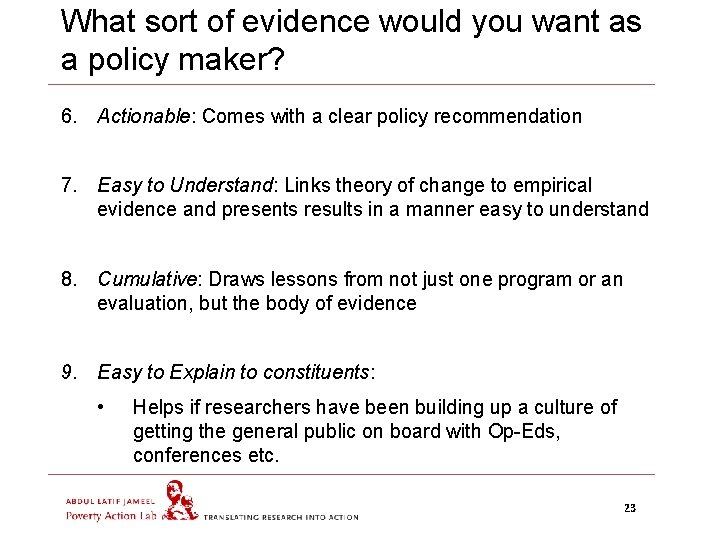
What sort of evidence would you want as a policy maker? 6. Actionable: Comes with a clear policy recommendation 7. Easy to Understand: Links theory of change to empirical evidence and presents results in a manner easy to understand 8. Cumulative: Draws lessons from not just one program or an evaluation, but the body of evidence 9. Easy to Explain to constituents: • Helps if researchers have been building up a culture of getting the general public on board with Op-Eds, conferences etc. 23
Outline We recognize that: (a) There are many channels to inform policy, though focus here on those used by J-PAL (b) There is no “one size fits all” strategy to use impact evaluations to inform policy (example of four different scale up models) 1. What sort of evidence would you want as a policy maker? 2. Factors that Help or Hinder the use of Evidence in Policy 3. Is it the job of researchers to influence policy? 4. Do governments only want to evaluate programs they think work? 24
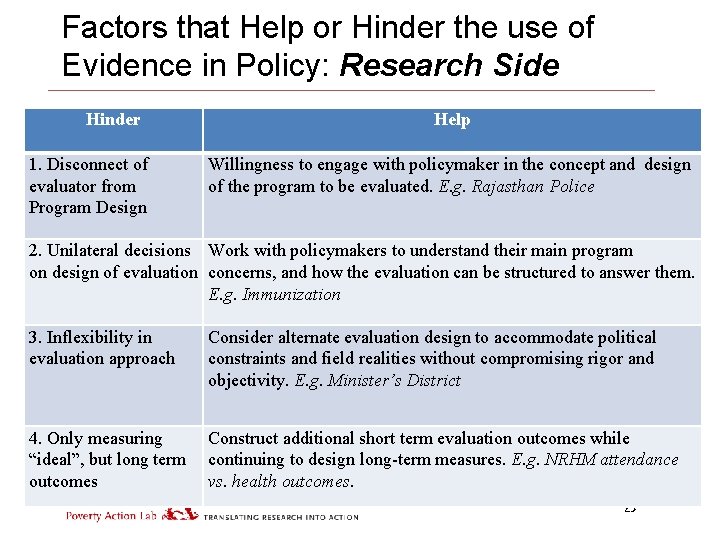
Factors that Help or Hinder the use of Evidence in Policy: Research Side Hinder 1. Disconnect of evaluator from Program Design Help Willingness to engage with policymaker in the concept and design of the program to be evaluated. E. g. Rajasthan Police 2. Unilateral decisions Work with policymakers to understand their main program on design of evaluation concerns, and how the evaluation can be structured to answer them. E. g. Immunization 3. Inflexibility in evaluation approach Consider alternate evaluation design to accommodate political constraints and field realities without compromising rigor and objectivity. E. g. Minister’s District 4. Only measuring “ideal”, but long term outcomes Construct additional short term evaluation outcomes while continuing to design long-term measures. E. g. NRHM attendance vs. health outcomes. 25
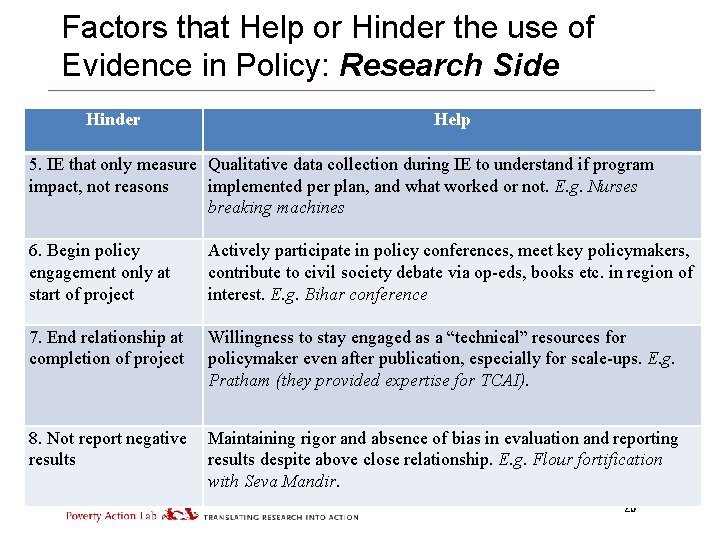
Factors that Help or Hinder the use of Evidence in Policy: Research Side Hinder Help 5. IE that only measure Qualitative data collection during IE to understand if program impact, not reasons implemented per plan, and what worked or not. E. g. Nurses breaking machines 6. Begin policy engagement only at start of project Actively participate in policy conferences, meet key policymakers, contribute to civil society debate via op-eds, books etc. in region of interest. E. g. Bihar conference 7. End relationship at completion of project Willingness to stay engaged as a “technical” resources for policymaker even after publication, especially for scale-ups. E. g. Pratham (they provided expertise for TCAI). 8. Not report negative results Maintaining rigor and absence of bias in evaluation and reporting results despite above close relationship. E. g. Flour fortification with Seva Mandir. 26
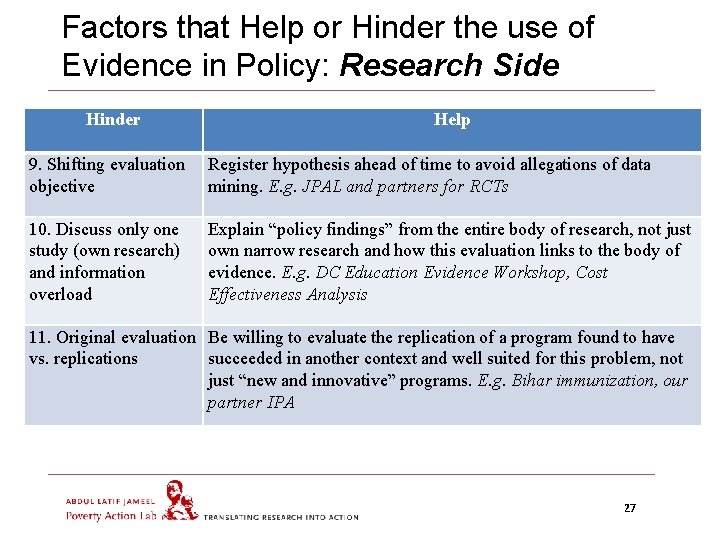
Factors that Help or Hinder the use of Evidence in Policy: Research Side Hinder Help 9. Shifting evaluation objective Register hypothesis ahead of time to avoid allegations of data mining. E. g. JPAL and partners for RCTs 10. Discuss only one study (own research) and information overload Explain “policy findings” from the entire body of research, not just own narrow research and how this evaluation links to the body of evidence. E. g. DC Education Evidence Workshop, Cost Effectiveness Analysis 11. Original evaluation Be willing to evaluate the replication of a program found to have vs. replications succeeded in another context and well suited for this problem, not just “new and innovative” programs. E. g. Bihar immunization, our partner IPA 27
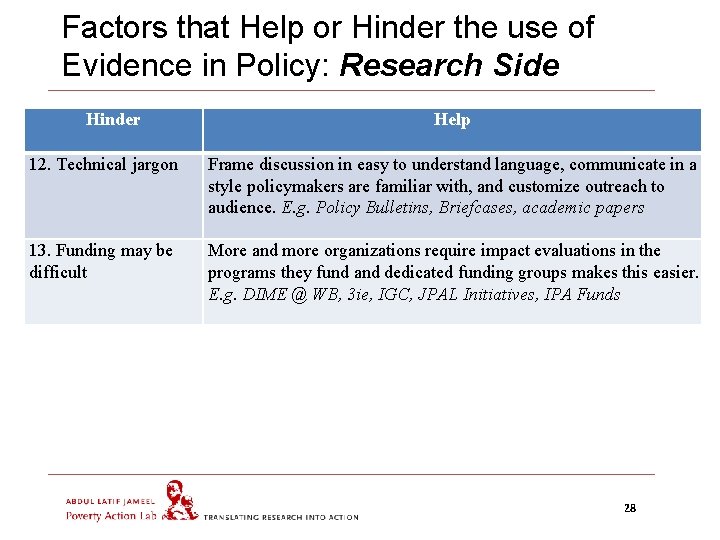
Factors that Help or Hinder the use of Evidence in Policy: Research Side Hinder Help 12. Technical jargon Frame discussion in easy to understand language, communicate in a style policymakers are familiar with, and customize outreach to audience. E. g. Policy Bulletins, Briefcases, academic papers 13. Funding may be difficult More and more organizations require impact evaluations in the programs they fund and dedicated funding groups makes this easier. E. g. DIME @ WB, 3 ie, IGC, JPAL Initiatives, IPA Funds 28
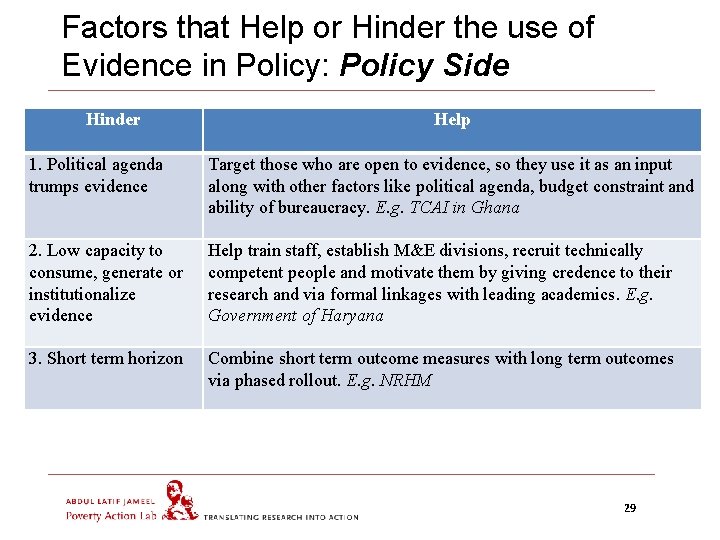
Factors that Help or Hinder the use of Evidence in Policy: Policy Side Hinder Help 1. Political agenda trumps evidence Target those who are open to evidence, so they use it as an input along with other factors like political agenda, budget constraint and ability of bureaucracy. E. g. TCAI in Ghana 2. Low capacity to consume, generate or institutionalize evidence Help train staff, establish M&E divisions, recruit technically competent people and motivate them by giving credence to their research and via formal linkages with leading academics. E. g. Government of Haryana 3. Short term horizon Combine short term outcome measures with long term outcomes via phased rollout. E. g. NRHM 29
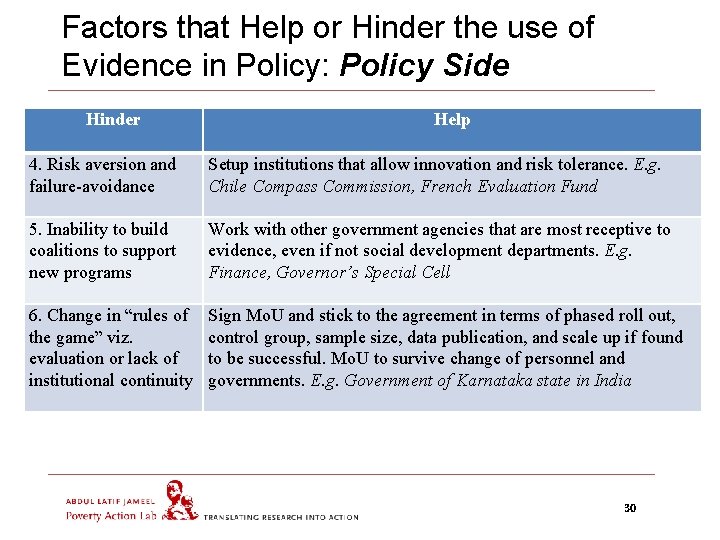
Factors that Help or Hinder the use of Evidence in Policy: Policy Side Hinder Help 4. Risk aversion and failure-avoidance Setup institutions that allow innovation and risk tolerance. E. g. Chile Compass Commission, French Evaluation Fund 5. Inability to build coalitions to support new programs Work with other government agencies that are most receptive to evidence, even if not social development departments. E. g. Finance, Governor’s Special Cell 6. Change in “rules of the game” viz. evaluation or lack of institutional continuity Sign Mo. U and stick to the agreement in terms of phased roll out, control group, sample size, data publication, and scale up if found to be successful. Mo. U to survive change of personnel and governments. E. g. Government of Karnataka state in India 30
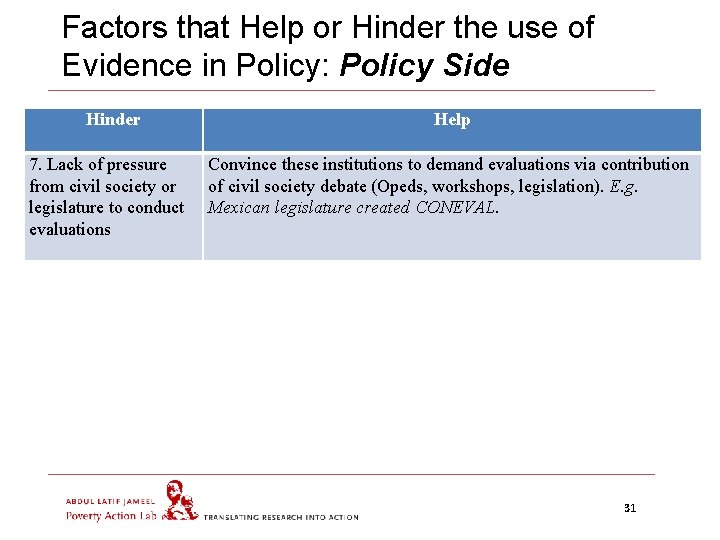
Factors that Help or Hinder the use of Evidence in Policy: Policy Side Hinder 7. Lack of pressure from civil society or legislature to conduct evaluations Help Convince these institutions to demand evaluations via contribution of civil society debate (Opeds, workshops, legislation). E. g. Mexican legislature created CONEVAL. 31
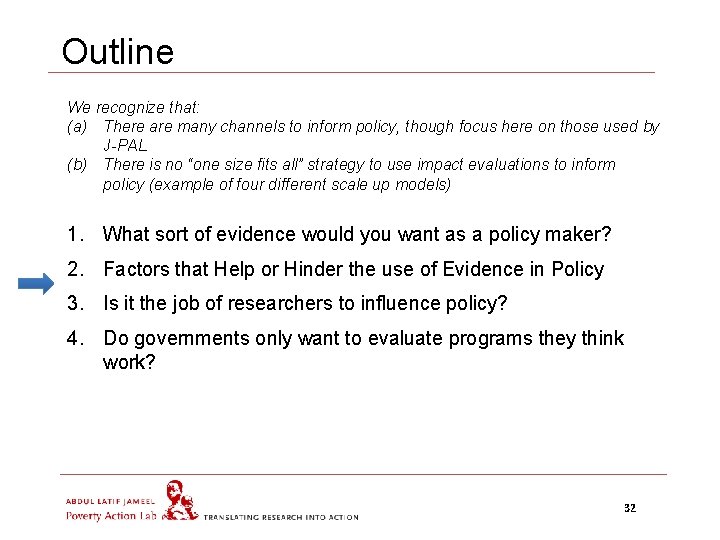
Outline We recognize that: (a) There are many channels to inform policy, though focus here on those used by J-PAL (b) There is no “one size fits all” strategy to use impact evaluations to inform policy (example of four different scale up models) 1. What sort of evidence would you want as a policy maker? 2. Factors that Help or Hinder the use of Evidence in Policy 3. Is it the job of researchers to influence policy? 4. Do governments only want to evaluate programs they think work? 32
Is it the Job of Researchers to Influence Policy 1. 2. Normative Perspective • Research should not be the end in itself, just a tool / means • If research is not translated into policy, it is a huge waste of the resources that go into funding it (universities, NSF, 3 ie, foundations, etc. ) Benefit to Policymakers • Researchers bring credibility to evidence - unbiased and rigorous research has better potential to influence policy if disseminated well • Knowledge of overall literature / field so can synthesize what would work best in a context • You understand the underlying program the best - closely involved with the program design, independently observed the implementation (qualitative data) and measured the impacts 33
Is it the Job of Researchers to Influence Policy 3. Benefit to Researchers (aka “Selfish” reasons) • Facilitates research: If you have contributed to program design, then you are integral part of the project and implementer will safeguard your interests (control group contamination, data access) • Follow up research / work: If you stay engaged with policymakers, then they will ask you next time for program concept, design and evaluation • Funding: There is great interest currently in funding evaluations, but if after a few years donors find no linkage with policy, your research funds will dry out, as also the relevance of your field because it is so dependent on external funding • Opportunity to influence the field: Engaging with policymakers stimulates interest in related research and draws in others (e. g. Cap and Trade Environment project in India) 34
Outline We recognize that: (a) There are many channels to inform policy, though focus here on those used by J-PAL (b) There is no “one size fits all” strategy to use impact evaluations to inform policy (example of four different scale up models) 1. What sort of evidence would you want as a policy maker? 2. Factors that Help or Hinder the use of Evidence in Policy 3. Is it the job of researchers to influence policy? 4. Do governments only want to evaluate programs they think work? 35
Do governments only want to evaluate programs they think work? 1. Yes: If the program finalized and the government has put its full political capital behind it: • Rely on internal M&E departments to undertake evaluations and tightly control the results emerging from the evaluations • Best resolution maybe to evaluate variations in program (benefits, beneficiary selection and program delivery process) 2. No: If evaluator involved in the program conception and design from beginning, then may be able to convince the government to: • Conduct pilot programs to test the proof of concept • Phased rollouts that allow you to conduct evaluations and also influence policy 36
- Slides: 36