
Pathways and Laddering The Irish Model Dr Brendan
Pathways and Laddering: The Irish Model Dr Brendan J. Murphy Toronto 28 November 2011
Ireland/Background Population Education 4. 6 million 40% < 25 years 10% > 65 Years 90%+ complete secondary education (not streamed) 66% of secondary school leavers go on to Higher Education (HE) Higher Education System 7 Traditional Universities (1592 -1845 -1980) 14 Institutes of Technology (Io. Ts) (1970 -1999) All public funded (162, 000 full-time students, 40% Io. Ts, 60% University)
1970’s Ireland- A time of Change • Free Secondary School Education • Regional Technical Colleges established; now called Io. Ts • New means tested grant system to increase access to Higher Education • Transition from an agriculture to high-tech economy • Ireland joined EEC (now EU) 1973
1970 -1980 Growth of the Io. Ts • Io. T staff were either new university graduates (Science, Engineering, Business) or had worked in the US with new American companies setting up in Ireland e. g Pfizer, Apple • No existing rule book for sub-degree courses • NCEA (now HETAC) set up in 1972 as an awarding and quality assurance body for the non-university sector. An attempt by the traditional universities to limit this body and the Io. Ts to sub-degree courses only failed in 1979/80 • Only requirement was that our awards, where appropriate, were to be comparable to those of the universities
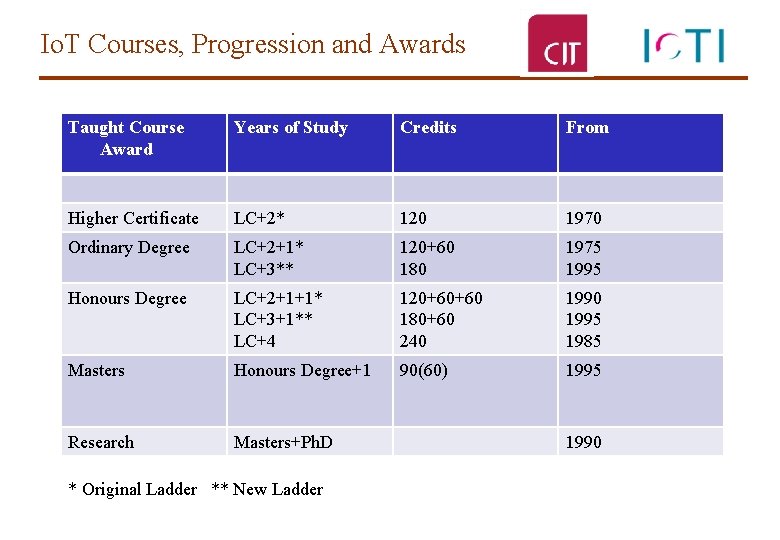
Io. T Courses, Progression and Awards Taught Course Award Years of Study Credits From Higher Certificate LC+2* 120 1970 Ordinary Degree LC+2+1* LC+3** 120+60 180 1975 1995 Honours Degree LC+2+1+1* LC+3+1** LC+4 120+60+60 180+60 240 1995 1985 Masters Honours Degree+1 90(60) 1995 Research Masters+Ph. D * Original Ladder ** New Ladder 1990
Io. T Courses Differences from traditional universities • New type of Technicians, Engineers and Scientists needed by our high tech industries • Industry involved in new course development, in validation panels, in industry advisory boards • Work placement/internships a feature of courses • Companies wanted our graduates with their balance of Knowledge, Skills and Competence • Produce a professionally ready graduate
Academic Quality Assurance • From the beginning all Io. Ts were required by law to have Academic Councils and an internal system of QA. • Established by HETAC: a rigorous system of validation and institutional review, credit transfer, learning outcomes • HETAC/NQAI is the national body recognised in EU, giving European recognition of our awards • In 2001 Ireland established NQAI and NFQ. National Framework of Qualification. All educational awards had to be placed on this framework of 10 levels of knowledge, skills and competence. All HE awards are at L 6 -L 10. www. nfq. ie

National Framework of Qualifications

European Framework of Qualifications (EFQ) 2006 -09 Irish NFQ Level E FQ Knowledge Skills Competence L 6 L 5 • comprehensive, specialised, factual and theoretical knowledge within a field of work or study and an awareness of the boundaries of that knowledge • a comprehensive range of cognitive and practical skills required to develop creative solutions to abstract problems • exercise management and supervision in contexts of work or study activities where there is unpredictable change • review and develop performance of self and others L 7&8 L 6 • advanced knowledge of a field of work or study, involving a critical understanding of theories and principles • advanced skills, demonstrating mastery and innovation, required to solve complex and unpredictable problems in a specialised field of work or study • manage complex technical or professional activities or projects, taking responsibility for decision-making in unpredictable work or study contexts • take responsibility for managing professional development of individuals and groups L 9 L 7 • highly specialised knowledge, some of which is at the forefront of knowledge in a field of work or study, as the basis for original thinking and/or research • critical awareness of knowledge issues in a field and at the interface between different fields • specialised problem-solving skills required in research and/or innovation in order to develop new knowledge and procedures and to integrate knowledge from different fields • manage and transform work or study contexts that are complex, unpredictable and require new strategic approaches • take responsibility for contributing to professional knowledge and practice and/or for reviewing the strategic performance of teams L 10 L 8 • knowledge at the most advanced frontier of a field of work or study and at the interface between fields • the most advanced and specialised skills and techniques, including synthesis and evaluation, required to solve critical problems in research and/or innovation and to extend and redefine existing knowledge or professional practice • demonstrate substantial authority, innovation, autonomy, scholarly and professional integrity and sustained commitment to the development of new ideas or processes at the forefront of work or study contexts including research
Ladder of Progression • National Qualification Body and a National Framework of all Qualifications • International recognition of Irish qualifications • New Ladder now used by 1 st time entrants to HE, normally Ordinary Degree +1. Jobs still for Ordinary Degree holders, embedded awards • Continuing Education/CPD and upskilling are our big market: original ladder+RPL/WBL. Giving a diverse system of HE. • Our engagement with enterprise and the community is still the distinguishing feature of our sector, in contrast to the traditional university sector
Present and Future of Io. Ts • Growth of taught Masters driven by industry, professional bodies and internationalisation • Applied research, innovation, startup companies research Masters and Ph. D • Innovation ecosystems • Technological Universities
References • • • www. hetac. ie www. nqai. ie www. ioti. ie www. cit. ie president@cit. ie http: //ec. europa. eu/education/pub/pdf/general/e qf/broch_en. pdf END
- Slides: 12