
Pathway to Completion Start Strong Finish Faster Funded


- Slides: 29
Pathway to Completion Start Strong – Finish Faster Funded by Presentation at AACC Convention April 2015
Presenters Jill Wakefield, Chancellor, Seattle Colleges Warren Brown, President, North Seattle College Rosie Rimando-Charensup, Vice President of Student Services, South Seattle College Jane Muhich, Productive Persistence & Accelerated Math Lead, Seattle Colleges
About The Seattle Colleges Educate nearly 50, 000 students annually Largest urban community college district in state Three comprehensive, separately accredited colleges Offer 135 professional-technical programs and 7 applied baccalaureate degrees § Highly diverse with 51% students of color § Median student age of 29 years § §
Pathway to Completion Grant § Awarded in 2012 by the Bill & Melinda Gates Foundation § Large, urban, multi-college district § Redesigning student entry experience and accelerating pre-college math pathways – Start to Finish § District-wide staff and faculty collaborative workgroups § Dedicated to forming regional and statewide strategic partnerships focused on completion
Pathway to Completion FIRST-YEAR EXPERIENCE REDESIGN Start to Finish Presented by: Warren Brown
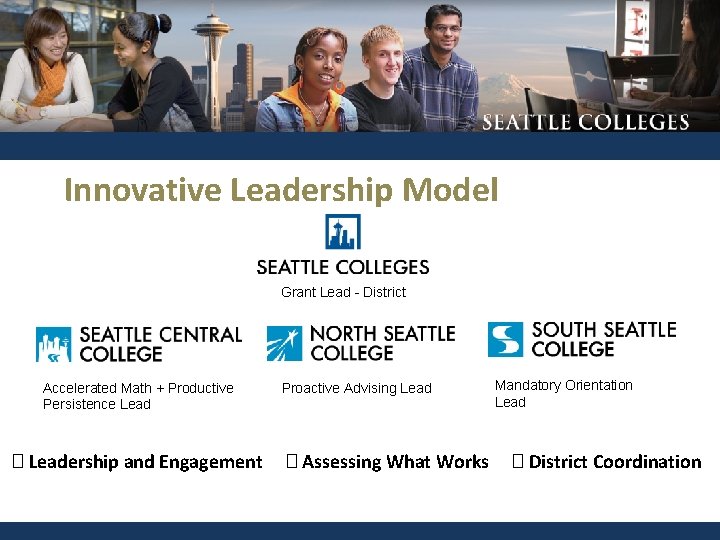
Innovative Leadership Model Grant Lead - District Accelerated Math + Productive Persistence Lead � Leadership and Engagement Proactive Advising Lead � Assessing What Works Mandatory Orientation Lead � District Coordination
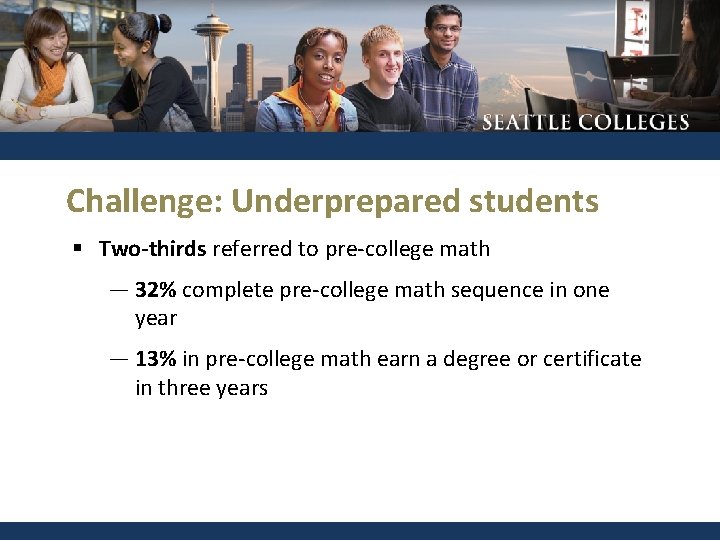
Challenge: Underprepared students § Two-thirds referred to pre-college math ― 32% complete pre-college math sequence in one year ― 13% in pre-college math earn a degree or certificate in three years
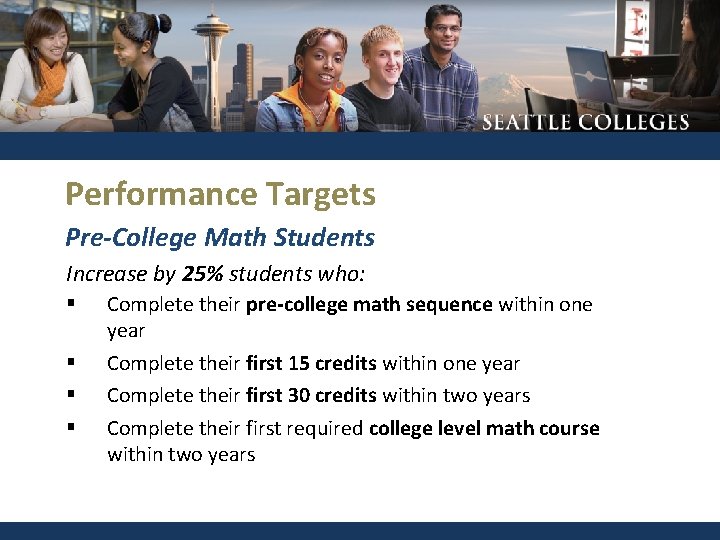
Performance Targets Pre-College Math Students Increase by 25% students who: § § Complete their pre-college math sequence within one year Complete their first 15 credits within one year Complete their first 30 credits within two years Complete their first required college level math course within two years
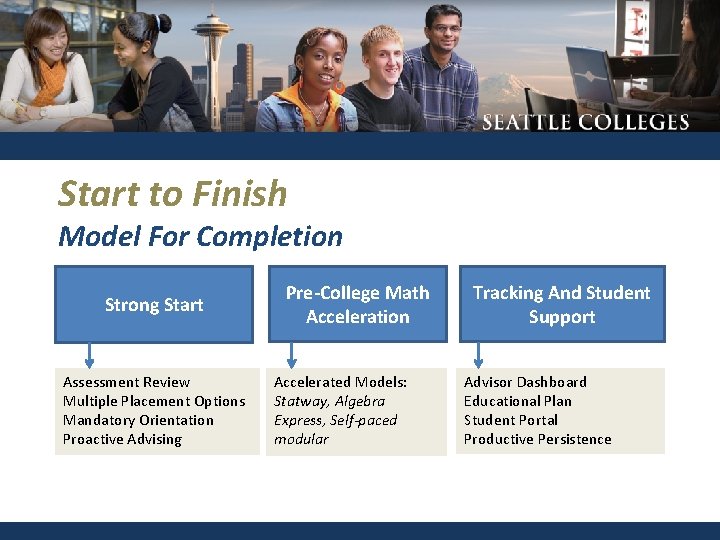
Start to Finish Model For Completion Strong Start Assessment Review Multiple Placement Options Mandatory Orientation Proactive Advising Pre-College Math Acceleration Accelerated Models: Statway, Algebra Express, Self-paced modular Tracking And Student Support Advisor Dashboard Educational Plan Student Portal Productive Persistence
Intentional Practices for First Time Students Presented by: Rosie SEATTLE COMMUNITY Rimando-Charensup
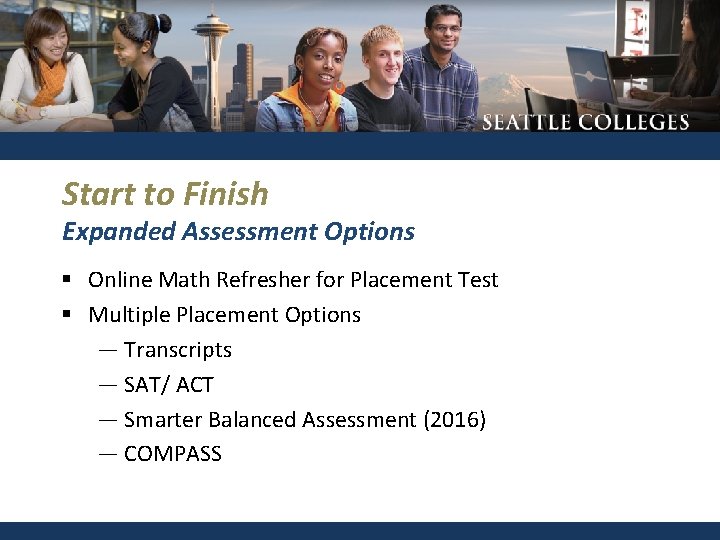
Start to Finish Expanded Assessment Options § Online Math Refresher for Placement Test § Multiple Placement Options — Transcripts — SAT/ ACT — Smarter Balanced Assessment (2016) — COMPASS
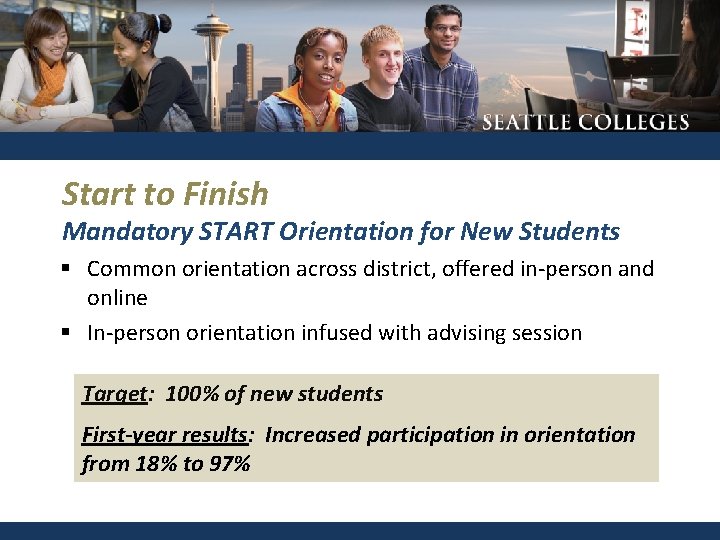
Start to Finish Mandatory START Orientation for New Students § Common orientation across district, offered in-person and online § In-person orientation infused with advising session Target: 100% of new students First-year results: Increased participation in orientation from 18% to 97%
Start to Finish Proactive Advising for Pre-College Math Students § Classroom Advising – Develop educational plan; monitor student progress § Educational Plan – Courses to complete program & degree Increased math sections with advisors from 3 in 2012 to 90 in 2013 -2014
Start to Finish Advisor Dashboard – Monitoring Student Progress § Tool developed in-house to create educational plans and monitor student progress § Available to faculty counselors, academic advisors and students
Start to Finish Online/Mobile Student Portal – One Stop Access § Deliver a common experience to students across the district to improve the student experience and increase completion rates. § Important student information in one place: Ø Class schedule, registration, financial aid, transcripts, pay tuition, degree audit, educational plan, add/drop classes, wait list
Seattle Public Schools Partnership SEATTLE COMMUNITY COLLEGES
Improving College Readiness Collaborative Work Groups resulting in: § Multiple placement options– Transcripts, SAT/ACT § Transition math course for high school seniors § Curriculum alignment – Intermediate algebra learning community
Accelerated Pre-College Math Presented by: Jane SEATTLE COMMUNITY Muhich
Accelerated Pre-College Math Three Models across the District § Statway: 61% completed pre-college and college level math in one year compared to 32% in traditional sequence § Algebra Express: 53% completed pre-college math in one year compared to 32% in traditional sequence § Self-Paced Modular Math: 36% of students complete two or more classes in one quarter; 15% complete sequence in one quarter
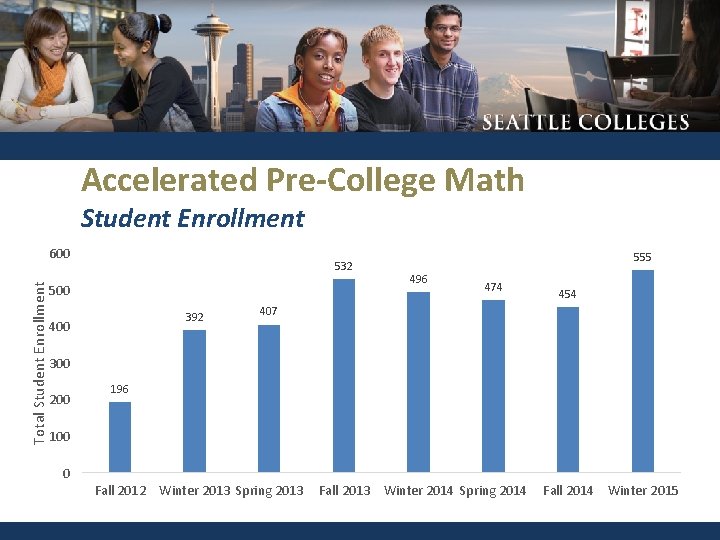
Accelerated Pre-College Math Student Enrollment Total Student Enrollment 600 532 500 392 400 555 496 474 454 407 300 200 196 100 0 Fall 2012 Winter 2013 Spring 2013 Fall 2013 Winter 2014 Spring 2014 Fall 2014 Winter 2015
Productive Persistence A Student Success Initiative
Productive Persistence § The productive mindsets and effective learning strategies students need in order to be successful § Tested classroom activities and interventions § Practitioner and researcher partnerships § Continuous learning to improve using data Increased faculty participation from 35 to 120
Productive Persistence Growth Mindsets § Growth mindset: “I can learn using effort and good strategies. ” § Fixed mindset: “I’m not a math person. ” § Students with growth mindsets show increased academic performance. Social Ties § Students who have doubts about their belonging withdraw at higher rates.
Productive Persistence Current Projects § Creating social-ties through collaborative learning § Helping students set and reach reasonable goals § Promoting a growth mindset in classrooms § Giving students a social purpose for learning § Increasing self-paced math acceleration
Results 2012 - 2014 Presented by: Warren Brown
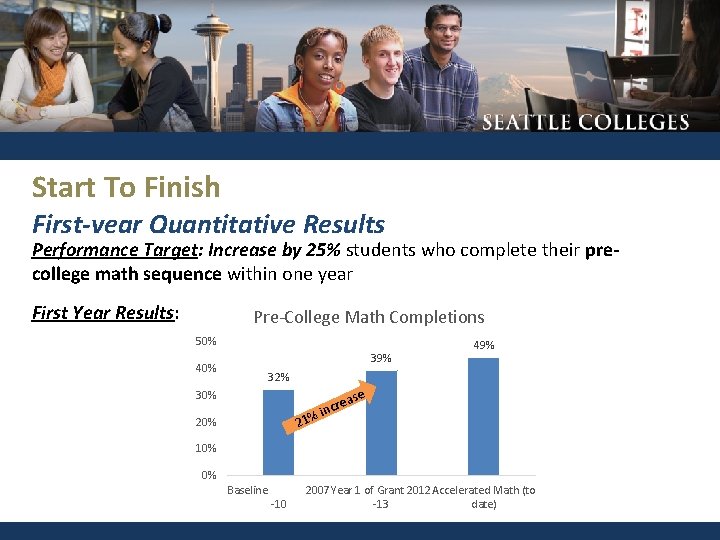
Start To Finish First-year Quantitative Results Performance Target: Increase by 25% students who complete their precollege math sequence within one year First Year Results: Pre-College Math Completions 50% 39% 40% 49% 32% ase e r inc % 1 2 30% 20% 10% 0% Baseline -10 2007 Year 1 of Grant 2012 Accelerated Math (to -13 date)
Start To Finish First-year Quantitative Results Performance Target: Increase by 25% students who complete their first 15 credits within one year First Year Results: § 13% increase in completion of first 15 credits within one year Second Year Results: § 19% increase in completion of first 15 credits within one year Students starting in summer or fall 2013 Number of Students Impacted to date § In total, 13, 855 students impacted by completion initiative
Ongoing Completion Efforts Project Finish Line – Bill & Melinda Gates Foundation § § Completion coaches to improve credential completion and transfer rates Focus on students who are close to credential completion Culture of Inquiry – Rob Johnstone § Developing a culture of completion by following the lead of Completion by Design and other nationally renowned completion efforts § Focus on structured educational pathways and intentional, well-designed student support interventions Washington State Math Taskforce § § § 3 pathway model – STEM, Statistics, Quantitative Reasoning Multi-measure placement – SAT, transcripts, COMPASS Improving HS college readiness – transition courses
Discussion Q&A