
Paths and Connectivity Lec 19 1 Agenda Paths
- Slides: 42
Paths and Connectivity Lec 19 1
Agenda Paths Connectivity Lec 19 2
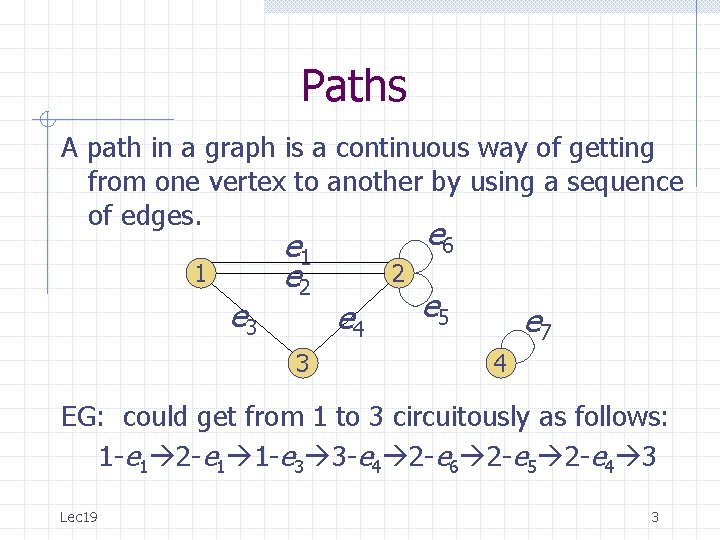
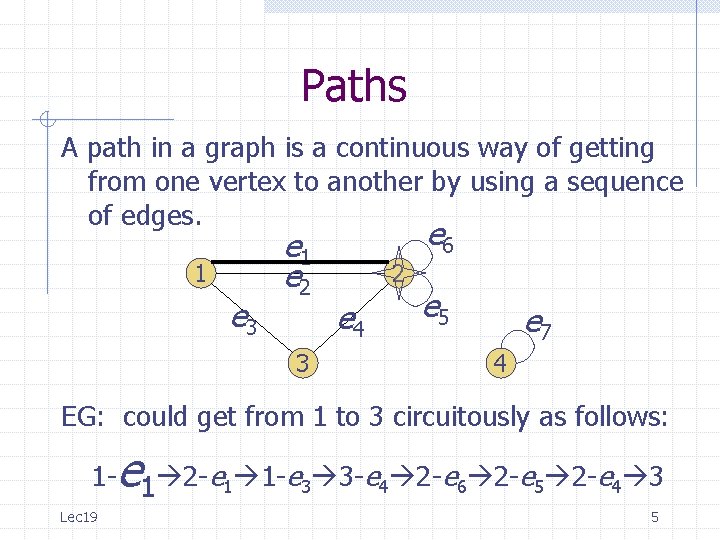
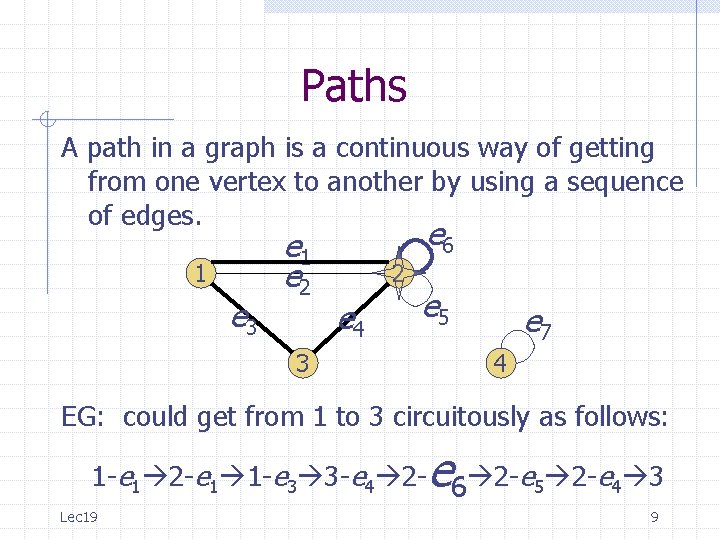
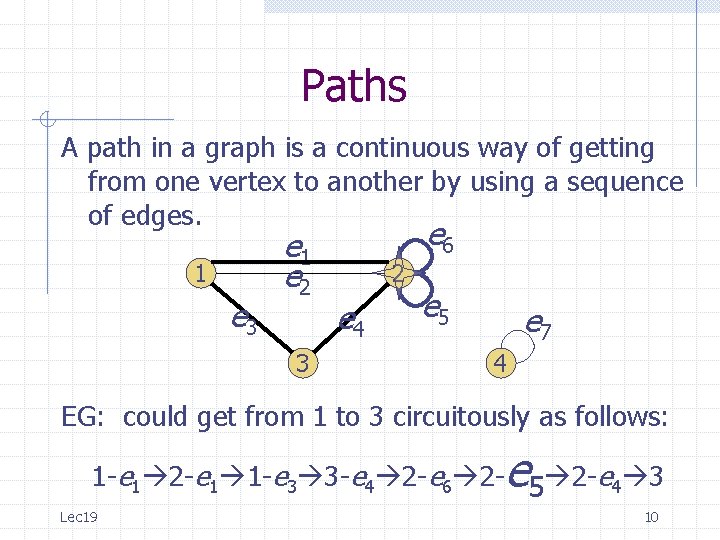
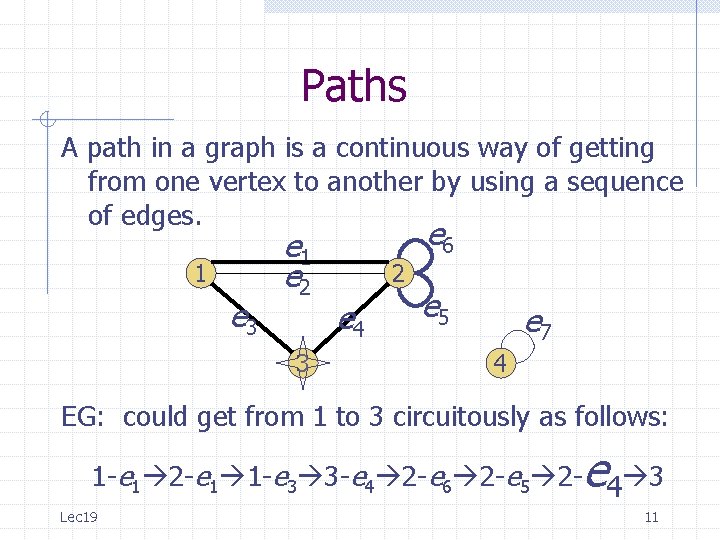
Paths A path in a graph is a continuous way of getting from one vertex to another by using a sequence of edges. 1 e 3 e 1 e 2 3 e 6 2 e 4 e 5 e 7 4 EG: could get from 1 to 3 circuitously as follows: 1 -e 1 2 -e 1 1 -e 3 3 -e 4 2 -e 6 2 -e 5 2 -e 4 3 Lec 19 3
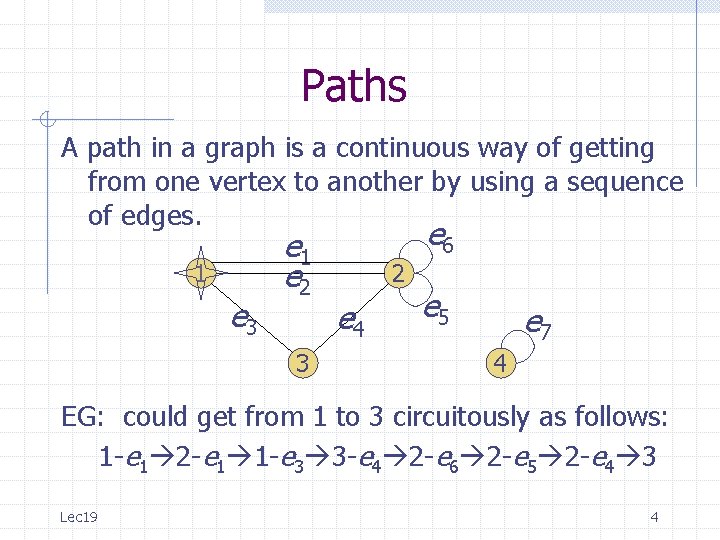
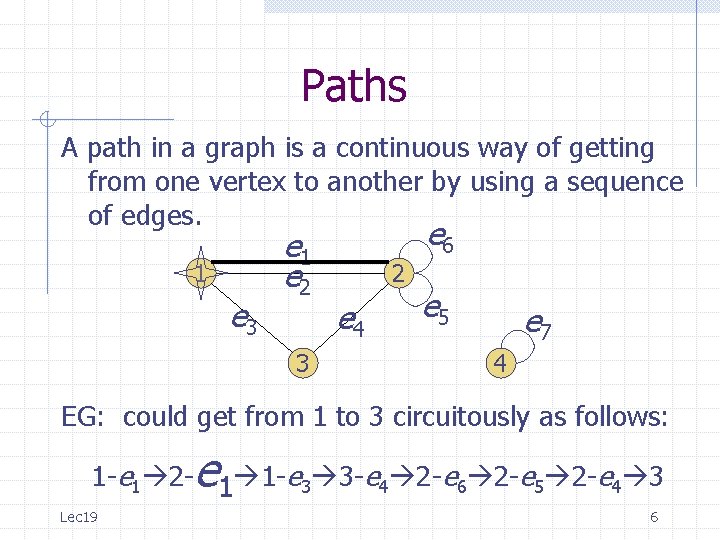
Paths A path in a graph is a continuous way of getting from one vertex to another by using a sequence of edges. 1 e 3 e 1 e 2 3 e 6 2 e 4 e 5 e 7 4 EG: could get from 1 to 3 circuitously as follows: 1 -e 1 2 -e 1 1 -e 3 3 -e 4 2 -e 6 2 -e 5 2 -e 4 3 Lec 19 4
Paths A path in a graph is a continuous way of getting from one vertex to another by using a sequence of edges. 1 e 3 e 1 e 2 3 e 6 2 e 4 e 5 e 7 4 EG: could get from 1 to 3 circuitously as follows: e 1 - 1 2 -e 1 1 -e 3 3 -e 4 2 -e 6 2 -e 5 2 -e 4 3 Lec 19 5
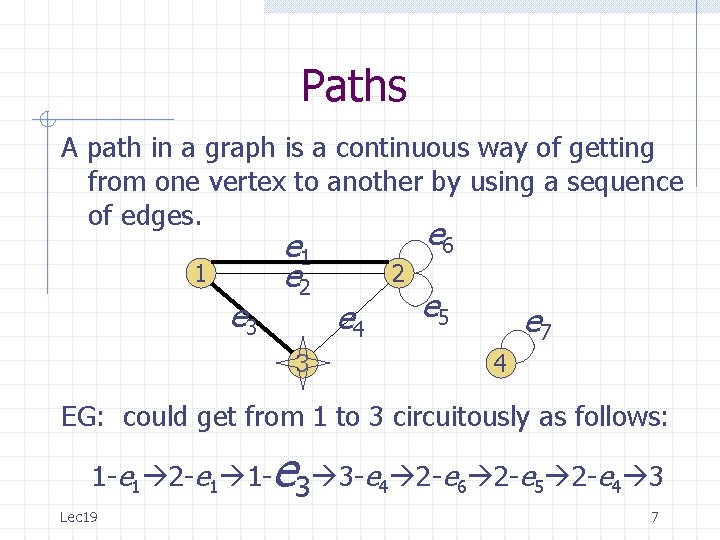
Paths A path in a graph is a continuous way of getting from one vertex to another by using a sequence of edges. 1 e 3 e 1 e 2 3 e 6 2 e 4 e 5 e 7 4 EG: could get from 1 to 3 circuitously as follows: e 1 -e 1 2 - 1 1 -e 3 3 -e 4 2 -e 6 2 -e 5 2 -e 4 3 Lec 19 6
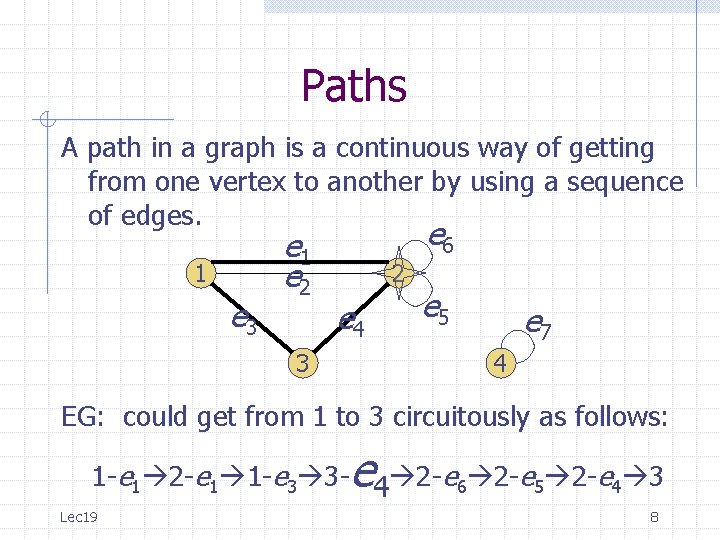
Paths A path in a graph is a continuous way of getting from one vertex to another by using a sequence of edges. 1 e 3 e 1 e 2 3 e 6 2 e 4 e 5 e 7 4 EG: could get from 1 to 3 circuitously as follows: e 1 -e 1 2 -e 1 1 - 3 3 -e 4 2 -e 6 2 -e 5 2 -e 4 3 Lec 19 7
Paths A path in a graph is a continuous way of getting from one vertex to another by using a sequence of edges. 1 e 3 e 1 e 2 e 6 2 e 4 3 e 5 e 7 4 EG: could get from 1 to 3 circuitously as follows: e 1 -e 1 2 -e 1 1 -e 3 3 - 4 2 -e 6 2 -e 5 2 -e 4 3 Lec 19 8
Paths A path in a graph is a continuous way of getting from one vertex to another by using a sequence of edges. 1 e 3 e 1 e 2 e 6 2 e 4 e 5 3 e 7 4 EG: could get from 1 to 3 circuitously as follows: e 1 -e 1 2 -e 1 1 -e 3 3 -e 4 2 - 6 2 -e 5 2 -e 4 3 Lec 19 9
Paths A path in a graph is a continuous way of getting from one vertex to another by using a sequence of edges. 1 e 3 e 1 e 2 3 e 6 2 e 4 e 5 e 7 4 EG: could get from 1 to 3 circuitously as follows: e 1 -e 1 2 -e 1 1 -e 3 3 -e 4 2 -e 6 2 - 5 2 -e 4 3 Lec 19 10
Paths A path in a graph is a continuous way of getting from one vertex to another by using a sequence of edges. 1 e 3 e 1 e 2 3 e 6 2 e 4 e 5 e 7 4 EG: could get from 1 to 3 circuitously as follows: e 1 -e 1 2 -e 1 1 -e 3 3 -e 4 2 -e 6 2 -e 5 2 - 4 3 Lec 19 11
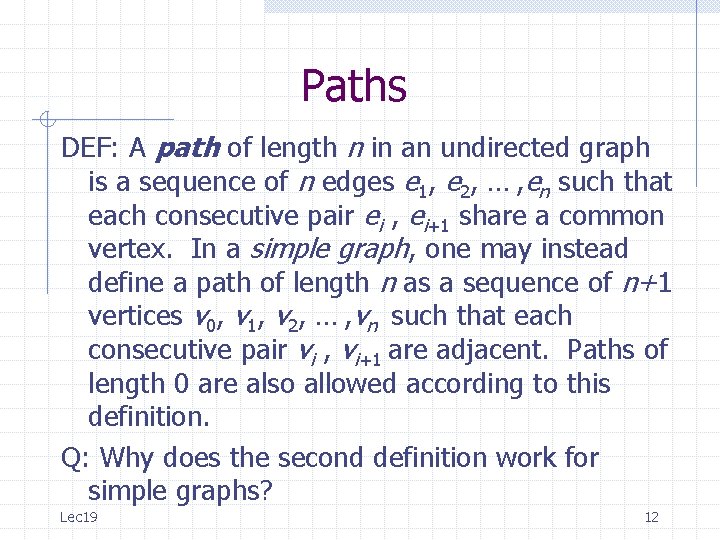
Paths DEF: A path of length n in an undirected graph is a sequence of n edges e 1, e 2, … , en such that each consecutive pair ei , ei+1 share a common vertex. In a simple graph, one may instead define a path of length n as a sequence of n+1 vertices v 0, v 1, v 2, … , vn such that each consecutive pair vi , vi+1 are adjacent. Paths of length 0 are also allowed according to this definition. Q: Why does the second definition work for simple graphs? Lec 19 12
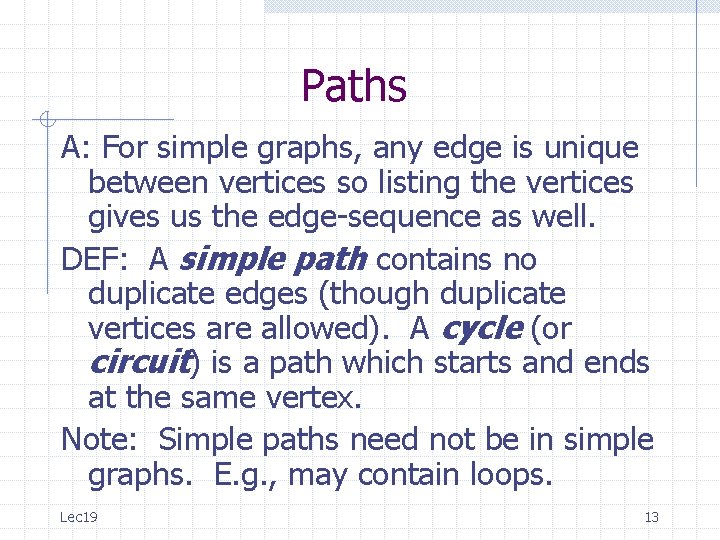
Paths A: For simple graphs, any edge is unique between vertices so listing the vertices gives us the edge-sequence as well. DEF: A simple path contains no duplicate edges (though duplicate vertices are allowed). A cycle (or circuit) is a path which starts and ends at the same vertex. Note: Simple paths need not be in simple graphs. E. g. , may contain loops. Lec 19 13
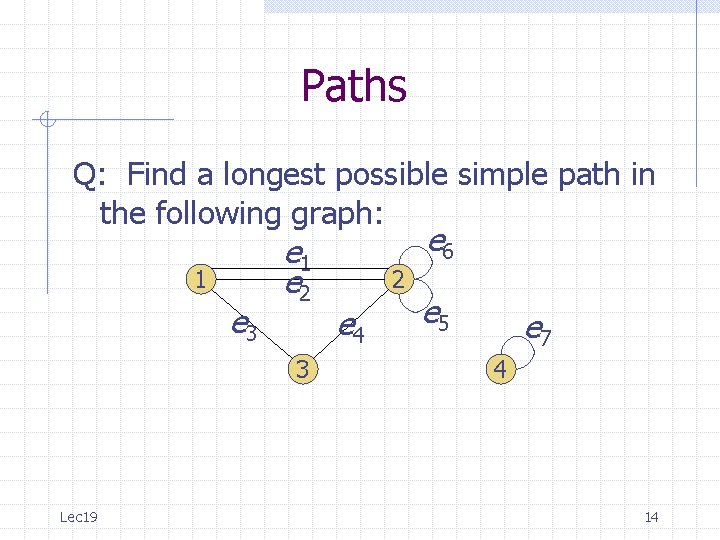
Paths Q: Find a longest possible simple path in the following graph: 1 e 3 e 1 e 2 3 Lec 19 e 6 2 e 4 e 5 e 7 4 14
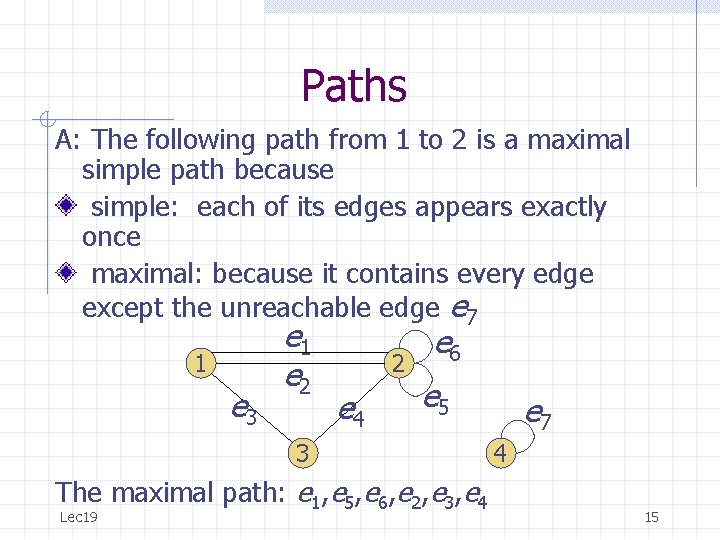
Paths A: The following path from 1 to 2 is a maximal simple path because simple: each of its edges appears exactly once maximal: because it contains every edge except the unreachable edge e 7 1 e 3 e 1 e 2 2 e 4 e 6 e 5 3 The maximal path: e 1, e 5, e 6, e 2, e 3, e 4 Lec 19 e 7 4 15
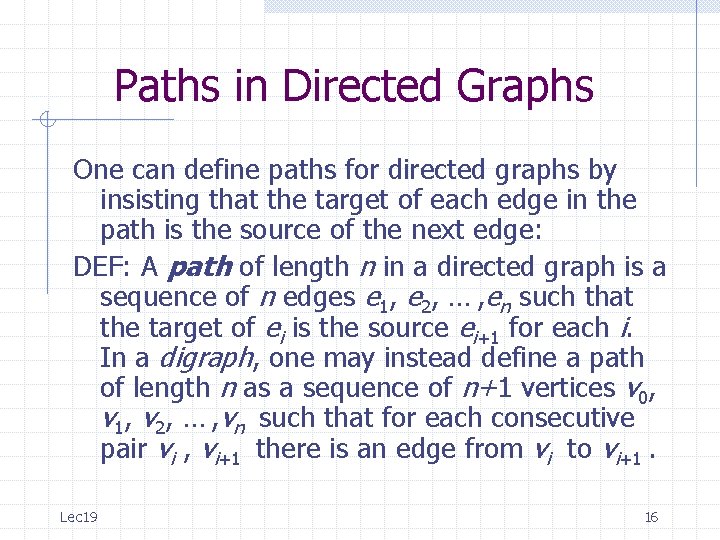
Paths in Directed Graphs One can define paths for directed graphs by insisting that the target of each edge in the path is the source of the next edge: DEF: A path of length n in a directed graph is a sequence of n edges e 1, e 2, … , en such that the target of ei is the source ei+1 for each i. In a digraph, one may instead define a path of length n as a sequence of n+1 vertices v 0, v 1, v 2, … , vn such that for each consecutive pair vi , vi+1 there is an edge from vi to vi+1. Lec 19 16
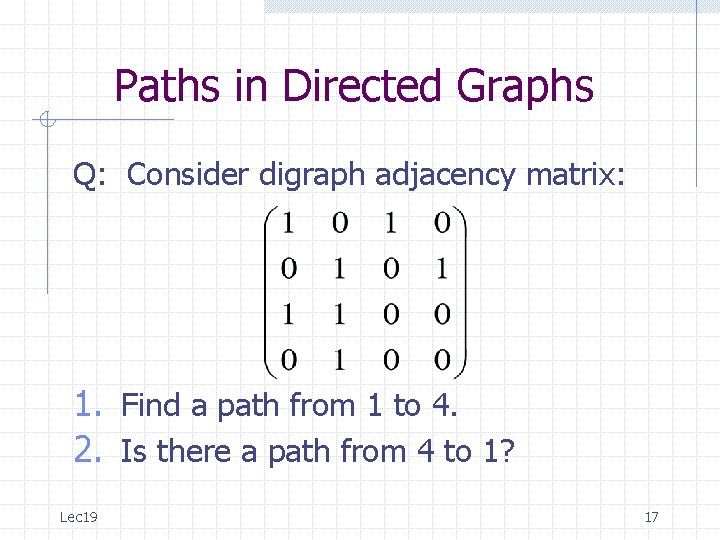
Paths in Directed Graphs Q: Consider digraph adjacency matrix: 1. Find a path from 1 to 4. 2. Is there a path from 4 to 1? Lec 19 17
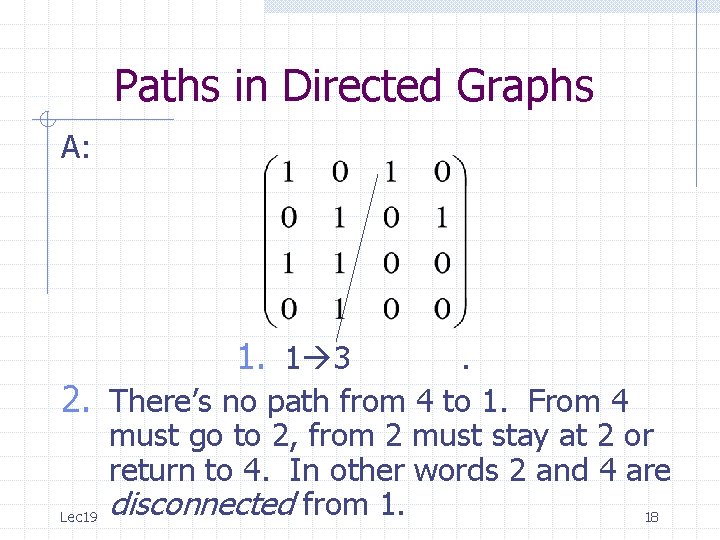
Paths in Directed Graphs A: 1. 1 3 . 2. There’s no path from 4 to 1. From 4 must go to 2, from 2 must stay at 2 or return to 4. In other words 2 and 4 are Lec 19 disconnected from 1. 18
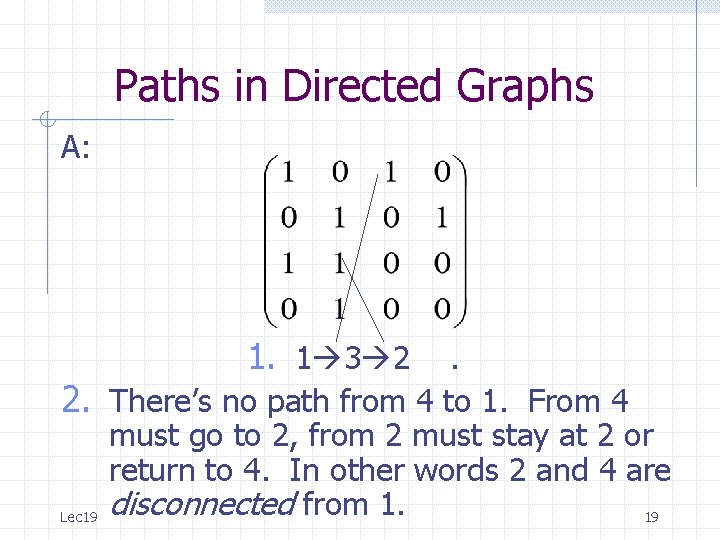
Paths in Directed Graphs A: 1. 1 3 2 . 2. There’s no path from 4 to 1. From 4 must go to 2, from 2 must stay at 2 or return to 4. In other words 2 and 4 are Lec 19 disconnected from 1. 19
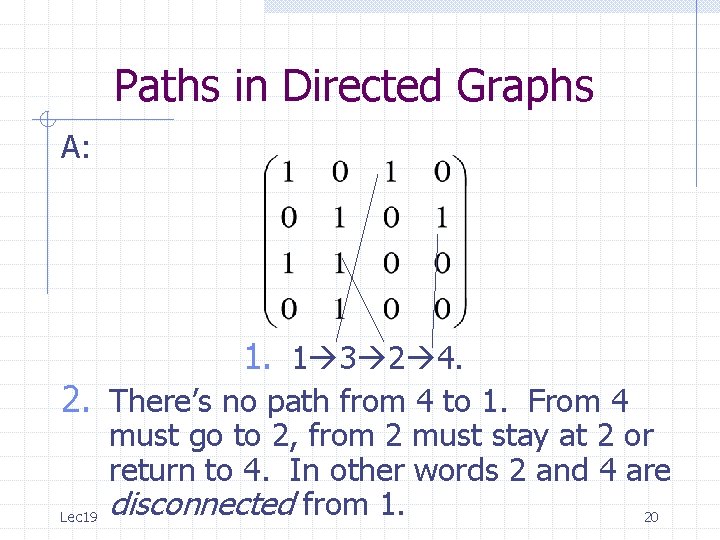
Paths in Directed Graphs A: 1. 1 3 2 4. 2. There’s no path from 4 to 1. From 4 Lec 19 must go to 2, from 2 must stay at 2 or return to 4. In other words 2 and 4 are disconnected from 1. 20
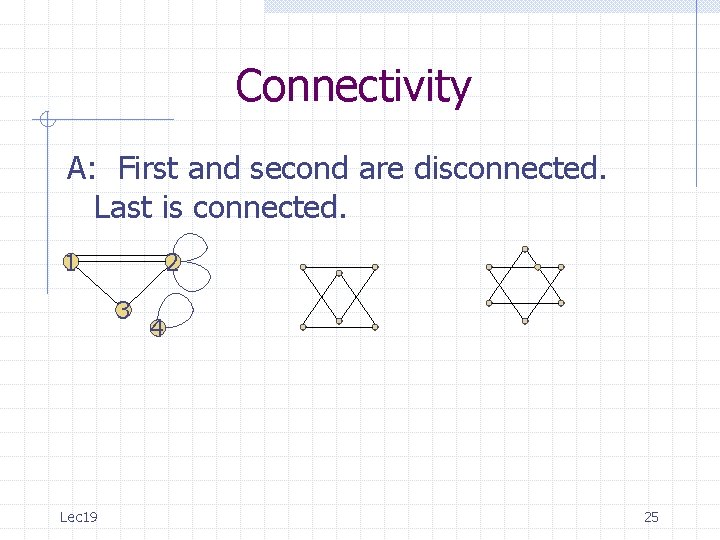
Connectivity DEF: Let G be a pseudograph. Let u and v be vertices. u and v are connected to each other if there is a path in G which starts at u and ends at v. G is said to be connected if all vertices are connected to each other. 1. Note: Any vertex is automatically connected to itself via the empty path. 2. Note: A suitable definition for directed graphs will follow later. Lec 19 21
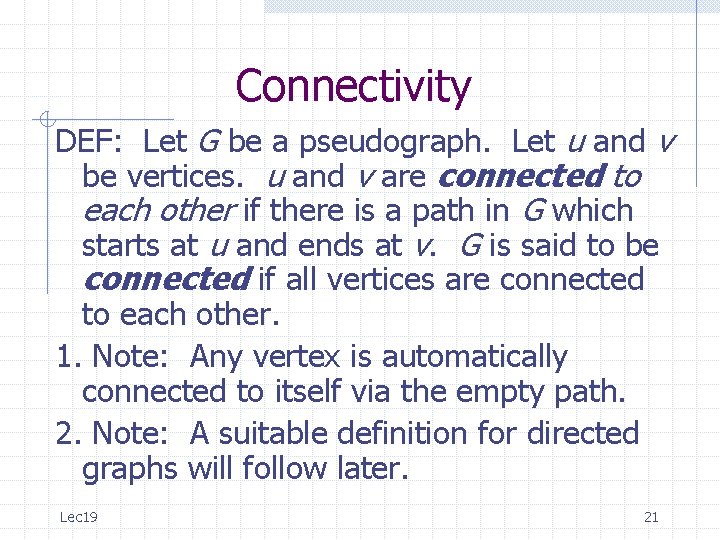
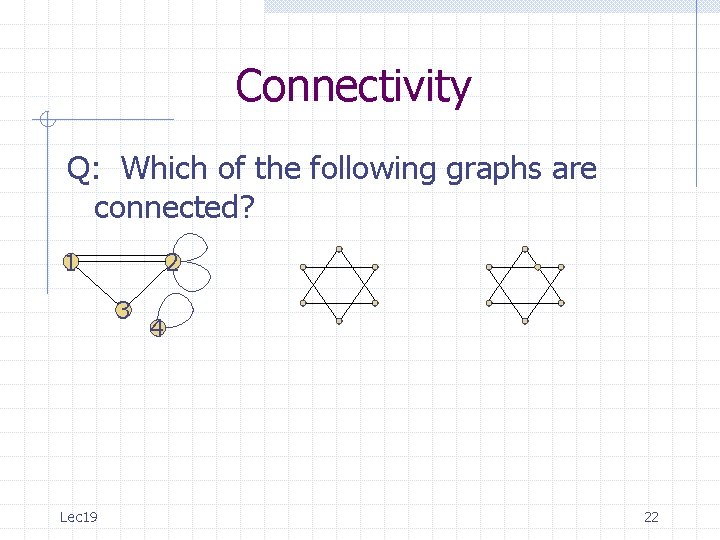
Connectivity Q: Which of the following graphs are connected? 1 2 3 Lec 19 4 22
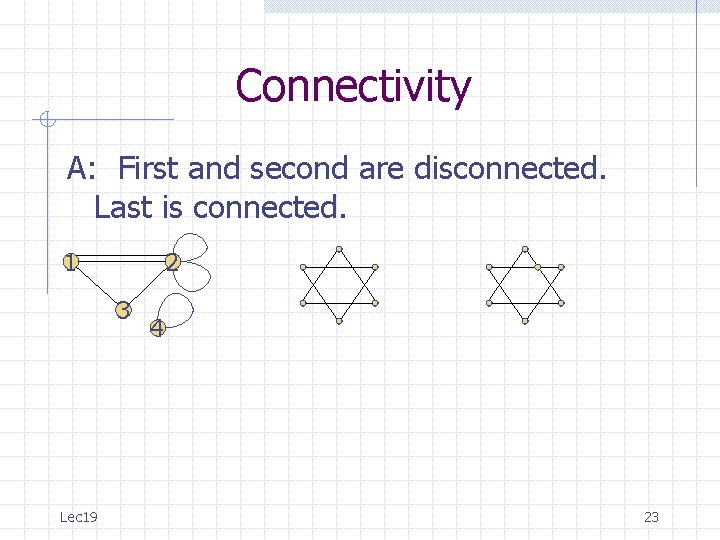
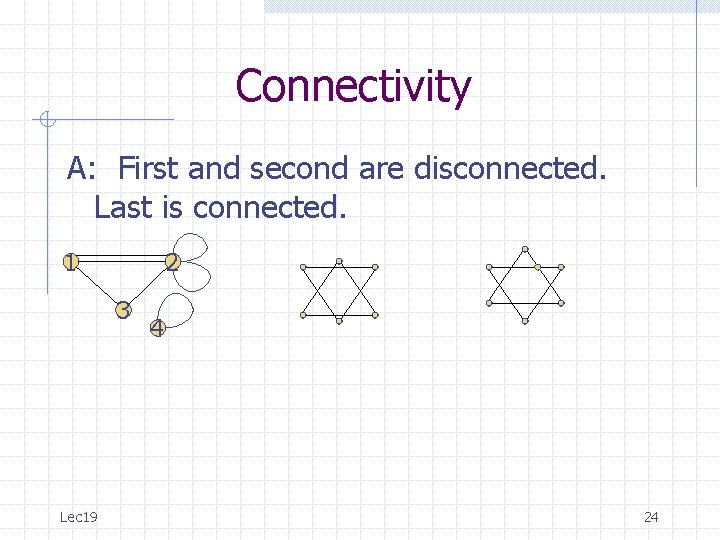
Connectivity A: First and second are disconnected. Last is connected. 1 2 3 Lec 19 4 23
Connectivity A: First and second are disconnected. Last is connected. 1 2 3 Lec 19 4 24
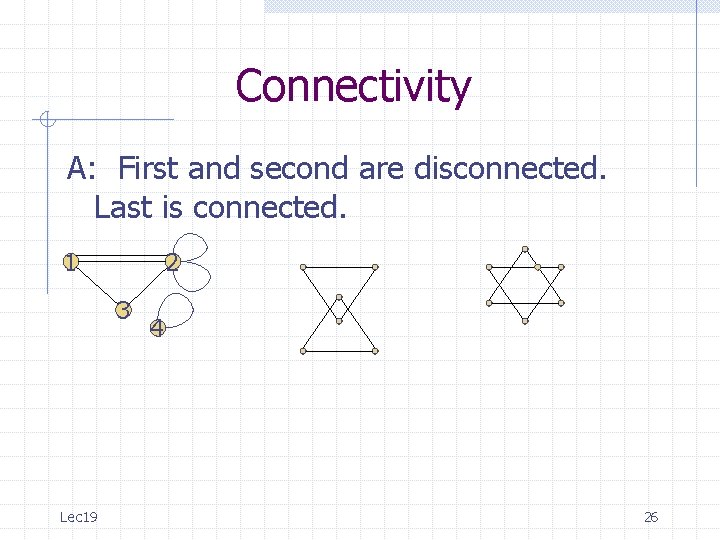
Connectivity A: First and second are disconnected. Last is connected. 1 2 3 Lec 19 4 25
Connectivity A: First and second are disconnected. Last is connected. 1 2 3 Lec 19 4 26
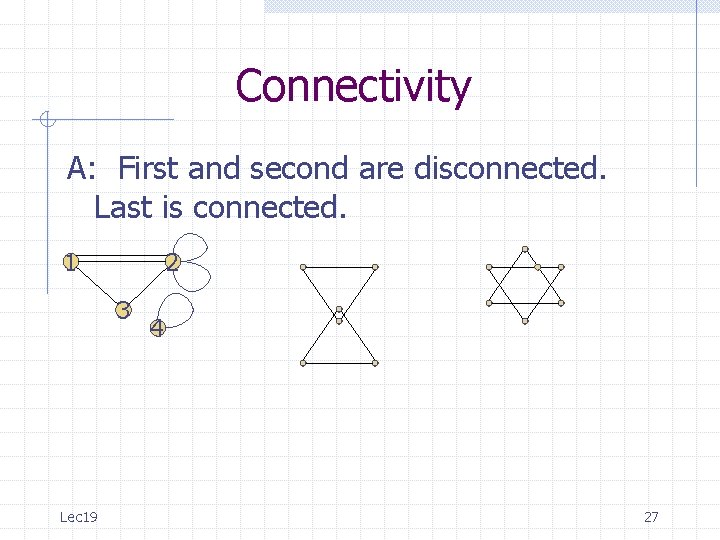
Connectivity A: First and second are disconnected. Last is connected. 1 2 3 Lec 19 4 27
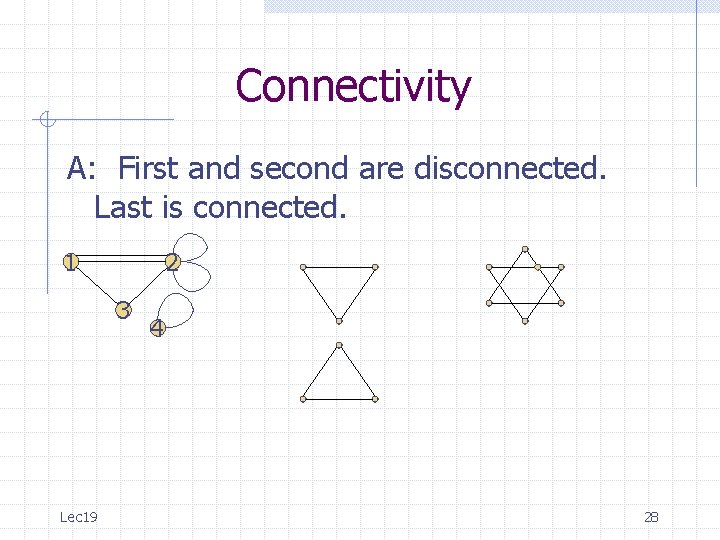
Connectivity A: First and second are disconnected. Last is connected. 1 2 3 Lec 19 4 28
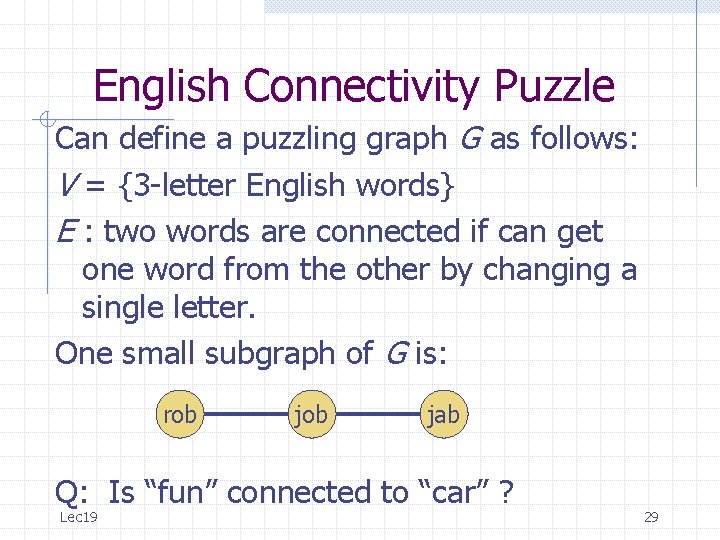
English Connectivity Puzzle Can define a puzzling graph G as follows: V = {3 -letter English words} E : two words are connected if can get one word from the other by changing a single letter. One small subgraph of G is: rob jab Q: Is “fun” connected to “car” ? Lec 19 29
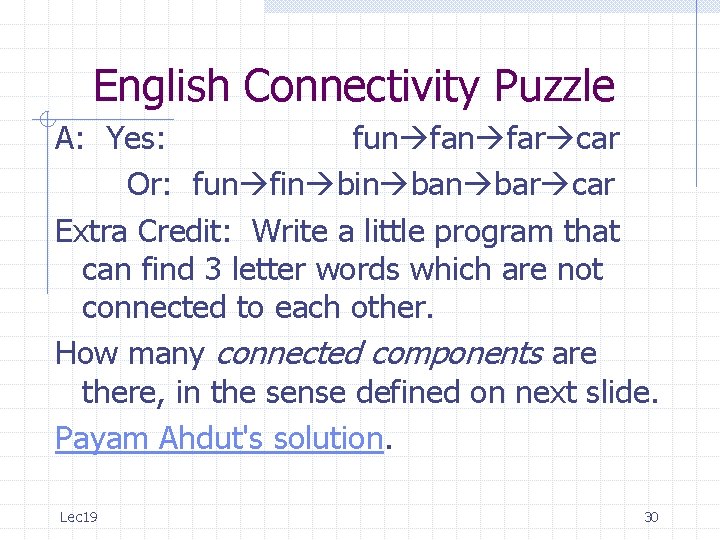
English Connectivity Puzzle A: Yes: fun far car Or: fun fin ban bar car Extra Credit: Write a little program that can find 3 letter words which are not connected to each other. How many connected components are there, in the sense defined on next slide. Payam Ahdut's solution. Lec 19 30
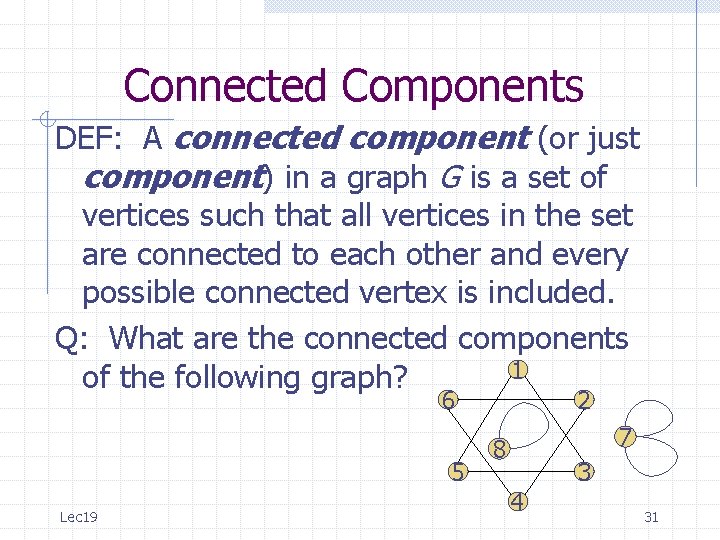
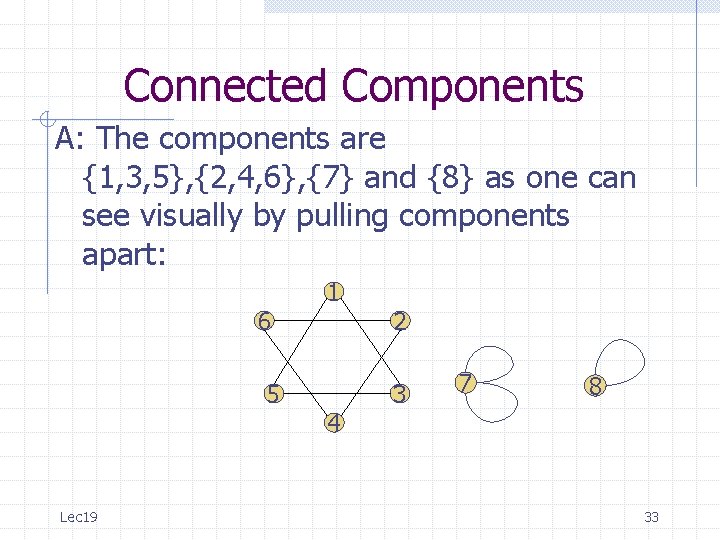
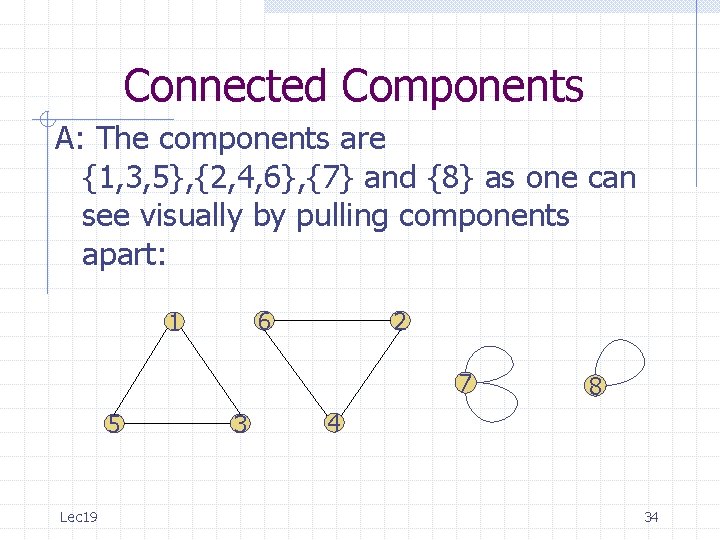
Connected Components DEF: A connected component (or just component) in a graph G is a set of vertices such that all vertices in the set are connected to each other and every possible connected vertex is included. Q: What are the connected components 1 of the following graph? 6 5 Lec 19 2 7 8 3 4 31
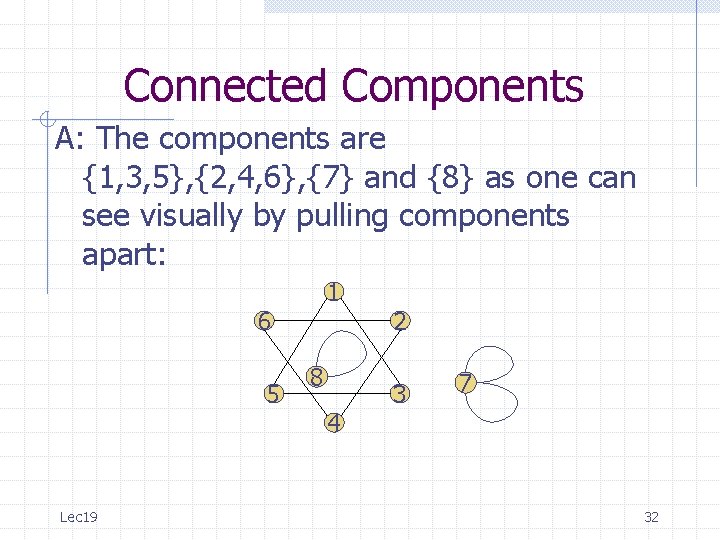
Connected Components A: The components are {1, 3, 5}, {2, 4, 6}, {7} and {8} as one can see visually by pulling components apart: 1 6 5 2 8 3 7 4 Lec 19 32
Connected Components A: The components are {1, 3, 5}, {2, 4, 6}, {7} and {8} as one can see visually by pulling components apart: 1 6 2 5 3 7 8 4 Lec 19 33
Connected Components A: The components are {1, 3, 5}, {2, 4, 6}, {7} and {8} as one can see visually by pulling components apart: 6 1 2 7 5 Lec 19 3 8 4 34
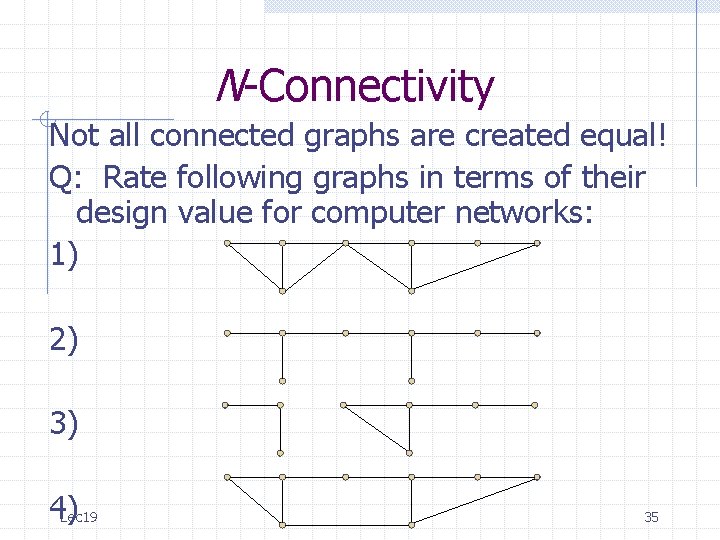
N-Connectivity Not all connected graphs are created equal! Q: Rate following graphs in terms of their design value for computer networks: 1) 2) 3) 4) Lec 19 35
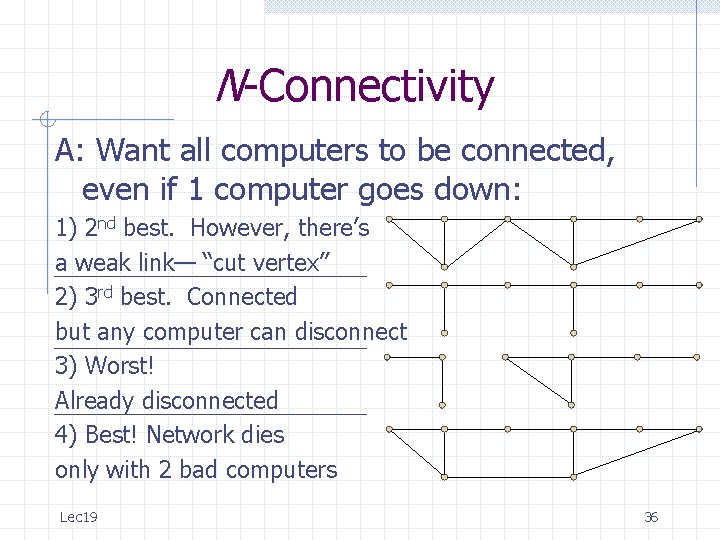
N-Connectivity A: Want all computers to be connected, even if 1 computer goes down: 1) 2 nd best. However, there’s a weak link— “cut vertex” 2) 3 rd best. Connected but any computer can disconnect 3) Worst! Already disconnected 4) Best! Network dies only with 2 bad computers Lec 19 36
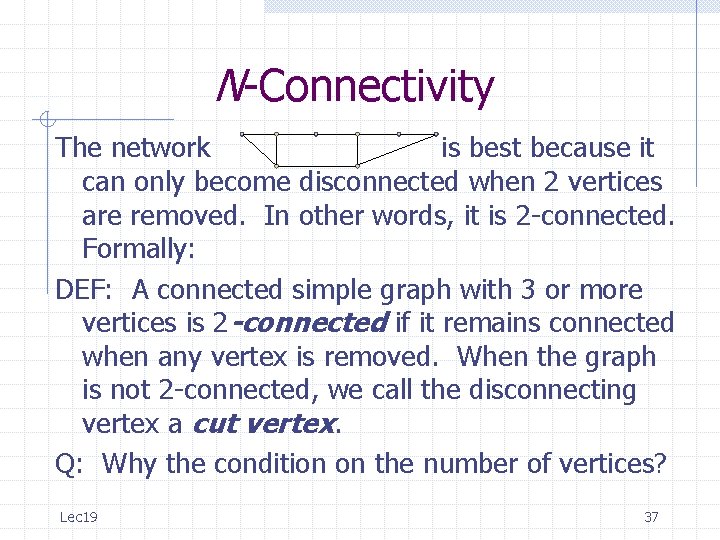
N-Connectivity The network is best because it can only become disconnected when 2 vertices are removed. In other words, it is 2 -connected. Formally: DEF: A connected simple graph with 3 or more vertices is 2 -connected if it remains connected when any vertex is removed. When the graph is not 2 -connected, we call the disconnecting vertex a cut vertex. Q: Why the condition on the number of vertices? Lec 19 37
N-Connectivity A: To avoid being 2 -connected. There is also a notion of N-Connectivity where we require at least N vertices to be removed to disconnect the graph. Lec 19 38
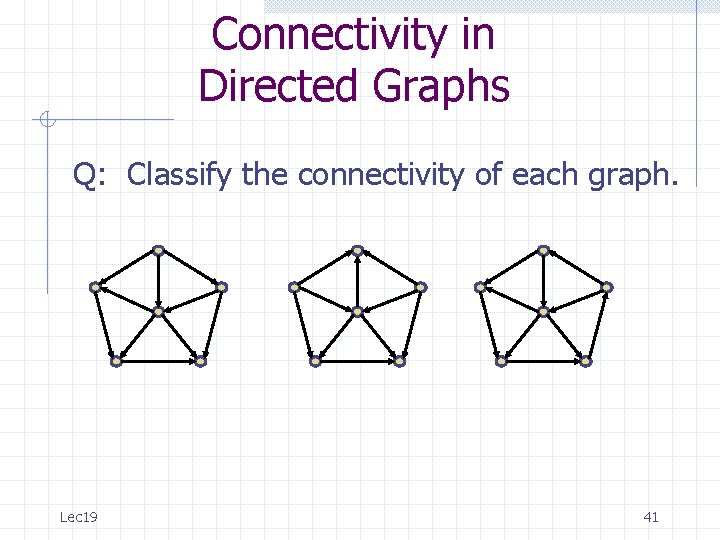
Connectivity in Directed Graphs In directed graphs may be able to find a path from a to b but not from b to a. However, Connectivity was a symmetric concept for undirected graphs. So how to define directed Connectivity is non-obvious: 1) Should we ignore directions? 2) Should we insist that can get from a to b in actual digraph? 3) Should we insist that can get from a to b and that can get from b to a? Lec 19 39
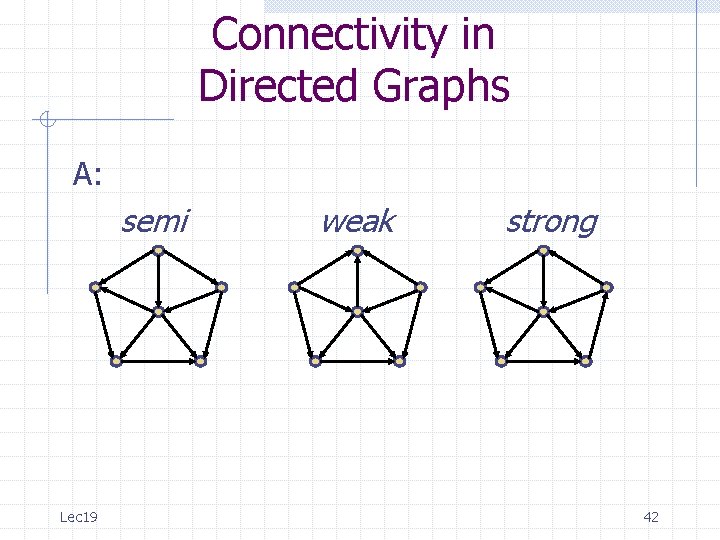
Connectivity in Directed Graphs Resolution: Don’t bother choosing which definition is better. Just define to separate concepts: 1) Weakly connected : can get from a to b in underlying undirected graph 2) Semi-connected (my terminology): can get from a to b OR from b to a in digraph 3) Strongly connected : can get from a to b AND from b to a in the digraph DEF: A graph is strongly (resp. semi, resp. weakly) connected if every pair of vertices is connected in the same sense. Lec 19 40
Connectivity in Directed Graphs Q: Classify the connectivity of each graph. Lec 19 41
Connectivity in Directed Graphs A: semi Lec 19 weak strong 42