
Pathology of the lower female genital tract Vulvar





- Slides: 24
Pathology of the lower female genital tract • Vulvar Diseases: • Can be divided to non-neoplastic and neoplastic diseases. • The neoplastic diseases are much less common. Of those, squamous cell carcinoma is the most common.
Non-neoplastic vulvar diseases • Licken sclerosus • Lichen Simplex Chronicus • Condylomas
Neoplastic vulvar diseases • Vulvar Intraepithelial Neoplasia • Carcinoma of the Vulva: Squamous Cell Carcinoma; adenocarcinomas, melanomas, or basal cell carcinomas
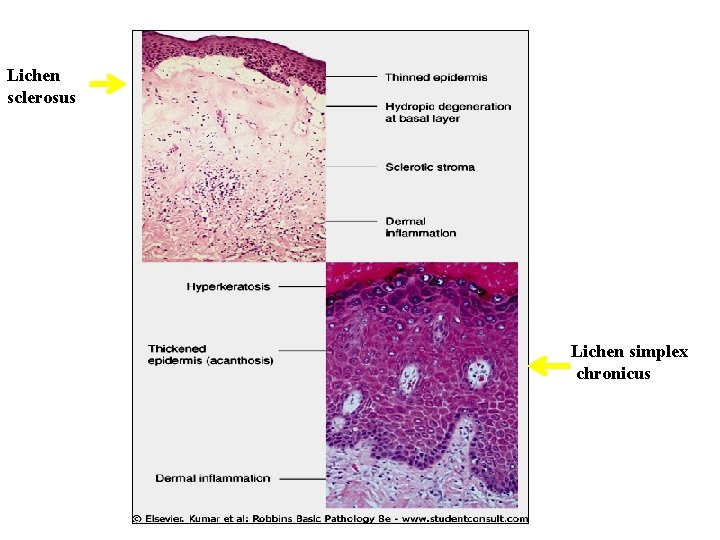
Licken sclerosus • most common in postmenopausal women. • smooth, white plaques; skin is thinned out and resembles paper. • Microscopically: thinning of the epidermis and disappearance of rete pegs, hydropic degeneration of the basal cells • The pathogenesis: is uncertain, (? )autoimmune reaction • lichen sclerosus is not pre-malignant by itself
Lichen sclerosus Lichen simplex chronicus
Lichen Simplex Chronicus • end result of many inflammatory conditions • an area of leukoplakia. • Microscopically: epithelial thickening and significant surface hyperkeratosis. The hyperplastic epithelial changes show no atypia. • There is generally no increased predisposition to cancer, but suspiciously, lichen simplex chronicus is often present at the margins of adjacent cancer of the vulva.
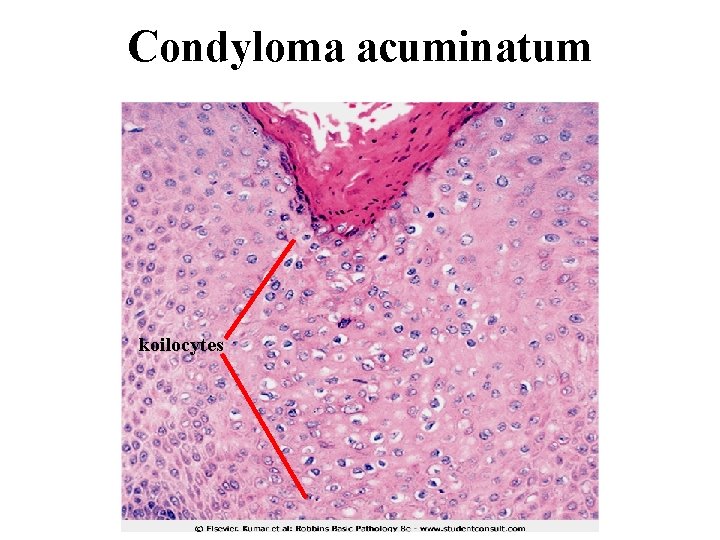
Condylomas and Low-Grade Vulvar Intraepithelial Neoplasia (VIN) • Condylomas are anogenital warts (HPV infection, esp. HPV type 6 and HPV type 11 ) • perinuclear cytoplasmic vacuolization (koilocytosis) with nuclear pleomorphism. • The types of HPV isolated from the cancers differ from those most often found in condylomas. • Vulvar condylomas are not precancerous
Condyloma acuminatum koilocytes
High-Grade Vulvar Intraepithelial Neoplasia and Carcinoma of the Vulva • high grade VIN= VIN II or VIN III (carcinoma in situ). • It may be found in multiple foci, or it may coexist with an invasive lesion. • VIN may be present for many years, perhaps decades before progression to cancer. • genetic, immunologic, or environmental influences (e. g. , cigarette smoking or superinfection with new strains of HPV) determine the course.
Carcinoma of the Vulva • 3% of all genital tract cancers in women. • mostly in women older than age 60. • 90% squamous cell carcinomas; the remainder are: adenocarcinomas, melanomas, or basal cell carcinomas. • Squamous cell carcinoma SCC: there are two biologic forms of vulvar SCC.
First type of SCC (basaloid or poorly differentiated SCC): vmost common 75% to 90% vrelatively younger patients v. HPV-related, especially type 16 & 18 vin many cases other lesions related to HPV infection are seen in vagina and cervix. v. Poorly differentiated cells
The second form of SCC (well-differentiated SCC): • older women 60 -70 s. v. Not HPV-related v. Less common vwell to moderately differentiated v. No known premalignant lesion v. May be found adjacent to lichen simplex or sclerosus
Vaginal pathologic diseases • Inflammatory Vaginal Diseases • Vaginitis: common; usually transient; produces a vaginal discharge (leukorrhea). • A large variety of organisms including bacteria, fungi, and parasites. • predisposing conditions: diabetes, systemic antibiotics, abortion or pregnancy, or compromised immune function. • Frequent causes are bacteria, Candida albicans and Trichomonas vaginalis.
Vaginal Neoplastic Diseases • Sarcoma botryoides (embryonal rhabdomyosarcoma): • Rare sarcoma of skeletal muscle differentiation • Mostly in infants and children <5 years. • soft polypoid masses (grape-like). • Primitive cells (rhabdomyoblasts)
Cervical pathology • Cervical carcinoma • Used to be the most frequent cancer in women around the world. • But, since the introduction of the Papanicolaou (Pap) smear 50 years ago, the incidence of cervical cancer has dropped.
• Detection of prinvasive lesions by the Pap smear at an early stage, permits discovery of these lesions when curative treatment is possible. • The Pap smear remains the most successful cancer screening test ever developed because it helped reducing cervical cancer mortality by as much as 99%, ranking it 13 th in cancer deaths for women.
Cervical cancer • The most common cervical carcinomas are SCC(75%), followed by adenocarcinomas and adenosquamous carcinomas (20%), and smallcell neuroendocrine carcinomas (<5%). • The SCC are increasingly appearing in younger women, now with a peak incidence at about 45 years, almost 10 to 15 years after detection of their precursors: cervical intraepithelial neoplasia (CIN).
Cervical intraepithelial neoplasia • On the basis of histology, precancerous changes are graded as follows (depending on the extent of involvement): *CIN I: Mild dysplasia (<third of full epithelial thickness) *CIN II: Moderate dysplasia (up to 2/3 of full epithelial thickness) *CIN III: Severe dysplasia in full epithelial thickness (carcinoma in situ)
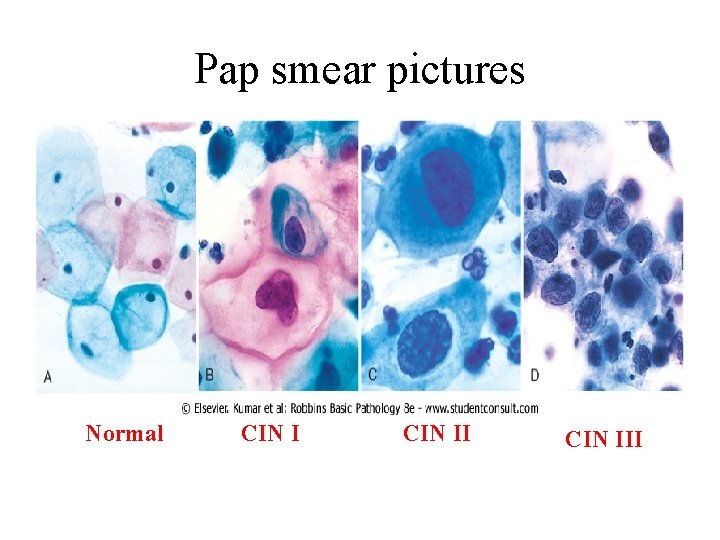
Dysplasia = increased N/C ratio, nuclear enlargement, hyperchromasia, and abnormal nuclear membranes
Pap smear pictures Normal CIN III
Epidemiology and Pathogenesis • The peak age incidence of CIN is about 30 years, whereas that of invasive carcinoma is about 45 years. • HPV can be detected by molecular methods in nearly all precancerous lesions and invasive neoplasms. • high-risk HPV types, including 16, 18, 45, and 31, account for the majority of cervical carcinomas
• HPV 16 and 18 usually integrate into the host genome and express large amounts of E 6 and E 7 proteins, which block or inactivate tumor suppressor genes p 53 and RB, respectively. • The recently introduced HPV vaccine used in USA and Europe is very effective in preventing HPV infections and hence cervical cancers.
Clinical Aspects Of Cervical Cancers • - Symptomatic tumors can cause: unexpected vaginal bleeding leukorrhea dyspareunia dysuria
• Detection of precursors by cytologic examination (pap smear) and their eradication by laser vaporization or cone biopsy is the most effective method of cancer prevention. • Mortality is most strongly related to tumor extent (stage), with 5 -year survivals as follows: stage 0 (preinvasive) 100%; stage 1 90%; stage 2 82%; stage 3 35%; and stage 4 10%. • Radiotherapy and Chemotherapy may improve survival in advanced cases.