
Pathology of The Gastrointestinal tract Ghadeer Hayel MD
- Slides: 30
Pathology of The Gastrointestinal tract Ghadeer Hayel, MD
4. Small and Large Intestines COLONIC POLYPS & NEOPLASTIC DISEASE
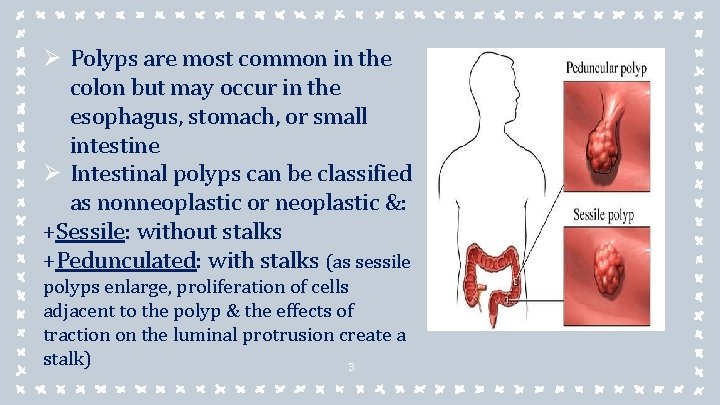
Ø Polyps are most common in the colon but may occur in the esophagus, stomach, or small intestine Ø Intestinal polyps can be classified as nonneoplastic or neoplastic &: +Sessile: without stalks +Pedunculated: with stalks (as sessile polyps enlarge, proliferation of cells adjacent to the polyp & the effects of traction on the luminal protrusion create a stalk) 3
Inflammatory Polyps Ø Solitary rectal ulcer syndromeis associated with a purely inflammatory polyp. Ø Patients present with the clinical triad of rectal bleeding, mucus discharge, and an inflammatory lesion of the anterior rectal wall. Ø Pathogenesis: impaired relaxation of anorectal sphincter creating a sharp angle at the anterior rectal shelf recurrent abrasion and ulceration of rectal mucosa chronic cycles of injury and healing produce a polypoid mass composed of inflamed and reactive mucosal tissue. 4
Hamartomatous Polyps Ø Hamartomas: are disorganized, tumor-like growths composed of mature cell types normally present at the site at which the polyp develops. Ø occur sporadically and as components of various syndromes (genetically determined or acquired) m Ø Hamartomatous polyposis syndromes are rare, but important to recognize because of ass intestinal & extraintestinal manifestations & the need to screen family members. Ø Two types: Juvenile Polyps & Peutz-Jeghers 5
Juvenile Polyps Ø The most common type of hamartomatous polyp. Ø Sporadic polyps are solitary, but in AD juvenile polyposis syndrome reach 3 -100. Ø The majority occur in children < 5 years of age. Ø Located in rectum manifest with rectal bleeding. Ø Dysplasia in a small proportion (syndrome ass) Ø Juvenile polyposis syndrome is ass with an increased risk for development of adeno. Ca. in colon & other sites. Ø Tx: Colectomy to limit the hemorrhage due to ulceration in polys. 6
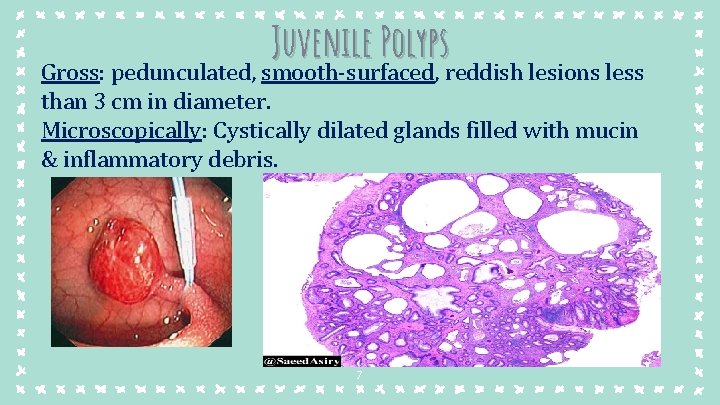
Juvenile Polyps Gross: pedunculated, smooth-surfaced, reddish lesions less than 3 cm in diameter. Microscopically: Cystically dilated glands filled with mucin & inflammatory debris. 7
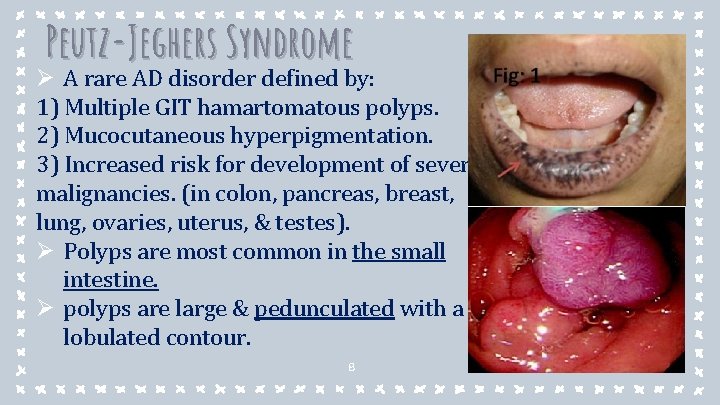
Peutz-Jeghers Syndrome Ø A rare AD disorder defined by: 1) Multiple GIT hamartomatous polyps. 2) Mucocutaneous hyperpigmentation. 3) Increased risk for development of several malignancies. (in colon, pancreas, breast, lung, ovaries, uterus, & testes). Ø Polyps are most common in the small intestine. Ø polyps are large & pedunculated with a lobulated contour. 8
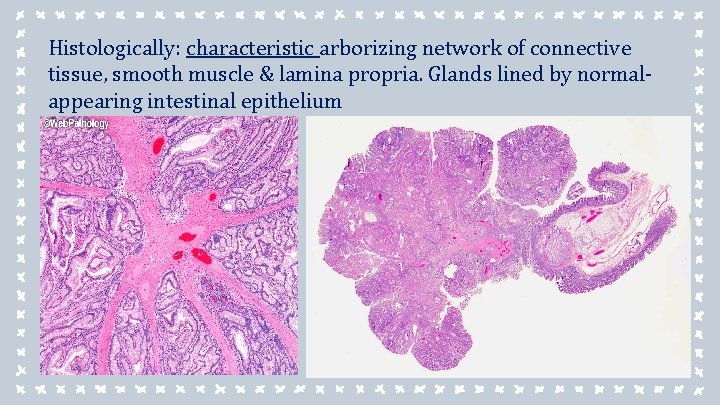
Histologically: characteristic arborizing network of connective tissue, smooth muscle & lamina propria. Glands lined by normalappearing intestinal epithelium 9
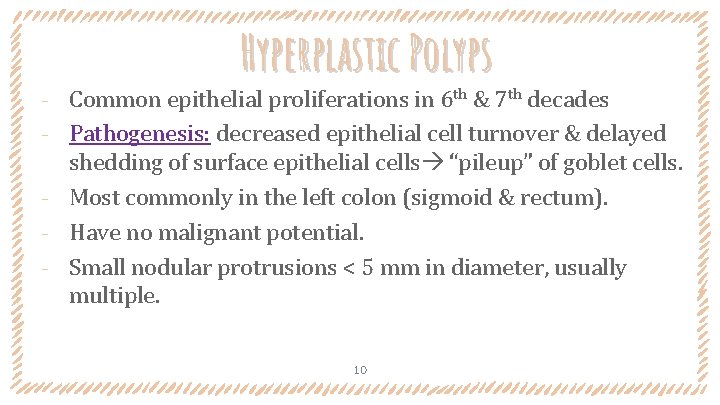
Hyperplastic Polyps ‐ ‐ ‐ Common epithelial proliferations in 6 th & 7 th decades Pathogenesis: decreased epithelial cell turnover & delayed shedding of surface epithelial cells “pileup” of goblet cells. Most commonly in the left colon (sigmoid & rectum). Have no malignant potential. Small nodular protrusions < 5 mm in diameter, usually multiple. 10
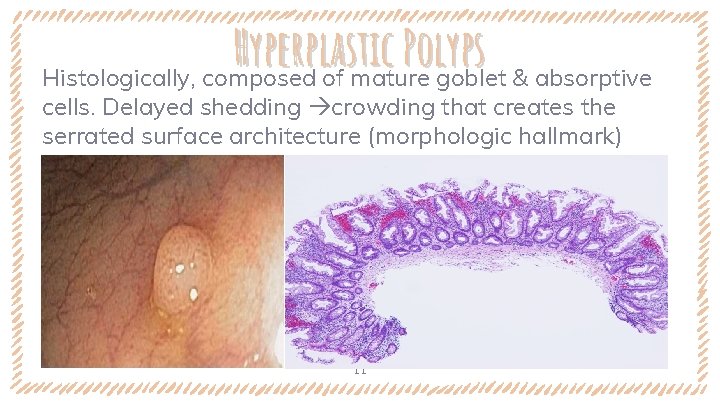
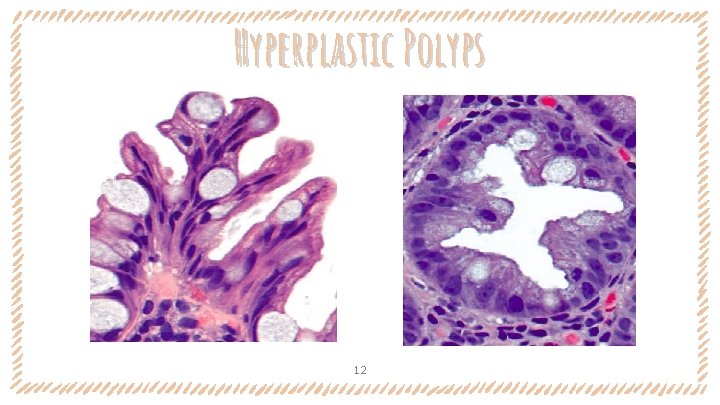
Hyperplastic Polyps Histologically, composed of mature goblet & absorptive cells. Delayed shedding crowding that creates the serrated surface architecture (morphologic hallmark) 11
Hyperplastic Polyps 12
Adenomas Ø The most common & clinically important neoplastic polyps are colonic adenomas. Ø Precursor to majority of colorectal adeno. Ca(s). Ø Most adenomas, however, do not progress to adeno. Ca(s). Ø Colorectal adenomas are characterized by the presence of epithelial dysplasia. Ø Current recommendations adults undergo screening colonoscopy starting at 50 (if there is family history screened at least 10 years before the youngest age at which a relative was diagnosed) 13
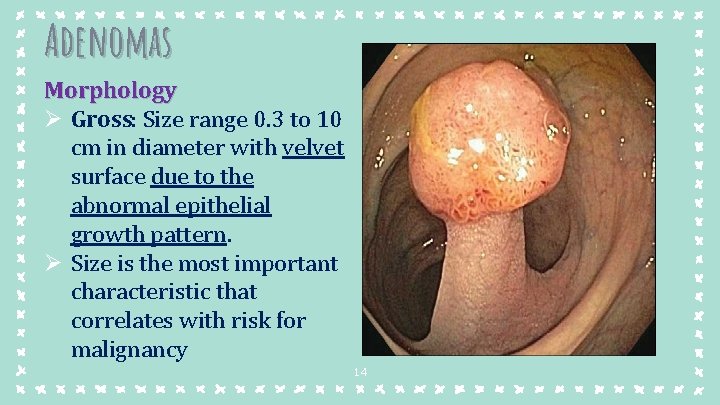
Adenomas Morphology Ø Gross: Size range 0. 3 to 10 cm in diameter with velvet surface due to the abnormal epithelial growth pattern. Ø Size is the most important characteristic that correlates with risk for malignancy 14
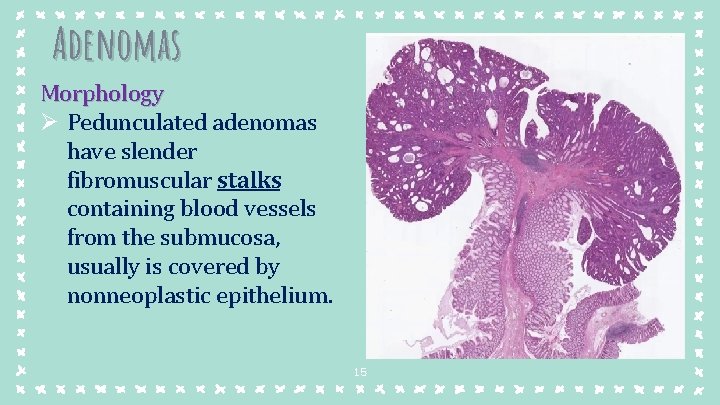
Adenomas Morphology Ø Pedunculated adenomas have slender fibromuscular stalks containing blood vessels from the submucosa, usually is covered by nonneoplastic epithelium. 15
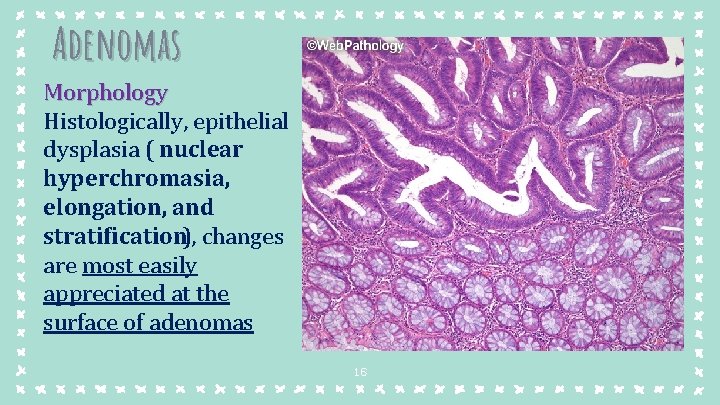
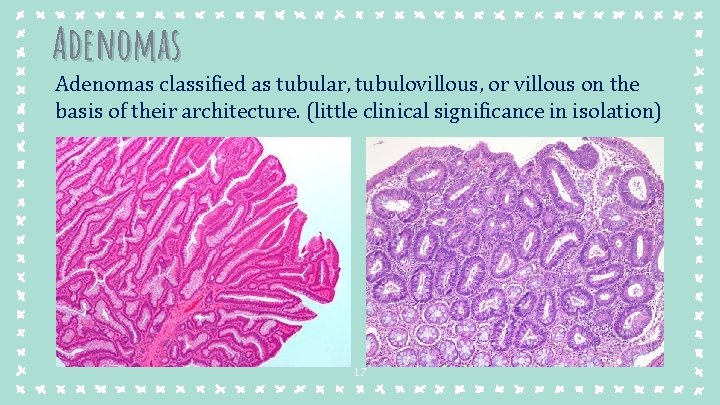
Adenomas Morphology Histologically, epithelial dysplasia ( nuclear hyperchromasia, elongation, and stratification), changes are most easily appreciated at the surface of adenomas 16
Adenomas classified as tubular, tubulovillous, or villous on the basis of their architecture. (little clinical significance in isolation) 17
Several syndromes associated with colonic polyps & increased rates of colon cancer have been described. The genetic basis of these disorders has been established & has greatly enhanced the current understanding of sporadic colon cancer
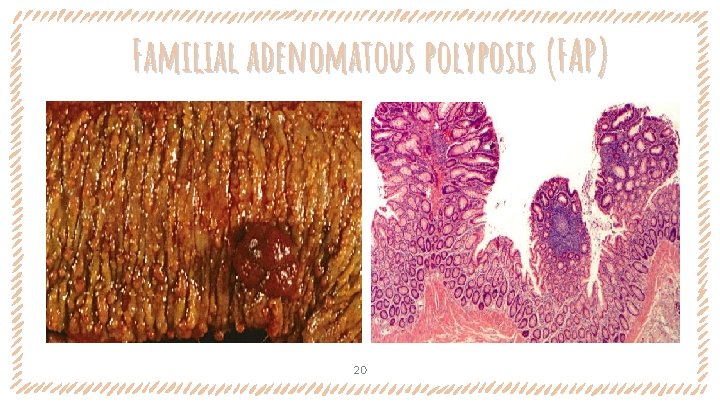
‐ ‐ ‐ Familial adenomatous polyposis (FAP) An AD disorder marked by the appearance of numerous colorectal adenomas by teenage years. It is caused by mutations of the adenomatous polyposis coli gene (APC). A count of at least 100 polyps is necessary for a diagnosis of classic FAP. Colorectal adenocarcinoma develops in 100% of patients with untreated FAP (before 30). Prophylactic colectomy is standard therapy 19
Familial adenomatous polyposis (FAP) 20
‐ Lynch syndrome Hereditary nonpolyposis colorectal cancer (HNPCC). Familial clustering of cancers at several sites including the colorectum, endometrium, stomach, small bowel, ovary, ureters, brain, skin, & hepatobiliary tract. ‐ Colon cancers at younger ages than do sporadic colon cancers. Often located in right colon. ‐ Caused by inherited mutations in genes that encode proteins responsible for the detection, excision, and repair of errors that occur during DNA replication (mismatch repair genes). ‐ 21
COLONIC ADENOCARCINOMA The most commonmalignancy of GIT. ‐ The small intestine is an uncommon site for benign & malignant tumors. ‐ Among malignant small-intestinal tumors, adeno. Ca & carcinoid (neuroendocrine) tumors have roughly equal rates of occurrence, followed by lymphomas & sarcomas. ‐ Dietry factor ass with increased colorectal cancer rates: (1)low intake of unabsorbable vegetable fiber. (2)high intake of refined carbohydrates & fat. ‐ 22
Pathogenesis: ‐ At least two distinct genetic pathways have been described in sporadic colon cancer: 1) APC/β-catenin pathway(80%): mutations in this pathway lead to increase WNT signaling. 2) DNA mismatch repair deficiency: defects in DNA mismatch repair. ‐ Both pathways involve the stepwise accumulation of multiple mutations, but the genes involved and the mechanisms by which the mutations accumulated differ. 23
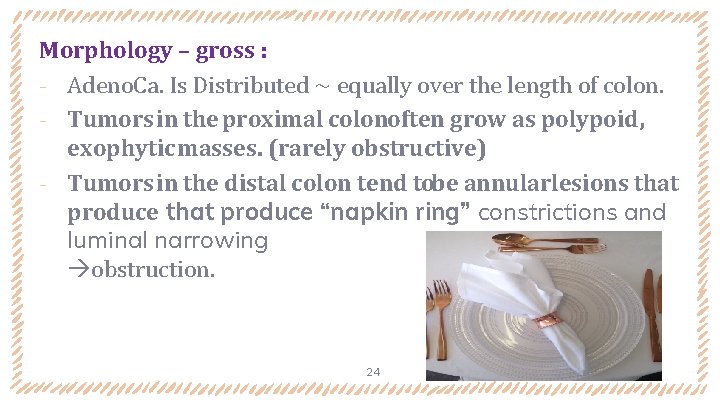
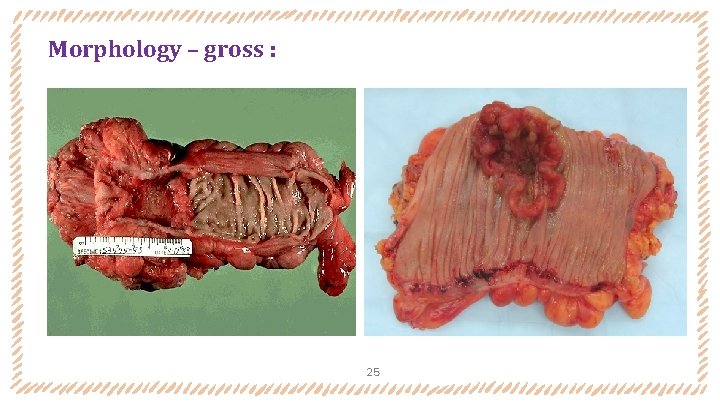
Morphology – gross : ‐ Adeno. Ca. Is Distributed ~ equally over the length of colon. ‐ Tumors in the proximal colonoften grow as polypoid, exophytic masses. (rarely obstructive) ‐ Tumors in the distal colon tend tobe annularlesions that produce “napkin ring” constrictions and luminal narrowing obstruction. 24
Morphology – gross : 25
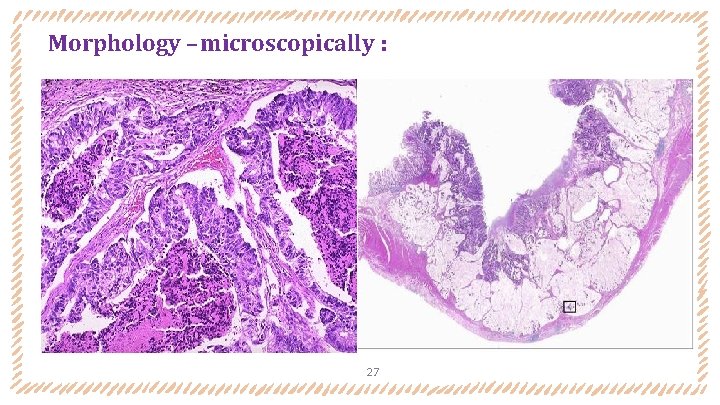
Morphology – microscopically : ‐ Most tumors are composed of tall columnar cells that resemble dysplastic epithelium found in adenomas ‐ The invasive component of these tumors elicits a strong stromal desmoplasticresponse, gives characteristic firm consistency. ‐ Some poorly differentiated tumors form few glands ‐ Others may produce abundant mucin that accumulates within the intestinal wall ( poor prognosis). ‐ Tumors also may be composed of signet ring cells similar to gastric cancer 26
Morphology – microscopically : 27
Clinical features: ‐ Endoscopic screening & the fact that most carcinomas arise within adenomas presents a unique opportunity for cancer prevention. ‐ Colorectal cancers develop insidiously & may therefore go undetected for long periods. ‐ Presentation: 1) Cecal & other right-sided cancers fatigue and weakness due to iron-deficiency anemia. 2) Left-sided cancers occult bleeding, changes in bowel habits, or cramping left lower-quadrant discomfort. 28
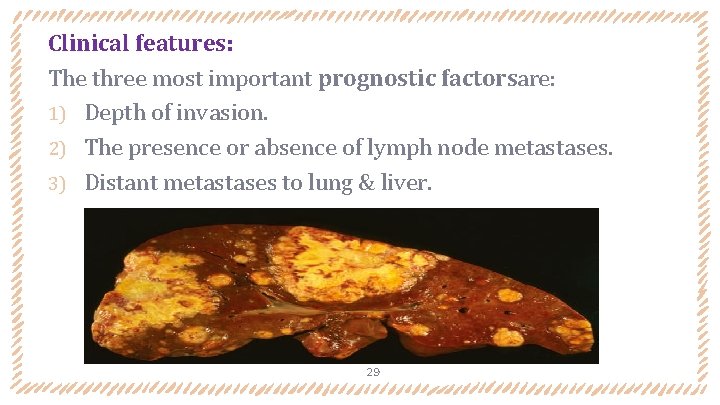
Clinical features: The three most important prognostic factorsare: 1) Depth of invasion. 2) The presence or absence of lymph node metastases. 3) Distant metastases to lung & liver. 29
Thnak YOU! Good luck & eat healthy! 30