
Pathology of the Fallopian tubes Inflammations Salpingitis almost
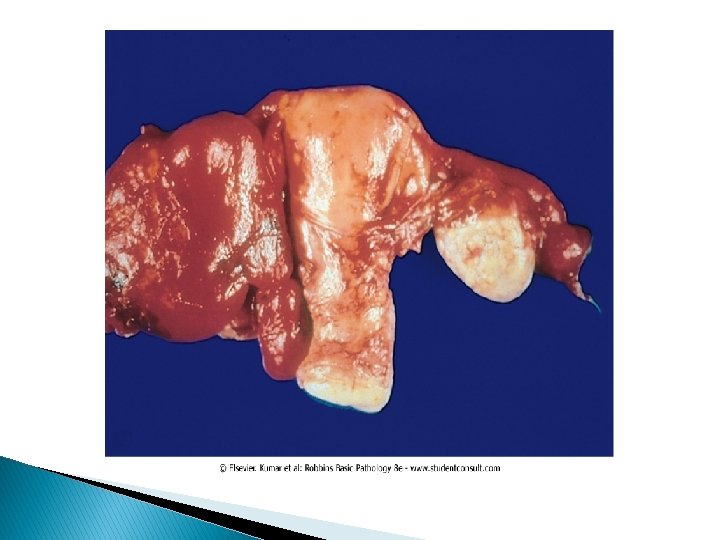
Pathology of the Fallopian tubes �Inflammations (Salpingitis) almost always bacterial in origin. � Chlamydia, Mycoplasma , coliforms, (postpartum) strept. and staph. are now the major offenders. � Tuberculous salpingitis is far less common and almost always with tuberculosis of the endometrium. � fever, lower abdominal or pelvic pain, and pelvic masses when the tubes become distended with either exudate or secretions. � Complications: � Adherence of tube to ovary tubo-ovarian abscess. � more serious adhesions of the tubal plicae, and increasing the risk of tubal ectopic pregnancy. � Damage or obstruction of the tubal lumina may produce permanent sterility �
Tubal malignancies � Currently, primary adenocarcinomas of the fallopian tubes are considered rare. � The most common is papillary serous carcinoma, others include endometrioid histology. � fallopian tube carcinomas are increased in women with BRCA mutations ( In studies of prophylactic oophorectomies: 10% occult foci of malignancy usually in the fimbria). � Because the lumen and fimbria of the fallopian tube have access to the peritoneal cavity, fallopian tube carcinomas frequently involve the omentum and peritoneal cavity at time of presentation.
Ovarian Pathology � POLYCYSTIC OVARIES (also called Stein-Leventhal syndrome). q oligomenorrhea, hirsutism, infertility, and obesity q usually in girls after menarche q secondary to excessive production of androgens by multiple cystic follicles in the ovaries (unclear causes). q Pathogenesis: excessive production of androgens; high concentrations of LH, and low concentrations of FSH. q The ovaries are enlarged, gray-white with a smooth outer cortex, and are studded with subcortical cysts 0. 5 to 1. 5 cm in diameter. q Histologically, there is a thickened, fibrotic outer surface, overlying cysts lined by granulosa cells with a hypertrophic and hyperplastic luteinized theca interna, with absence of corpora lutea.
Ovarian Neoplastic Diseases � Ovarian cancer is the fifth most common cancer in women. � It is also the fifth leading cause of cancer death in women. � Tumors of the ovary are diverse pathologic entities. � This diversity is attributable to the three cell types that make up the normal ovary: 1 -The surface (coelomic) covering epithelium 2 - The germ cells 3 - The sex cord/stromal cells. � Each of these cell types gives rise to a variety of tumors
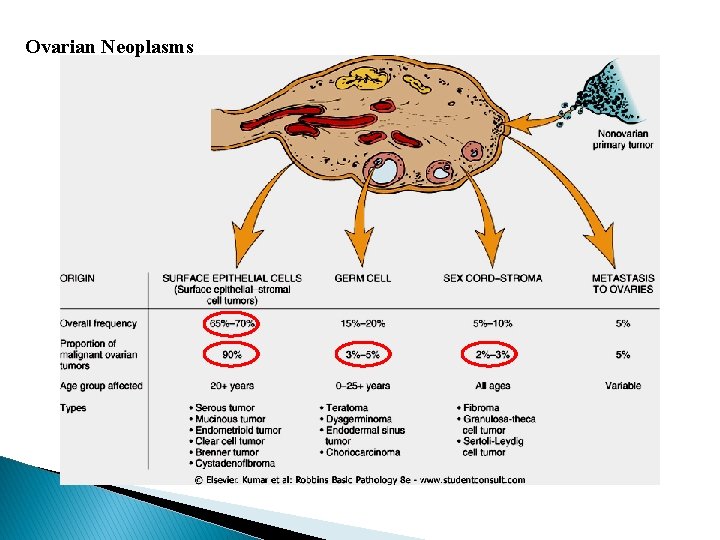
Ovarian Neoplasms
Pathogenesis-familial cases � Several risk factors for epithelial ovarian cancers have been recognized. Two of the most important are nulliparity and family history. � prolonged use of oral contraceptives may reduce the risk. � Only 5%-10% of ovarian cancers are familial, the molecular pathogenesis of these cancers involve specific genes in these cases: � mutations in the BRCA genes 1 and 2. � The average lifetime risk for ovarian cancer approximates 30% in BRCA 1 carriers, with figures varying from 16% to 44% in different studies. The risk in BRCA 2 carriers is somewhat lower.
Pathogenesis- sporadic cases � Mutations in BRCA genes mutations are seen in only 8% to 10% of sporadic ovarian cancers. Thus, there must be other molecular pathways for ovarian neoplasms. � HER 2/NEU is overexpressed in 35% of ovarian cancers (poor prognosis). � K-RAS protein is overexpressed in up to 30% of tumors, mostly mucinous cystadenocarcinomas. � p 53 is mutated in about 50% of all ovarian cancers
SURFACE EPITHELIAL TUMORS � derived from the coelomic mesothelium that covers the surface of the ovary. � Benign lesions are usually cystic (cystadenoma) or can have an accompanying stromal component (cystadenofibroma). � Malignant tumors may be cystic (cystadenocarcinoma) or solid (carcinoma). � The surface epithelial tumors also have an intermediate, borderline category currently referred to as tumors of low malignant potential. These seem to be low-grade cancers with limited invasive potential. Thus, they have a better prognosis than the fully malignant ovarian carcinomas.
1 - Serous Tumors � These are the most frequent ovarian tumors. � 60% benign, 15% borderline, and 25% malignant. � Benign serous lesions 30 and 40 years � malignant serous tumors 45 and 65 years of age. � Combined, borderline and malignant serous tumors are the most common malignant ovarian tumors and account for about 60% of all ovarian cancers. � Mutations in BRAF and K-RAS are common in borderline tumors and low grade cancers. � High-grade serous carcinomas mutations in p 53 and BRCA 1, and typically lack mutations in KRAS and BRAF.
Morphology � Benign serous tumors: � large cystic structures, (30 to 40 cm in diameter). May be bilateral. The serosal covering is smooth and glistening. The cysts are usually filled with a clear serous fluid. characterized by a single layer of tall columnar epithelium. Some of the cells are ciliated. � Borderline serous tumors: � more complex architecture with mild cytologic atypia but no stromal invasion. However, they might be associated with peritoneal implants. � Malignant serous carcinoma: Anaplasia of the lining cells and invasion of the stroma. � Note: Psammoma bodies (concentrically laminated calcified concretions) are common in the tips of papillae of serous tumors in general.
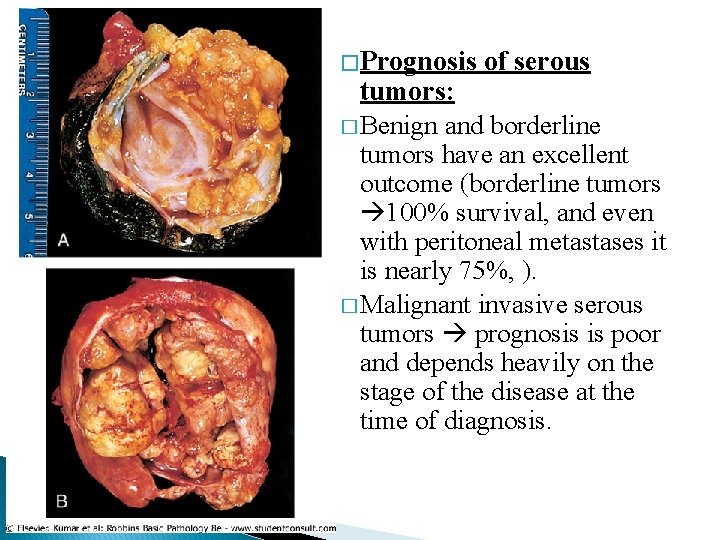
� Prognosis of serous tumors: � Benign and borderline tumors have an excellent outcome (borderline tumors 100% survival, and even with peritoneal metastases it is nearly 75%, ). � Malignant invasive serous tumors prognosis is poor and depends heavily on the stage of the disease at the time of diagnosis.
2 - Mucinous ovarian tumors � these tumors consists of mucin-secreting cells. � Only 10% of mucinous tumors are malignant (cystadenocarcinomas), while 10% are of low malignant potential (borderline), and 80% are benign. � Morphology � they are larger and multilocular. � psammoma bodies are not found � The cysts are lined by mucin secreting cells with abundant vaculated cytoplasm � Depending on the architectural complexity, these tumors are classified to benign, borederline or malignant. � The prognosis of mucinous cystadenocarcinoma is somewhat better than that for the serous counterpart, but the stage rather than the histologic type is the major determinant of treatment success.
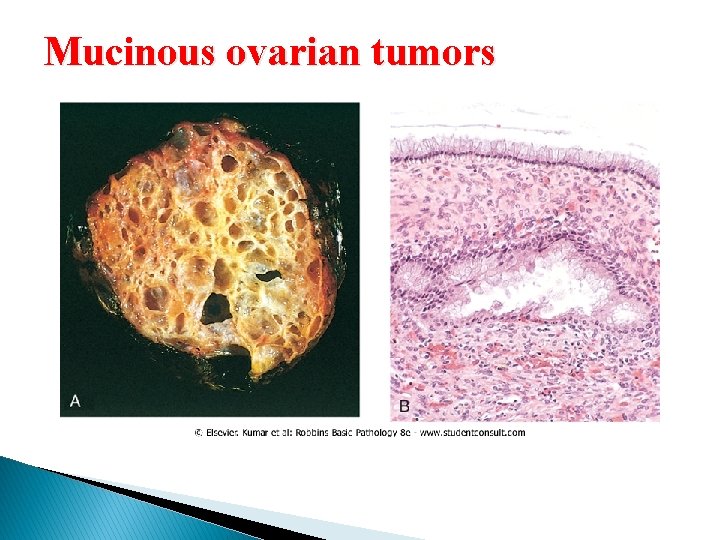
Mucinous ovarian tumors
3 - Ovarian Endometrioid Carcinoma � Microscopically they are distinguished by the formation of tubular glands, similar to those of the endometrium, within the linings of cystic spaces. � Although benign and borderline forms exist, endometrioid tumors are usually malignant. � They are bilateral in about 30% of cases � 15% to 30% of women with these ovarian tumors have a concomitant endometrial carcinoma. � Similar to endometrial cancer, endometrioid carcinomas have mutations in the PTEN suppressor gene
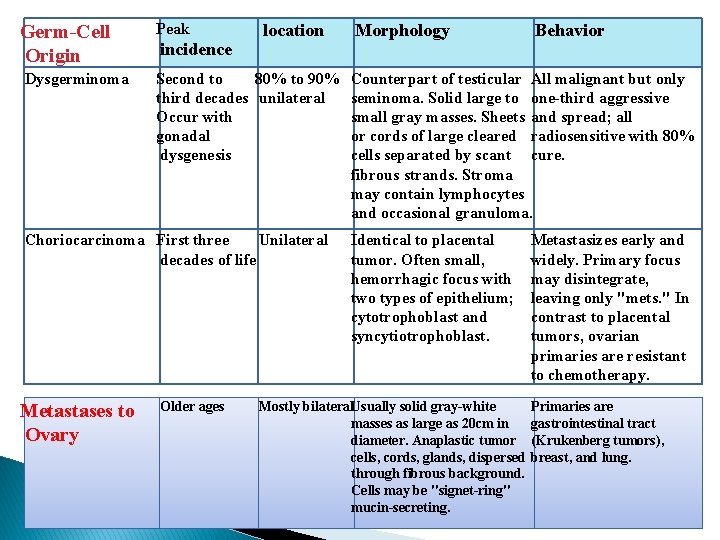
Germ-Cell Origin Dysgerminoma Peak incidence location Second to 80% to 90% third decades unilateral Occur with gonadal dysgenesis Choriocarcinoma First three Unilateral decades of life Metastases to Ovary Older ages Morphology Behavior Counterpart of testicular All malignant but only seminoma. Solid large to one-third aggressive small gray masses. Sheets and spread; all or cords of large cleared radiosensitive with 80% cells separated by scant cure. fibrous strands. Stroma may contain lymphocytes and occasional granuloma. Identical to placental tumor. Often small, hemorrhagic focus with two types of epithelium; cytotrophoblast and syncytiotrophoblast. Mostly bilateral. Usually solid gray-white masses as large as 20 cm in diameter. Anaplastic tumor cells, cords, glands, dispersed through fibrous background. Cells may be "signet-ring" mucin-secreting. Metastasizes early and widely. Primary focus may disintegrate, leaving only "mets. " In contrast to placental tumors, ovarian primaries are resistant to chemotherapy. Primaries are gastrointestinal tract (Krukenberg tumors), breast, and lung.
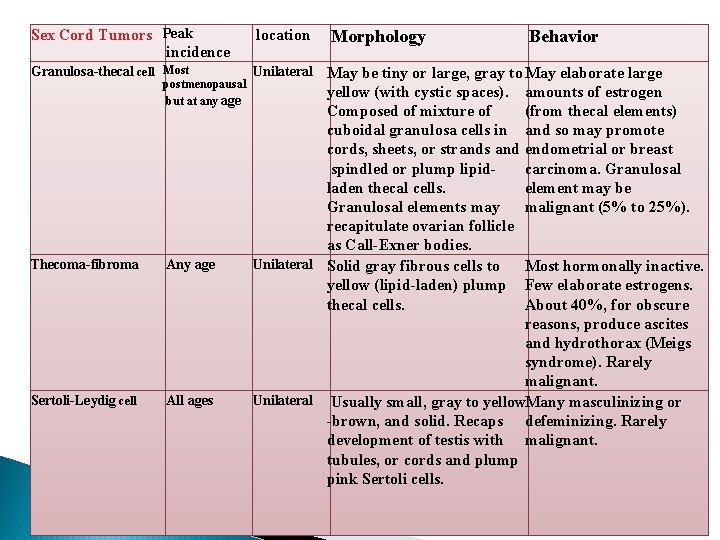
Sex Cord Tumors Peak incidence location Granulosa-thecal cell Most Unilateral May be tiny or large, gray to May elaborate large postmenopausal but at any age Thecoma-fibroma Any age Sertoli-Leydig cell All ages Morphology Behavior yellow (with cystic spaces). amounts of estrogen Composed of mixture of (from thecal elements) cuboidal granulosa cells in and so may promote cords, sheets, or strands and endometrial or breast spindled or plump lipidcarcinoma. Granulosal laden thecal cells. element may be Granulosal elements may malignant (5% to 25%). recapitulate ovarian follicle as Call-Exner bodies. Unilateral Solid gray fibrous cells to Most hormonally inactive. yellow (lipid-laden) plump Few elaborate estrogens. thecal cells. About 40%, for obscure reasons, produce ascites and hydrothorax (Meigs syndrome). Rarely malignant. Unilateral Usually small, gray to yellow. Many masculinizing or -brown, and solid. Recaps defeminizing. Rarely development of testis with malignant. tubules, or cords and plump pink Sertoli cells.
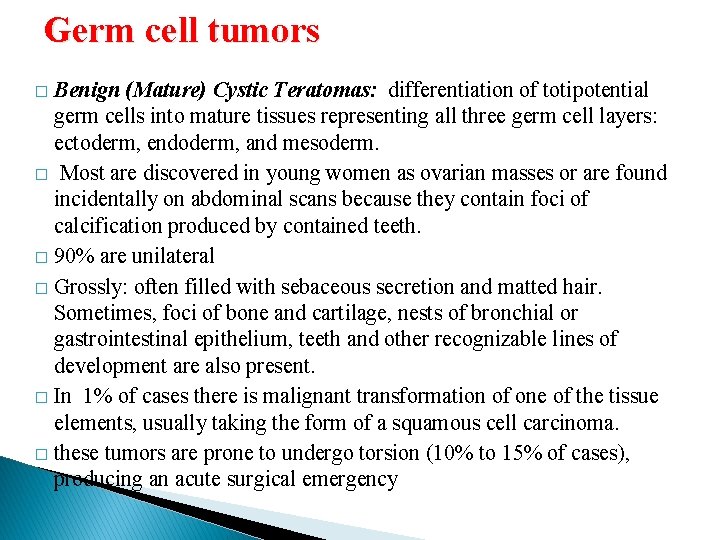
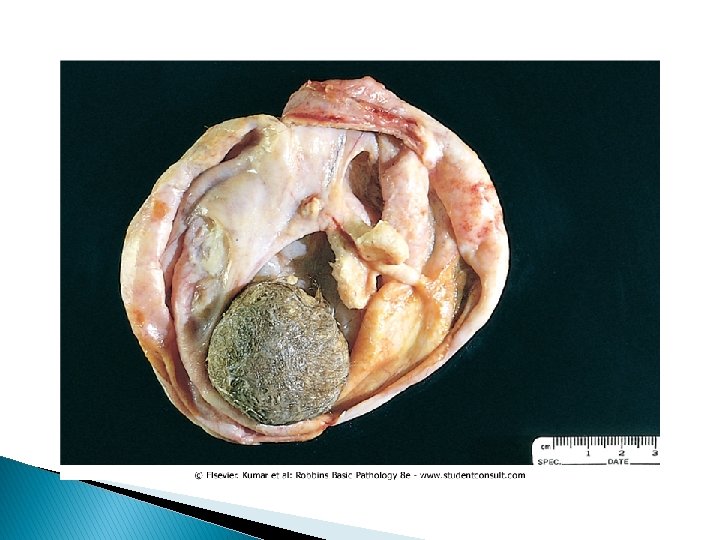
Germ cell tumors Benign (Mature) Cystic Teratomas: differentiation of totipotential germ cells into mature tissues representing all three germ cell layers: ectoderm, endoderm, and mesoderm. � Most are discovered in young women as ovarian masses or are found incidentally on abdominal scans because they contain foci of calcification produced by contained teeth. � 90% are unilateral � Grossly: often filled with sebaceous secretion and matted hair. Sometimes, foci of bone and cartilage, nests of bronchial or gastrointestinal epithelium, teeth and other recognizable lines of development are also present. � In 1% of cases there is malignant transformation of one of the tissue elements, usually taking the form of a squamous cell carcinoma. � these tumors are prone to undergo torsion (10% to 15% of cases), producing an acute surgical emergency �
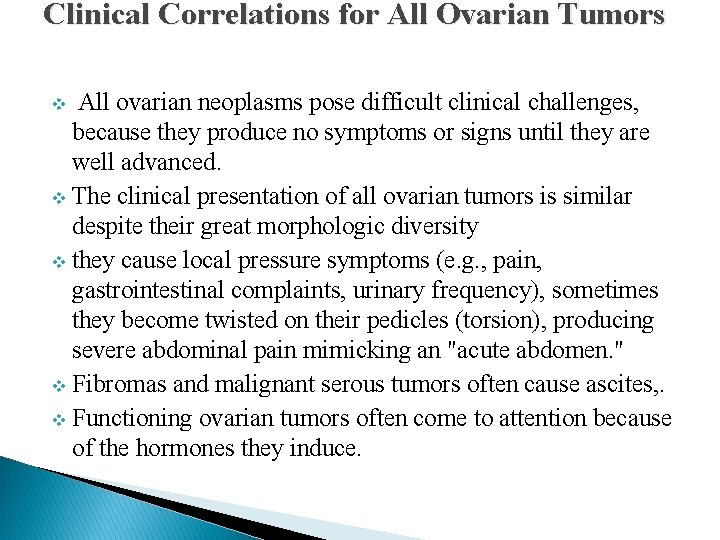
Clinical Correlations for All Ovarian Tumors All ovarian neoplasms pose difficult clinical challenges, because they produce no symptoms or signs until they are well advanced. v The clinical presentation of all ovarian tumors is similar despite their great morphologic diversity v they cause local pressure symptoms (e. g. , pain, gastrointestinal complaints, urinary frequency), sometimes they become twisted on their pedicles (torsion), producing severe abdominal pain mimicking an "acute abdomen. " v Fibromas and malignant serous tumors often cause ascites, . v Functioning ovarian tumors often come to attention because of the hormones they induce. v
- Slides: 20