
Pathology Laboratory By Alejandra Munoz CPC NCICS Types
Pathology & Laboratory By Alejandra Munoz, CPC, NCICS
Types of Pathology and Laboratory • Organ or Disease-Oriented Panels • Transfusion Medicine • Drug Testing • Microbiology • Therapeutic Drug Assays • Anatomic Pathology • Evocative/Suppression Testing • Cytogenetic Studies • Consultations (Clinical Pathology) • Surgical Pathology • Urinalysis • Transcutaneous Procedures • Molecular Pathology • Other Procedures • Chemistry • • Hematology and Coagulation Reproductive Medicine Procedures • Immunology
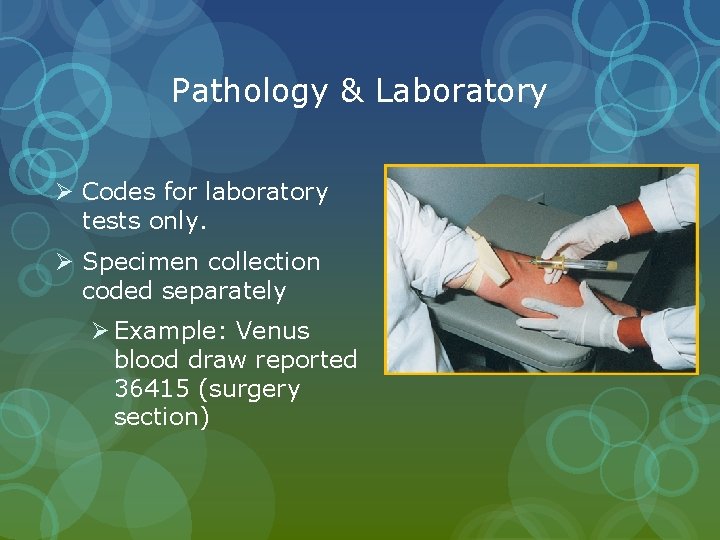
Pathology & Laboratory Ø Codes for laboratory tests only. Ø Specimen collection coded separately Ø Example: Venus blood draw reported 36415 (surgery section)
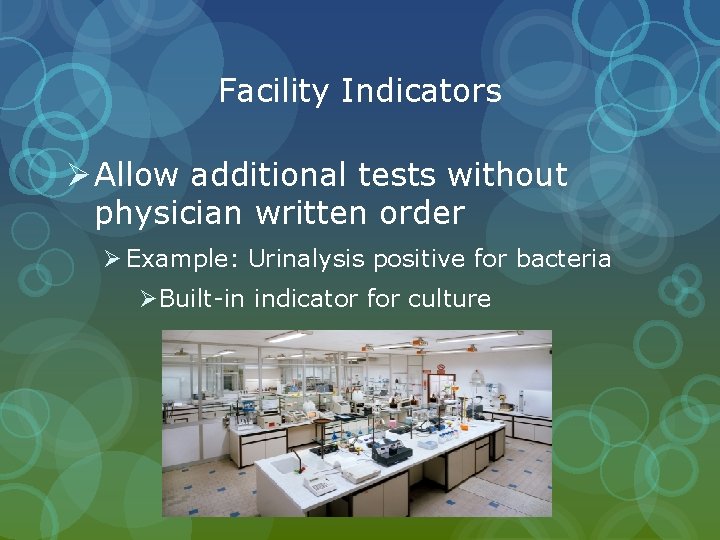
Facility Indicators Ø Allow additional tests without physician written order Ø Example: Urinalysis positive for bacteria ØBuilt-in indicator for culture
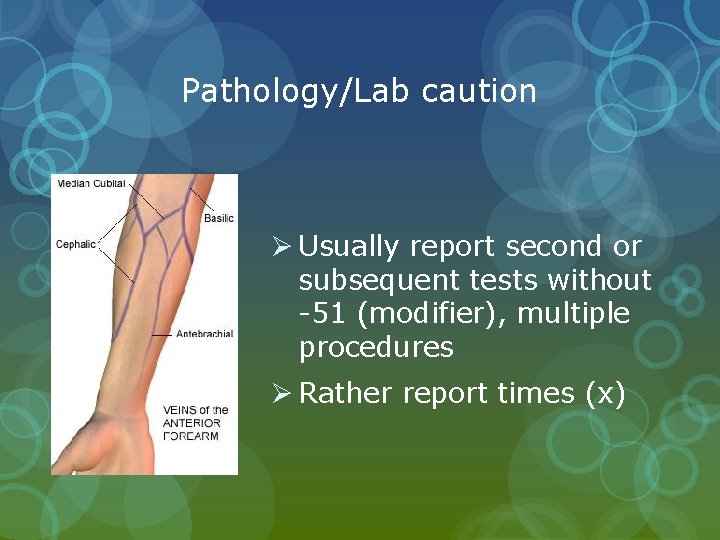
Pathology/Lab caution Ø Usually report second or subsequent tests without -51 (modifier), multiple procedures Ø Rather report times (x)
Organ or Disease-oriented Panels (80047 -80076) Ø Groups of tests often ordered together ØExamples: ØBasic Metabolic panel ØGeneral Health panel ØElectrolyte panel
Rules of Panels Ø All tests must have been conducted and be medically necessary Ø Do not use -52, Reduced Service Ø Additional tests, over those in panel, reported separately Ø If all test in panel not performed: Ø List each test separately Ø Do not use panel code Ø Problem oriented scope
Drug Testing (80100 -80104) Ø Lists drug screening, drug confirmation, and tissue preparation services Ø Identifies presence or absence of drug – qualitative analysis Ø Confirmation conducted to double check results of positive drug test (80102)
Drug Testing, Cont… Ø Chromatography” Procedure in which multiple drugs identified. ØSome machines identify all drugs present in one procedure ØOthers require two or more procedures to identify two or more drugs
Drug Testing, Cont. . Ø Code the number of procedures, not the number of drugs tested for. ØExample: ØTwo procedures to identify three drugs: 80100 x 2 ØOne procedure to identify three drugs: 80100
Therapeutic Drug Assays Ø Reports presence and amount (quantitative) or absence of a substance Ø Material examined can be from any source Ø Drugs listed by Generic names Ø Example: Amitriptyline generic name for brand name Elavil Ø PDR a must for coding drug testing Ø Measures peaks (after drug given at intervals) and troughs (before drug given) – used to monitor therapeutic drug medication adjustment
Evocation/Suppression Testing (80400 -80440) Ø Measures stimulating (evocative – calling forth a response) or suppressing agents Ø Codes report only TC of service ØTC= Technical Component
Evocation/Suppression Testing Ø Additional services to report: ØSupplies and/or drugs used in testing (99070 and/or HCPCS J codes) Ø E/M for physician monitoring of testing
Consultations (Clinical pathology) Ø At request of physician Ø Additional information about specimen Ø Consultant prepares written report Ø Levels Ø Limited: Without review of medical records Ø Comprehensive: With review of medical record
More Consultation codes… Ø Surgical pathology (8832188334) Ø Used when pathologist either: ØReviews slides, material, or reports ØProvides consultation during surgery Ø Reported on specimen, block, section, cytologic exam
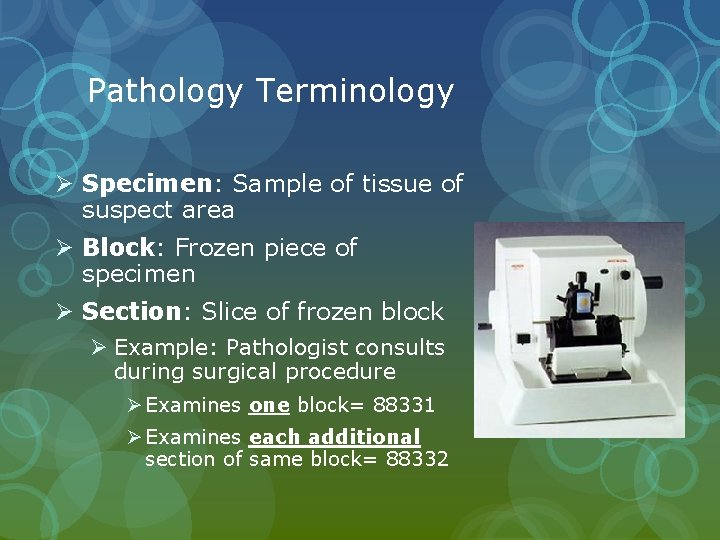
Pathology Terminology Ø Specimen: Sample of tissue of suspect area Ø Block: Frozen piece of specimen Ø Section: Slice of frozen block Ø Example: Pathologist consults during surgical procedure Ø Examines one block= 88331 Ø Examines each additional section of same block= 88332
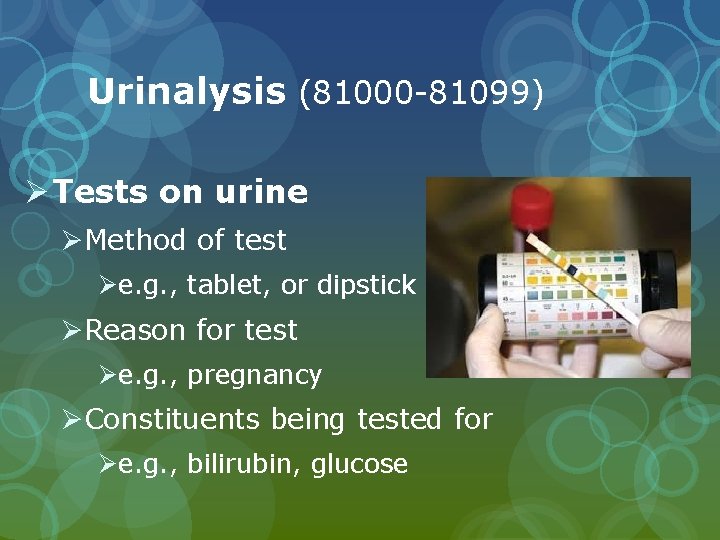
Urinalysis (81000 -81099) Ø Tests on urine ØMethod of test Øe. g. , tablet, or dipstick ØReason for test Øe. g. , pregnancy ØConstituents being tested for Øe. g. , bilirubin, glucose
Urinalysis, cont… Ø Equipment used ØAutomated or non automated ØWith or without a microscope Ø Number of test performed
Chemistry (82000 -84999) Ø Specific tests on any bodily substance ØUrine ØBlood ØBreath ØFeces Ø Most chemistry tests are quantitative (specific amount) unless specified qualitative
Chemistry, Cont… Ø Samples from different sources, reported separately Øe. g. , blood, feces Ø Samples taken at different times of days reported separately
Molecular pathology Procedures (81200 -81406) Ø 81200 -81383 are Tier 1 procedures that report molecular assay Ø More common gene specific procedures Ø Example: Breast cancer gene-81211 Ø 81499 -81406 are Tier 2 procedures to report less commonly performed analyses
Hematology and Coagulation (85002 -85999) Ø Laboratory procedures on blood ØExample: ØComplete blood count (CBC) ØWhite blood cell count (WBC) Ø Codes divided based on method of: ØBlood draw ØTest being conducted
Immunology (86000 -86804) Ø Identifying immune system conditions caused by antibodies and antigens ØExample: Hepatitis C antibody screening Ø Tissue typing ØBasic assay, screening, typing
Transfusion Medicine (8685086999) Ø Blood bank codes Ø Test performed on blood or blood products Ø Do NOT identify supply of blood, but ØCollection ØProcessing Øtyping
Surgical Pathology (8830088399) Ø Evaluation of specimens to determine disease pathology Ø All tissue removed during procedures undergoes pathology evaluation
Types of Pathologic Examination Ø Microscopic: With microscope Ø Gross: Without microscope Ø 88300, only gross exam code ØOther gross AND microscopic
Levels Ø Level I Ø Specimen can be diagnosed without microscopic examination Ø Level II Ø Gross and microscopic examination performed Ø Level III, IV, V, VI Ø Includes gross and microscopic examination and additional physician work Ø Based upon method of or need for removal Ø Same anatomic site can be listed in each level
Reference: Buck, C (2010). Step by Step. Elsevier.
- Slides: 28