
PATHOLOGICAL GAMBLING IMPULSE COMPULSION OR ADDICTION THE ADDICTION
PATHOLOGICAL GAMBLING: IMPULSE, COMPULSION, OR ADDICTION? THE ADDICTION PERSPECTIVE Nady el-Guebaly, MD*, Heidi Friesen BSR (OT)C, Jennifer Corbiell MSW. *Prof & Head, Addiction Division, U of Calgary Consultant, Addiction Centre & Program, Alberta Health Services Chair, Alberta Gaming Research Institute [AGRI] Program AGRI: www. abgaminginstitute. ualberta. ca Networ k
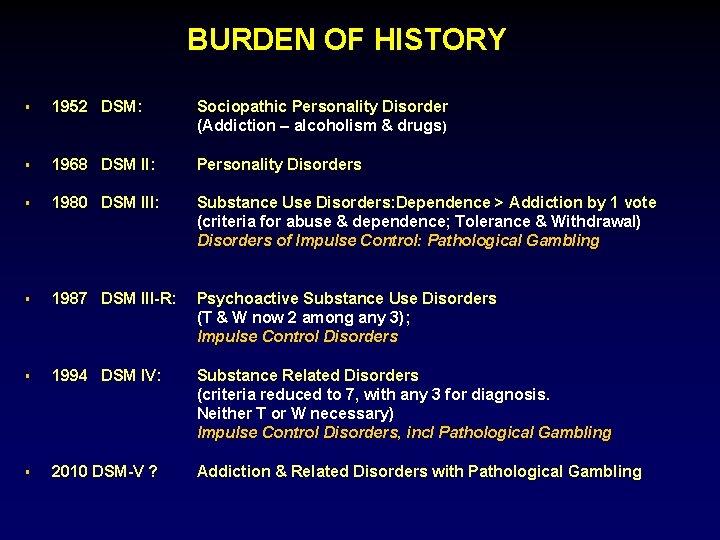
BURDEN OF HISTORY § 1952 DSM: Sociopathic Personality Disorder (Addiction – alcoholism & drugs) § 1968 DSM II: Personality Disorders § 1980 DSM III: Substance Use Disorders: Dependence > Addiction by 1 vote (criteria for abuse & dependence; Tolerance & Withdrawal) Disorders of Impulse Control: Pathological Gambling § 1987 DSM III-R: Psychoactive Substance Use Disorders (T & W now 2 among any 3); Impulse Control Disorders § 1994 DSM IV: Substance Related Disorders (criteria reduced to 7, with any 3 for diagnosis. Neither T or W necessary) Impulse Control Disorders, incl Pathological Gambling § 2010 DSM-V ? Addiction & Related Disorders with Pathological Gambling
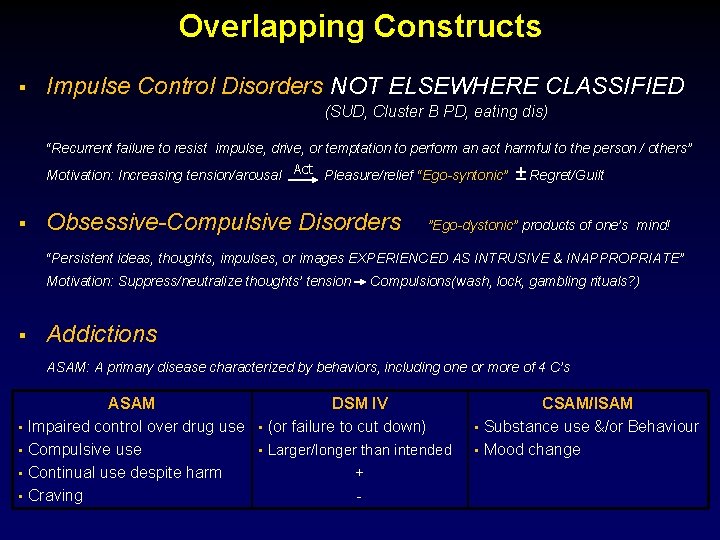
Overlapping Constructs § Impulse Control Disorders NOT ELSEWHERE CLASSIFIED (SUD, Cluster B PD, eating dis) “Recurrent failure to resist impulse, drive, or temptation to perform an act harmful to the person / others” Motivation: Increasing tension/arousal Act Pleasure/relief “Ego-syntonic” ± Regret/Guilt § Obsessive-Compulsive Disorders ”Ego-dystonic” products of one’s mind! “Persistent ideas, thoughts, impulses, or images EXPERIENCED AS INTRUSIVE & INAPPROPRIATE” Motivation: Suppress/neutralize thoughts’ tension § Compulsions(wash, lock, gambling rituals? ) Addictions ASAM: A primary disease characterized by behaviors, including one or more of 4 C’s ASAM • Impaired control over drug use • Compulsive use • Continual use despite harm • Craving DSM IV • (or failure to cut down) • Larger/longer than intended + CSAM/ISAM • Substance use &/or Behaviour • Mood change

WHY AM I CONFUSED? § IMPULSIVE/COMPULSIVE SPECTRUM ALONG HARM AVOIDANCE (HA) High HA Low HA OCD ICD BUT DIFFERENCE IS NOT CONSTANT Ø Ø § In OCD & PG , Mix of impulsivity & harm avoidance vary i. e. , suicidality (despair), course severity, appreciation of consequences Ø Cultural differences? Gender differences WHAT ABOUT ADDICTION’S MOTIVATION in HA? • Varied “impaired control” i. e. , initial caution disappears; apprec of consequences § WHAT ABOUT DENIAL? § Scarce investigation of triad OCT, ICD, & Addiction Unconscious disclaimer of intolerable thoughts / feelings / realities to allay anxiety.
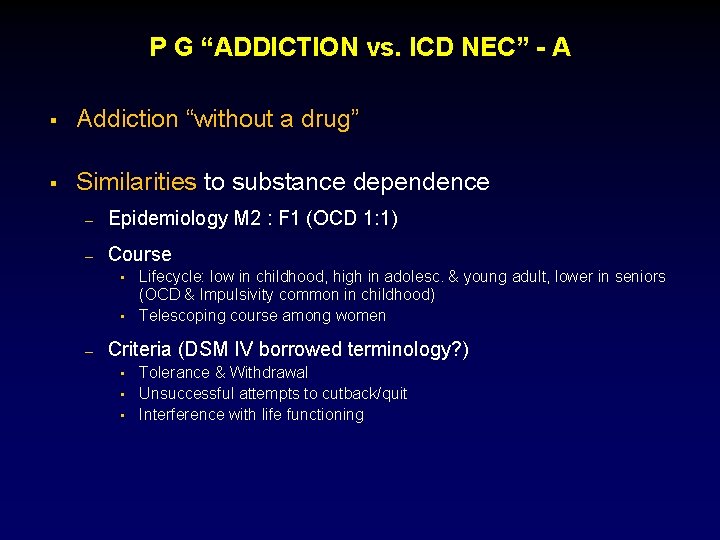
P G “ADDICTION vs. ICD NEC” - A § Addiction “without a drug” § Similarities to substance dependence – Epidemiology M 2 : F 1 (OCD 1: 1) – Course • • – Lifecycle: low in childhood, high in adolesc. & young adult, lower in seniors (OCD & Impulsivity common in childhood) Telescoping course among women Criteria (DSM IV borrowed terminology? ) • • • Tolerance & Withdrawal Unsuccessful attempts to cutback/quit Interference with life functioning
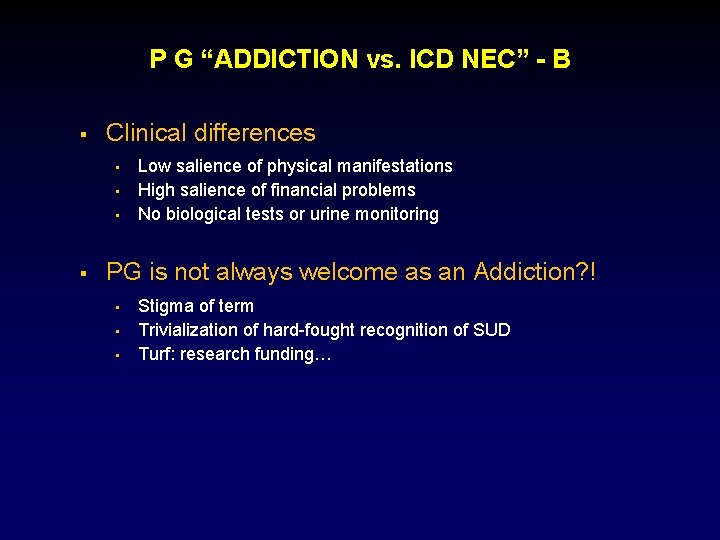
P G “ADDICTION vs. ICD NEC” - B § Clinical differences • • • § Low salience of physical manifestations High salience of financial problems No biological tests or urine monitoring PG is not always welcome as an Addiction? ! • • • Stigma of term Trivialization of hard fought recognition of SUD Turf: research funding…
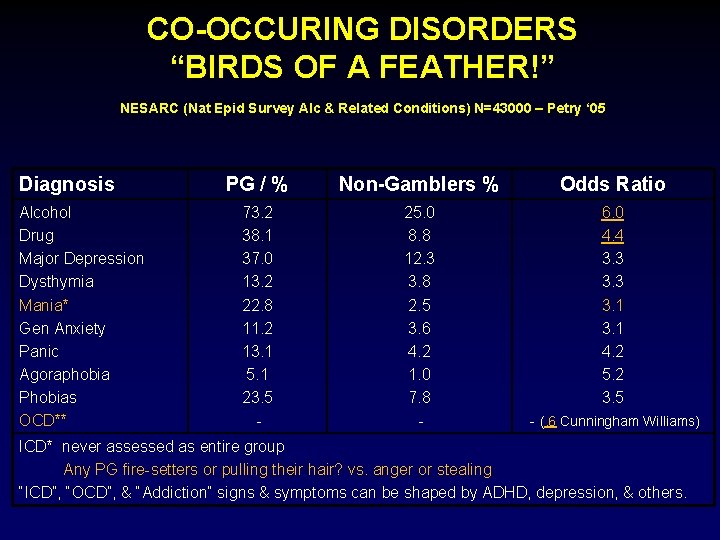
CO-OCCURING DISORDERS “BIRDS OF A FEATHER!” NESARC (Nat Epid Survey Alc & Related Conditions) N=43000 – Petry ‘ 05 Diagnosis Alcohol Drug Major Depression Dysthymia Mania* Gen Anxiety Panic Agoraphobia Phobias OCD** PG / % Non-Gamblers % Odds Ratio 73. 2 38. 1 37. 0 13. 2 22. 8 11. 2 13. 1 5. 1 23. 5 25. 0 8. 8 12. 3 3. 8 2. 5 3. 6 4. 2 1. 0 7. 8 6. 0 4. 4 3. 3 3. 1 4. 2 5. 2 3. 5 (. 6 Cunningham Williams) ICD* never assessed as entire group Any PG fire setters or pulling their hair? vs. anger or stealing “ICD”, “OCD”, & “Addiction” signs & symptoms can be shaped by ADHD, depression, & others.
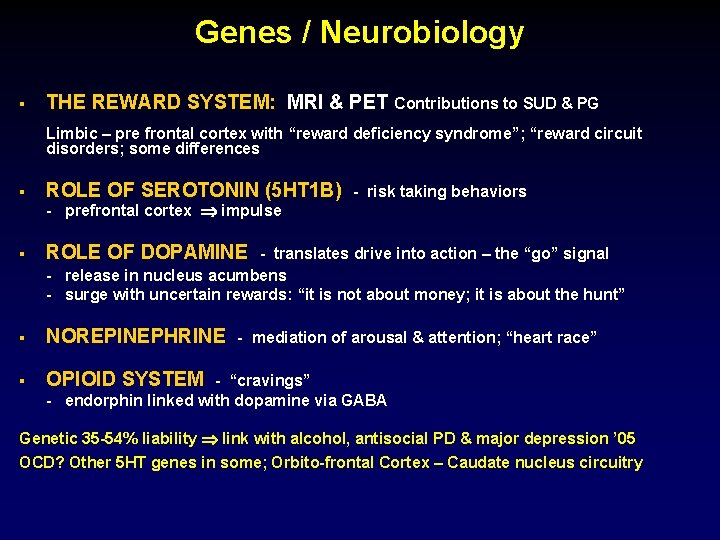
Genes / Neurobiology § THE REWARD SYSTEM: MRI & PET Contributions to SUD & PG Limbic – pre frontal cortex with “reward deficiency syndrome”; “reward circuit disorders; some differences § ROLE OF SEROTONIN (5 HT 1 B) - risk taking behaviors - prefrontal cortex impulse § ROLE OF DOPAMINE § NOREPINEPHRINE § OPIOID SYSTEM - translates drive into action – the “go” signal - release in nucleus acumbens - surge with uncertain rewards: “it is not about money; it is about the hunt” - mediation of arousal & attention; “heart race” - “cravings” - endorphin linked with dopamine via GABA Genetic 35 -54% liability link with alcohol, antisocial PD & major depression ’ 05 OCD? Other 5 HT genes in some; Orbito-frontal Cortex – Caudate nucleus circuitry
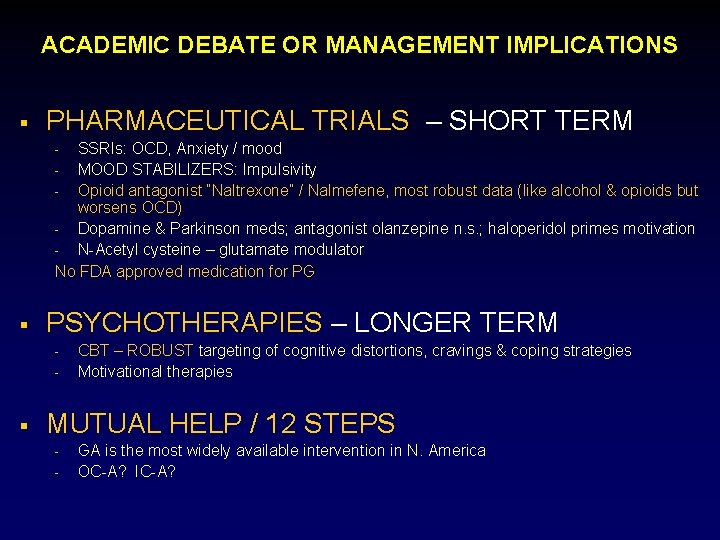
ACADEMIC DEBATE OR MANAGEMENT IMPLICATIONS § PHARMACEUTICAL TRIALS – SHORT TERM SSRIs: OCD, Anxiety / mood MOOD STABILIZERS: Impulsivity Opioid antagonist “Naltrexone” / Nalmefene, most robust data (like alcohol & opioids but worsens OCD) Dopamine & Parkinson meds; antagonist olanzepine n. s. ; haloperidol primes motivation N Acetyl cysteine – glutamate modulator No FDA approved medication for PG § PSYCHOTHERAPIES – LONGER TERM § CBT – ROBUST targeting of cognitive distortions, cravings & coping strategies Motivational therapies MUTUAL HELP / 12 STEPS GA is the most widely available intervention in N. America OC A? IC A?
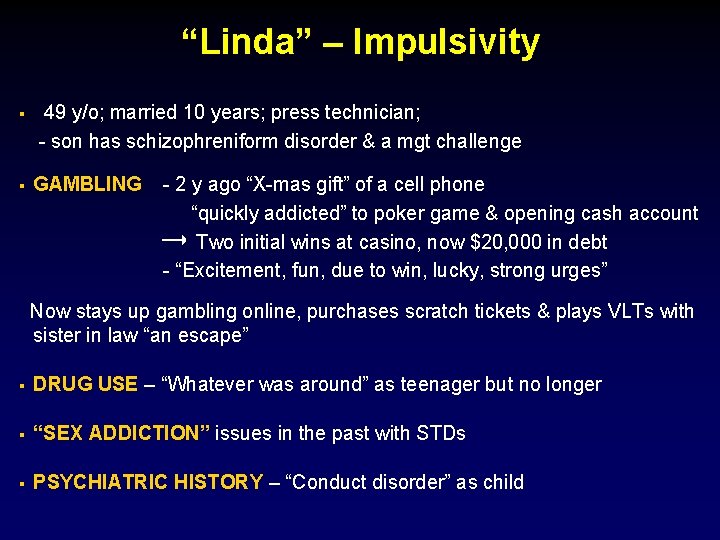
“Linda” – Impulsivity § § 49 y/o; married 10 years; press technician; son has schizophreniform disorder & a mgt challenge GAMBLING 2 y ago “X mas gift” of a cell phone “quickly addicted” to poker game & opening cash account Two initial wins at casino, now $20, 000 in debt “Excitement, fun, due to win, lucky, strong urges” Now stays up gambling online, purchases scratch tickets & plays VLTs with sister in law “an escape” § DRUG USE – “Whatever was around” as teenager but no longer § “SEX ADDICTION” issues in the past with STDs § PSYCHIATRIC HISTORY – “Conduct disorder” as child
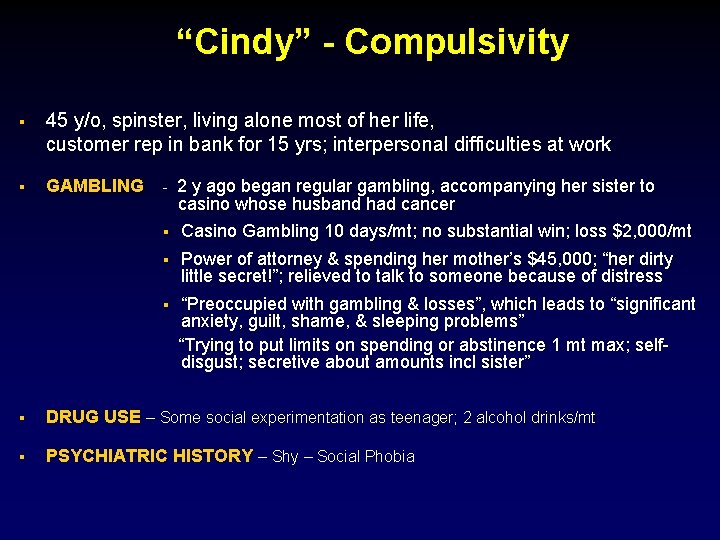
“Cindy” - Compulsivity § 45 y/o, spinster, living alone most of her life, customer rep in bank for 15 yrs; interpersonal difficulties at work § GAMBLING 2 y ago began regular gambling, accompanying her sister to casino whose husband had cancer § Casino Gambling 10 days/mt; no substantial win; loss $2, 000/mt § Power of attorney & spending her mother’s $45, 000; “her dirty little secret!”; relieved to talk to someone because of distress § “Preoccupied with gambling & losses”, which leads to “significant anxiety, guilt, shame, & sleeping problems” “Trying to put limits on spending or abstinence 1 mt max; self disgust; secretive about amounts incl sister” § DRUG USE – Some social experimentation as teenager; 2 alcohol drinks/mt § PSYCHIATRIC HISTORY – Shy – Social Phobia
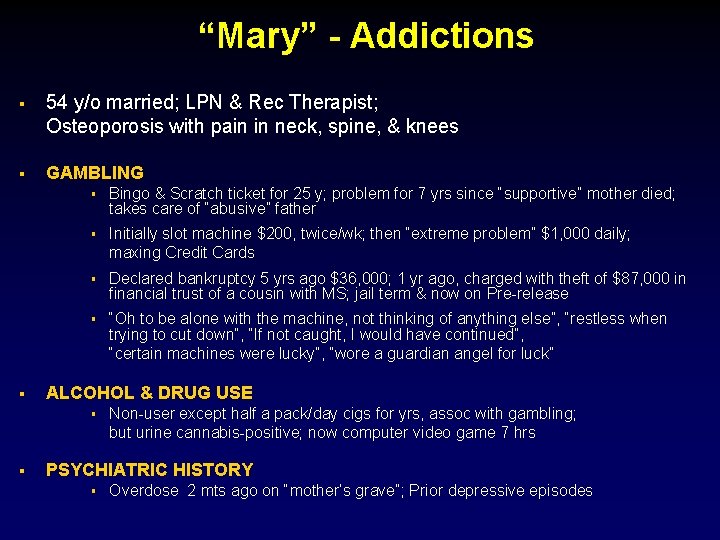
“Mary” - Addictions § 54 y/o married; LPN & Rec Therapist; Osteoporosis with pain in neck, spine, & knees § GAMBLING § § Bingo & Scratch ticket for 25 y; problem for 7 yrs since “supportive” mother died; takes care of “abusive” father § Initially slot machine $200, twice/wk; then “extreme problem” $1, 000 daily; maxing Credit Cards § Declared bankruptcy 5 yrs ago $36, 000; 1 yr ago, charged with theft of $87, 000 in financial trust of a cousin with MS; jail term & now on Pre release § “Oh to be alone with the machine, not thinking of anything else”, “restless when trying to cut down”, “If not caught, I would have continued”, “certain machines were lucky”, “wore a guardian angel for luck” ALCOHOL & DRUG USE § § Non user except half a pack/day cigs for yrs, assoc with gambling; but urine cannabis positive; now computer video game 7 hrs PSYCHIATRIC HISTORY § Overdose 2 mts ago on “mother’s grave”; Prior depressive episodes
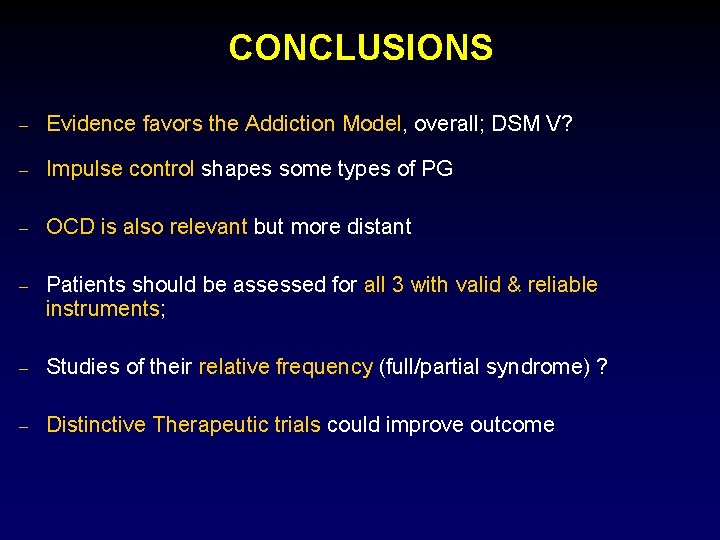
CONCLUSIONS – Evidence favors the Addiction Model, overall; DSM V? – Impulse control shapes some types of PG – OCD is also relevant but more distant – Patients should be assessed for all 3 with valid & reliable instruments; – Studies of their relative frequency (full/partial syndrome) ? – Distinctive Therapeutic trials could improve outcome
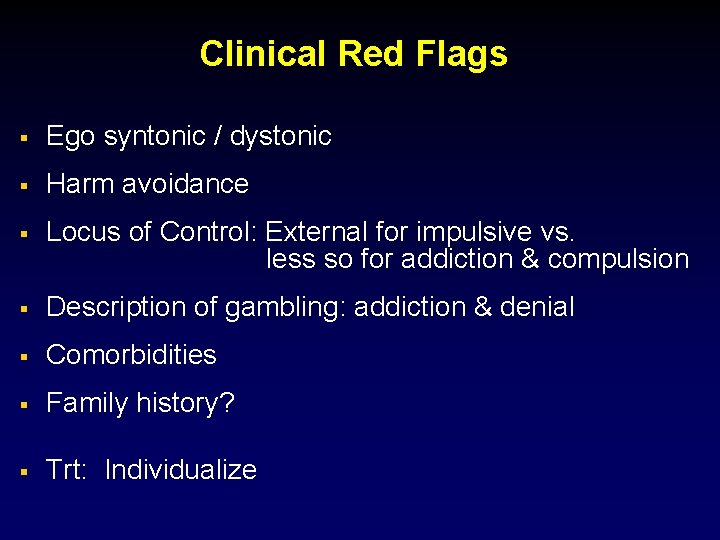
Clinical Red Flags § Ego syntonic / dystonic § Harm avoidance § Locus of Control: External for impulsive vs. less so for addiction & compulsion § Description of gambling: addiction & denial § Comorbidities § Family history? § Trt: Individualize
- Slides: 14