
Pathological fractures continued Are pathological fractures traumatic We
![Pathological fractures with a stated underlying bone disease • Pathological fracture [of X bone]](https://slidetodoc.com/presentation_image_h2/a559b0c92acfcb2de42ba309073fd836/image-8.jpg "Pathological fractures with a stated underlying bone disease • Pathological fracture [of X bone]")
- Slides: 13
Pathological fractures continued
Are pathological fractures traumatic? • We have agreement that fractures do not arise spontaneously but rather due to some external physical force acting on bone. • There is however a difference between a physical force that is encountered during normal daily activities that would result in a fracture only of a bone weakened by disease as opposed to an external force of sufficient magnitude that could result in a fracture of normal bone. • The above is what distinguishes what are commonly referred to in the literature as nontraumatic fractures from traumatic fractures
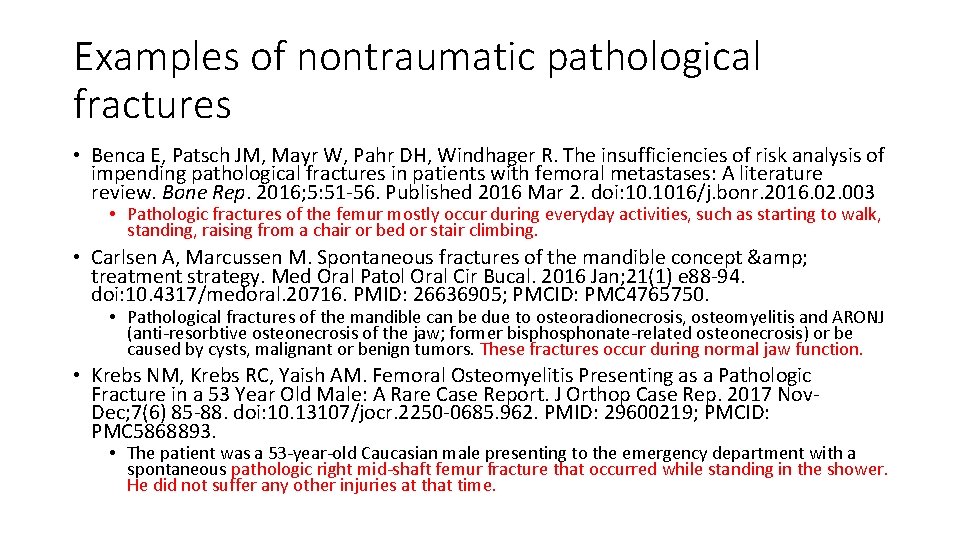
Examples of nontraumatic pathological fractures • Benca E, Patsch JM, Mayr W, Pahr DH, Windhager R. The insufficiencies of risk analysis of impending pathological fractures in patients with femoral metastases: A literature review. Bone Rep. 2016; 5: 51 -56. Published 2016 Mar 2. doi: 10. 1016/j. bonr. 2016. 02. 003 • Pathologic fractures of the femur mostly occur during everyday activities, such as starting to walk, standing, raising from a chair or bed or stair climbing. • Carlsen A, Marcussen M. Spontaneous fractures of the mandible concept & treatment strategy. Med Oral Patol Oral Cir Bucal. 2016 Jan; 21(1) e 88 -94. doi: 10. 4317/medoral. 20716. PMID: 26636905; PMCID: PMC 4765750. • Pathological fractures of the mandible can be due to osteoradionecrosis, osteomyelitis and ARONJ (anti-resorbtive osteonecrosis of the jaw; former bisphonate-related osteonecrosis) or be caused by cysts, malignant or benign tumors. These fractures occur during normal jaw function. • Krebs NM, Krebs RC, Yaish AM. Femoral Osteomyelitis Presenting as a Pathologic Fracture in a 53 Year Old Male: A Rare Case Report. J Orthop Case Rep. 2017 Nov. Dec; 7(6) 85 -88. doi: 10. 13107/jocr. 2250 -0685. 962. PMID: 29600219; PMCID: PMC 5868893. • The patient was a 53 -year-old Caucasian male presenting to the emergency department with a spontaneous pathologic right mid-shaft femur fracture that occurred while standing in the shower. He did not suffer any other injuries at that time.
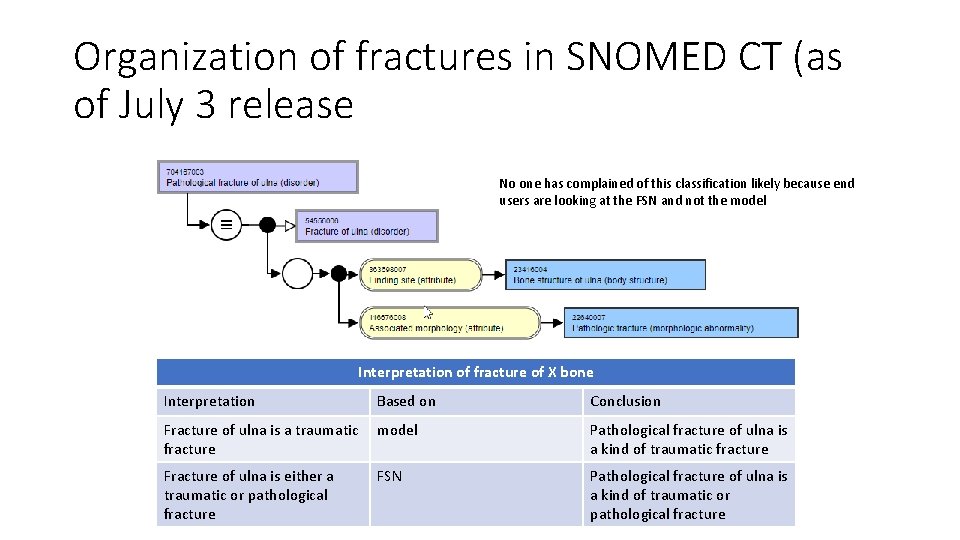
Organization of fractures in SNOMED CT (as of July 3 release No one has complained of this classification likely because end users are looking at the FSN and not the model Interpretation of fracture of X bone Interpretation Based on Conclusion Fracture of ulna is a traumatic fracture model Pathological fracture of ulna is a kind of traumatic fracture Fracture of ulna is either a traumatic or pathological fracture FSN Pathological fracture of ulna is a kind of traumatic or pathological fracture
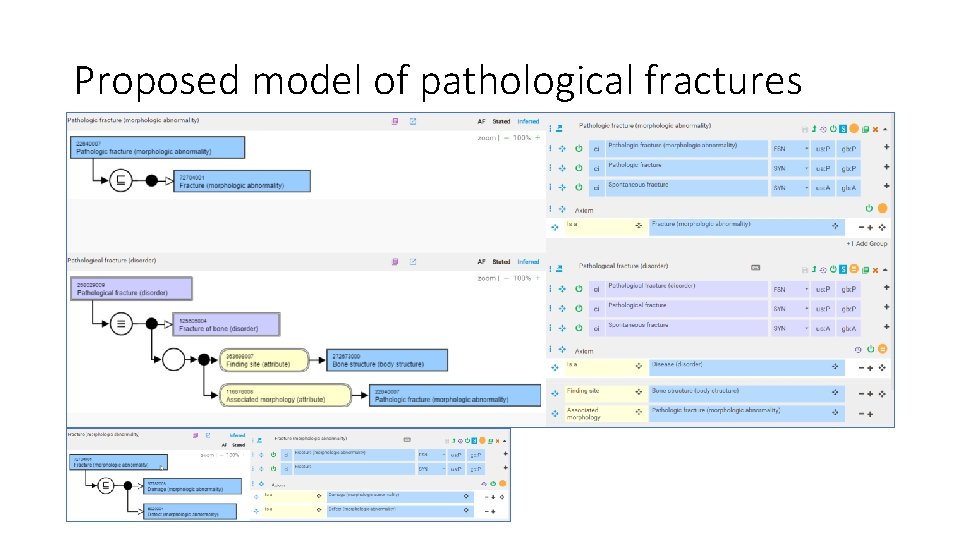
Proposed model of pathological fractures
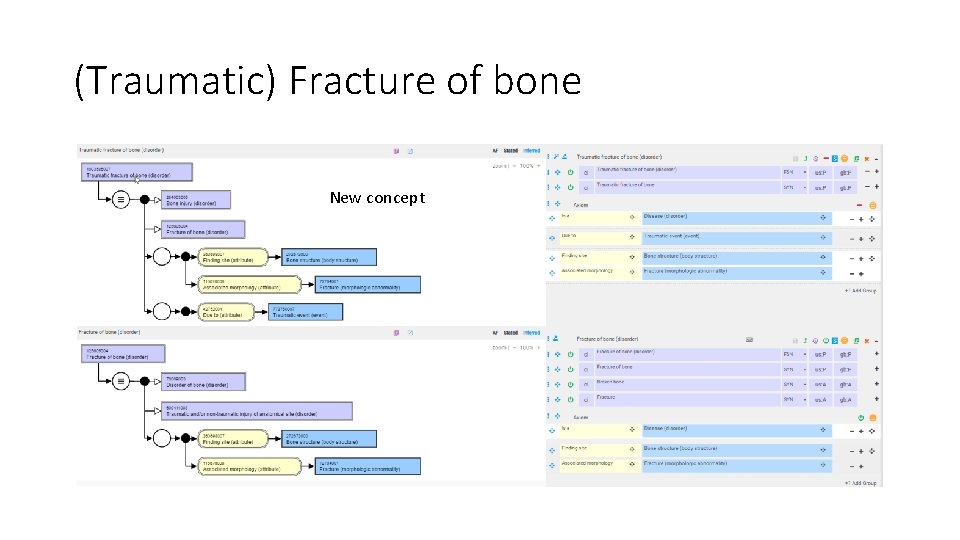
(Traumatic) Fracture of bone New concept
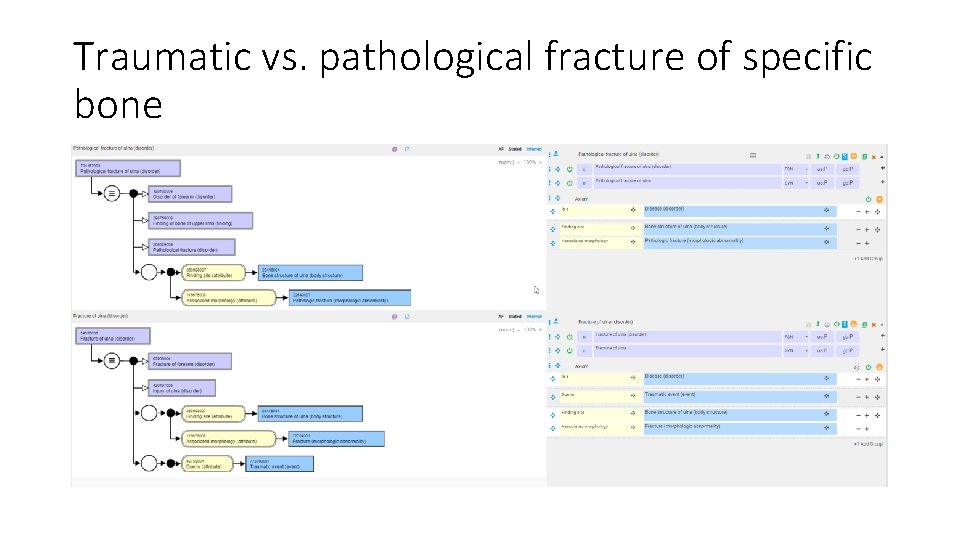
Traumatic vs. pathological fracture of specific bone
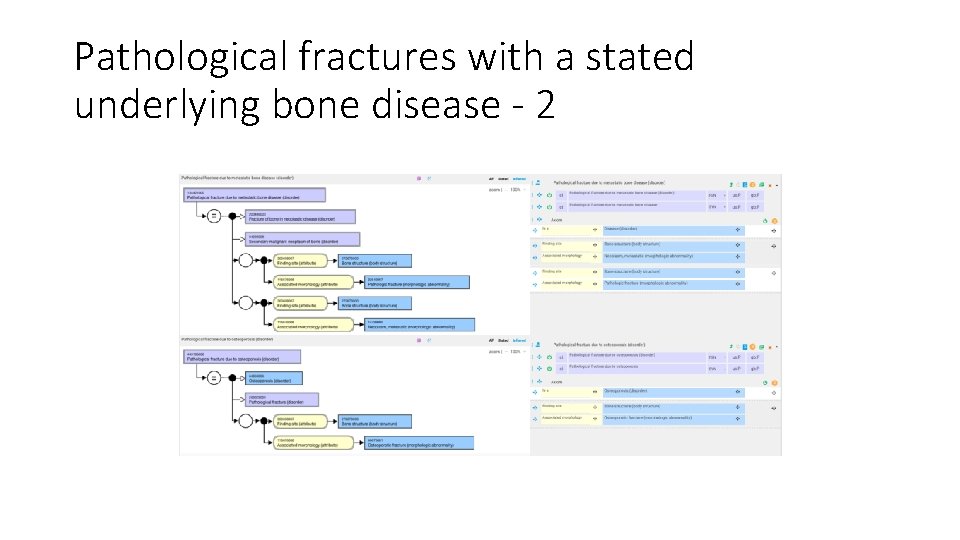
Pathological fractures with a stated underlying bone disease • Pathological fracture [of X bone] [due to Y disease] • Y disease: • <<Osteoporosis • Neoplastic disease • Metastatic bone disease • As pathological fractures are directly due to a physical force occurring in a diseased bone, our model captures the diseased bone with a 2 nd role group (or proximal primitive parent).
Pathological fractures with a stated underlying bone disease - 2
Pathological fractures with a stated underlying bone disease - terming • 134421000 |Pathological fracture due to metastatic bone disease (disorder)| • Having “due to” in the FSN is counterintuitive as a due to relationship is not included in the model. • Suggested terming for pathological fractures with a stated underlying bone disease • Use the underlying disease as an adjectival modifier of the fracture • E. g. • Neoplastic pathological fracture [of X bone] • Metastatic pathological fracture [of X bone] • Osteoporotic pathological fracture [of X bone] * *See next slide
Insufficiency fractures • Insufficiency fracture – An insufficiency fracture occurs when the mechanical strength of a bone is reduced to the point at which a stress that would not fracture a healthy bone breaks the weak one. The condition that causes reduced bone strength typically does so throughout the skeleton (eg, osteoporosis, osteomalacia, or osteogenesis imperfecta) but may be more localized (eg, demineralization in a limb due to disuse). • Pathologic fracture – A pathologic fracture is due to a localized loss of strength in a bone from a disease process immediately underlying the bone. Examples of pathologic fractures include those that occur at sites of bone tumors (primary or metastatic), bone cysts, and infections.
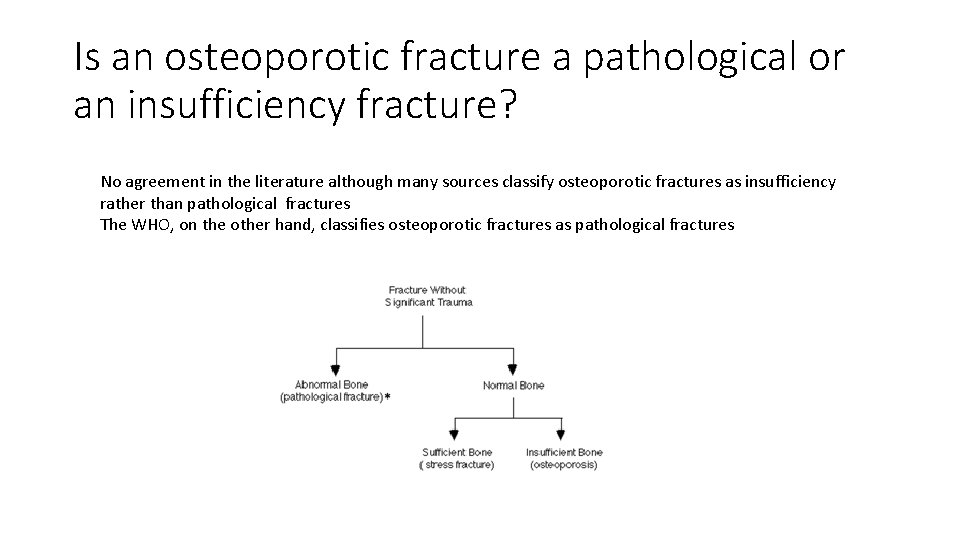
Is an osteoporotic fracture a pathological or an insufficiency fracture? No agreement in the literature although many sources classify osteoporotic fractures as insufficiency rather than pathological fractures The WHO, on the other hand, classifies osteoporotic fractures as pathological fractures
Additional questions • Should all concepts with an FSN of Fracture of X bone (disorder) have a synonym of Traumatic fracture of bone (disorder) as these will no longer subsume, similar Pathological fracture of X bone (disorder) concepts? • Should a SD grouper of Nontraumatic fracture of bone be created?