
PATHOGEN REDUCTION A SCIENTIFIC DIALOGUE PANEL 4 INTERVENTION


- Slides: 31
PATHOGEN REDUCTION A SCIENTIFIC DIALOGUE PANEL 4: INTERVENTION STRATEGIES REDUCTION OF CONTAMINATION AT SLAUGHTER John N. Sofos May 7, 2002
Reduction of Contamination at Slaughter Decontamination Processes or Interventions Before hide removal Animal cleaning and hair removal Chemical dehairing After hide removal Knife-trimming or Steam-vacuuming Washing/Spraying/Rinsing Water or Chemicals; Cold or Hot Pressurized steam Chilling Multiple Combined/Sequential Interventions Fabrication/Distribution/Processing/Retail?
Reduction of Contamination at Slaughter ANIMAL CLEANING AND HAIR REMOVAL
Reduction of Contamination at Slaughter Animal cleaning and hair removal Fecal tag and hair removal Animal washing Variable results Limited application Climate/facilities Alternatives: Segregate soiled animals Reduce slaughter speed Increase personnel
Reduction of Contamination at Slaughter CHEMICAL DEHAIRING
Reduction of Contamination at Slaughter Chemical dehairing Effective procedure Sodium sulfide and hydrogen peroxide Spraying Capital investment Waste handling Sodium sulfide: regeneration and reuse Hydrolyzed hair: fertilizer
Reduction of Contamination at Slaughter KNIFE-TRIMMING AND STEAM-VACUUMING
Reduction of Contamination at Slaughter Knife-Trimming Required “Zero Tolerance” Variable results for microbial reduction Potential for spreading and cross-contamination Necessary and important for aesthetics Steam-vacuuming Spot decontamination ( 1 inch) Variable results Equipment maintenance Employee diligence
Reduction of Contamination at Slaughter CARCASS WASHING AND DECONTAMINATION
Reduction of Contamination at Slaughter Whole (pre-evis) or half (before chilling) carcass Immersion/flooding/deluging/cascading Spraying or rinsing Water or chemical solutions Important variables: Method, stage and time of application Equipment design and maintenance Pressure and nozzle type Temperature Chemicals Duration
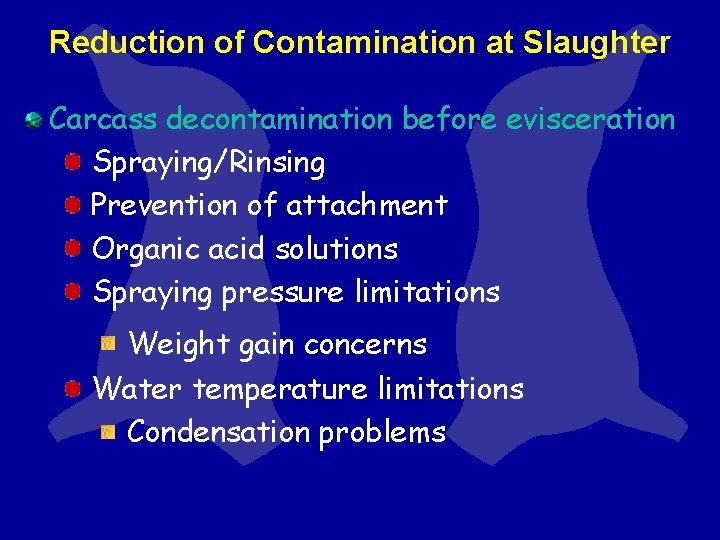
Reduction of Contamination at Slaughter Carcass decontamination before evisceration Spraying/Rinsing Prevention of attachment Organic acid solutions Spraying pressure limitations Weight gain concerns Water temperature limitations Condensation problems
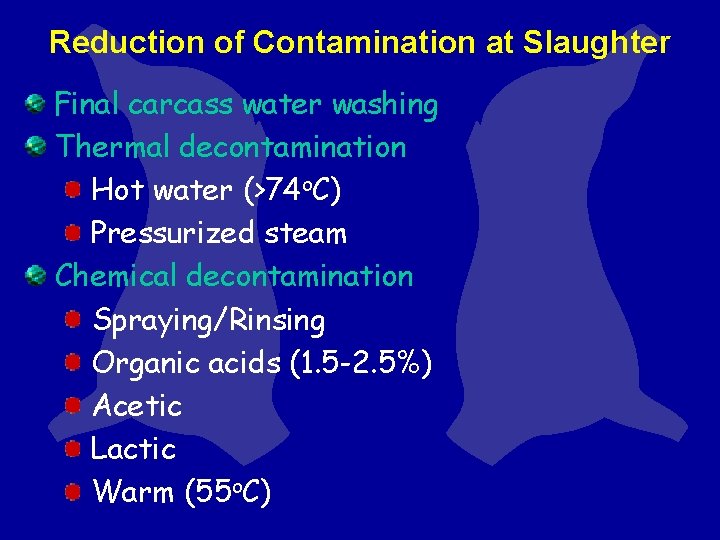
Reduction of Contamination at Slaughter Final carcass water washing Thermal decontamination Hot water (>74 o. C) Pressurized steam Chemical decontamination Spraying/Rinsing Organic acids (1. 5 -2. 5%) Acetic Lactic Warm (55 o. C)
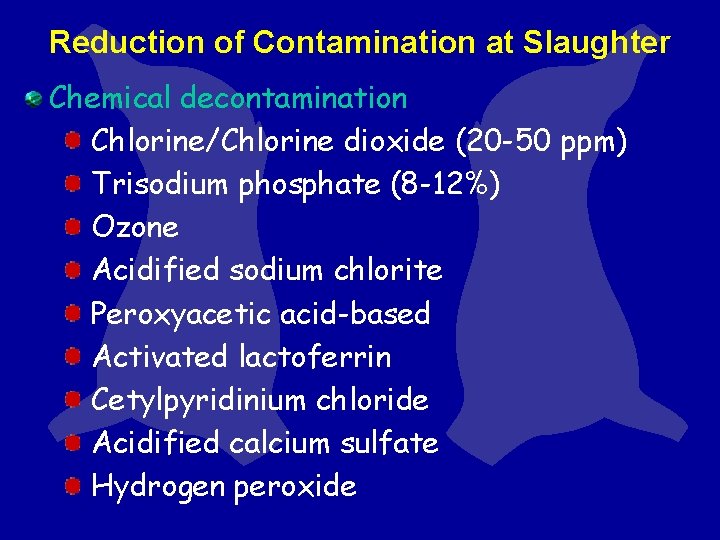
Reduction of Contamination at Slaughter Chemical decontamination Chlorine/Chlorine dioxide (20 -50 ppm) Trisodium phosphate (8 -12%) Ozone Acidified sodium chlorite Peroxyacetic acid-based Activated lactoferrin Cetylpyridinium chloride Acidified calcium sulfate Hydrogen peroxide
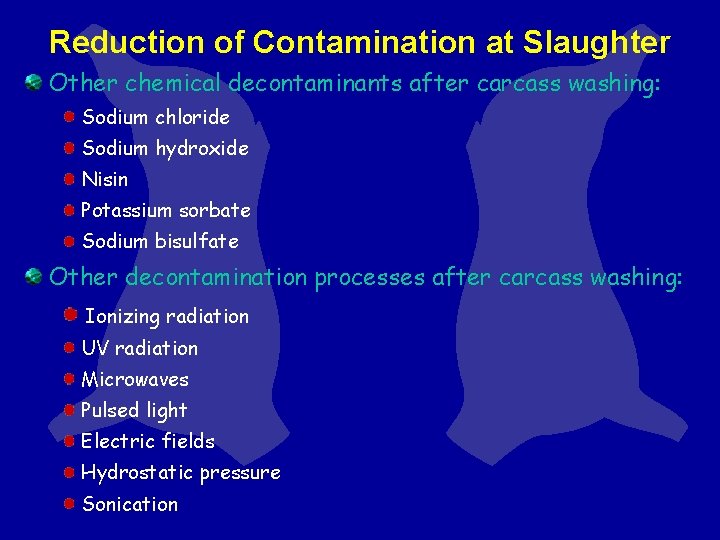
Reduction of Contamination at Slaughter Other chemical decontaminants after carcass washing: Sodium chloride Sodium hydroxide Nisin Potassium sorbate Sodium bisulfate Other decontamination processes after carcass washing: Ionizing radiation UV radiation Microwaves Pulsed light Electric fields Hydrostatic pressure Sonication
Reduction of Contamination at Slaughter MULTIPLE COMBINED AND/OR SEQUENTIAL DECONTAMINATION
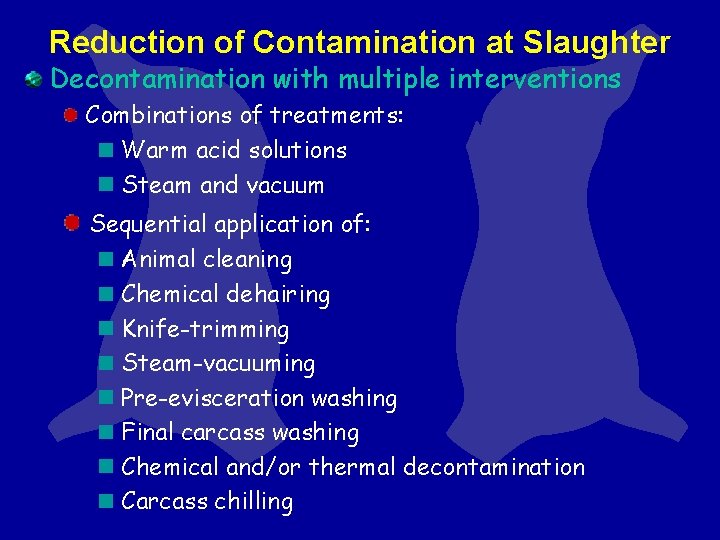
Reduction of Contamination at Slaughter Decontamination with multiple interventions Combinations of treatments: Warm acid solutions Steam and vacuum Sequential application of: Animal cleaning Chemical dehairing Knife-trimming Steam-vacuuming Pre-evisceration washing Final carcass washing Chemical and/or thermal decontamination Carcass chilling
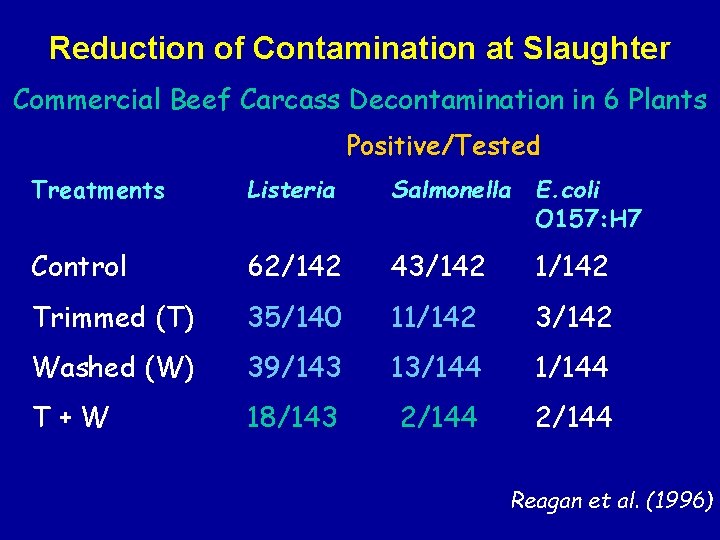
Reduction of Contamination at Slaughter Commercial Beef Carcass Decontamination in 6 Plants Positive/Tested Treatments Listeria Salmonella E. coli O 157: H 7 Control 62/142 43/142 1/142 Trimmed (T) 35/140 11/142 3/142 Washed (W) 39/143 13/144 1/144 T+W 18/143 2/144 Reagan et al. (1996)
Reduction of Contamination at Slaughter CARCASS WASHING AND DECONTAMINATION CONCERNS
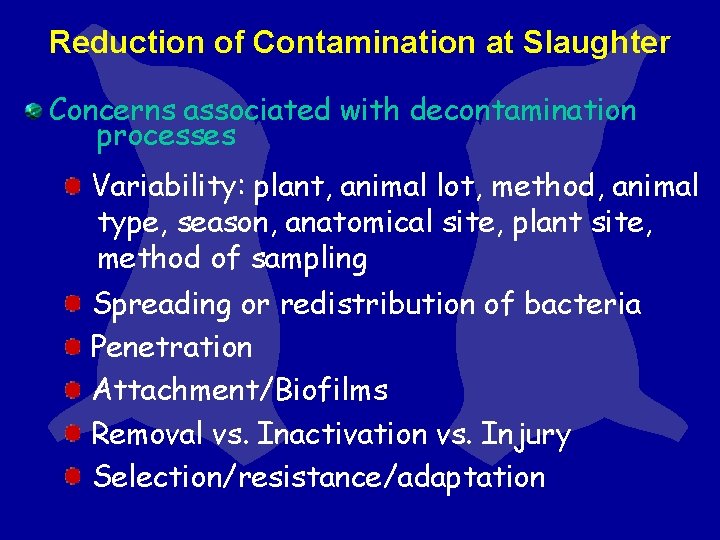
Reduction of Contamination at Slaughter Concerns associated with decontamination processes Variability: plant, animal lot, method, animal type, season, anatomical site, plant site, method of sampling Spreading or redistribution of bacteria Penetration Attachment/Biofilms Removal vs. Inactivation vs. Injury Selection/resistance/adaptation
Reduction of Contamination at Slaughter Salmonella in 4 Steer/Heifer and 3 Cow/Bull Plants Animal Type and Season Variation Sofos et al. (1999)
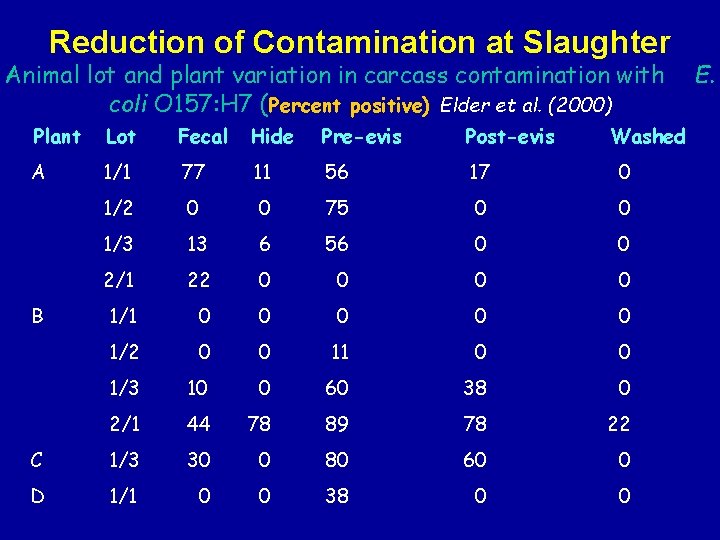
Reduction of Contamination at Slaughter Animal lot and plant variation in carcass contamination with coli O 157: H 7 (Percent positive) Elder et al. (2000) Plant Lot Fecal Hide Pre-evis Post-evis A 1/1 77 11 56 17 0 1/2 0 0 75 0 0 1/3 13 6 56 0 0 2/1 22 0 0 1/1 0 0 0 1/2 0 0 11 0 0 1/3 10 0 60 38 0 2/1 44 78 89 78 22 C 1/3 30 0 80 60 0 D 1/1 0 0 38 0 0 B Washed E.
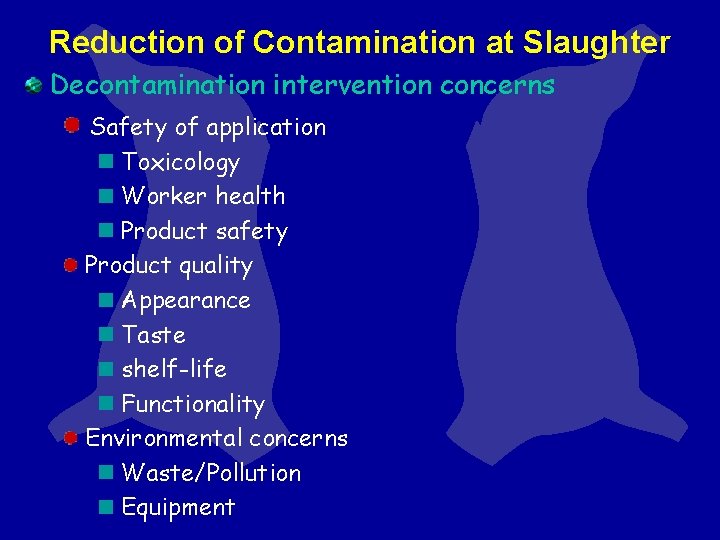
Reduction of Contamination at Slaughter Decontamination intervention concerns Safety of application Toxicology Worker health Product safety Product quality Appearance Taste shelf-life Functionality Environmental concerns Waste/Pollution Equipment
Reduction of Contamination at Slaughter RECONTAMINATION CONCERNS AND POTENTIAL FOR POST-SLAUGHTER DECONTAMINATION
Reduction of Contamination at Slaughter Contamination concerns following slaughter Carcass chilling Contamination reduction? Microbial growth? Additional contamination? Chilling rate Chilling uniformity Sanitation and hygiene
Reduction of Contamination at Slaughter Carcass fabrication concerns New and additional contamination Spreading and redistribution Microbial growth Sanitation and hygiene Room temperature Time duration Potential decontamination interventions Application technology issues Labeling issues
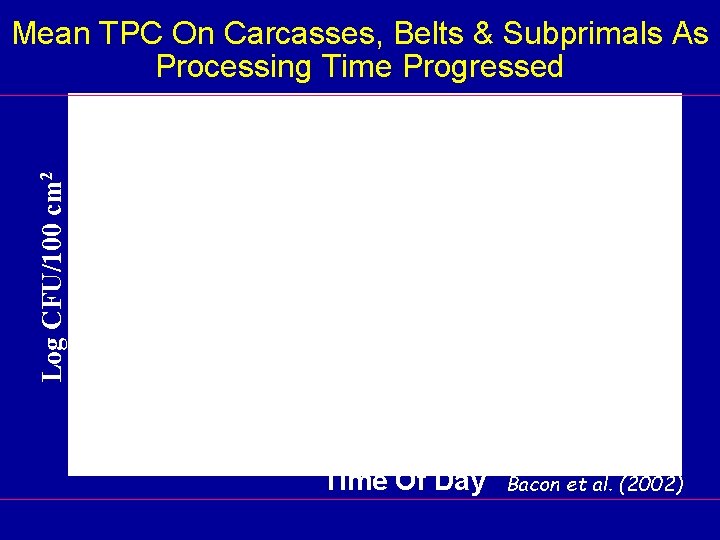
Log CFU/100 cm 2 Mean TPC On Carcasses, Belts & Subprimals As Processing Time Progressed Time Of Day Bacon et al. (2002)
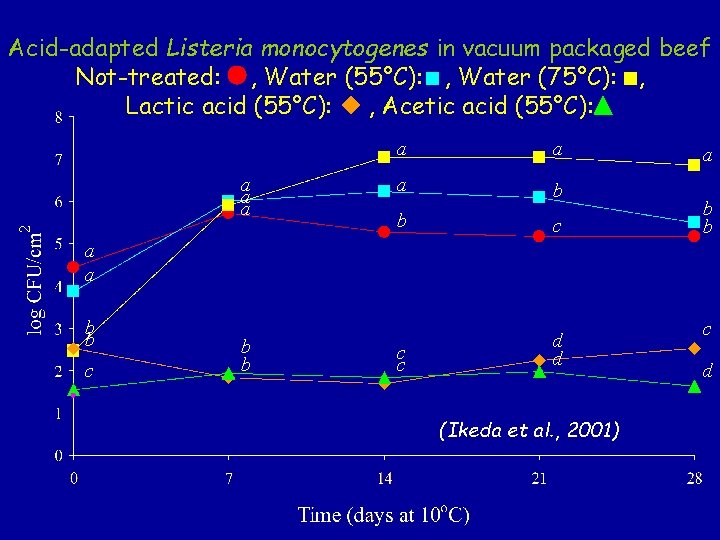
Acid-adapted Listeria monocytogenes in vacuum packaged beef Not-treated: , Water (55°C): , Water (75°C): , Lactic acid (55°C): , Acetic acid (55°C): 2 a a a b b c c c d d a b b a a b b c b b (Ikeda et al. , 2001) c d
Reduction of Contamination at Slaughter QUESTIONS CONCERNS ISSUES
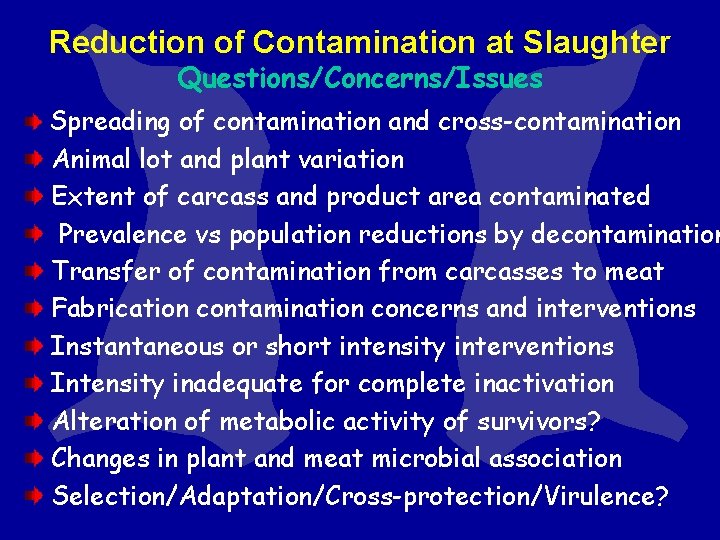
Reduction of Contamination at Slaughter Questions/Concerns/Issues Spreading of contamination and cross-contamination Animal lot and plant variation Extent of carcass and product area contaminated Prevalence vs population reductions by decontamination Transfer of contamination from carcasses to meat Fabrication contamination concerns and interventions Instantaneous or short intensity interventions Intensity inadequate for complete inactivation Alteration of metabolic activity of survivors? Changes in plant and meat microbial association Selection/Adaptation/Cross-protection/Virulence?
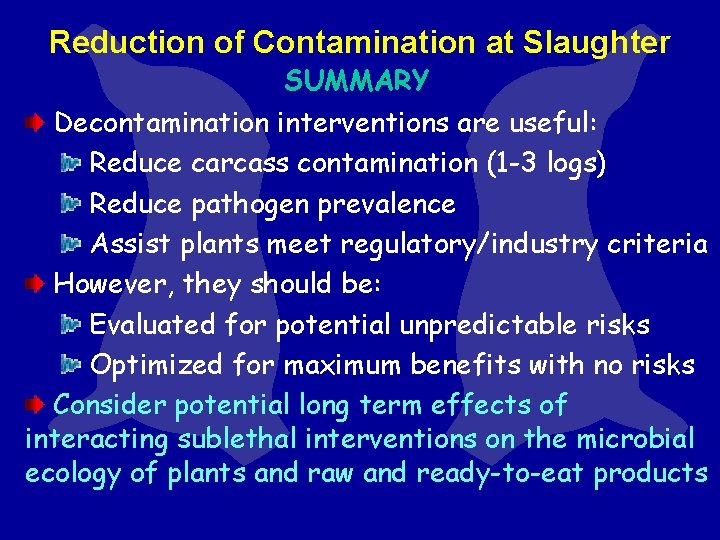
Reduction of Contamination at Slaughter SUMMARY Decontamination interventions are useful: Reduce carcass contamination (1 -3 logs) Reduce pathogen prevalence Assist plants meet regulatory/industry criteria However, they should be: Evaluated for potential unpredictable risks Optimized for maximum benefits with no risks Consider potential long term effects of interacting sublethal interventions on the microbial ecology of plants and raw and ready-to-eat products
Reduction of Contamination at Slaughter SUMMARY Select and apply proper interventions of the right intensity and in the correct sequence in order to maximize antimicrobial effects and minimize resistance development Evaluate further processing concerns Research new technologies and beyond slaughter Validation of decontamination technologies Minimize decontamination variations Not ready-to-eat until further processed/cooked Useful in reducing probability of illness when product intentionally or unintentionally undercooked