
Path Testing Coverage Chapter 9 Assigned reading from
- Slides: 21
Path Testing + Coverage Chapter 9 Assigned reading from Binder
Structural Testing n n Also known as glass/white/open box testing A software testing technique whereby explicit knowledge of the internal workings of the item being tested are used to select the test data Functional Testing uses program specification Structural Testing is based on specific knowledge of the source code to define the test cases and to examine outputs. 2
Structural Testing n Structural testing methods are very amenable to: n Rigorous definitions n n Mathematical analysis n n Control flow, data flow, coverage criteria Graphs, path analysis Precise measurement n Metrics, coverage analysis 3
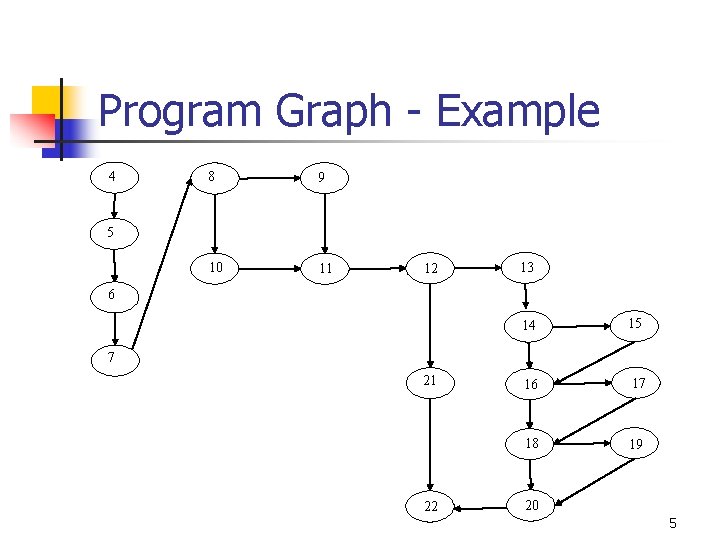
Program Graph - Definition n n Given a program written in an imperative programming language, its program graph is a directed graph in which nodes are statement fragments, and edges represent flow of control A complete statement is also considered a statement fragment 4
Program Graph - Example 4 8 9 10 11 5 12 13 6 14 15 7 21 22 16 17 18 19 20 5
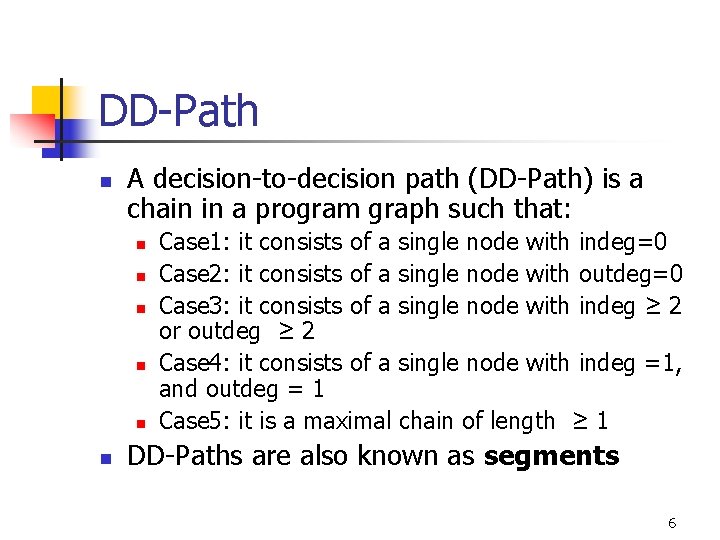
DD-Path n A decision-to-decision path (DD-Path) is a chain in a program graph such that: n n n Case 1: it consists of a single node with indeg=0 Case 2: it consists of a single node with outdeg=0 Case 3: it consists of a single node with indeg ≥ 2 or outdeg ≥ 2 Case 4: it consists of a single node with indeg =1, and outdeg = 1 Case 5: it is a maximal chain of length ≥ 1 DD-Paths are also known as segments 6
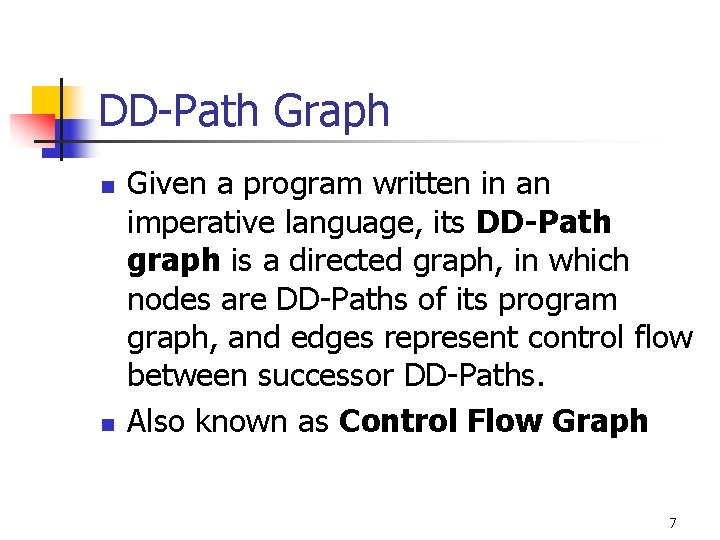
DD-Path Graph n n Given a program written in an imperative language, its DD-Path graph is a directed graph, in which nodes are DD-Paths of its program graph, and edges represent control flow between successor DD-Paths. Also known as Control Flow Graph 7
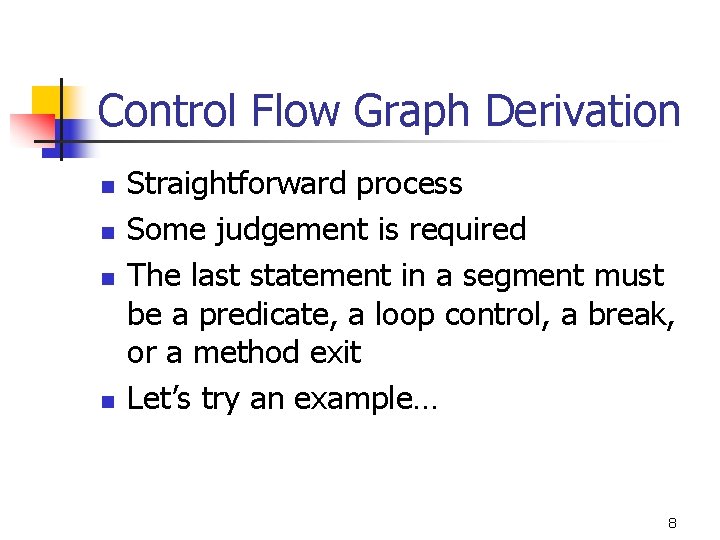
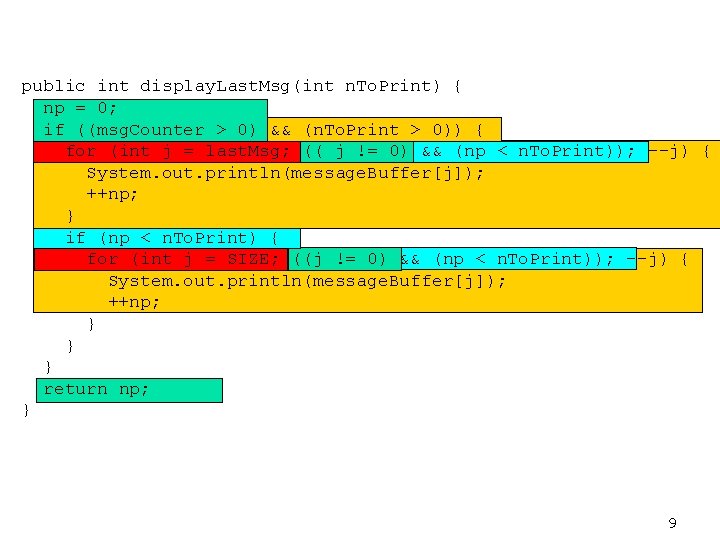
Control Flow Graph Derivation n n Straightforward process Some judgement is required The last statement in a segment must be a predicate, a loop control, a break, or a method exit Let’s try an example… 8
public int display. Last. Msg(int n. To. Print) { np = 0; if ((msg. Counter > 0) && (n. To. Print > 0)) { for (int j = last. Msg; (( j != 0) && (np < n. To. Print)); --j) { System. out. println(message. Buffer[j]); ++np; } if (np < n. To. Print) { for (int j = SIZE; ((j != 0) && (np < n. To. Print)); --j) { System. out. println(message. Buffer[j]); ++np; } } } return np; } 9
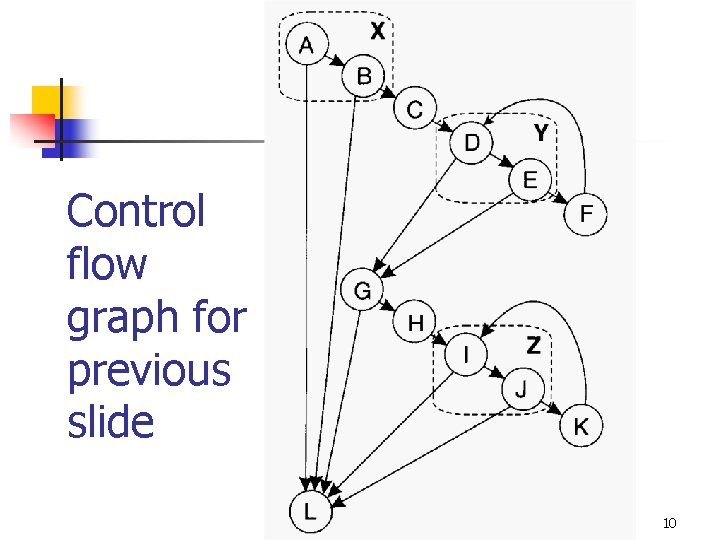
Control flow graph for previous slide 10
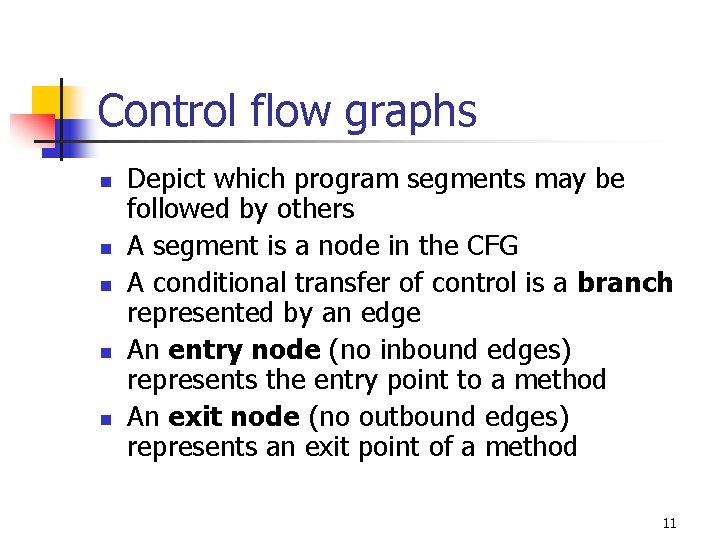
Control flow graphs n n n Depict which program segments may be followed by others A segment is a node in the CFG A conditional transfer of control is a branch represented by an edge An entry node (no inbound edges) represents the entry point to a method An exit node (no outbound edges) represents an exit point of a method 11
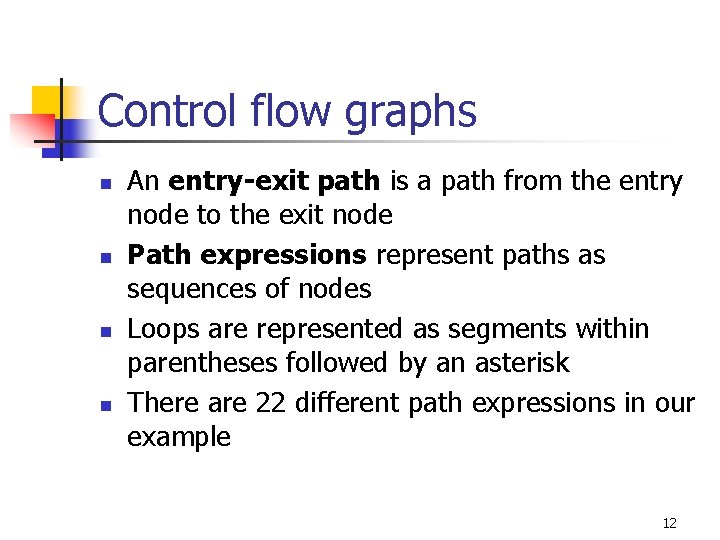
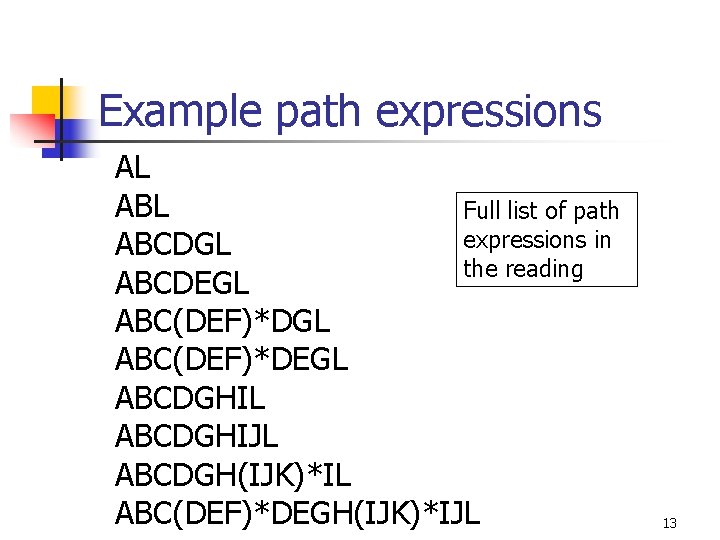
Control flow graphs n n An entry-exit path is a path from the entry node to the exit node Path expressions represent paths as sequences of nodes Loops are represented as segments within parentheses followed by an asterisk There are 22 different path expressions in our example 12
Example path expressions AL ABL Full list of path expressions in ABCDGL the reading ABCDEGL ABC(DEF)*DEGL ABCDGHIJL ABCDGH(IJK)*IL ABC(DEF)*DEGH(IJK)*IJL 13
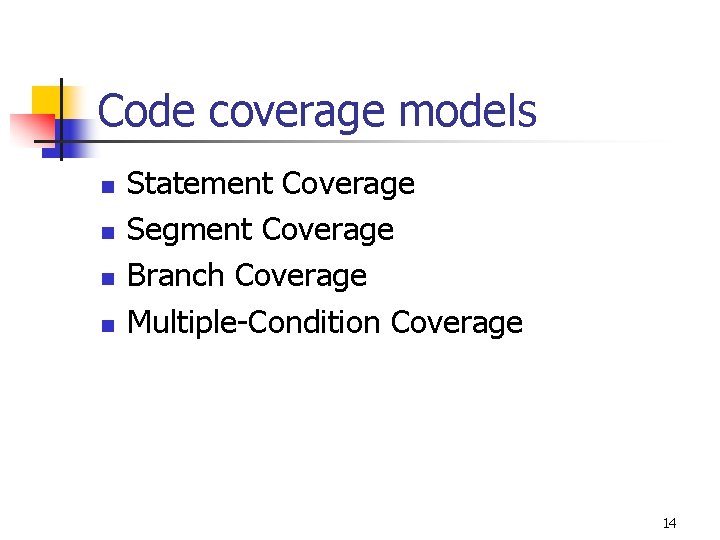
Code coverage models n n Statement Coverage Segment Coverage Branch Coverage Multiple-Condition Coverage 14
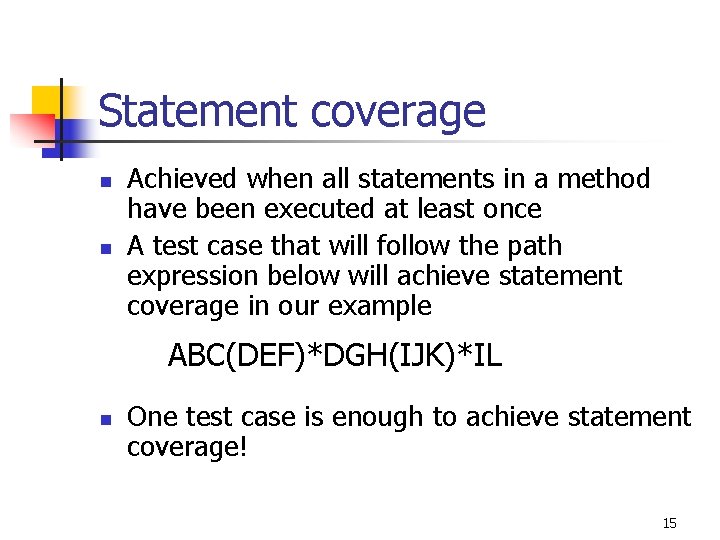
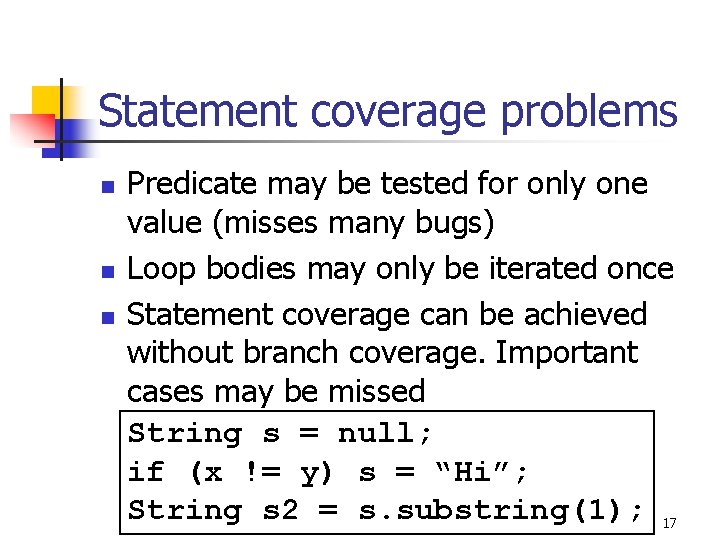
Statement coverage n n Achieved when all statements in a method have been executed at least once A test case that will follow the path expression below will achieve statement coverage in our example ABC(DEF)*DGH(IJK)*IL n One test case is enough to achieve statement coverage! 15
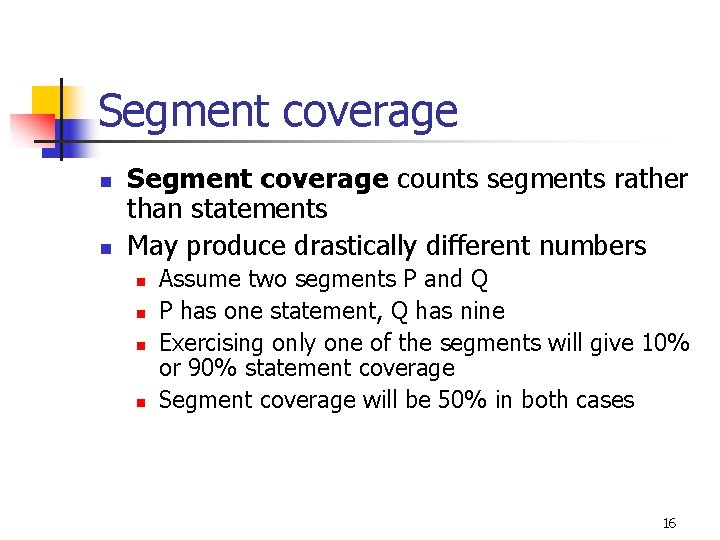
Segment coverage n n Segment coverage counts segments rather than statements May produce drastically different numbers n n Assume two segments P and Q P has one statement, Q has nine Exercising only one of the segments will give 10% or 90% statement coverage Segment coverage will be 50% in both cases 16
Statement coverage problems n n n Predicate may be tested for only one value (misses many bugs) Loop bodies may only be iterated once Statement coverage can be achieved without branch coverage. Important cases may be missed String s = null; if (x != y) s = “Hi”; String s 2 = s. substring(1); 17
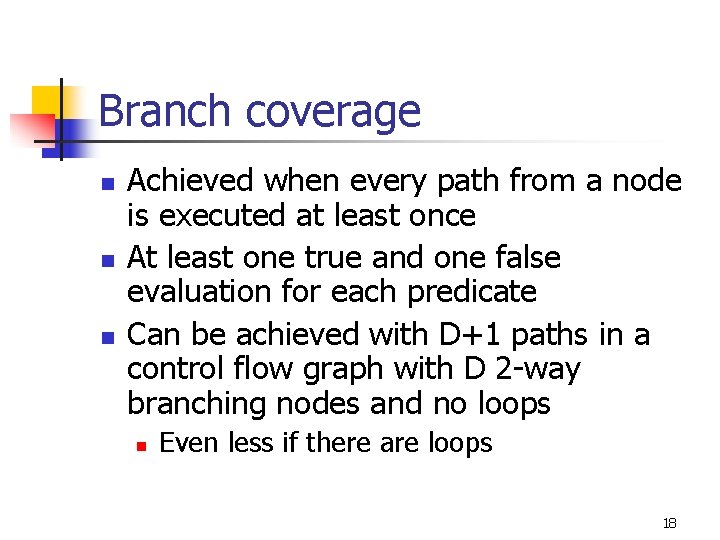
Branch coverage n n n Achieved when every path from a node is executed at least once At least one true and one false evaluation for each predicate Can be achieved with D+1 paths in a control flow graph with D 2 -way branching nodes and no loops n Even less if there are loops 18
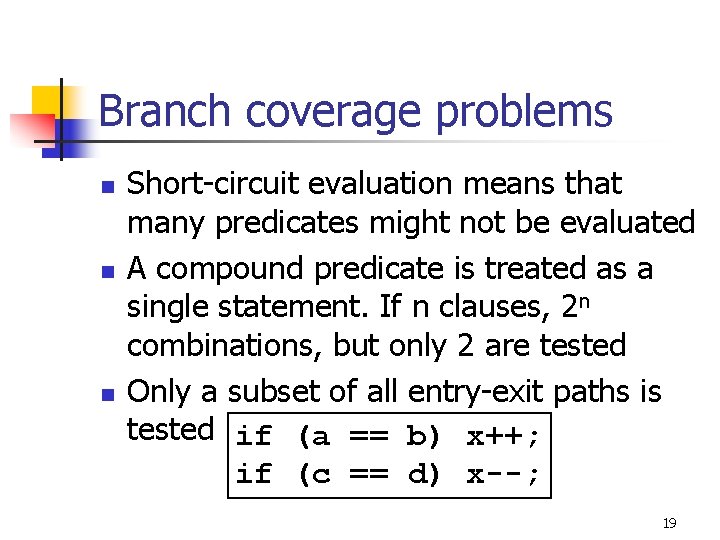
Branch coverage problems n n n Short-circuit evaluation means that many predicates might not be evaluated A compound predicate is treated as a single statement. If n clauses, 2 n combinations, but only 2 are tested Only a subset of all entry-exit paths is tested if (a == b) x++; if (c == d) x--; 19
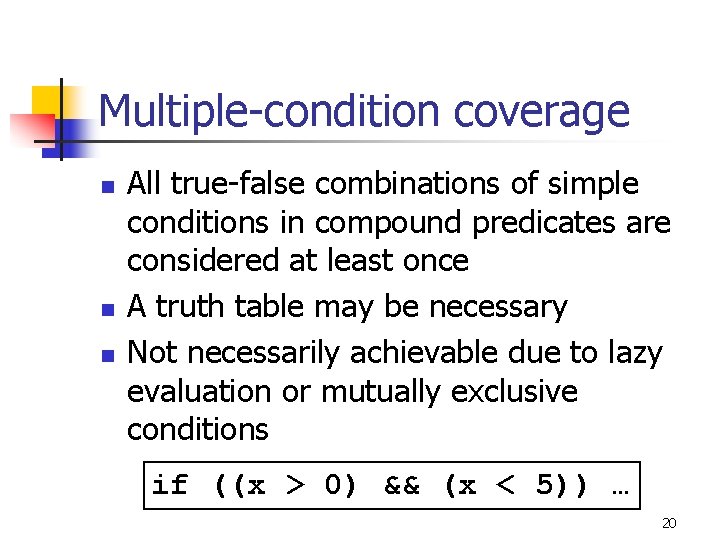
Multiple-condition coverage n n n All true-false combinations of simple conditions in compound predicates are considered at least once A truth table may be necessary Not necessarily achievable due to lazy evaluation or mutually exclusive conditions if ((x > 0) && (x < 5)) … 20
Dealing with Loops n n Loops are highly fault-prone, so they need to be tested carefully Simple view: Every loop involves a decision to traverse the loop or not A bit better: Boundary value analysis on the index variable Nested loops have to be tested separately starting with the innermost 21