
Path Planning in Expansive CSpaces D Hsu J

- Slides: 24
Path Planning in Expansive C-Spaces D. Hsu J. -C. Latombe R. Motwani CS Dept. , Stanford University, 1997
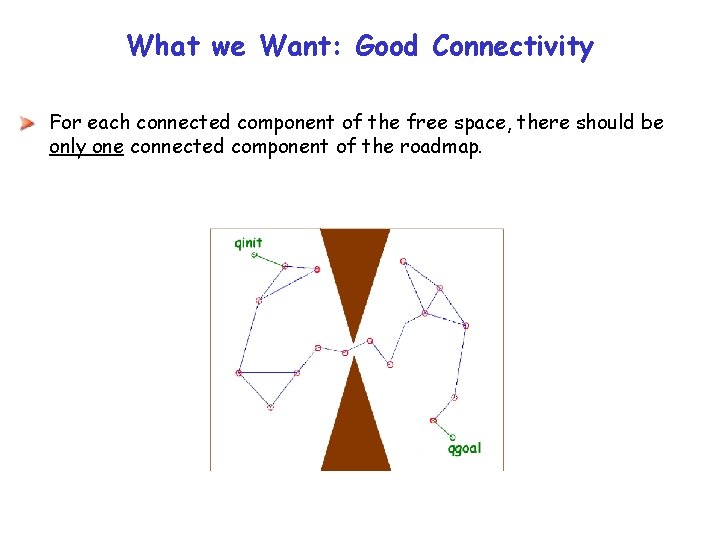
What we Want: Good Connectivity For each connected component of the free space, there should be only one connected component of the roadmap.
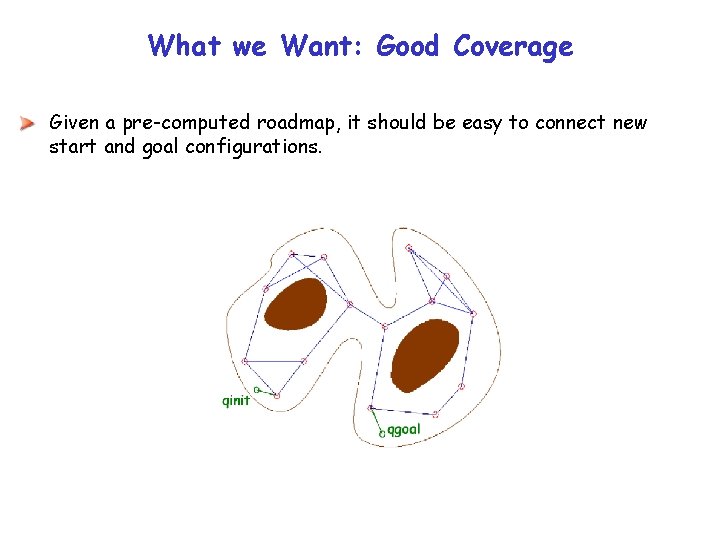
What we Want: Good Coverage Given a pre-computed roadmap, it should be easy to connect new start and goal configurations.
Main Result If the C-space is expansive, then we can build a roadmap that has both good connectivity and good coverage.
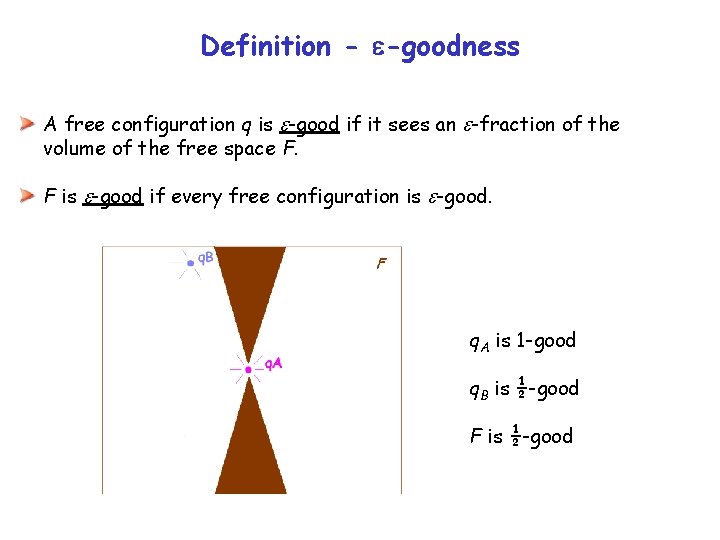
Definition - -goodness A free configuration q is -good if it sees an -fraction of the volume of the free space F. F is -good if every free configuration is -good. q. A is 1 -good q. B is ½-good F is ½-good
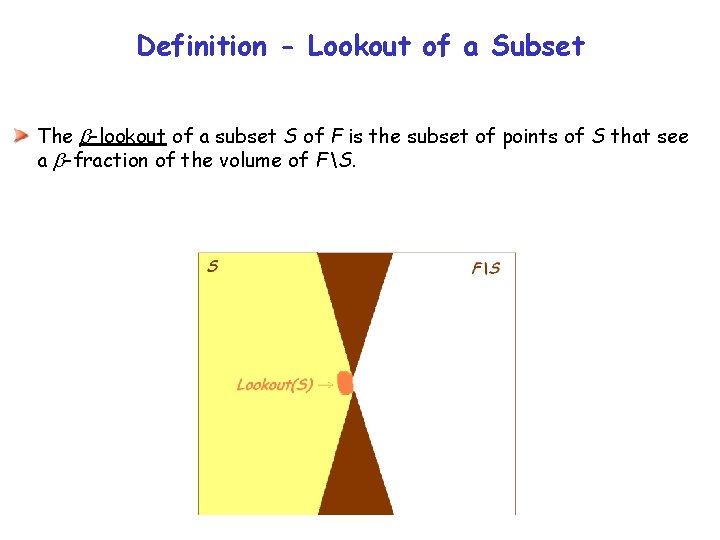
Definition - Lookout of a Subset The -lookout of a subset S of F is the subset of points of S that see a -fraction of the volume of FS.
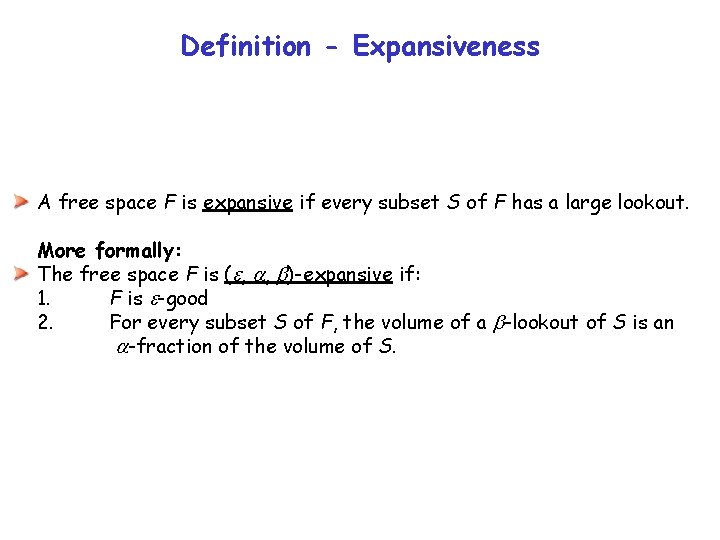
Definition - Expansiveness A free space F is expansive if every subset S of F has a large lookout. More formally: The free space F is ( , , )-expansive if: 1. F is -good 2. For every subset S of F, the volume of a -lookout of S is an -fraction of the volume of S.
Main Result If the C-space is expansive, then we can build a roadmap that has both good connectivity and good coverage.
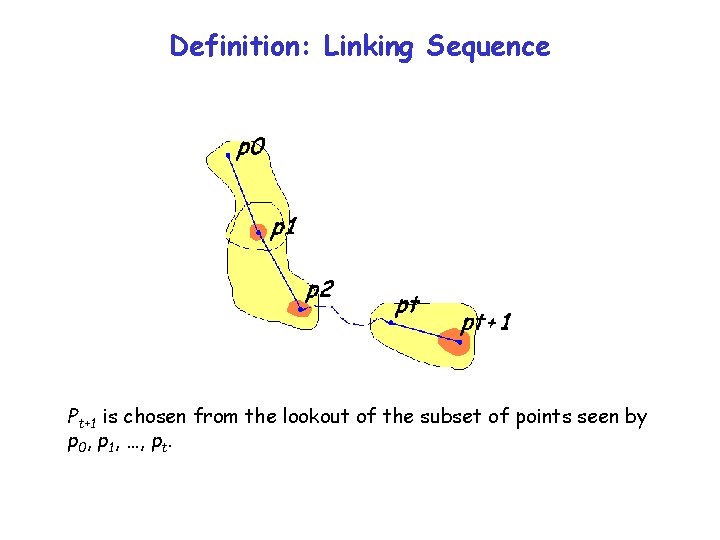
Definition: Linking Sequence Pt+1 is chosen from the lookout of the subset of points seen by p 0, p 1, …, pt.
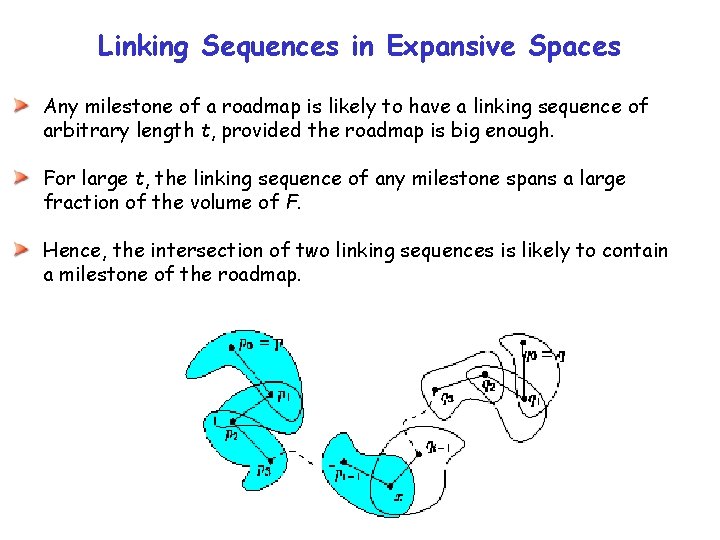
Linking Sequences in Expansive Spaces Any milestone of a roadmap is likely to have a linking sequence of arbitrary length t, provided the roadmap is big enough. For large t, the linking sequence of any milestone spans a large fraction of the volume of F. Hence, the intersection of two linking sequences is likely to contain a milestone of the roadmap.
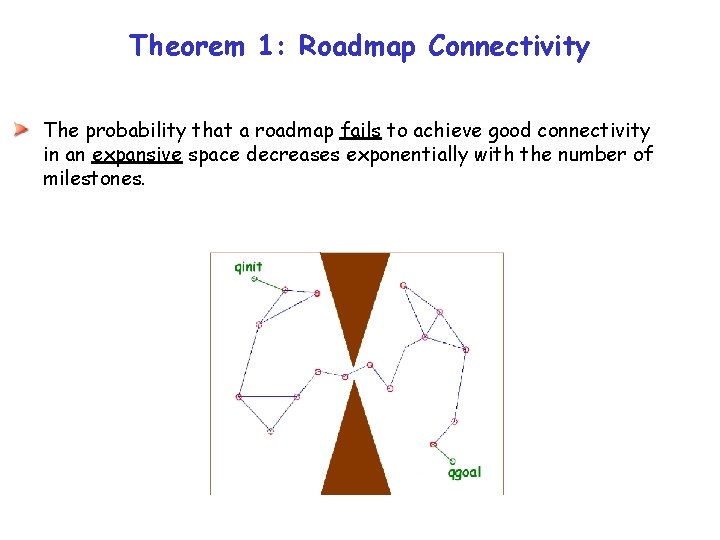
Theorem 1: Roadmap Connectivity The probability that a roadmap fails to achieve good connectivity in an expansive space decreases exponentially with the number of milestones.
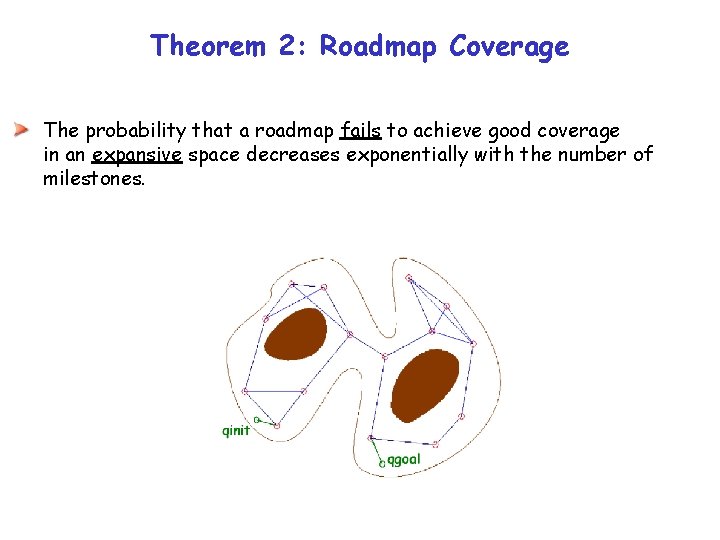
Theorem 2: Roadmap Coverage The probability that a roadmap fails to achieve good coverage in an expansive space decreases exponentially with the number of milestones.
In Practice… How to build linking sequences ? Problem: lookouts cannot be easily computed. However, we know that lookouts occupy a large fraction of the free space. Hence, linking sequences can be found by sampling uniformly at random, and by keeping only those points that see a large portion of the free space.
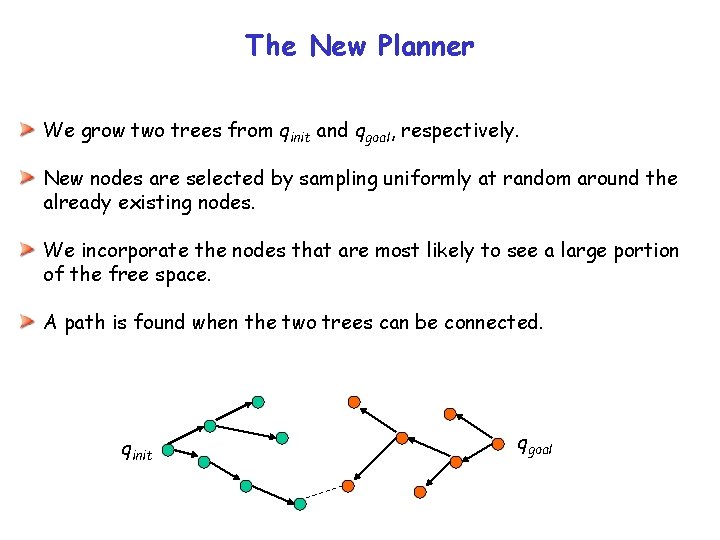
The New Planner We grow two trees from qinit and qgoal, respectively. New nodes are selected by sampling uniformly at random around the already existing nodes. We incorporate the nodes that are most likely to see a large portion of the free space. A path is found when the two trees can be connected. qinit qgoal
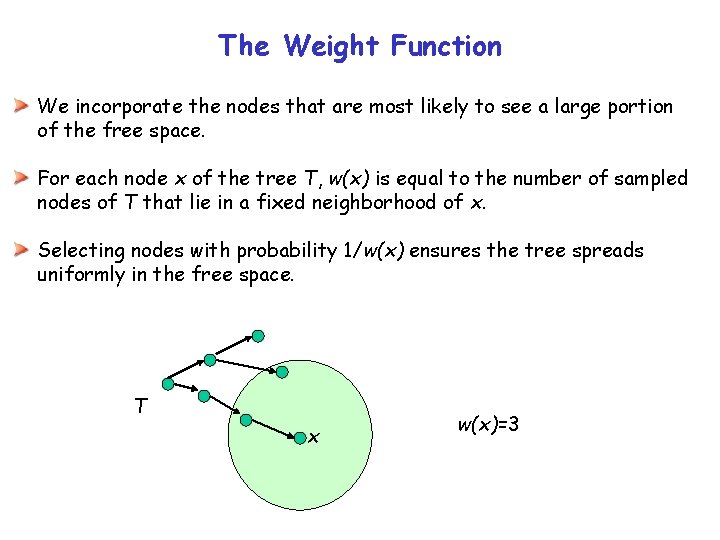
The Weight Function We incorporate the nodes that are most likely to see a large portion of the free space. For each node x of the tree T, w(x) is equal to the number of sampled nodes of T that lie in a fixed neighborhood of x. Selecting nodes with probability 1/w(x) ensures the tree spreads uniformly in the free space. T x w(x)=3
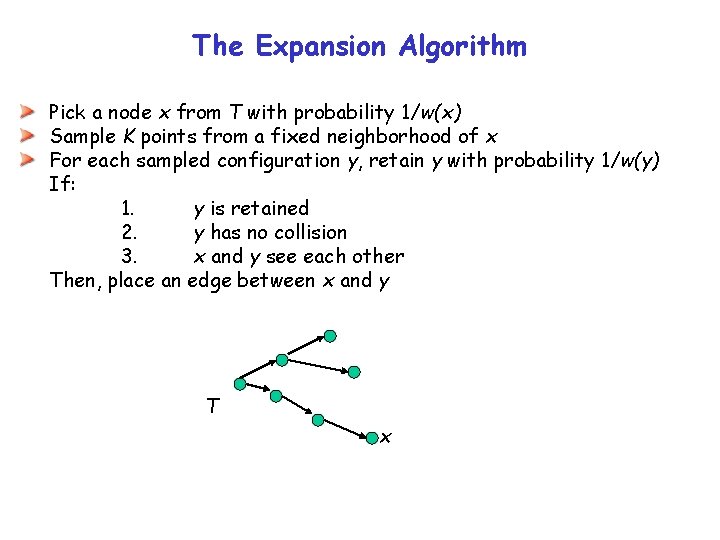
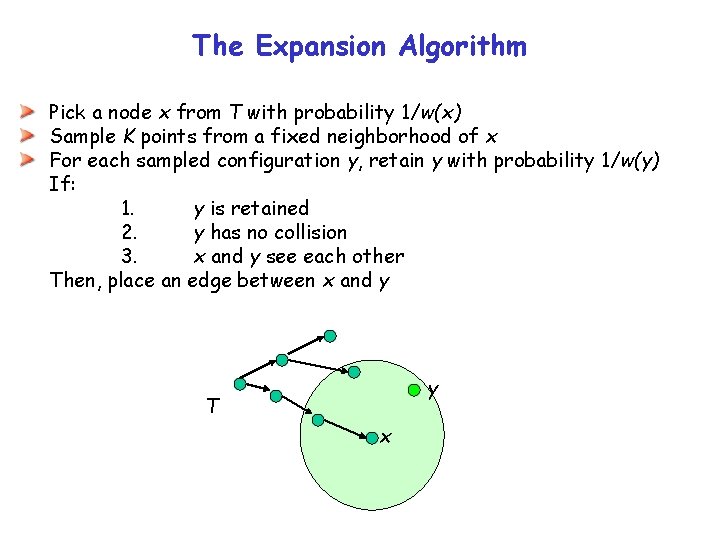
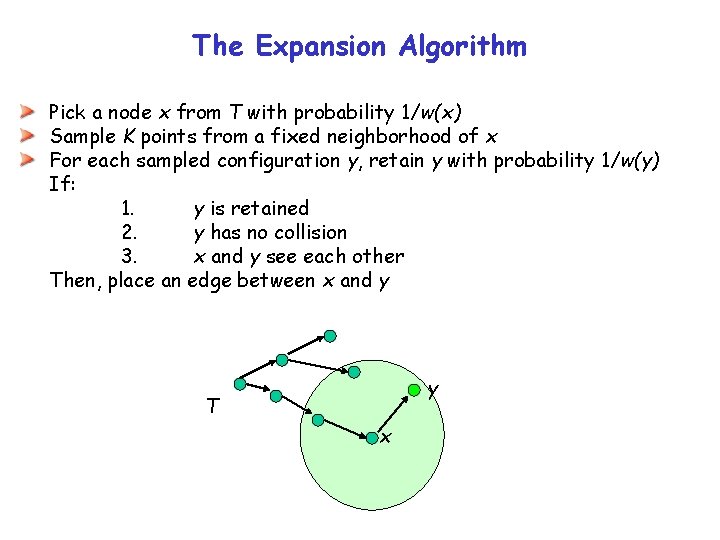
The Expansion Algorithm Pick a node x from T with probability 1/w(x) Sample K points from a fixed neighborhood of x For each sampled configuration y, retain y with probability 1/w(y) If: 1. y is retained 2. y has no collision 3. x and y see each other Then, place an edge between x and y T x
The Expansion Algorithm Pick a node x from T with probability 1/w(x) Sample K points from a fixed neighborhood of x For each sampled configuration y, retain y with probability 1/w(y) If: 1. y is retained 2. y has no collision 3. x and y see each other Then, place an edge between x and y T x
The Expansion Algorithm Pick a node x from T with probability 1/w(x) Sample K points from a fixed neighborhood of x For each sampled configuration y, retain y with probability 1/w(y) If: 1. y is retained 2. y has no collision 3. x and y see each other Then, place an edge between x and y y T x
The Expansion Algorithm Pick a node x from T with probability 1/w(x) Sample K points from a fixed neighborhood of x For each sampled configuration y, retain y with probability 1/w(y) If: 1. y is retained 2. y has no collision 3. x and y see each other Then, place an edge between x and y y T x
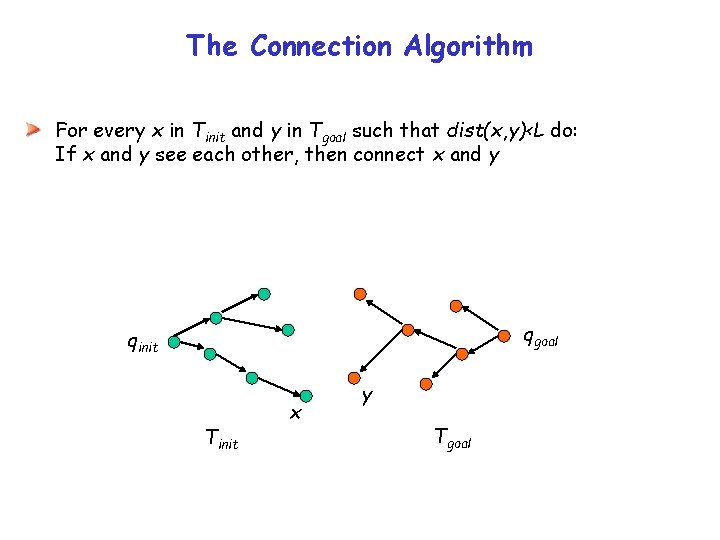
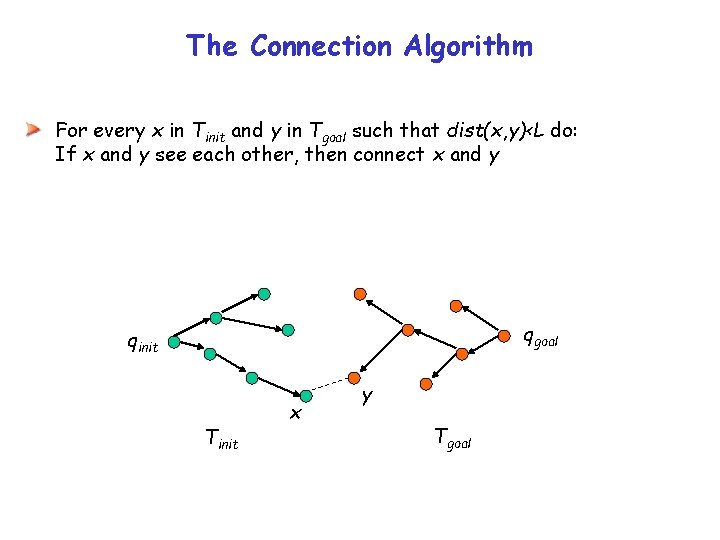
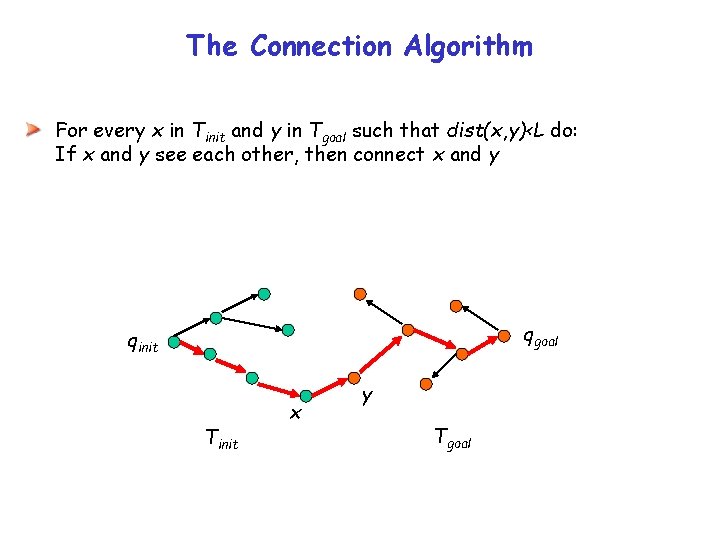
The Connection Algorithm For every x in Tinit and y in Tgoal such that dist(x, y)<L do: If x and y see each other, then connect x and y qgoal qinit Tinit x y Tgoal
The Connection Algorithm For every x in Tinit and y in Tgoal such that dist(x, y)<L do: If x and y see each other, then connect x and y qgoal qinit Tinit x y Tgoal
The Connection Algorithm For every x in Tinit and y in Tgoal such that dist(x, y)<L do: If x and y see each other, then connect x and y qgoal qinit Tinit x y Tgoal
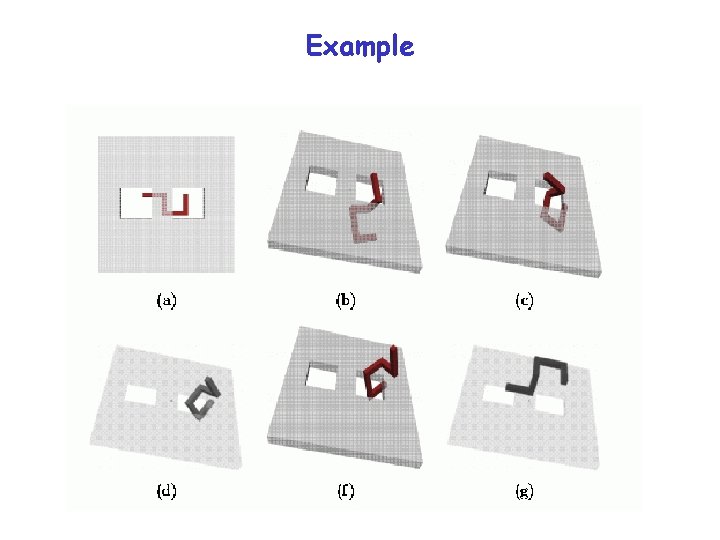
Example
Conclusion If the C-space is expansive, then we can efficiently build a roadmap that has both good connectivity and good coverage. Suggested improvements: Find a parametrization of the C-space that maximizes expansiveness Apply geometric transforms that increase expansiveness Decompose the free space into expansive components