
PATH DEPENDENCY and the DEVELOPMENT OF TOURISM REGIONS
- Slides: 8
PATH DEPENDENCY and the DEVELOPMENT OF TOURISM REGIONS Challenges of Change in Mature European Destinations Professor Henrik Halkier Aalborg University, Denmark halkier@cgs. aau. dk
PATH DEPENDENCY and the DEVELOPMENT OF TOURISM REGIONS Challenges of Change in Mature European Destinations 1. Regions and destinations: Path dependency and change 2. Reconceptualising tourist destinations 3. Maturity and beyond? The case of North Jutland, Denmark Conclusion: Maturity, thinness and economic change 4. Professor Henrik Halkier Aalborg University, Denmark halkier@cgs. aau. dk
PATH DEPENDENCY AND CHANGE Regions and destinations From path dependency as (negative) lock-in… q System of institutions maintaining direction (Martin/Sunley 2006, Howlett/Rayner 2006) § Firms, regulation, actor behaviour, discourse q Sudden change, from outside system § Changes in demand competition (Martin/Sunley 2014, Martin 2010, Mahoney 2000) … towards less rigid paths q Co-existence of institutions in regions q Plasticity of institutions (Martin/Sunley 2014, Hassink 2010) (Strambach 2010, Strambach/Halkier 2013) q Path creation as contextualised strategic action Henrik Halkier – halkier@cgs. aau. dk (Karnøe/Garud 2012)
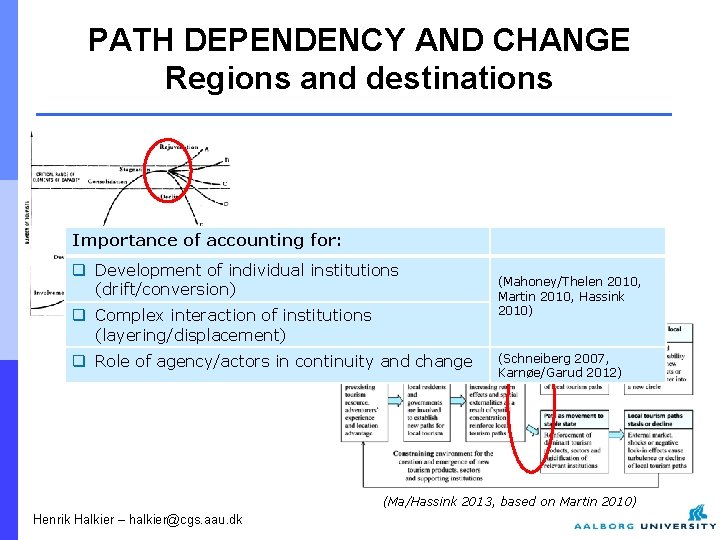
PATH DEPENDENCY AND CHANGE Regions and destinations Importance of accounting for: q Development of individual institutions (drift/conversion) q Complex interaction of institutions (Butler 1980) (layering/displacement) q Role of agency/actors in continuity and change (Mahoney/Thelen 2010, Martin 2010, Hassink 2010) (Schneiberg 2007, Karnøe/Garud 2012) (Ma/Hassink 2013, based on Martin 2010) Henrik Halkier – halkier@cgs. aau. dk
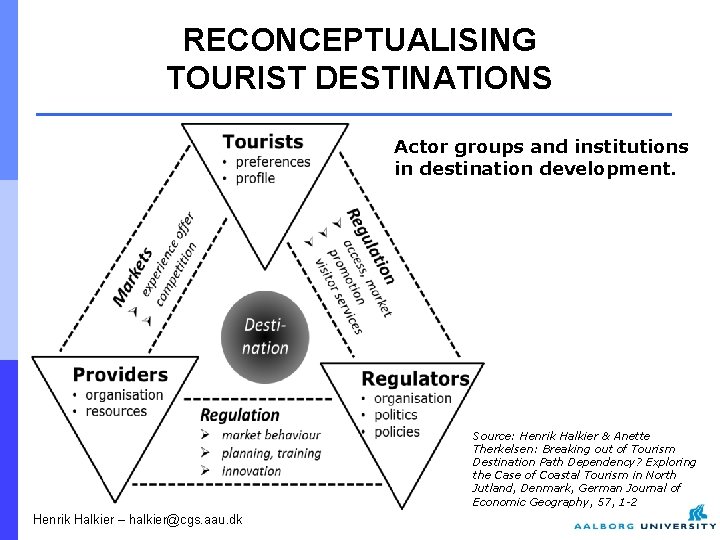
RECONCEPTUALISING TOURIST DESTINATIONS Actor groups and institutions in destination development. Source: Henrik Halkier & Anette Therkelsen: Breaking out of Tourism Destination Path Dependency? Exploring the Case of Coastal Tourism in North Jutland, Denmark, German Journal of Economic Geography, 57, 1 -2 Henrik Halkier – halkier@cgs. aau. dk
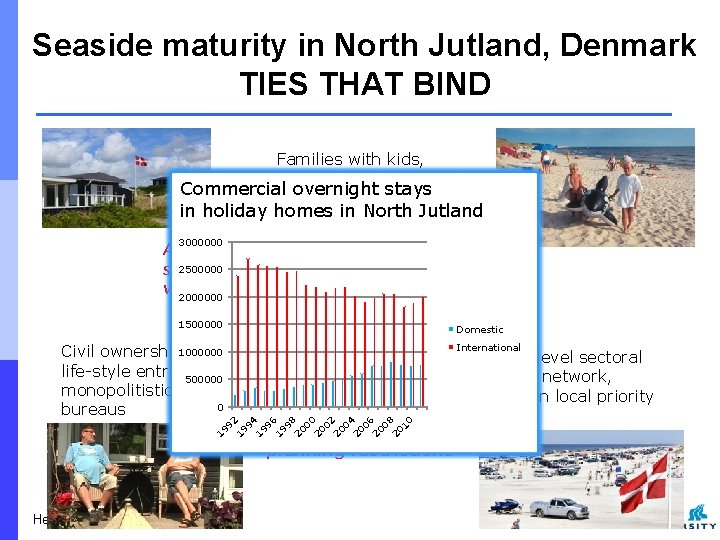
Seaside maturity in North Jutland, Denmark TIES THAT BIND Families with kids, nature-based, seasonal, Commercial overnight stays neighbouring markets in holiday homes in North Jutland 3000000 Automobile, 2500000 self-catering, week-based 2000000 Marketing 1500000 Domestic International 1000000 Civil ownership/co-use, life-style entrepreneurs, 500000 monopolitistic rental 0 bureaus 19 92 19 94 19 96 19 98 20 00 20 02 20 04 20 06 20 08 20 10 Multi-level sectoral policy network, uneven local priority Henrik Halkier – halkier@cgs. aau. dk National ownership, planning restrictions
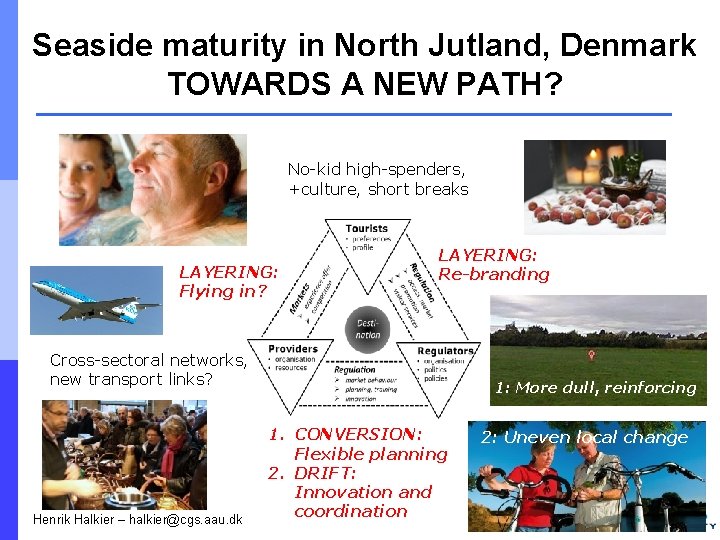
Seaside maturity in North Jutland, Denmark TOWARDS A NEW PATH? No-kid high-spenders, +culture, short breaks LAYERING: Flying in? LAYERING: Re-branding Cross-sectoral networks, new transport links? Henrik Halkier – halkier@cgs. aau. dk 1: More dull, reinforcing 1. CONVERSION: Flexible planning 2. DRIFT: Innovation and coordination 2: Uneven local change
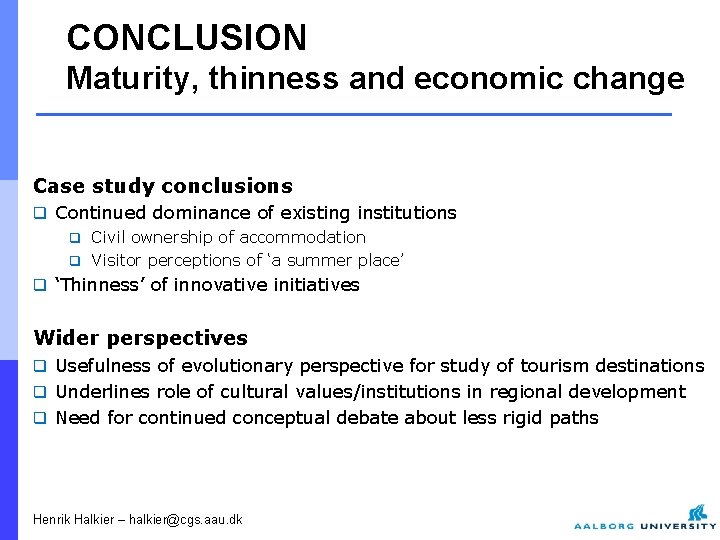
CONCLUSION Maturity, thinness and economic change Case study conclusions q Continued dominance of existing institutions q Civil ownership of accommodation q Visitor perceptions of ‘a summer place’ q ‘Thinness’ of innovative initiatives Wider perspectives q Usefulness of evolutionary perspective for study of tourism destinations q Underlines role of cultural values/institutions in regional development q Need for continued conceptual debate about less rigid paths Henrik Halkier – halkier@cgs. aau. dk