
Patent Information Open Patent Services 3 rd Annual
- Slides: 33
Patent Information: Open Patent Services 3 rd Annual Forum for SMEs Information Workshop on European Bioinformatics Resources Nigel S. Clarke Manager Online Products and User Support Vienna, September 2009
Open Patent Services: the evolution of a web service Written by: Davide Lingua Presented by: Nigel Clarke EPO Vienna September 2009
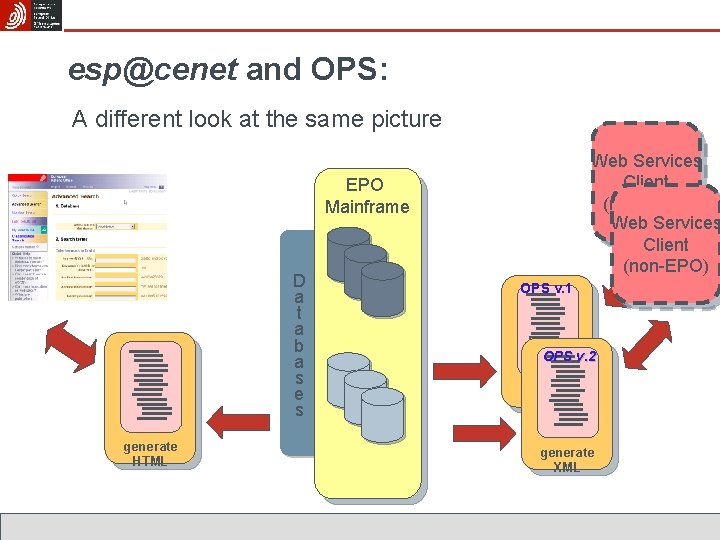
esp@cenet and OPS: A different look at the same picture Web Services Client (non-EPO) EPO Mainframe D a t a b a s e s generate HTML OPS v. 1 OPS v. 2 generate XML
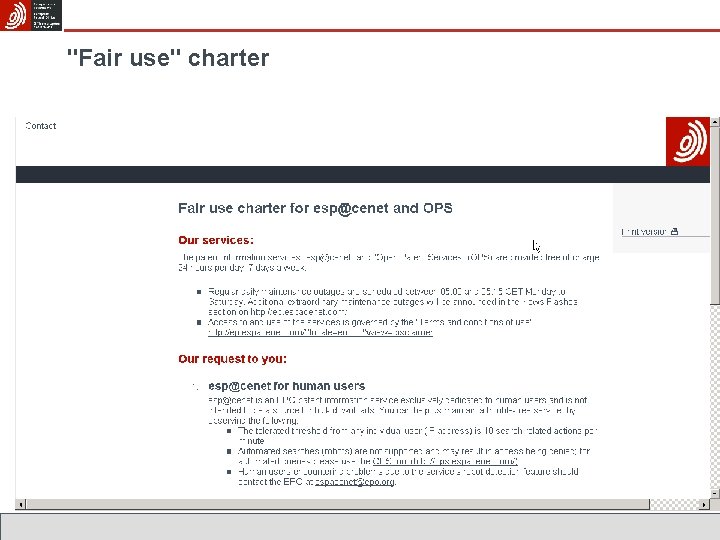
The "Fair use" charter
"Fair use" charter
esp@cenet and OPS: • Free of charge • 24 x 7 Availability : 24 hours/day, 7 days/week • (Note: regular and extraordinary outages) • esp@cenet has been developed for human users only no robots please • OPS: is dedicated to integrated systems/automated access restrictions when bulk downloading • And: EPO resources are limited
The "Fair use" charter • To give clarity on: – what the EPO can offer – how the users are expected to behave • Visible on: – http: //ep. espacenet. com and – http: //ops. epo. org/ • Main principle: Human users always come first!
Specific to OPS • Integrated systems and robots must: – let us know who they are (IP address used)! – Sign a data user agreement – Observe restrictions as indicated • Enforcement of these principles is being implemented gradually
Open Patent Services v. 1 http: //ops. espacenet. com
Open Patent Services (OPS) v. 1 q. To be discontinued in October/November 2009 q. Retrieval of data for single input numbers q. In operation since Summer 2003
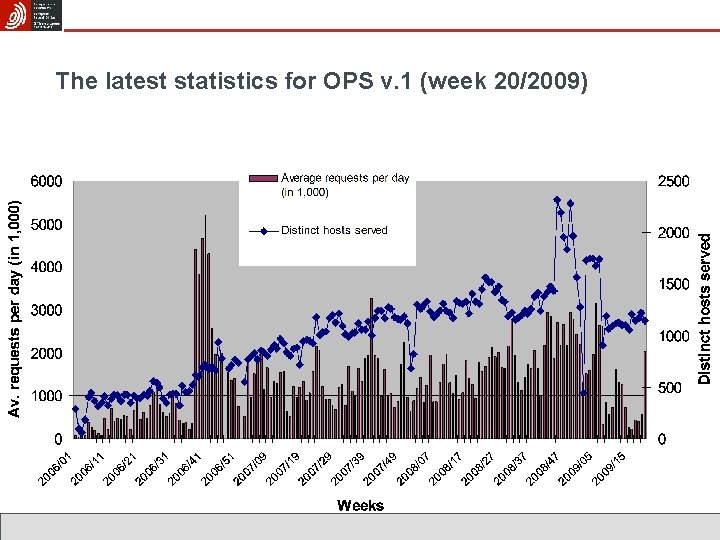
The latest statistics for OPS v. 1 (week 20/2009)
Open Patent Services v. 2 http: //ops. epo. org
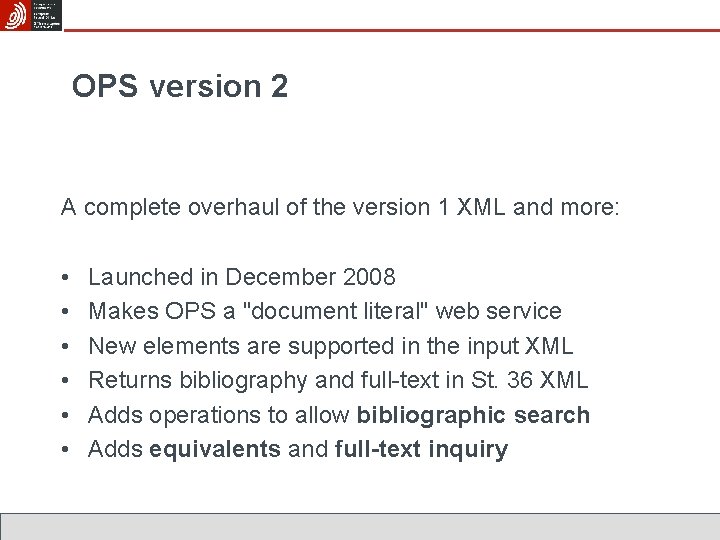
OPS version 2 A complete overhaul of the version 1 XML and more: • • • Launched in December 2008 Makes OPS a "document literal" web service New elements are supported in the input XML Returns bibliography and full-text in St. 36 XML Adds operations to allow bibliographic search Adds equivalents and full-text inquiry
The latest statistics for OPS v. 2 (week 20/2009)
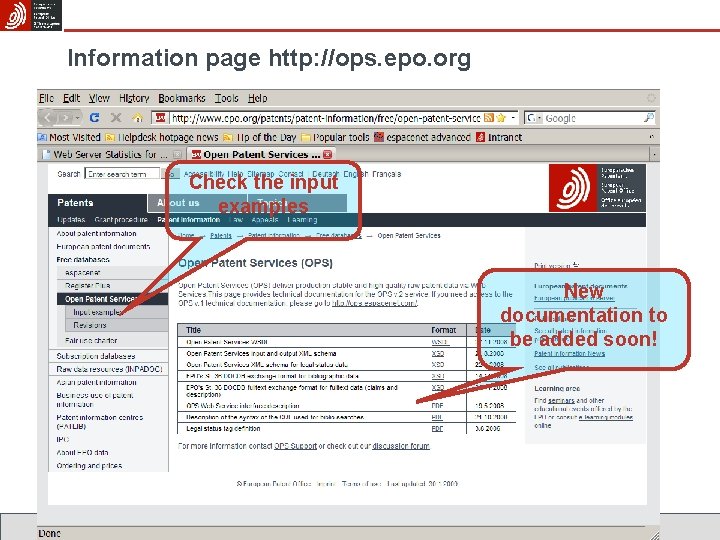
Information page http: //ops. epo. org Check the input examples New documentation to be added soon!
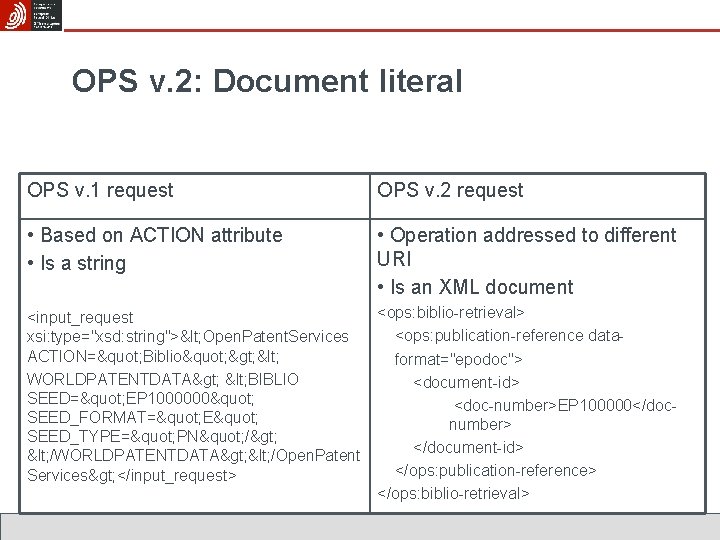
OPS v. 2: Document literal OPS v. 1 request OPS v. 2 request • Based on ACTION attribute • Is a string • Operation addressed to different URI • Is an XML document <input_request xsi: type="xsd: string">< Open. Patent. Services ACTION=" Biblio" > < WORLDPATENTDATA> < BIBLIO SEED=" EP 1000000" SEED_FORMAT=" E" SEED_TYPE=" PN" /> < /WORLDPATENTDATA> < /Open. Patent Services> </input_request> <ops: biblio-retrieval> <ops: publication-reference dataformat="epodoc"> <document-id> <doc-number>EP 100000</docnumber> </document-id> </ops: publication-reference> </ops: biblio-retrieval>
Biblio and full-text in St. 36 XML • Bibliographic data is returned in XML derived from the WIPO St. 36 used in DOCDB exchange • Full-text data is returned in XML compatible with the extensions to the WIPO St. 36 planned for full-text exchange
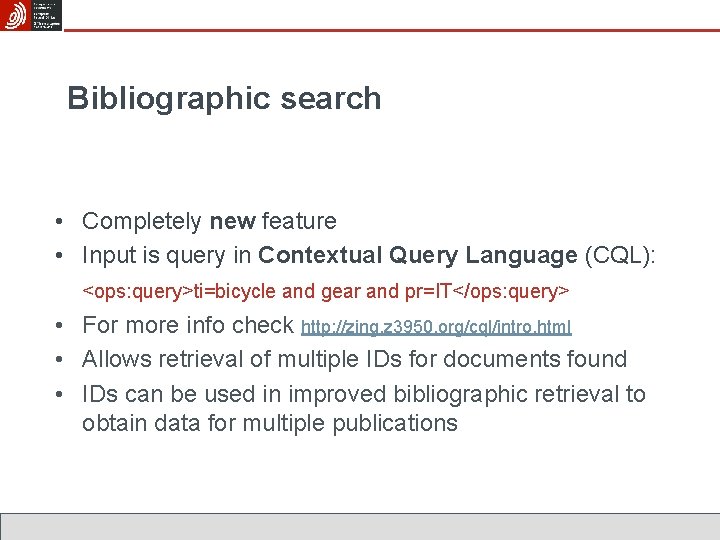
Bibliographic search • Completely new feature • Input is query in Contextual Query Language (CQL): <ops: query>ti=bicycle and gear and pr=IT</ops: query> • For more info check http: //zing. z 3950. org/cql/intro. html • Allows retrieval of multiple IDs for documents found • IDs can be used in improved bibliographic retrieval to obtain data for multiple publications
Full-text inquiry • • Completely new feature Inquiry for full-text availability Input is a publication number Indicates whether claims or description texts are available
Equivalents inquiry • • Completely new feature Input is a publication number Provides list of equivalents ("simple family") Only one number publication cycle (full publication cycle available in "biblio request")
Tips on using OPS v. 2
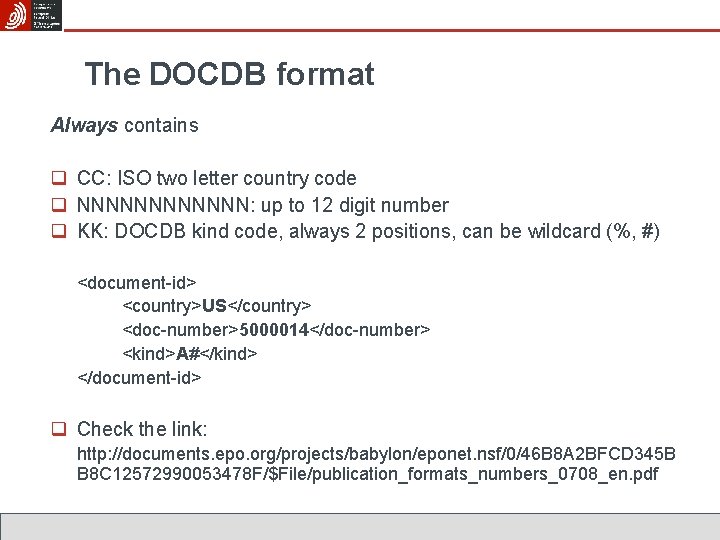
The DOCDB format Always contains q CC: ISO two letter country code q NNNNNN: up to 12 digit number q KK: DOCDB kind code, always 2 positions, can be wildcard (%, #) <document-id> <country>US</country> <doc-number>5000014</doc-number> <kind>A#</kind> </document-id> q Check the link: http: //documents. epo. org/projects/babylon/eponet. nsf/0/46 B 8 A 2 BFCD 345 B B 8 C 12572990053478 F/$File/publication_formats_numbers_0708_en. pdf
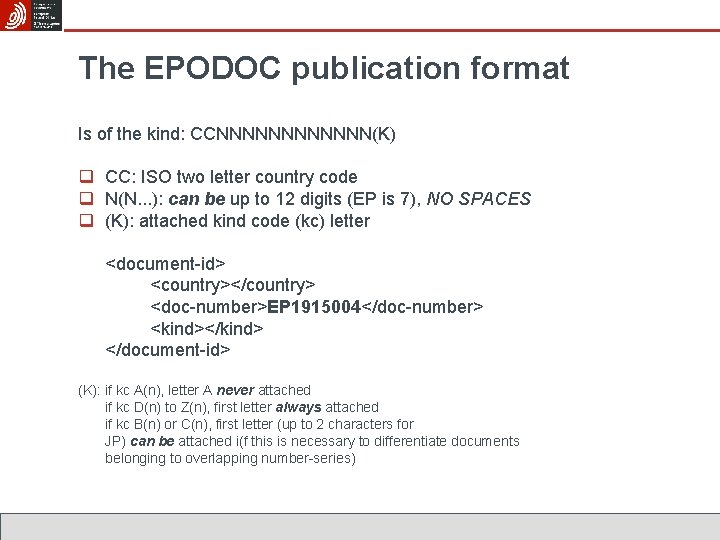
The EPODOC publication format Is of the kind: CCNNNNNN(K) q CC: ISO two letter country code q N(N. . . ): can be up to 12 digits (EP is 7), NO SPACES q (K): attached kind code (kc) letter <document-id> <country></country> <doc-number>EP 1915004</doc-number> <kind></kind> </document-id> (K): if kc A(n), letter A never attached if kc D(n) to Z(n), first letter always attached if kc B(n) or C(n), first letter (up to 2 characters for JP) can be attached i(f this is necessary to differentiate documents belonging to overlapping number-series)
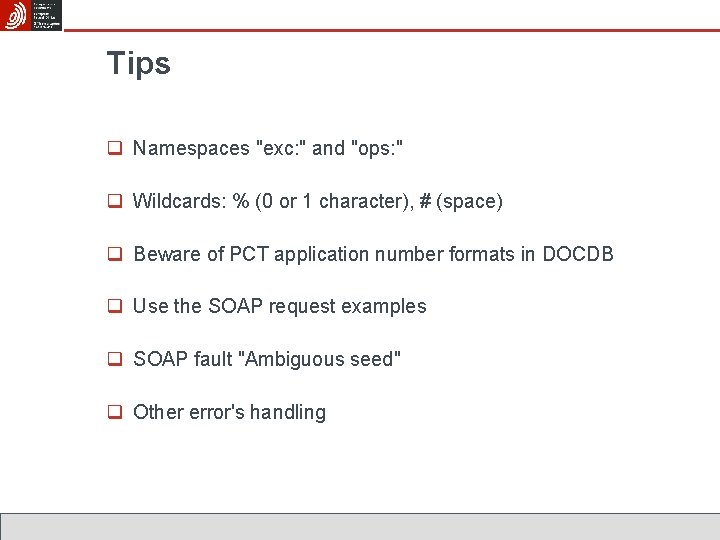
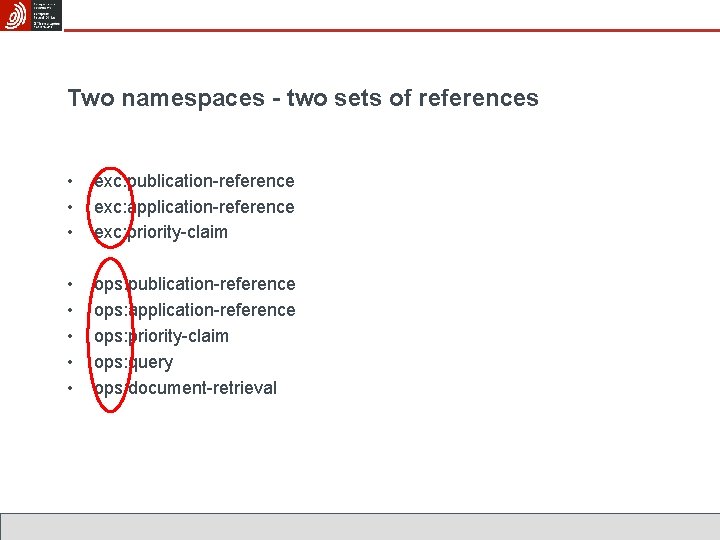
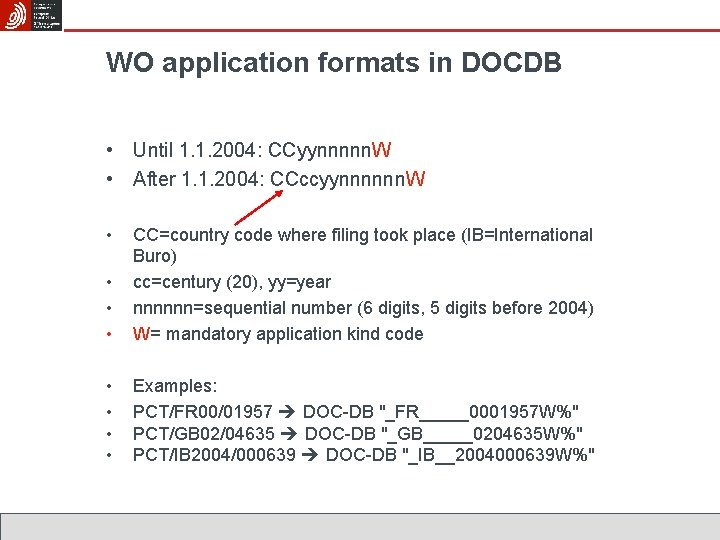
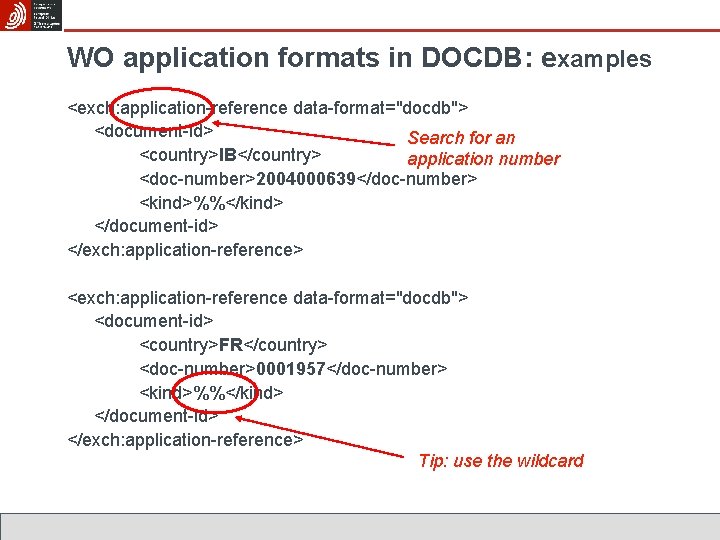
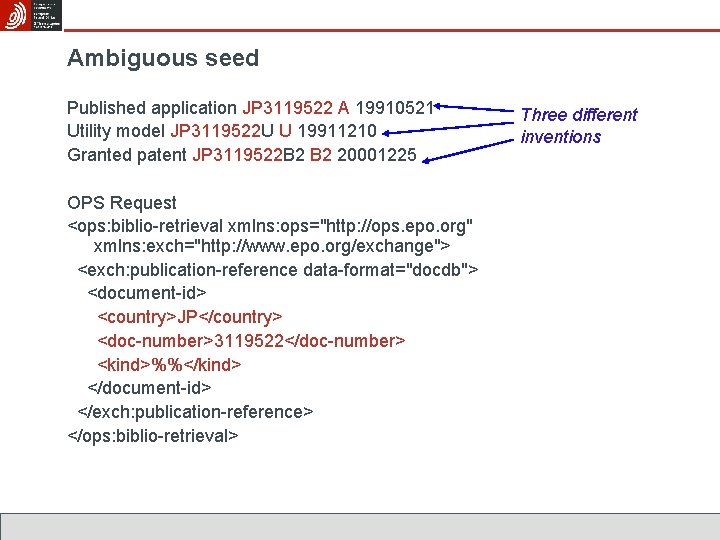
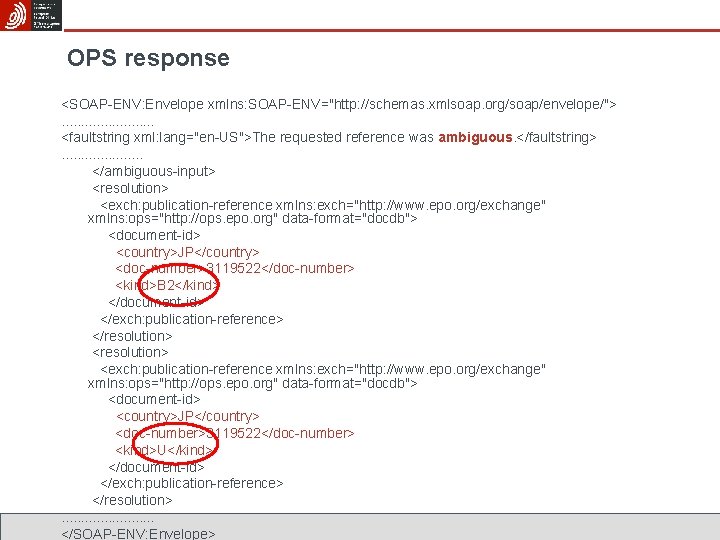
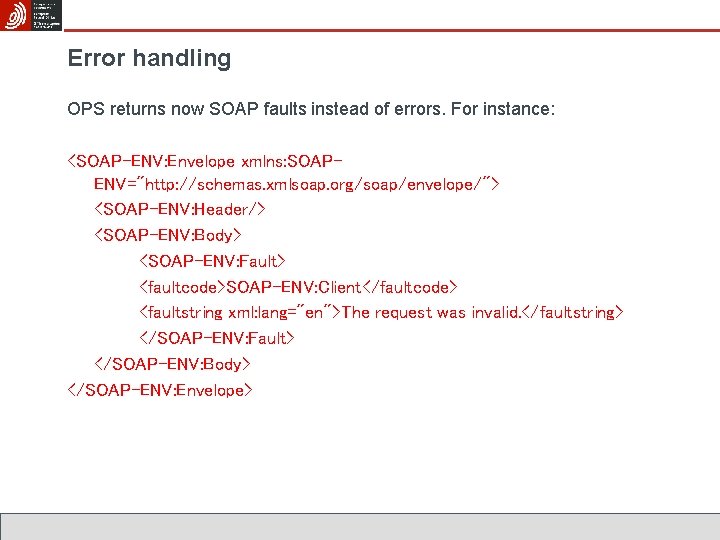
Tips q Namespaces "exc: " and "ops: " q Wildcards: % (0 or 1 character), # (space) q Beware of PCT application number formats in DOCDB q Use the SOAP request examples q SOAP fault "Ambiguous seed" q Other error's handling
Two namespaces - two sets of references • • • exc: publication-reference exc: application-reference exc: priority-claim • • • ops: publication-reference ops: application-reference ops: priority-claim ops: query ops: document-retrieval
WO application formats in DOCDB • Until 1. 1. 2004: CCyynnnnn. W • After 1. 1. 2004: CCccyynnnnnn. W • • CC=country code where filing took place (IB=International Buro) cc=century (20), yy=year nnnnnn=sequential number (6 digits, 5 digits before 2004) W= mandatory application kind code • • Examples: PCT/FR 00/01957 DOC-DB "_FR_____0001957 W%" PCT/GB 02/04635 DOC-DB "_GB_____0204635 W%" PCT/IB 2004/000639 DOC-DB "_IB__2004000639 W%"
WO application formats in DOCDB: examples <exch: application-reference data-format="docdb"> <document-id> Search for an <country>IB</country> application number <doc-number>2004000639</doc-number> <kind>%%</kind> </document-id> </exch: application-reference> <exch: application-reference data-format="docdb"> <document-id> <country>FR</country> <doc-number>0001957</doc-number> <kind>%%</kind> </document-id> </exch: application-reference> Tip: use the wildcard
Ambiguous seed Published application JP 3119522 A 19910521 Utility model JP 3119522 U U 19911210 Granted patent JP 3119522 B 2 20001225 OPS Request <ops: biblio-retrieval xmlns: ops="http: //ops. epo. org" xmlns: exch="http: //www. epo. org/exchange"> <exch: publication-reference data-format="docdb"> <document-id> <country>JP</country> <doc-number>3119522</doc-number> <kind>%%</kind> </document-id> </exch: publication-reference> </ops: biblio-retrieval> Three different inventions
OPS response <SOAP-ENV: Envelope xmlns: SOAP-ENV="http: //schemas. xmlsoap. org/soap/envelope/">. . . <faultstring xml: lang="en-US">The requested reference was ambiguous. </faultstring>. . . . . </ambiguous-input> <resolution> <exch: publication-reference xmlns: exch="http: //www. epo. org/exchange" xmlns: ops="http: //ops. epo. org" data-format="docdb"> <document-id> <country>JP</country> <doc-number>3119522</doc-number> <kind>B 2</kind> </document-id> </exch: publication-reference> </resolution> <exch: publication-reference xmlns: exch="http: //www. epo. org/exchange" xmlns: ops="http: //ops. epo. org" data-format="docdb"> <document-id> <country>JP</country> <doc-number>3119522</doc-number> <kind>U</kind> </document-id> </exch: publication-reference> </resolution>. . . </SOAP-ENV: Envelope>
Error handling OPS returns now SOAP faults instead of errors. For instance: <SOAP-ENV: Envelope xmlns: SOAPENV="http: //schemas. xmlsoap. org/soap/envelope/"> <SOAP-ENV: Header/> <SOAP-ENV: Body> <SOAP-ENV: Fault> <faultcode>SOAP-ENV: Client</faultcode> <faultstring xml: lang="en">The request was invalid. </faultstring> </SOAP-ENV: Fault> </SOAP-ENV: Body> </SOAP-ENV: Envelope>
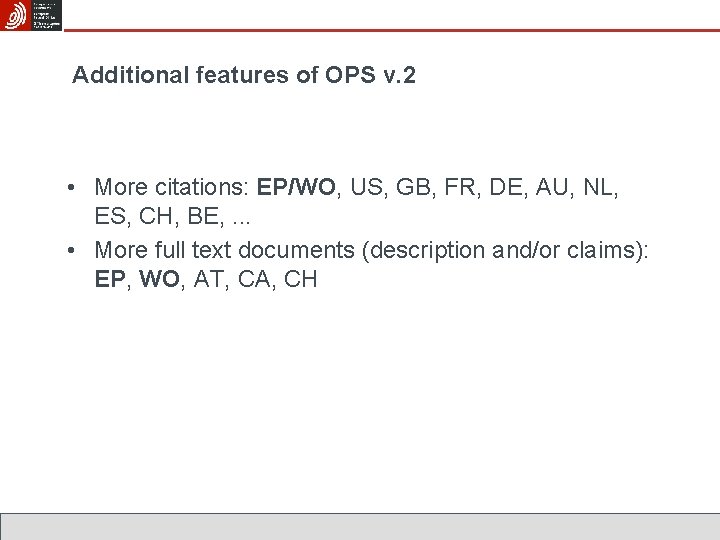
Additional features of OPS v. 2 • More citations: EP/WO, US, GB, FR, DE, AU, NL, ES, CH, BE, . . . • More full text documents (description and/or claims): EP, WO, AT, CA, CH
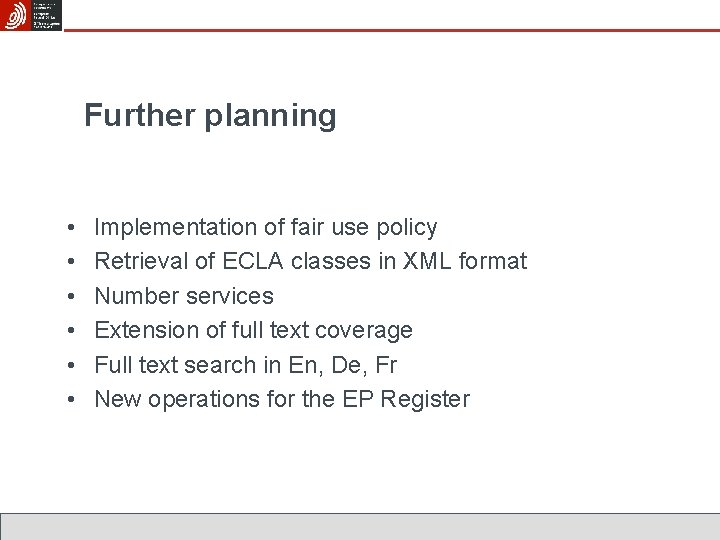
Further planning • • • Implementation of fair use policy Retrieval of ECLA classes in XML format Number services Extension of full text coverage Full text search in En, De, Fr New operations for the EP Register
Thank you for your attention D 5. 5. 2 Davide Lingua dlingua@epo. org