
Pastry Scalable decentralized object locations and routing for
Pastry Scalable, decentralized object locations and routing for large p 2 p systems
Outline � Introduction � Design of Pastry � Pastry Node State � Routing Table � Neighborhood Set � Leaf Set � Routing Algorithm and Performance � Self Adaptation � Node Arrival � Node Departure � Locality � Arbitrary Node Failure � Experimental Results � Applications with Pastry � Conclusion
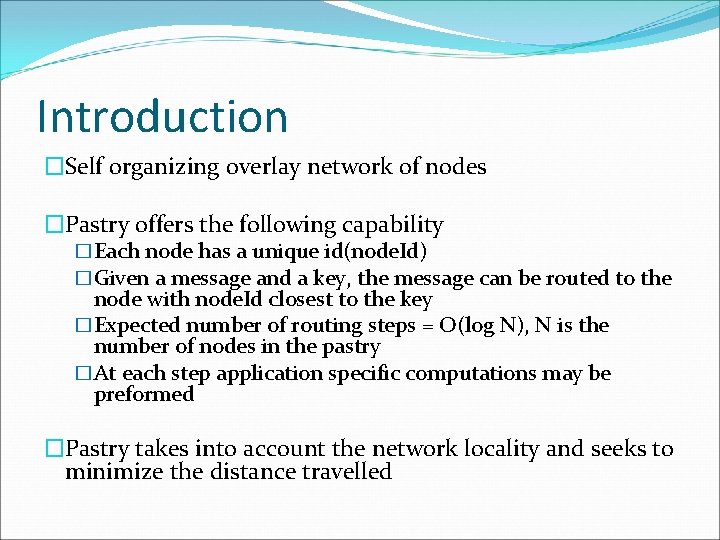
Introduction �Self organizing overlay network of nodes �Pastry offers the following capability �Each node has a unique id(node. Id) �Given a message and a key, the message can be routed to the node with node. Id closest to the key �Expected number of routing steps = O(log N), N is the number of nodes in the pastry �At each step application specific computations may be preformed �Pastry takes into account the network locality and seeks to minimize the distance travelled
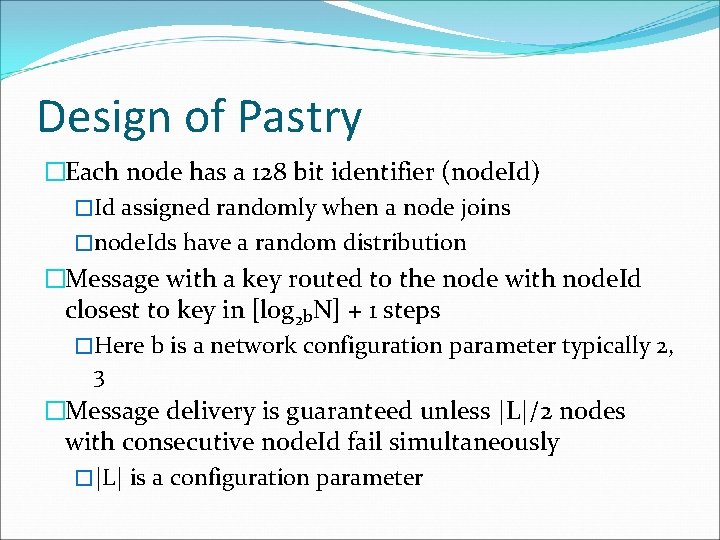
Design of Pastry �Each node has a 128 bit identifier (node. Id) �Id assigned randomly when a node joins �node. Ids have a random distribution �Message with a key routed to the node with node. Id closest to key in [log 2 b. N] + 1 steps �Here b is a network configuration parameter typically 2, 3 �Message delivery is guaranteed unless |L|/2 nodes with consecutive node. Id fail simultaneously �|L| is a configuration parameter
Design of Pastry cont… �When routing the message M with a key K, K is considered a number with base 2 b �At each step of routing message M is sent to a node that has a node. Id such that it shares with K a prefix that is at least 1 bit longer than what is shared by the current node �The information maintained by each node is described later
Pastry Node State �Each node maintains �A routing table, R �A neighborhood set, M �A leaf set, L �Routing table R and leaf set L are used in the routing algorithm described later �Neighborhood set M is used to maintain locality properties
Routing Table (R) �Let each node. Id have X bits, then the routing table has X/b rows �X/b is of the order of log 2 b. N �The routing table has 2 b – 1 entries for each row �Let R[m, n] denote the entry in row m and column n of the routing table �R[m, n] refers to a node whose node. Id has m bits same as the present node and value of its (m+1)th bit is n �Choice of b in the configuration parameter provides a trade off �Increasing b decreases the number of steps for routing but increases the size of the routing table

Routing Table Example �This is an example of a routing table (taken from the original paper that talks about Pastry) �The different row and column entries are shown �Node. Id = 10233102, b = 2, l = 8 and all numbers are in base 4 �It also shows the leaf set, neighborhood set for the same node
Neighborhood Set M �Neighborhood set contains the |M| node. Ids and their IPs such that they are closest to the node �Closeness is measured according to a proximity metric �Proximity metric can be: �Number of IP routing hops �Geographical distance �Round trip time �It is assumed to follow the triangle inequality
Leaf Set L �It contains |L|/2 nodes with numerically closest larger node. Ids �And |L|/2 nodes with numerically closest smaller node. Ids �Leaf set is used during message routing �Typical values of |L| and |M| are 2 b or 2*2 b
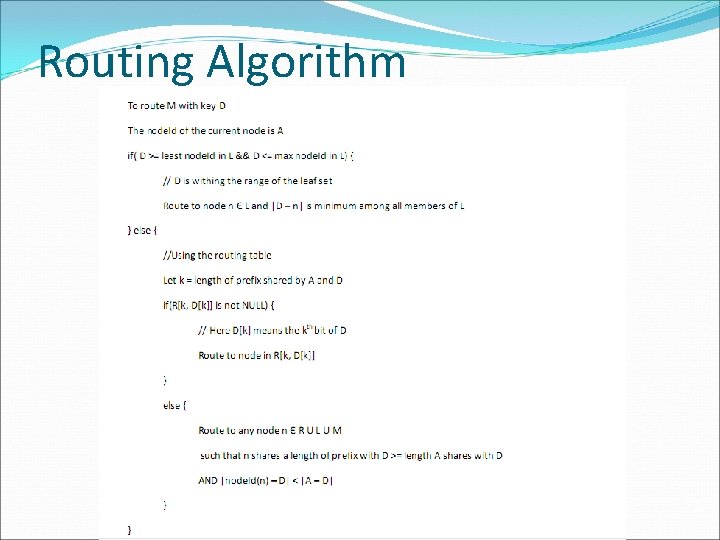
Routing Algorithm
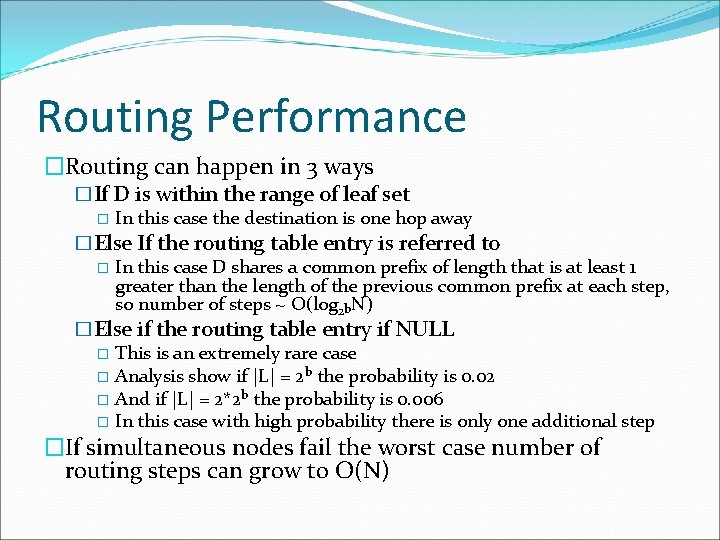
Routing Performance �Routing can happen in 3 ways �If D is within the range of leaf set � In this case the destination is one hop away �Else If the routing table entry is referred to � In this case D shares a common prefix of length that is at least 1 greater than the length of the previous common prefix at each step, so number of steps ~ O(log 2 b. N) �Else if the routing table entry if NULL � This is an extremely rare case � Analysis show if |L| = 2 b the probability is 0. 02 � And if |L| = 2*2 b the probability is 0. 006 � In this case with high probability there is only one additional step �If simultaneous nodes fail the worst case number of routing steps can grow to O(N)
Self Adaptation �Pastry is a self organizing network �It is unaffected to a large extent by node arrivals and departures �To enable this it must alter the node states with node arrivals and departures

Node Arrivals �Let us assume node n joins with node. Id X �We assume that X knows one node A in the network �A is assumed to be in proximity of X �X sends special “join” message to A with key X �So A routes the message to the node with node. Id closest to X �Each node on the path sends its state to X �X builds its state based on the states it receives �The ways for building R, M and L for X are described below
Building the Routing Table R �Let the path of routing of “join” message be X A B C …. . Z �The first row of X is the first row of A �As A does not share any common prefix with X �The second row of X is the second row of B �As B shares prefix of size one with X �The third row of X is the third row of C �As C shares prefix of size two with X �And so on…
Building the Neighborhood Set M �The neighborhood Set of X is built using the neighborhood Set of A �The neighborhood Set of X is initialized with the neighborhood set of A �X can then request the neighborhood sets of the individual members to make any modifications necessary �If any member from the requested neighborhood set is found to be at a closer distance it replaces a member at a larger distance in M

Building the Leaf Set L �Let the path of routing of “join” message be X A B C …. . Z �The leaf set of X is build using the leaf set of Z �Let the leaf set of Z in increasing order of node. Id be �a 1, a 2, a 3, …. , a|L| �X and Z lie between a(|L|/2 -1) and a(|L|/2+1) �So Z is inserted between these nodes and one of a 1 and a|L| is removed so that properties of L still holds
Node Departure �A node is considered failed when its immediate neighbors can no longer communicate with it �A node referred in either L, M or R can fail �In each of the 3 cases: L, M or R needs to be updated accordingly �The ways these are updated is described below for each of the 3 cases
Node Departure in L �If a node in leaf set fails the node asks the extreme valued node. Id on the side where the node has failed for its neighborhood set �Let the neighborhood set of the extreme node be L’ �A part of L’ will overlap with L �The first node. Id that is not present in L but present in L’ after the overlap is added in L �Before adding the node it is verified that the node is alive by contacting it
Node Departure in R �If a node has failed in the mth row and nth of R then any other node in the mth row is contacted and its entry in R[m, n] is added �If no node in mth row is alive then we move on to (m+1)th row and copy its R[m, n] and so on… �If a valid live node exists it is extremely likely that we will find one
Node Departure from M �Neighborhood Set is not used for routing �Still it is important to keep this list up to date as it plays an important role in exchanging information about nearby nodes �Each member of M is periodically contacted �If it does not respond it needs to be replaced �This is done by asking other members of M for their neighborhood sets and updating accordingly
Locality �The nodes in the routing table R are close to the node with respect to the proximity metrics �It is assumed that the triangle inequality law holds for the proximity metrics �Let us assume that the nodes in the routing tables of the present nodes are close �We then prove that when a node joins the nodes in its routing table are also close to it �When a new node X joins it knows a current node A �It is assumed that A is close to X
Locality cont… �As the first row of routing table of A is copied to the new routing table these nodes are close to X (because A is close to X) �The next row is copied from B �The average distance grows exponentially with each row, as the number of nodes to choose from decreases exponentially �So the average distance of first row nodes of B from B is exponentially larger than the distance between A and B �So the distance of X from first row elements of B is of the same order as the distance of B from the elements �The same argument holds from C, D… �So the nodes in routing table of X are close to X
Locality among k Nodes �In some Pastry-based applications, object is replicated on k nodes on its route (during insertion) �In prefix-base routing: goal is to reach any of k numerically closest nodes that has a copy of object �Here it is possible to miss nearby nodes with different prefix �Here due to properties of the routing table one reaches a close node that stores the object with high probability
Arbitrary Node Failure �When a node continues to be responsive but behaves incorrectly or maliciously �In such a case repeated queries will fail as each time we take the same route �This is solved using randomized routing �If a number of nodes are satisfying a routing condition then one can randomly choose one of them �One can also be slightly biased towards a closer node instead of being completely biased
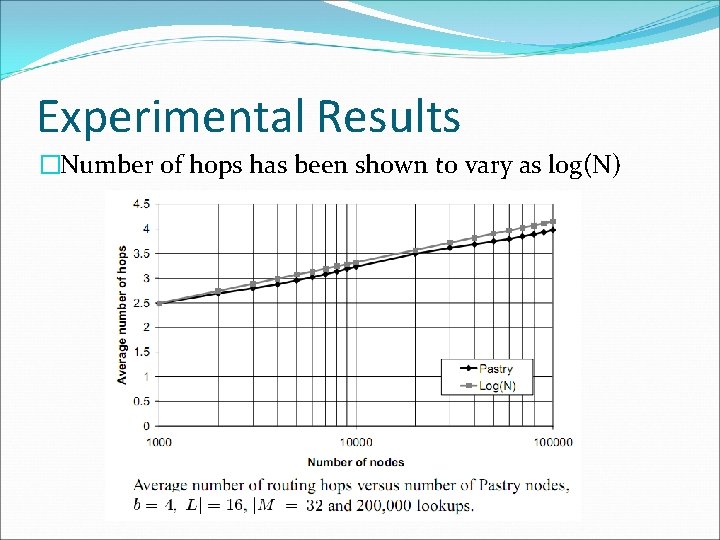
Experimental Results �Number of hops has been shown to vary as log(N)
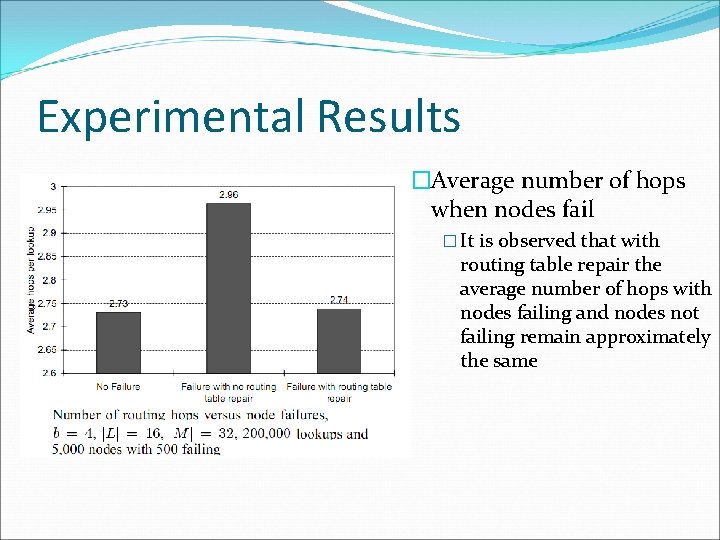
Experimental Results �Average number of hops when nodes fail � It is observed that with routing table repair the average number of hops with nodes failing and nodes not failing remain approximately the same

Applications using Pastry �PAST: It is a distributed file system implemented on top of Pastry �SCRIBE: It is a decentralized publish/subscribe system that uses Pastry for its underlying route management and host lookup

Conclusion �Pastry is a p 2 p content location and routing system �It performs relatively unaffected even with relatively large number of node failures �Results with up to 100, 000 nodes show that the system is efficient and scales well �It can be used as a building block for varied internet applications �Examples are file sharing, Global file storage, group communications and naming systems
References �ROWSTRON, A. AND DRUSCHEL, P. 2001. Pastry: Scalable, distributed object location and routing for large-scale peer -to-peer systems. In Proceedings of IFIP/ACMMiddleware. Heidelberg, Germany �http: //en. wikipedia. org/wiki/Pastry_(DHT) �A Survey of Peer-to-Peer Content Distribution Technologies, STEPHANOS AND ROUTSELLISTHEOTOKIS AND DIOMIDIS SPINELLIS �http: //research. microsoft. com/enus/um/people/antr/pastry/
- Slides: 30