
Pastry making method Ratio Flour Fat Full list
- Slides: 8
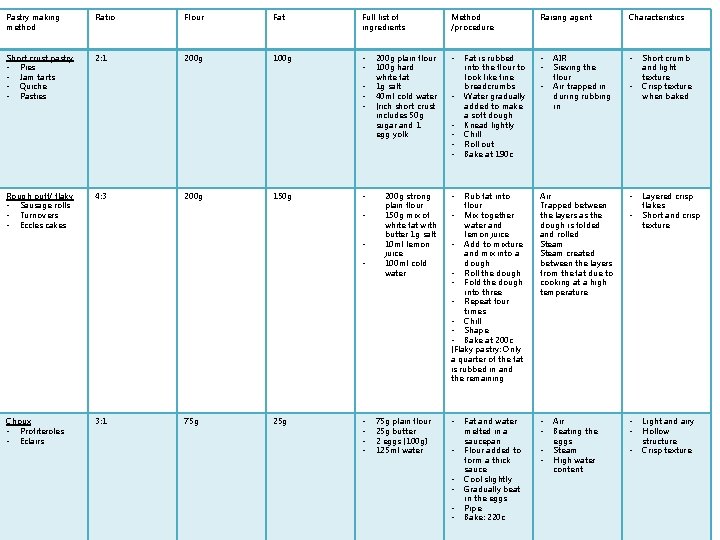
Pastry making method Ratio Flour Fat Full list of ingredients Short crust pastry • Pies • Jam tarts • Quiche • Pasties 2: 1 200 g 100 g • • Rough puff/ flaky • Sausage rolls • Turnovers • Eccles cakes • • • 4: 3 200 g 150 g • • Choux • Profiteroles • Eclairs 3: 1 75 g 25 g • • Method /procedure 200 g plain flour 100 g hard white fat 1 g salt 40 ml cold water (rich short crust includes 50 g sugar and 1 egg yolk • 200 g strong plain flour 150 g mix of white fat with butter 1 g salt 10 ml lemon juice 100 ml cold water • 75 g plain flour 25 g butter 2 eggs (100 g) 125 ml water • • • Fat is rubbed into the flour to look like fine breadcrumbs Water gradually added to make a soft dough Knead lightly Chill Roll out Bake at 190 c Rub fat into flour • Mix together water and lemon juice • Add to mixture and mix into a dough • Roll the dough • Fold the dough into three • Repeat four times • Chill • Shape • Bake at 200 c (Flaky pastry: Only a quarter of the fat is rubbed in and the remaining • • • Fat and water melted in a saucepan Flour added to form a thick sauce Cool slightly Gradually beat in the eggs Pipe Bake: 220 c Raising agent Characteristics AIR Sieving the flour Air trapped in during rubbing in • Air Trapped between the layers as the dough is folded and rolled Steam created between the layers from the fat due to cooking at a high temperature • Air Beating the eggs Steam High water content • • • Short crumb and light texture Crisp texture when baked Layered crisp flakes Short and crisp texture Light and airy Hollow structure Crisp texture
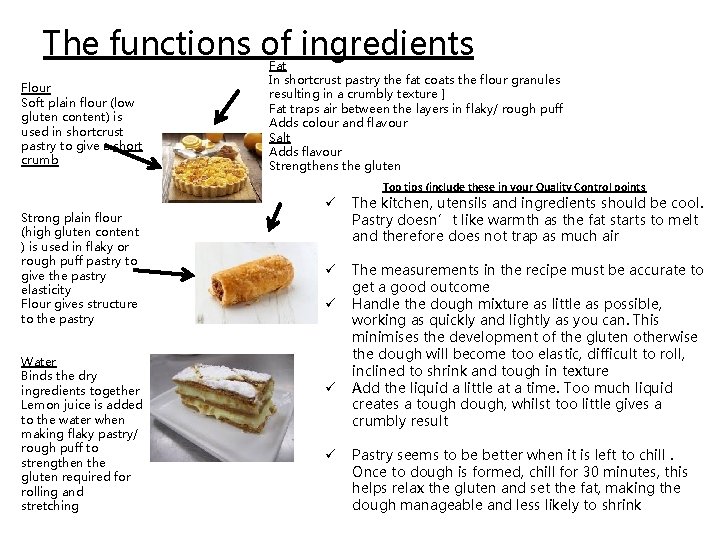
The functions of ingredients Flour Soft plain flour (low gluten content) is used in shortcrust pastry to give a short crumb Fat In shortcrust pastry the fat coats the flour granules resulting in a crumbly texture ] Fat traps air between the layers in flaky/ rough puff Adds colour and flavour Salt Adds flavour Strengthens the gluten Top tips (include these in your Quality Control points Strong plain flour (high gluten content ) is used in flaky or rough puff pastry to give the pastry elasticity Flour gives structure to the pastry Water Binds the dry ingredients together Lemon juice is added to the water when making flaky pastry/ rough puff to strengthen the gluten required for rolling and stretching ü The kitchen, utensils and ingredients should be cool. Pastry doesn’t like warmth as the fat starts to melt and therefore does not trap as much air ü The measurements in the recipe must be accurate to get a good outcome Handle the dough mixture as little as possible, working as quickly and lightly as you can. This minimises the development of the gluten otherwise the dough will become too elastic, difficult to roll, inclined to shrink and tough in texture Add the liquid a little at a time. Too much liquid creates a tough dough, whilst too little gives a crumbly result ü ü ü Pastry seems to be better when it is left to chill. Once to dough is formed, chill for 30 minutes, this helps relax the gluten and set the fat, making the dough manageable and less likely to shrink
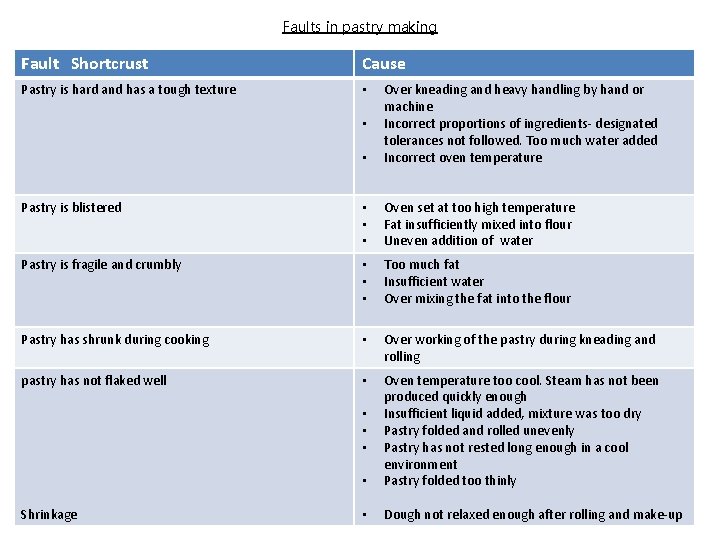
Faults in pastry making Fault Shortcrust Cause Pastry is hard and has a tough texture • • Over kneading and heavy handling by hand or machine Incorrect proportions of ingredients- designated tolerances not followed. Too much water added Incorrect oven temperature Pastry is blistered • • • Oven set at too high temperature Fat insufficiently mixed into flour Uneven addition of water Pastry is fragile and crumbly • • • Too much fat Insufficient water Over mixing the fat into the flour Pastry has shrunk during cooking • Over working of the pastry during kneading and rolling pastry has not flaked well • • Oven temperature too cool. Steam has not been produced quickly enough Insufficient liquid added, mixture was too dry Pastry folded and rolled unevenly Pastry has not rested long enough in a cool environment Pastry folded too thinly • Dough not relaxed enough after rolling and make-up • • Shrinkage