
Pastoral Care for Students Colleagues and Self during

- Slides: 26
Pastoral Care for Students, Colleagues and Self during COVID-2019 “It’s easy to blame, it’s easy to politicize, it’s harder to tackle a problem together and find solutions together. ” WHO Director-General Tedros Adhanom Ghebreyesus Online Workshop/Webinar Charlie Reis Director PGCert February 2020
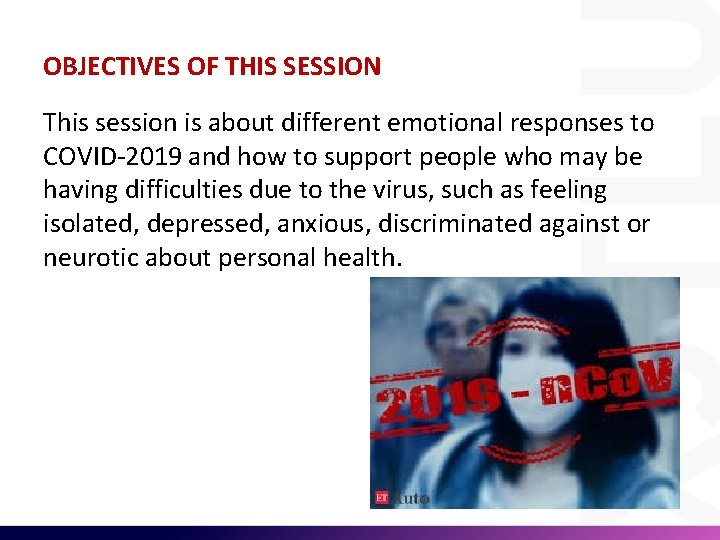
OBJECTIVES OF THIS SESSION This session is about different emotional responses to COVID-2019 and how to support people who may be having difficulties due to the virus, such as feeling isolated, depressed, anxious, discriminated against or neurotic about personal health.
OBJECTIVES OF THIS SESSION We will open a forum for general discussion as well as review some basic, non-invasive guidelines on how to: • deal with isolation and anxiety at this time; • find reliable information; • be mindful about our assumptions about others. As we all know, one of the characteristics of going through this health crisis is a lack of certainty.
WELCOME While I am greeting you, as an icebreaker, please use our public chat to post your ideas about student selfassessment in an online environment. Please say hi and address: • What mental health issues have you seen related to COVID-19? • How did you provide support (to students, others, yourself)? If we spend the hour talking about your ideas, that is an hour well spent; the ppt is available at: https: //ice. xjtlu. edu. cn/course/view. php? id=1605§ion=12.
REMOTE WORK AND SCHOOL According the State of Remote Work (Buffer, 2019) mental health issues related to working remotely often can be: • Feelings of isolation, loneliness and disconnection; • Being unable to ‘unplug’ or set healthy boundaries between work and ‘life’; • Becoming inactive. Ideas to help? Use the chat.
REMOTE WORK AND SCHOOL TIPS • Set clear expectations of working and non-working hours; • Highlight that it is not necessary to remain connected around the clock; • Suggest that they break up their day with personal activities; • Be aware that most shopping, etc, is now only available during working hours; • Understand the disruption that school closures have caused to many families; • Advise that they stay as connected as possible with their teams via company digital platforms and have regular check-ins with managers and team members.
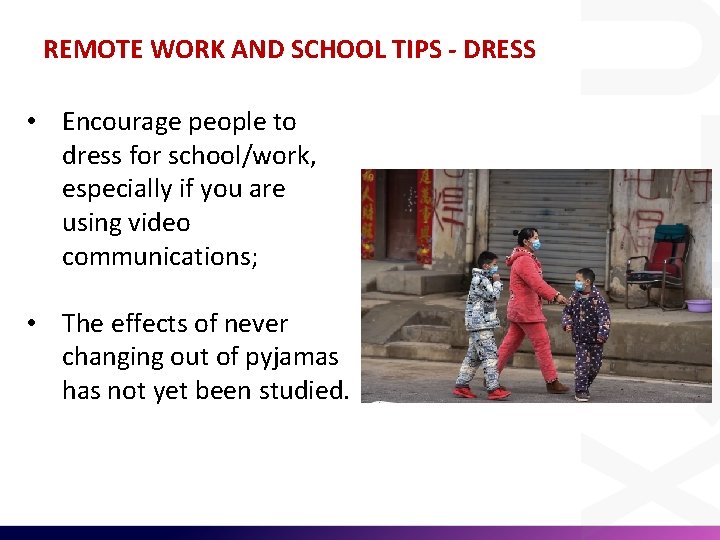
REMOTE WORK AND SCHOOL TIPS - DRESS • Encourage people to dress for school/work, especially if you are using video communications; • The effects of never changing out of pyjamas has not yet been studied.
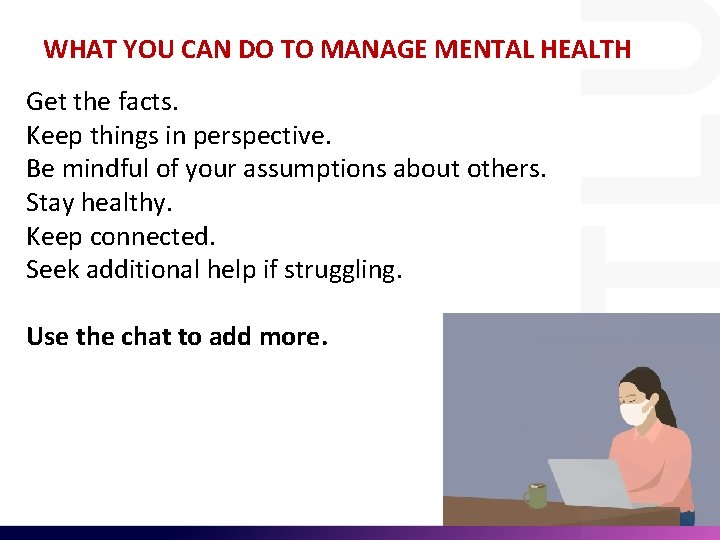
WHAT YOU CAN DO TO MANAGE MENTAL HEALTH Get the facts. Keep things in perspective. Be mindful of your assumptions about others. Stay healthy. Keep connected. Seek additional help if struggling. Use the chat to add more.
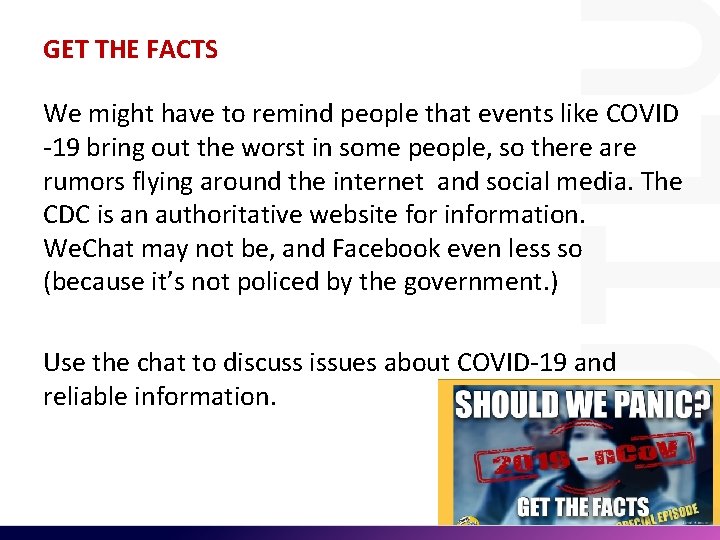
GET THE FACTS We might have to remind people that events like COVID -19 bring out the worst in some people, so there are rumors flying around the internet and social media. The CDC is an authoritative website for information. We. Chat may not be, and Facebook even less so (because it’s not policed by the government. ) Use the chat to discuss issues about COVID-19 and reliable information.
FACTS ABOUT HEALTH AND MORTALITY The common flu has a mortality rate of about 0. 1%, meaning that for all the people who get the flu, not many actually die. COVID-19 has a mortality rate of 2%, which is much higher than the flu, but still not like Ebola or the Marburg Virus. As of Monday, there were 39 people infected with COVID-19 in the UK, with no fatalities, while an average of 1, 300 people die from flu-related complications each year. Also, the elderly are effected in a different way than the young.
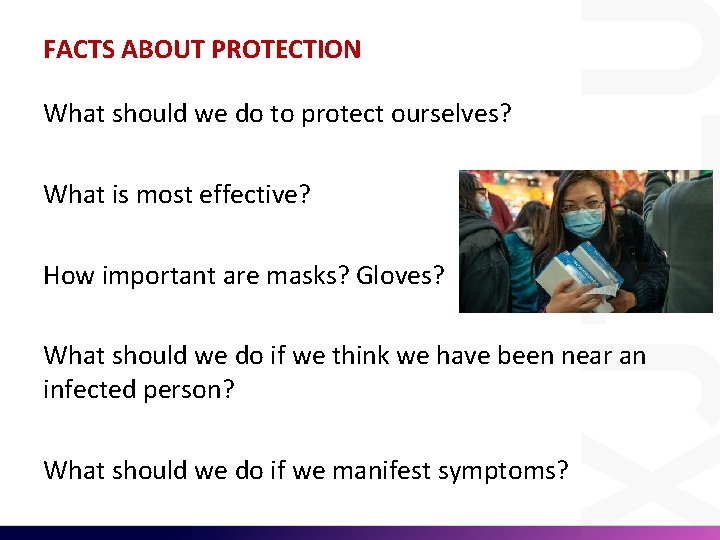
FACTS ABOUT PROTECTION What should we do to protect ourselves? What is most effective? How important are masks? Gloves? What should we do if we think we have been near an infected person? What should we do if we manifest symptoms?
FACTS ABOUT CONTACT How far can the virus travel through the air? Should I keep the windows closed? How long does the virus live on different surfaces? Are animals carriers?
KEEP THINGS IN PERSPECTIVE To much news about the virus could drive you crazy or be agitating, as too much news about anything bad could, like a slower-moving catastrophe like climate crisis. People can limit worry and agitation by lessening the time spent exposed to media coverage. Take a break and go for a walk. Remember what’s good in life, what is positive in your life and things you have control over. Thoughts?
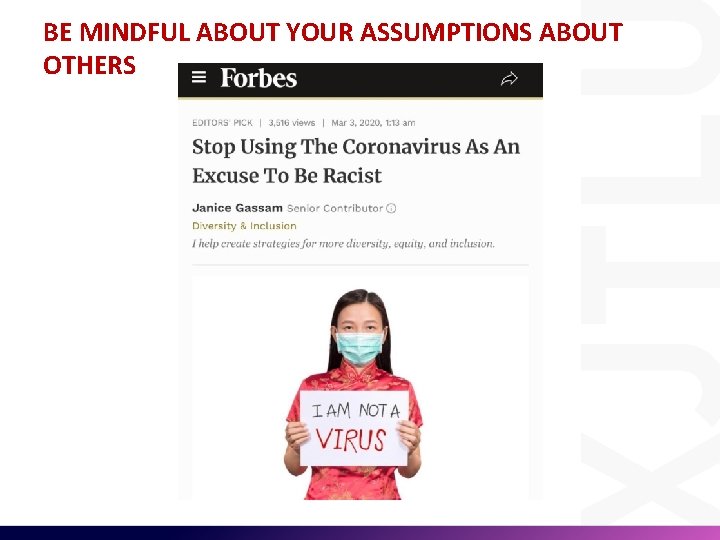
BE MINDFUL ABOUT YOUR ASSUMPTIONS ABOUT OTHERS
BE MINDFUL ABOUT YOUR ASSUMPTIONS ABOUT OTHERS • The people in the hardest-hit areas are suffering more than you are if you are in a cooler zone and could probably use the most support and understanding now. • The virus infects all peoples indiscriminately. • People will still cough and sneeze as frequently they did before the virus, so not everyone who coughs is a carrier. • More… use the chat.
STAY HEALTHY • Learn how to wash your hands properly and use soap. • • Do this also after coughing or sneezing. Alcohol-based sanitizer also works, but drinking alcohol does not, alas. • Try not to touch your face (eyes, nose, mouth, ears). • To protect others, cover your mouth and nose when coughing or sneezing. Unless it is sealed to your face, this is what masks are for. • Avoid contact with others who are sick. • Stay home while sick.
STAY MENTALLY HEALTHY • Try to get out of your home regularly if you are not in a hot spot. • Figure out a way to exercise. • Find something non-virus related to focus on (great for Ph. D candidates). • Be sure to maintain connections with friends. • Try to have some fun to stay sane (but mah-jong is frowned upon by police). In truth, no one really knows the mental health effects of this type of event. (Yay! More uncertainty!)
KEEP CONNECTED • Many people are stuck by themselves, some far away, so reach out to them. • Some people have people, but are going crazy being inside too much with them, so be understanding. • Maintaining networks and connections can provide a sense of normalcy, or an anchor for a world gone adrift. • Allow yourself some venting to others and allow them to vent to you to ‘blow off steam’ and share feelings.
SEEK ADDITIONAL HELP Normally, typing ‘mental health’ into an XJTLU email gets a response from the student counselling centre, but I tried last week and got nothing. According to CCTV, hotlines and social media support groups have also been set up in China for mental health issues, but how to access them was not reported (QQ: Wuhan University and Huazhong University of Science and Technology; JD. com; We. Chat: Know. Yourself).
ANXIETY Anxiety is fear or worry about the future. It is generally compounded by a lack of certainty, and anxiety is certainly stressful. Manifestations of anxiety can include: • • • Hyper-consumption of media; Depression; Oversleeping and insomnia; Immobility, such as not getting out of bed; Increased risk-taking behaviours or irrational riskaversion.
DEPRESSION The National Institute of Mental Health (US) defines depression as: Depression (major depressive disorder or clinical depression) is a common but serious mood disorder. It causes severe symptoms that affect how you feel, think, and handle daily activities, such as sleeping, eating, or working. To be diagnosed with depression, the symptoms must be present for at least two weeks.
DEPRESSION Depression is defined as a low mood and the loss of interest in the activities of everyday life, which can easily be caused by uncertainty and impair the ‘normal’ functioning of a person. This means that COVID-19 will be immobilising for many as they are affected by forms of depression, as happened with SARS.
DEPRESSION Here are other tips that may help people during depression: • Try to be active and exercise. • Set realistic goals for yourself. • Try to spend time with other people and confide in a trusted friend or relative. • Try not to isolate yourself, and let others help you. • Expect your mood to improve gradually, not immediately. • Postpone important decisions. • Educate yourself about depression.
PANIC Panic is an irrational or debilitating response to something. Panicked behaviours in response to COVID-19 may include: • • • Overblown worry; Neuroses about personal health; Over-anxiety about the health of others; Hoarding behaviours; Xenophobia (irrational fear of strangers/outsiders); Agoraphobia (irrational fear of going outside).
WEB RESOURCES You can always email me at charlie. reis@xjtlu. edu. cn. We have also created a page for getting started thinking about online pedagogies: https: //ice. xjtlu. edu. cn/course/view. php? id=1605§ion=12.
THANK YOU VISIT US FOLLOW US WWW. XJTLU. EDU. CN @XJTLU