
Past Tense Simple Past Hello Do you want

- Slides: 17
Past Tense Simple Past Hello! Do you want to know about past tense? Then choose what you want to know and Questions click. Negatives Vyberte si kapitolu a kliknutím vstupte. Na stránce vždy jednou klikněte myší, počkejte, co se bude dít, a splňte úkoly. Některé věty máte napsat do sešitu. Čtěte zadání! Pak můžete zase kliknout a jít dál. Dostupné z Metodického portálu www. rvp. cz, ISSN: 1802 -4785, financovaného z ESF a státního rozpočtu ČR. Provozováno Výzkumným ústavem pedagogickým v Praze.
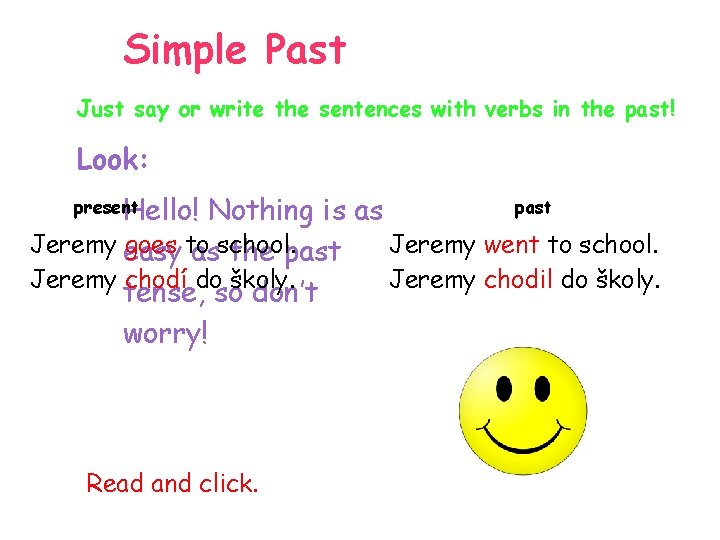
Simple Past Just say or write the sentences with verbs in the past! Look: past Hello! Nothing is as Jeremy easy goes to Jeremy went to school. asschool. the past Jeremy chodí do školy. Jeremy chodil do školy. tense, so don’t worry! present Read and click.
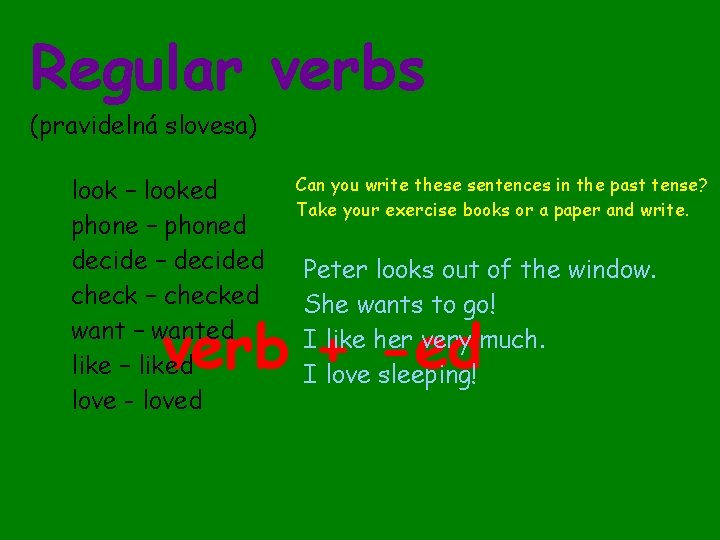
Regular verbs (pravidelná slovesa) look – looked phone – phoned decide – decided check – checked want – wanted like – liked love - loved Can you write these sentences in the past tense? Take your exercise books or a paper and write. Peter looks out of the window. She wants to go! I like her very much. I love sleeping! verb + -ed
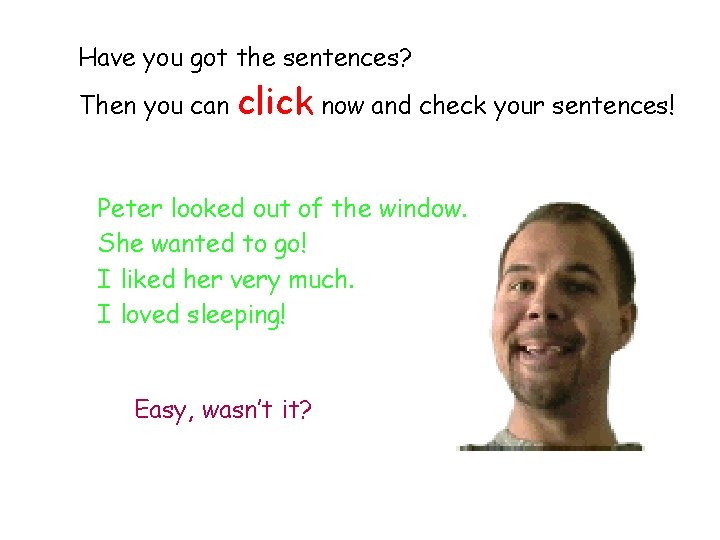
Have you got the sentences? Then you can click now and check your sentences! Peter looked out of the window. She wanted to go! I liked her very much. I loved sleeping! Easy, wasn’t it?
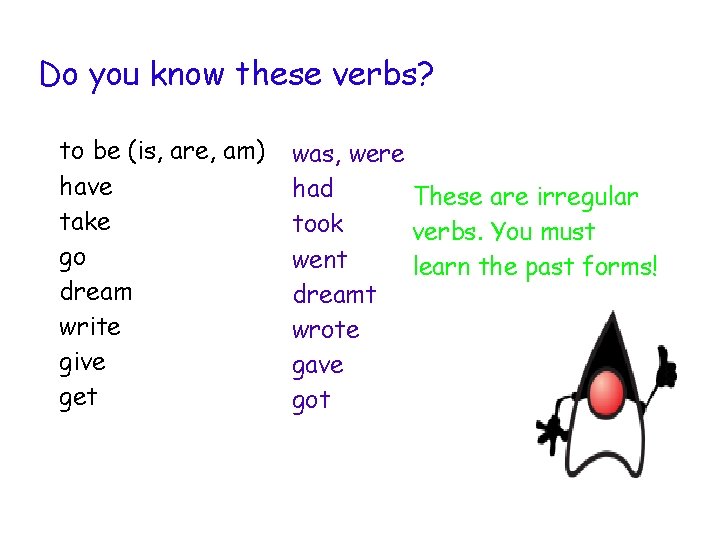
Do you know these verbs? to be (is, are, am) have take go dream write give get was, were had These are irregular took verbs. You must went learn the past forms! dreamt wrote gave got
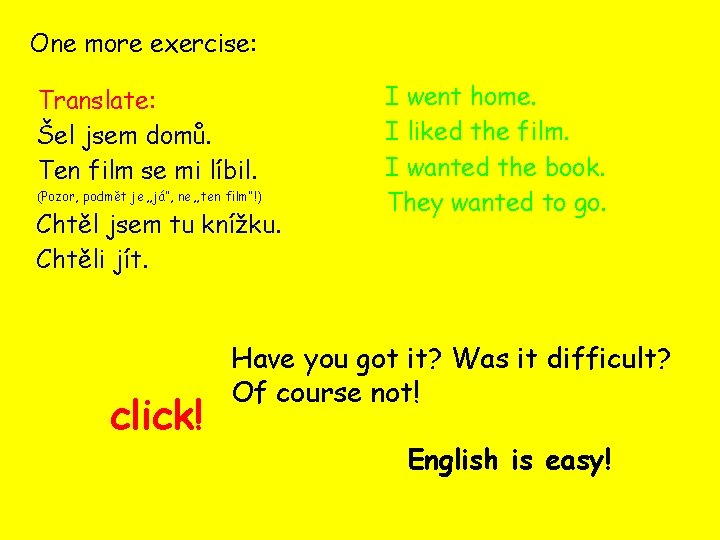
One more exercise: Translate: Šel jsem domů. Ten film se mi líbil. (Pozor, podmět je „já“, ne „ten film“!) Chtěl jsem tu knížku. Chtěli jít. click! I went home. I liked the film. I wanted the book. They wanted to go. Have you got it? Was it difficult? Of course not! English is easy!
That’s all! Now you can use the simple past tense! Bye! Go back to the start
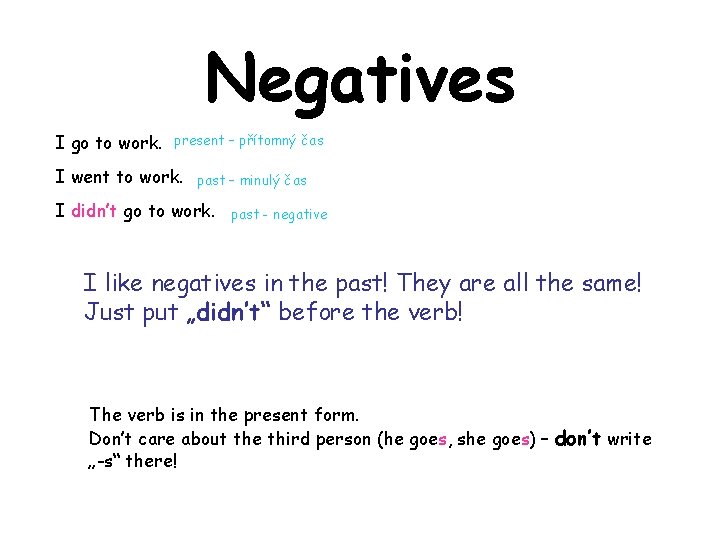
Negatives I go to work. present – přítomný čas I went to work. past – minulý čas I didn’t go to work. past - negative I like negatives in the past! They are all the same! Just put „didn’t“ before the verb! The verb is in the present form. Don’t care about the third person (he goes, she goes) – don’t write „-s“ there!
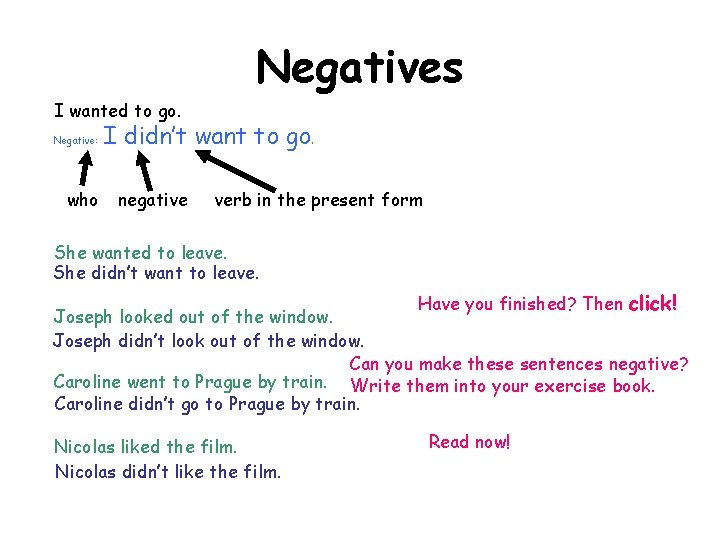
Negatives I wanted to go. Negative: who I didn’t want to go. negative verb in the present form She wanted to leave. She didn’t want to leave. Have you finished? Then click! Joseph looked out of the window. Joseph didn’t look out of the window. Can you make these sentences negative? Caroline went to Prague by train. Write them into your exercise book. Caroline didn’t go to Prague by train. Nicolas liked the film. Nicolas didn’t like the film. Read now!
How good you are! Now you can do negatives in the past! Hurray! Back to start
Questions ? It is easy - just use your brain! You can understand it, but read it properly! … and if you do not know what „properly“ is, it means „pořádně, pečlivě“ in Czech!
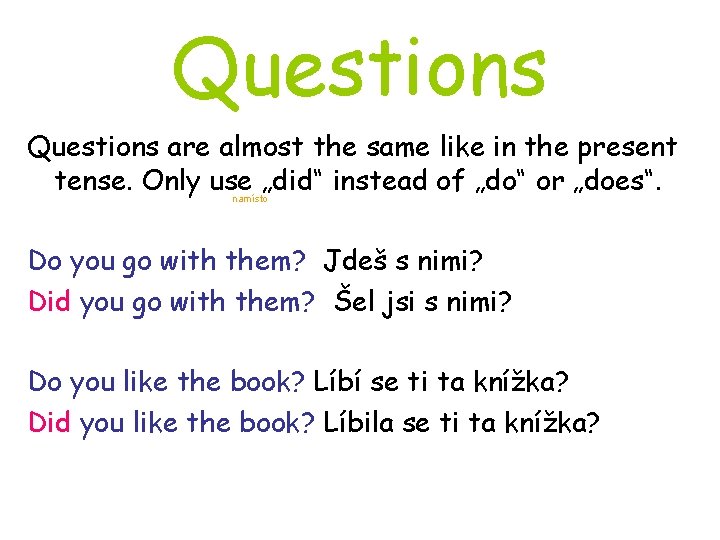
Questions are almost the same like in the present tense. Only use „did“ instead of „do“ or „does“. namísto Do you go with them? Jdeš s nimi? Did you go with them? Šel jsi s nimi? Do you like the book? Líbí se ti ta knížka? Did you like the book? Líbila se ti ta knížka?
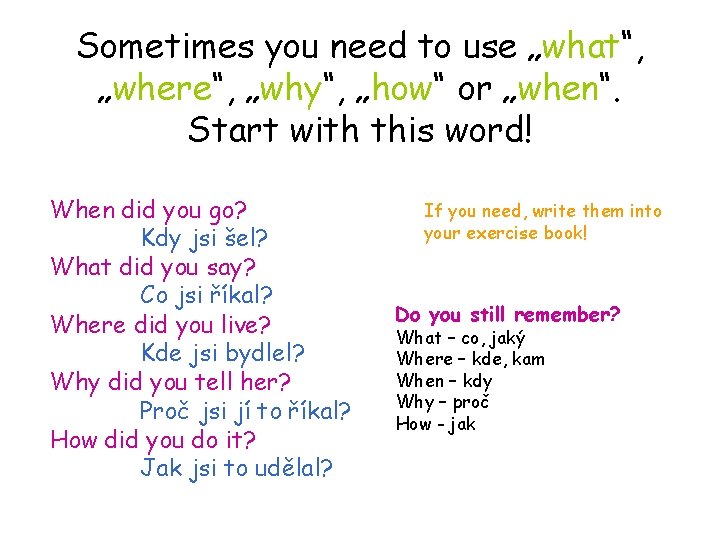
Sometimes you need to use „what“, „where“, „why“, „how“ or „when“. Start with this word! When did you go? Kdy jsi šel? What did you say? Co jsi říkal? Where did you live? Kde jsi bydlel? Why did you tell her? Proč jsi jí to říkal? How did you do it? Jak jsi to udělal? If you need, write them into your exercise book! Do you still remember? What – co, jaký Where – kde, kam When – kdy Why – proč How - jak
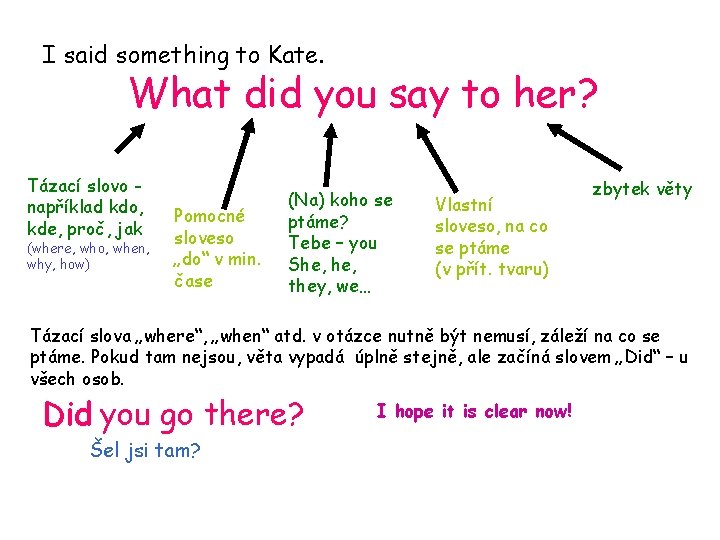
I said something to Kate. What did you say to her? Tázací slovo například kdo, kde, proč, jak (where, who, when, why, how) Pomocné sloveso „do“ v min. čase (Na) koho se ptáme? Tebe – you She, they, we… Vlastní sloveso, na co se ptáme (v přít. tvaru) zbytek věty Tázací slova „where“, „when“ atd. v otázce nutně být nemusí, záleží na co se ptáme. Pokud tam nejsou, věta vypadá úplně stejně, ale začíná slovem „Did“ – u všech osob. Did you go there? Šel jsi tam? I hope it is clear now!
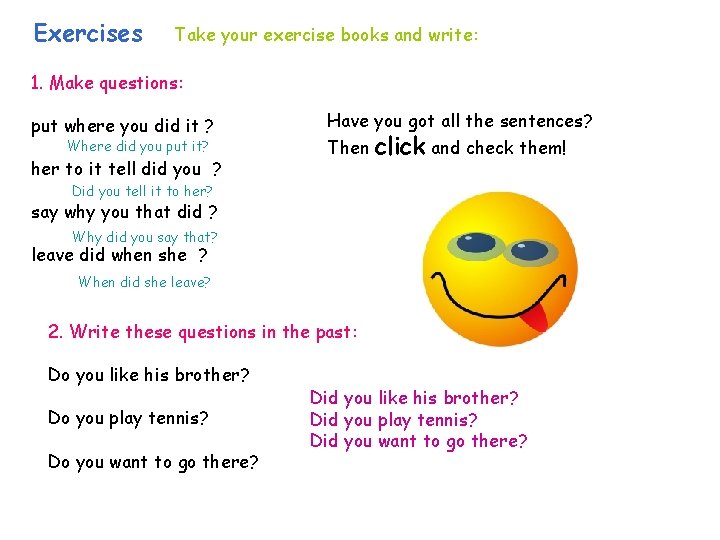
Exercises Take your exercise books and write: 1. Make questions: put where you did it ? Where did you put it? her to it tell did you ? Have you got all the sentences? Then click and check them! Did you tell it to her? say why you that did ? Why did you say that? leave did when she ? When did she leave? 2. Write these questions in the past: Do you like his brother? Do you play tennis? Do you want to go there? Did you like his brother? Did you play tennis? Did you want to go there?
That‘s all. Now you can go back to the start! Back to start
Zdroje obrázků Všechny uveřejněné odkazy [cit. 2009 -27 -01]. Dostupné pod licencí Creative Commons – na http: //www. wikipedia. org/. http: //commons. wikimedia. org/wiki/File: Movicons 2 -hello. gif http: //commons. wikimedia. org/wiki/File: Smiley. svg http: //commons. wikimedia. org/wiki/File: Roberth. Edberg. gif http: //commons. wikimedia. org/wiki/File: Pffffft. gif http: //commons. wikimedia. org/wiki/File: Thumbs. Up. svg http: //commons. wikimedia. org/wiki/File: Narro_smiley. jpg http: //commons. wikimedia. org/wiki/File: Wave. svg