
Past present and future of knowledge Meredith Payne
- Slides: 29
Past, present, and future of knowledge Meredith Payne, Donna Edgar, Kristen Gravelin
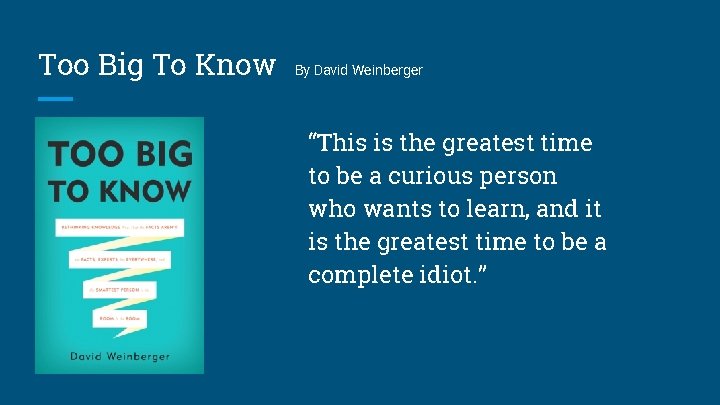
Too Big To Know By David Weinberger “This is the greatest time to be a curious person who wants to learn, and it is the greatest time to be a complete idiot. ”
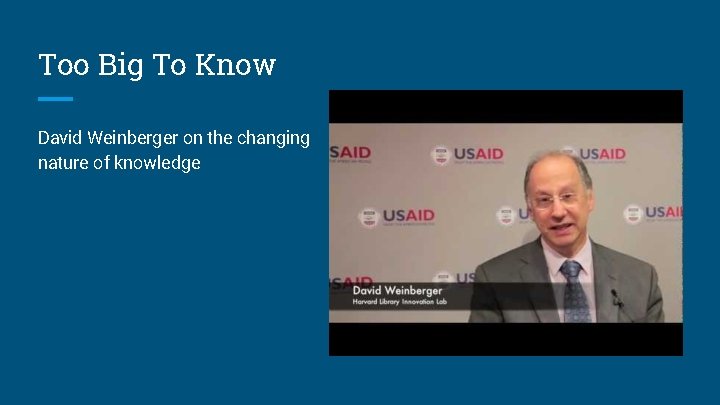
Too Big To Know David Weinberger on the changing nature of knowledge
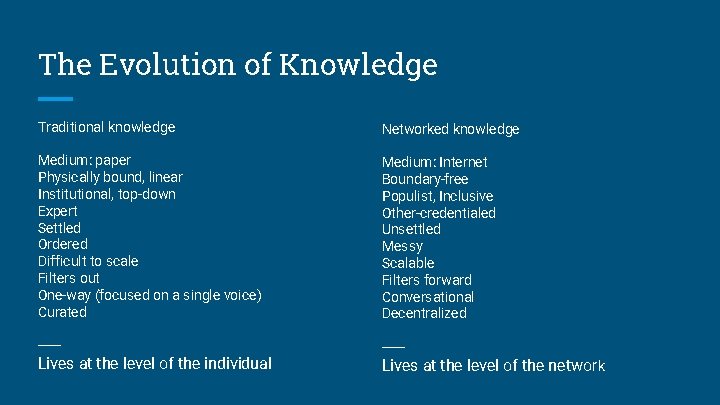
The Evolution of Knowledge Traditional knowledge Networked knowledge Medium: paper Physically bound, linear Institutional, top-down Expert Settled Ordered Difficult to scale Filters out One-way (focused on a single voice) Curated Medium: Internet Boundary-free Populist, Inclusive Other-credentialed Unsettled Messy Scalable Filters forward Conversational Decentralized ------ Lives at the level of the individual Lives at the level of the network
What does this mean for how we deal with knowledge?
Challenge: There’s so much of it! How will we find it? Weinberger says embrace it; focus on findability. ‘Filter forward’ “Instead of reducing information and hiding what doesn’t make it through, filters now increase information and reveal the whole deep sea. ” Filtering is social and algorithmic Curation can be expert or ‘most like me’ (Example: Amazon)
Challenge: There’s so much of it! How can we retain it? Determine what needs to be saved ● ● The question during dawn of information was what can we afford to save? Question now is with the ability for everyone to share data on the internet what can we afford to lose? Biological Memory-Digital Memory ● ● Sets up a series of gates and controls to turn away the trivial or distracting and allow ready admittance of valuable information for conversion to long-term memory. Who would be the gatekeeper? Public Versus Private Data We’ll need to ensure that control over culturally significant data doesn’t end up in the hands of a small group of commercial enterprises that focus on profit, not posterity. (Rumsey)
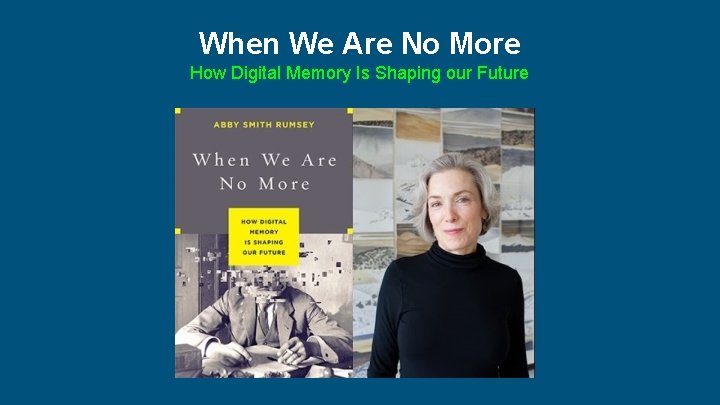
When We Are No More How Digital Memory Is Shaping our Future
Key Points ● Data Storage is not Memory ● Memory is not about the past it is about the future. ● Collective memory of humanity is dependent on two things: a durable medium on which to record; and an institution that takes responsibility for the care of the collection for generations into the future. ● Future access to our own history depends on actions taken today to preserve and maintain information.
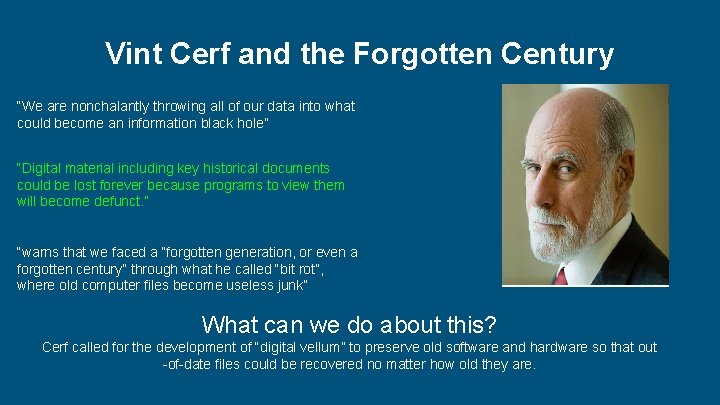
Vint Cerf and the Forgotten Century “We are nonchalantly throwing all of our data into what could become an information black hole” “Digital material including key historical documents could be lost forever because programs to view them will become defunct. ” “warns that we faced a “forgotten generation, or even a forgotten century” through what he called “bit rot”, where old computer files become useless junk” What can we do about this? Cerf called for the development of “digital vellum” to preserve old software and hardware so that out -of-date files could be recovered no matter how old they are.
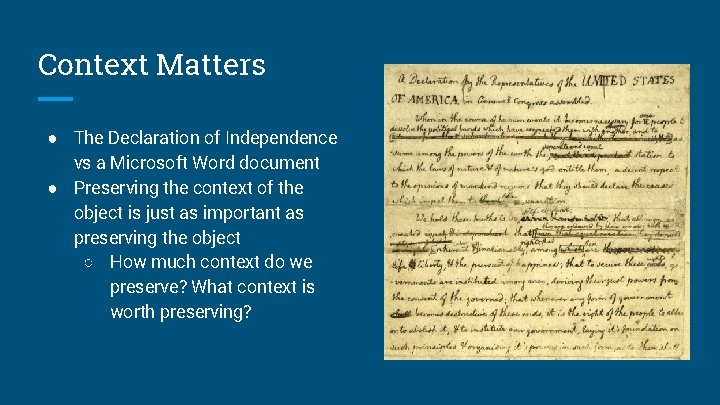
Context Matters ● The Declaration of Independence vs a Microsoft Word document ● Preserving the context of the object is just as important as preserving the object ○ How much context do we preserve? What context is worth preserving?
Class Activity Time! Navigating organizational systems! Durable Data Sources! Digital Zombie Apocalypse!
Consider this situation: Imagine, after weeks of procrastination, you need to go to the library to find the book you need for LIS 753. You arrive to the library and you find out not only is their internet down, but all the surrounding libraries use the same provider so they are in the same situation. And when you try to turn on your phone, you realize the battery is dead and your charger is at home. How do you find your book without the use of the internet?
“Even though we may subjectively experience the world as overloaded with information, until we build the memory systems that will ensure the future access of digital information, it is all potentially at risk. ” - Rumsey, 97.
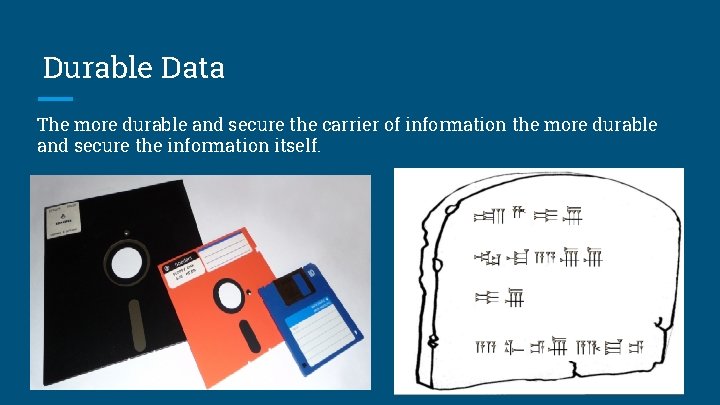
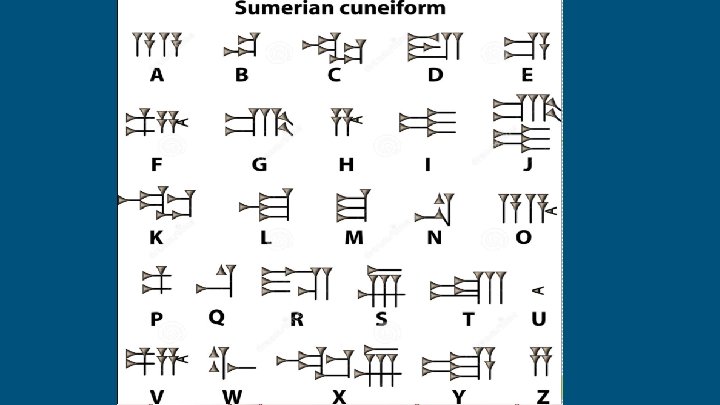
Durable Data The more durable and secure the carrier of information the more durable and secure the information itself.
Zombie Apocalypse World Library
Zombie Apocalypse. The restart of Civilization The entire world is under attack by Zombies! In a last ditch effort to save humanity and contain the infected every major city will be bombed! When this happens all infrastructure including buildings, roads and power supplies will be destroyed.
Zombie Apocalypse. The restart of Civilization As Curator of the World Library you have access to countless data sources. Being the forward thinker that you are, You know that after the bombs clear and the undead are finally put to rest civilization will have to be rebuil. T. Your Help is key to rebuilding society!
Zombie Apocalypse. The restart of Civilization You have 15 minutes to grab materials from the library before the last transport out of the city departs. What data sources do you take with you and why? As civilization around you crumbles you finally realize that Rumsey person was on to something. What could we have done as librarians to preserve more of our digital data?
What does this mean for libraries?
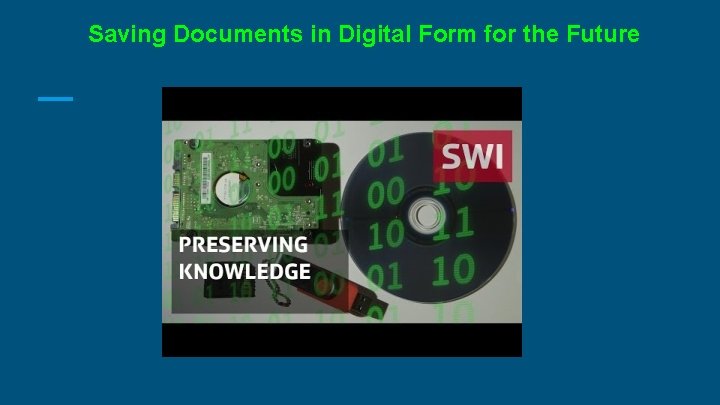
Saving Documents in Digital Form for the Future
What does this mean for libraries? Think about conversations and connections: ● Be networked, distributed, and open source ● Create rich, interoperable metadata (For example: crosswalks, linked data) ● Teach everyone how to use the net, how to evaluate knowledge claims, how to love difference ● Advocate for net neutrality & open access ● Support public learning and crowdsourcing Think about preservation: ● Develop protocols for determining what data needs to be saved and what can be discarded.
Questions?
To Sum Up. . . #Covfefe