
Past Performance Strategies Using It to Your Best
Past Performance Strategies: Using It to Your Best Advantage By: Anne Marie Tavella and Jonathan De. Mella Phone: 907. 257. 5345 and 206. 622. 3150 E-mail: annemarietavella@dwt. com and jonathandemella@dwt. com 1
Past Performance Overview § FAR Subpart 42. 15 § FAR Subpart 15. 3 § FAR Subpart 9. 1 § Past Performance Information Retrieval System (PPIRS) § Contractor Performance Assessment Rating § Challenging a CPAR § Subcontractor Past Performance Pilot Program § Past Performance in Bidding 2 dwt. com
FAR Subpart 42. 15 — Contractor Performance Information, General § Past Performance Information relevant for future source selection purposes. Includes: 1. Conforming to requirements and to standards of good workmanship 2. Forecasting and controlling costs 3. Adherence to schedules, including the administrative aspects of performance 4. Reasonable and cooperative behavior and commitment to customer satisfaction 5. Reporting into databases (see subpart 4. 14, and reporting requirements in the solicitation provisions and clauses referenced in 9. 104 -7) 6. Integrity and business ethics 7. Business-like concern for the interest of the customer FAR 42. 1501(a) 3 dwt. com
FAR Subpart 42. 15 — Contractor Performance Information, Policy § Agencies must complete evaluations “at least annually. ” FAR 42. 1502(a) § Required at contracts and orders that exceed SAT. FAR 42. 1502(b) – If modification causes contractor or order to exceed SAT, evaluation is required. FAR 42. 1502(b) § Required for all construction contracts: – Exceeding $700 k – Terminated for default, regardless of value. FAR 42. 1502(e) § Required for all A/E contracts: – Exceeding $35, 000 – Terminated for default, regardless of value. FAR 42. 1502(f) § Evaluations must include: – Assessment against goals in SB subcontracting plan – Reduced payments to SB subs deemed by the CO to be “unjustified. ” FAR 42. 1502(f) – Agencies may not evaluate performance for contracts awarded under subpart 8. 7, Ability. One program. FAR 42. 1502(h) 4 dwt. com
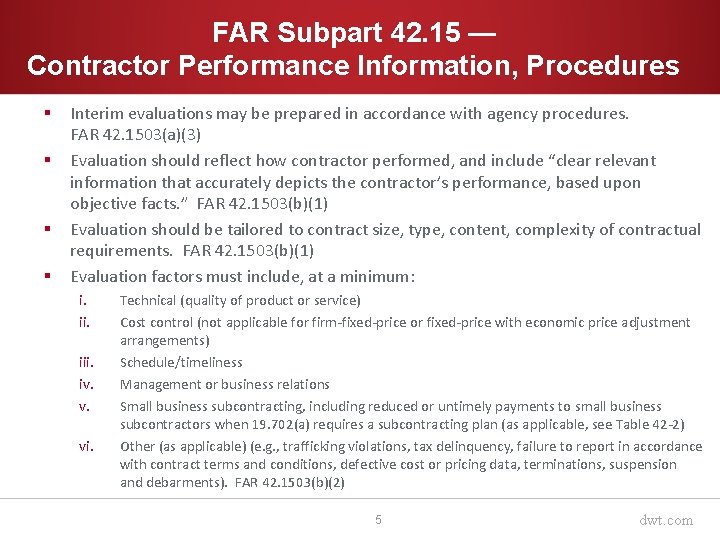
FAR Subpart 42. 15 — Contractor Performance Information, Procedures § § Interim evaluations may be prepared in accordance with agency procedures. FAR 42. 1503(a)(3) Evaluation should reflect how contractor performed, and include “clear relevant information that accurately depicts the contractor’s performance, based upon objective facts. ” FAR 42. 1503(b)(1) Evaluation should be tailored to contract size, type, content, complexity of contractual requirements. FAR 42. 1503(b)(1) Evaluation factors must include, at a minimum: i. iii. iv. v. vi. Technical (quality of product or service) Cost control (not applicable for firm-fixed-price or fixed-price with economic price adjustment arrangements) Schedule/timeliness Management or business relations Small business subcontracting, including reduced or untimely payments to small business subcontractors when 19. 702(a) requires a subcontracting plan (as applicable, see Table 42 -2) Other (as applicable) (e. g. , trafficking violations, tax delinquency, failure to report in accordance with contract terms and conditions, defective cost or pricing data, terminations, suspension and debarments). FAR 42. 1503(b)(2) 5 dwt. com

FAR Subpart 42. 15 — Contractor Performance Information, Procedures § Evaluations must be provided to contractor “as soon as practicable after completion of the evaluation. ” FAR 42. 1503(d) § Contractors have 14 days to submit comments, rebuttals. Id. § Agency must provide for review above CO to consider disagreements between the parties. Id. § Evaluation may not be released to other Government personnel or to contractor. § Agencies must submit all performance information into CPARS. FAR 42. 1503(f) § Evaluations and any contractor submitted information submitted to PPIRS no later than 14 days after date on which contractor is notified of the evaluation for comment. Id. § Government shall update PPIRS with any contractor comments provided after 14 days, as well agency review of comments received. Id. § Agencies shall use the past performance information in PPIRS that is within three years (six for construction and architect-engineer contracts) of the completion of performance of the evaluated contract or order, and information contained in the Federal Awardee Performance and Integrity Information System (FAPIIS), e. g. , terminations for default or cause. FAR 42. 1503(g) 6 dwt. com

FAR Subpart 42. 15 — Contractor Performance Information, Procedures § § Other Contractor Performance Information – Agencies must report into the FAPIIS module of CPARS within three days if CO: i. Issues final determination that contractor submitted defective cost or pricing data; ii. Makes subsequent change to final determination concerning defective cost or pricing data pursuant to 15. 407 -1(d); iii. Issues a final termination for cause or default notice; iv. Makes a subsequent withdrawal or a conversion of a T/D to T/C; v. Receives a final determination after an administrative proceeding, in accordance with 22. 1704(d)(1), that substantiates an allegation of a violation of the trafficking in persons prohibitions in 22. 1703(a) and 52. 222 -50(b); or vi. Determines that a contractor has a history of three or more unjustified reduced or untimely payments to small business subcontractors under a single contract within a 12 -month period (see 42. 1502(g)(2)). This does not constitute a “past performance review” exempted from public release, i. e. , all such information posted in FAPIIS will be publicly available. FAR 42. 1503(h) 7 dwt. com
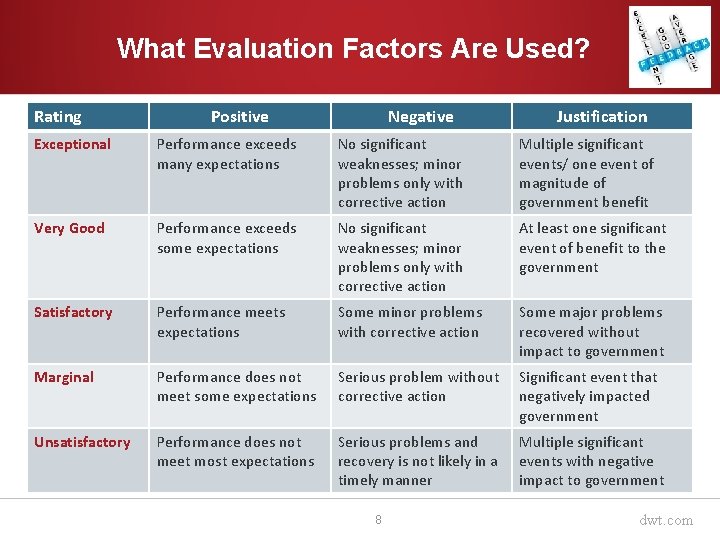
What Evaluation Factors Are Used? Rating Positive Negative Justification Exceptional Performance exceeds many expectations No significant weaknesses; minor problems only with corrective action Multiple significant events/ one event of magnitude of government benefit Very Good Performance exceeds some expectations No significant weaknesses; minor problems only with corrective action At least one significant event of benefit to the government Satisfactory Performance meets expectations Some minor problems with corrective action Some major problems recovered without impact to government Marginal Performance does not meet some expectations Serious problem without corrective action Significant event that negatively impacted government Unsatisfactory Performance does not meet most expectations Serious problems and recovery is not likely in a timely manner Multiple significant events with negative impact to government 8 dwt. com
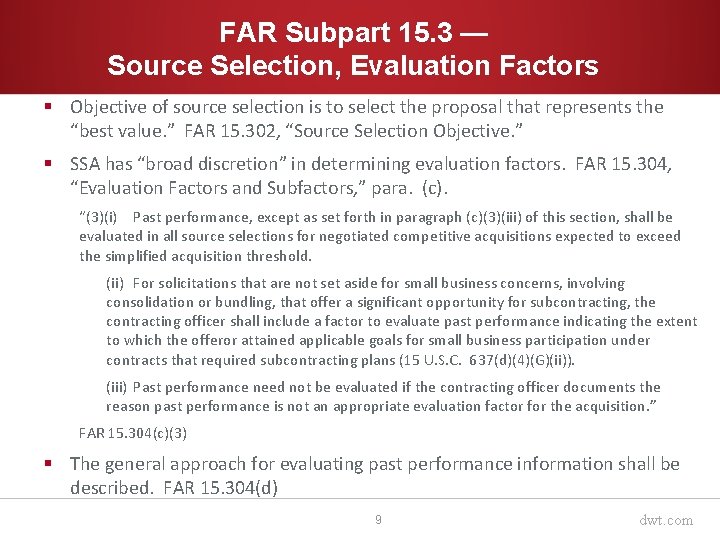
FAR Subpart 15. 3 — Source Selection, Evaluation Factors § Objective of source selection is to select the proposal that represents the “best value. ” FAR 15. 302, “Source Selection Objective. ” § SSA has “broad discretion” in determining evaluation factors. FAR 15. 304, “Evaluation Factors and Subfactors, ” para. (c). “(3)(i) Past performance, except as set forth in paragraph (c)(3)(iii) of this section, shall be evaluated in all source selections for negotiated competitive acquisitions expected to exceed the simplified acquisition threshold. (ii) For solicitations that are not set aside for small business concerns, involving consolidation or bundling, that offer a significant opportunity for subcontracting, the contracting officer shall include a factor to evaluate past performance indicating the extent to which the offeror attained applicable goals for small business participation under contracts that required subcontracting plans (15 U. S. C. 637(d)(4)(G)(ii)). (iii) Past performance need not be evaluated if the contracting officer documents the reason past performance is not an appropriate evaluation factor for the acquisition. ” FAR 15. 304(c)(3) § The general approach for evaluating past performance information shall be described. FAR 15. 304(d) 9 dwt. com
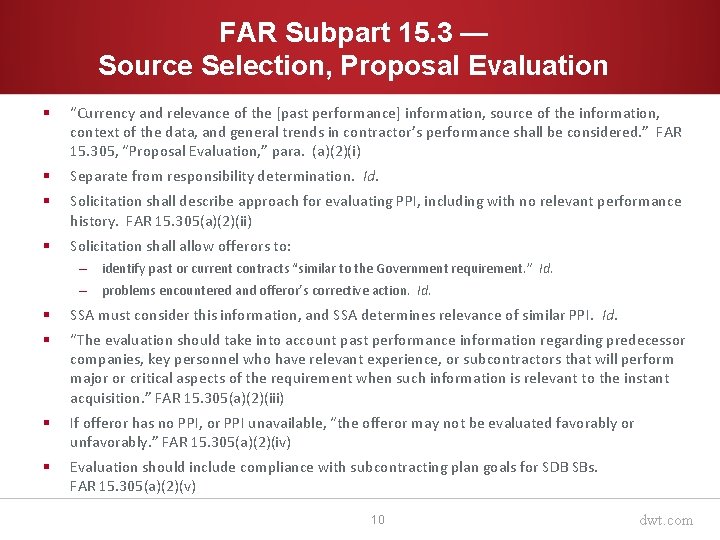
FAR Subpart 15. 3 — Source Selection, Proposal Evaluation § “Currency and relevance of the [past performance] information, source of the information, context of the data, and general trends in contractor’s performance shall be considered. ” FAR 15. 305, “Proposal Evaluation, ” para. (a)(2)(i) § Separate from responsibility determination. Id. § Solicitation shall describe approach for evaluating PPI, including with no relevant performance history. FAR 15. 305(a)(2)(ii) § Solicitation shall allow offerors to: – identify past or current contracts “similar to the Government requirement. ” Id. – problems encountered and offeror’s corrective action. Id. § SSA must consider this information, and SSA determines relevance of similar PPI. Id. § “The evaluation should take into account past performance information regarding predecessor companies, key personnel who have relevant experience, or subcontractors that will perform major or critical aspects of the requirement when such information is relevant to the instant acquisition. ” FAR 15. 305(a)(2)(iii) § If offeror has no PPI, or PPI unavailable, “the offeror may not be evaluated favorably or unfavorably. ” FAR 15. 305(a)(2)(iv) § Evaluation should include compliance with subcontracting plan goals for SDB SBs. FAR 15. 305(a)(2)(v) 10 dwt. com
FAR Subpart 15. 3 — Source Selection, Exchanges with Offerors After Receipt of Proposals § “Communications with offerors before establishment of the competitive range. Communications are exchanges, between the Government and offerors, after receipt of proposals, leading to establishment of the competitive range. ” FAR 15. 306(b) § If a competitive range is to be established, these communications — – Shall not provide opportunity for offeror to “revise” proposal, but “may address. . . information relating to past performance, ” FAR 15. 306 (b)(3)(ii); – “Shall address adverse past performance information to which the offeror has not previously had an opportunity to comment. ” FAR 15. 306 (b)(4). § “Exchanges with offerors after establishment of the competitive range. Negotiations are exchanges, in either a competitive or sole source environment, between the Government and offerors, that are undertaken with the intent of allowing the offeror to revise its proposal. ” FAR 15. 306(d) § “At a minimum, ” the CO must discuss with each offeror still being considered “significant weaknesses, and adverse past performance information to which the offeror has not yet had an opportunity to respond. ” FAR 15. 306(d)(3) § Scope and extend of discussions are matter of CO judgment. Id. § SSA decision must be documented and include rationale and basis for tradeoffs. FAR 15. 308, “Source Selection Decision. ” 11 dwt. com
FAR Subpart 9. 1 — Responsible Prospective Contractors • “No purchase or award shall be made unless the contracting officer makes an affirmative determination of responsibility. ” FAR 9. 103(b) • In absence if information, CO shall make determination of “nonresponsibility. ” Id. • If offeror is 8(a) SBC, CO shall comply with Subparts 19. 8 and 19. 6 re Certificates of Competency and Determinations of Responsibility. Id. • To be deemed responsible, contractor must have “satisfactory performance record, ” but, “prospective contractor shall not be determined responsible or nonresponsible solely on the basis of a lack of relevant performance history. ” FAR 9. 104 -1(c) 12 dwt. com
FAR Subpart 9. 1 — Responsible Prospective Contractors “(b) Satisfactory performance record. A prospective contractor that is or recently has been seriously deficient in contract performance shall be presumed to be nonresponsible, unless the contracting officer determines that the circumstances were properly beyond the contractor’s control, or that the contractor has taken appropriate corrective action. Past failure to apply sufficient tenacity and perseverance to perform acceptably is strong evidence of nonresponsibility. Failure to meet the quality requirements of the contract is a significant factor to consider in determining satisfactory performance. The contracting officer shall consider the number of contracts involved and the extent of deficient performance in each contract when making this determination. If the pending contract requires a subcontracting plan pursuant to subpart 19. 7, The Small Business Subcontracting Program, the contracting officer shall also consider the prospective contractor’s compliance with subcontracting plans under recent contracts. ” FAR 9. 104 -3(b) 13 dwt. com
FAR Subpart 9. 1 — Responsible Prospective Contractors “(c) Affiliated concerns (see “Concern” in 19. 001 and “Affiliates” in 19. 101) are normally considered separate entities in determining whether the concern that is to perform the contract meets the applicable standards for responsibility. However, the contracting officer shall consider the affiliate’s past performance and integrity when they may adversely affect the prospective contractor’s responsibility. (d)(1) Small business concerns. Upon making a determination of nonresponsibility with regard to a small business concern, the contracting officer shall refer the matter to the Small Business Administration, which will decide whether to issue a Certificate of Competency (see subpart 19. 6). (2) A small business that is unable to comply with the limitations on subcontracting at 52. 219 -14 may be considered nonresponsible. ” FAR 9. 103(c), (d) 14 dwt. com
FAR Subpart 9. 1 — Responsible Prospective Contractors § Before award, CO must review performance and integrity information in FAPIIS. FAR 9. 104 -6, “Federal Awardee Performance and Integrity Information System. ” – Includes information in FAPIIS from SAM and PPIRS § CO shall consider information in FAPIIS re offeror’s owners, predecessors, subsidiaries, affiliates (which is in FAPIIS). FAR 9. 104 -6(b) § If CO obtains relevant information from FAPIIS re, e. g. , T/D, determinations of nonresponsibility based on bad past performance, CO shall request additional information from offeror as is necessary to determine present responsibility. FAR 9. 104 -6(c) § In addition to info in FAPIIS, CO may consider other information on performance, e. g. , “verifiable knowledge of personnel within the contracting office, ” “subcontractors, ” “customers of prospective contractor. ” FAR 9. 105(c) § “Contracting offices and cognizant contract administration offices that become aware of circumstances casting doubt on a contractor’s ability to perform contracts successfully shall promptly exchange relevant information. ” FAR 9. 105(d) § PLEASE NOTE: – Contractors’ ability to challenge agency determinations of nonresponsibility, or that another contractor is responsible, is limited. 15 dwt. com
How Do You Respond to a CPAR? • After receiving a CPAR (interim or final), a contractor has 14 days to provide responsive comments – Use CPAR Guidance to prepare your comments (available at https: //www. cpars. gov/pdfs/CPARS-Guidance. pdf) • On the 15 th day, the CPAR and any response from the contractor (with indication whether agency review is pending), are automatically transmitted to PPIRS • If the contractor disputes the CPAR within the 14 day period, a reviewing official (above the contracting officer) will review the CPAR and contractor response and provide an additional assessment 16 dwt. com
How Do You Close Out a Contract with a Negative CPAR? § Include request for CPAR revision in any REA or claim § Reserve claims before signing any release and before final payment – read the fine print! § Claims for CPAR revisions may be made prior to contract completion – but usually does not make sense logistically § Past Performance may be challenged – Armed Services Board of Contract Appeals – Civilian Board of Contract Appeals – Court of Federal Claims • Courts, Boards can “declare” evaluation is unreasonable, arbitrary, capricious, unfair, incorrect, not objective § Courts, Boards will not direct Agency to: – Remove, delete, improve, or revise a rating – Revise an evaluation narrative • Include or exclude particular facts, events, issues 17 dwt. com
Past Performance — Subcontractors § Many small businesses who work primarily as subcontractors do not have past performance data (i. e. , CPARS) § On April 20, 2018, the Small Business Administration published a notice for a pilot program for Subcontractor Past Performance – 3 -year pilot program § Eligibility to request past performance data – Must be a small business concern registered and active in SAM – Without a past performance rating as a prime contractor in CPARS – Must be the first-tier subcontractor under a contract that requires a subcontracting plan – Subcontract value must meet the mandatory CPARS level 18 dwt. com
Past Performance — Subcontractors (cont. ) § Subcontractors must submit an application within 270 days after the SBC completed the work or 180 days after the prime contractor completes work on the contract, whichever is earlier § The application includes the subcontractor’s suggested performance ratings for each past performance element with justifications for each suggested rating § The Prime Contractor and the Office of Small Disadvantaged Business Utilization (“OSDBU”) have 30 days to concur or contest with the SBC’s suggested ratings § If the Prime or the OSDBU fail to respond, disagree about the rating, or disagree with the SBC’s suggested rating, the SBC has an opportunity to submit comments, rebuttals, or additional information § The appropriate official will enter a neutral rating in CPARS with the documentation from the SBC, Prime, and/or OSDBU 19 dwt. com
Past Performance in Bidding § How an agency will consider past performance is determined by the RFP/Solicitation § Specifically explaining the relevance of the past performance information to the solicitation may assist in the evaluation § If relying on the experience of a teaming partner or subcontractor, review RFP for whether submission of such information is permitted or required, and explain role of subcontractor/teaming partner and how experience is relevant § Submit information as required by the RFP – Be aware of and prepared to respond to negative past performance – Even if not submitted in response to the RFP § “Performance” may include more than actual work, i. e. , timeliness of payments to subcontractors § Prime contractor is generally liable for its subcontractors’ past performance 20 dwt. com
Past Performance Provided Must Specifically Meet RFP § Solicitation provided for additional points if the proposal demonstrated the offeror had previously performed in the proposed business arrangement § Protestor submitted a proposal as the prime contractor under a prime/sub relationship with its primary sub § Proposal included past performance information with a reversed prime/sub relationship — the offeror was the sub – Offeror argued it was the “team lead” and effectively acted as the prime contractor § Agency did not award the points on the basis that it was not the same business relationship § GAO held the agency’s evaluation was in accordance with the solicitation Amyx, Inc. , B-415789. 4, May 18, 2018 21 dwt. com
Past Performance Provided Must Specifically Meet RFP Requirements § Solicitation required past performance information be submitted in past performance questionnaires (“PPQs”) § Agency gave protestor’s proposal “satisfactory confidence” rather than “substantial confidence” § Protestor argued its PPQs should have been rated higher and that it submitted a matrix that detailed various aspects of its past performance and their relevance to the scope of work § Agency did not consider the information in the matrix because solicitation required that information be submitted only on the PPQ form and that past performance information submitted in a format other than the PPQ form would not be considered Consultech Environmental, LLC, B-416003, May 4, 2018 22 dwt. com
Past Performance in Bidding — Teaming Partners § Protestor argued agency unreasonably failed to credit the firm’s proposal for its prior experience with its teaming partner § The agency’s position was that the protestor did not provide information about what the teaming partner had done in the performance of its prior projects and the proposal did not verify what similar work the teaming partner had done or how well it had done any work § Protestor argued it only had to demonstrate prior experience similar roles on relevant projects to increase the agency’s level of confidence § GAO held agency acted reasonably and agency could assess how well Tantara’s teaming partner performed on past projects in order to assess increased confidence Tantara Corporation, B-416003. 2, May 23, 2018 23 dwt. com
Past Performance — Joint Venture Partners § Solicitation determines scope of consideration of how individual JV partners past performance will be considered § New joint venture with no past performance submitted proposal relying on past performance of individual JV members § Protestors argued past performance of JV members should not be considered and that agency improperly considered negative past performance of the protestor § GAO held the agency may properly consider the relevant past performance history of the individual joint venture partners of the prime contractor as long as it was not expressly prohibited by the solicitation Dyn. Corp. International LLC, B-415873, April 12, 2018 24 dwt. com
Dyn. Corp. International LLC (cont. ) § The GAO also determined the agency reasonably evaluated the protestor’s negative past performance § The GAO noted an agency may consider past performance trends and corrective actions, but that an agency is not required to ignore instances of negative past performance § Dyn. Corp. ’s negative past performance also included its failure to timely pay its subcontractors on prior contracts 25 dwt. com
Past Performance in Bidding Consideration of Other Information § Solicitation required at least three past performance references § Protestor had a prior contract for the same services that was terminated for default § Protestor argued evaluation was biased because agency considered prior default by protestor in its past performance evaluation – Also considered proposers failure to timely pay its subcontractors on a prior contract § GAO held consideration of other information was appropriate and not precluded by the solicitation § “An agency acts reasonably when it solicits additional past performance references beyond those listed in the proposal” Veteran National Transportation, LLC, B-415696, April 16, 2018 26 dwt. com
Past Performance in Bidding Responding to Negative Past Performance § Protestor argued its past performance was improperly rated because the agency did not properly consider the negative past performance of the awardee § After learning of the adverse past performance ratings, the awardee submitted a list of clarification questions to the agency § The agency provided a spreadsheet cataloging the performance issues and the awardee provided a detailed rebuttal to the past performance issues § The GAO held protestor’s disagreement with the agency’s evaluation was not sufficient basis for protest Onsite OHS, Inc. , B-415987, April 27, 2018 27 dwt. com
Conclusions and Best Practices § Understand the rules and regulations for collecting past performance data § If you receive a negative CPAR, timely submit a response § If a small business subcontractor without a CPAR, consider submitting an application in the SBA pilot program § When submitting past performance data in response to a solicitation/RFP comply with the requirements and explain the relevance of the past performance information to the work in the solicitation § Be prepared to address negative past performance data 28 dwt. com
DAVIS WRIGHT TREMAINE LLP Anne Marie Tavella Jonathan De. Mella Davis Wright Tremaine LLP 188 W Northern Lights Blvd, Suite 1100 Anchorage, AK 99503 -3985 (907) 257 -5300 annemarietavella@dwt. com jonathandemella@dwt. com 29 dwt. com
- Slides: 29