
Past Performance Obtaining It Using It Defending It
Past Performance: Obtaining It, Using It & Defending It National 8(a) Association Small Business Conference February 13, 2020 Copyright © 2014 Holland & Knight LLP. All Rights Reserved
Your Panel Moderator: Robert K. (Bob) Tompkins, Holland & Knight Panelists: Sydney Cody, Vanguard Pacific Wallace Sermons, Environmental Protection Agency Mario Burgos, The Burgos Group Angela Terry, Small Business Administration 2
What this Presentation Covers » What is Past Performance and what Challenges are presented by Solicitation Past Performance requirements » Obtaining Past Performance » Using Past Performance » Earning Past Performance » Defending Past Performance and Challenging Negative CPARs 3
1. The Basics: Past Performance » The FAR requires consideration of an offeror’s past performance as part of proposal evaluation (FAR 15. 305) » The Contractor Performance Assessment Reporting System (CPARS)(cpars. gov) is a primary source of information » Agencies may also use questionnaires or other means to assess past performance 4
1. The Basics: CPARS » Contractor Performance Assessment Reporting System (CPARS)(cpars. gov) » A central repository for contractor performance reviews » Required of all agencies with limited exceptions » Available to government contracting officers for use in evaluating offerors » A contractor can access its own CPARS » Part of a broader reporting and data gathering hierarchy (including FAPIIS, SAM, etc. ) 5
2. Obtaining Past Performance » Through direct experience » Can include commercial and subcontracted work » May include teaming partners (up to a point) » May be vested in your key personnel » May be acquired 6
3. Using Past Performance: Bids, Proposals and Protests » An RFP may allow an offeror to rely on affiliates, subsidiaries, key personnel, etc. , to meet the RFP requirements (FAR 15. 305), but • Be mindful of the ostensible subcontractor rule, and • Know that GAO has repeatedly ruled that those affiliate resources must actually be made available for contract performance in the proposal!!! • Key Takeaway – Read the RFP!!! • Consider how to 7
4. Earning Past Performance: CPARS Coverage » CPARS are required to cover at a minimum: » (i) Technical (quality of product or service). » (ii) Cost control (not applicable for firm-fixed-price or fixed-price with economic price adjustment arrangements). » (iii) Schedule/timeliness. » (iv) Management or business relations. » (v) Small business subcontracting, including reduced or untimely payments to small business subcontractors when 19. 702(a) requires a subcontracting plan (as applicable, see Table 42 -2). » (vi) Other (as applicable) (e. g. , trafficking violations, tax delinquency, failure to report in accordance with contract terms and conditions, defective cost or pricing data, terminations, suspension and debarments). 8
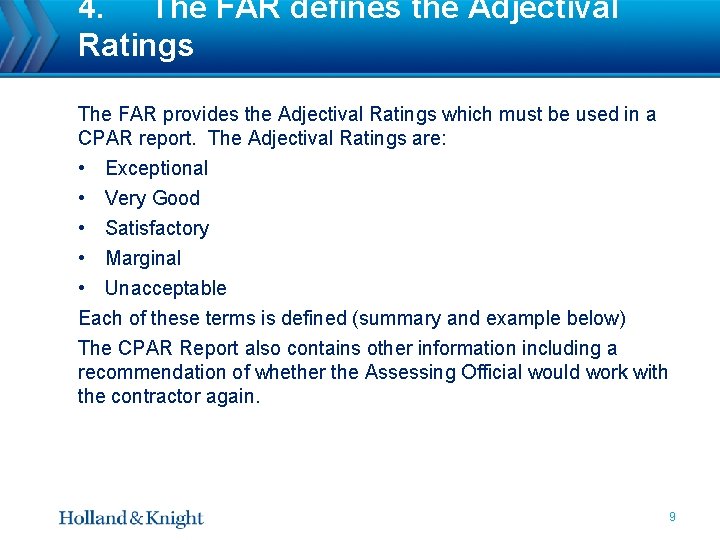
4. The FAR defines the Adjectival Ratings The FAR provides the Adjectival Ratings which must be used in a CPAR report. The Adjectival Ratings are: • Exceptional • Very Good • Satisfactory • Marginal • Unacceptable Each of these terms is defined (summary and example below) The CPAR Report also contains other information including a recommendation of whether the Assessing Official would work with the contractor again. 9
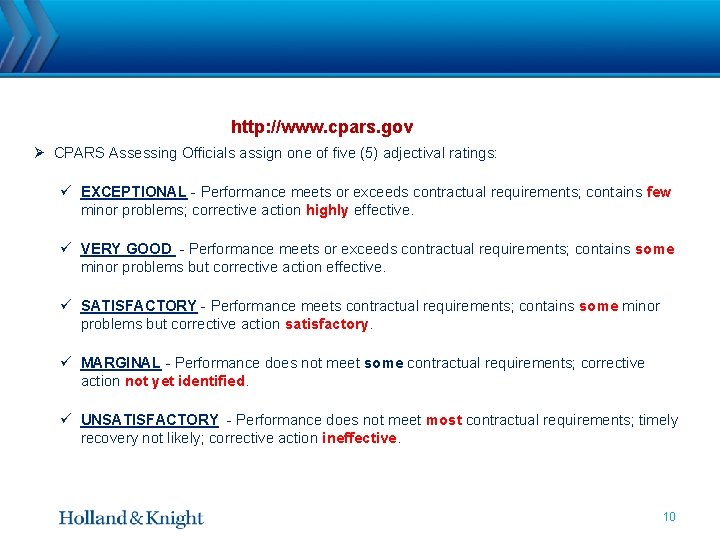
Contractor Performance Assessment Reporting System http: //www. cpars. gov Ø CPARS Assessing Officials assign one of five (5) adjectival ratings: ü EXCEPTIONAL - Performance meets or exceeds contractual requirements; contains few minor problems; corrective action highly effective. ü VERY GOOD - Performance meets or exceeds contractual requirements; contains some minor problems but corrective action effective. ü SATISFACTORY - Performance meets contractual requirements; contains some minor problems but corrective action satisfactory. ü MARGINAL - Performance does not meet some contractual requirements; corrective action not yet identified. ü UNSATISFACTORY - Performance does not meet most contractual requirements; timely recovery not likely; corrective action ineffective. 10
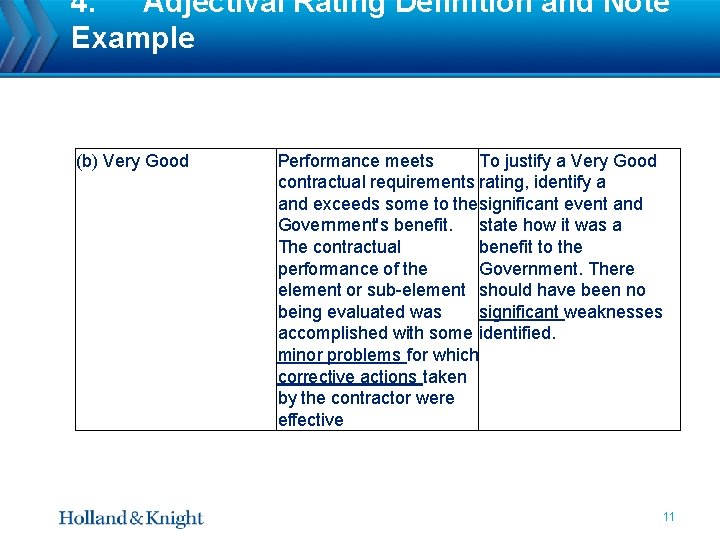
4. Adjectival Rating Definition and Note Example (b) Very Good Performance meets To justify a Very Good contractual requirements rating, identify a and exceeds some to the significant event and Government's benefit. state how it was a The contractual benefit to the performance of the Government. There element or sub-element should have been no being evaluated was significant weaknesses accomplished with some identified. minor problems for which corrective actions taken by the contractor were effective 11
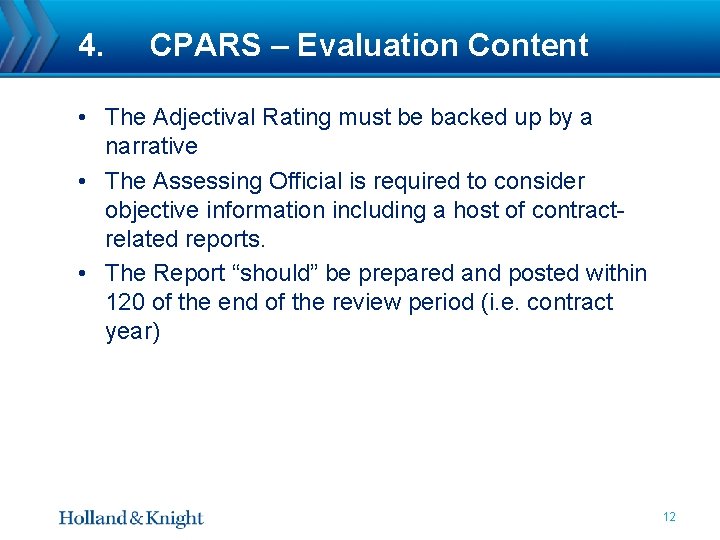
4. CPARS – Evaluation Content • The Adjectival Rating must be backed up by a narrative • The Assessing Official is required to consider objective information including a host of contractrelated reports. • The Report “should” be prepared and posted within 120 of the end of the review period (i. e. contract year) 12
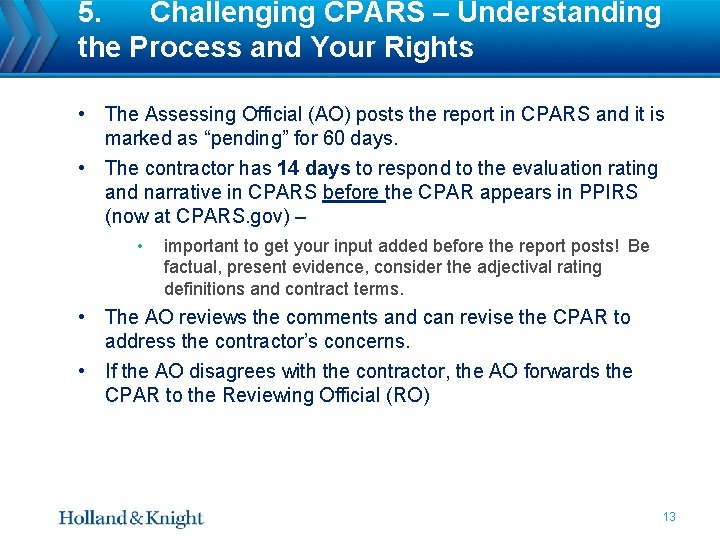
5. Challenging CPARS – Understanding the Process and Your Rights • The Assessing Official (AO) posts the report in CPARS and it is marked as “pending” for 60 days. • The contractor has 14 days to respond to the evaluation rating and narrative in CPARS before the CPAR appears in PPIRS (now at CPARS. gov) – • important to get your input added before the report posts! Be factual, present evidence, consider the adjectival rating definitions and contract terms. • The AO reviews the comments and can revise the CPAR to address the contractor’s concerns. • If the AO disagrees with the contractor, the AO forwards the CPAR to the Reviewing Official (RO) 13
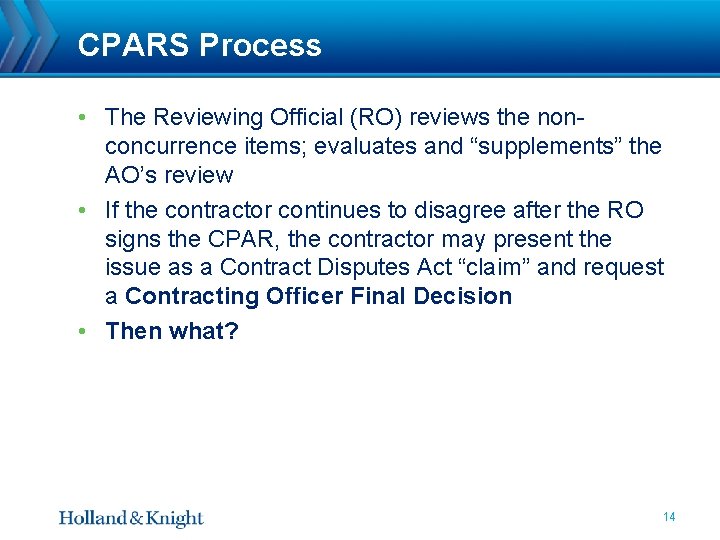
CPARS Process • The Reviewing Official (RO) reviews the nonconcurrence items; evaluates and “supplements” the AO’s review • If the contractor continues to disagree after the RO signs the CPAR, the contractor may present the issue as a Contract Disputes Act “claim” and request a Contracting Officer Final Decision • Then what? 14
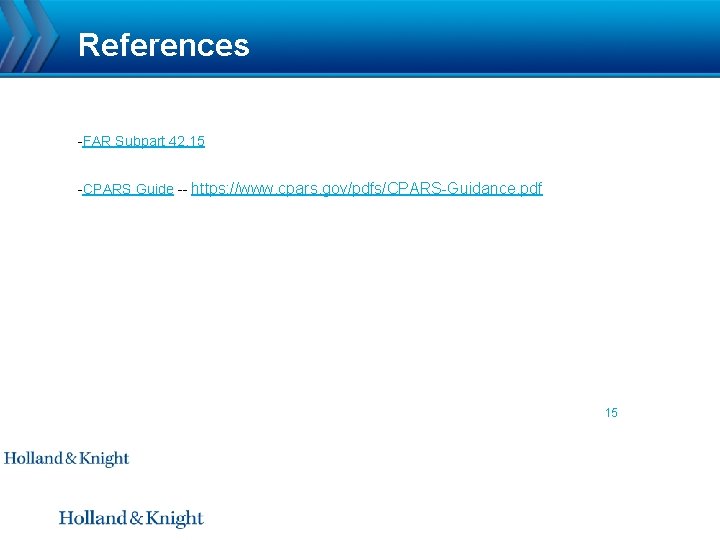
References -FAR Subpart 42. 15 -CPARS Guide -- https: //www. cpars. gov/pdfs/CPARS-Guidance. pdf 15
Questions? 16
Thank You! 17
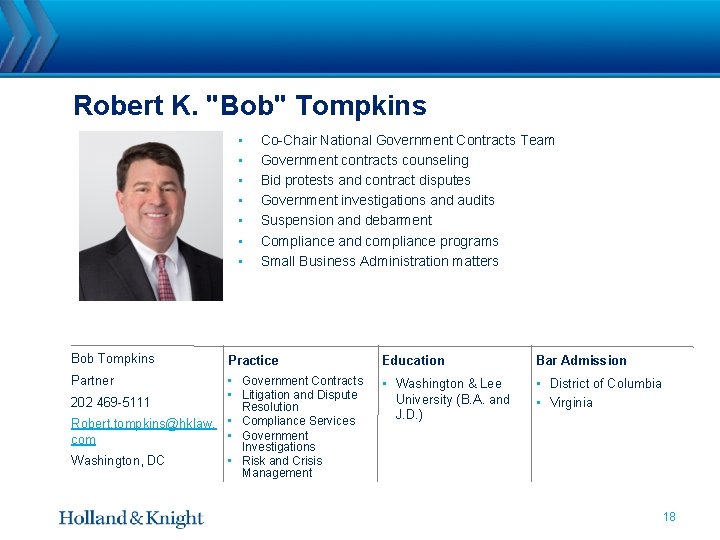
Robert K. "Bob" Tompkins • • Bob Tompkins Partner Co-Chair National Government Contracts Team Government contracts counseling Bid protests and contract disputes Government investigations and audits Suspension and debarment Compliance and compliance programs Small Business Administration matters Practice • Government Contracts • Litigation and Dispute 202 469 -5111 Resolution Robert. tompkins@hklaw. • Compliance Services • Government com Investigations Washington, DC • Risk and Crisis Management Education Bar Admission • Washington & Lee University (B. A. and J. D. ) • District of Columbia • Virginia 18
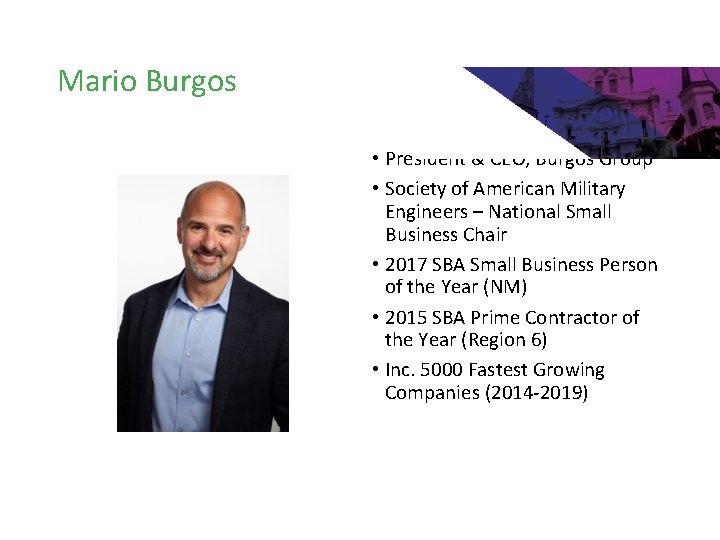
Mario Burgos • President & CEO, Burgos Group • Society of American Military Engineers – National Small Business Chair • 2017 SBA Small Business Person of the Year (NM) • 2015 SBA Prime Contractor of the Year (Region 6) • Inc. 5000 Fastest Growing Companies (2014 -2019)
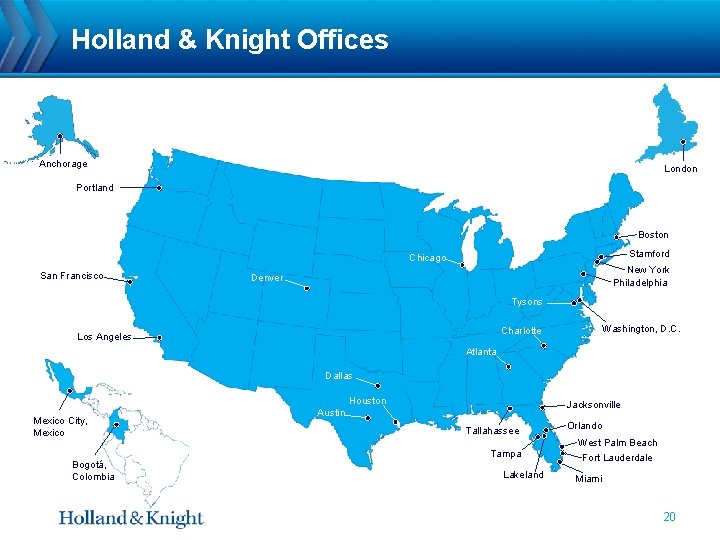
Holland & Knight Offices Anchorage London Portland Boston Stamford Chicago San Francisco New York Philadelphia Denver Tysons Washington, D. C. Charlotte Los Angeles Atlanta Dallas Houston Mexico City, Mexico Bogotá, Colombia Jacksonville Austin Tallahassee Orlando West Palm Beach Tampa Lakeland Fort Lauderdale Miami 20
- Slides: 20