
Past Perfect Grammar Guide mgr Anna Waligrska Kotfas
- Slides: 12
Past Perfect Grammar Guide mgr Anna Waligórska – Kotfas PWSZ Konin
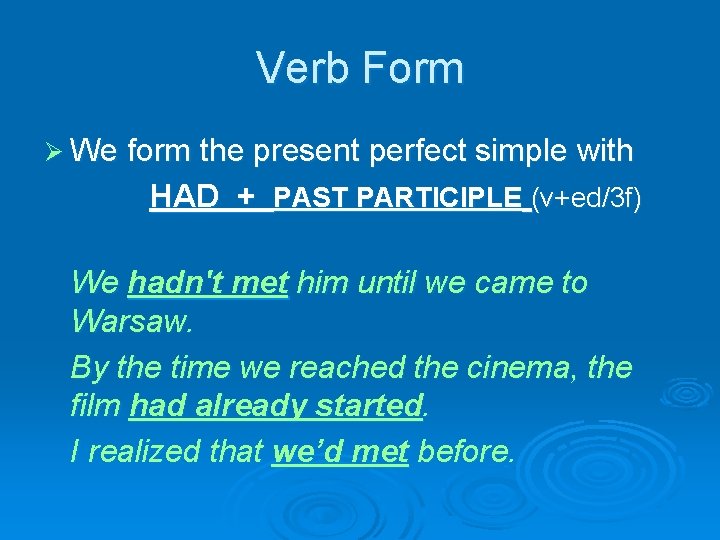
Verb Form Ø We form the present perfect simple with HAD + PAST PARTICIPLE (v+ed/3 f) We hadn't met him until we came to Warsaw. By the time we reached the cinema, the film had already started. I realized that we’d met before.
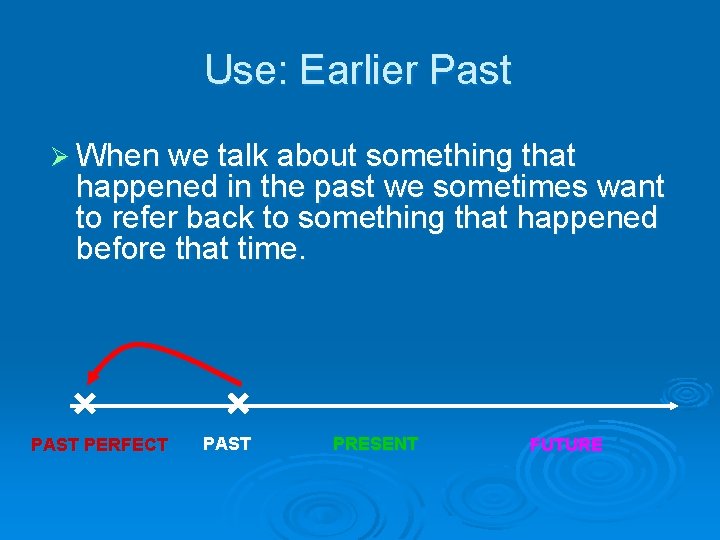
Use: Earlier Past Ø When we talk about something that happened in the past we sometimes want to refer back to something that happened before that time. PAST PERFECT PAST PRESENT FUTURE
Use: Earlier Past Ø Look at these two sentences: John left the house at 7: 30 yesterday morning. Mary rang John’s doorbell at 8: 15 yesterday. Both actions happened in the past so we use the past simple tense. But look at how we can combine the sentences. Mary rang John’s doorbell at 8: 15 yesterday but John had already left the house. We use the past perfect (had left) because the action happened before another action in the past (Mary rang the doorbell. )
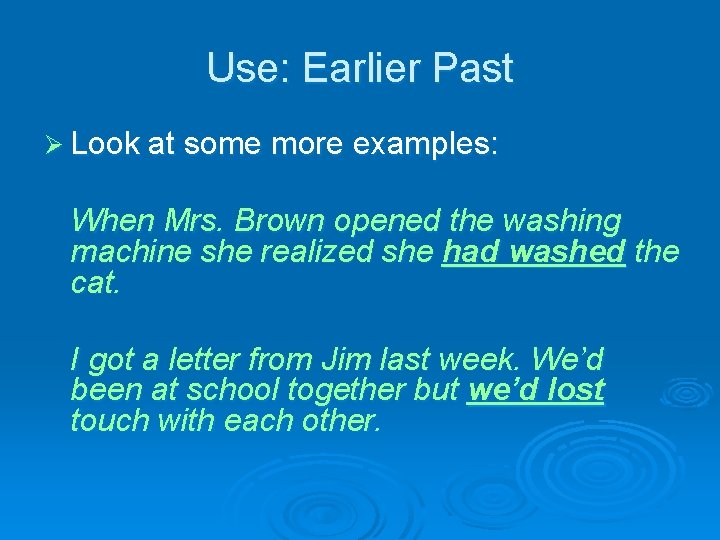
Use: Earlier Past Ø Look at some more examples: When Mrs. Brown opened the washing machine she realized she had washed the cat. I got a letter from Jim last week. We’d been at school together but we’d lost touch with each other.
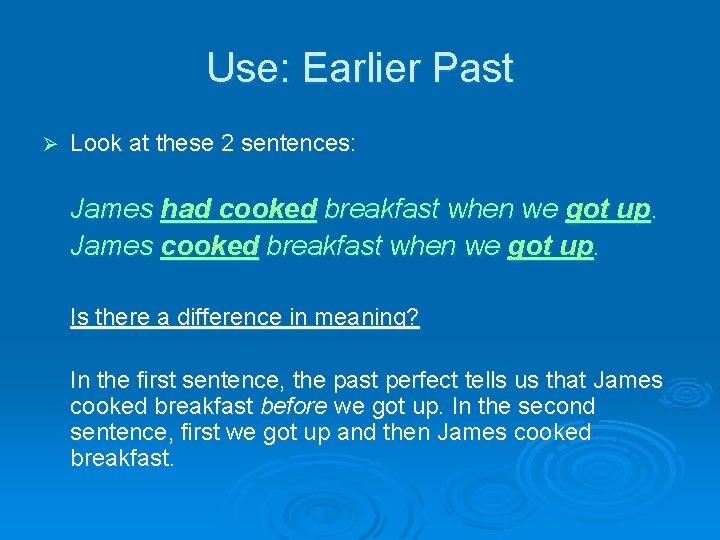
Use: Earlier Past Ø Look at these 2 sentences: James had cooked breakfast when we got up. James cooked breakfast when we got up. Is there a difference in meaning? In the first sentence, the past perfect tells us that James cooked breakfast before we got up. In the second sentence, first we got up and then James cooked breakfast.
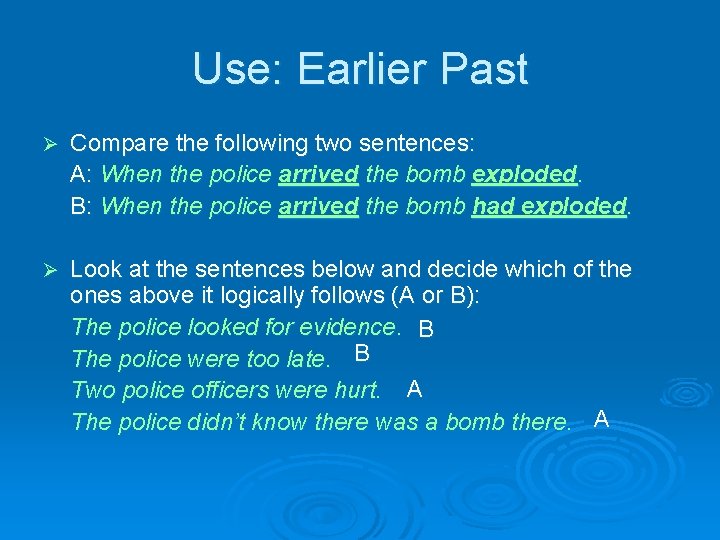
Use: Earlier Past Ø Compare the following two sentences: A: When the police arrived the bomb exploded. B: When the police arrived the bomb had exploded. Ø Look at the sentences below and decide which of the ones above it logically follows (A or B): The police looked for evidence. B The police were too late. B Two police officers were hurt. A The police didn’t know there was a bomb there. A
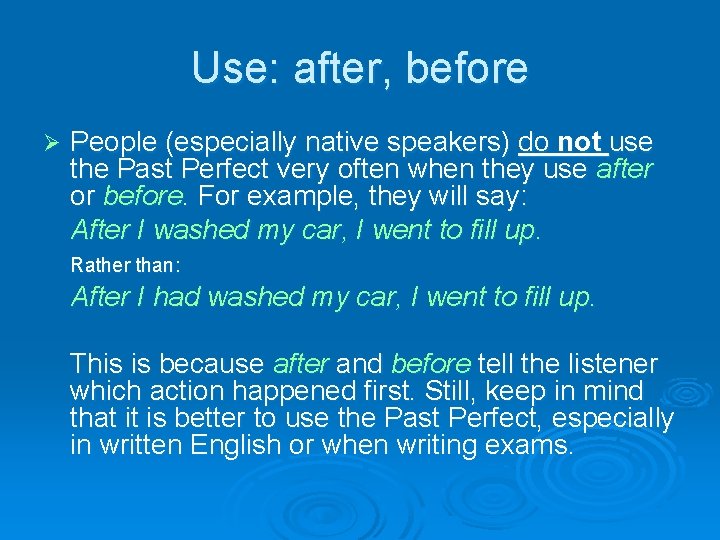
Use: after, before Ø People (especially native speakers) do not use the Past Perfect very often when they use after or before. For example, they will say: After I washed my car, I went to fill up. Rather than: After I had washed my car, I went to fill up. This is because after and before tell the listener which action happened first. Still, keep in mind that it is better to use the Past Perfect, especially in written English or when writing exams.
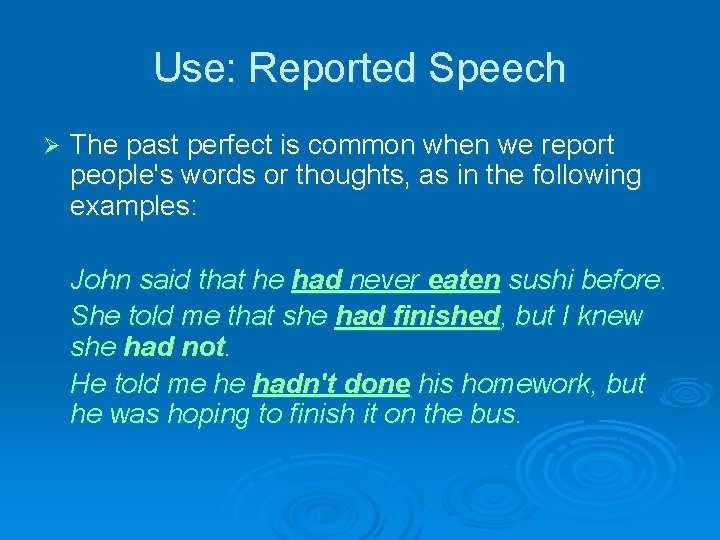
Use: Reported Speech Ø The past perfect is common when we report people's words or thoughts, as in the following examples: John said that he had never eaten sushi before. She told me that she had finished, but I knew she had not. He told me he hadn't done his homework, but he was hoping to finish it on the bus.
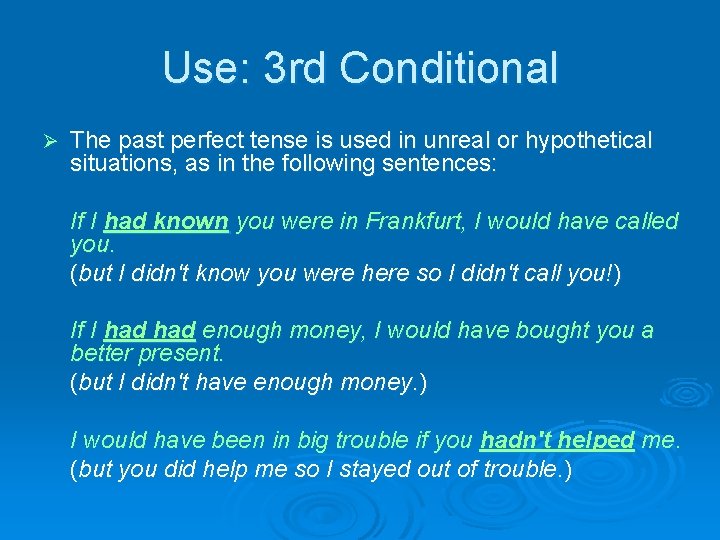
Use: 3 rd Conditional Ø The past perfect tense is used in unreal or hypothetical situations, as in the following sentences: If I had known you were in Frankfurt, I would have called you. (but I didn't know you were here so I didn't call you!) If I had enough money, I would have bought you a better present. (but I didn't have enough money. ) I would have been in big trouble if you hadn't helped me. (but you did help me so I stayed out of trouble. )
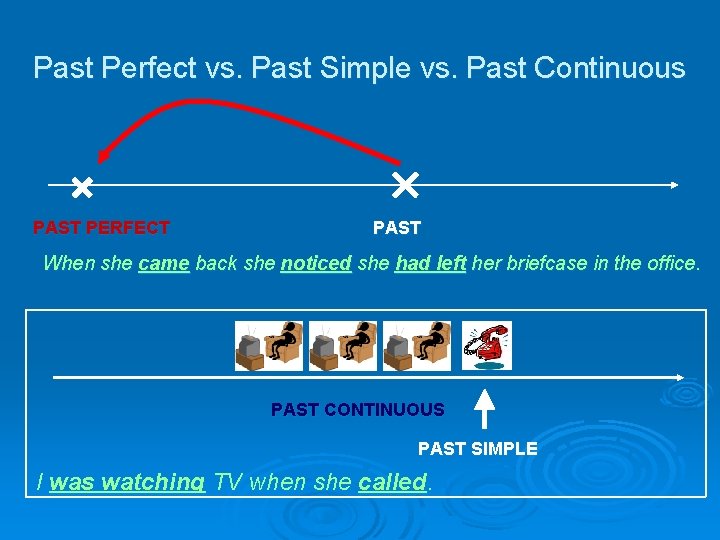
Past Perfect vs. Past Simple vs. Past Continuous PAST PERFECT PAST When she came back she noticed she had left her briefcase in the office. PAST CONTINUOUS PAST SIMPLE I was watching TV when she called.
Bibliography 1. 2. 3. 4. 5. 6. A Guide to Learning English: http: //esl. fis. edu/grammar/rules/pastperf. htm, 23. 09. 2013. Learn English Tenses: http: //www. englishtenses. com/tenses/past_perfect, 23. 10. 2013. Maxwell, K. G. , Clandfield L. : Past perfect aspect – tips and activities. http: //www. onestopenglish. com/grammarreference/verbs-and-tenses/past-perfect-aspect-tips-andactivities/152811. article, 1. 10. 2013. Murphy R. : English Grammar in Use. Cambridge: Cambridge University Press, 2006. Swan M. : Practical English Usage. Oxford: Oxford University Press, 2005. Thomas A. J. , Martinet A. V. : A practical English Grammar. Oxford: Oxford University Press, 1986.