
Passwords Everywhere Ing Ondej eveek GOPAS a s
- Slides: 20
Passwords Everywhere Ing. Ondřej Ševeček | GOPAS a. s. | MCM: Directory Services | MVP: Enterprise Security | Certified Ethical Hacker | ondrej@sevecek. com | www. sevecek. com | GOPAS: info@gopas, cz | www. gopas. cz | www. facebook. com/P. S. GOPAS
Take care of your passwords § People use the same passwords for different services • AD network, mobile phone, credit card PIN, facebook, eshops, free-mail, … § § People type their passwords on unknown computers Passwords travel over network unencrypted Somebody else is your computer administrator Computers store passwords often in full form
Hardware keyloggers § Easy soldier
Different service = different password? § Do you thing the databases of facebook, google+, gmail, microsoft, alza, seznam, … are encrypted? • nonsense § What do you thing the Indians do when bored? • are they surfing your email, or facebook? § What do you thing is the first thing a virus is going to do after infection? • list all user accounts • touch anything in your network with your current password
User Account Control (UAC) § Locally limits Administrators group membership § Does nothing over network § It matters only for a BFU on a single machine § It does not affect administrative accounts
Windows authentication seems secure § Kerberos, sometimes NTLM § Encrypted network transport • AES, mutual authentication, rekeying, etc.
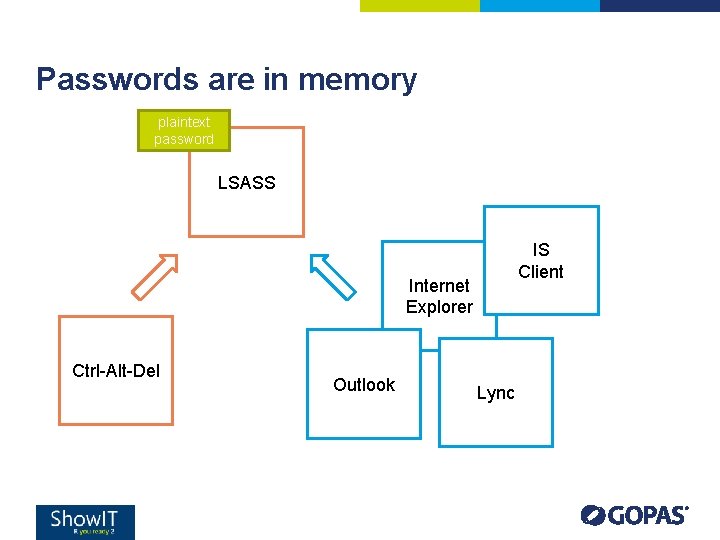
Passwords are in memory plaintext password LSASS IS Client Internet Explorer Ctrl-Alt-Del Outlook Lync
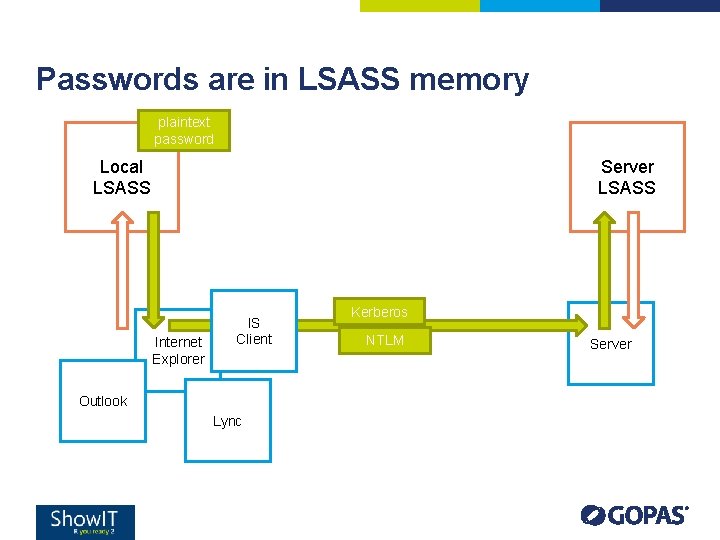
Passwords are in LSASS memory plaintext password Local LSASS Server LSASS Internet Explorer IS Client Outlook Lync Kerberos NTLM Server
Who can steal passwords from LSASS § Local Administrators • Debug privilege is just the only necessary to break into LSASS memory
Basic authentication § HTTP Basic authentication • used veeeeery often even on intranets • mostly BFU accounts § LDAP Simple bind • used veeeeery often by third-party NAS, VPN, Vo. IP, gateways, routers, VMWare console, etc. • often administrative accounts § RDP • used extreeeeemely often • extreeeeemely often administrative accounts
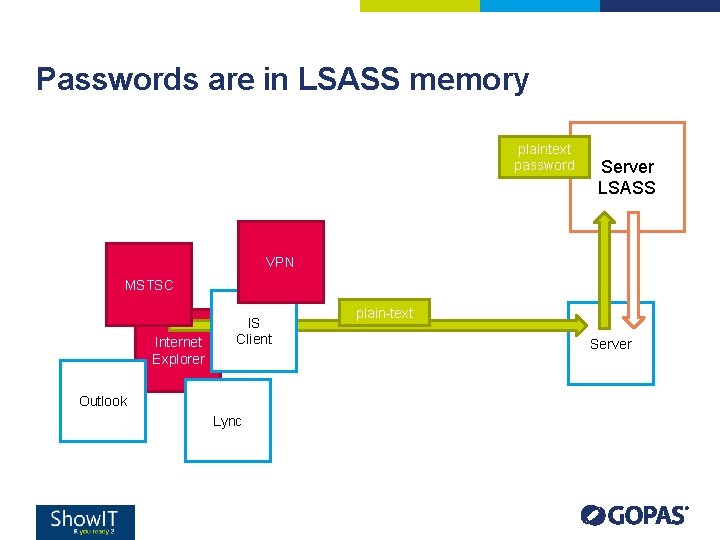
Passwords are in LSASS memory plaintext password Server LSASS VPN MSTSC Internet Explorer IS Client Outlook Lync plain-text Server
Passwords are stored in full form § IIS application pools § Services § Scheduled tasks
After attack, change your password! § Really? § Password filter on DC or on local SAM database
Good password § Long at least 12 characters § All four types of characters (a-z, A-Z, 0 -9, #$%^…) • 80% passwords are alfa-numeric § Never reuse the same password for critical services • not too much change necessary
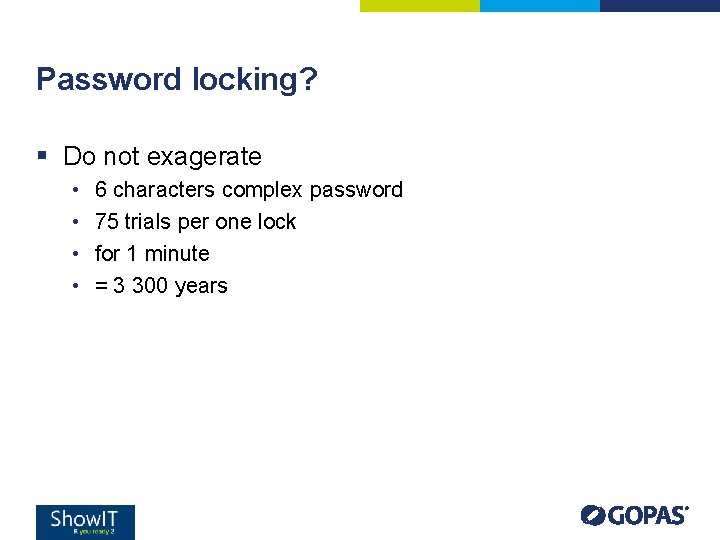
Password locking? § Do not exagerate • • 6 characters complex password 75 trials per one lock for 1 minute = 3 300 years
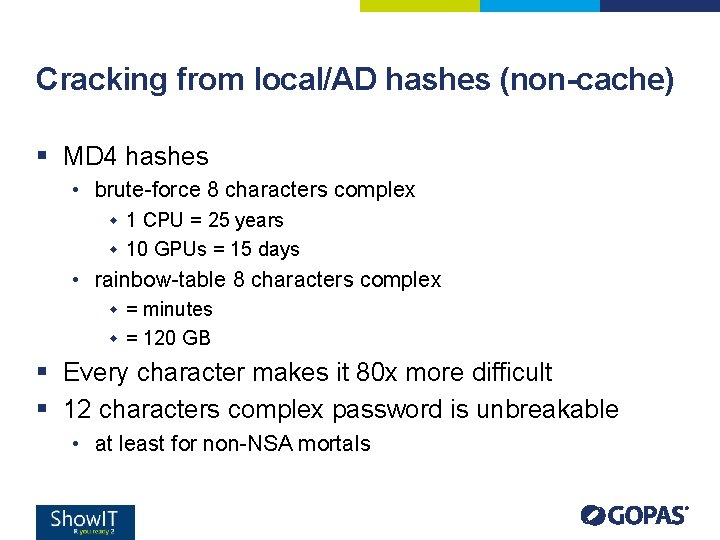
Cracking from local/AD hashes (non-cache) § MD 4 hashes • brute-force 8 characters complex 1 CPU = 25 years 10 GPUs = 15 days • rainbow-table 8 characters complex = minutes = 120 GB § Every character makes it 80 x more difficult § 12 characters complex password is unbreakable • at least for non-NSA mortals
Cracking from network trace and password cache § No use for rainbow-table • MD 4 salted § Only brute-force possible
What to remember § Never type a password on an unknown computer § Accessing remote machines with RDP sends there your password § Disable all HTTP Basic and LDAP Simple bind authentications § Use smart cards instead
Where to read more http: //www. sevecek. com/Lists/Categories/Category. asp x? Category. Id=17&Name=(Anti)hacking http: //www. sevecek. com/Lists/Post. aspx? ID=145
NASHLEDANOU na kurzech v počítačové škole GOPAS, a. s. GOC 171 - Active Directory Troubleshooting GOC 172 - Kerberos Troubleshooting GOC 173 - Enterprise PKI Deployment GOC 175 - Administering Security GOPAS: info@gopas, cz | www. gopas. cz | www. facebook. com/P. S. GOPAS