
Passives Subject be past participle Ex My bike
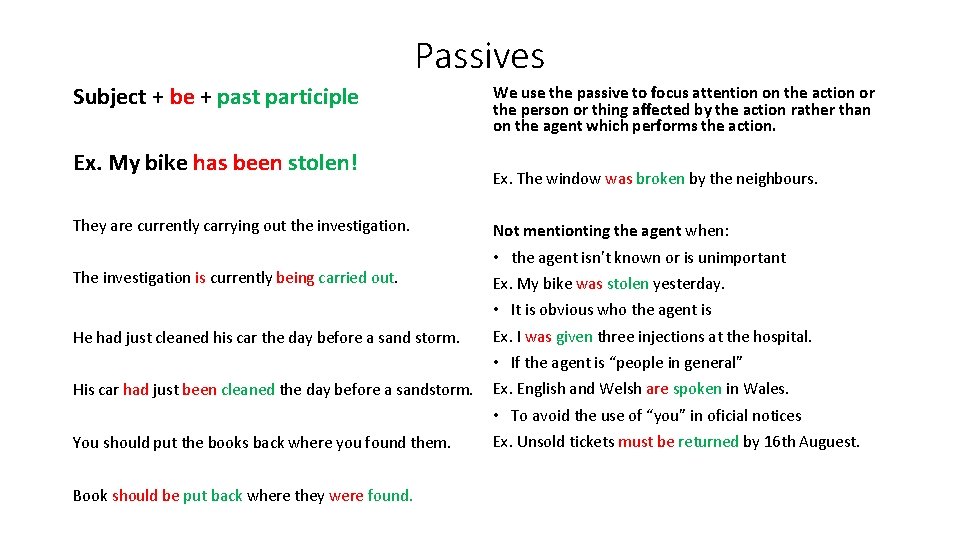
Passives Subject + be + past participle Ex. My bike has been stolen! They are currently carrying out the investigation. The investigation is currently being carried out. We use the passive to focus attention on the action or the person or thing affected by the action rather than on the agent which performs the action. Ex. The window was broken by the neighbours. Not mentionting the agent when: • the agent isn’t known or is unimportant Ex. My bike was stolen yesterday. • It is obvious who the agent is He had just cleaned his car the day before a sand storm. Ex. I was given three injections at the hospital. • If the agent is “people in general” His car had just been cleaned the day before a sandstorm. Ex. English and Welsh are spoken in Wales. • To avoid the use of “you” in oficial notices You should put the books back where you found them. Book should be put back where they were found. Ex. Unsold tickets must be returned by 16 th Auguest.
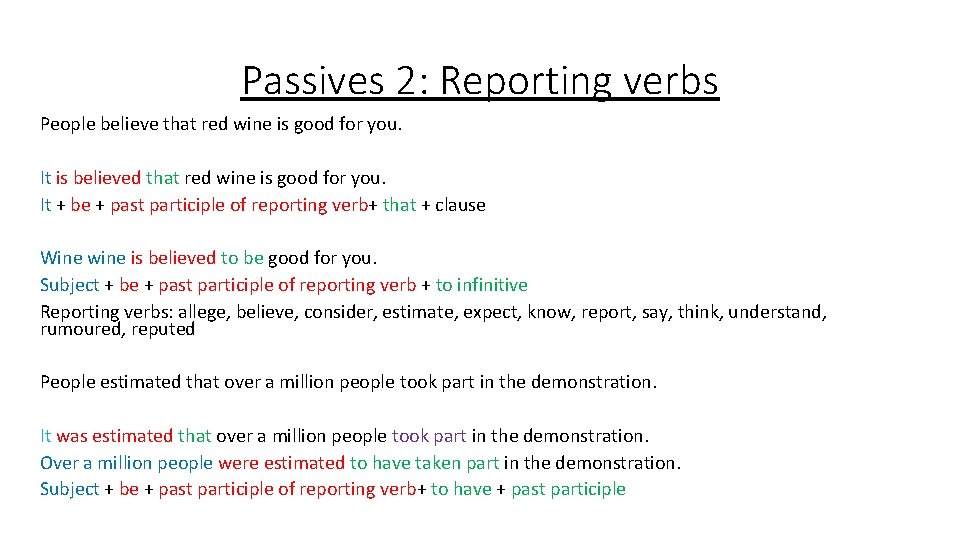
Passives 2: Reporting verbs People believe that red wine is good for you. It is believed that red wine is good for you. It + be + past participle of reporting verb+ that + clause Wine wine is believed to be good for you. Subject + be + past participle of reporting verb + to infinitive Reporting verbs: allege, believe, consider, estimate, expect, know, report, say, think, understand, rumoured, reputed People estimated that over a million people took part in the demonstration. It was estimated that over a million people took part in the demonstration. Over a million people were estimated to have taken part in the demonstration. Subject + be + past participle of reporting verb+ to have + past participle
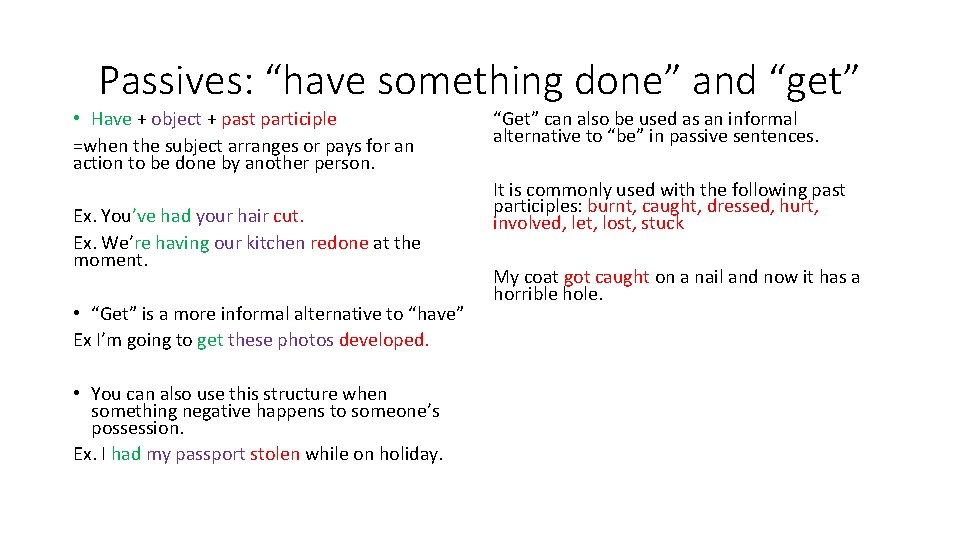
Passives: “have something done” and “get” • Have + object + past participle =when the subject arranges or pays for an action to be done by another person. Ex. You’ve had your hair cut. Ex. We’re having our kitchen redone at the moment. • “Get” is a more informal alternative to “have” Ex I’m going to get these photos developed. • You can also use this structure when something negative happens to someone’s possession. Ex. I had my passport stolen while on holiday. “Get” can also be used as an informal alternative to “be” in passive sentences. It is commonly used with the following past participles: burnt, caught, dressed, hurt, involved, let, lost, stuck My coat got caught on a nail and now it has a horrible hole.
- Slides: 3