
Passive Sampling for PCB in Air Takeshi Nakano
Passive Sampling for PCB in Air Takeshi Nakano (Osaka University)
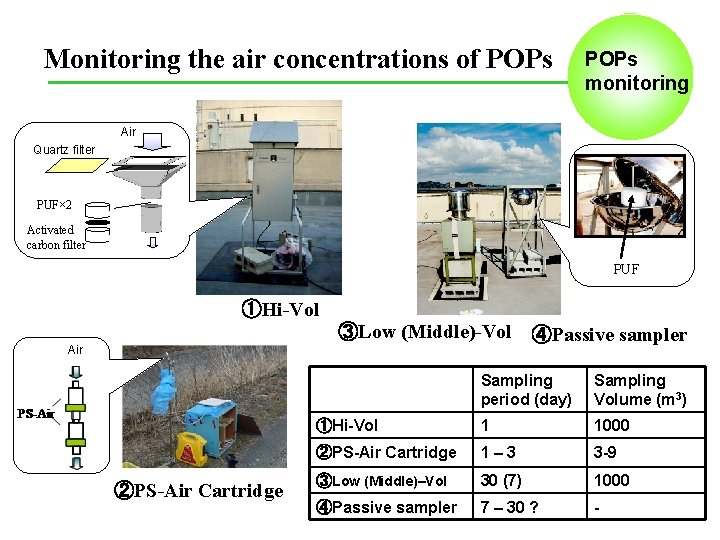
Monitoring the air concentrations of POPs monitoring Air Quartz filter PUF× 2 Activated carbon filter PUF ①Hi-Vol ③Low (Middle)-Vol ④Passive sampler Air ②PS-Air Cartridge Sampling period (day) Sampling Volume (m 3) ①Hi-Vol 1 1000 ②PS-Air Cartridge 1– 3 3 -9 ③Low (Middle)–Vol 30 (7) 1000 ④Passive sampler 7 – 30 ? -
Active sampling using conventional high volume air sampler requires pumps and a source of electricity. In addition, a short period sampling by high volume air sampler may be affected by the weather conditions, specific contaminated sources. Estimating the risk of hazardous substances, it is important to practice the long term monitoring and evaluate the concentration level in the local area. In order to put this method practical use, we sampled the air simultaneously using PAS and low volume air sampler and compared those results. PAS is consist of one polyurethane foam (PUF, 85 mm i. d. × 50 mm) covered with two stainless steel bowls to eliminate the wind effect or prevent from the rain.
Low volume air sampler is consist of quartz micro fiber filter (QMF, 150 mm i. d. ) and three polyurethane foam plugs. Monitoring the ambient air by PAS and low volume air sampler over the same period, the effectiveness of PAS is verified from isomer distribution point of view. Comparing adsorbed amount (ng) to PAS with concentration (ng/m 3) measured by low volume air sampler, we estimate the effective sample volume(m 3/day) concerning each chemical substances. PAS and low volume air sampler were deployed every two months at few sites, which is considered to characterize urban-industrial areas. Seasonal variation, summer and winter, is also investigated. Isotope-labeled compounds (surrogate) are added to the sampling medium (PUF) prior to exposure.
Sampler Design. The PAS consists of a stainless steel mesh cylinder, filled with XAD-2 resin and suspended in a steel can with an open bottom (11). The PAS is deployed at 1. 5 m above ground except in locations with a deep snowpack, where deployment height is increased to ensure that the PAS is not covered by snow. Contaminants are taken up in the resin from the atmosphere by diffusion, whereby previous experiments established independence of the sampling rate over a wide range of wind speeds (11). Measurements of the sorption coefficients for the XAD-2 resin (18) as well as yearlong calibration experiments in Arctic and southern Canada (11) confirmed that the OCPs of interest do not reach equilibrium between the atmospheric gas phase and the resin. This makes it feasible to interpret the amounts of OCPs quantified in the PAS in terms of volumetric air concentrations, using a sampling rate that is largely independent of chemical, wind speed, and temperature (11). Atmospheric Distribution and Long-Range Transport Behavior of Organochlorine Pesticides in North America Shen et al (2005 ): Environ. Sci. Technol. 39(2)
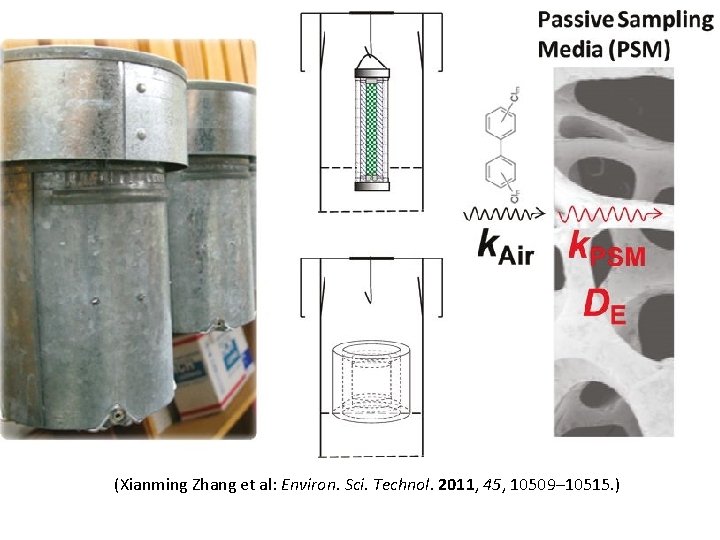
(Xianming Zhang et al: Environ. Sci. Technol. 2011, 45, 10509– 10515. )
Fig. Design of the layered passive air sampling media (XAD and PUF) used to study the distribution of PCBs within the passive sampling medium. (Xianming Zhang et al: Environ. Sci. Technol. 2011, 45, 10509– 10515. )
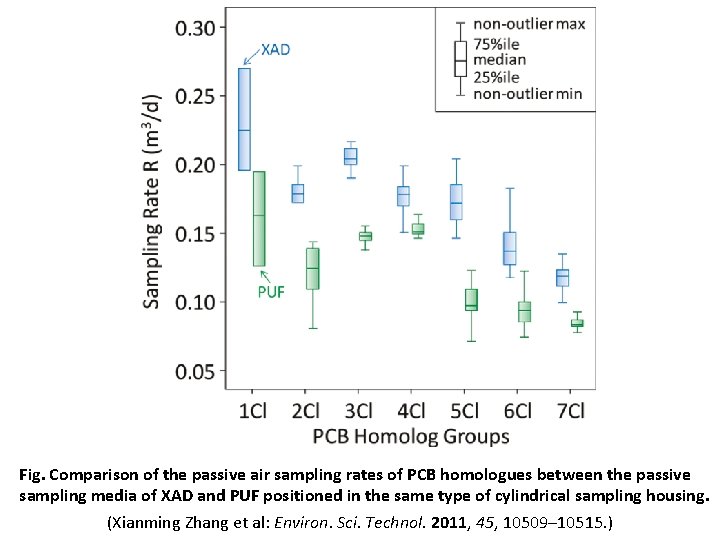
Fig. Comparison of the passive air sampling rates of PCB homologues between the passive sampling media of XAD and PUF positioned in the same type of cylindrical sampling housing. (Xianming Zhang et al: Environ. Sci. Technol. 2011, 45, 10509– 10515. )
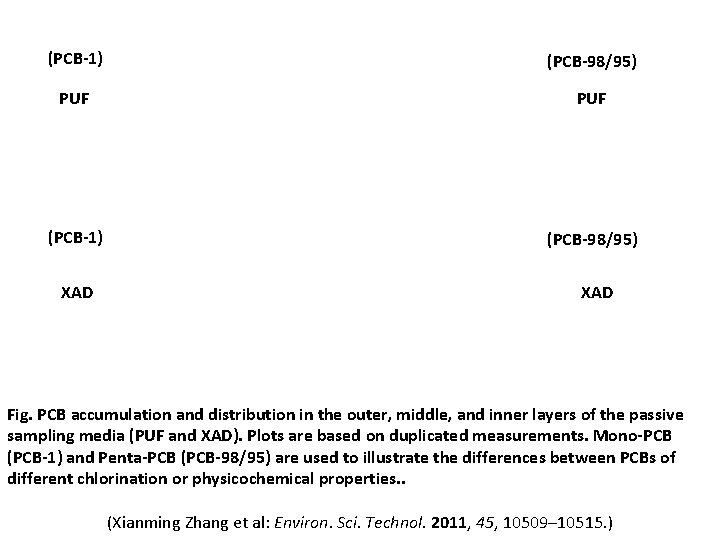
(PCB-1) (PCB-98/95) PUF (PCB-1) (PCB-98/95) XAD Fig. PCB accumulation and distribution in the outer, middle, and inner layers of the passive sampling media (PUF and XAD). Plots are based on duplicated measurements. Mono-PCB (PCB-1) and Penta-PCB (PCB-98/95) are used to illustrate the differences between PCBs of different chlorination or physicochemical properties. . (Xianming Zhang et al: Environ. Sci. Technol. 2011, 45, 10509– 10515. )
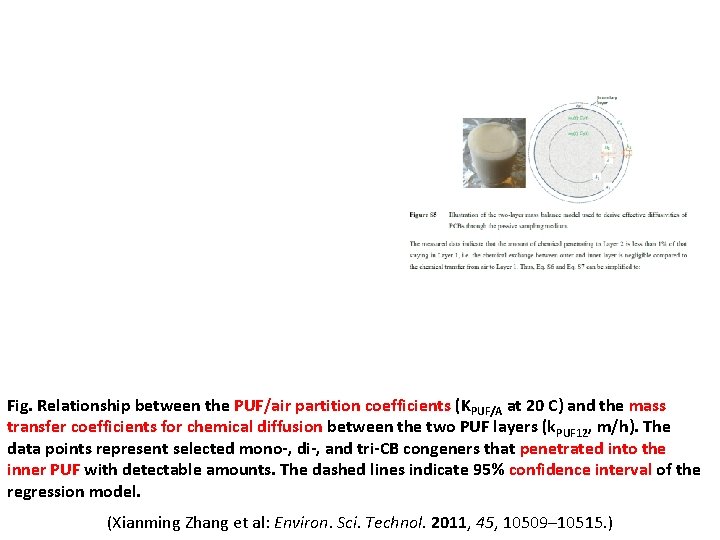
Fig. Relationship between the PUF/air partition coefficients (KPUF/A at 20 C) and the mass transfer coefficients for chemical diffusion between the two PUF layers (k. PUF 12, m/h). The data points represent selected mono-, di-, and tri-CB congeners that penetrated into the inner PUF with detectable amounts. The dashed lines indicate 95% confidence interval of the regression model. (Xianming Zhang et al: Environ. Sci. Technol. 2011, 45, 10509– 10515. )
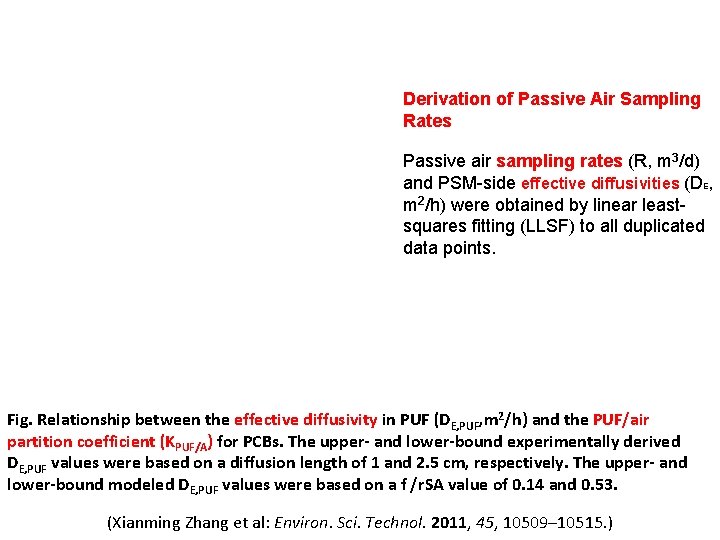
Derivation of Passive Air Sampling Rates Passive air sampling rates (R, m 3/d) and PSM-side effective diffusivities (DE, m 2/h) were obtained by linear leastsquares fitting (LLSF) to all duplicated data points. Fig. Relationship between the effective diffusivity in PUF (DE, PUF, m 2/h) and the PUF/air partition coefficient (KPUF/A) for PCBs. The upper- and lower-bound experimentally derived DE, PUF values were based on a diffusion length of 1 and 2. 5 cm, respectively. The upper- and lower-bound modeled DE, PUF values were based on a f /r. SA value of 0. 14 and 0. 53. (Xianming Zhang et al: Environ. Sci. Technol. 2011, 45, 10509– 10515. )

Monitoring the air concentrations of POPs monitoring Air Quartz filter PUF× 2 Activated carbon filter PUF ①Hi-Vol ③Low (Middle)-Vol ④Passive sampler Air ②PS-Air Cartridge Sampling period (day) Sampling Volume (m 3) ①Hi-Vol 1 1000 ②PS-Air Cartridge 1– 3 3 -9 ③Low (Middle)–Vol 30 (7) 1000 ④Passive sampler 7 – 30 ? -
PCB/PCN congener profiles in air sample Comparison of AAS and PAS (AAS)Active Air Sampling and (PAS) Passive Air Sampling
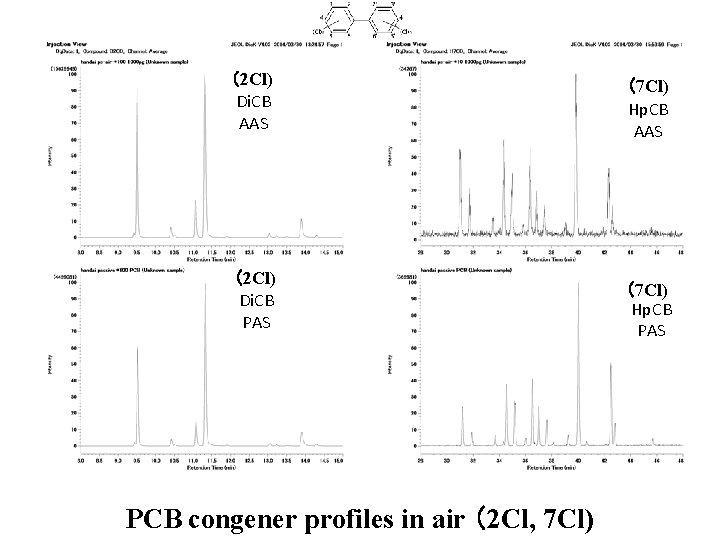
(2 Cl) Di. CB AAS (7 Cl) Hp. CB AAS (2 Cl) Di. CB PAS (7 Cl) Hp. CB PAS PCB congener profiles in air (2 Cl, 7 Cl)
(3 Cl) (4 Cl) Tr. CB AAS Te 4 CB AAS (3 Cl) Tr. CB PAS (4 Cl) Te. CB PAS PCB congener profiles in air (3 Cl, 4 Cl)
(5 Cl) Pe. CB AAS (6 Cl) Hx. CB AAS (5 Cl) Pe. CB PAS (6 Cl) Hx. CB PAS PCB congener profiles in air (5 Cl, 6 Cl)
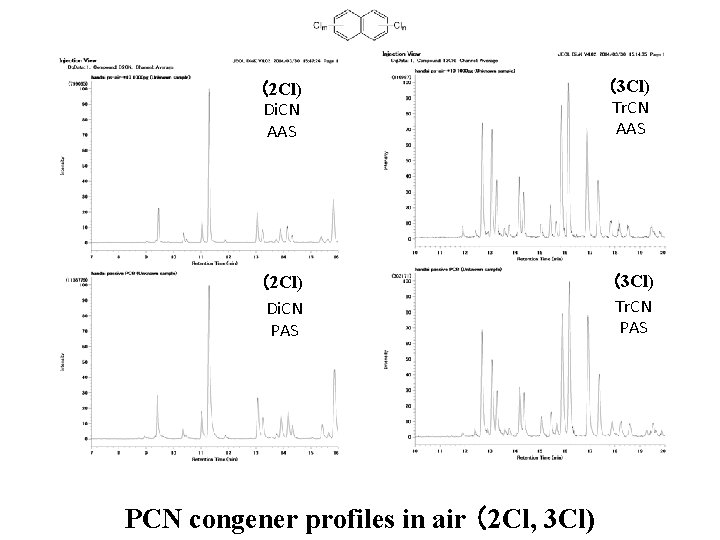
(2 Cl) Di. CN AAS (3 Cl) Tr. CN AAS (2 Cl) Di. CN PAS (3 Cl) Tr. CN PAS PCN congener profiles in air (2 Cl, 3 Cl)
Daily variation of PCB homologue profiles in air sample
3 Cl 3 Cl 2 Cl Daily variation of PCB homologue profiles in air sample
PCB congener profiles in air sample (PUF) Poly Urethane Foam
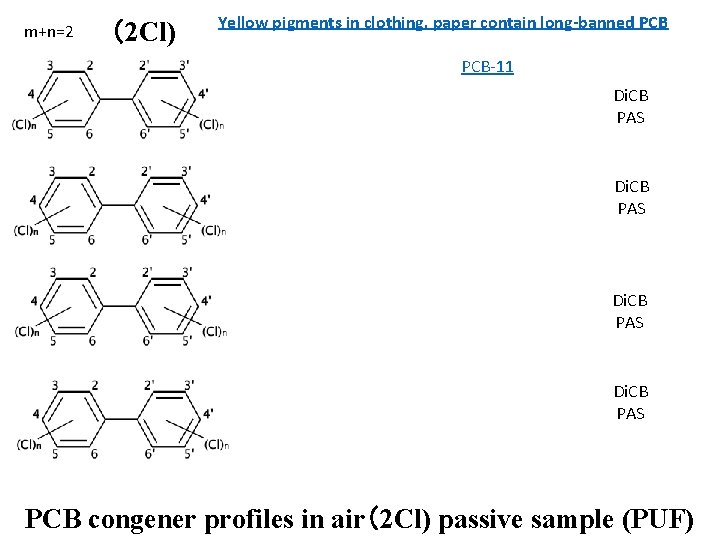
m+n=2 (2 Cl) Yellow pigments in clothing, paper contain long-banned PCB-11 Di. CB PAS PCB congener profiles in air(2 Cl) passive sample (PUF)
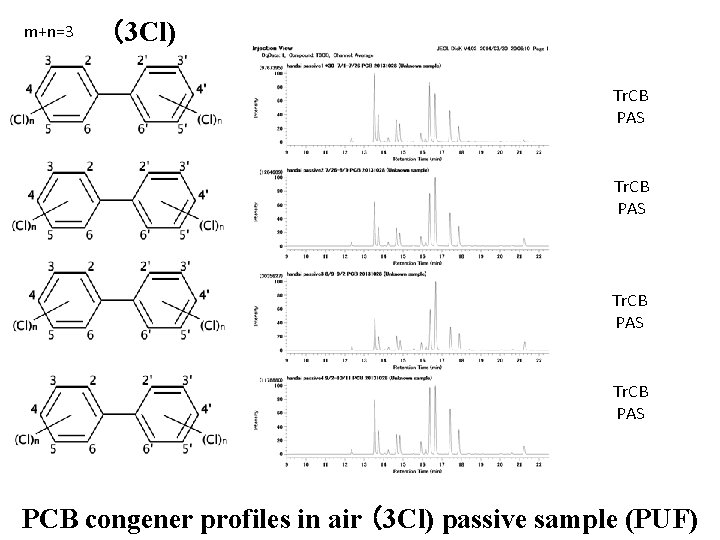
m+n=3 (3 Cl) Tr. CB PAS PCB congener profiles in air (3 Cl) passive sample (PUF)
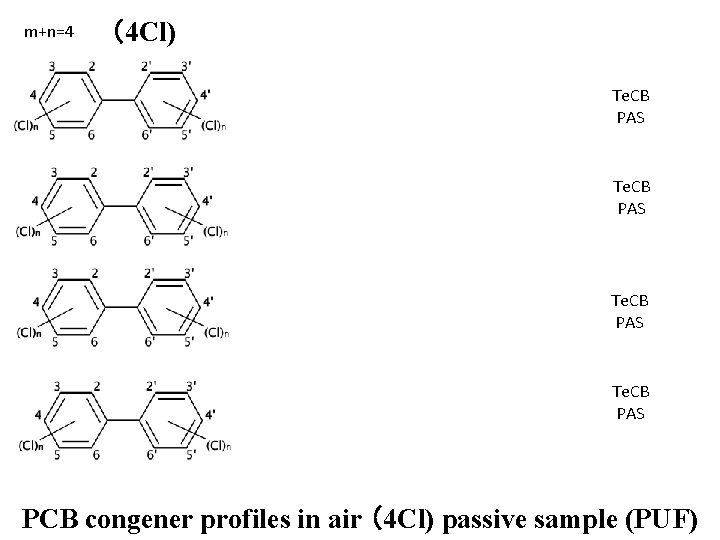
m+n=4 (4 Cl) Te. CB PAS PCB congener profiles in air (4 Cl) passive sample (PUF)
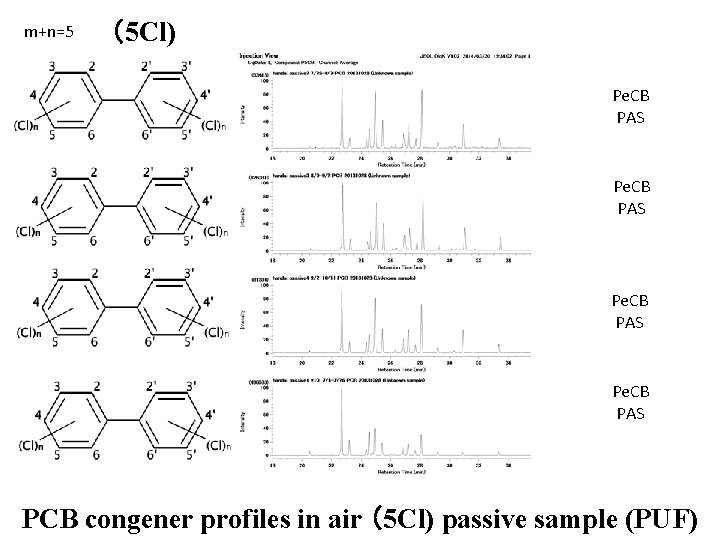
m+n=5 (5 Cl) Pe. CB PAS PCB congener profiles in air (5 Cl) passive sample (PUF)
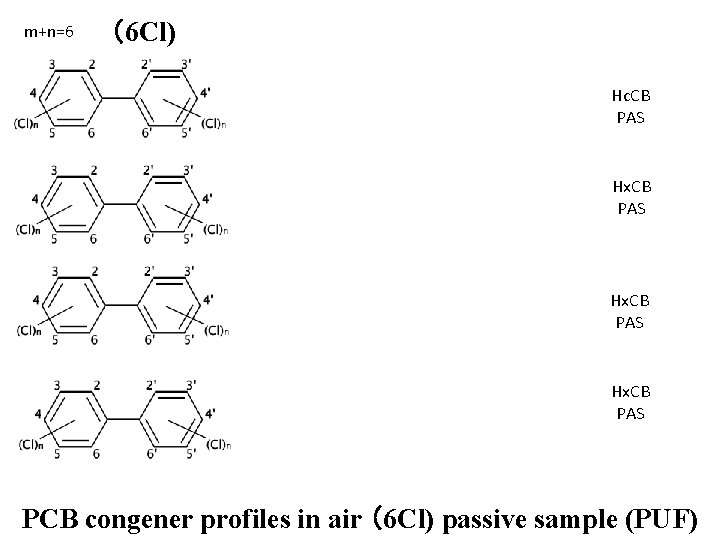
m+n=6 (6 Cl) Hc. CB PAS Hx. CB PAS PCB congener profiles in air (6 Cl) passive sample (PUF)
PCN congener profiles in air sample (PUF) Poly Urethane Foam
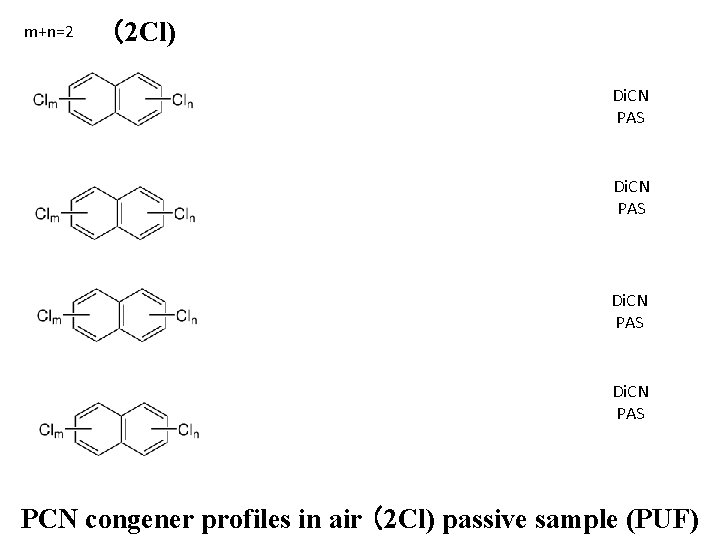
m+n=2 (2 Cl) Di. CN PAS PCN congener profiles in air (2 Cl) passive sample (PUF)
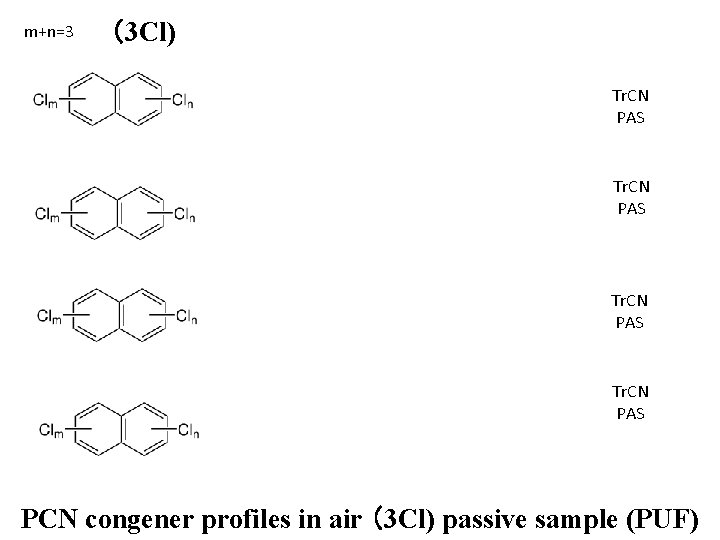
m+n=3 (3 Cl) Tr. CN PAS PCN congener profiles in air (3 Cl) passive sample (PUF)
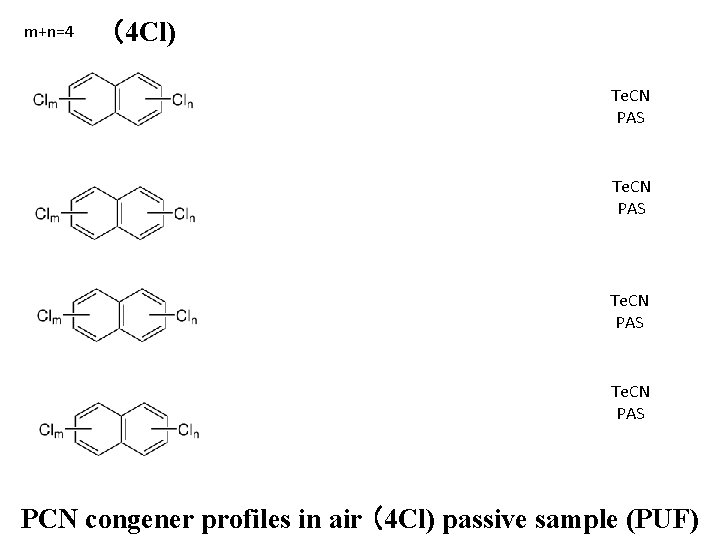
m+n=4 (4 Cl) Te. CN PAS PCN congener profiles in air (4 Cl) passive sample (PUF)
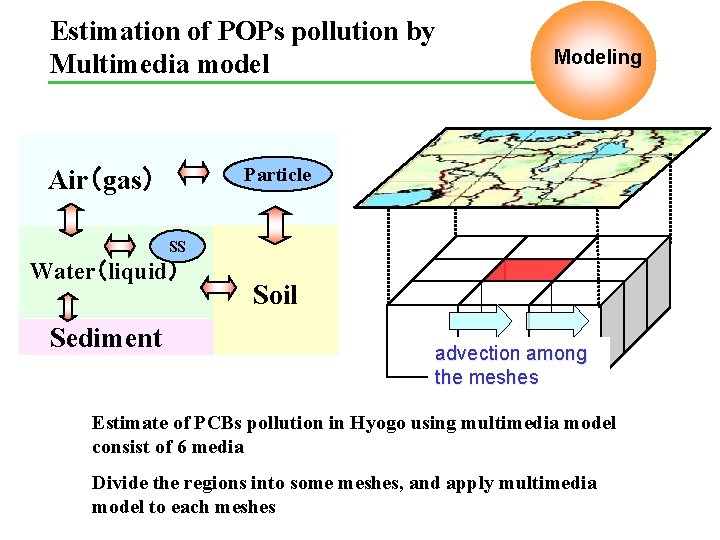
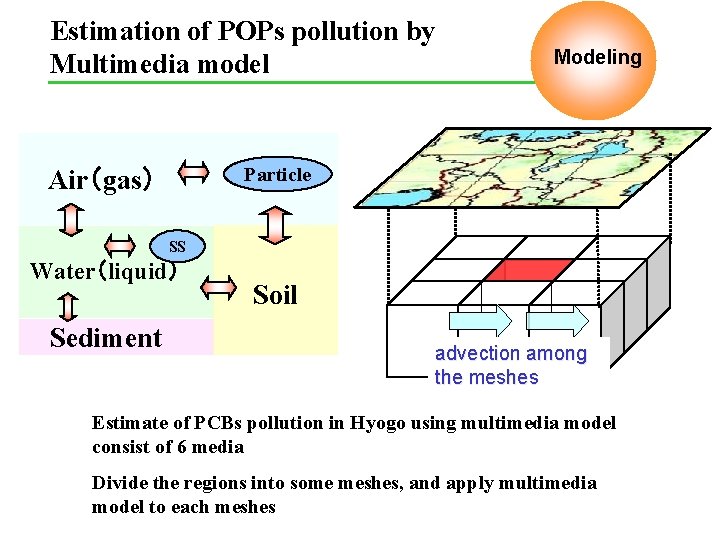
Estimation of POPs pollution by Multimedia model Air(gas) SS Water(liquid) Sediment Modeling Particle Soil advection among the meshes Estimate of PCBs pollution in Hyogo using multimedia model consist of 6 media Divide the regions into some meshes, and apply multimedia model to each meshes
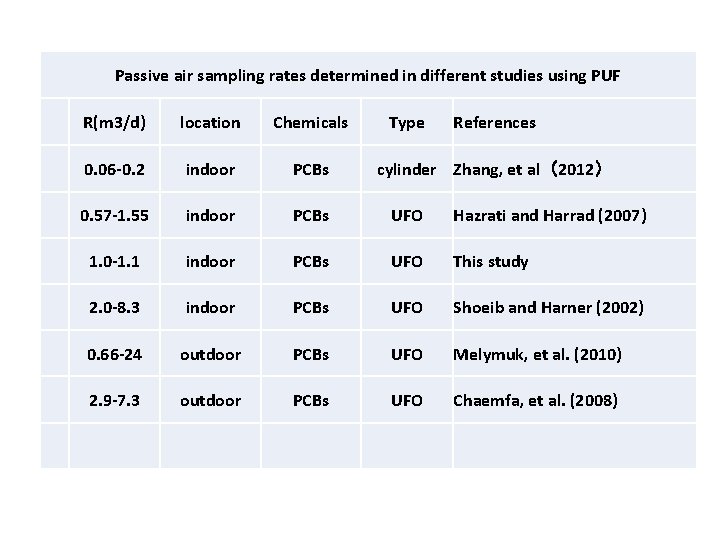
Passive air sampling rates determined in different studies using PUF R(m 3/d) location Chemicals Type References 0. 06 -0. 2 indoor PCBs 0. 57 -1. 55 indoor PCBs UFO Hazrati and Harrad (2007) 1. 0 -1. 1 indoor PCBs UFO This study 2. 0 -8. 3 indoor PCBs UFO Shoeib and Harner (2002) 0. 66 -24 outdoor PCBs UFO Melymuk, et al. (2010) 2. 9 -7. 3 outdoor PCBs UFO Chaemfa, et al. (2008) cylinder Zhang, et al(2012)
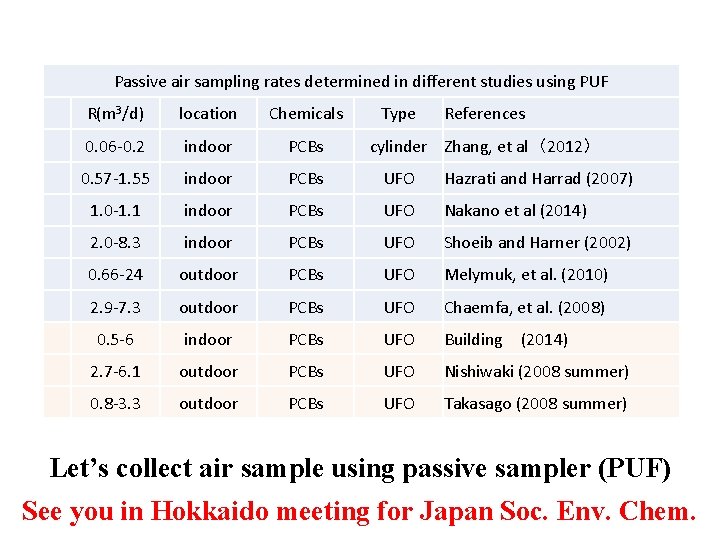
Passive air sampling rates determined in different studies using PUF R(m 3/d) location Chemicals Type References 0. 06 -0. 2 indoor PCBs 0. 57 -1. 55 indoor PCBs UFO Hazrati and Harrad (2007) 1. 0 -1. 1 indoor PCBs UFO Nakano et al (2014) 2. 0 -8. 3 indoor PCBs UFO Shoeib and Harner (2002) 0. 66 -24 outdoor PCBs UFO Melymuk, et al. (2010) 2. 9 -7. 3 outdoor PCBs UFO Chaemfa, et al. (2008) 0. 5 -6 indoor PCBs UFO Building (2014) 2. 7 -6. 1 outdoor PCBs UFO Nishiwaki (2008 summer) 0. 8 -3. 3 outdoor PCBs UFO Takasago (2008 summer) cylinder Zhang, et al(2012) Let’s collect air sample using passive sampler (PUF) See you in Hokkaido meeting for Japan Soc. Env. Chem.
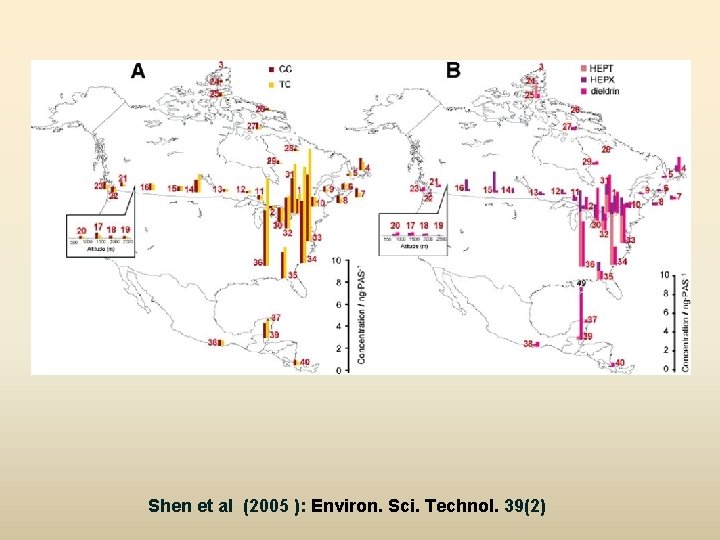
Shen et al (2005 ): Environ. Sci. Technol. 39(2)
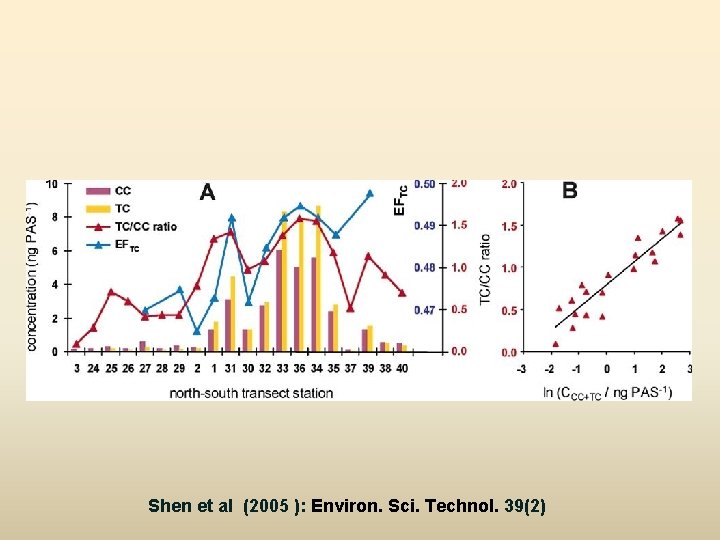
Shen et al (2005 ): Environ. Sci. Technol. 39(2)
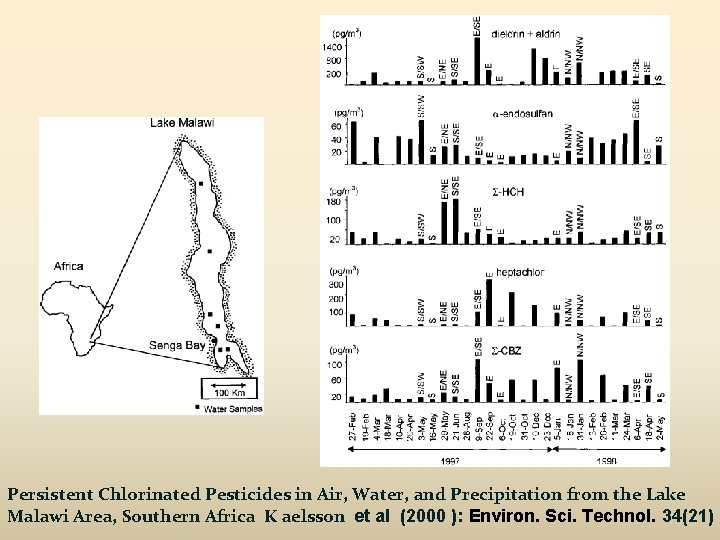
Persistent Chlorinated Pesticides in Air, Water, and Precipitation from the Lake Malawi Area, Southern Africa K aelsson et al (2000 ): Environ. Sci. Technol. 34(21)
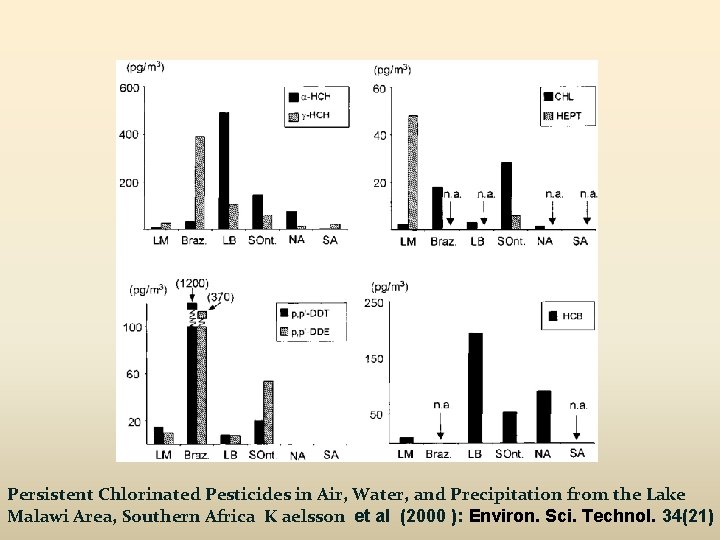
Persistent Chlorinated Pesticides in Air, Water, and Precipitation from the Lake Malawi Area, Southern Africa K aelsson et al (2000 ): Environ. Sci. Technol. 34(21)
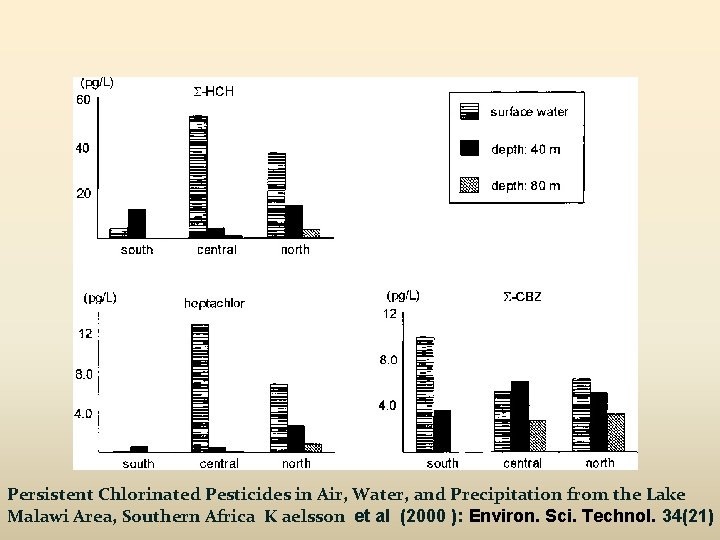
Persistent Chlorinated Pesticides in Air, Water, and Precipitation from the Lake Malawi Area, Southern Africa K aelsson et al (2000 ): Environ. Sci. Technol. 34(21)
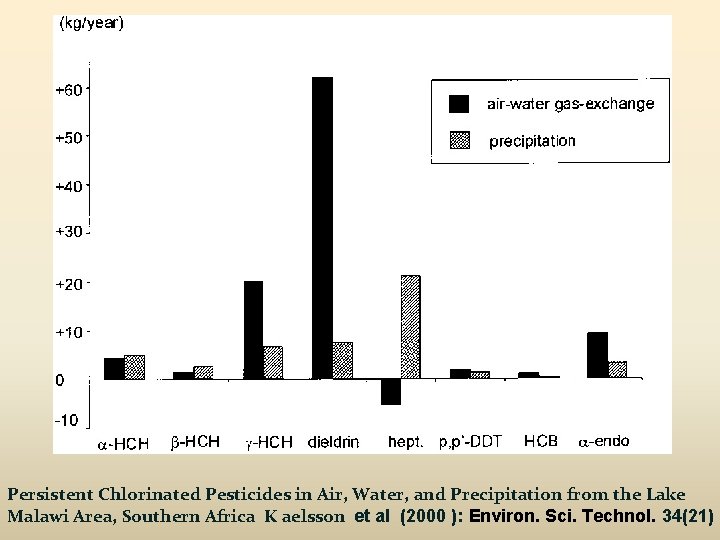
Persistent Chlorinated Pesticides in Air, Water, and Precipitation from the Lake Malawi Area, Southern Africa K aelsson et al (2000 ): Environ. Sci. Technol. 34(21)
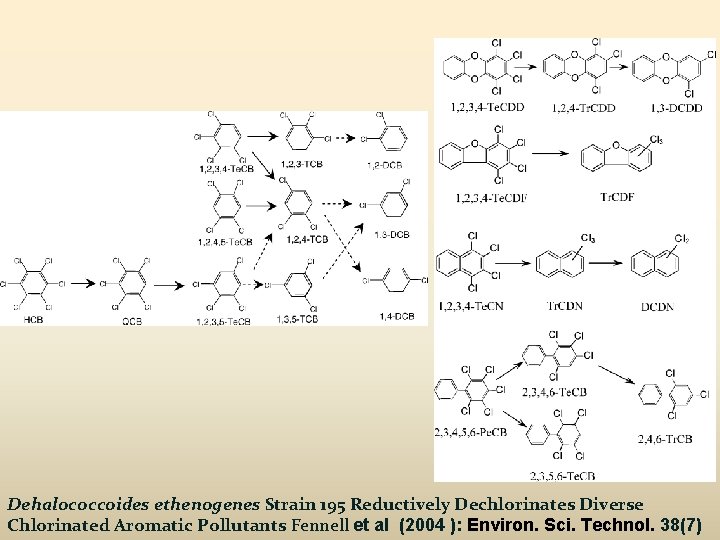
Dehalococcoides ethenogenes Strain 195 Reductively Dechlorinates Diverse Chlorinated Aromatic Pollutants Fennell et al (2004 ): Environ. Sci. Technol. 38(7)
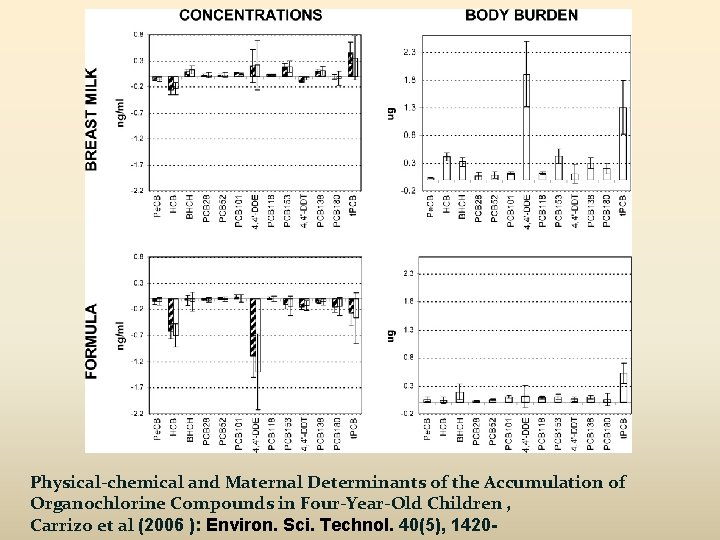
Physical-chemical and Maternal Determinants of the Accumulation of Organochlorine Compounds in Four-Year-Old Children , Carrizo et al (2006 ): Environ. Sci. Technol. 40(5), 1420 -
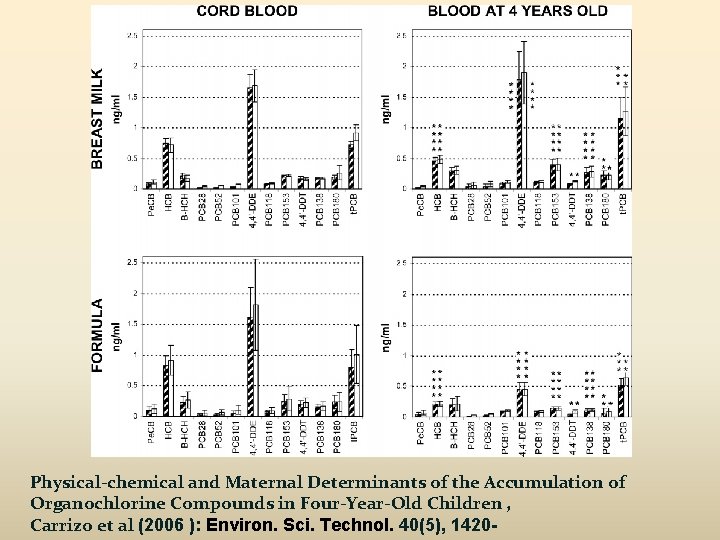
Physical-chemical and Maternal Determinants of the Accumulation of Organochlorine Compounds in Four-Year-Old Children , Carrizo et al (2006 ): Environ. Sci. Technol. 40(5), 1420 -
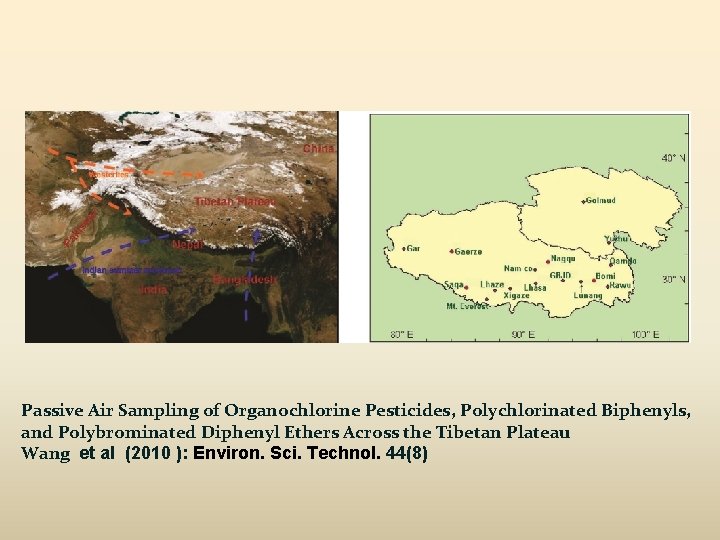
Passive Air Sampling of Organochlorine Pesticides, Polychlorinated Biphenyls, and Polybrominated Diphenyl Ethers Across the Tibetan Plateau Wang et al (2010 ): Environ. Sci. Technol. 44(8)
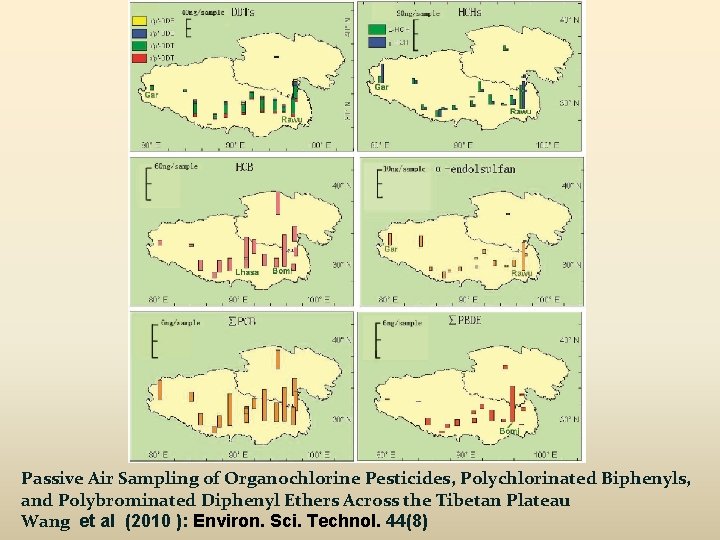
Passive Air Sampling of Organochlorine Pesticides, Polychlorinated Biphenyls, and Polybrominated Diphenyl Ethers Across the Tibetan Plateau Wang et al (2010 ): Environ. Sci. Technol. 44(8)
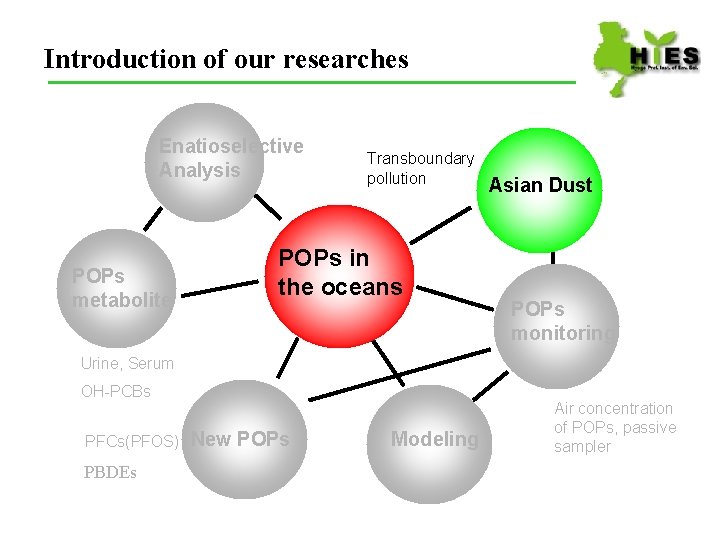
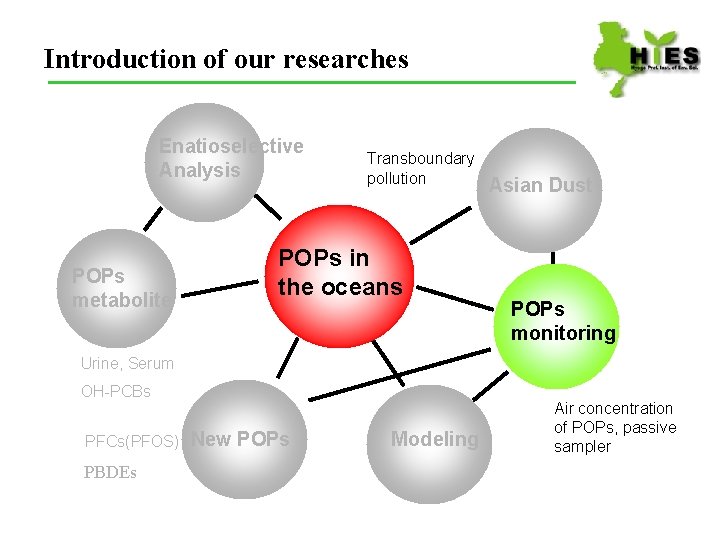
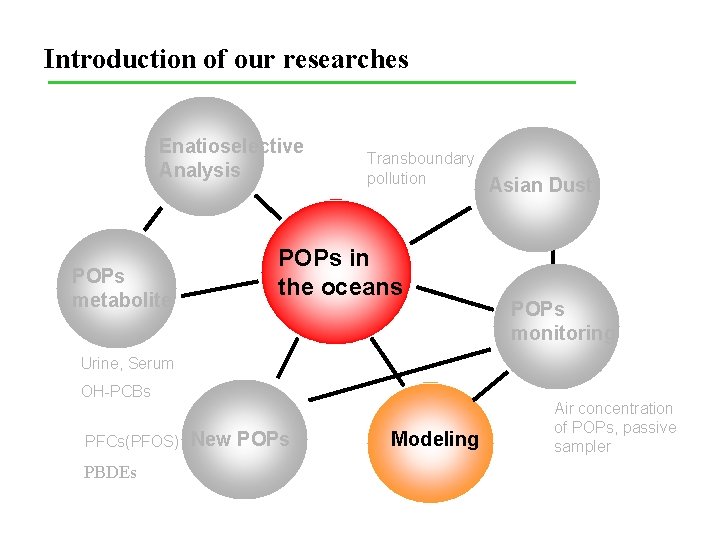
Introduction of our researches Enatioselective Analysis POPs metabolite Transboundary pollution POPs in the oceans Asian Dust POPs monitoring Urine, Serum OH-PCBs PFCs(PFOS) PBDEs New POPs Modeling Air concentration of POPs, passive sampler
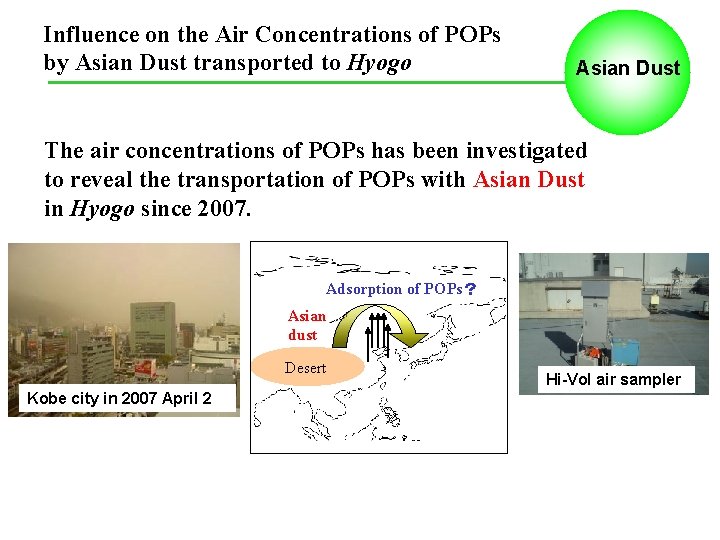
Influence on the Air Concentrations of POPs by Asian Dust transported to Hyogo Asian Dust The air concentrations of POPs has been investigated to reveal the transportation of POPs with Asian Dust in Hyogo since 2007. Adsorption of POPs? Asian dust Desert Kobe city in 2007 April 2 Hi-Vol air sampler
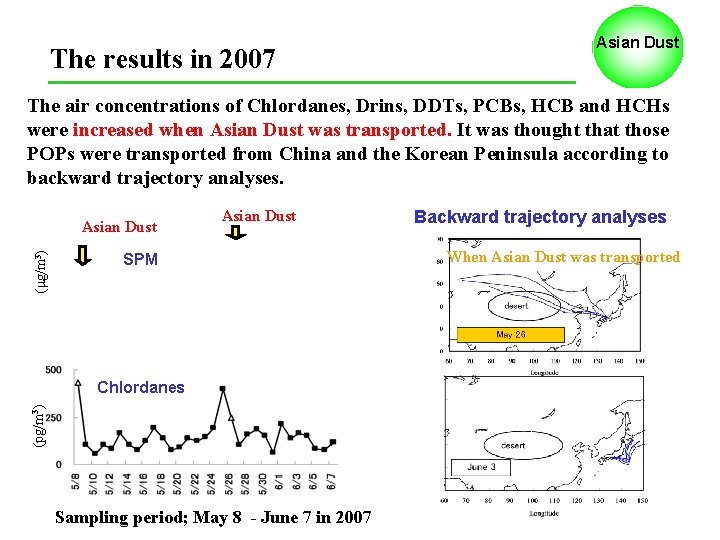
The results in 2007 Asian Dust The air concentrations of Chlordanes, Drins, DDTs, PCBs, HCB and HCHs were increased when Asian Dust was transported. It was thought that those POPs were transported from China and the Korean Peninsula according to backward trajectory analyses. (μg/m 3) Asian Dust SPM (pg/m 3) Chlordanes Sampling period; May 8 - June 7 in 2007 Backward trajectory analyses When Asian Dust was transported
Introduction of our researches Enatioselective Analysis POPs metabolite Transboundary pollution POPs in the oceans Asian Dust POPs monitoring Urine, Serum OH-PCBs PFCs(PFOS) PBDEs New POPs Modeling Air concentration of POPs, passive sampler
Introduction of our researches Enatioselective Analysis POPs metabolite Transboundary pollution POPs in the oceans Asian Dust POPs monitoring Urine, Serum OH-PCBs PFCs(PFOS) PBDEs New POPs Modeling Air concentration of POPs, passive sampler
Estimation of POPs pollution by Multimedia model Air(gas) SS Water(liquid) Sediment Modeling Particle Soil advection among the meshes Estimate of PCBs pollution in Hyogo using multimedia model consist of 6 media Divide the regions into some meshes, and apply multimedia model to each meshes

Endosulfan
Sampler Design. The PAS consists of a stainless steel mesh cylinder, filled with XAD-2 resin and suspended in a steel can with an open bottom (11). The PAS is deployed at 1. 5 m above ground except in locations with a deep snowpack, where deployment height is increased to ensure that the PAS is not covered by snow. Contaminants are taken up in the resin from the atmosphere by diffusion, whereby previous experiments established independence of the sampling rate over a wide range of wind speeds (11). Measurements of the sorption coefficients for the XAD-2 resin (18) as well as yearlong calibration experiments in Arctic and southern Canada (11) confirmed that the OCPs of interest do not reach equilibrium between the atmospheric gas phase and the resin. This makes it feasible to interpret the amounts of OCPs quantified in the PAS in terms of volumetric air concentrations, using a sampling rate that is largely independent of chemical, wind speed, and temperature (11). Atmospheric Distribution and Long-Range Transport Behavior of Organochlorine Pesticides in North America Shen et al (2005 ): Environ. Sci. Technol. 39(2)
Extraction and Quantification. The XAD-2 from the sampling container was transferred to an elution column and solvent extracted and then fractionatedonactivated silica gel, as described in detail in Wania et al. (11). This reference also provides details on the quantification of OCPs by gas chromatography/electron capture detection, and the quality assurance steps involving procedure, resin, and field blanks. The extracts were analyzed for cis- (CC) and transchlordane (TC), trans-nonachlor (TN), oxychlordane (OXY), heptachlor (HEPT), heptachlor-exo-epoxide (HEPX), aldrin, dieldrin, endrin, and a-endosulfan, DDTgroupcompounds(DDTs), pentachlorobenzene (Pe. CB), and hexachlorobenzene (HCB). The passive air sampler concentrations (in units of ng/PAS) are presented as blank-corrected averages of duplicates using the averages of 19 resin blanks and 8 field blanks. Time averaged volumetric air concentrations (CA; in pg/m 3) are estimated by dividing the sampler concentration (in pg/PAS) by the product of the deployment period (365 d) and the PAS sampling rate. The latter is 0. 52 m 3/d PAS- as estimated from the average of all sampling rates below 1 m 3/d PAS in Table 1 of ref 11. Shen et al (2005 ): Environ. Sci. Technol. 39(2)
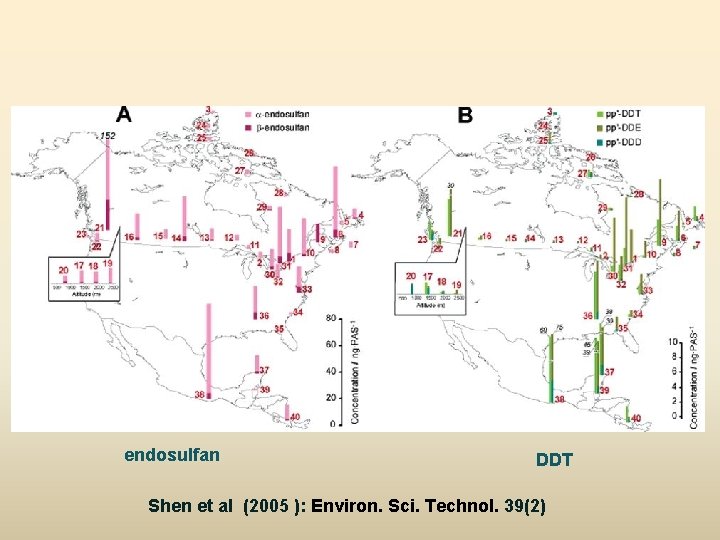
endosulfan DDT Shen et al (2005 ): Environ. Sci. Technol. 39(2)
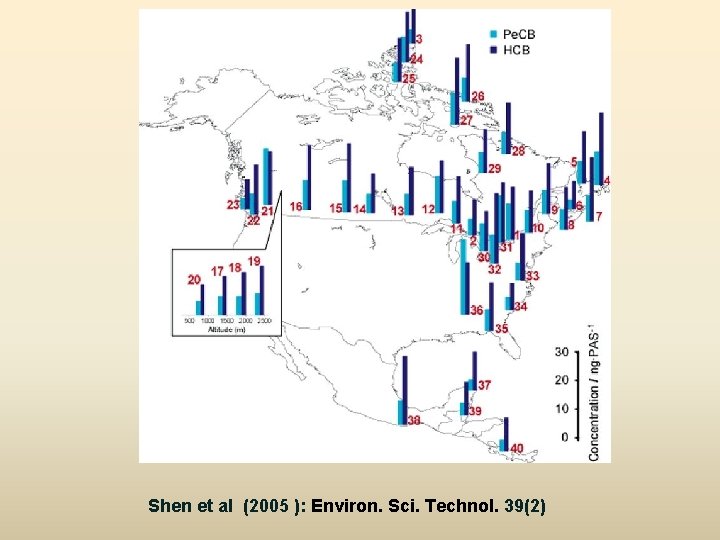
Shen et al (2005 ): Environ. Sci. Technol. 39(2)
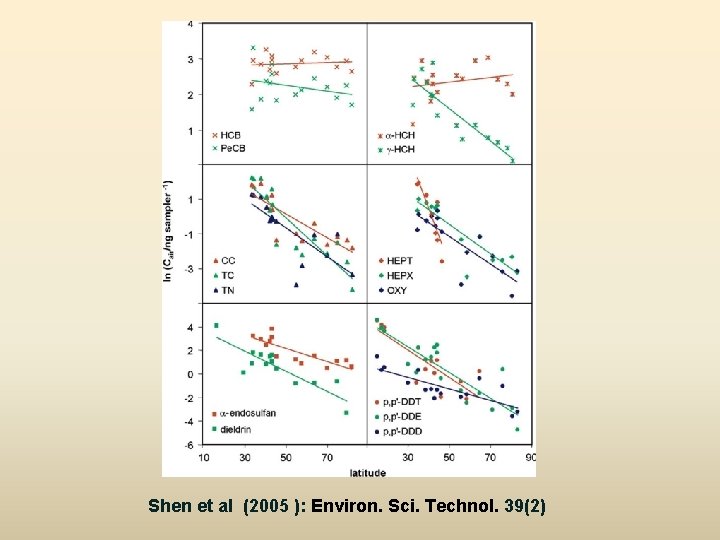
Shen et al (2005 ): Environ. Sci. Technol. 39(2)
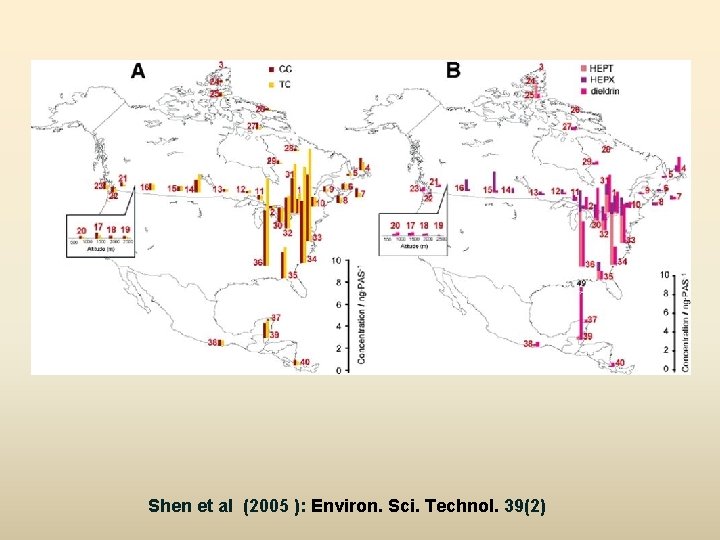
Shen et al (2005 ): Environ. Sci. Technol. 39(2)
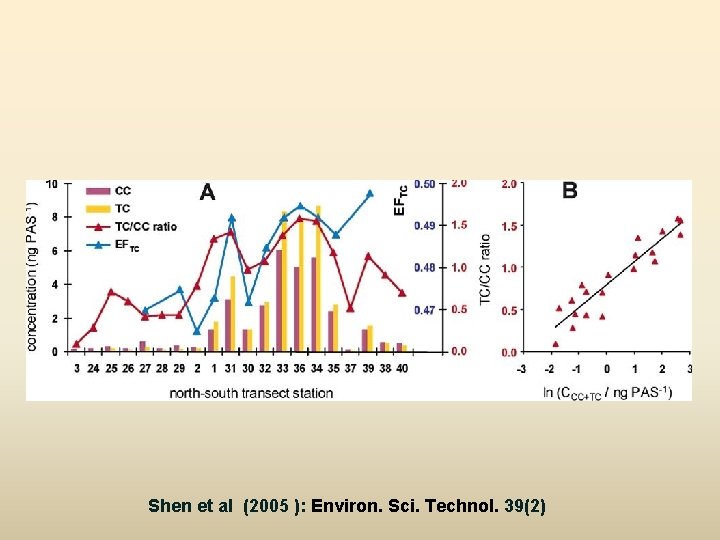
Shen et al (2005 ): Environ. Sci. Technol. 39(2)
- Slides: 57