
Passive Microwave Remote Sensing Outline Passive Microwave Radiometry
- Slides: 22
Passive Microwave Remote Sensing
Outline • Passive Microwave Radiometry
Passive Microwave Radiometry • Microwave region: 1 -200 GHz (0. 15 -30 cm) • Uses the same principles as thermal remote sensing • Multi-frequency/multi-polarization sensing • Weak energy source so need large IFOV and wide bands
Microwave Brightness Temperature • Microwave radiometers can measure the emitted spectral radiance received (Ll) • This is called the brightness temperature and is linearly related to the kinetic temperature of the surface • The Rayleigh-Jeans approximation provides a simple linear relationship between measured spectral radiance temperature and emissivity
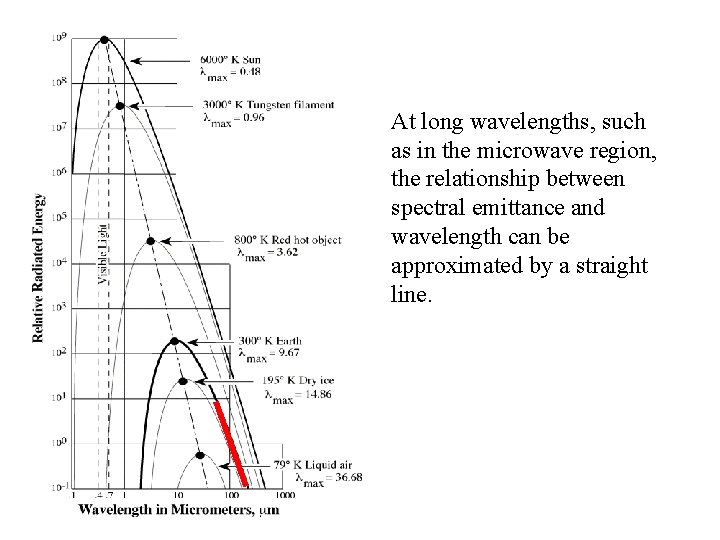
At long wavelengths, such as in the microwave region, the relationship between spectral emittance and wavelength can be approximated by a straight line.
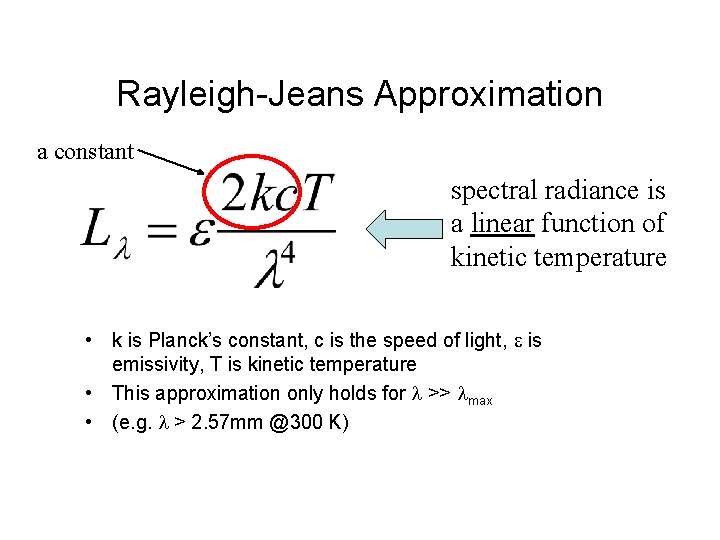
Rayleigh-Jeans Approximation a constant spectral radiance is a linear function of kinetic temperature • k is Planck’s constant, c is the speed of light, e is emissivity, T is kinetic temperature • This approximation only holds for l >> lmax • (e. g. l > 2. 57 mm @300 K)
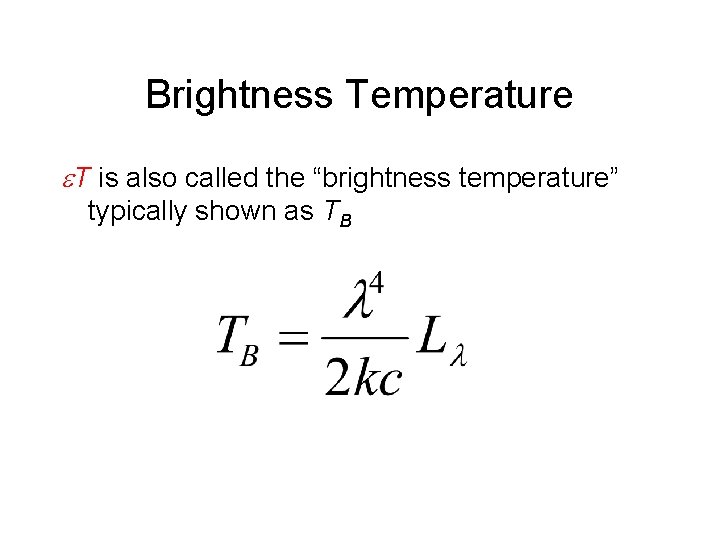
Brightness Temperature e. T is also called the “brightness temperature” typically shown as TB
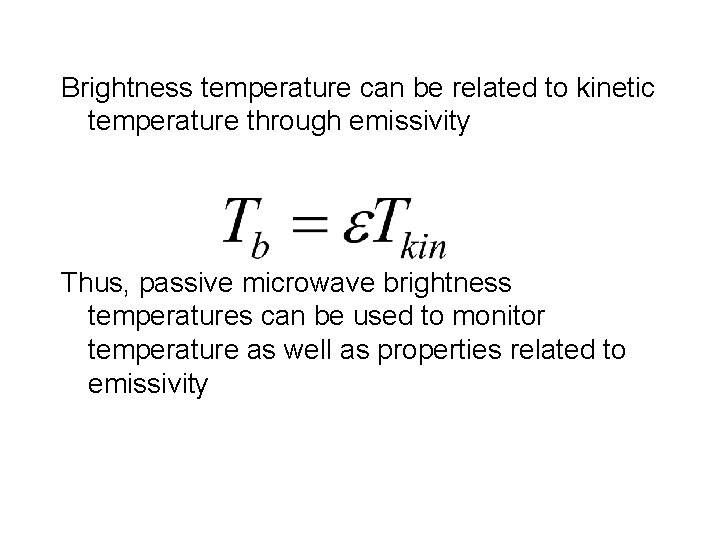
Brightness temperature can be related to kinetic temperature through emissivity Thus, passive microwave brightness temperatures can be used to monitor temperature as well as properties related to emissivity
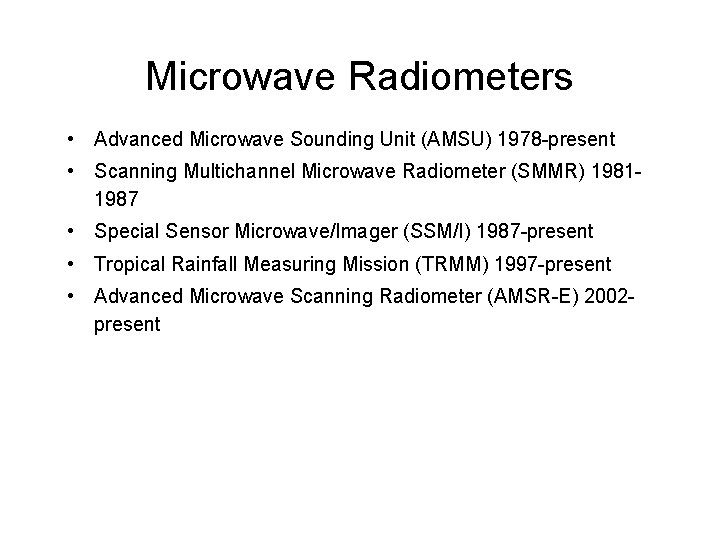
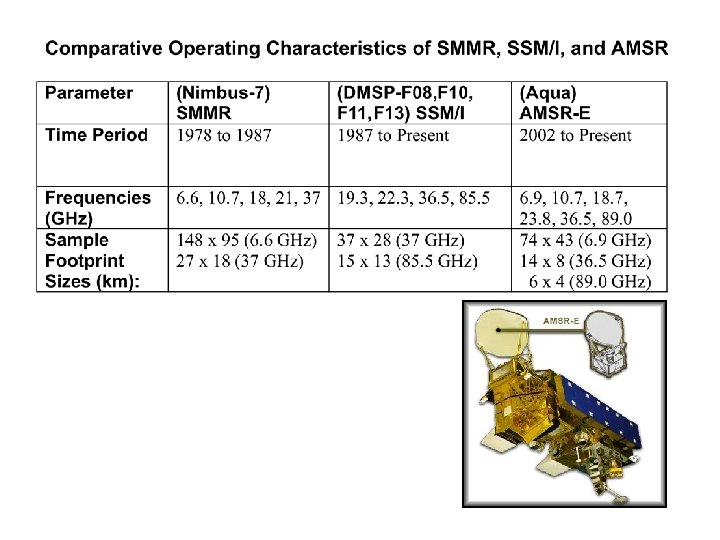
Microwave Radiometers • Advanced Microwave Sounding Unit (AMSU) 1978 -present • Scanning Multichannel Microwave Radiometer (SMMR) 19811987 • Special Sensor Microwave/Imager (SSM/I) 1987 -present • Tropical Rainfall Measuring Mission (TRMM) 1997 -present • Advanced Microwave Scanning Radiometer (AMSR-E) 2002 present
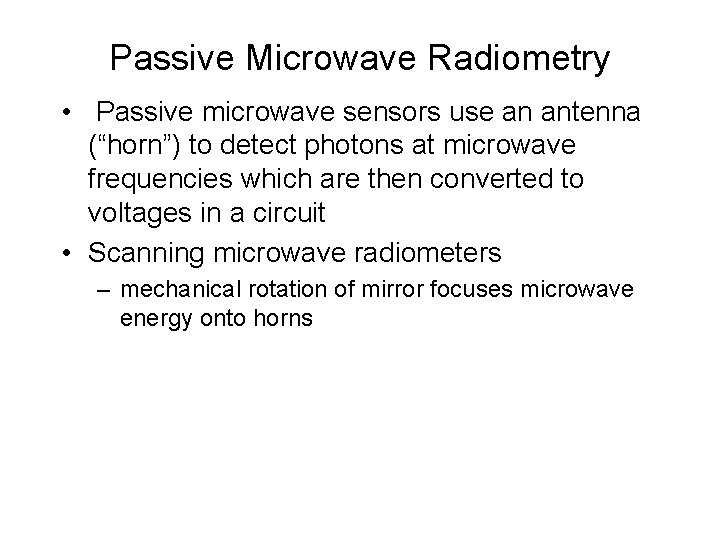
Passive Microwave Radiometry • Passive microwave sensors use an antenna (“horn”) to detect photons at microwave frequencies which are then converted to voltages in a circuit • Scanning microwave radiometers – mechanical rotation of mirror focuses microwave energy onto horns
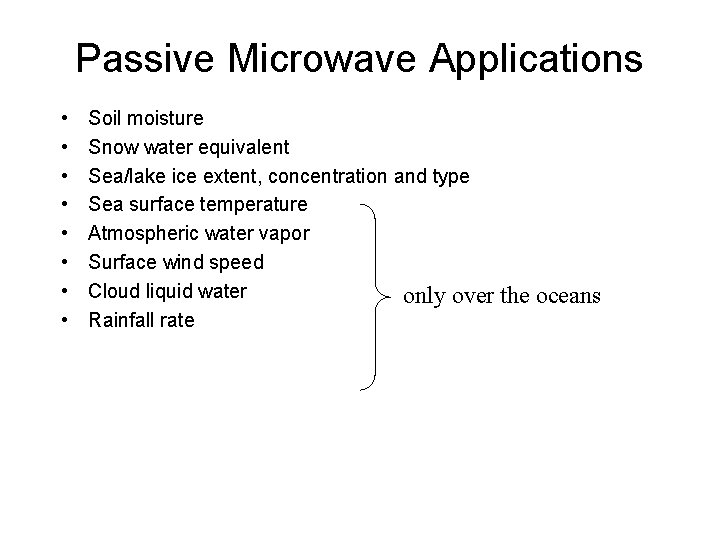
Passive Microwave Applications • • Soil moisture Snow water equivalent Sea/lake ice extent, concentration and type Sea surface temperature Atmospheric water vapor Surface wind speed Cloud liquid water only over Rainfall rate the oceans
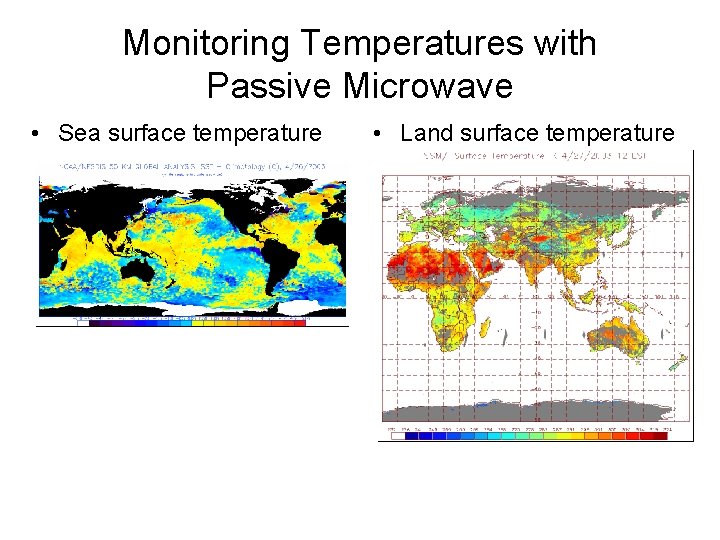
Monitoring Temperatures with Passive Microwave • Sea surface temperature • Land surface temperature
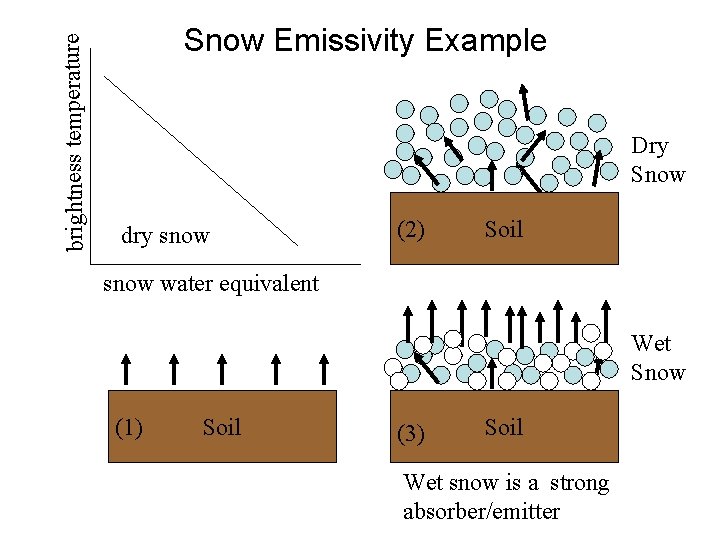
Passive Microwave Sensing of Land Surface Emissivity Differences • Microwave emissivity is a function of the “dielectric constant” • Most earth materials have a dielectric constant in the range of 1 to 4 (air=1, veg=3, ice=3. 2) • Dielectric constant of liquid water is 80 • Thus, moisture content affects brightness temperature • Surface roughness also influences emissivity
brightness temperature Snow Emissivity Example Dry Snow dry snow (2) Soil snow water equivalent Wet Snow (1) Soil (3) Soil Wet snow is a strong absorber/emitter
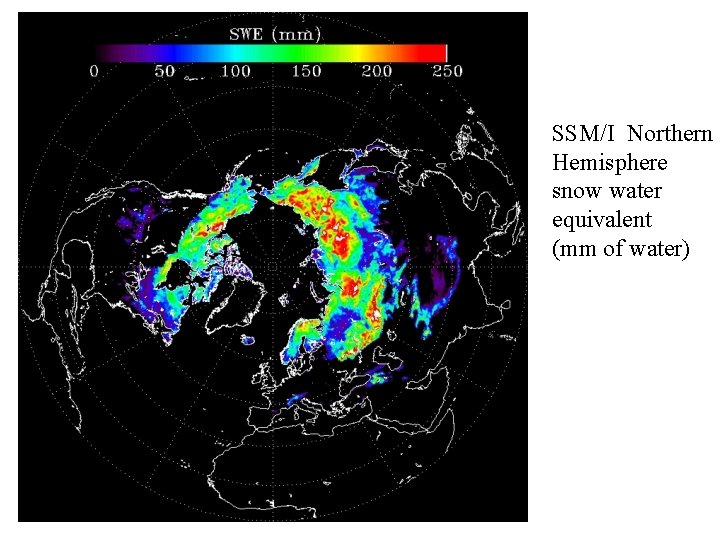
SSM/I Northern Hemisphere snow water equivalent (mm of water)
Atmospheric Effects • At frequencies less than 50 GHz, there’s little effect of clouds and fog on brightness temperature (it “sees through” clouds) • Thus, PM can be used to monitor the land surface under cloudy conditions • In atmospheric absorption bands, PM is used to map water vapor, rain rates, clouds
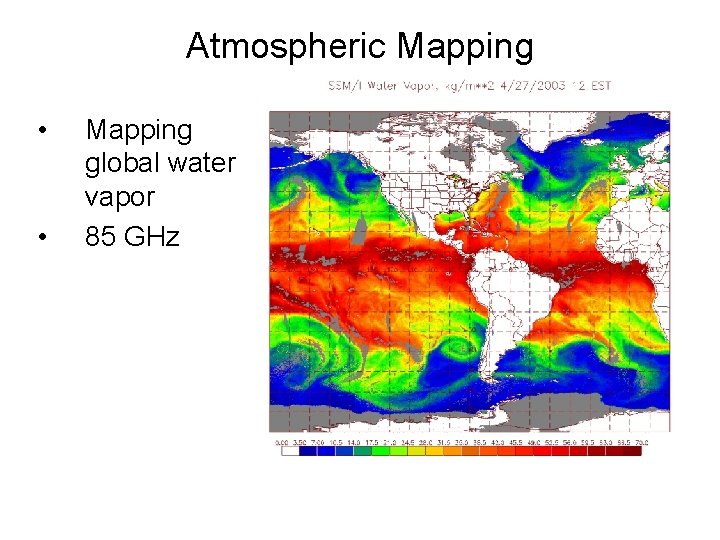
Atmospheric Mapping • • Mapping global water vapor 85 GHz
Passive Microwave Sensing of Rain • Over the ocean: – Microwave emissivity of rain (liquid water) is about 0. 9 – Emissivity of the ocean is much lower (0. 5) – Changes in emissivity (as seen by the measured brightness temperature) provide and estimate of surface rain rate • Over the land surface: – Microwave scattering by frozen hydrometeors is used as a measure of rain rate – Physical or empirical models relate the scattering signature to surface rain rates
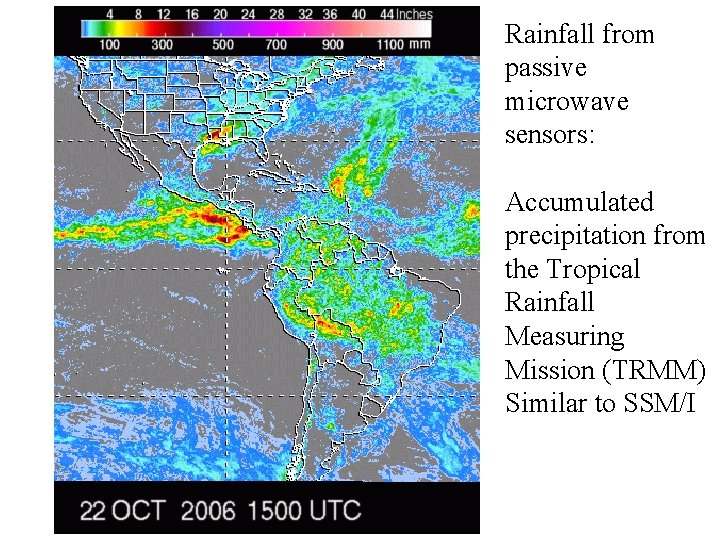
Rainfall from passive microwave sensors: Accumulated precipitation from the Tropical Rainfall Measuring Mission (TRMM) Similar to SSM/I
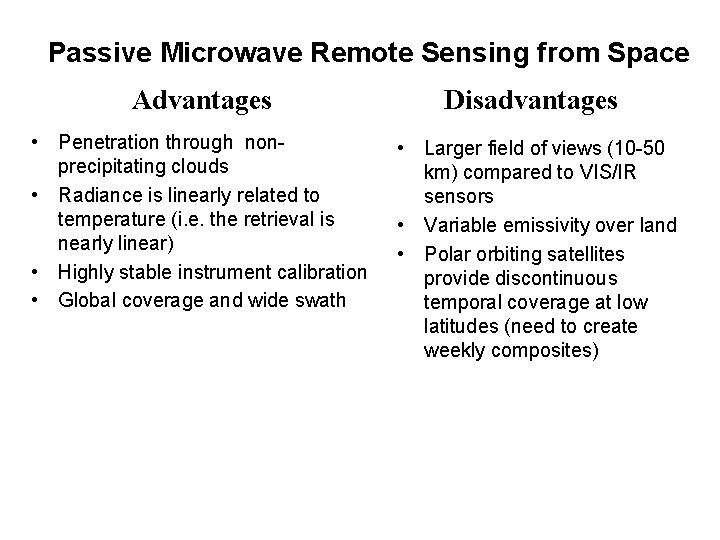
Passive Microwave Remote Sensing from Space Advantages Disadvantages • Penetration through nonprecipitating clouds • Radiance is linearly related to temperature (i. e. the retrieval is nearly linear) • Highly stable instrument calibration • Global coverage and wide swath • Larger field of views (10 -50 km) compared to VIS/IR sensors • Variable emissivity over land • Polar orbiting satellites provide discontinuous temporal coverage at low latitudes (need to create weekly composites)
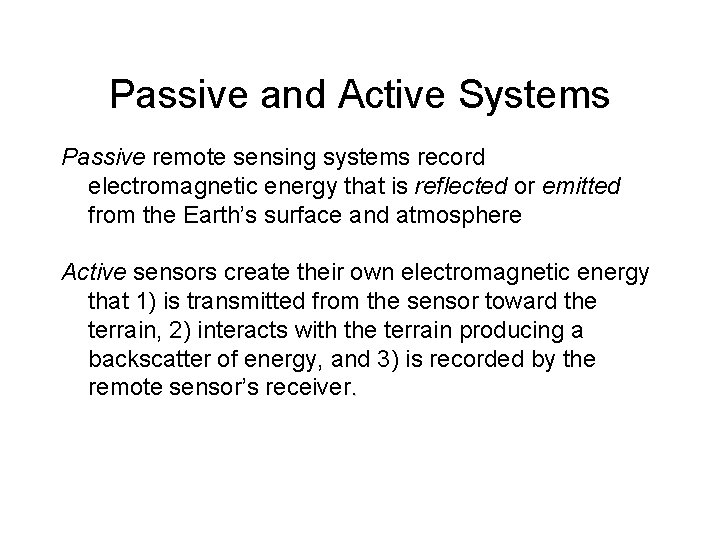
Passive and Active Systems Passive remote sensing systems record electromagnetic energy that is reflected or emitted from the Earth’s surface and atmosphere Active sensors create their own electromagnetic energy that 1) is transmitted from the sensor toward the terrain, 2) interacts with the terrain producing a backscatter of energy, and 3) is recorded by the remote sensor’s receiver.