
Passive Fire Protection Lec 7 PFP Systems 4

- Slides: 92
Passive Fire Protection Lec 7 -PFP Systems 4: Fire stopping & penetration seals Dr. Zayed Al-Hamamre Chemical Engineering Department | University of Jordan | Amman 11942, Jordan Tel. +962 6 535 5000 | 22888
Introduction Ø Effective fire-stopping in fire-resisting separating elements plays a critical role in containing a fire at its source, thereby reducing its effect on the primary building structure. Ø The degree of spread is controlled by creating fire-resisting compartments which subdivide the building. Ø Mechanical and electrical services, by necessity, breach compartment walls and floors allowing failure of integrity and insulation to occur where gaps around services have not been adequately firestopped. Ø Fire-stopping products must be able to provide sufficient insulation to the penetrating services, in order to reduce the temperature rise along conductive materials, in accordance with the required insulation criteria of the fire-separating element. Chemical Engineering Department | University of Jordan | Amman 11942, Jordan Tel. +962 6 535 5000 | 22888 1 -2
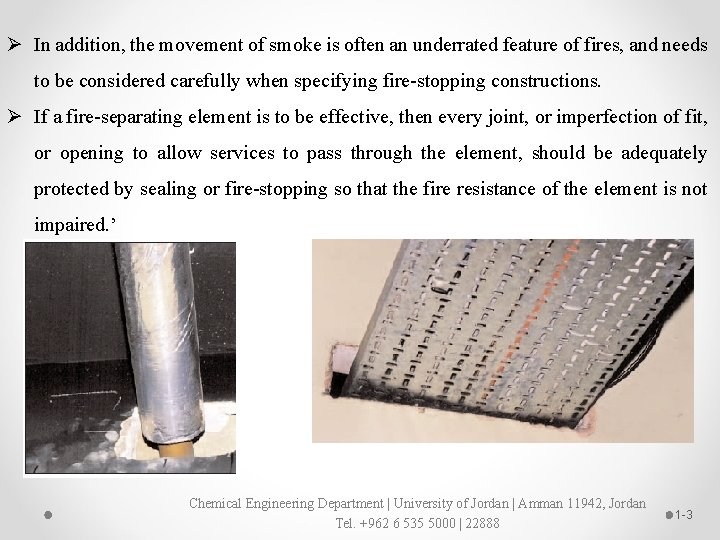
Ø In addition, the movement of smoke is often an underrated feature of fires, and needs to be considered carefully when specifying fire-stopping constructions. Ø If a fire-separating element is to be effective, then every joint, or imperfection of fit, or opening to allow services to pass through the element, should be adequately protected by sealing or fire-stopping so that the fire resistance of the element is not impaired. ’ Chemical Engineering Department | University of Jordan | Amman 11942, Jordan Tel. +962 6 535 5000 | 22888 1 -3
component we need to consider when looking at a total fire stopping system Ø The design of penetration sealing systems needs to take into consideration the differential deflection in fire conditions of o the fire resistant barrier (see firewalls) o Opening size o the service(s) o the fire stopping product(s), which if not correctly accounted for can lead to gaps forming, allowing the passage of flames and hot gases and resulting in premature failure during fire testing. Chemical Engineering Department | University of Jordan | Amman 11942, Jordan Tel. +962 6 535 5000 | 22888 1 -4
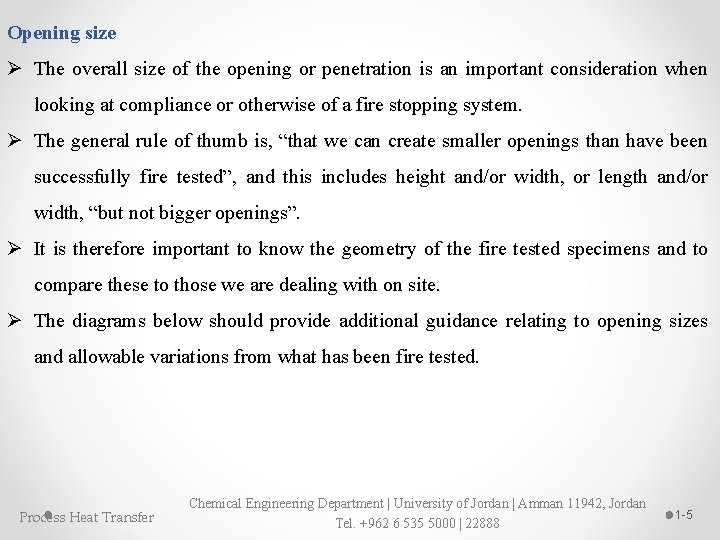
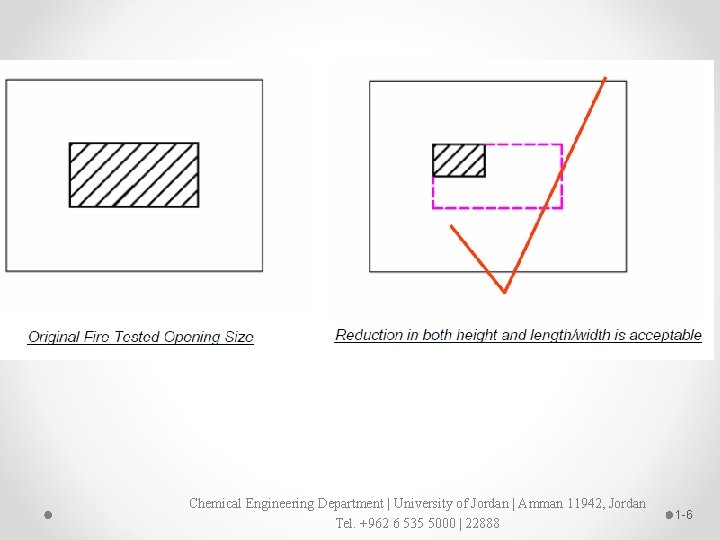
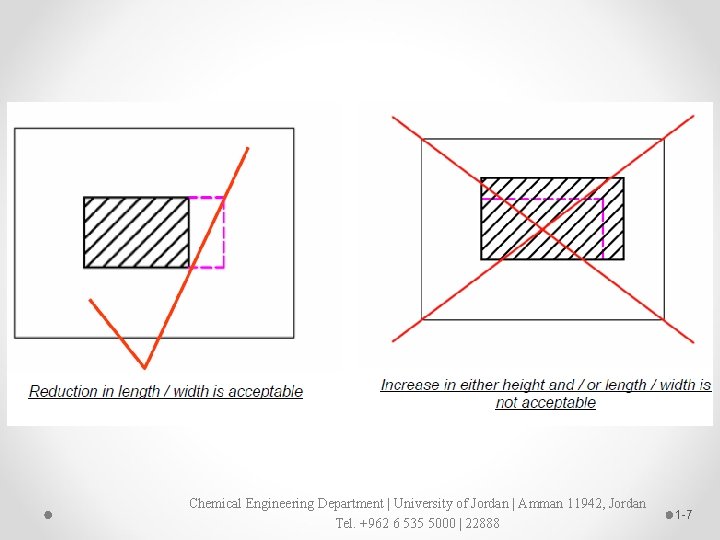
Opening size Ø The overall size of the opening or penetration is an important consideration when looking at compliance or otherwise of a fire stopping system. Ø The general rule of thumb is, “that we can create smaller openings than have been successfully fire tested”, and this includes height and/or width, or length and/or width, “but not bigger openings”. Ø It is therefore important to know the geometry of the fire tested specimens and to compare these to those we are dealing with on site. Ø The diagrams below should provide additional guidance relating to opening sizes and allowable variations from what has been fire tested. Process Heat Transfer Chemical Engineering Department | University of Jordan | Amman 11942, Jordan Tel. +962 6 535 5000 | 22888 1 -5
Chemical Engineering Department | University of Jordan | Amman 11942, Jordan Tel. +962 6 535 5000 | 22888 1 -6
Chemical Engineering Department | University of Jordan | Amman 11942, Jordan Tel. +962 6 535 5000 | 22888 1 -7
Service Penetration Types Ø The configuration of any support for the service(s) (or their absence) can also have an effect on the suitability or otherwise of the fire stopping system. Ø The different generic types of services are i. Blank penetration seals: o openings with no service penetrations. o These blank openings or blank penetrations typically result from services that are relocated or where provision is being made for future services for example. ii. Plumbing services o Plumbing services usually consist of plumbing related reticulation piping for items such as toilets (pans), sinks, vanities and the like. Chemical Engineering Department | University of Jordan | Amman 11942, Jordan Tel. +962 6 535 5000 | 22888 1 -8
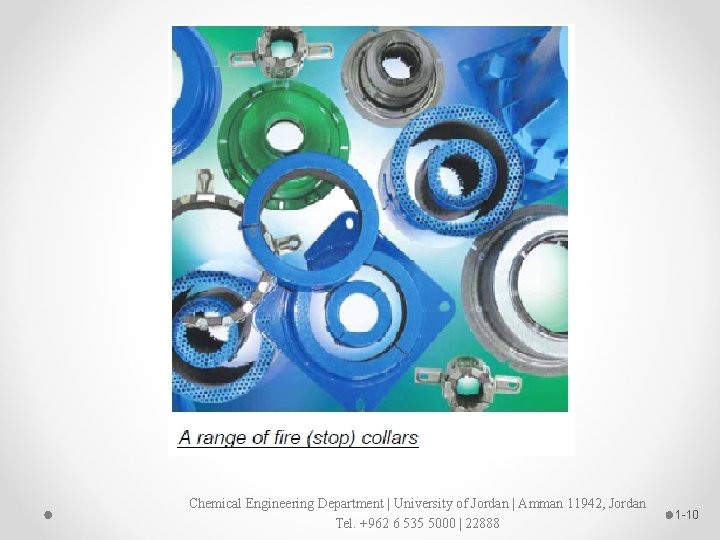
Plastic pipes Ø Include many different types of plastics, different internal or external diameters and different walls thicknesses, each attribute having a bearing on the effectiveness or otherwise of the fire stopping system. Ø The most common type of plastic pipe is unplasticised polyvinyl chloride (u. PVC), or just PVC for short, whilst others include HDPE, PP, PE, and ABS for example. Ø Plastic pipes, which melt in fires, create a special challenge for fire stopping, and typically, fire stopping systems incorporating intumescent (high expansion gap filling compounds) are required to effectively seal these penetrations during fire conditions. Ø The most common means of fire stopping plastic pipe penetrations is by using a device known as an intumescent fire stop collar (or fire collar for short). Chemical Engineering Department | University of Jordan | Amman 11942, Jordan Tel. +962 6 535 5000 | 22888 1 -9
Chemical Engineering Department | University of Jordan | Amman 11942, Jordan Tel. +962 6 535 5000 | 22888 1 -10
Metallic or ductile pipes, Ø Are less common in plumbing applications, but include steel, cast iron, copper and brass for example. Ø Insulated or lagged metallic pipes, where acoustic or noise considerations are being catered for around the pipe in question, need to be treated differently than noninsulated or un-lagged pipes. Ø For both plastic and metallic or ductile pipe types, the pipe end conditions, governed by the use of the pipe and the ability or otherwise for hot gases to flow through the pipe prior to any fire related reactions (such as intumescence) occurring are also a very important consideration. Ø For example the end conditions might be open or closed on one or both sides of the fire resistant barrier. Chemical Engineering Department | University of Jordan | Amman 11942, Jordan Tel. +962 6 535 5000 | 22888 1 -11
Ø Examples might include PVC pipes incorporating a waste trap, used for a stack at the top of a building, or used for a storm water pipe. Ø The waste trap, as it has water in it to stop odours in non-fire mode would be considered a closed end condition. Ø The stack and storm water pipes would be considered open end conditions. iii. Electrical services o Electrical services are those which transmit electrical power (current) and any associated reticulation supporting structures. o These translate in layman’s terms to cables, cable trays and cable trunking and Lighting. Chemical Engineering Department | University of Jordan | Amman 11942, Jordan Tel. +962 6 535 5000 | 22888 1 -12
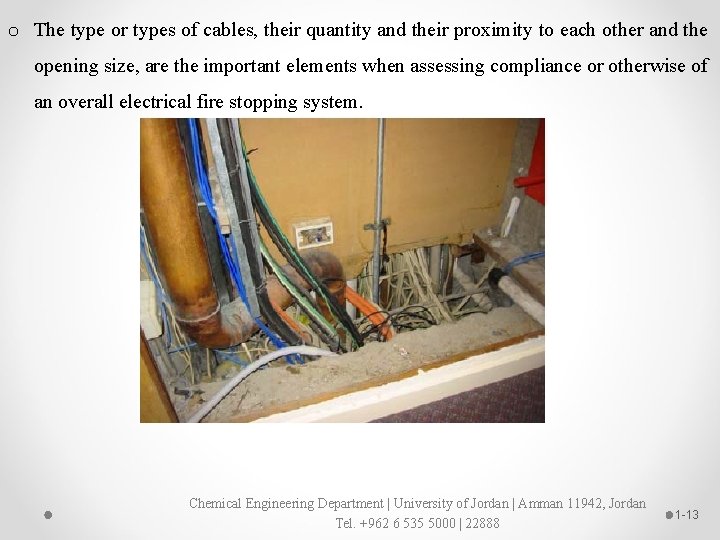
o The type or types of cables, their quantity and their proximity to each other and the opening size, are the important elements when assessing compliance or otherwise of an overall electrical fire stopping system. Chemical Engineering Department | University of Jordan | Amman 11942, Jordan Tel. +962 6 535 5000 | 22888 1 -13
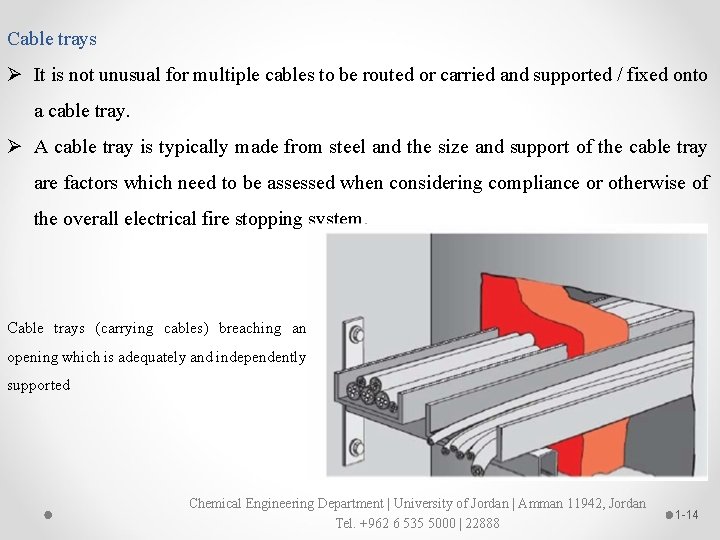
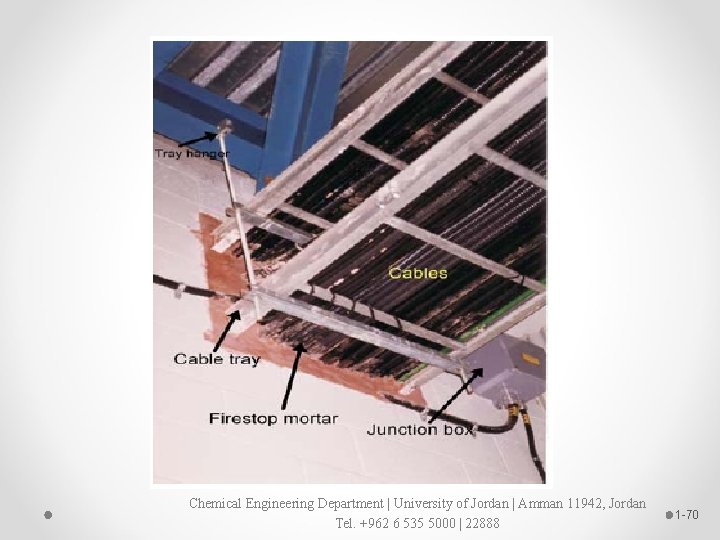
Cable trays Ø It is not unusual for multiple cables to be routed or carried and supported / fixed onto a cable tray. Ø A cable tray is typically made from steel and the size and support of the cable tray are factors which need to be assessed when considering compliance or otherwise of the overall electrical fire stopping system. Cable trays (carrying cables) breaching an opening which is adequately and independently supported Chemical Engineering Department | University of Jordan | Amman 11942, Jordan Tel. +962 6 535 5000 | 22888 1 -14
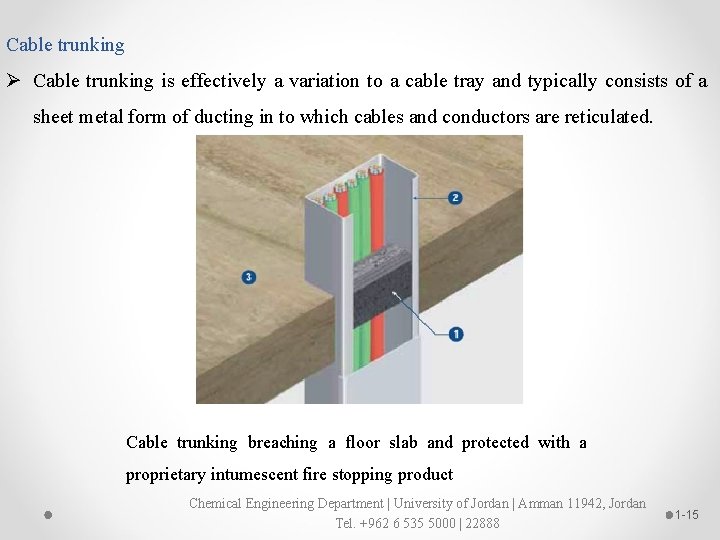
Cable trunking Ø Cable trunking is effectively a variation to a cable tray and typically consists of a sheet metal form of ducting in to which cables and conductors are reticulated. Cable trunking breaching a floor slab and protected with a proprietary intumescent fire stopping product Chemical Engineering Department | University of Jordan | Amman 11942, Jordan Tel. +962 6 535 5000 | 22888 1 -15
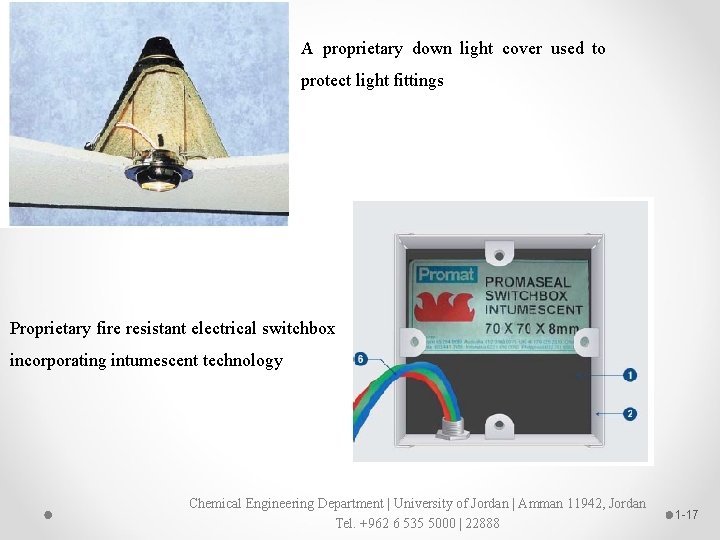
Lighting in fire resistant ceilings Ø When fire resistant (incipient fire) ceiling incorporate light fittings, these need to be Ø effectively fire stopped. Ø There a number of methods of doing this including building fire resistant boxes over fluorescent tube type lighting or using proprietary intumescent down light covers. Ø Switch boxes position back-to-back in fire resistant and lightweight (plasterboard walls) are required to be proprietary systems, which essentially consist of a conventional electrical switch box incorporating intumescent materials inside the box. Chemical Engineering Department | University of Jordan | Amman 11942, Jordan Tel. +962 6 535 5000 | 22888 1 -16
A proprietary down light cover used to protect light fittings Proprietary fire resistant electrical switchbox incorporating intumescent technology Chemical Engineering Department | University of Jordan | Amman 11942, Jordan Tel. +962 6 535 5000 | 22888 1 -17
iv. Mechanical services o Mechanical services for the purposes of this Guide will include services for either fire services or for Heating, Ventilation and/or Air Conditioning services; the latter which is commonly abbreviated as HVAC. o HVAC services typically form openings or breaches in fire resistant barriers by way of ducting or other openings for the transfer of natural, heated or chilled air. o They may also include piping for refrigerants. o Ducting is typically made from sheet metal but in recent times, there has been an increased use of proprietary and fire retardant plastic ducting. o Fire dampers are typically used to effectively seal against the passage of fire through ducted openings. Chemical Engineering Department | University of Jordan | Amman 11942, Jordan Tel. +962 6 535 5000 | 22888 1 -18
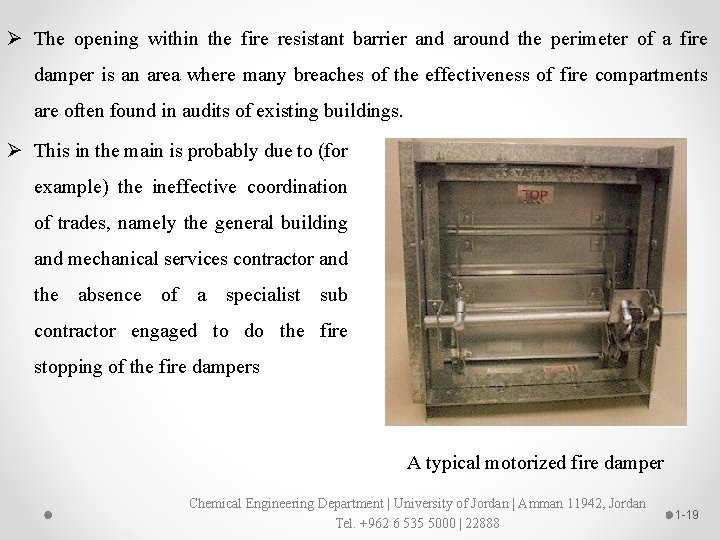
Ø The opening within the fire resistant barrier and around the perimeter of a fire damper is an area where many breaches of the effectiveness of fire compartments are often found in audits of existing buildings. Ø This in the main is probably due to (for example) the ineffective coordination of trades, namely the general building and mechanical services contractor and the absence of a specialist sub contractor engaged to do the fire stopping of the fire dampers A typical motorized fire damper Chemical Engineering Department | University of Jordan | Amman 11942, Jordan Tel. +962 6 535 5000 | 22888 1 -19
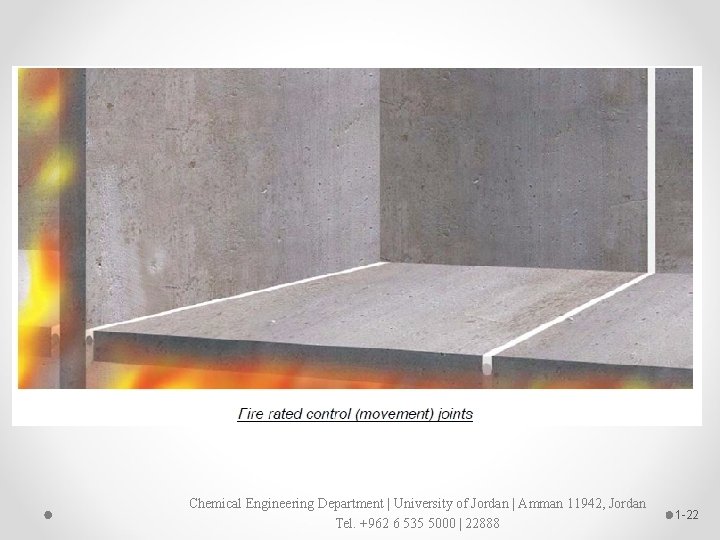
v. Control joints o Fire resistant compartments or buildings will typically incorporate transitions between floors and walls, adjacent walls and other fire resistant barrier intersections. o There also times where joints are designed and incorporated into discrete and usually longer or wider fire resistant barriers. o These transitions and joints are designed to cater for building movement, and to avoid the transfer of loads during heating and cooling of the building, into the elements themselves. o The absence of, or poorly designed joints, will typically manifest themselves as unsightly and unwanted structural cracking. Chemical Engineering Department | University of Jordan | Amman 11942, Jordan Tel. +962 6 535 5000 | 22888 1 -20
o The common term for these transitions and joints are movement joints or control joints. o They may also be referred to as linear gap seals as their length is many orders of magnitude bigger than their width or depth. o Fire sealing systems for control joints must of course be able to cater for movement throughout their design life and also provide effective fire stopping qualities if and when required. o The fire resistant barrier type(s), the orientation of the control joint, (vertical or horizontal), the joint width and length and of course the movement requirements are important design attributes when assessing compliance or otherwise of the overall control joint system. Chemical Engineering Department | University of Jordan | Amman 11942, Jordan Tel. +962 6 535 5000 | 22888 1 -21
Chemical Engineering Department | University of Jordan | Amman 11942, Jordan Tel. +962 6 535 5000 | 22888 1 -22
Fire Stopping Products Ø There are many different fire stopping product types available to cater for the many different penetration sealing configurations that we encounter in buildings. Ø The type of product(s) used is obviously an important element of a total fire safety system. Ø The generic types of fire stopping products are: 1. Fire dampers 5. Fire collars 2. Sealants 6. Larger opening barriers 3. Mortars 7. Control joint materials 4. Pillows Chemical Engineering Department | University of Jordan | Amman 11942, Jordan Tel. +962 6 535 5000 | 22888 1 -23
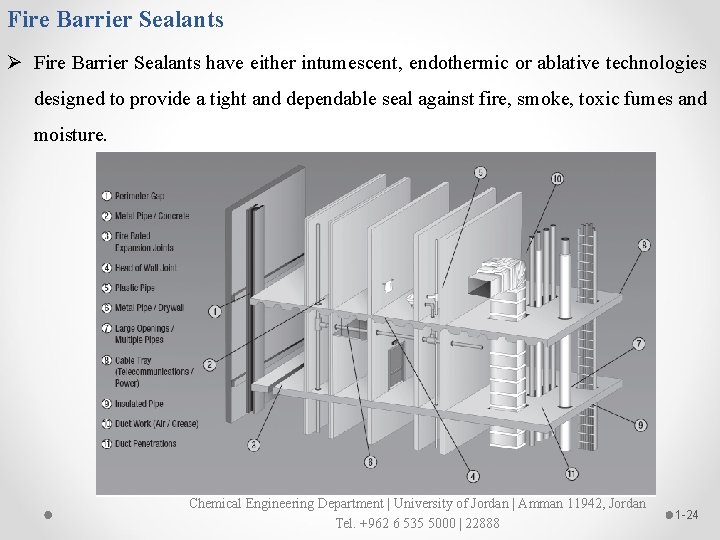
Fire Barrier Sealants Ø Fire Barrier Sealants have either intumescent, endothermic or ablative technologies designed to provide a tight and dependable seal against fire, smoke, toxic fumes and moisture. Chemical Engineering Department | University of Jordan | Amman 11942, Jordan Tel. +962 6 535 5000 | 22888 1 -24
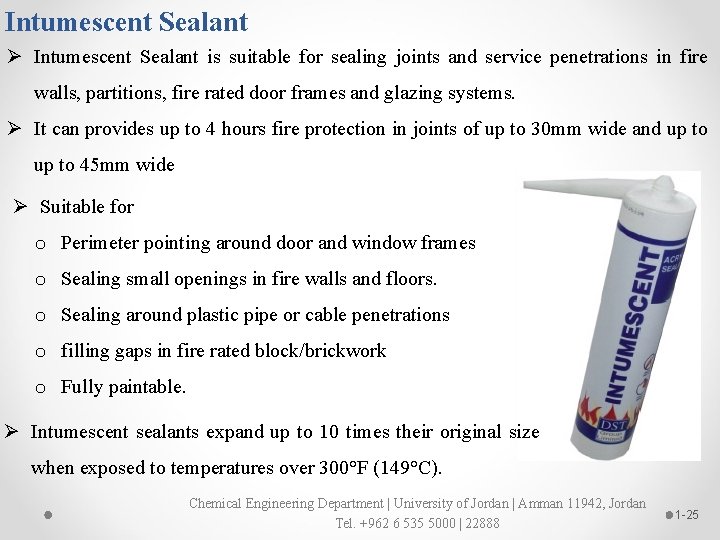
Intumescent Sealant Ø Intumescent Sealant is suitable for sealing joints and service penetrations in fire walls, partitions, fire rated door frames and glazing systems. Ø It can provides up to 4 hours fire protection in joints of up to 30 mm wide and up to 45 mm wide Ø Suitable for o Perimeter pointing around door and window frames o Sealing small openings in fire walls and floors. o Sealing around plastic pipe or cable penetrations o filling gaps in fire rated block/brickwork o Fully paintable. Ø Intumescent sealants expand up to 10 times their original size when exposed to temperatures over 300°F (149°C). Chemical Engineering Department | University of Jordan | Amman 11942, Jordan Tel. +962 6 535 5000 | 22888 1 -25
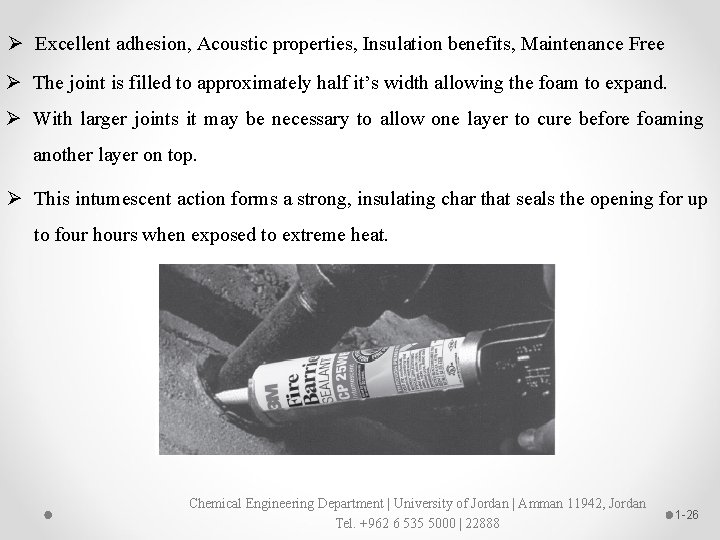
Ø Excellent adhesion, Acoustic properties, Insulation benefits, Maintenance Free Ø The joint is filled to approximately half it’s width allowing the foam to expand. Ø With larger joints it may be necessary to allow one layer to cure before foaming another layer on top. Ø This intumescent action forms a strong, insulating char that seals the opening for up to four hours when exposed to extreme heat. Chemical Engineering Department | University of Jordan | Amman 11942, Jordan Tel. +962 6 535 5000 | 22888 1 -26
Ø Fire sealants are ideal for new construction or retrofit in a wide variety of applications such as metal, plastic, insulated and glass pipe, construction gaps, dynamic joints, HVAC ductwork and insulated cable applications. Ø All come in convenient job-size packages and install easily with a standard caulking gun, pneumatic pumping equipment or putty knife. Types of Intumescent sealant 1. Intumescent latex-based sealant o Offers outstanding fire performance plus a non-halogen formula. o Provides up to 4 hour rating of UL systems tested o Water base—easy cleanup, no special handling, routine disposal o Intumescent—expands when heated to choke and seal around items consumed by fire Chemical Engineering Department | University of Jordan | Amman 11942, Jordan Tel. +962 6 535 5000 | 22888 1 -27
o Endothermic—releases chemically bound water to cool exposed surfaces o Fast-dry—tack-free in approximately 10 -15 minutes o Red color for easy inspection 2. Acrylic Latex Sealant o Acrylic Latex Sealant is an acrylic latex sealant used to fire-stop metal pipes and cables through concrete or gypsum, and for use in dynamic head-of-wall systems. o Approved for many metal pipe through penetration applications o Easily spread to a smooth finished surface o Low shrinkage o Available in blue and limestone colors Chemical Engineering Department | University of Jordan | Amman 11942, Jordan Tel. +962 6 535 5000 | 22888 1 -28
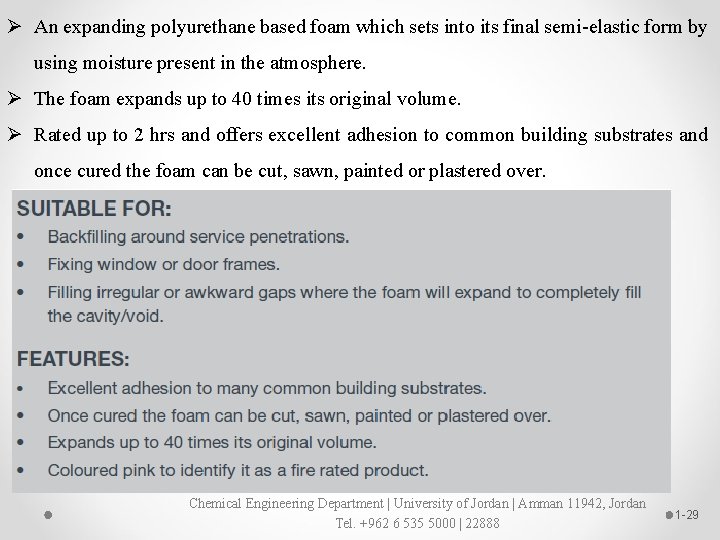
Ø An expanding polyurethane based foam which sets into its final semi-elastic form by using moisture present in the atmosphere. Ø The foam expands up to 40 times its original volume. Ø Rated up to 2 hrs and offers excellent adhesion to common building substrates and once cured the foam can be cut, sawn, painted or plastered over. Chemical Engineering Department | University of Jordan | Amman 11942, Jordan Tel. +962 6 535 5000 | 22888 1 -29
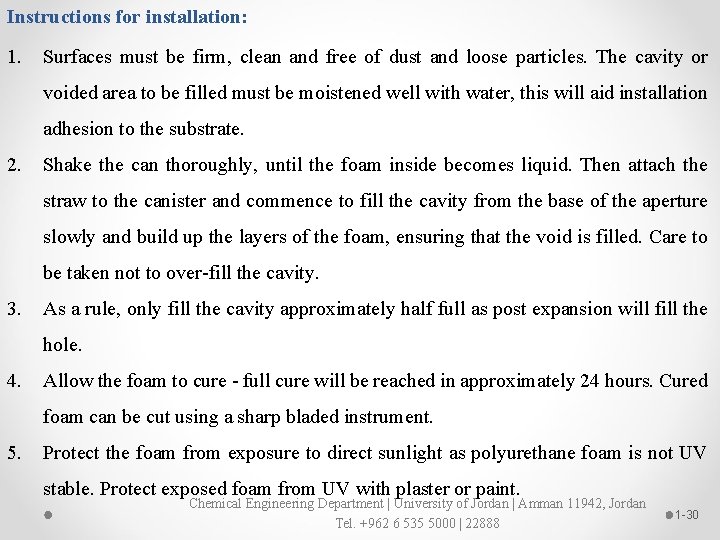
Instructions for installation: 1. Surfaces must be firm, clean and free of dust and loose particles. The cavity or voided area to be filled must be moistened well with water, this will aid installation adhesion to the substrate. 2. Shake the can thoroughly, until the foam inside becomes liquid. Then attach the straw to the canister and commence to fill the cavity from the base of the aperture slowly and build up the layers of the foam, ensuring that the void is filled. Care to be taken not to over-fill the cavity. 3. As a rule, only fill the cavity approximately half full as post expansion will fill the hole. 4. Allow the foam to cure - full cure will be reached in approximately 24 hours. Cured foam can be cut using a sharp bladed instrument. 5. Protect the foam from exposure to direct sunlight as polyurethane foam is not UV stable. Protect exposed foam from UV with plaster or paint. Chemical Engineering Department | University of Jordan | Amman 11942, Jordan Tel. +962 6 535 5000 | 22888 1 -30
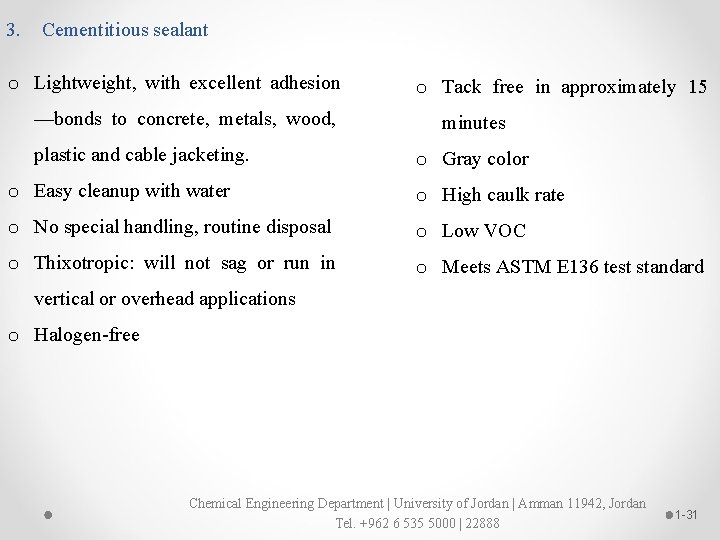
3. Cementitious sealant o Lightweight, with excellent adhesion —bonds to concrete, metals, wood, plastic and cable jacketing. o Tack free in approximately 15 minutes o Gray color o Easy cleanup with water o High caulk rate o No special handling, routine disposal o Low VOC o Thixotropic: will not sag or run in o Meets ASTM E 136 test standard vertical or overhead applications o Halogen-free Chemical Engineering Department | University of Jordan | Amman 11942, Jordan Tel. +962 6 535 5000 | 22888 1 -31
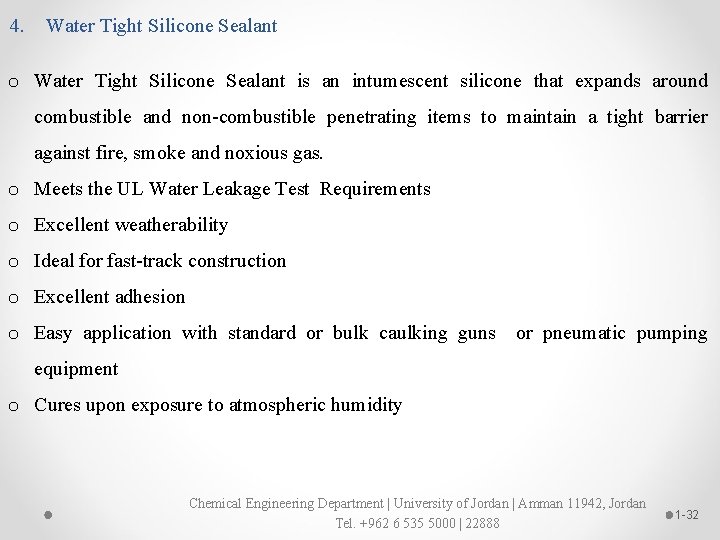
4. Water Tight Silicone Sealant o Water Tight Silicone Sealant is an intumescent silicone that expands around combustible and non-combustible penetrating items to maintain a tight barrier against fire, smoke and noxious gas. o Meets the UL Water Leakage Test Requirements o Excellent weatherability o Ideal for fast-track construction o Excellent adhesion o Easy application with standard or bulk caulking guns or pneumatic pumping equipment o Cures upon exposure to atmospheric humidity Chemical Engineering Department | University of Jordan | Amman 11942, Jordan Tel. +962 6 535 5000 | 22888 1 -32
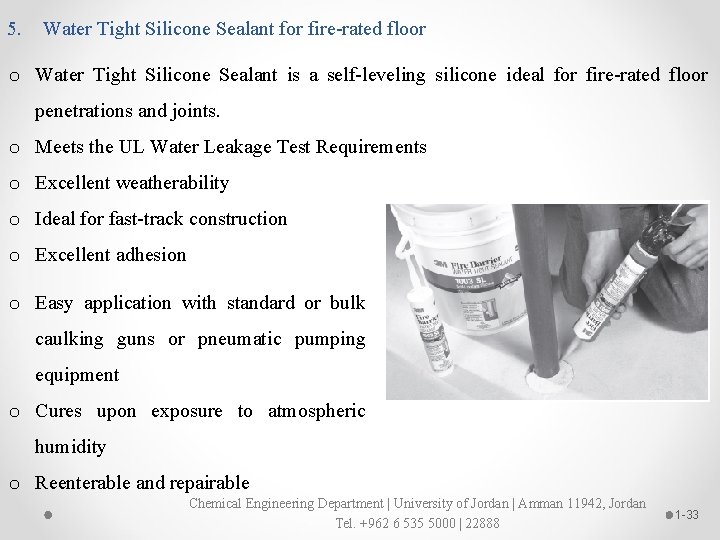
5. Water Tight Silicone Sealant for fire-rated floor o Water Tight Silicone Sealant is a self-leveling silicone ideal for fire-rated floor penetrations and joints. o Meets the UL Water Leakage Test Requirements o Excellent weatherability o Ideal for fast-track construction o Excellent adhesion o Easy application with standard or bulk caulking guns or pneumatic pumping equipment o Cures upon exposure to atmospheric humidity o Reenterable and repairable Chemical Engineering Department | University of Jordan | Amman 11942, Jordan Tel. +962 6 535 5000 | 22888 1 -33
6. Intumescent smoke and firestopping sealant Ø A low-cost, latex based, intumescent smoke and firestopping sealant for wall and floor penetrations. Ø Easy-to-handle formulation that bonds to concrete, metal, wood and cable jacketing. Ø Dries to a firm, rubber-like solid. Provides up to three hours of rating of UL systems tested. Ø Water base—easy cleanup, no special handling, routine disposal Ø Intumescent—expands when heated to choke and seal around items consumed by fire Ø Endothermic—releases chemically bound water to cool exposed surfaces Ø Fast-dry—tack-free in approximately 10 -15 minutes Chemical Engineering Department | University of Jordan | Amman 11942, Jordan Tel. +962 6 535 5000 | 22888 1 -34
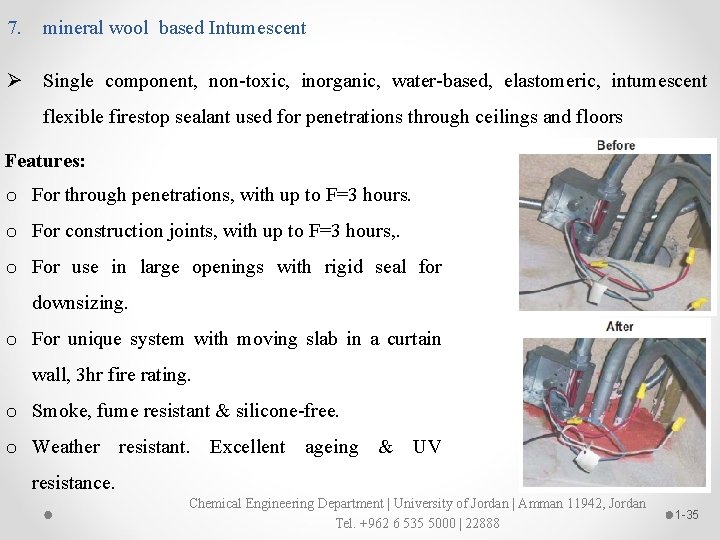
7. mineral wool based Intumescent Ø Single component, non-toxic, inorganic, water-based, elastomeric, intumescent flexible firestop sealant used for penetrations through ceilings and floors Features: o For through penetrations, with up to F=3 hours. o For construction joints, with up to F=3 hours, . o For use in large openings with rigid seal for downsizing. o For unique system with moving slab in a curtain wall, 3 hr fire rating. o Smoke, fume resistant & silicone-free. o Weather resistant. Excellent ageing & UV resistance. Chemical Engineering Department | University of Jordan | Amman 11942, Jordan Tel. +962 6 535 5000 | 22888 1 -35
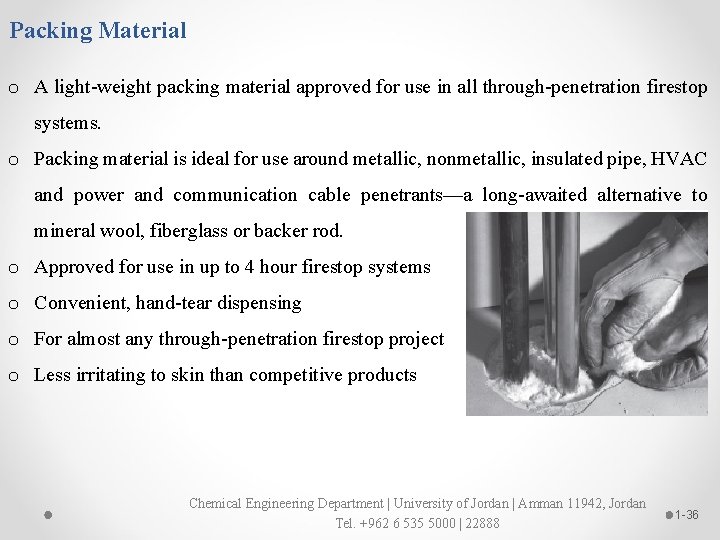
Packing Material o A light-weight packing material approved for use in all through-penetration firestop systems. o Packing material is ideal for use around metallic, nonmetallic, insulated pipe, HVAC and power and communication cable penetrants—a long-awaited alternative to mineral wool, fiberglass or backer rod. o Approved for use in up to 4 hour firestop systems o Convenient, hand-tear dispensing o For almost any through-penetration firestop project o Less irritating to skin than competitive products Chemical Engineering Department | University of Jordan | Amman 11942, Jordan Tel. +962 6 535 5000 | 22888 1 -36
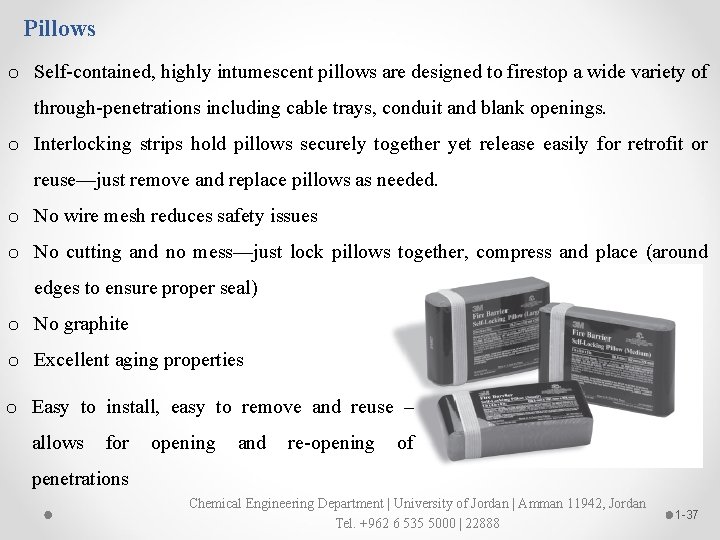
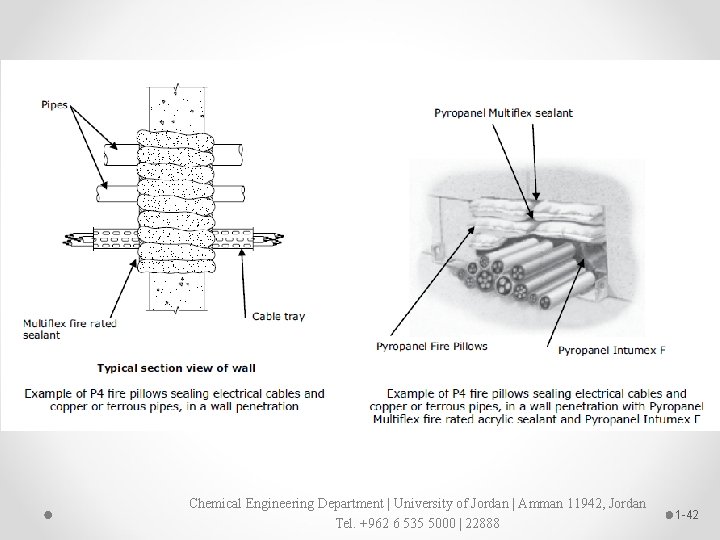
Pillows o Self-contained, highly intumescent pillows are designed to firestop a wide variety of through-penetrations including cable trays, conduit and blank openings. o Interlocking strips hold pillows securely together yet release easily for retrofit or reuse—just remove and replace pillows as needed. o No wire mesh reduces safety issues o No cutting and no mess—just lock pillows together, compress and place (around edges to ensure proper seal) o No graphite o Excellent aging properties o Easy to install, easy to remove and reuse – allows for opening and re-opening of penetrations Chemical Engineering Department | University of Jordan | Amman 11942, Jordan Tel. +962 6 535 5000 | 22888 1 -37
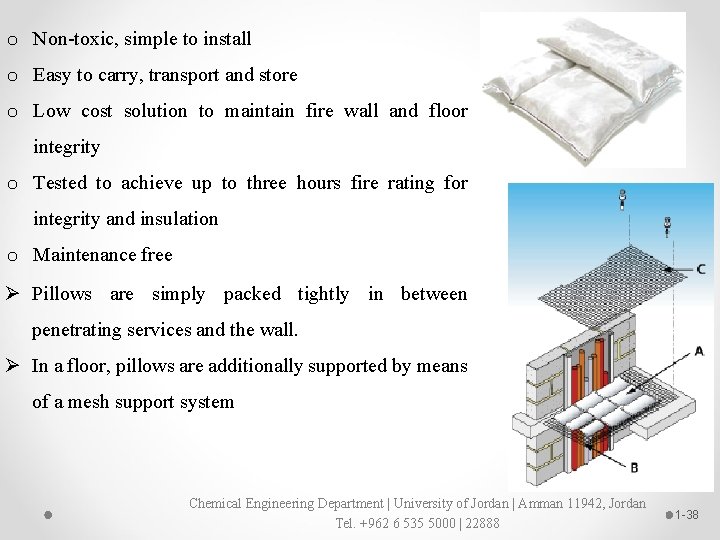
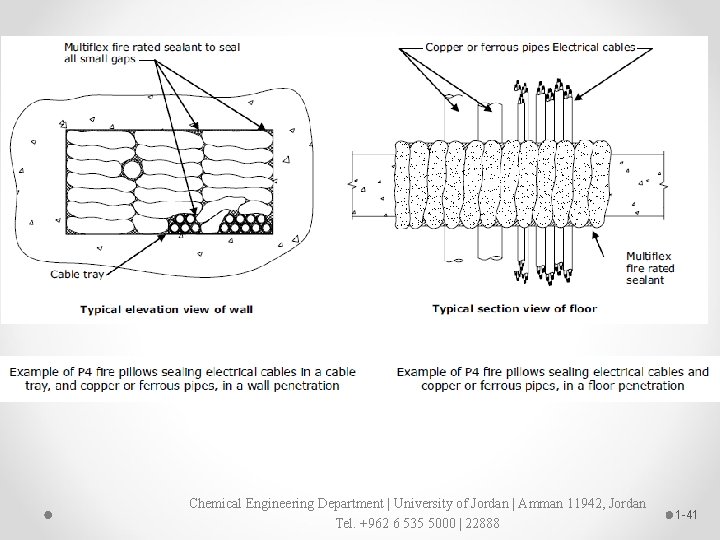
o Non-toxic, simple to install o Easy to carry, transport and store o Low cost solution to maintain fire wall and floor integrity o Tested to achieve up to three hours fire rating for integrity and insulation o Maintenance free Ø Pillows are simply packed tightly in between penetrating services and the wall. Ø In a floor, pillows are additionally supported by means of a mesh support system Chemical Engineering Department | University of Jordan | Amman 11942, Jordan Tel. +962 6 535 5000 | 22888 1 -38
Chemical Engineering Department | University of Jordan | Amman 11942, Jordan Tel. +962 6 535 5000 | 22888 1 -39
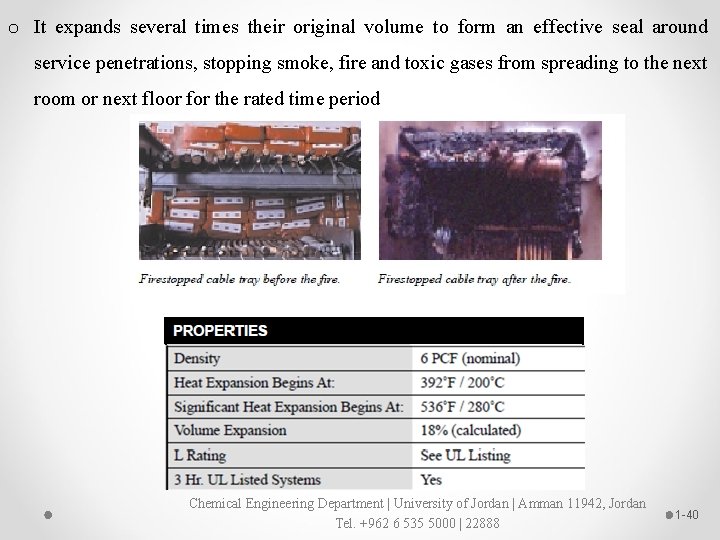
o It expands several times their original volume to form an effective seal around service penetrations, stopping smoke, fire and toxic gases from spreading to the next room or next floor for the rated time period Chemical Engineering Department | University of Jordan | Amman 11942, Jordan Tel. +962 6 535 5000 | 22888 1 -40
Chemical Engineering Department | University of Jordan | Amman 11942, Jordan Tel. +962 6 535 5000 | 22888 1 -41
Chemical Engineering Department | University of Jordan | Amman 11942, Jordan Tel. +962 6 535 5000 | 22888 1 -42
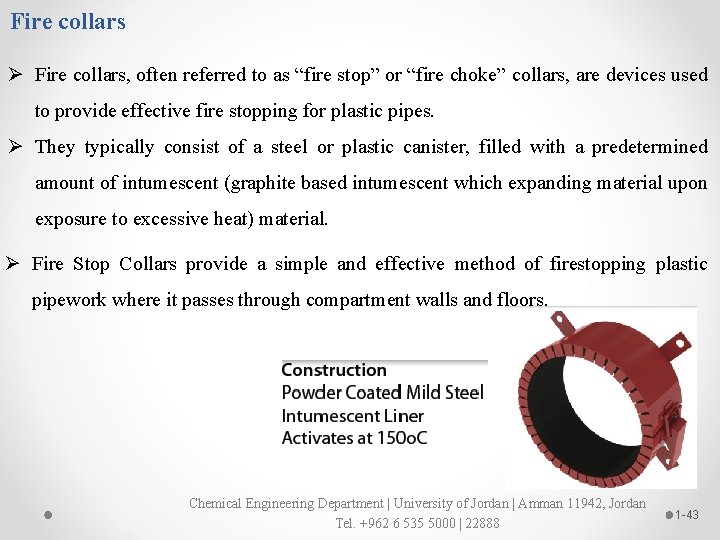
Fire collars Ø Fire collars, often referred to as “fire stop” or “fire choke” collars, are devices used to provide effective fire stopping for plastic pipes. Ø They typically consist of a steel or plastic canister, filled with a predetermined amount of intumescent (graphite based intumescent which expanding material upon exposure to excessive heat) material. Ø Fire Stop Collars provide a simple and effective method of firestopping plastic pipework where it passes through compartment walls and floors. Chemical Engineering Department | University of Jordan | Amman 11942, Jordan Tel. +962 6 535 5000 | 22888 1 -43
Fire collars Ø During a fire scenario, as the plastic pipe begins to soften, the intumescent material expands to many times its original volume, helping crush the plastic pipe and fill the void, providing an effective seal against the passage of flames and hot gases. Ø Traditionally fire collars for use on PVC pipes were supplied in size increments to match the common pipe sizes. Ø Many proprietary fire collars can be used on more than one size and type of plastic pipe Ø Provide up to 4 hours’ fire protection, Simple to install, Water resistant, Maintenance Free Ø Conventional fire collars are not typically suitable for protection of ducting or for toilet ventilation systems, rather fire damper should be used. Chemical Engineering Department | University of Jordan | Amman 11942, Jordan Tel. +962 6 535 5000 | 22888 1 -44
Ø Fire collars designs consist of the following generic types: 1. Cast in situ floor slab collars 2. Retrofit or surface mounted collars 3. Wall collars 4. Ceiling collars 5. Wraps Cast in situ floor slab collars Ø These are nailed or fixed to the formwork and integrated within the steel reinforcing, prior to pouring of a concrete floor slab in a multi-storey building. Ø They consisted of a robust, spun metal canister, casing, or plastic canisters. Ø The cast-in situ fire collar reduces the need for time consuming and expensive concrete core hole drilling by helping form an opening in the floor slab for the plastic pipe to be quickly and easily reticulated. Chemical Engineering Department | University of Jordan | Amman 11942, Jordan Tel. +962 6 535 5000 | 22888 1 -45
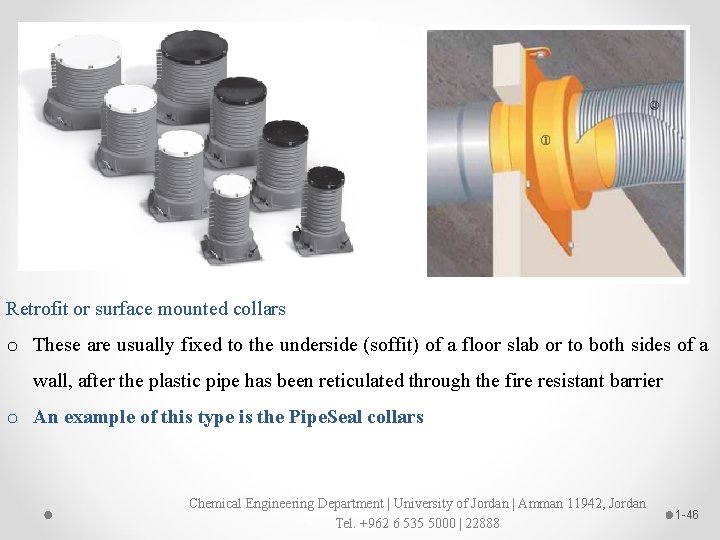
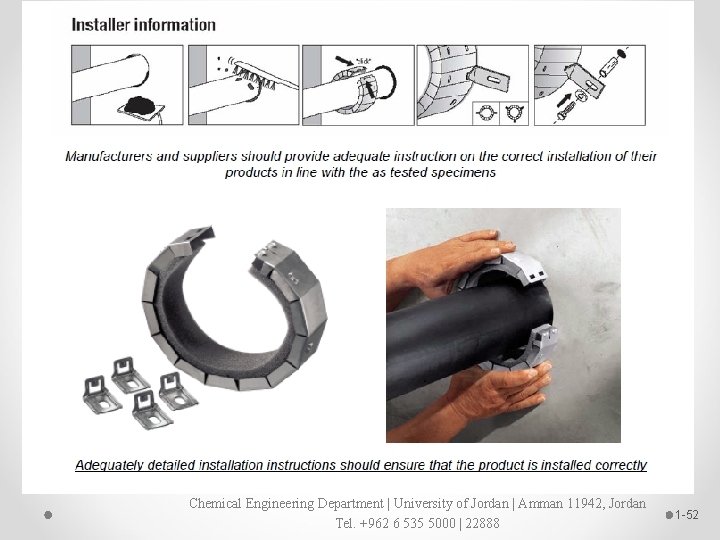
Retrofit or surface mounted collars o These are usually fixed to the underside (soffit) of a floor slab or to both sides of a wall, after the plastic pipe has been reticulated through the fire resistant barrier o An example of this type is the Pipe. Seal collars Chemical Engineering Department | University of Jordan | Amman 11942, Jordan Tel. +962 6 535 5000 | 22888 1 -46
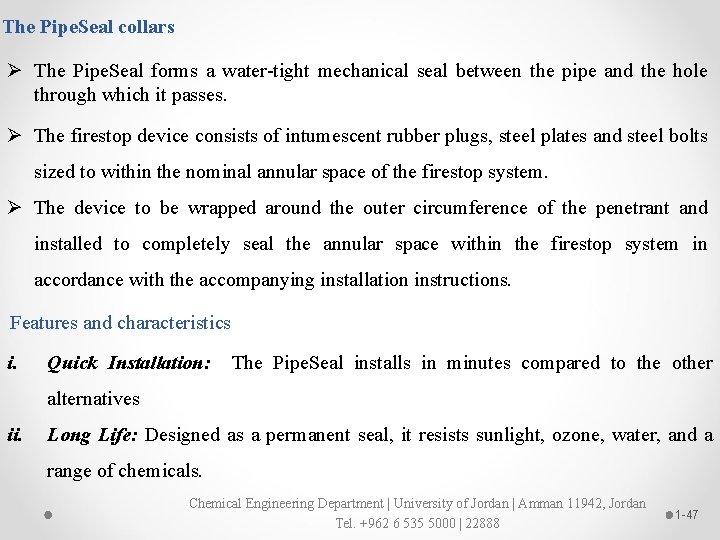
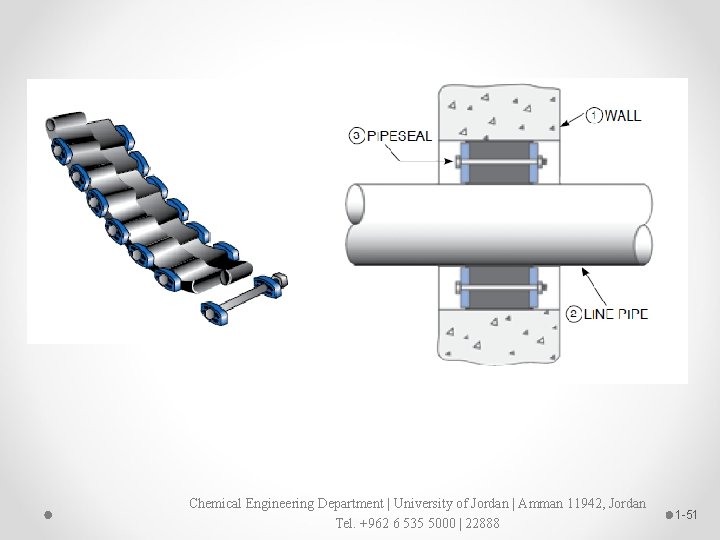
The Pipe. Seal collars Ø The Pipe. Seal forms a water-tight mechanical seal between the pipe and the hole through which it passes. Ø The firestop device consists of intumescent rubber plugs, steel plates and steel bolts sized to within the nominal annular space of the firestop system. Ø The device to be wrapped around the outer circumference of the penetrant and installed to completely seal the annular space within the firestop system in accordance with the accompanying installation instructions. Features and characteristics i. Quick Installation: The Pipe. Seal installs in minutes compared to the other alternatives ii. Long Life: Designed as a permanent seal, it resists sunlight, ozone, water, and a range of chemicals. Chemical Engineering Department | University of Jordan | Amman 11942, Jordan Tel. +962 6 535 5000 | 22888 1 -47
iii. Pressure Rated: The Pipe. Seal can withstand 20 psi of pressure. iv. Vibration and Shock Protection: Transfer of vibration and shock in a pipeline is greatly reduced by the rubber seal. 1. 2 Hour Fire Rating: Matched with the type of installation and provides up to 2 hours of protection with an intumescent seal. 2. Verifiable Seal: The seal is easy to identify for inspectors, who can verify that the stop is in place at a glance. 3. No Curing Time or Waste: There is no 10 -14 days of curing time required, as with caulks. Chemical Engineering Department | University of Jordan | Amman 11942, Jordan Tel. +962 6 535 5000 | 22888 1 -48
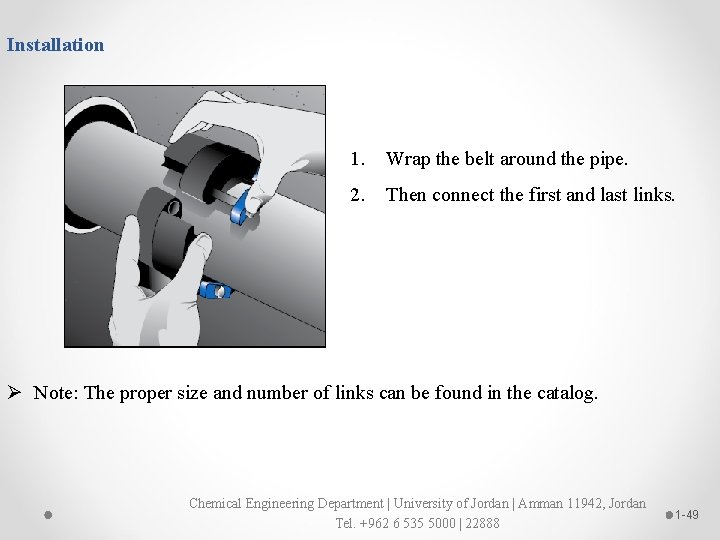
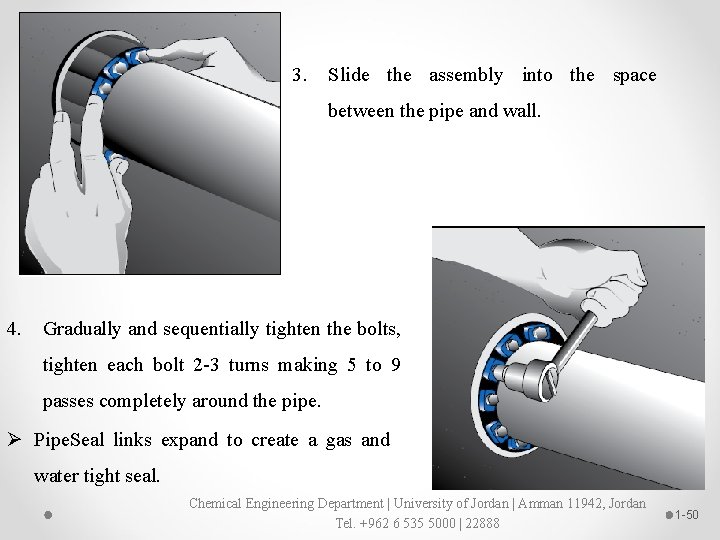
Installation 1. Wrap the belt around the pipe. 2. Then connect the first and last links. Ø Note: The proper size and number of links can be found in the catalog. Chemical Engineering Department | University of Jordan | Amman 11942, Jordan Tel. +962 6 535 5000 | 22888 1 -49
3. Slide the assembly into the space between the pipe and wall. 4. Gradually and sequentially tighten the bolts, tighten each bolt 2 -3 turns making 5 to 9 passes completely around the pipe. Ø Pipe. Seal links expand to create a gas and water tight seal. Chemical Engineering Department | University of Jordan | Amman 11942, Jordan Tel. +962 6 535 5000 | 22888 1 -50
Chemical Engineering Department | University of Jordan | Amman 11942, Jordan Tel. +962 6 535 5000 | 22888 1 -51
Chemical Engineering Department | University of Jordan | Amman 11942, Jordan Tel. +962 6 535 5000 | 22888 1 -52
Ø Pipe. Seal forms a mechanical rubber seal between pipes going through walls, floors, vaults, tanks, and pipeline casings. Ø Pipe. Seal makes a watertight seal between a pipe and a wall hole. Ø It can also seal the gap between an inner pipe and an outer pipe sleeve or pipeline casing. Ø It seals the gap between electrical conduit and the outer conduit, or between electrical conduit and the wall hole it passes through. Ø Pipe. Seal is designed to make a hydrostatic seal of up to 20 psig and up to 40 feet of head. Ø The Pipe. Seal, in addition to it’s sealing properties, helps absorb vibrations, shocks, and sound waves. Ø It also insulates the inner pipe from all other outer structures, including outer pipe sleeves, pipeline casings, walls and tanks. Chemical Engineering Department | University of Jordan | Amman 11942, Jordan Tel. +962 6 535 5000 | 22888 1 -53
Ø Pipe. Seals are made from synthetic rubber with heavy-duty plastic or steel pressure plates, which are resistant to sunlight and ozone. Ø All bolts and nuts are plated with an anti-corrosive coating or made from 316 Stainless steel. Chemical Engineering Department | University of Jordan | Amman 11942, Jordan Tel. +962 6 535 5000 | 22888 1 -54
Wraps Ø Wraps are effectively fire collars without the outer casings / canisters, typically consisting of a pre-manufactured quantity of intumescent material (graphite based intumescent sheet encapsulated in a polythene sheathing). Ø As there is no canister, they are typically limited to concrete or masonry openings, where the fire resistant barrier provides the necessary constraints to limit the intumescent expanding anywhere except into the opening as the pipe softens. Ø The wraps are manufactured as a sealed unit to the correct length and width to suit the pipe diameter and fire rating. Ø Tested in accordance with BS 476: Part 20 and BS EN: 1366 -3, PFC Corofil Intumescent Pipe Wraps provide up to 4 hours fire protection. Chemical Engineering Department | University of Jordan | Amman 11942, Jordan Tel. +962 6 535 5000 | 22888 1 -55
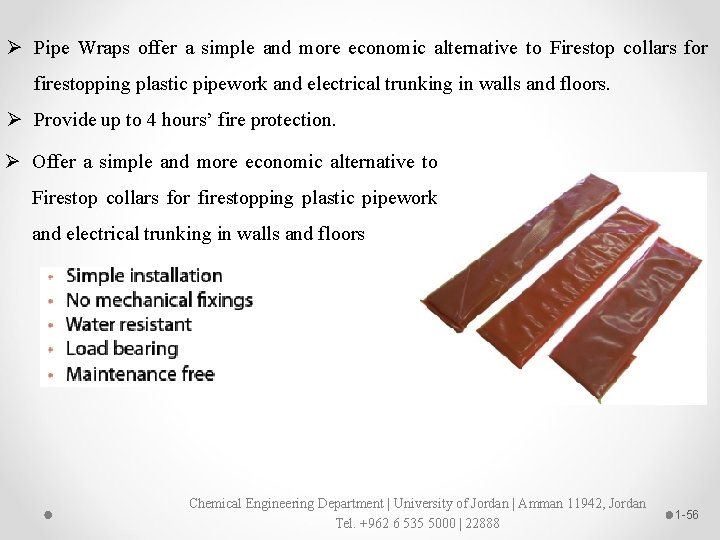
Ø Pipe Wraps offer a simple and more economic alternative to Firestop collars for firestopping plastic pipework and electrical trunking in walls and floors. Ø Provide up to 4 hours’ fire protection. Ø Offer a simple and more economic alternative to Firestop collars for firestopping plastic pipework and electrical trunking in walls and floors Chemical Engineering Department | University of Jordan | Amman 11942, Jordan Tel. +962 6 535 5000 | 22888 1 -56
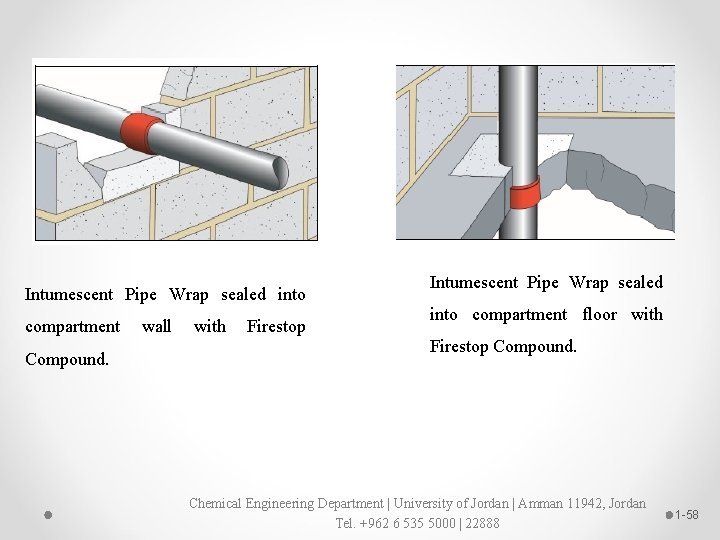
Ø Pipe Wraps comprise layers of a graphite based intumescent sheet encapsulated in a polythene sheath. Ø The product is manufactured to be wrapped around the outside diameter of the pipework or trunking and is secured by means of a self-adhesive strip. Ø It is then positioned within the compartment wall or floor so that the edge of the product is left exposed at the face of the wall or soffit. Ø Under fire conditions, the intumescent material expands against the structure and fills the void left by the burnt out plastic. Ø For walls it may be necessary to fit two wraps depending on the fire risk areas concerned Ø provide up to 4 hours’ fire protection to all plastic pipework and electrical trunking where they pass through fire rated walls and floors Chemical Engineering Department | University of Jordan | Amman 11942, Jordan Tel. +962 6 535 5000 | 22888 1 -57
Intumescent Pipe Wrap sealed into compartment Compound. wall with Firestop Intumescent Pipe Wrap sealed into compartment floor with Firestop Compound. Chemical Engineering Department | University of Jordan | Amman 11942, Jordan Tel. +962 6 535 5000 | 22888 1 -58
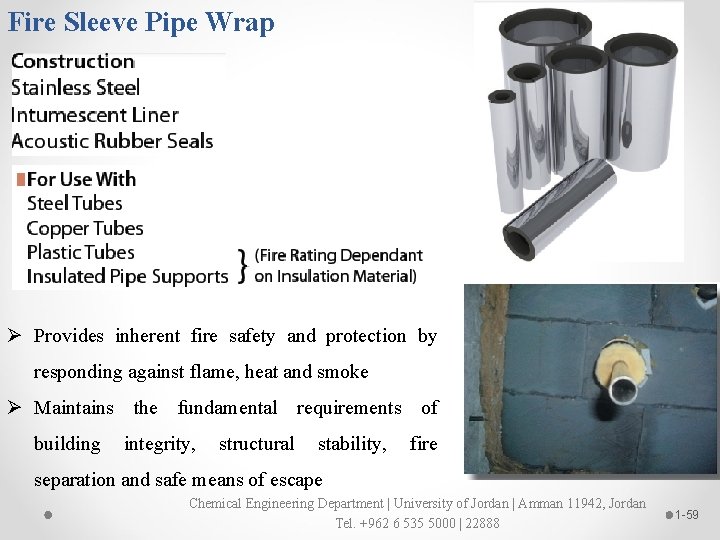
Fire Sleeve Pipe Wrap Ø Provides inherent fire safety and protection by responding against flame, heat and smoke Ø Maintains the fundamental requirements of building integrity, structural stability, fire separation and safe means of escape Chemical Engineering Department | University of Jordan | Amman 11942, Jordan Tel. +962 6 535 5000 | 22888 1 -59
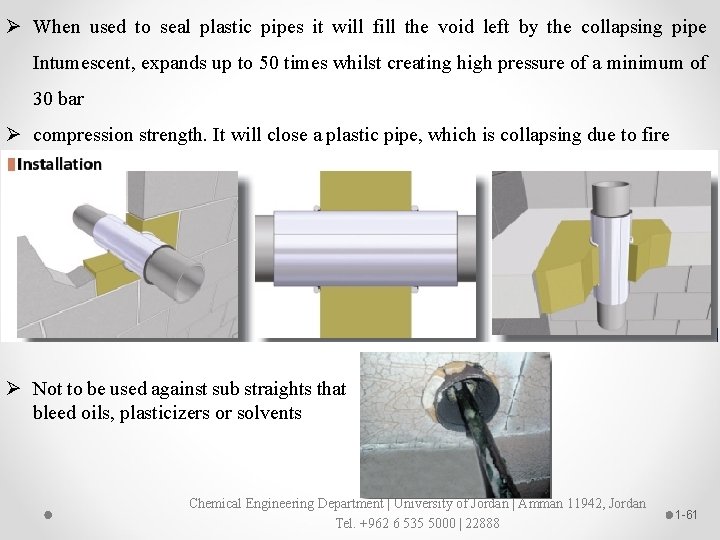
Ø Achieve their intended purpose by raising the fire resistance of the structure, protecting against the effects of fire, and limiting the movement of flame and smoke Ø Products serve, by fire containment, to protect life, safeguard building structure and protect assets Ø Suitable for fire containment in both plasterboard and block work walls for up to two hour fire rated seal Ø The Fire Sleeve Pipe Wrap is a stainless steel sleeve lined with a high expansion intumescent compound overlaid with a fire resistant acoustic foam compression seal Ø The intumescent liner and foam are water, moisture and lubricant resistant Ø The intumescent liner expands when exposed to heat and so provides a fire barrier Chemical Engineering Department | University of Jordan | Amman 11942, Jordan Tel. +962 6 535 5000 | 22888 1 -60
Ø When used to seal plastic pipes it will fill the void left by the collapsing pipe Intumescent, expands up to 50 times whilst creating high pressure of a minimum of 30 bar Ø compression strength. It will close a plastic pipe, which is collapsing due to fire Ø Not to be used against sub straights that bleed oils, plasticizers or solvents Chemical Engineering Department | University of Jordan | Amman 11942, Jordan Tel. +962 6 535 5000 | 22888 1 -61
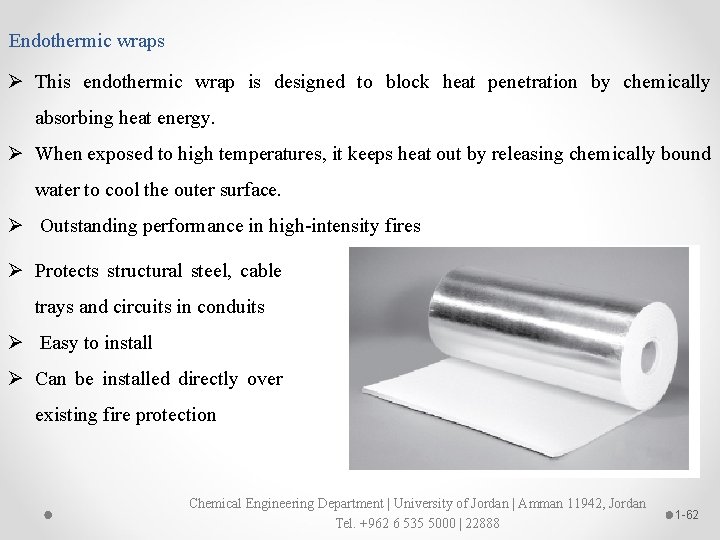
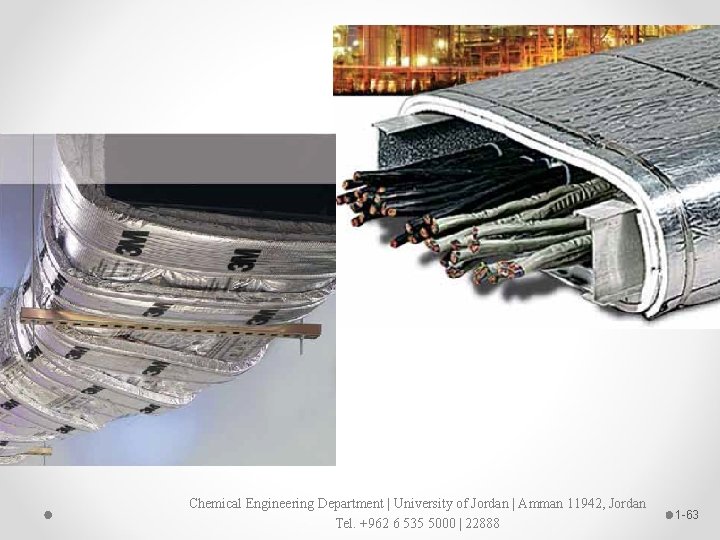
Endothermic wraps Ø This endothermic wrap is designed to block heat penetration by chemically absorbing heat energy. Ø When exposed to high temperatures, it keeps heat out by releasing chemically bound water to cool the outer surface. Ø Outstanding performance in high-intensity fires Ø Protects structural steel, cable trays and circuits in conduits Ø Easy to install Ø Can be installed directly over existing fire protection Chemical Engineering Department | University of Jordan | Amman 11942, Jordan Tel. +962 6 535 5000 | 22888 1 -62
Chemical Engineering Department | University of Jordan | Amman 11942, Jordan Tel. +962 6 535 5000 | 22888 1 -63
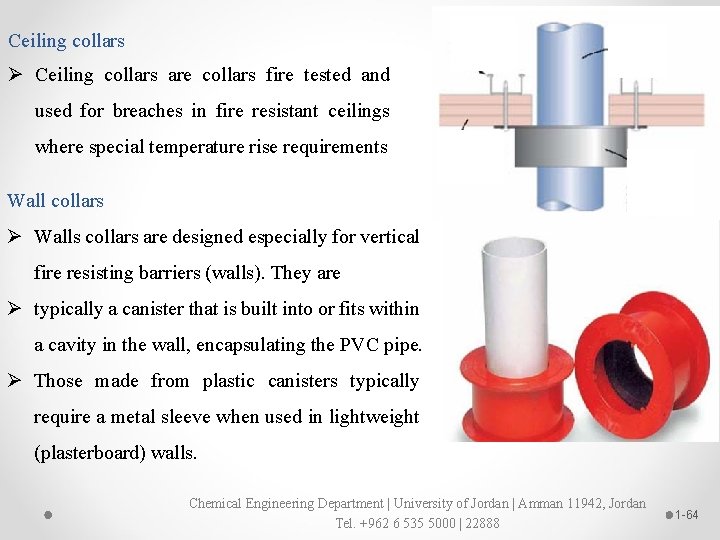
Ceiling collars Ø Ceiling collars are collars fire tested and used for breaches in fire resistant ceilings where special temperature rise requirements Wall collars Ø Walls collars are designed especially for vertical fire resisting barriers (walls). They are Ø typically a canister that is built into or fits within a cavity in the wall, encapsulating the PVC pipe. Ø Those made from plastic canisters typically require a metal sleeve when used in lightweight (plasterboard) walls. Chemical Engineering Department | University of Jordan | Amman 11942, Jordan Tel. +962 6 535 5000 | 22888 1 -64
Mortar Ø Mortar is a workable paste used to bind building blocks such as stones, bricks, and concrete masonry units together, fill and seal the irregular gaps between them, and sometimes add decorative colors or patterns in masonry walls. Ø Fire-stop mortars are mortars most typically used to fires-top large openings in walls and floors required to have a fire-resistance rating Ø Water Based Inorganic, Expanding type, Heat Absorbing Fire Stop Mortar designed to seal cable & pipe penetrations through walls & ceilings. Chemical Engineering Department | University of Jordan | Amman 11942, Jordan Tel. +962 6 535 5000 | 22888 1 -65
Features: Ø Expands in curing, making tight fit. Most other mortar firestop do not expand some shrink in curing. Ø Ensuring the fire protection for special conditions like: o Humid environment. o Resistance to gamma radiation in nuclear power plants. o Flood, without losing penetration seal, up to 3 atm = 44 psi. o Very hot environment, up to 250ºC (482ºF) on a continuous basis. o Corrosive conditions. Ø Non-toxic (No asbestos, no halogens, no noxious vapors, no lead). Ø Maximum fire safety (high F (fire) and T (temperature) ratings up to 4 hours). Chemical Engineering Department | University of Jordan | Amman 11942, Jordan Tel. +962 6 535 5000 | 22888 1 -66
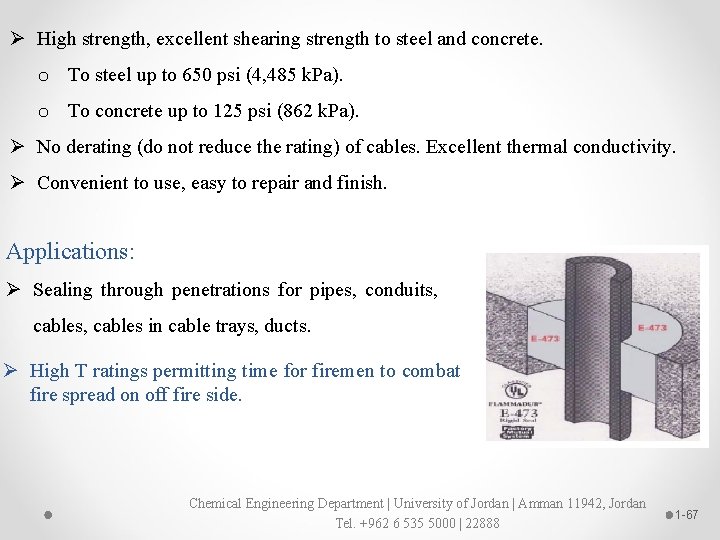
Ø High strength, excellent shearing strength to steel and concrete. o To steel up to 650 psi (4, 485 k. Pa). o To concrete up to 125 psi (862 k. Pa). Ø No derating (do not reduce the rating) of cables. Excellent thermal conductivity. Ø Convenient to use, easy to repair and finish. Applications: Ø Sealing through penetrations for pipes, conduits, cables in cable trays, ducts. Ø High T ratings permitting time for firemen to combat fire spread on off fire side. Chemical Engineering Department | University of Jordan | Amman 11942, Jordan Tel. +962 6 535 5000 | 22888 1 -67
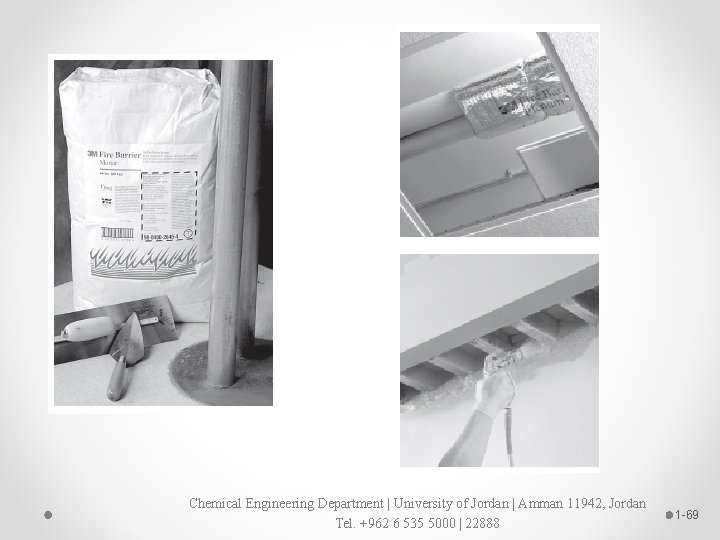
Cementitious firestop Mortar Ø Is a lightweight cementitious firestop product. Ø Variable mix ratio—permits self-leveling as well as no-sag (no forming) application consistencies, resulting in labor savings Ø Excellent adhesion—will bond to concrete, metals, wood, plastic and cable jacketing Ø Reenterable without use of power tools—results in lower maintenance costs due to ease of making cable changes Ø Bonds to itself—proven prior and during fire testing, resulting in proven and tested repair procedures Ø Pumpability Ø Mortar is available in 44 lb. bags Chemical Engineering Department | University of Jordan | Amman 11942, Jordan Tel. +962 6 535 5000 | 22888 1 -68
Chemical Engineering Department | University of Jordan | Amman 11942, Jordan Tel. +962 6 535 5000 | 22888 1 -69
Chemical Engineering Department | University of Jordan | Amman 11942, Jordan Tel. +962 6 535 5000 | 22888 1 -70
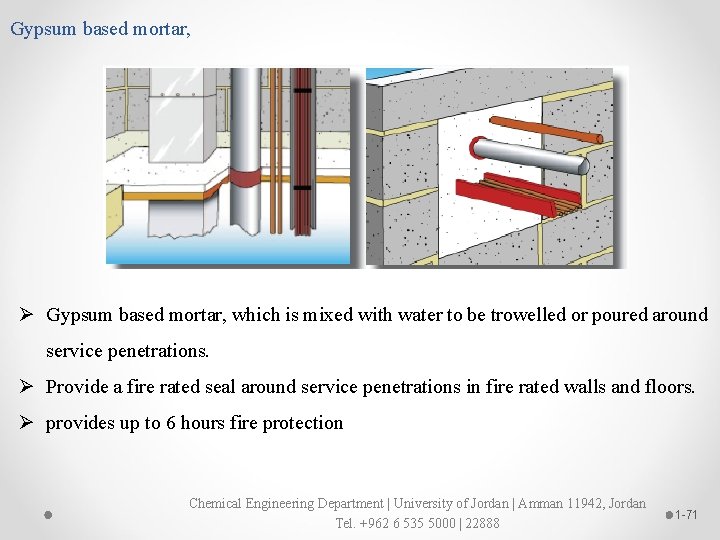
Gypsum based mortar, Ø Gypsum based mortar, which is mixed with water to be trowelled or poured around service penetrations. Ø Provide a fire rated seal around service penetrations in fire rated walls and floors. Ø provides up to 6 hours fire protection Chemical Engineering Department | University of Jordan | Amman 11942, Jordan Tel. +962 6 535 5000 | 22888 1 -71
Chemical Engineering Department | University of Jordan | Amman 11942, Jordan Tel. +962 6 535 5000 | 22888 1 -72
Larger opening barriers Ø This category has been created to cater for materials used to fill large openings. Ø These products are typically used to reduce the need to try and extend or build new infill parts to existing fire resistant barriers and/or to allow for the provision of a large quantity of service penetrations. Ø They are used in conjunction with other fire stopping products, especially where Ø the services breach the opening (for example sealants, fire collars and fire dampers might be used in addition to the larger opening barrier itself). Ø These products usually consist of a semi rigid or rigid board like materials however mortar and pillows are also used for fire stopping some larger openings. Ø Some examples include: o Composite boards o Fire resistant and non combustible boards o Coated mineral fibre batts Chemical Engineering Department | University of Jordan | Amman 11942, Jordan Tel. +962 6 535 5000 | 22888 1 -73
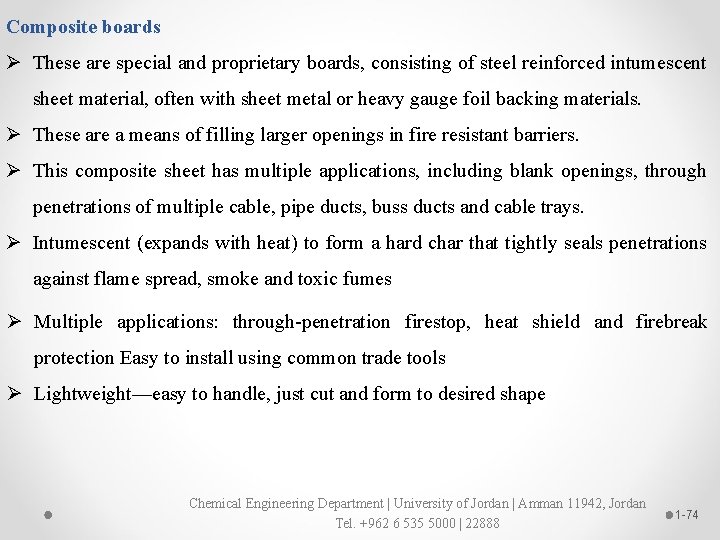
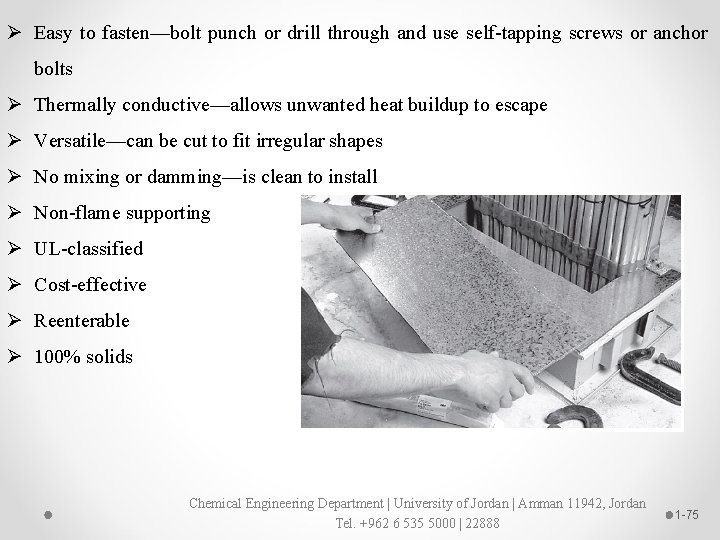
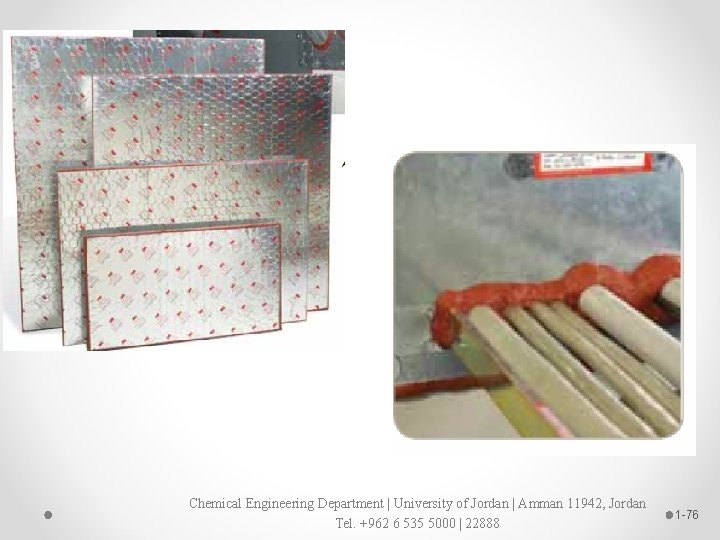
Composite boards Ø These are special and proprietary boards, consisting of steel reinforced intumescent sheet material, often with sheet metal or heavy gauge foil backing materials. Ø These are a means of filling larger openings in fire resistant barriers. Ø This composite sheet has multiple applications, including blank openings, through penetrations of multiple cable, pipe ducts, buss ducts and cable trays. Ø Intumescent (expands with heat) to form a hard char that tightly seals penetrations against flame spread, smoke and toxic fumes Ø Multiple applications: through-penetration firestop, heat shield and firebreak protection Easy to install using common trade tools Ø Lightweight—easy to handle, just cut and form to desired shape Chemical Engineering Department | University of Jordan | Amman 11942, Jordan Tel. +962 6 535 5000 | 22888 1 -74
Ø Easy to fasten—bolt punch or drill through and use self-tapping screws or anchor bolts Ø Thermally conductive—allows unwanted heat buildup to escape Ø Versatile—can be cut to fit irregular shapes Ø No mixing or damming—is clean to install Ø Non-flame supporting Ø UL-classified Ø Cost-effective Ø Reenterable Ø 100% solids Chemical Engineering Department | University of Jordan | Amman 11942, Jordan Tel. +962 6 535 5000 | 22888 1 -75
Chemical Engineering Department | University of Jordan | Amman 11942, Jordan Tel. +962 6 535 5000 | 22888 1 -76
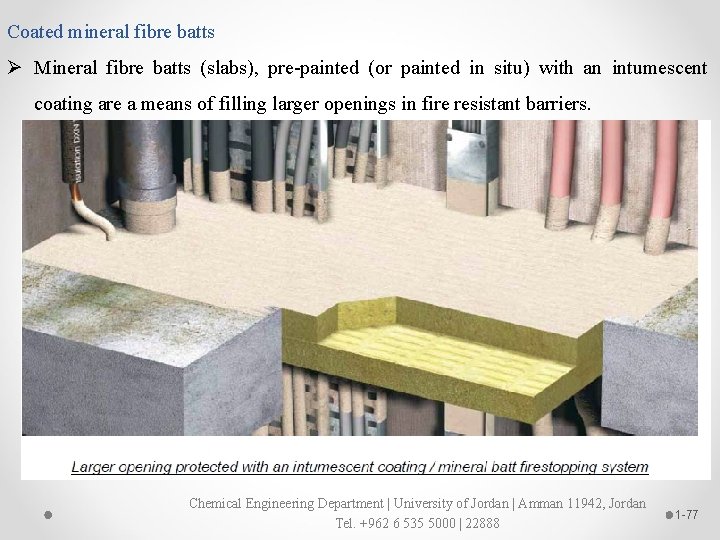
Coated mineral fibre batts Ø Mineral fibre batts (slabs), pre-painted (or painted in situ) with an intumescent coating are a means of filling larger openings in fire resistant barriers. Chemical Engineering Department | University of Jordan | Amman 11942, Jordan Tel. +962 6 535 5000 | 22888 1 -77
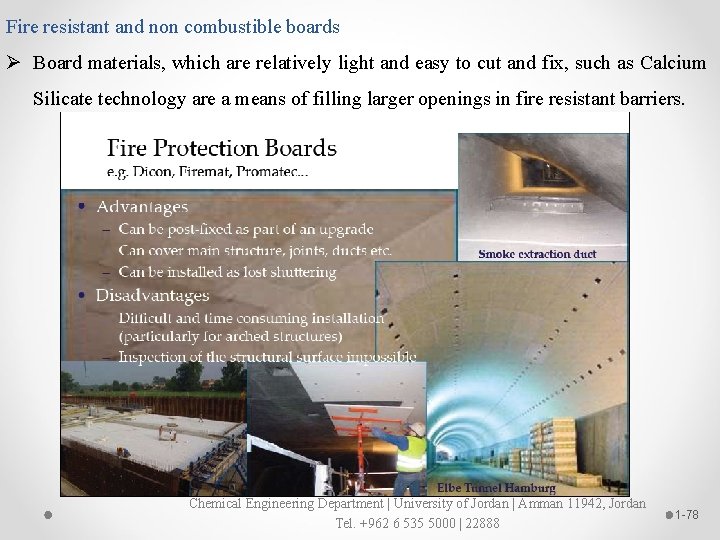
Fire resistant and non combustible boards Ø Board materials, which are relatively light and easy to cut and fix, such as Calcium Silicate technology are a means of filling larger openings in fire resistant barriers. Chemical Engineering Department | University of Jordan | Amman 11942, Jordan Tel. +962 6 535 5000 | 22888 1 -78
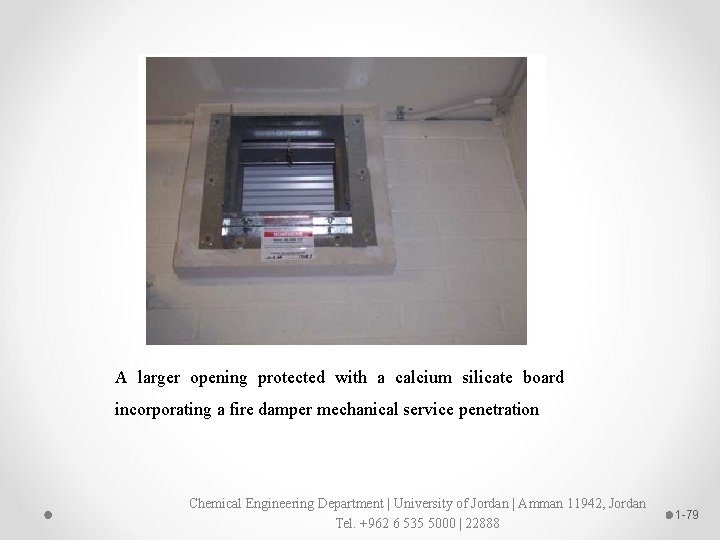
A larger opening protected with a calcium silicate board incorporating a fire damper mechanical service penetration Chemical Engineering Department | University of Jordan | Amman 11942, Jordan Tel. +962 6 535 5000 | 22888 1 -79
Chemical Engineering Department | University of Jordan | Amman 11942, Jordan Tel. +962 6 535 5000 | 22888 1 -80
Chemical Engineering Department | University of Jordan | Amman 11942, Jordan Tel. +962 6 535 5000 | 22888 1 -81
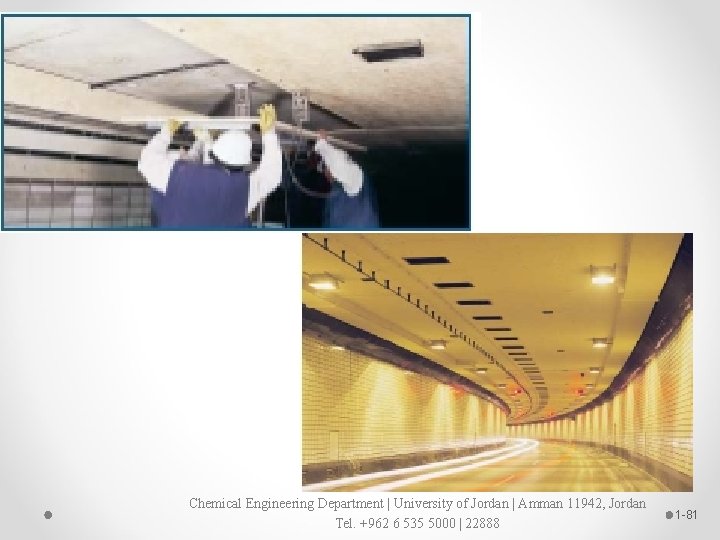
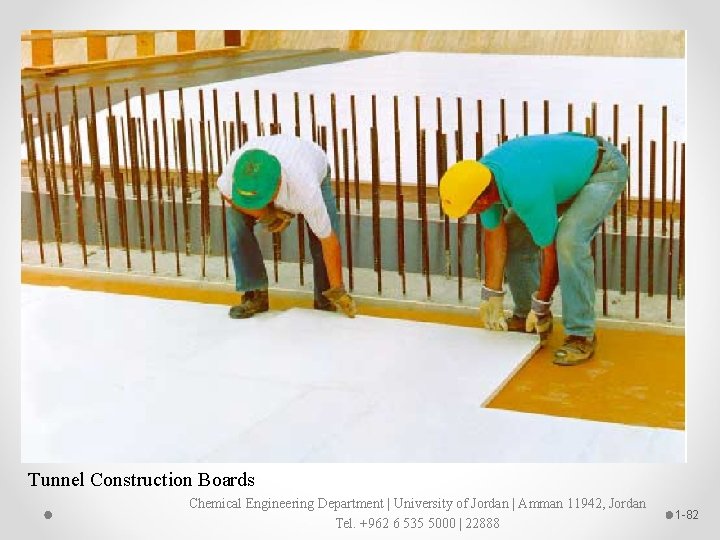
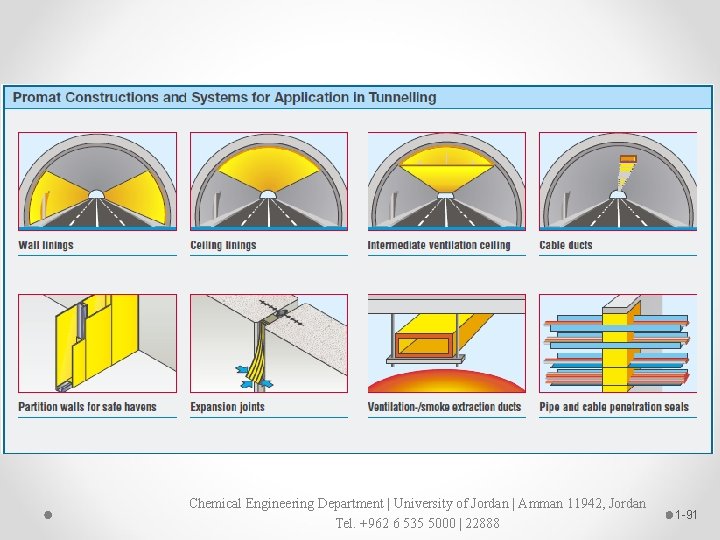
Tunnel Construction Boards Chemical Engineering Department | University of Jordan | Amman 11942, Jordan Tel. +962 6 535 5000 | 22888 1 -82
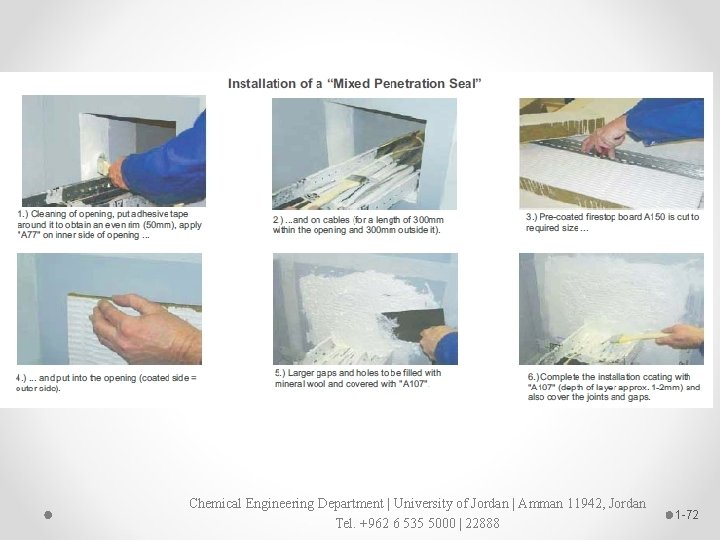
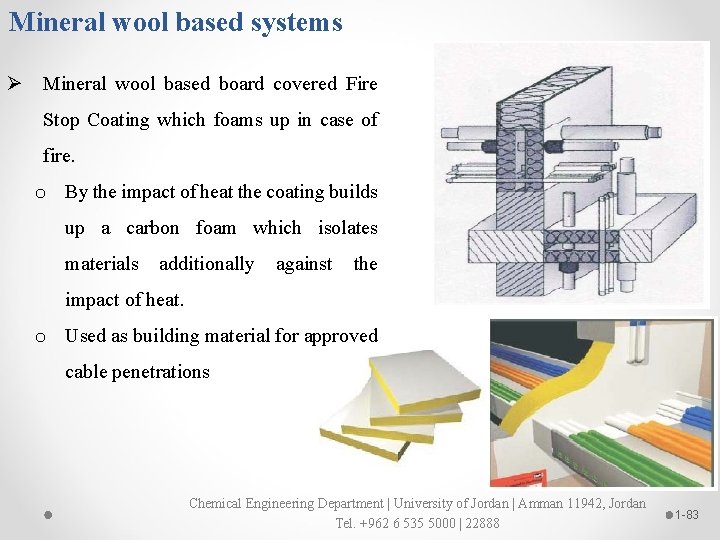
Mineral wool based systems Ø Mineral wool based board covered Fire Stop Coating which foams up in case of fire. o By the impact of heat the coating builds up a carbon foam which isolates materials additionally against the impact of heat. o Used as building material for approved cable penetrations Chemical Engineering Department | University of Jordan | Amman 11942, Jordan Tel. +962 6 535 5000 | 22888 1 -83
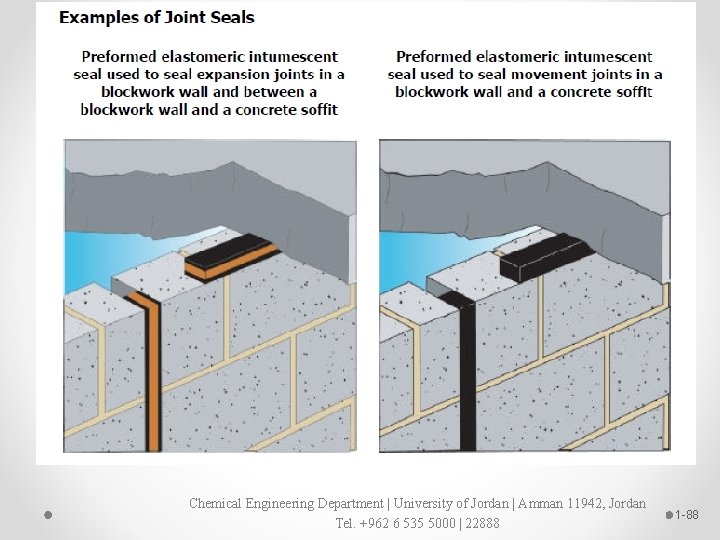
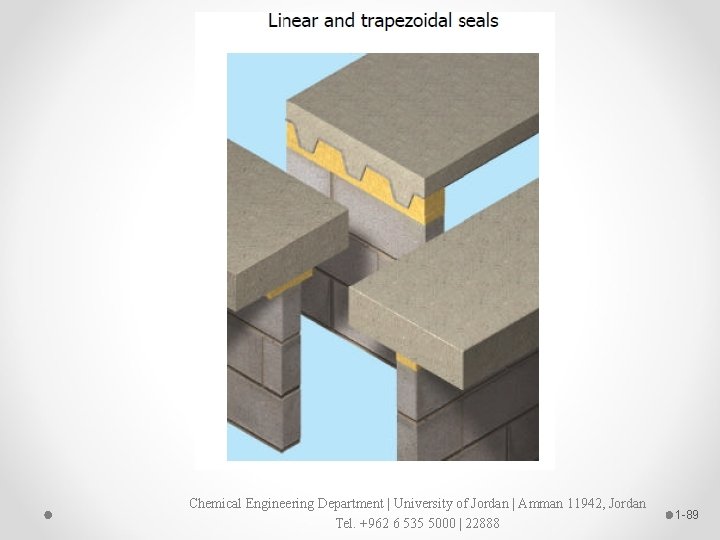
Control joint materials Ø Materials used to provide effective fire sealing between transitions and movement joints Ø discussed earlier are referred to here as control joint materials. Ø The type of material(s) depends on the fire resistant barrier type, size (width) of the joint and the movement capabilities. Ø Some generic types include: o Sealant o Deflection heads o Fire resistant foams o Composite foam & intumescent strip materials o Proprietary joint systems Chemical Engineering Department | University of Jordan | Amman 11942, Jordan Tel. +962 6 535 5000 | 22888 1 -84
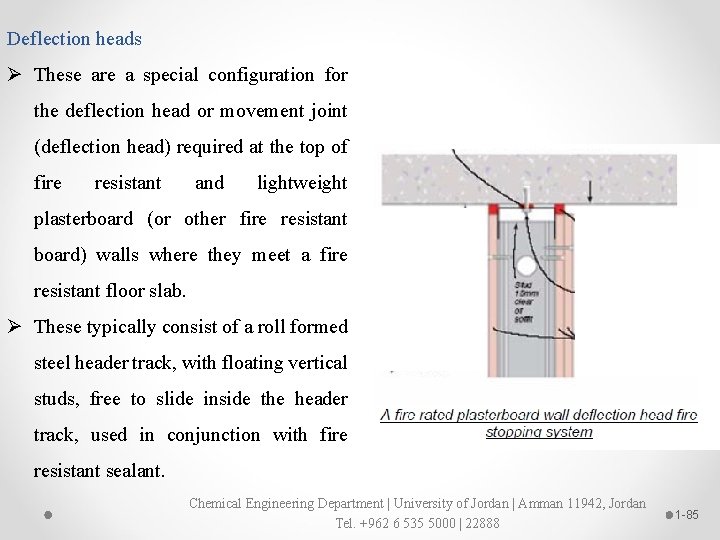
Deflection heads Ø These are a special configuration for the deflection head or movement joint (deflection head) required at the top of fire resistant and lightweight plasterboard (or other fire resistant board) walls where they meet a fire resistant floor slab. Ø These typically consist of a roll formed steel header track, with floating vertical studs, free to slide inside the header track, used in conjunction with fire resistant sealant. Chemical Engineering Department | University of Jordan | Amman 11942, Jordan Tel. +962 6 535 5000 | 22888 1 -85
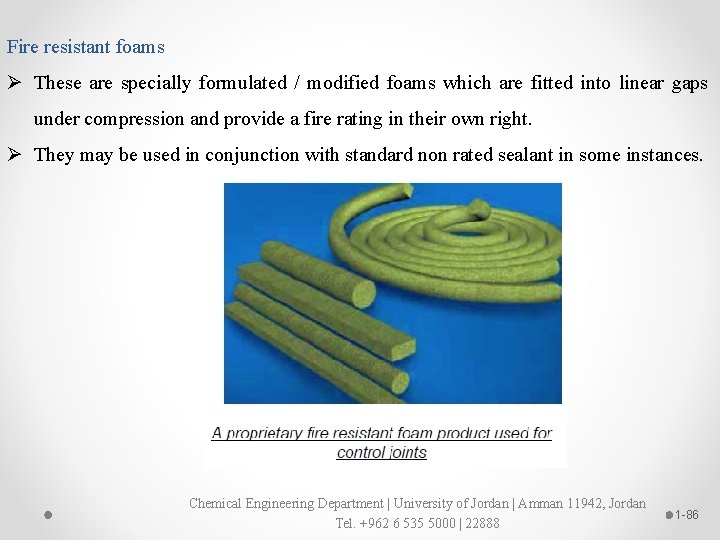
Fire resistant foams Ø These are specially formulated / modified foams which are fitted into linear gaps under compression and provide a fire rating in their own right. Ø They may be used in conjunction with standard non rated sealant in some instances. Chemical Engineering Department | University of Jordan | Amman 11942, Jordan Tel. +962 6 535 5000 | 22888 1 -86
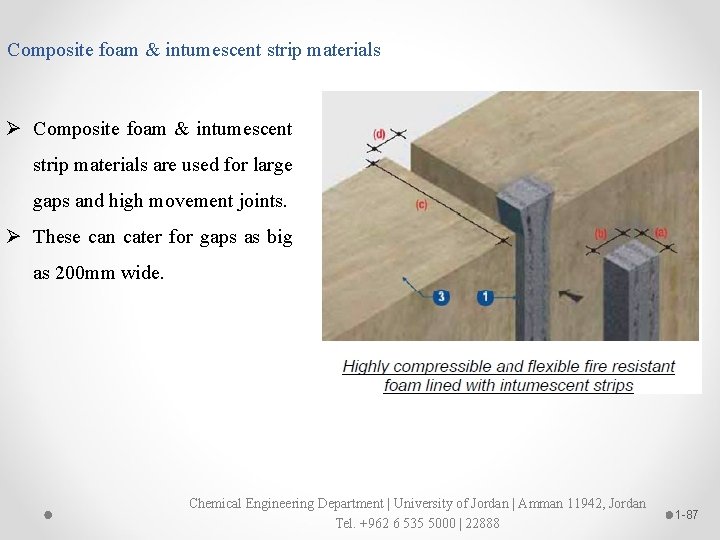
Composite foam & intumescent strip materials Ø Composite foam & intumescent strip materials are used for large gaps and high movement joints. Ø These can cater for gaps as big as 200 mm wide. Chemical Engineering Department | University of Jordan | Amman 11942, Jordan Tel. +962 6 535 5000 | 22888 1 -87
Chemical Engineering Department | University of Jordan | Amman 11942, Jordan Tel. +962 6 535 5000 | 22888 1 -88
Chemical Engineering Department | University of Jordan | Amman 11942, Jordan Tel. +962 6 535 5000 | 22888 1 -89
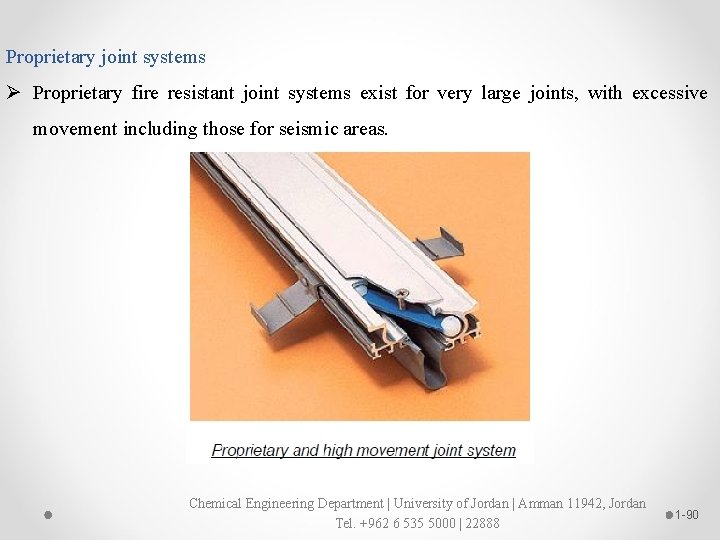
Proprietary joint systems Ø Proprietary fire resistant joint systems exist for very large joints, with excessive movement including those for seismic areas. Chemical Engineering Department | University of Jordan | Amman 11942, Jordan Tel. +962 6 535 5000 | 22888 1 -90
Chemical Engineering Department | University of Jordan | Amman 11942, Jordan Tel. +962 6 535 5000 | 22888 1 -91
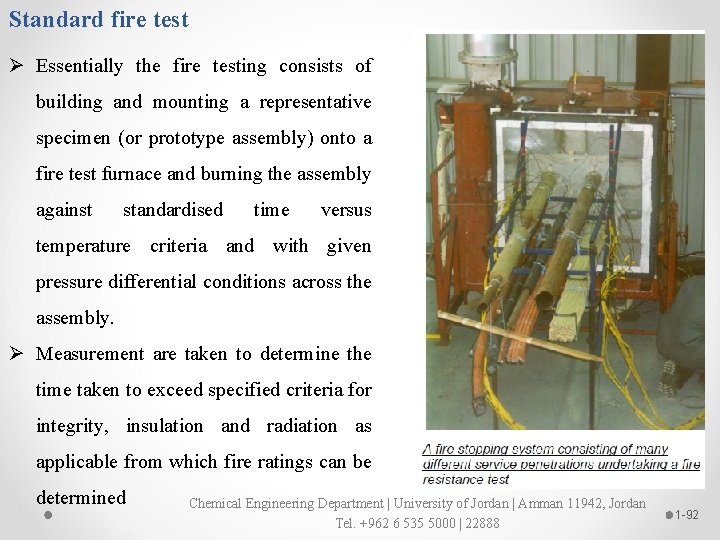
Standard fire test Ø Essentially the fire testing consists of building and mounting a representative specimen (or prototype assembly) onto a fire test furnace and burning the assembly against standardised time versus temperature criteria and with given pressure differential conditions across the assembly. Ø Measurement are taken to determine the time taken to exceed specified criteria for integrity, insulation and radiation as applicable from which fire ratings can be determined Chemical Engineering Department | University of Jordan | Amman 11942, Jordan Tel. +962 6 535 5000 | 22888 1 -92