
Passive Atomic Frequency Standards W J Riley 2006
- Slides: 41
Passive Atomic Frequency Standards W. J. Riley 2006 IEEE International Frequency Control Symposium Miami, Florida USA Short Course June 4, 2006 Rev B 06/10/06
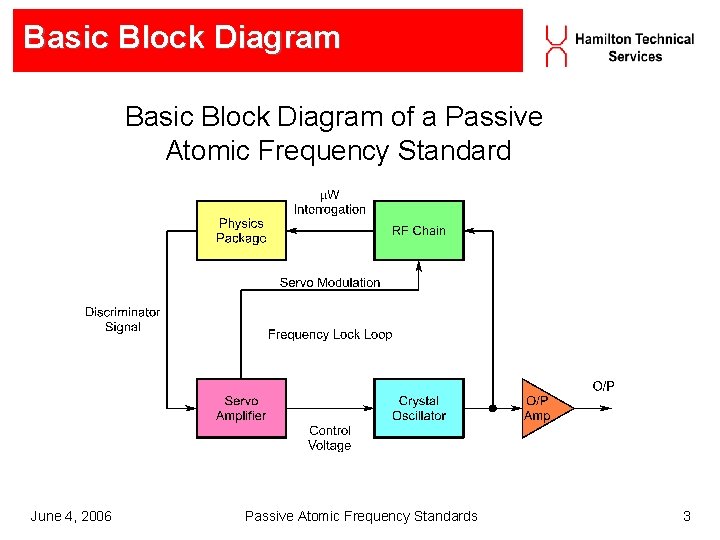
Introduction A passive atomic frequency standard (AFS) is the most common type of atomic clock. It uses a crystal oscillator or other frequency source to excite a passive atomic discriminator that produces a correction signal in a frequency control loop to lock the oscillator to the atomic reference. The crystal oscillator provides the stable output frequency. June 4, 2006 Passive Atomic Frequency Standards 2
Basic Block Diagram of a Passive Atomic Frequency Standard June 4, 2006 Passive Atomic Frequency Standards 3
Passive AFS Types Passive atomic frequency standards are usually categorized by their physics package type: • Rubidium Gas Cell • Cesium Beam Tube (Classic or Laser Pumped/Detected) • Passive Hydrogen Maser • Trapped Mercury Ion • Cs or Rb Fountain • Optical Standard (Several Species) • Coherent Population Trapping (CPT) • Chip-Scale Atomic Clock (CSAC) The first two are by far the most widely used, and are emphasized in this tutorial. June 4, 2006 Passive Atomic Frequency Standards 4
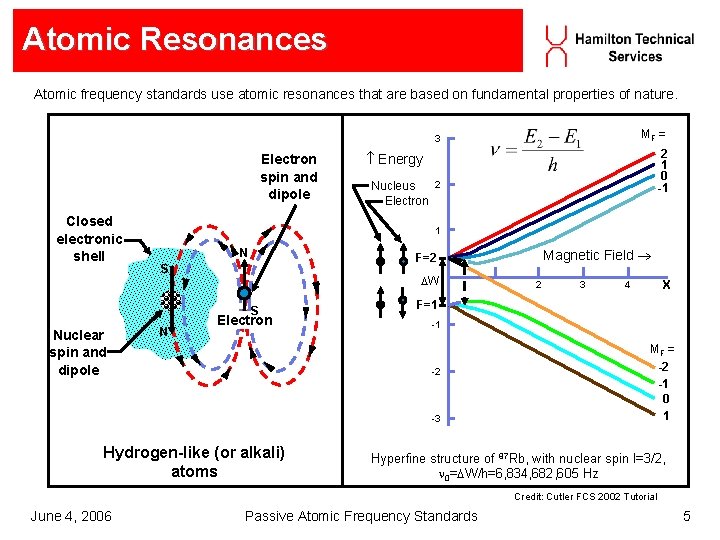
Atomic Resonances Atomic frequency standards use atomic resonances that are based on fundamental properties of nature. MF = 3 Electron spin and dipole Closed electronic shell 2 Nucleus Electron 1 N S N Magnetic Field F=2 W S Nuclear spin and dipole 2 1 0 -1 Energy Electron 2 3 X 4 F=1 -1 MF = -2 -1 0 1 -2 -3 Hydrogen-like (or alkali) atoms Hyperfine structure of 87 Rb, with nuclear spin I=3/2, 0= W/h=6, 834, 682, 605 Hz Credit: Cutler FCS 2002 Tutorial June 4, 2006 Passive Atomic Frequency Standards 5
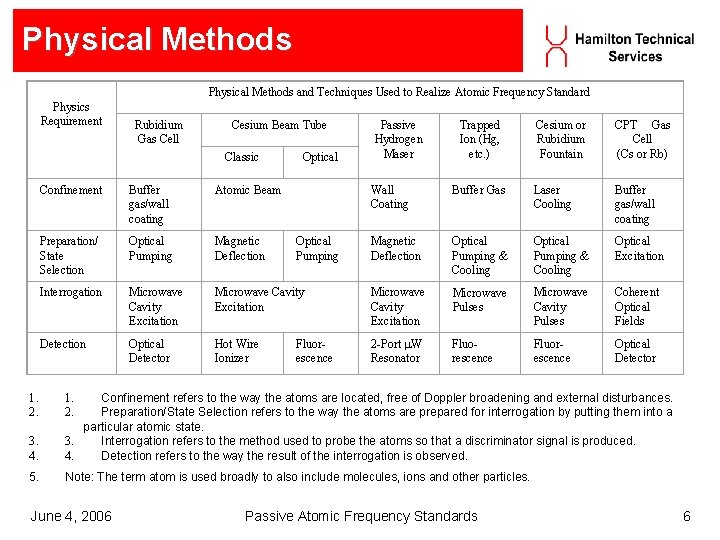
Physical Methods Physics Requirement Physical Methods and Techniques Used to Realize Atomic Frequency Standard Rubidium Gas Cell Cesium Beam Tube Classic 1. 2. Confinement Buffer gas/wall coating Atomic Beam Preparation/ State Selection Optical Pumping Magnetic Deflection Interrogation Microwave Cavity Excitation Detection Optical Detector Optical Passive Hydrogen Maser Trapped Ion (Hg, etc. ) Cesium or Rubidium Fountain CPT Gas Cell (Cs or Rb) Wall Coating Buffer Gas Laser Cooling Buffer gas/wall coating Magnetic Deflection Optical Pumping & Cooling Optical Excitation Microwave Cavity Excitation Microwave Pulses Microwave Cavity Pulses Coherent Optical Fields Hot Wire Ionizer 2 -Port W Resonator Fluorescence Optical Detector Optical Pumping Fluorescence 3. 4. 1. Confinement refers to the way the atoms are located, free of Doppler broadening and external disturbances. 2. Preparation/State Selection refers to the way the atoms are prepared for interrogation by putting them into a particular atomic state. 3. Interrogation refers to the method used to probe the atoms so that a discriminator signal is produced. 4. Detection refers to the way the result of the interrogation is observed. 5. Note: The term atom is used broadly to also include molecules, ions and other particles. June 4, 2006 Passive Atomic Frequency Standards 6
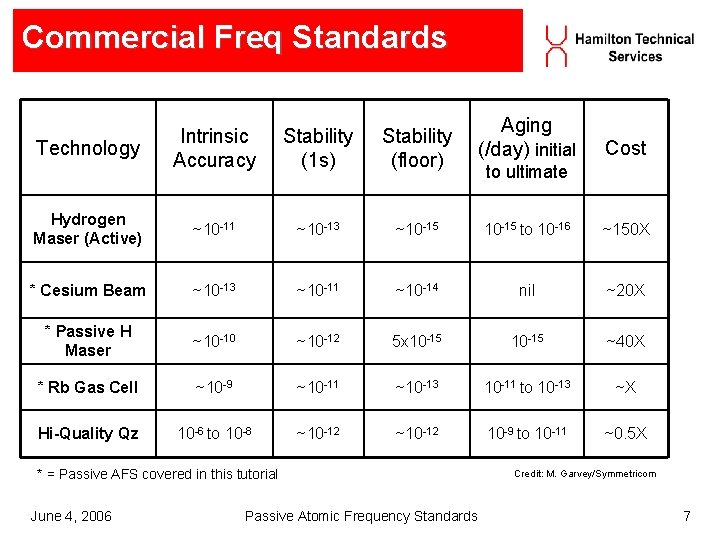
Commercial Freq Standards Aging (/day) initial Intrinsic Accuracy Stability (1 s) Stability (floor) Hydrogen Maser (Active) ~10 -11 ~10 -13 ~10 -15 to 10 -16 ~150 X * Cesium Beam ~10 -13 ~10 -11 ~10 -14 nil ~20 X * Passive H Maser ~10 -10 ~10 -12 5 x 10 -15 ~40 X * Rb Gas Cell ~10 -9 ~10 -11 ~10 -13 10 -11 to 10 -13 ~X Hi-Quality Qz 10 -6 to 10 -8 ~10 -12 10 -9 to 10 -11 ~0. 5 X Technology * = Passive AFS covered in this tutorial June 4, 2006 Passive Atomic Frequency Standards Cost to ultimate Credit: M. Garvey/Symmetricom 7
Rubidium Frequency Standards Rubidium Gas Cell Passive Atomic Frequency Standards June 4, 2006 Passive Atomic Frequency Standards 8
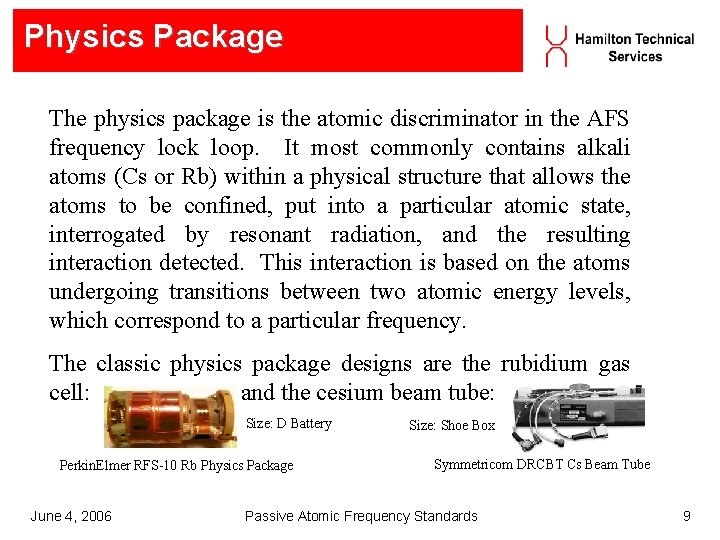
Physics Package The physics package is the atomic discriminator in the AFS frequency lock loop. It most commonly contains alkali atoms (Cs or Rb) within a physical structure that allows the atoms to be confined, put into a particular atomic state, interrogated by resonant radiation, and the resulting interaction detected. This interaction is based on the atoms undergoing transitions between two atomic energy levels, which correspond to a particular frequency. The classic physics package designs are the rubidium gas cell: and the cesium beam tube: Size: D Battery Perkin. Elmer RFS-10 Rb Physics Package June 4, 2006 Size: Shoe Box Symmetricom DRCBT Cs Beam Tube Passive Atomic Frequency Standards 9
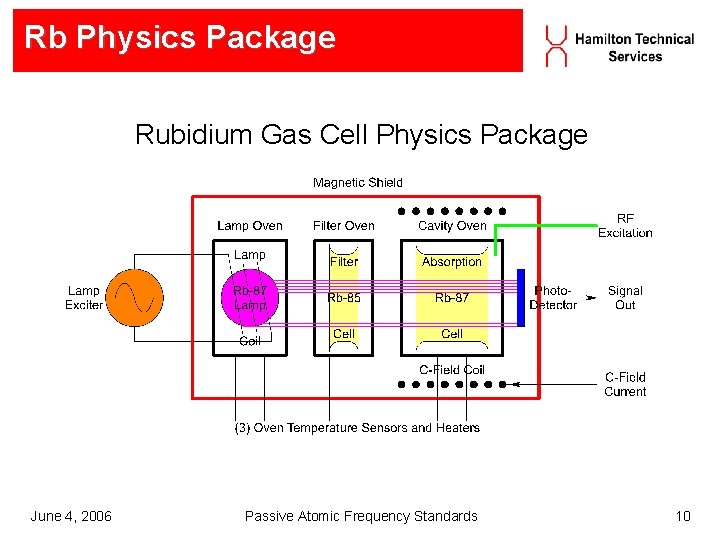
Rb Physics Package Rubidium Gas Cell Physics Package June 4, 2006 Passive Atomic Frequency Standards 10
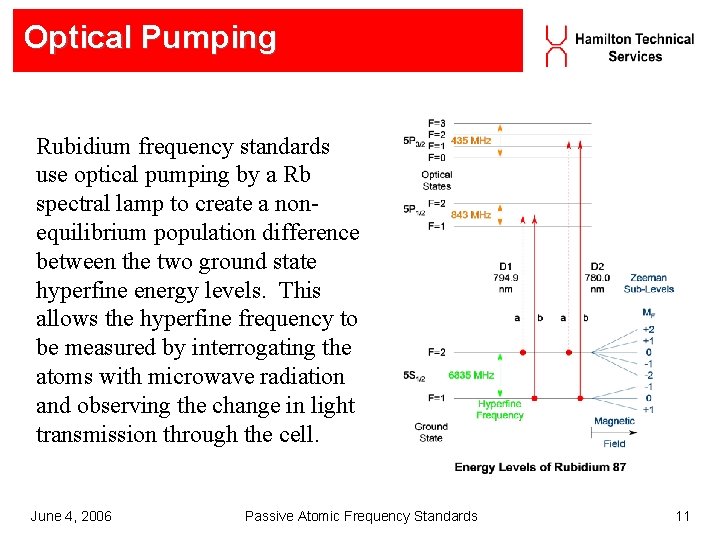
Optical Pumping Rubidium frequency standards use optical pumping by a Rb spectral lamp to create a nonequilibrium population difference between the two ground state hyperfine energy levels. This allows the hyperfine frequency to be measured by interrogating the atoms with microwave radiation and observing the change in light transmission through the cell. June 4, 2006 Passive Atomic Frequency Standards 11
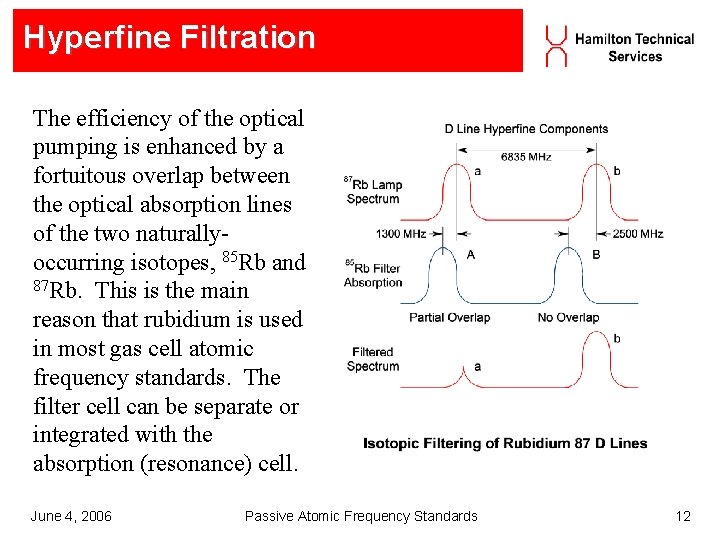
Hyperfine Filtration The efficiency of the optical pumping is enhanced by a fortuitous overlap between the optical absorption lines of the two naturallyoccurring isotopes, 85 Rb and 87 Rb. This is the main reason that rubidium is used in most gas cell atomic frequency standards. The filter cell can be separate or integrated with the absorption (resonance) cell. June 4, 2006 Passive Atomic Frequency Standards 12
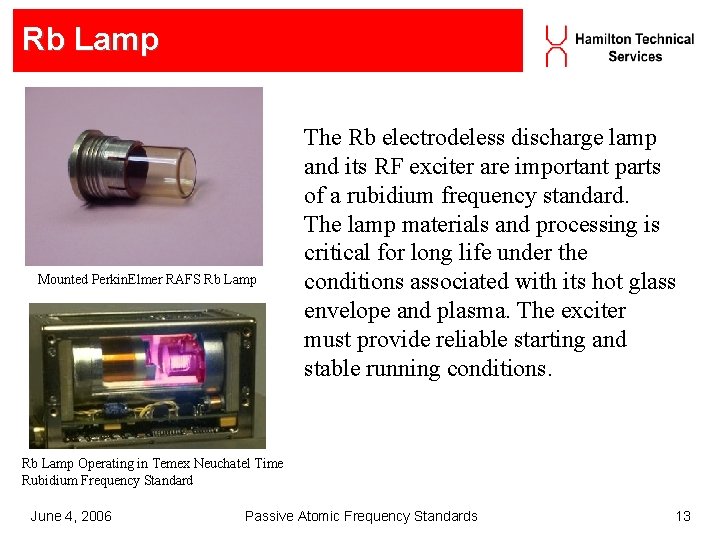
Rb Lamp Mounted Perkin. Elmer RAFS Rb Lamp The Rb electrodeless discharge lamp and its RF exciter are important parts of a rubidium frequency standard. The lamp materials and processing is critical for long life under the conditions associated with its hot glass envelope and plasma. The exciter must provide reliable starting and stable running conditions. Rb Lamp Operating in Temex Neuchatel Time Rubidium Frequency Standard June 4, 2006 Passive Atomic Frequency Standards 13
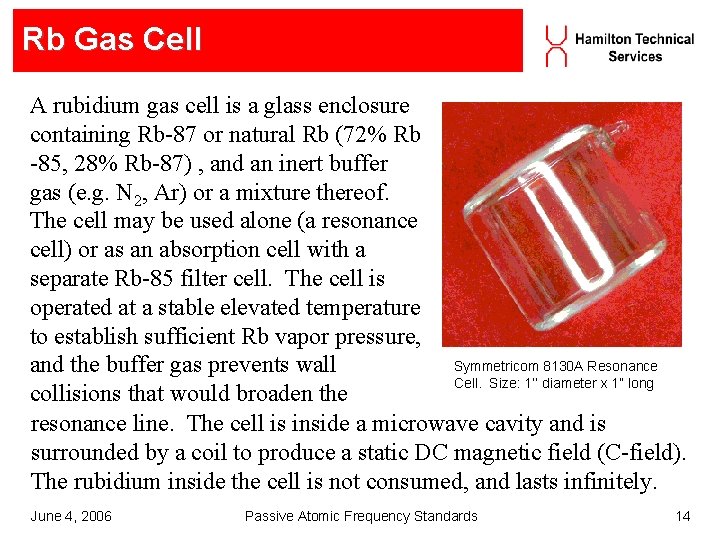
Rb Gas Cell A rubidium gas cell is a glass enclosure containing Rb-87 or natural Rb (72% Rb -85, 28% Rb-87) , and an inert buffer gas (e. g. N 2, Ar) or a mixture thereof. The cell may be used alone (a resonance cell) or as an absorption cell with a separate Rb-85 filter cell. The cell is operated at a stable elevated temperature to establish sufficient Rb vapor pressure, Symmetricom 8130 A Resonance and the buffer gas prevents wall Cell. Size: 1’’ diameter x 1” long collisions that would broaden the resonance line. The cell is inside a microwave cavity and is surrounded by a coil to produce a static DC magnetic field (C-field). The rubidium inside the cell is not consumed, and lasts infinitely. June 4, 2006 Passive Atomic Frequency Standards 14
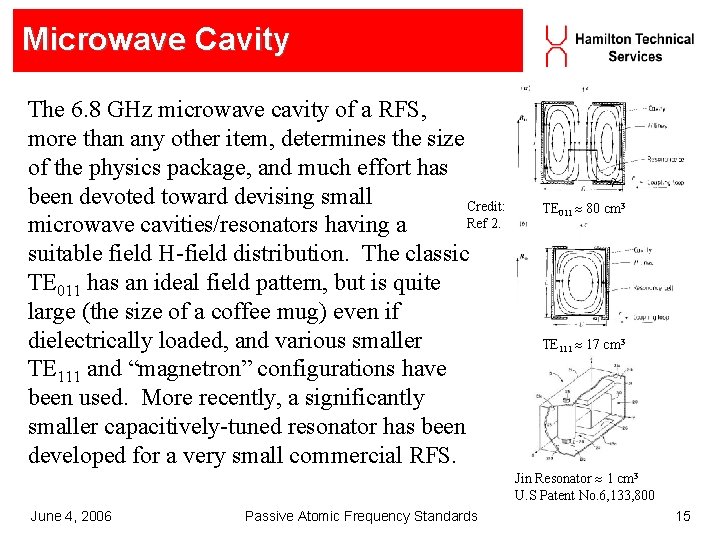
Microwave Cavity The 6. 8 GHz microwave cavity of a RFS, more than any other item, determines the size of the physics package, and much effort has been devoted toward devising small Credit: Ref 2. microwave cavities/resonators having a suitable field H-field distribution. The classic TE 011 has an ideal field pattern, but is quite large (the size of a coffee mug) even if dielectrically loaded, and various smaller TE 111 and “magnetron” configurations have been used. More recently, a significantly smaller capacitively-tuned resonator has been developed for a very small commercial RFS. TE 011 80 cm 3 TE 111 17 cm 3 Jin Resonator 1 cm 3 U. S Patent No. 6, 133, 800 June 4, 2006 Passive Atomic Frequency Standards 15
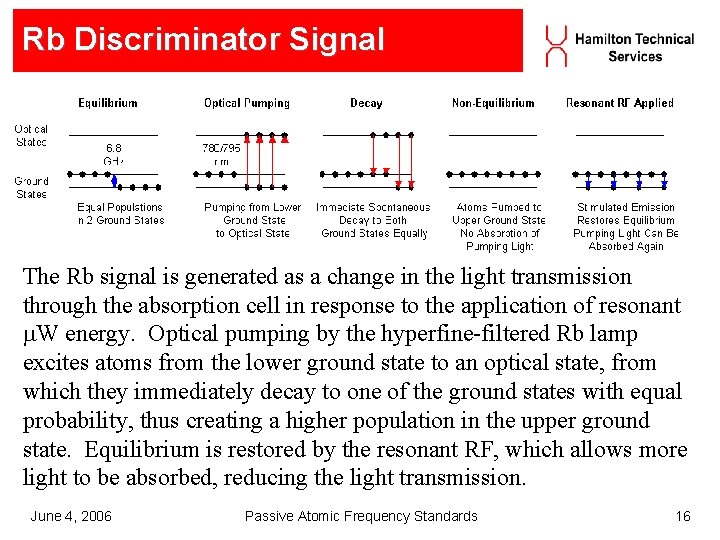
Rb Discriminator Signal The Rb signal is generated as a change in the light transmission through the absorption cell in response to the application of resonant W energy. Optical pumping by the hyperfine-filtered Rb lamp excites atoms from the lower ground state to an optical state, from which they immediately decay to one of the ground states with equal probability, thus creating a higher population in the upper ground state. Equilibrium is restored by the resonant RF, which allows more light to be absorbed, reducing the light transmission. June 4, 2006 Passive Atomic Frequency Standards 16
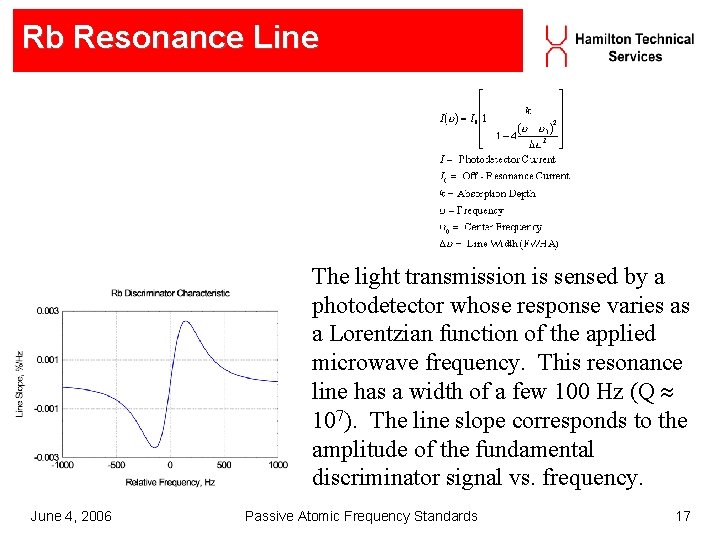
Rb Resonance Line The light transmission is sensed by a photodetector whose response varies as a Lorentzian function of the applied microwave frequency. This resonance line has a width of a few 100 Hz (Q 107). The line slope corresponds to the amplitude of the fundamental discriminator signal vs. frequency. June 4, 2006 Passive Atomic Frequency Standards 17
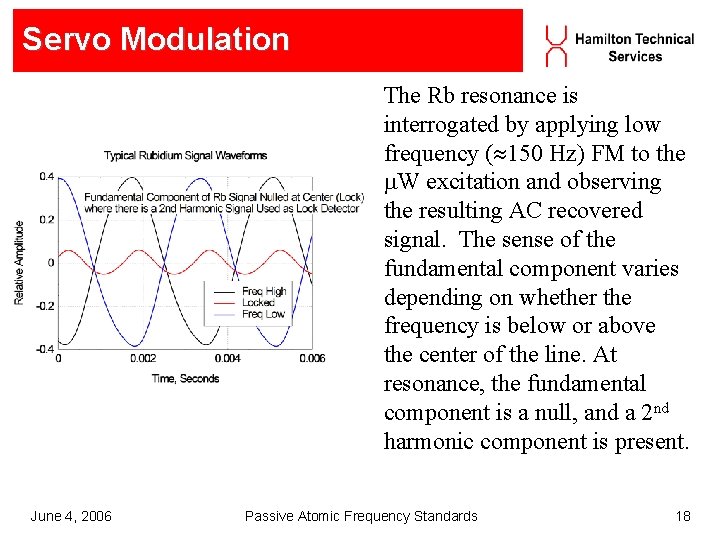
Servo Modulation The Rb resonance is interrogated by applying low frequency ( 150 Hz) FM to the W excitation and observing the resulting AC recovered signal. The sense of the fundamental component varies depending on whether the frequency is below or above the center of the line. At resonance, the fundamental component is a null, and a 2 nd harmonic component is present. June 4, 2006 Passive Atomic Frequency Standards 18
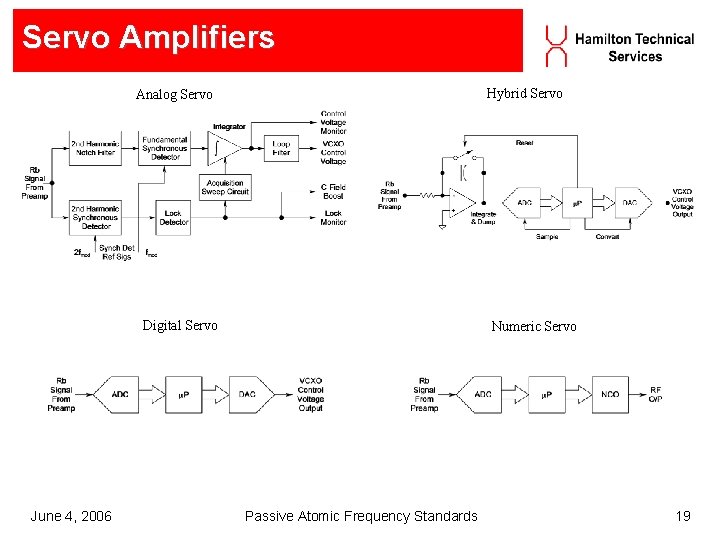
Servo Amplifiers Hybrid Servo Analog Servo Digital Servo June 4, 2006 Numeric Servo Passive Atomic Frequency Standards 19
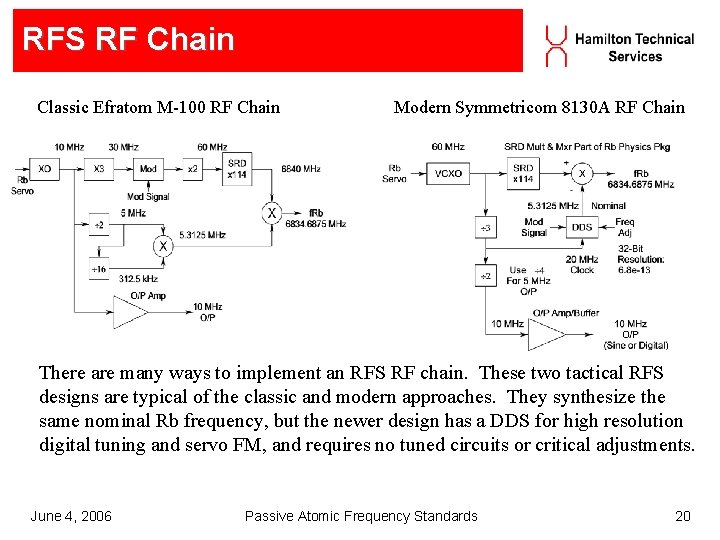
RFS RF Chain Classic Efratom M-100 RF Chain Modern Symmetricom 8130 A RF Chain There are many ways to implement an RFS RF chain. These two tactical RFS designs are typical of the classic and modern approaches. They synthesize the same nominal Rb frequency, but the newer design has a DDS for high resolution digital tuning and servo FM, and requires no tuned circuits or critical adjustments. June 4, 2006 Passive Atomic Frequency Standards 20
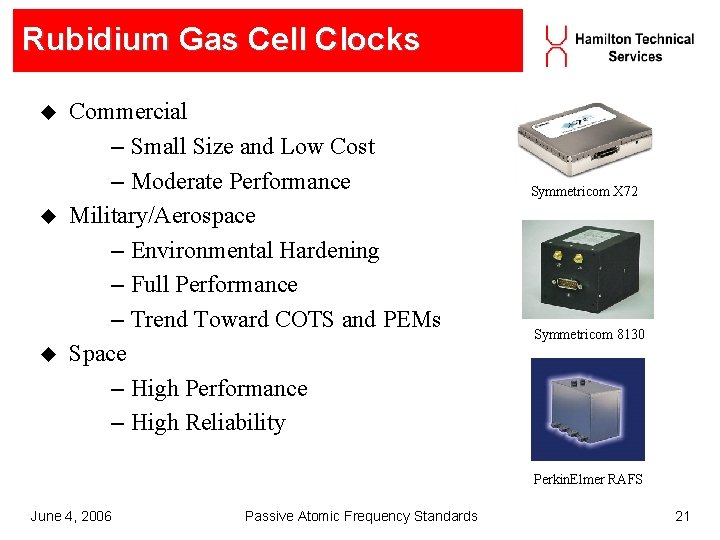
Rubidium Gas Cell Clocks u Commercial – Small Size and Low Cost – Moderate Performance u Military/Aerospace – Environmental Hardening – Full Performance – Trend Toward COTS and PEMs u Space – High Performance – High Reliability Symmetricom X 72 Symmetricom 8130 Perkin. Elmer RAFS June 4, 2006 Passive Atomic Frequency Standards 21
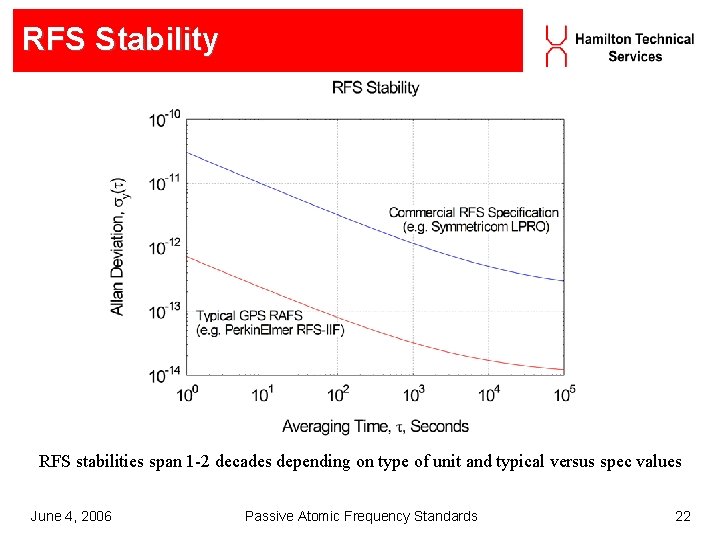
RFS Stability RFS stabilities span 1 -2 decades depending on type of unit and typical versus spec values June 4, 2006 Passive Atomic Frequency Standards 22
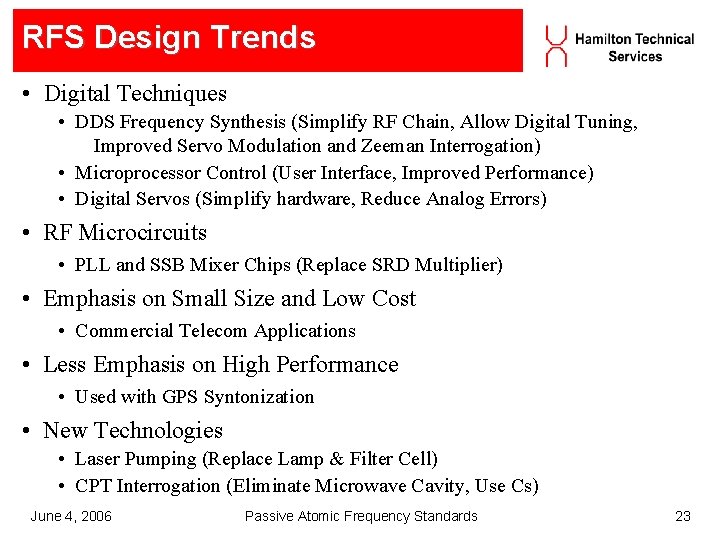
RFS Design Trends • Digital Techniques • DDS Frequency Synthesis (Simplify RF Chain, Allow Digital Tuning, Improved Servo Modulation and Zeeman Interrogation) • Microprocessor Control (User Interface, Improved Performance) • Digital Servos (Simplify hardware, Reduce Analog Errors) • RF Microcircuits • PLL and SSB Mixer Chips (Replace SRD Multiplier) • Emphasis on Small Size and Low Cost • Commercial Telecom Applications • Less Emphasis on High Performance • Used with GPS Syntonization • New Technologies • Laser Pumping (Replace Lamp & Filter Cell) • CPT Interrogation (Eliminate Microwave Cavity, Use Cs) June 4, 2006 Passive Atomic Frequency Standards 23
Cesium Frequency Standards Cesium Beam Tube Passive Atomic Frequency Standards June 4, 2006 Passive Atomic Frequency Standards 24
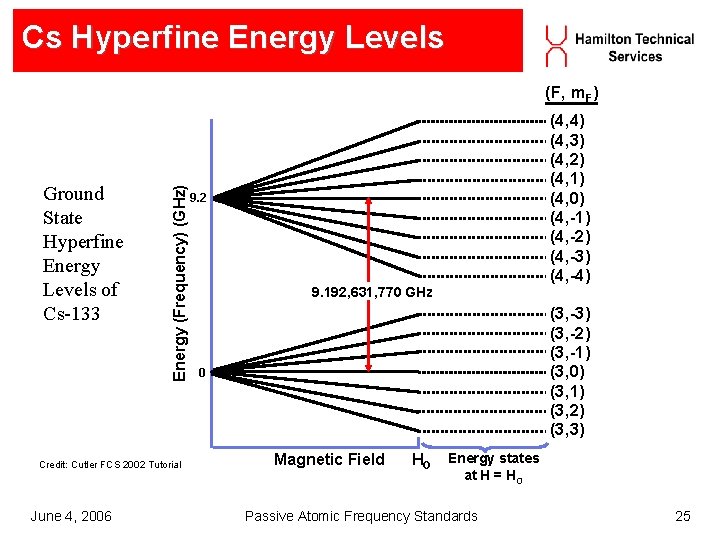
Cs Hyperfine Energy Levels Ground State Hyperfine Energy Levels of Cs-133 Energy (Frequency) (GHz) (F, m. F) Credit: Cutler FCS 2002 Tutorial June 4, 2006 (4, 4) (4, 3) (4, 2) (4, 1) (4, 0) (4, -1) (4, -2) (4, -3) (4, -4) 9. 2 9. 192, 631, 770 GHz (3, -3) (3, -2) (3, -1) (3, 0) (3, 1) (3, 2) (3, 3) 0 Magnetic Field HO Energy states at H = HO Passive Atomic Frequency Standards 25
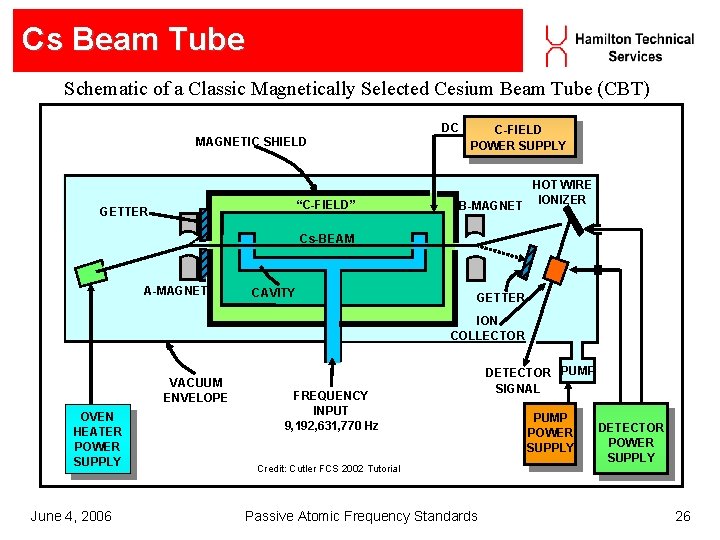
Cs Beam Tube Schematic of a Classic Magnetically Selected Cesium Beam Tube (CBT) MAGNETIC SHIELD “C-FIELD” GETTER DC C-FIELD POWER SUPPLY B-MAGNET HOT WIRE IONIZER Cs-BEAM A-MAGNET CAVITY GETTER ION COLLECTOR VACUUM ENVELOPE OVEN HEATER POWER SUPPLY June 4, 2006 FREQUENCY INPUT 9, 192, 631, 770 Hz Credit: Cutler FCS 2002 Tutorial Passive Atomic Frequency Standards DETECTOR PUMP SIGNAL PUMP POWER SUPPLY DETECTOR POWER SUPPLY 26
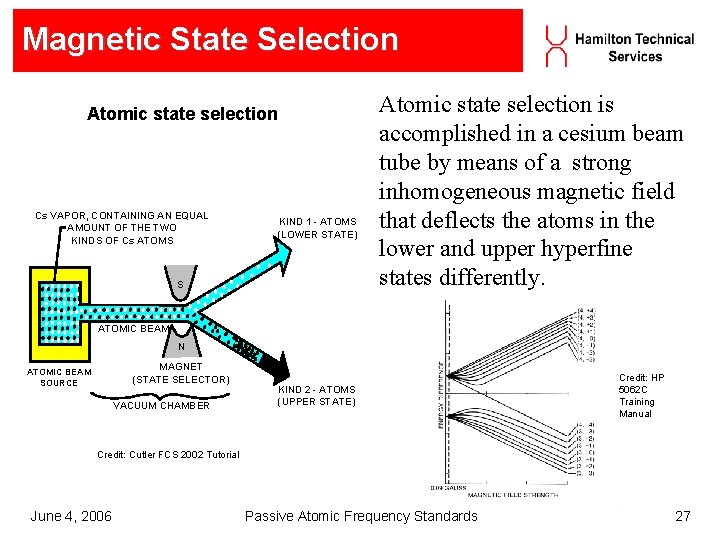
Magnetic State Selection Atomic state selection Cs VAPOR, CONTAINING AN EQUAL AMOUNT OF THE TWO KINDS OF Cs ATOMS KIND 1 - ATOMS (LOWER STATE) S Atomic state selection is accomplished in a cesium beam tube by means of a strong inhomogeneous magnetic field that deflects the atoms in the lower and upper hyperfine states differently. ATOMIC BEAM N MAGNET (STATE SELECTOR) ATOMIC BEAM SOURCE VACUUM CHAMBER KIND 2 - ATOMS (UPPER STATE) Credit: HP 5062 C Training Manual Credit: Cutler FCS 2002 Tutorial June 4, 2006 Passive Atomic Frequency Standards 27
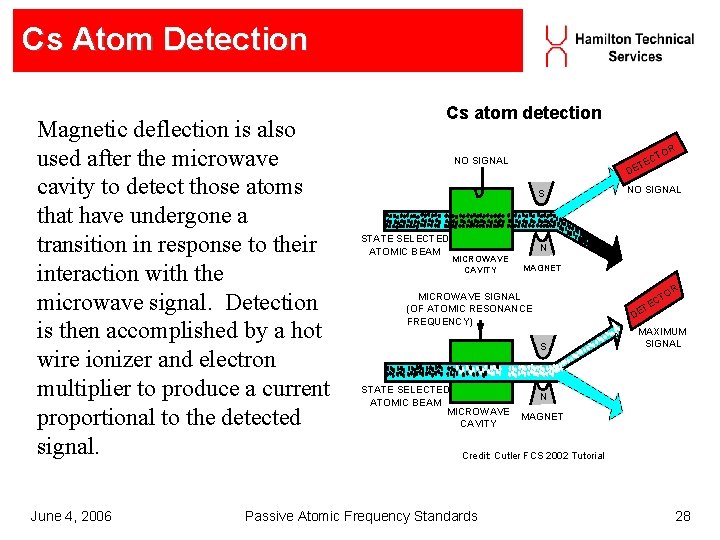
Cs Atom Detection Magnetic deflection is also used after the microwave cavity to detect those atoms that have undergone a transition in response to their interaction with the microwave signal. Detection is then accomplished by a hot wire ionizer and electron multiplier to produce a current proportional to the detected signal. June 4, 2006 Cs atom detection EC ET NO SIGNAL R TO D S STATE SELECTED ATOMIC BEAM NO SIGNAL N MICROWAVE CAVITY MAGNET OR MICROWAVE SIGNAL (OF ATOMIC RESONANCE FREQUENCY) T DE S STATE SELECTED ATOMIC BEAM MICROWAVE CAVITY T EC MAXIMUM SIGNAL N MAGNET Credit: Cutler FCS 2002 Tutorial Passive Atomic Frequency Standards 28
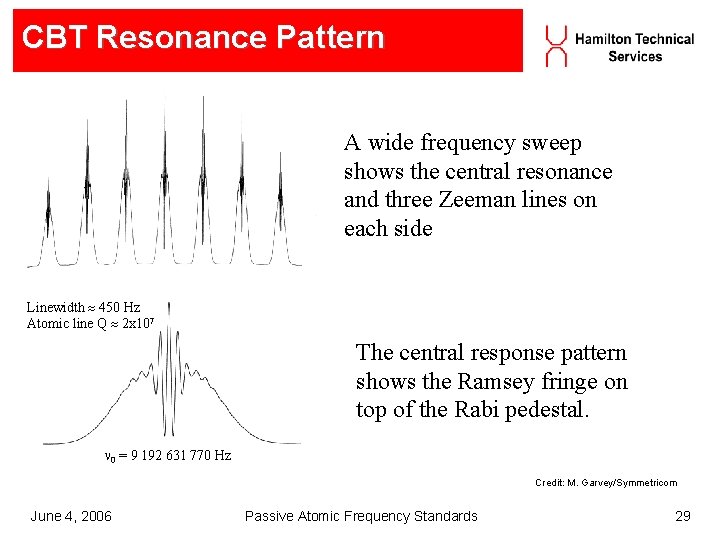
CBT Resonance Pattern A wide frequency sweep shows the central resonance and three Zeeman lines on each side Linewidth 450 Hz Atomic line Q 2 x 10⁷ The central response pattern shows the Ramsey fringe on top of the Rabi pedestal. 0 = 9 192 631 770 Hz Credit: M. Garvey/Symmetricom June 4, 2006 Passive Atomic Frequency Standards 29
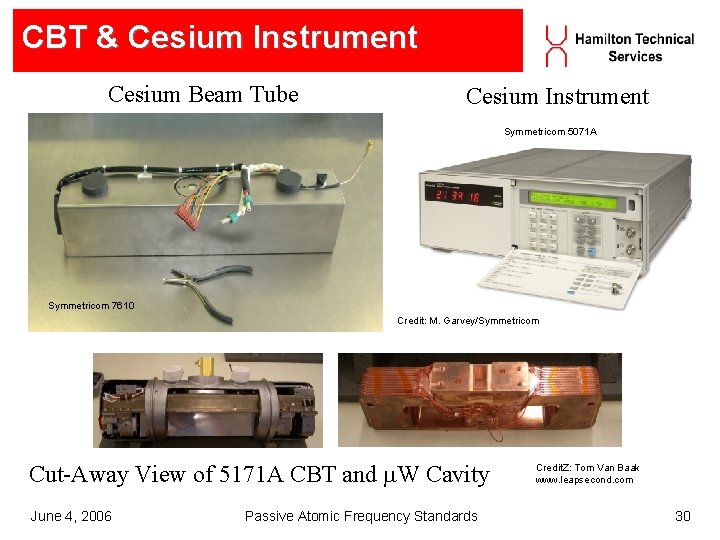
CBT & Cesium Instrument Cesium Beam Tube Cesium Instrument Symmetricom 5071 A Symmetricom 7610 Credit: M. Garvey/Symmetricom Cut-Away View of 5171 A CBT and W Cavity June 4, 2006 Passive Atomic Frequency Standards Credit. Z: Tom Van Baak www. leapsecond. com 30
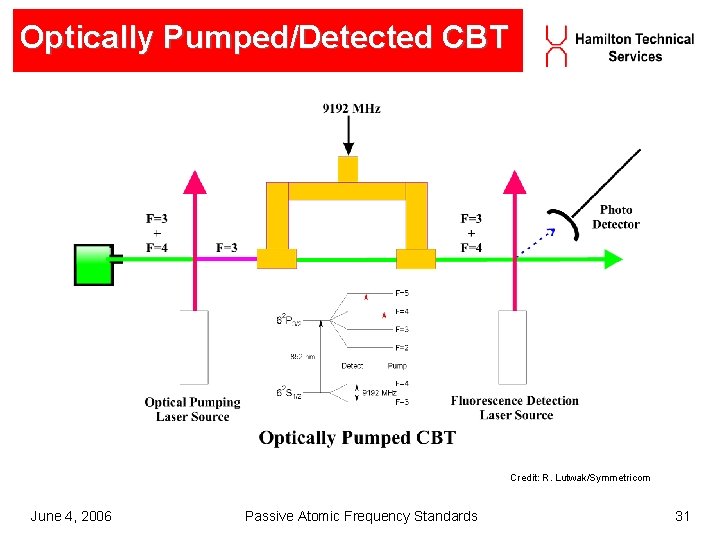
Optically Pumped/Detected CBT Credit: R. Lutwak/Symmetricom June 4, 2006 Passive Atomic Frequency Standards 31
Other Atomic Freq Standards Other Passive Atomic Frequency Standards • Passive Hydrogen Maser • Trapped Mercury Ion Standard • Cesium and Rubidium Fountains • Chip-Scale Atomic Clock June 4, 2006 Passive Atomic Frequency Standards 32
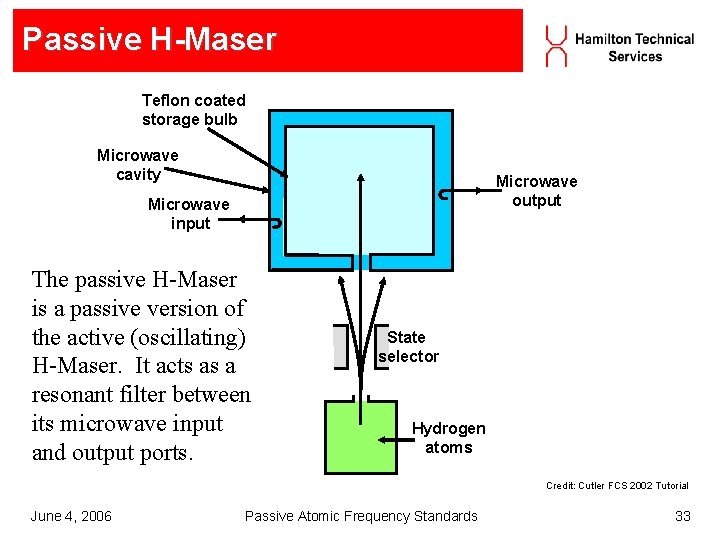
Passive H-Maser Teflon coated storage bulb Microwave cavity Microwave output Microwave input The passive H-Maser is a passive version of the active (oscillating) H-Maser. It acts as a resonant filter between its microwave input and output ports. State selector Hydrogen atoms Credit: Cutler FCS 2002 Tutorial June 4, 2006 Passive Atomic Frequency Standards 33
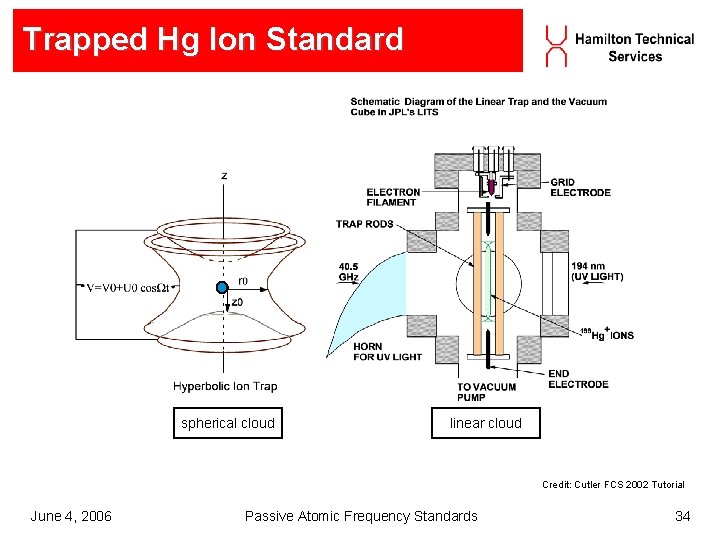
Trapped Hg Ion Standard Trappe Mercury 199 In Standard spherical cloud linear cloud Credit: Cutler FCS 2002 Tutorial June 4, 2006 Passive Atomic Frequency Standards 34
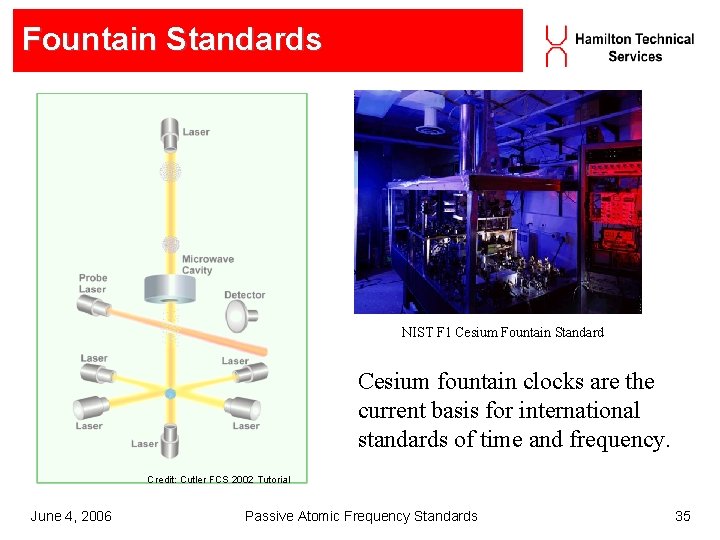
Fountain Standards NIST F 1 Cesium Fountain Standard Cesium fountain clocks are the current basis for international standards of time and frequency. Credit: Cutler FCS 2002 Tutorial June 4, 2006 Passive Atomic Frequency Standards 35
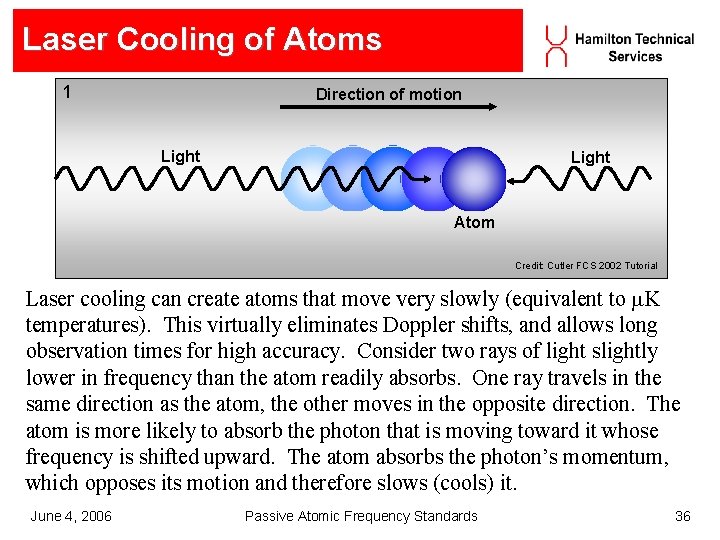
Laser Cooling of Atoms 1 Direction of motion Light Atom Credit: Cutler FCS 2002 Tutorial Laser cooling can create atoms that move very slowly (equivalent to K temperatures). This virtually eliminates Doppler shifts, and allows long observation times for high accuracy. Consider two rays of light slightly lower in frequency than the atom readily absorbs. One ray travels in the same direction as the atom, the other moves in the opposite direction. The atom is more likely to absorb the photon that is moving toward it whose frequency is shifted upward. The atom absorbs the photon’s momentum, which opposes its motion and therefore slows (cools) it. June 4, 2006 Passive Atomic Frequency Standards 36
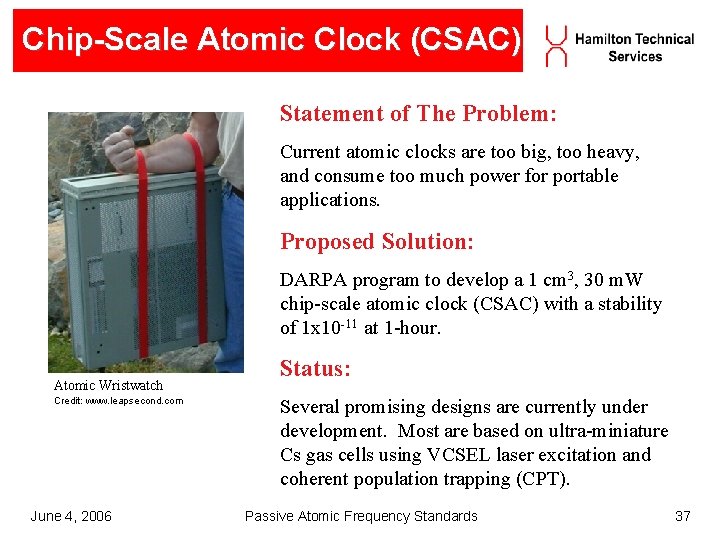
Chip-Scale Atomic Clock (CSAC) Statement of The Problem: Current atomic clocks are too big, too heavy, and consume too much power for portable applications. Proposed Solution: DARPA program to develop a 1 cm 3, 30 m. W chip-scale atomic clock (CSAC) with a stability of 1 x 10 -11 at 1 -hour. Atomic Wristwatch Credit: www. leapsecond. com June 4, 2006 Status: Several promising designs are currently under development. Most are based on ultra-miniature Cs gas cells using VCSEL laser excitation and coherent population trapping (CPT). Passive Atomic Frequency Standards 37
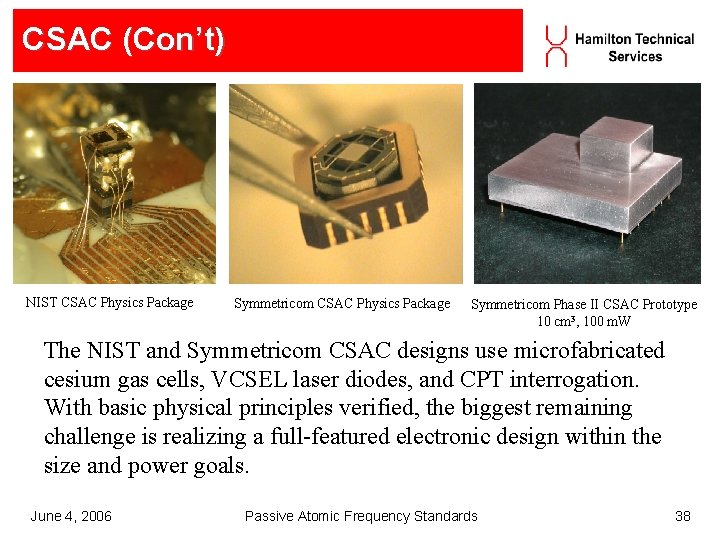
CSAC (Con’t) NIST CSAC Physics Package Symmetricom Phase II CSAC Prototype 10 cm 3, 100 m. W The NIST and Symmetricom CSAC designs use microfabricated cesium gas cells, VCSEL laser diodes, and CPT interrogation. With basic physical principles verified, the biggest remaining challenge is realizing a full-featured electronic design within the size and power goals. June 4, 2006 Passive Atomic Frequency Standards 38
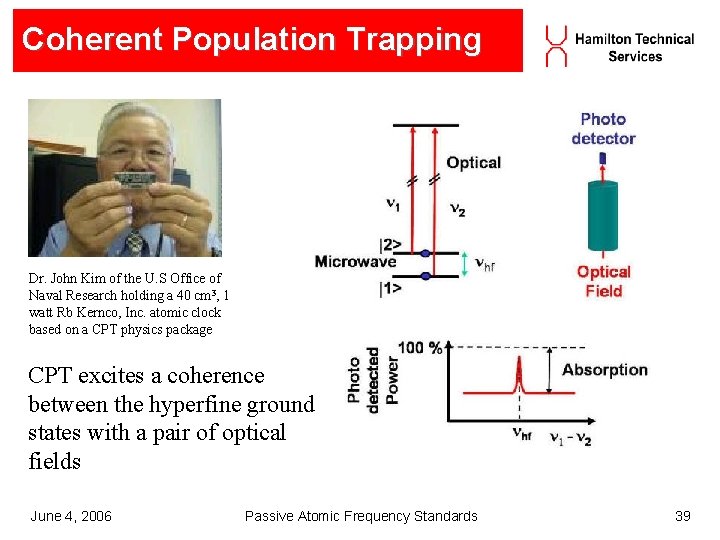
Coherent Population Trapping Dr. John Kim of the U. S Office of Naval Research holding a 40 cm 3, 1 watt Rb Kernco, Inc. atomic clock based on a CPT physics package CPT excites a coherence between the hyperfine ground states with a pair of optical fields June 4, 2006 Passive Atomic Frequency Standards 39
Acknowledgments and Thanks u u u u u Len Cutler/Aglient for material from FSC 2002 Tutorial (note that the original sources for his material includes organizations like NIST and JPL) Material from the NIST web site Material from the Symmetricom web site Mike Garvey/Symmetricom for material from his presentations Robert Lutwak/Symmetricom for optical CAFS material John Vaccaro/Perkin. Elmer for RFS/RAFS material Pascal Rochat/Temex Neuchatel Time for RFS picture Symmetricom for material from my previous presentations Miscellaneous credits are shown on slides as organization and/or individual names June 4, 2006 Passive Atomic Frequency Standards 40
References 1. C. Audoin and B. Guinot, The Measurement of Time, Cambridge University Press, 2001, ISBN 0 -521 -00397 -0 [An excellent middle technical level book on atomic clocks and timekeeping – get it from Amazon. com]. 2. J. Vanier and C. Audoin, The Quantum Physics of Atomic Frequency Standards, Adam Hilger, 1989, ISBN 0 -85274 -433 -1 [The in-depth ‘Bible’ for this subject]. 3. L. S Cutler, “Passive Atomic Frequency Standards”, http: //www. ieee-uffc. org/freqcontrol/tutorials/ Cutler_2002. htm [Tutorial at 2002 Frequency Control Symposium – highly recommended as a complement to this tutorial]. June 4, 2006 Passive Atomic Frequency Standards 41