
Passenger Aircraft Environmental Control System Safety Analysis Presented

- Slides: 26
Passenger Aircraft Environmental Control System Safety Analysis Presented By: Brian Cranley, Ali Dalal, Chris Hankins, Josh Martin
Objective • To analyze and perform a System Safety Analysis on Environmental Control Systems (ECS) in passenger aircraft • To derive possible redesigns in procedures and hardware involved in the functionality of the ECS
Scope • Focuses on the hazards involved in a passenger aircraft cruising at an altitude of 35, 000 ft
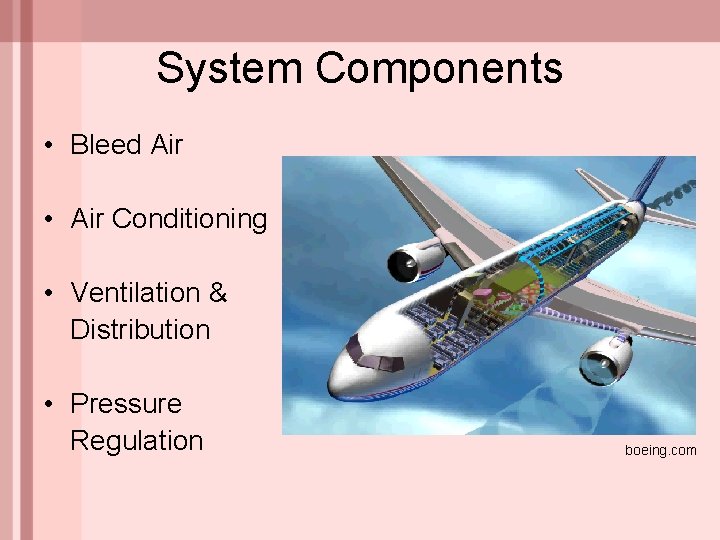
System Components • Bleed Air • Air Conditioning • Ventilation & Distribution • Pressure Regulation boeing. com
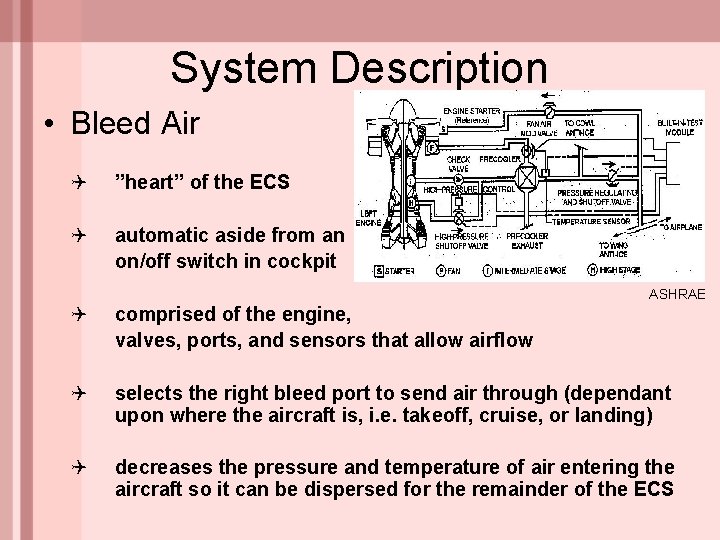
System Description • Bleed Air Q ”heart” of the ECS Q automatic aside from an on/off switch in cockpit ASHRAE Q comprised of the engine, valves, ports, and sensors that allow airflow Q selects the right bleed port to send air through (dependant upon where the aircraft is, i. e. takeoff, cruise, or landing) Q decreases the pressure and temperature of air entering the aircraft so it can be dispersed for the remainder of the ECS
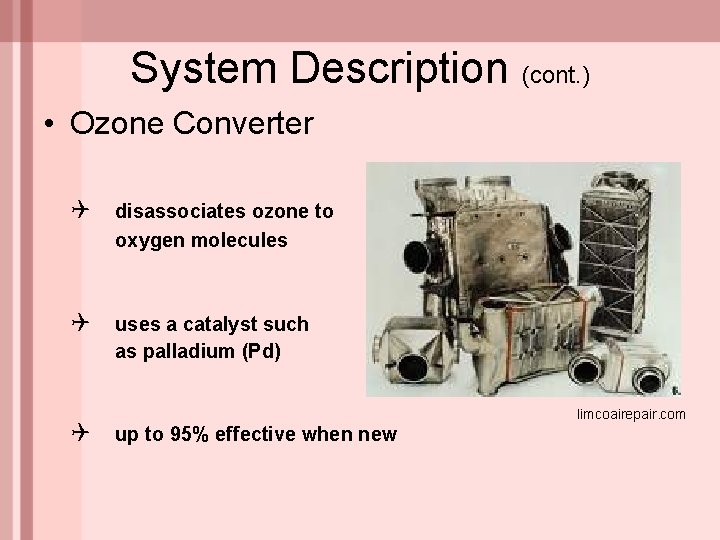
System Description (cont. ) • Ozone Converter Q disassociates ozone to oxygen molecules Q uses a catalyst such as palladium (Pd) Q up to 95% effective when new limcoairepair. com
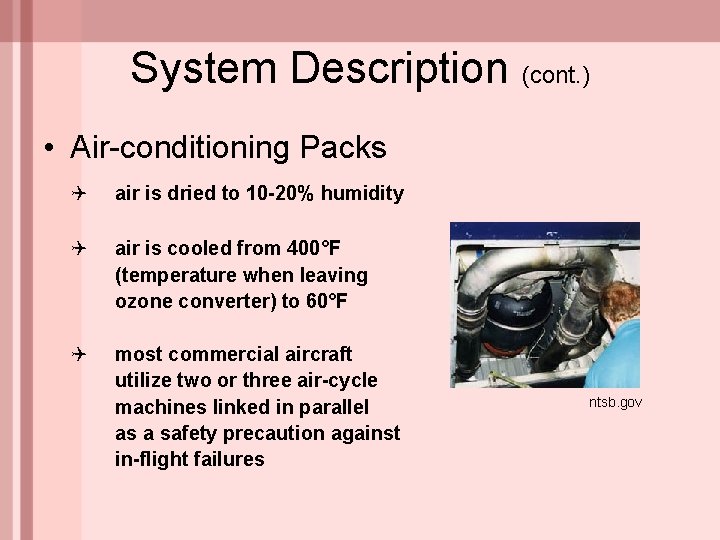
System Description (cont. ) • Air-conditioning Packs Q air is dried to 10 -20% humidity Q air is cooled from 400°F (temperature when leaving ozone converter) to 60°F Q most commercial aircraft utilize two or three air-cycle machines linked in parallel as a safety precaution against in-flight failures ntsb. gov
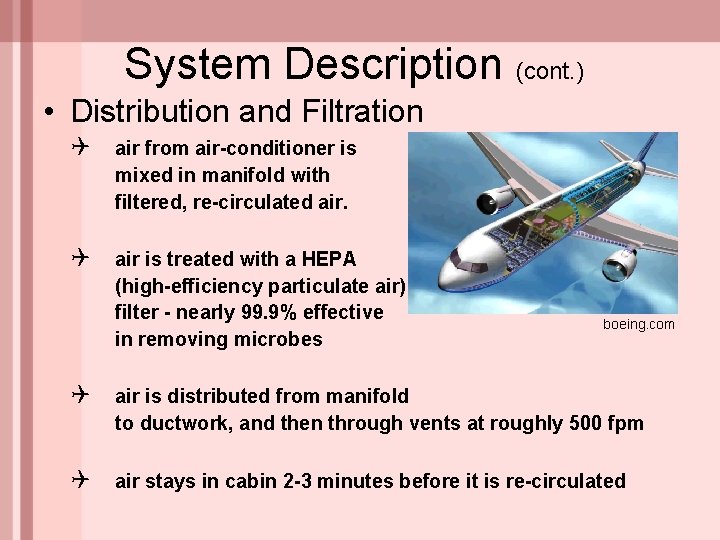
System Description (cont. ) • Distribution and Filtration Q air from air-conditioner is mixed in manifold with filtered, re-circulated air. Q air is treated with a HEPA (high-efficiency particulate air) filter - nearly 99. 9% effective in removing microbes boeing. com Q air is distributed from manifold to ductwork, and then through vents at roughly 500 fpm Q air stays in cabin 2 -3 minutes before it is re-circulated
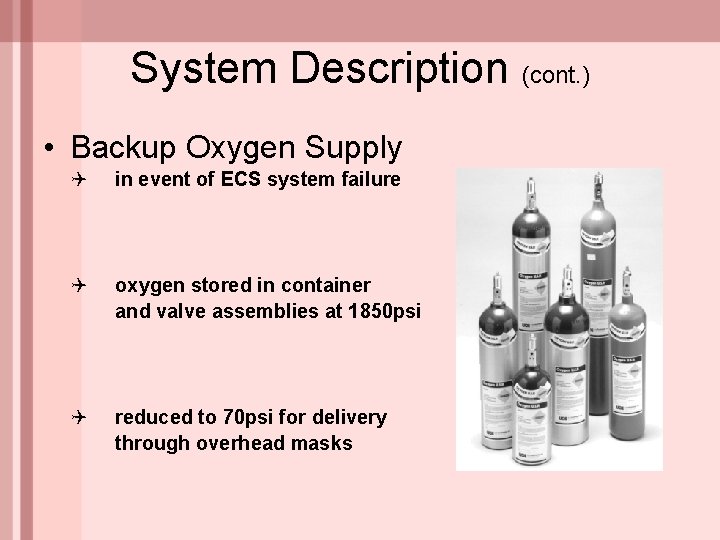
System Description (cont. ) • Backup Oxygen Supply Q in event of ECS system failure Q oxygen stored in container and valve assemblies at 1850 psi Q reduced to 70 psi for delivery through overhead masks
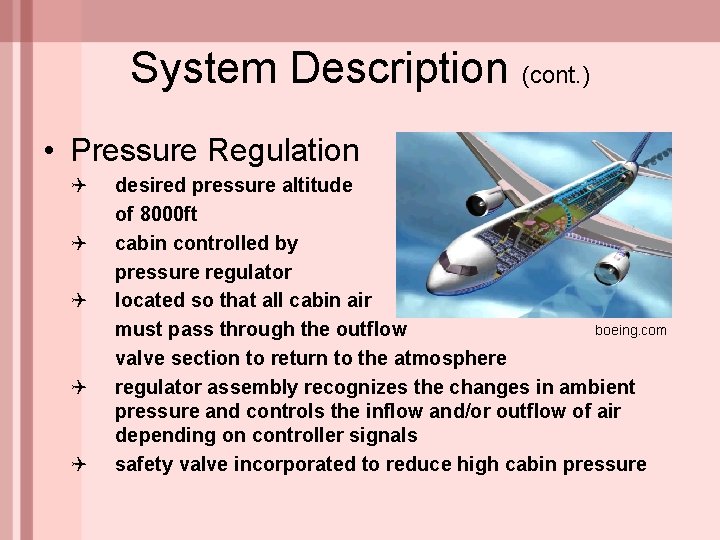
System Description (cont. ) • Pressure Regulation Q Q Q desired pressure altitude of 8000 ft cabin controlled by pressure regulator located so that all cabin air boeing. com must pass through the outflow valve section to return to the atmosphere regulator assembly recognizes the changes in ambient pressure and controls the inflow and/or outflow of air depending on controller signals safety valve incorporated to reduce high cabin pressure
Analyses Performed • Preliminary Hazard Analysis (PHA) • Failure Mode & Effects Analysis (FMEA) • Fault Tree Analysis (FTA)
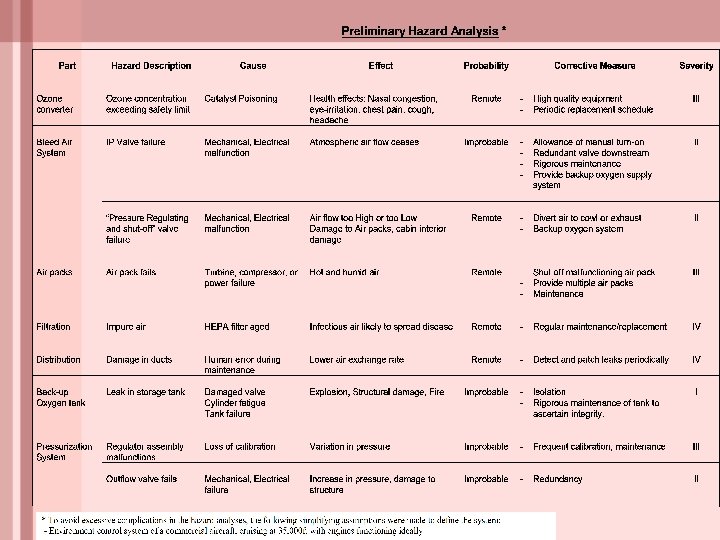
Preliminary Hazard Analysis • PHA Q takes place during the design phase Q review of historical safety experience Q identifies areas for concern Q identifies and evaluates hazards Q begins to consider safety design criteria
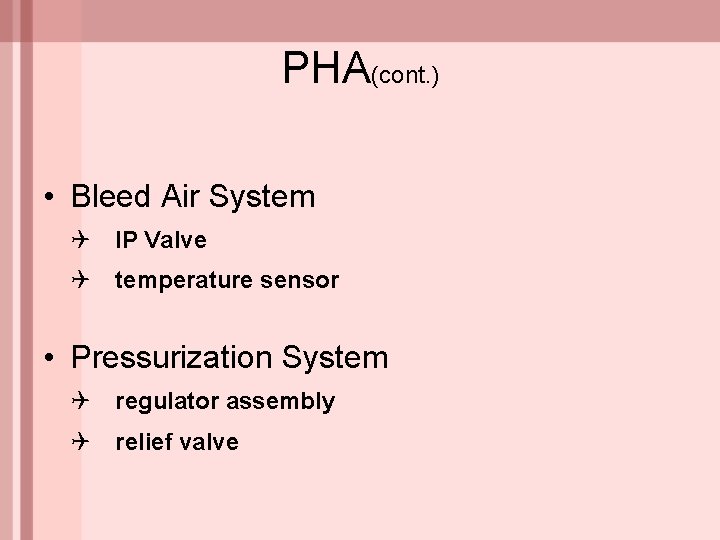
PHA(cont. ) • Bleed Air System Q IP Valve Q temperature sensor • Pressurization System Q regulator assembly Q relief valve
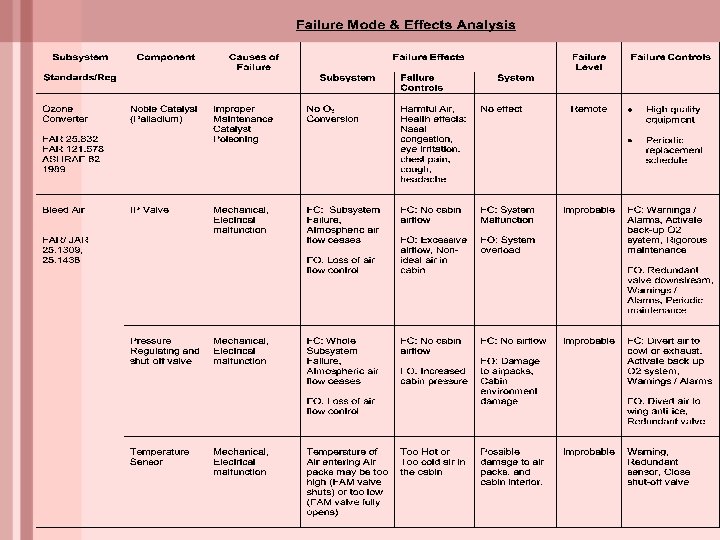
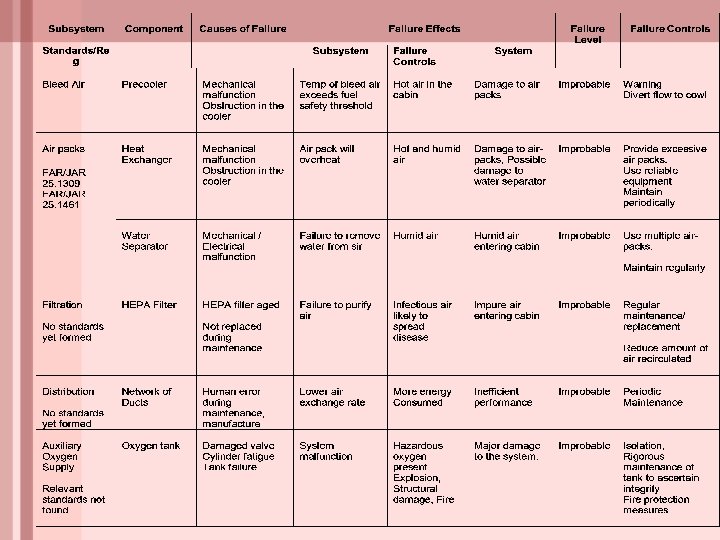
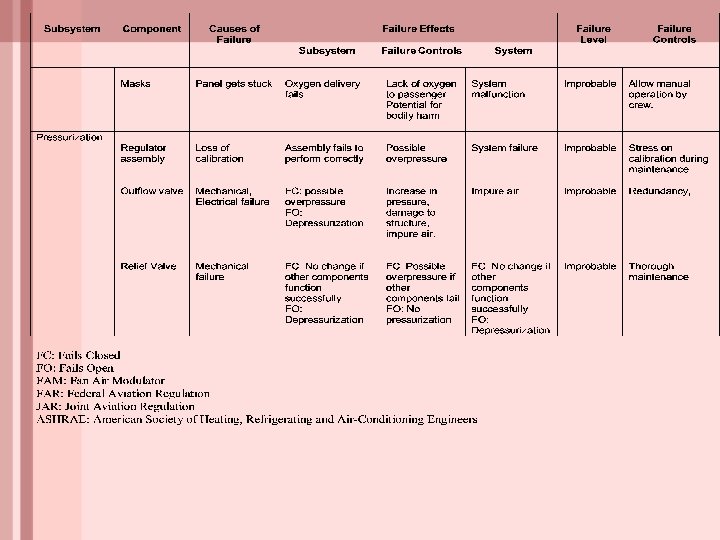
Failure Mode & Effects Analysis • FMEA Q reliability form of analysis Q may contain events that will not contribute to an accident Q analyzes system components for their contribution to a state of unreliability
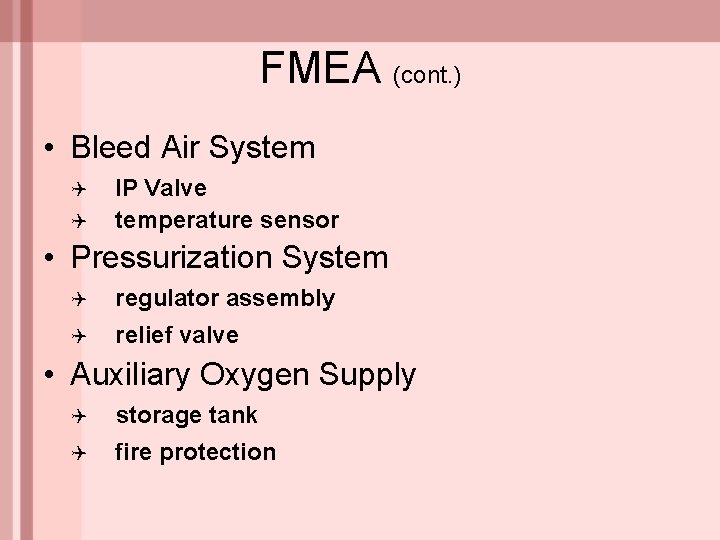
FMEA (cont. ) • Bleed Air System Q Q IP Valve temperature sensor • Pressurization System Q regulator assembly Q relief valve • Auxiliary Oxygen Supply Q storage tank Q fire protection
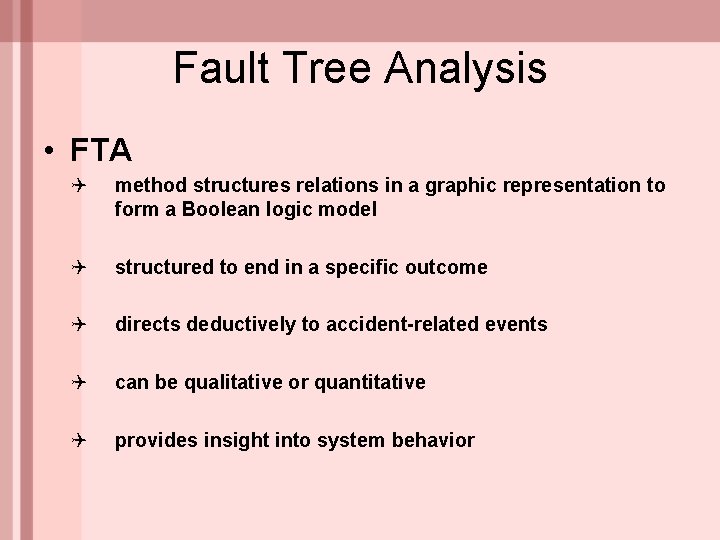
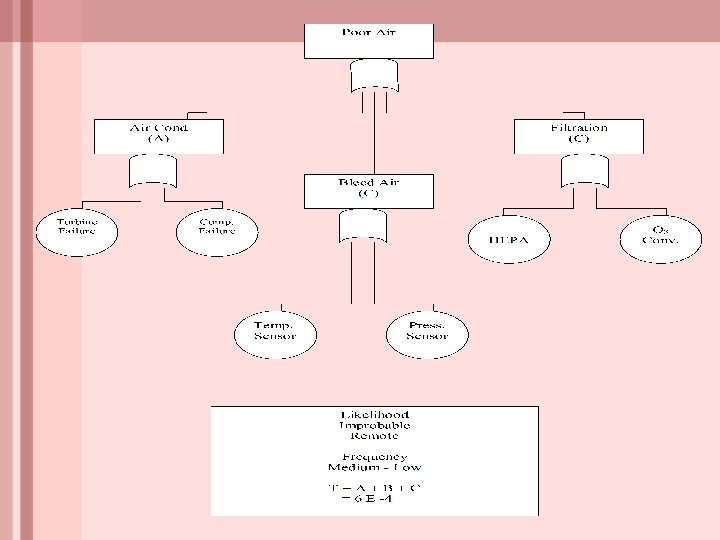
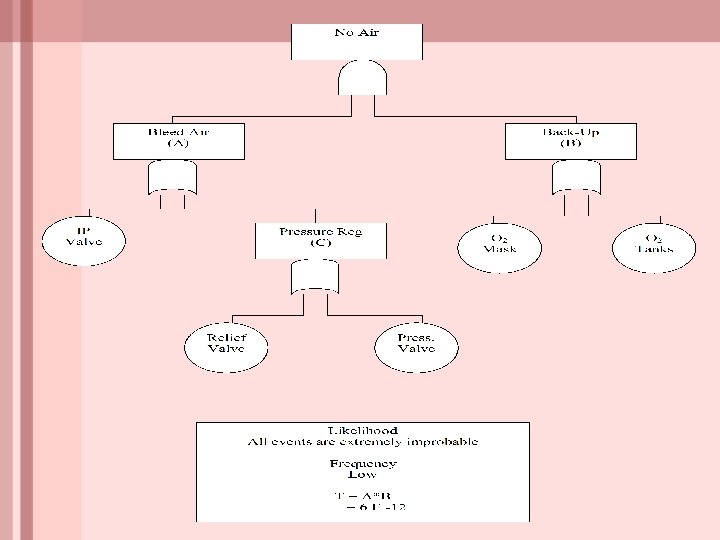
Fault Tree Analysis • FTA Q method structures relations in a graphic representation to form a Boolean logic model Q structured to end in a specific outcome Q directs deductively to accident-related events Q can be qualitative or quantitative Q provides insight into system behavior
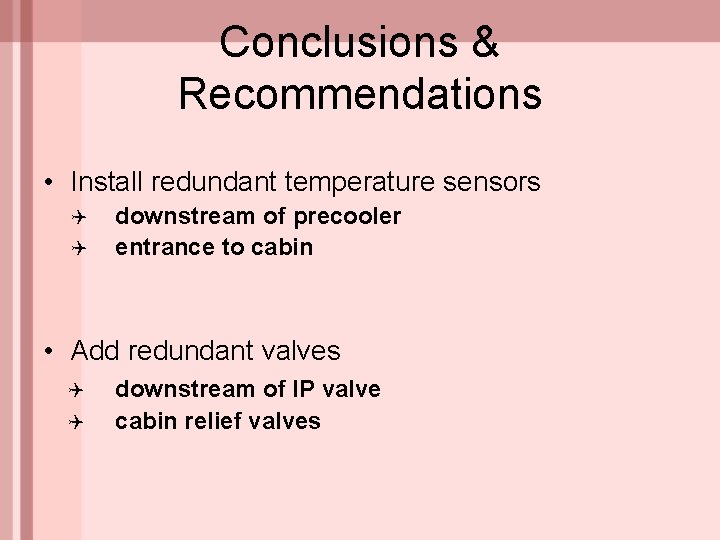
Conclusions & Recommendations • Install redundant temperature sensors Q Q downstream of precooler entrance to cabin • Add redundant valves Q Q downstream of IP valve cabin relief valves
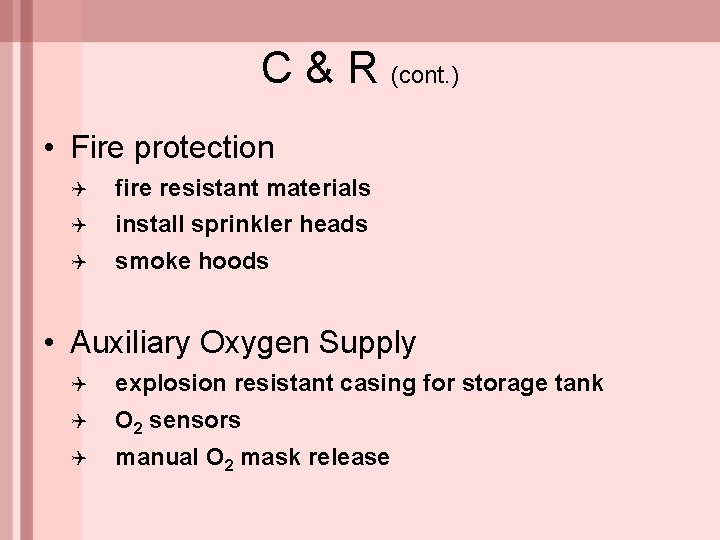
C & R (cont. ) • Fire protection Q fire resistant materials Q install sprinkler heads Q smoke hoods • Auxiliary Oxygen Supply Q explosion resistant casing for storage tank Q O 2 sensors Q manual O 2 mask release
C & R (cont. ) • Frequent software upgrades • Detailed maintenance procedures
Questions