
Pass Compos VS Imparfait WHEN WHY AND HOW
- Slides: 14
Passé Composé VS Imparfait WHEN, WHY AND HOW TO USE THEM ? Dr. Nidhi Sharma
PASSÉ COMPOSÉ AND IMPARFAIT ARE THE TWO MAJOR TENSES WHICH ARE USED TO TALK ABOUT
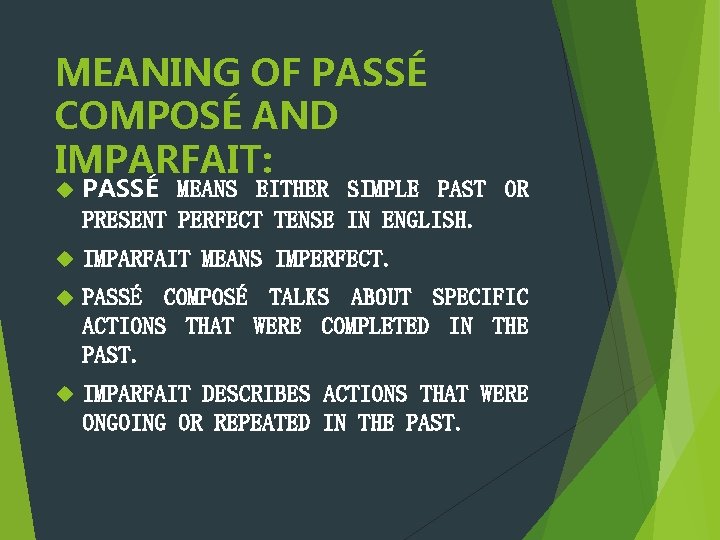
MEANING OF PASSÉ COMPOSÉ AND IMPARFAIT: PASSÉ MEANS EITHER SIMPLE PAST OR PRESENT PERFECT TENSE IN ENGLISH. IMPARFAIT MEANS IMPERFECT. PASSÉ COMPOSÉ TALKS ABOUT SPECIFIC ACTIONS THAT WERE COMPLETED IN THE PAST. IMPARFAIT DESCRIBES ACTIONS THAT WERE ONGOING OR REPEATED IN THE PAST.
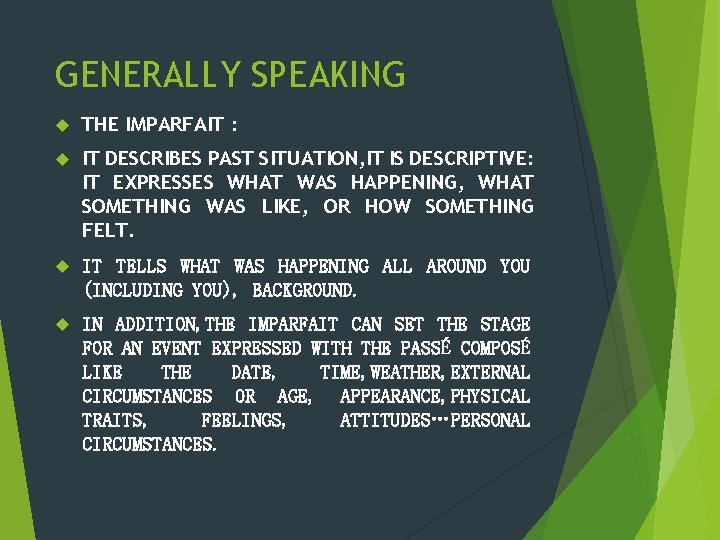
GENERALLY SPEAKING THE IMPARFAIT : IT DESCRIBES PAST SITUATION, IT IS DESCRIPTIVE: IT EXPRESSES WHAT WAS HAPPENING, WHAT SOMETHING WAS LIKE, OR HOW SOMETHING FELT. IT TELLS WHAT WAS HAPPENING ALL AROUND YOU (INCLUDING YOU), BACKGROUND. IN ADDITION, THE IMPARFAIT CAN SET THE STAGE FOR AN EVENT EXPRESSED WITH THE PASSÉ COMPOSÉ LIKE THE DATE, TIME, WEATHER, EXTERNAL CIRCUMSTANCES OR AGE, APPEARANCE, PHYSICAL TRAITS, FEELINGS, ATTITUDES…PERSONAL CIRCUMSTANCES.
Passé composé WHAT TOOK PLACE AT THAT VERY MOMENT: A SPECIFIC EVENT OR A SUCCESSION OF SPECIFIC EVENTS, THE MAIN STORYLINE. ** But you need to be careful as you cannot just translate from English. You have to understand the situation.
EXAMPLES: Le lundi, je dînais chez ma tante. (On Mondays, I used to have dinner at my aunt’s place. ) Un lundi, nous avons dîné au restaurant. (One Monday, we dined in a restaurant. ) * So, in this case, you need to look at the time setting words: “le lundi (habit) versus “un lundi” (specific).
Now see these examples: Je coupais des oignons quand il est arrivé. ( I was cutting onions when he arrived. ) Quand je suis arrivée chez elle, il pleuvait. ( when I arrived at her place, it was raining. )
COMPARE THE USES OF THESE TWO TENSES: INCOMPLETE VS COMPLETE THE IMPARFAIT DESCRIBES AN ONGOING ACTION IN THE PAST WITH NO SPECIFIED BEGINNING OR END FOR EXAMPLE: J’ALLAIS EN FRANCE. I WAS GOING TO FRANCE. JE VISITAIS DES MONUMENTS ET PRENAIS DES PHOTOS. I WAS VISITING MONUMENTS AND TAKING PICTURES.
PASSÉ COMPOSÉ EXPRESSES ONE OR MORE EVENTS OR ACTION THAT BEGAN AND ENDED IN THE PAST FOR EXAMPLE: JE SUIS ALLÉ EN FRANCE. I WENT TO FRANCE. J’AI VISITÉ DES MONUMENTS ET PRIS DES PHOTOS. I VISITED SOME MONUMENTS AND TOOK SOME PICTURES.
HABITUAL VS OCCASIONAL THE IMPERFECT IS USED FOR HABITUAL OR REPEATED ACTIONS, SOMETHING THAT HAPPENED AN UNCOUNTED NUMBER OF TIMES FOR EXAMPLE: JE VOYAGEAIS EN FRANCE TOUS LES ANS. I USED TO TRAVEL TO FRANCE EVERY YEAR. JE VISITAIS SOUVENT LE LOUVRE. I OFTEN VISITED THE LOUVRE.
ABOUT TALKS PASSÉ COMPOSÉ TALKS ABOUT A SINGLE EVENTS, OR AN EVENT THAT HAPPENED A SPECIFIC NUMBRE OF TIMES. FOR EXAMPLE J’AI VOYAGÉ EN FRANCE L’ANNÉE DERNIÈRE. I TRAVELLED TO FRANCE LAST YEAR.
Some “time” expressions are usually followed by the imperfect since they introduce habitual events. (But remember this is not set in stone, you need to see the context as well. Le lundi, le soir, le matin (on Mondays, in the evening, in the morning) Tous les lundis, tous les matins, tous les soirs. . ( Every Monday, every morning, every evening). Chaque jour, chaque semaine, chaque mois…(Each day, week, month) D’habitude, habituellement (ususally, habitually) Généralement, en general (in general) Normalement (usually) Parfois, quelque fois ( Sometimes) De temps en temps (from time to time) Autrefois (formerly) Rarement ( rarely, seldom)
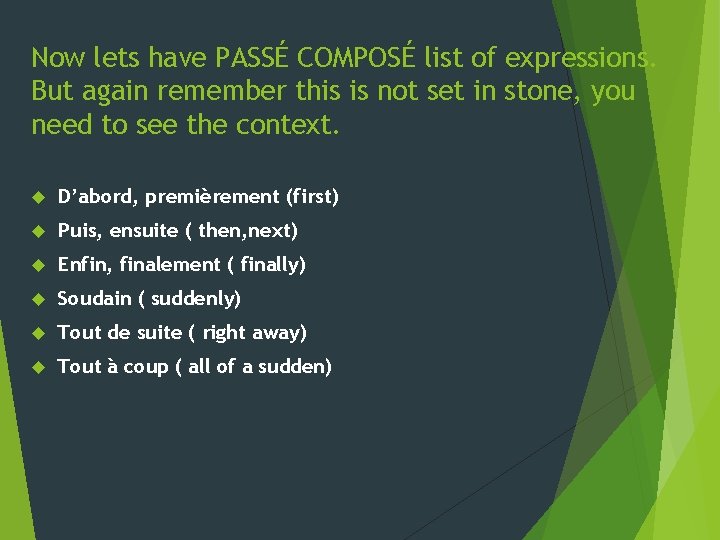
Now lets have PASSÉ COMPOSÉ list of expressions. But again remember this is not set in stone, you need to see the context. D’abord, premièrement (first) Puis, ensuite ( then, next) Enfin, finalement ( finally) Soudain ( suddenly) Tout de suite ( right away) Tout à coup ( all of a sudden)
MERCI BEAUCOUP