
Pascal To Java The Transition Documentation Variables and
Pascal To Java: The Transition Documentation Variables and constants Advanced input and output Decision making Loops Homogeneous composite types (arrays) Modularization (functions/procedures and methods) Intermediate Pascal to Java examples James Tam
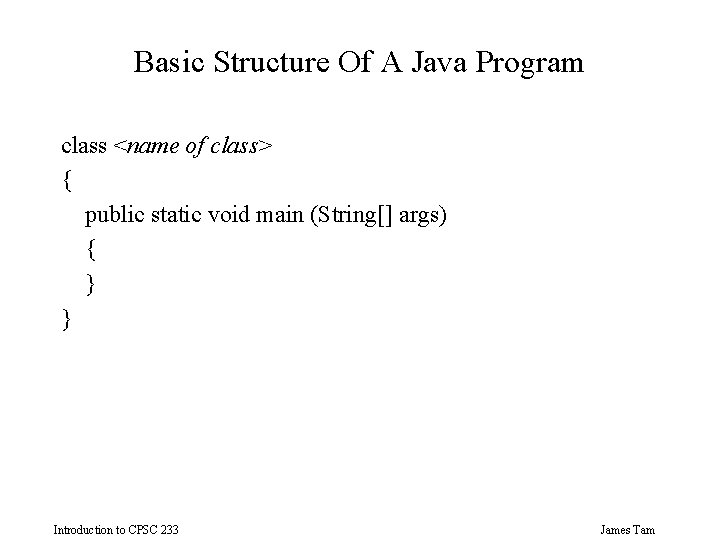
Basic Structure Of A Java Program class <name of class> { public static void main (String[] args) { } } Introduction to CPSC 233 James Tam
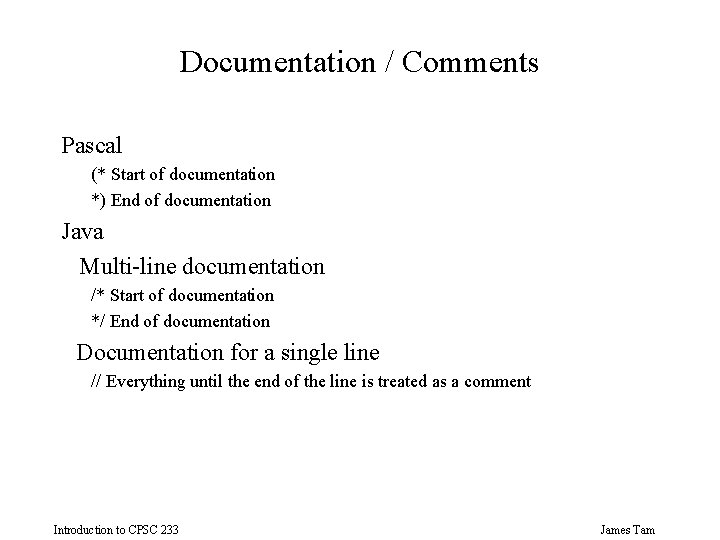
Documentation / Comments Pascal (* Start of documentation *) End of documentation Java Multi-line documentation /* Start of documentation */ End of documentation Documentation for a single line // Everything until the end of the line is treated as a comment Introduction to CPSC 233 James Tam
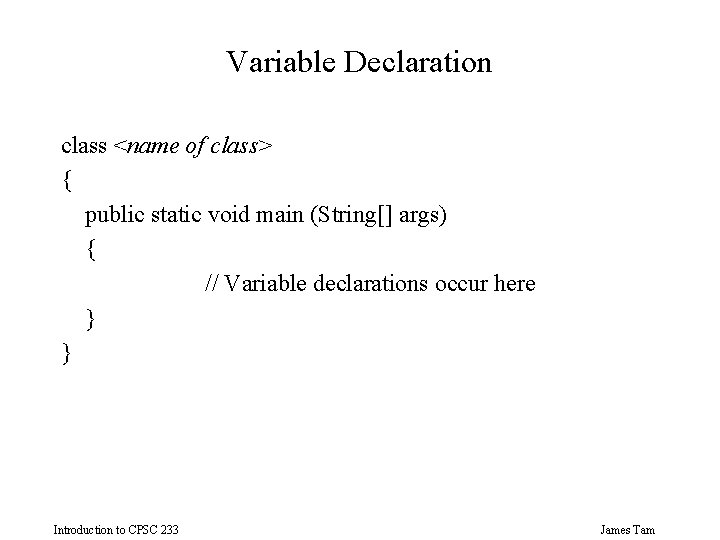
Variable Declaration class <name of class> { public static void main (String[] args) { // Variable declarations occur here } } Introduction to CPSC 233 James Tam
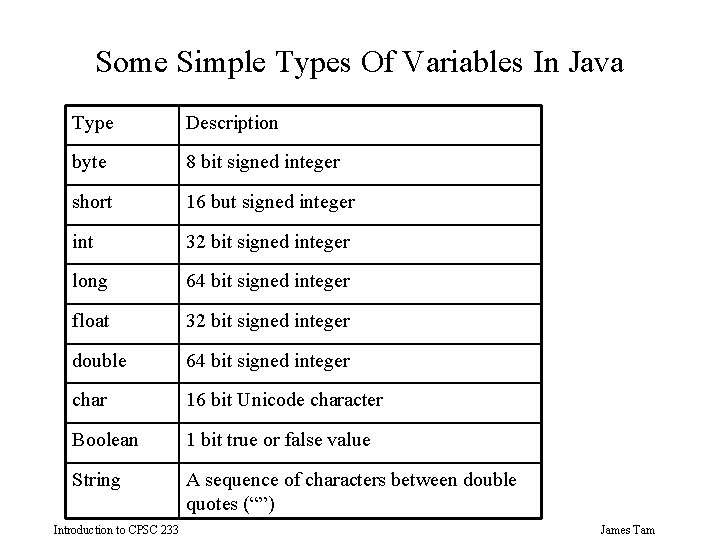
Some Simple Types Of Variables In Java Type Description byte 8 bit signed integer short 16 but signed integer int 32 bit signed integer long 64 bit signed integer float 32 bit signed integer double 64 bit signed integer char 16 bit Unicode character Boolean 1 bit true or false value String A sequence of characters between double quotes (“”) Introduction to CPSC 233 James Tam
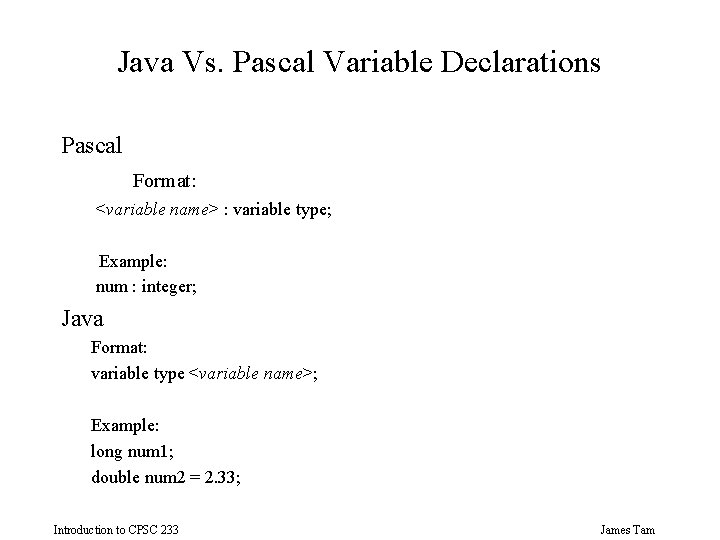
Java Vs. Pascal Variable Declarations Pascal Format: <variable name> : variable type; Example: num : integer; Java Format: variable type <variable name>; Example: long num 1; double num 2 = 2. 33; Introduction to CPSC 233 James Tam
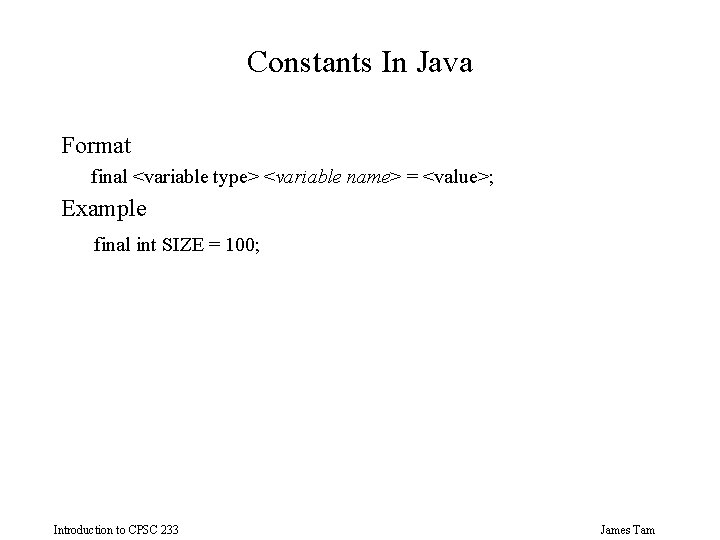
Constants In Java Format final <variable type> <variable name> = <value>; Example final int SIZE = 100; Introduction to CPSC 233 James Tam
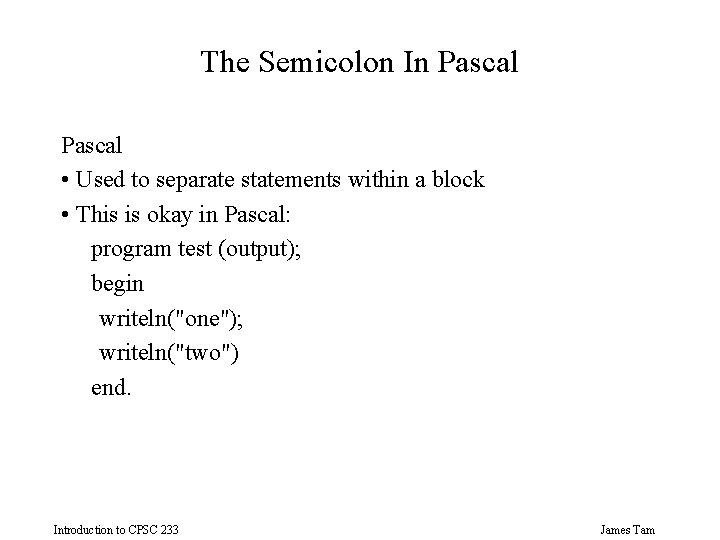
The Semicolon In Pascal • Used to separate statements within a block • This is okay in Pascal: program test (output); begin writeln("one"); writeln("two") end. Introduction to CPSC 233 James Tam
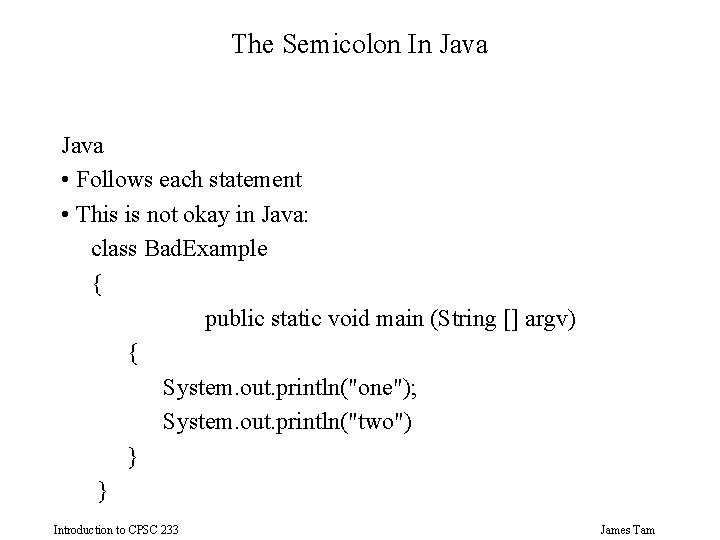
The Semicolon In Java • Follows each statement • This is not okay in Java: class Bad. Example { public static void main (String [] argv) { System. out. println("one"); System. out. println("two") } } Introduction to CPSC 233 James Tam
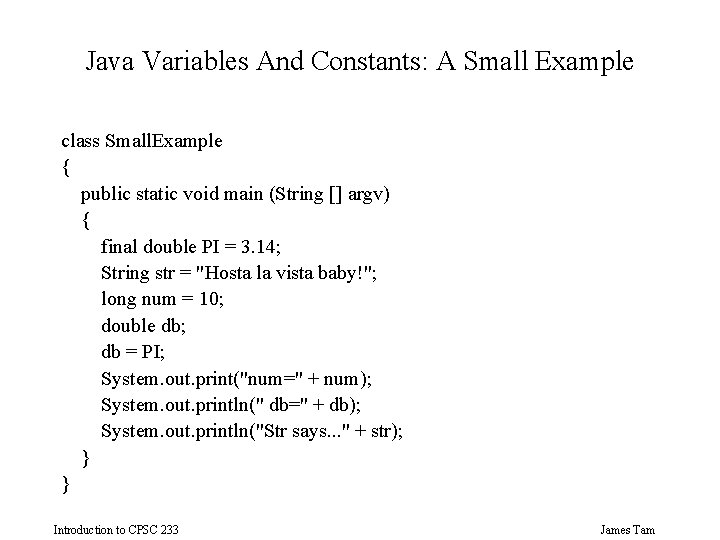
Java Variables And Constants: A Small Example class Small. Example { public static void main (String [] argv) { final double PI = 3. 14; String str = "Hosta la vista baby!"; long num = 10; double db; db = PI; System. out. print("num=" + num); System. out. println(" db=" + db); System. out. println("Str says. . . " + str); } } Introduction to CPSC 233 James Tam
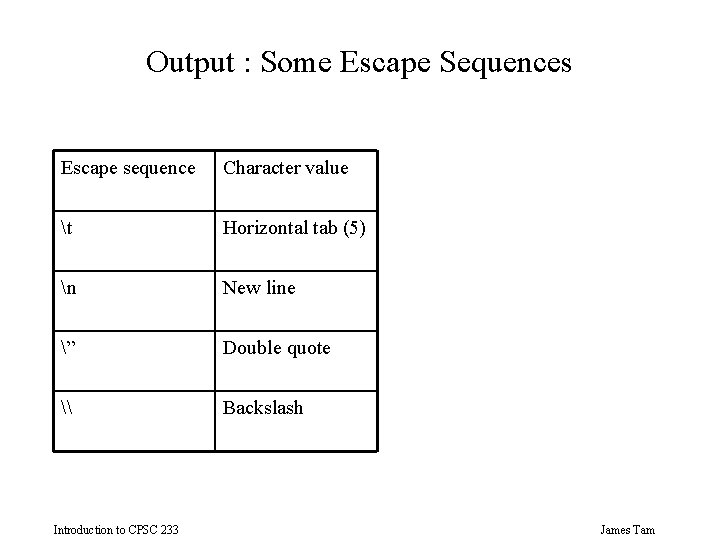
Output : Some Escape Sequences Escape sequence Character value t Horizontal tab (5) n New line ” Double quote \ Backslash Introduction to CPSC 233 James Tam
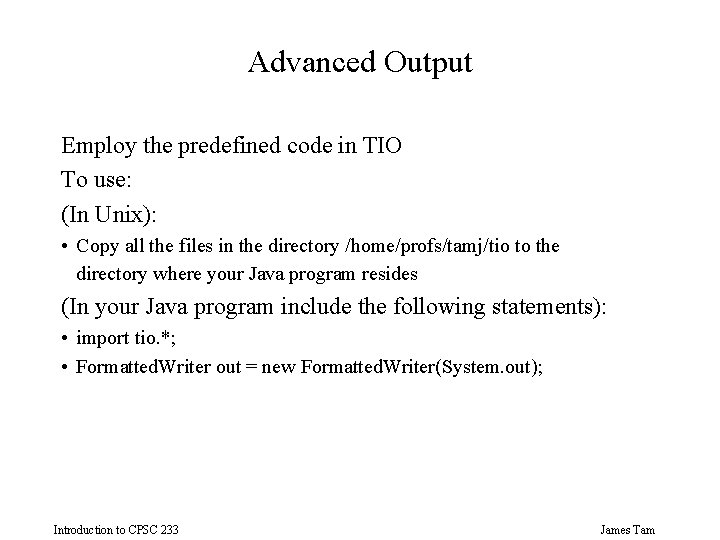
Advanced Output Employ the predefined code in TIO To use: (In Unix): • Copy all the files in the directory /home/profs/tamj/tio to the directory where your Java program resides (In your Java program include the following statements): • import tio. *; • Formatted. Writer out = new Formatted. Writer(System. out); Introduction to CPSC 233 James Tam
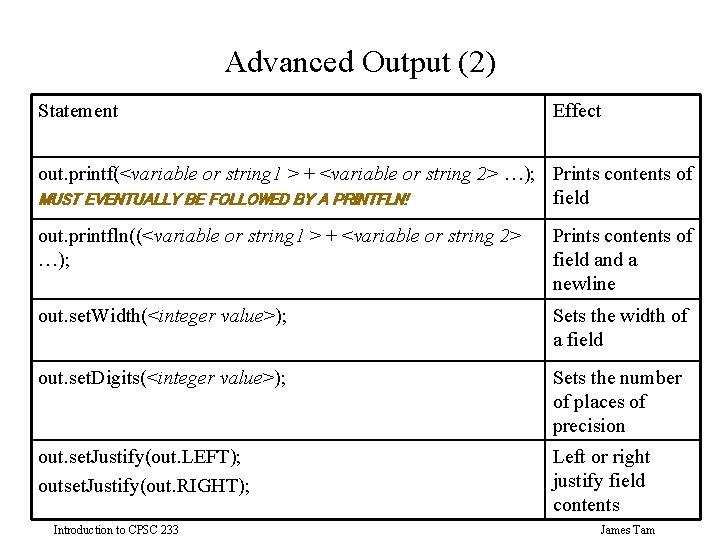
Advanced Output (2) Statement Effect out. printf(<variable or string 1 > + <variable or string 2> …); Prints contents of field MUST EVENTUALLY BE FOLLOWED BY A PRINTFLN! out. printfln((<variable or string 1 > + <variable or string 2> …); Prints contents of field and a newline out. set. Width(<integer value>); Sets the width of a field out. set. Digits(<integer value>); Sets the number of places of precision out. set. Justify(out. LEFT); outset. Justify(out. RIGHT); Left or right justify field contents Introduction to CPSC 233 James Tam
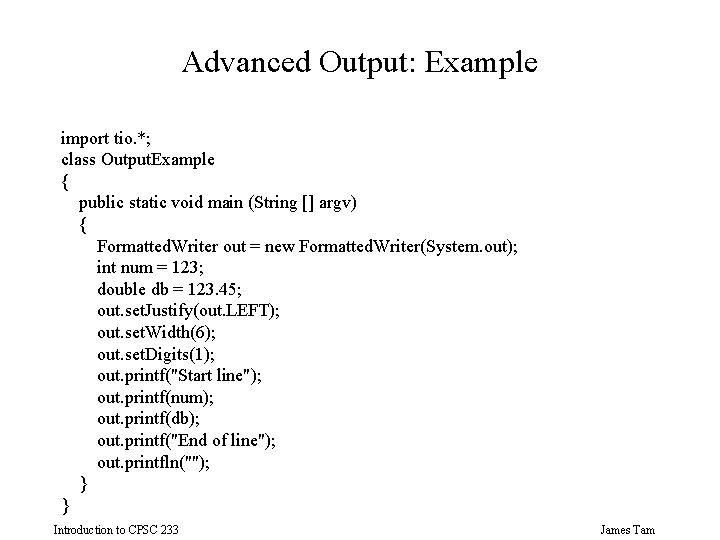
Advanced Output: Example import tio. *; class Output. Example { public static void main (String [] argv) { Formatted. Writer out = new Formatted. Writer(System. out); int num = 123; double db = 123. 45; out. set. Justify(out. LEFT); out. set. Width(6); out. set. Digits(1); out. printf("Start line"); out. printf(num); out. printf(db); out. printf("End of line"); out. printfln(""); } } Introduction to CPSC 233 James Tam
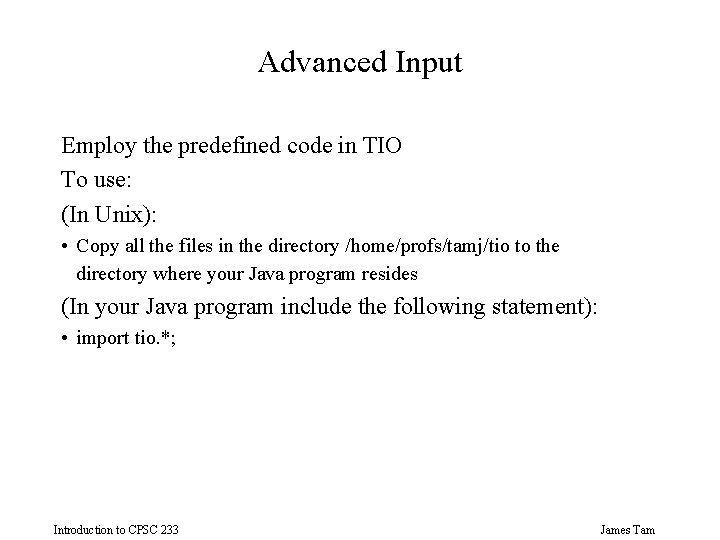
Advanced Input Employ the predefined code in TIO To use: (In Unix): • Copy all the files in the directory /home/profs/tamj/tio to the directory where your Java program resides (In your Java program include the following statement): • import tio. *; Introduction to CPSC 233 James Tam
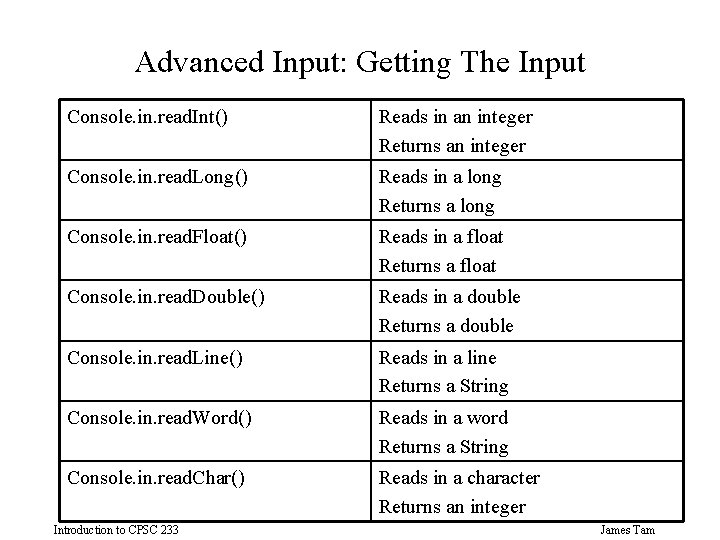
Advanced Input: Getting The Input Console. in. read. Int() Reads in an integer Returns an integer Console. in. read. Long() Reads in a long Returns a long Console. in. read. Float() Reads in a float Returns a float Console. in. read. Double() Reads in a double Returns a double Console. in. read. Line() Reads in a line Returns a String Console. in. read. Word() Reads in a word Returns a String Console. in. read. Char() Reads in a character Returns an integer Introduction to CPSC 233 James Tam
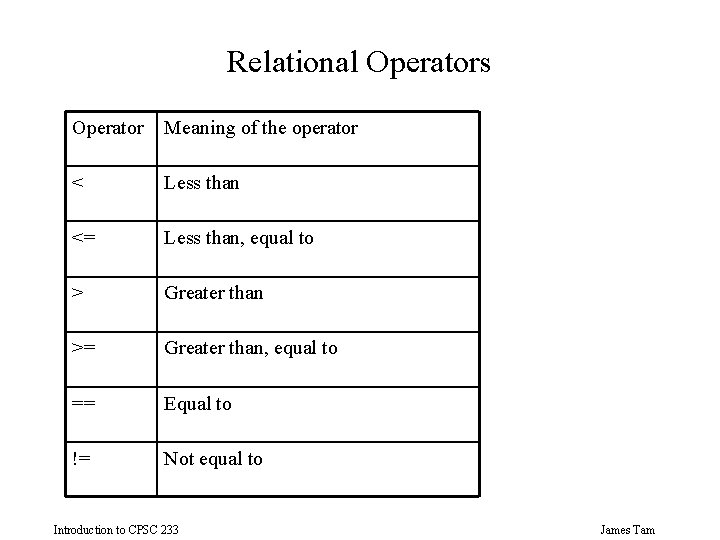
Relational Operators Operator Meaning of the operator < Less than <= Less than, equal to > Greater than >= Greater than, equal to == Equal to != Not equal to Introduction to CPSC 233 James Tam
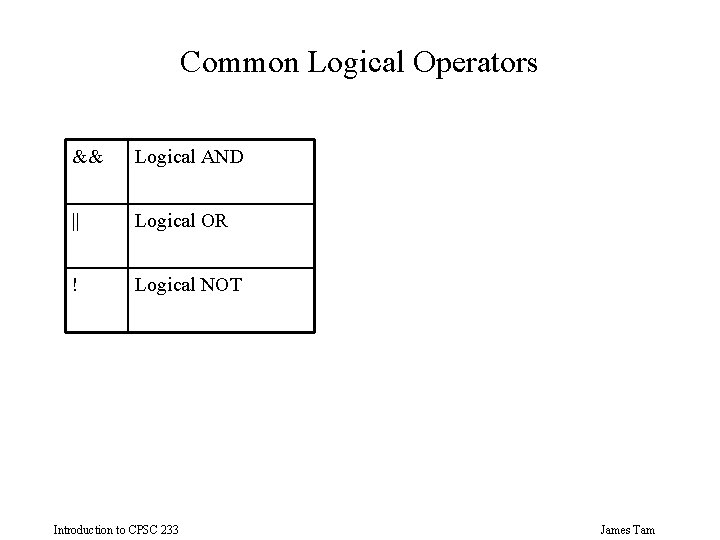
Common Logical Operators && Logical AND || Logical OR ! Logical NOT Introduction to CPSC 233 James Tam
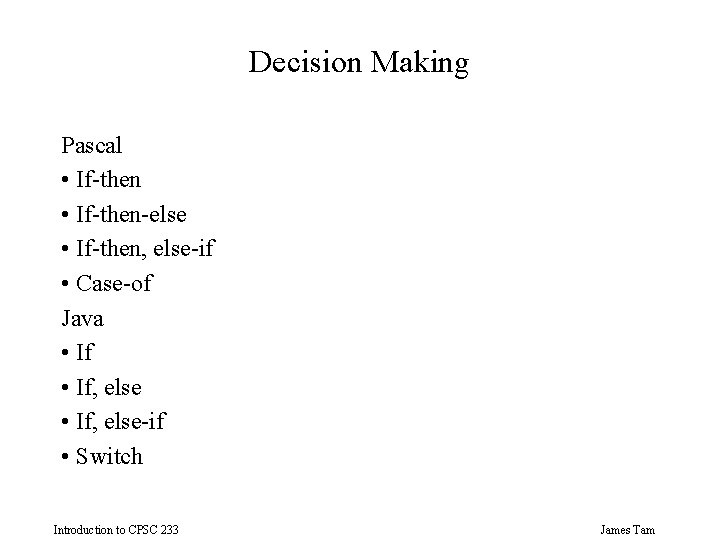
Decision Making Pascal • If-then-else • If-then, else-if • Case-of Java • If, else-if • Switch Introduction to CPSC 233 James Tam
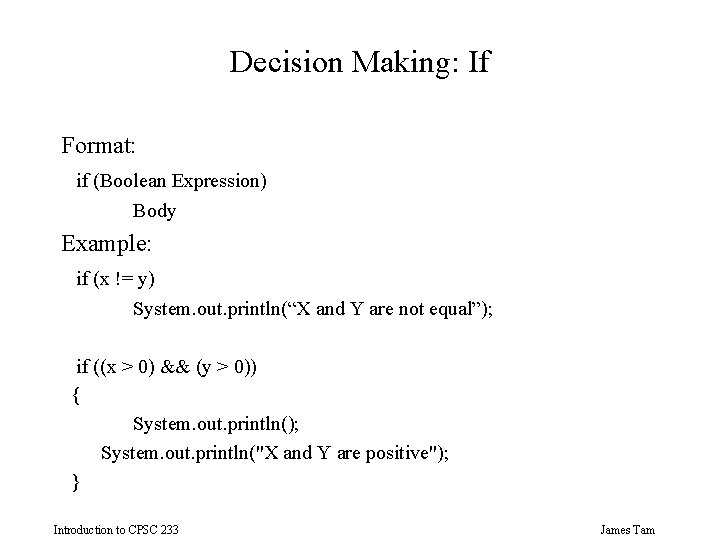
Decision Making: If Format: if (Boolean Expression) Body Example: if (x != y) System. out. println(“X and Y are not equal”); if ((x > 0) && (y > 0)) { System. out. println(); System. out. println("X and Y are positive"); } Introduction to CPSC 233 James Tam
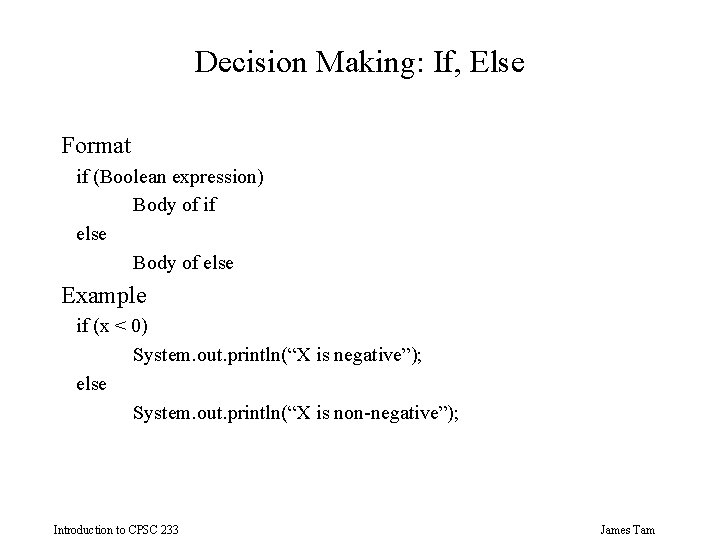
Decision Making: If, Else Format if (Boolean expression) Body of if else Body of else Example if (x < 0) System. out. println(“X is negative”); else System. out. println(“X is non-negative”); Introduction to CPSC 233 James Tam
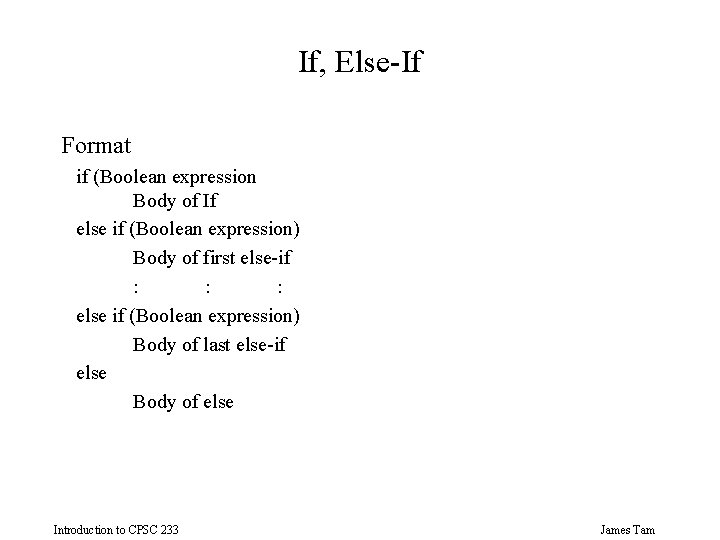
If, Else-If Format if (Boolean expression Body of If else if (Boolean expression) Body of first else-if : : : else if (Boolean expression) Body of last else-if else Body of else Introduction to CPSC 233 James Tam
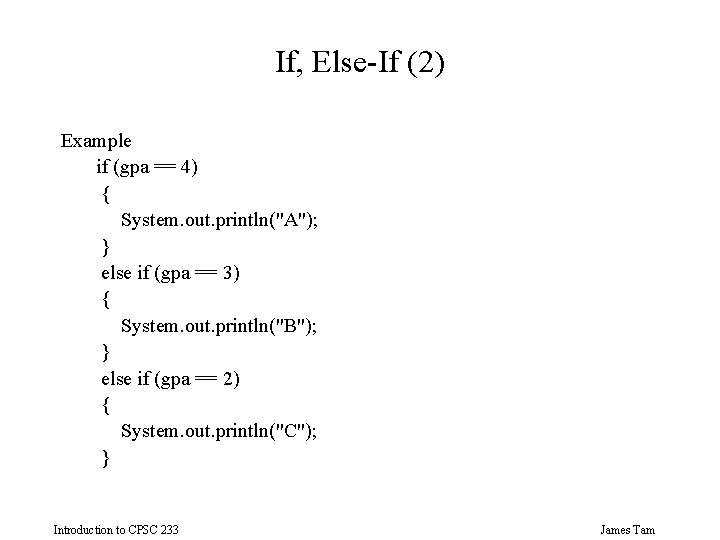
If, Else-If (2) Example if (gpa == 4) { System. out. println("A"); } else if (gpa == 3) { System. out. println("B"); } else if (gpa == 2) { System. out. println("C"); } Introduction to CPSC 233 James Tam
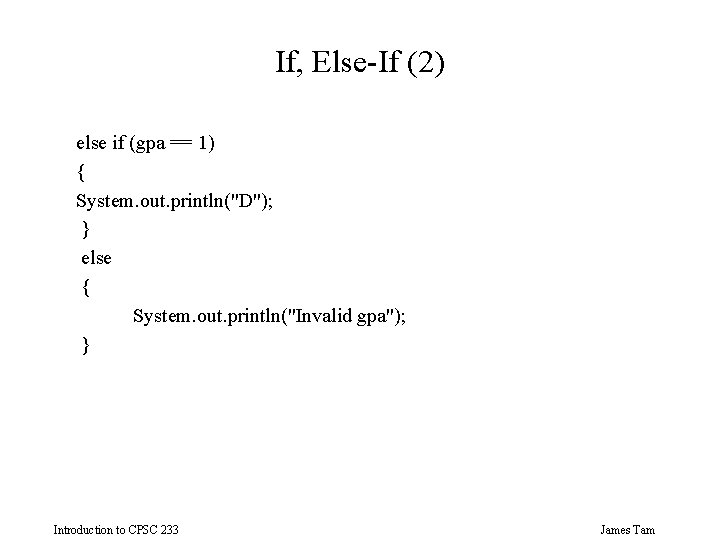
If, Else-If (2) else if (gpa == 1) { System. out. println("D"); } else { System. out. println("Invalid gpa"); } Introduction to CPSC 233 James Tam
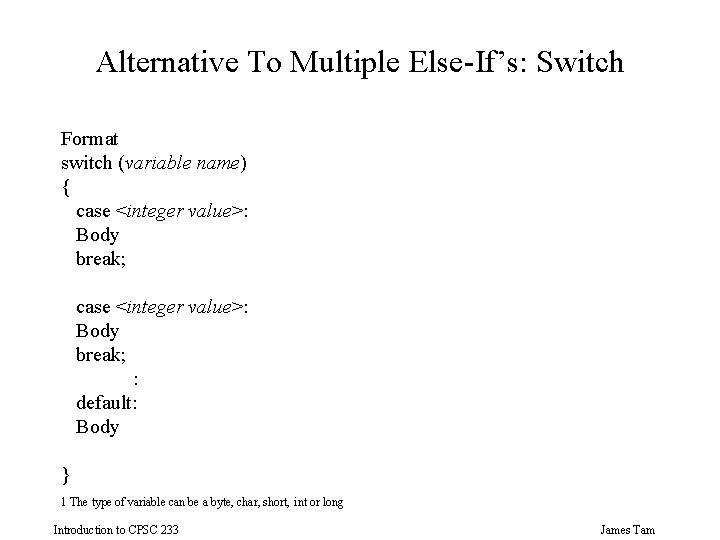
Alternative To Multiple Else-If’s: Switch Format switch (variable name) { case <integer value>: Body break; : default: Body } 1 The type of variable can be a byte, char, short, int or long Introduction to CPSC 233 James Tam
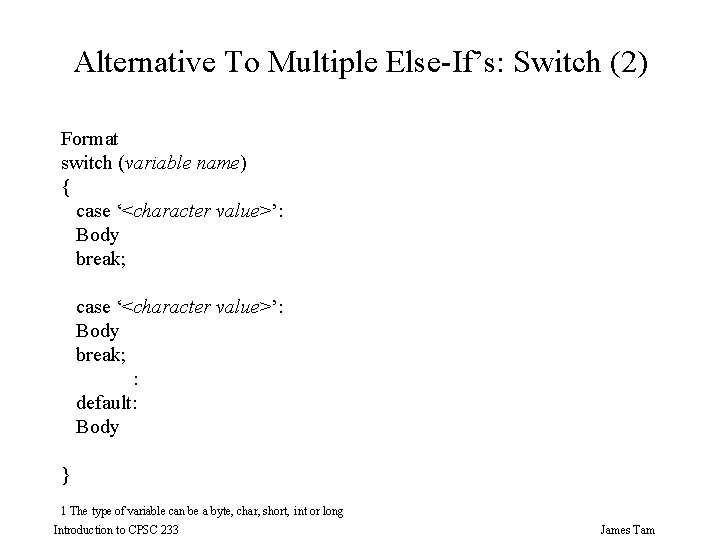
Alternative To Multiple Else-If’s: Switch (2) Format switch (variable name) { case ‘<character value>’: Body break; : default: Body } 1 The type of variable can be a byte, char, short, int or long Introduction to CPSC 233 James Tam
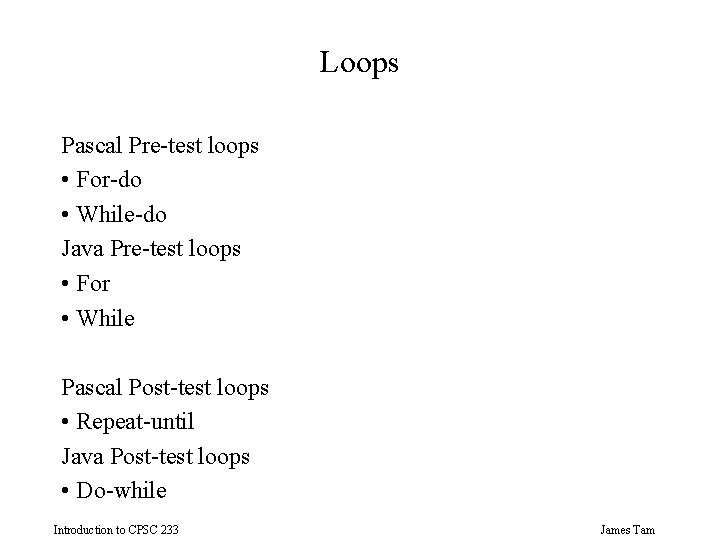
Loops Pascal Pre-test loops • For-do • While-do Java Pre-test loops • For • While Pascal Post-test loops • Repeat-until Java Post-test loops • Do-while Introduction to CPSC 233 James Tam
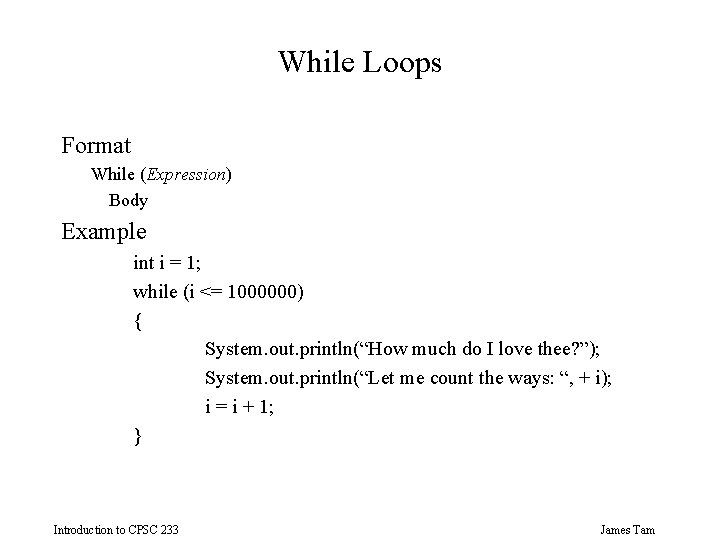
While Loops Format While (Expression) Body Example int i = 1; while (i <= 1000000) { System. out. println(“How much do I love thee? ”); System. out. println(“Let me count the ways: “, + i); i = i + 1; } Introduction to CPSC 233 James Tam
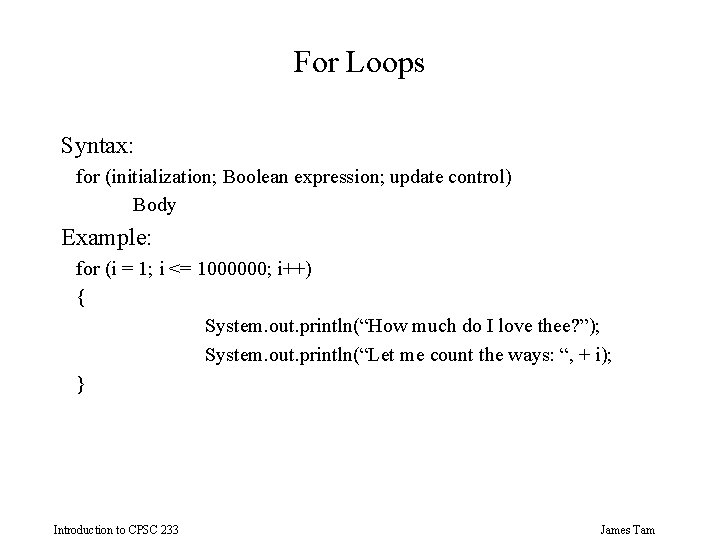
For Loops Syntax: for (initialization; Boolean expression; update control) Body Example: for (i = 1; i <= 1000000; i++) { System. out. println(“How much do I love thee? ”); System. out. println(“Let me count the ways: “, + i); } Introduction to CPSC 233 James Tam
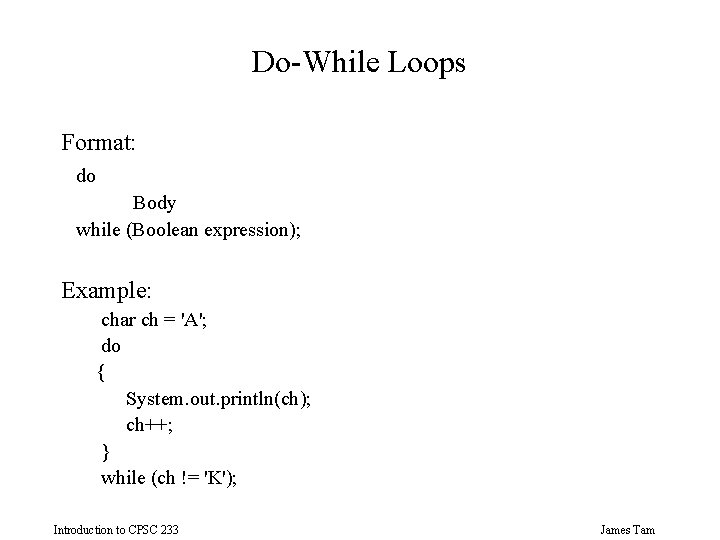
Do-While Loops Format: do Body while (Boolean expression); Example: char ch = 'A'; do { System. out. println(ch); ch++; } while (ch != 'K'); Introduction to CPSC 233 James Tam
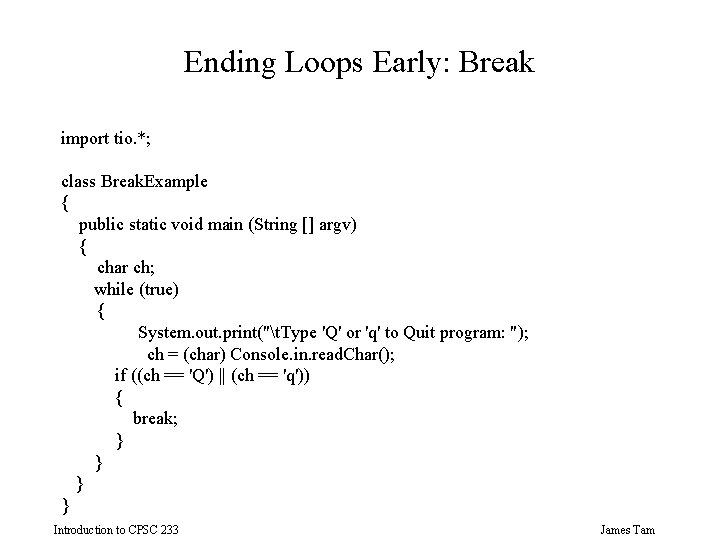
Ending Loops Early: Break import tio. *; class Break. Example { public static void main (String [] argv) { char ch; while (true) { System. out. print("t. Type 'Q' or 'q' to Quit program: "); ch = (char) Console. in. read. Char(); if ((ch == 'Q') || (ch == 'q')) { break; } } Introduction to CPSC 233 James Tam
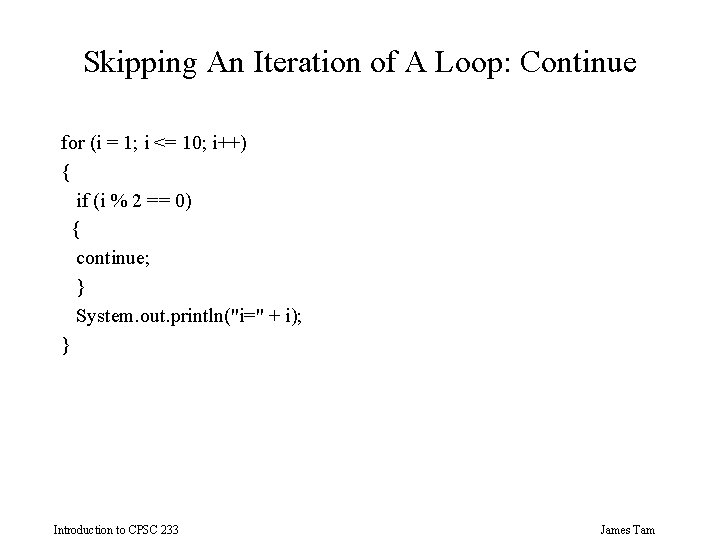
Skipping An Iteration of A Loop: Continue for (i = 1; i <= 10; i++) { if (i % 2 == 0) { continue; } System. out. println("i=" + i); } Introduction to CPSC 233 James Tam
Homogeneous Composite Types (Arrays) Important points to remember for Java: • An array of n elements will have an index of zero for the first element up to (n-1) for the last element • The array index must be an integer • Declaring arrays involves dynamic memory allocation (references) Introduction to CPSC 233 James Tam
Homogeneous Composite Types (Arrays) Important points to remember for Java: • An array of n elements will have an index of zero for the first element up to (n-1) for the last element • The array index must be an integer • Declaring arrays involves dynamic memory allocation (references) Introduction to CPSC 233 James Tam
References It is a pointer that cannot be dereferenced by the programmer Automatically garbage collected when no longer needed Introduction to CPSC 233 James Tam
References It is a pointer that cannot be dereferenced by the programmer Automatically garbage collected when no longer needed Introduction to CPSC 233 James Tam
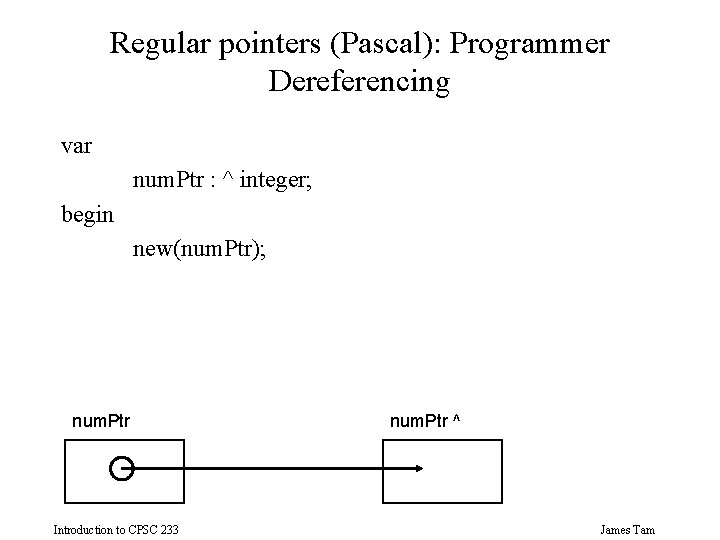
Regular pointers (Pascal): Programmer Dereferencing var num. Ptr : ^ integer; begin new(num. Ptr); num. Ptr Introduction to CPSC 233 num. Ptr ^ James Tam
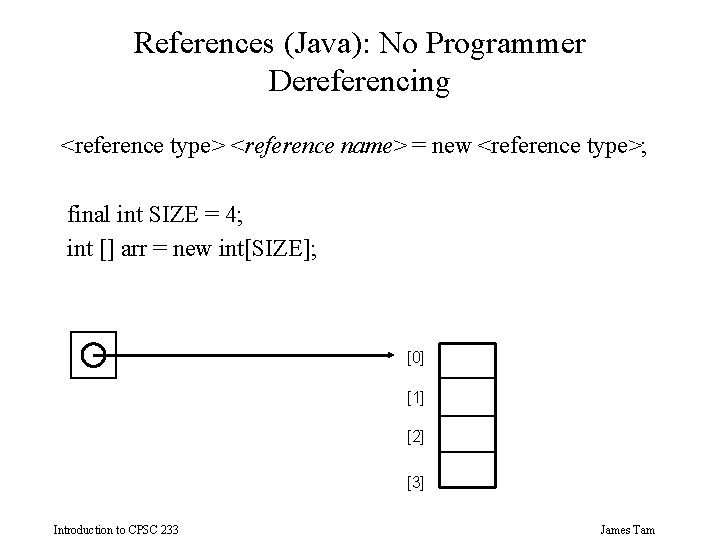
References (Java): No Programmer Dereferencing <reference type> <reference name> = new <reference type>; final int SIZE = 4; int [] arr = new int[SIZE]; [0] [1] [2] [3] Introduction to CPSC 233 James Tam
References It is a pointer that cannot be dereferenced by the programmer Automatically garbage collected when no longer needed Introduction to CPSC 233 James Tam
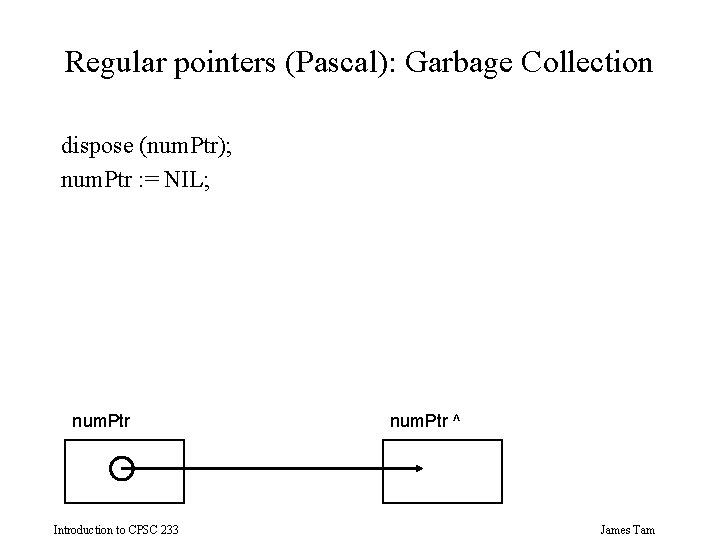
Regular pointers (Pascal): Garbage Collection dispose (num. Ptr); num. Ptr : = NIL; num. Ptr Introduction to CPSC 233 num. Ptr ^ James Tam
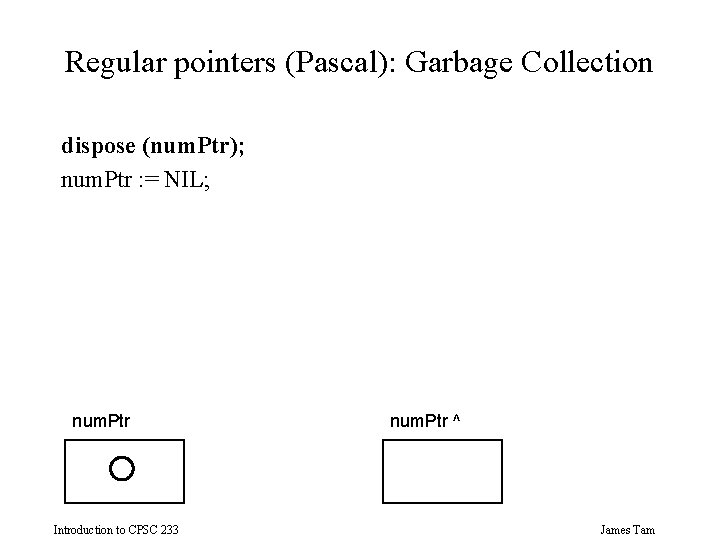
Regular pointers (Pascal): Garbage Collection dispose (num. Ptr); num. Ptr : = NIL; num. Ptr Introduction to CPSC 233 num. Ptr ^ James Tam
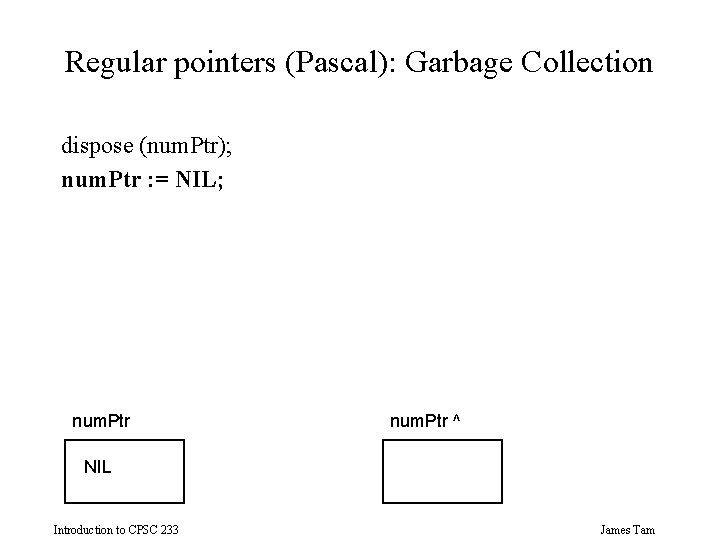
Regular pointers (Pascal): Garbage Collection dispose (num. Ptr); num. Ptr : = NIL; num. Ptr ^ NIL Introduction to CPSC 233 James Tam
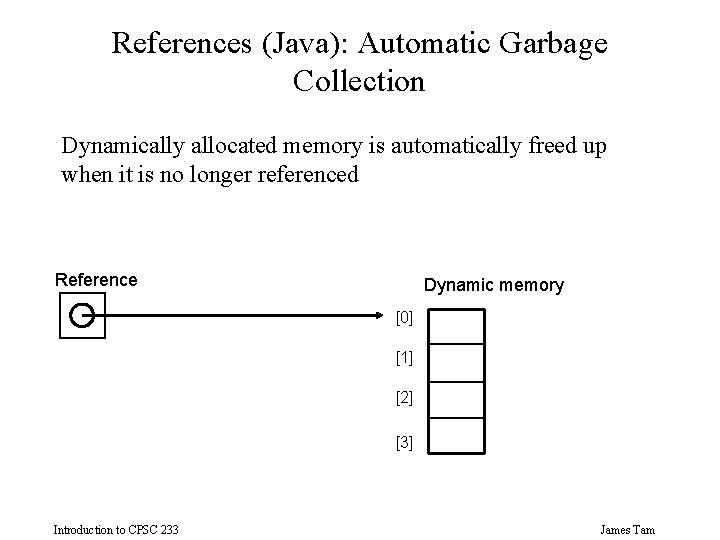
References (Java): Automatic Garbage Collection Dynamically allocated memory is automatically freed up when it is no longer referenced Reference Dynamic memory [0] [1] [2] [3] Introduction to CPSC 233 James Tam
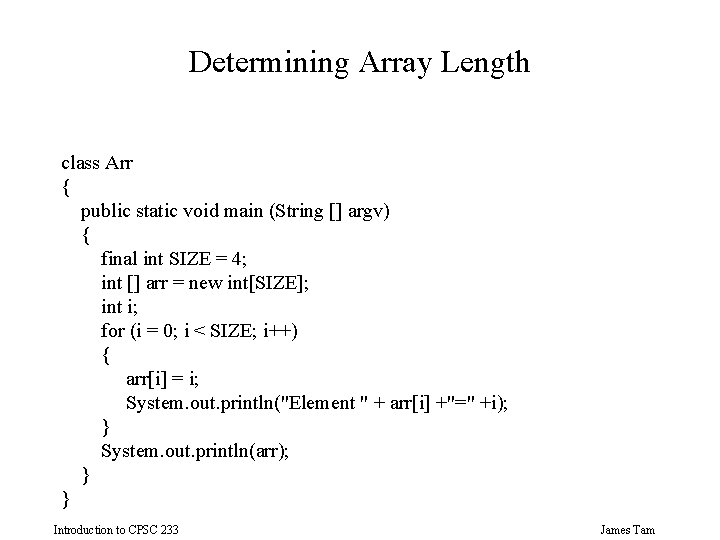
Determining Array Length class Arr { public static void main (String [] argv) { final int SIZE = 4; int [] arr = new int[SIZE]; int i; for (i = 0; i < SIZE; i++) { arr[i] = i; System. out. println("Element " + arr[i] +"=" +i); } System. out. println(arr); } } Introduction to CPSC 233 James Tam
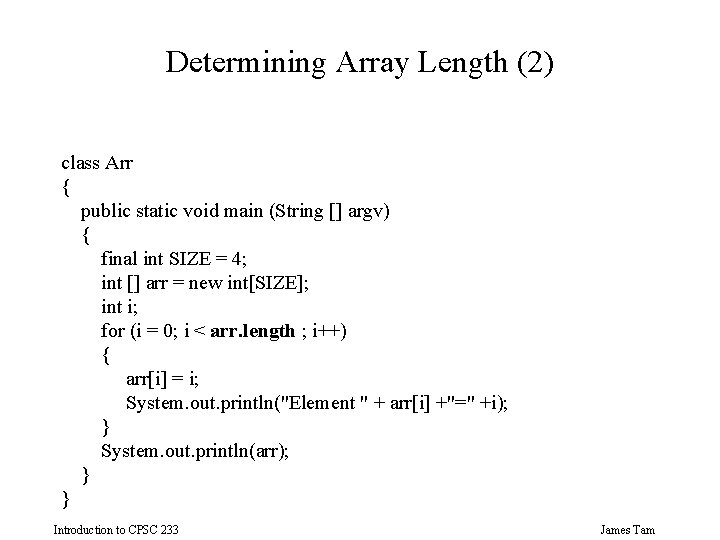
Determining Array Length (2) class Arr { public static void main (String [] argv) { final int SIZE = 4; int [] arr = new int[SIZE]; int i; for (i = 0; i < arr. length ; i++) { arr[i] = i; System. out. println("Element " + arr[i] +"=" +i); } System. out. println(arr); } } Introduction to CPSC 233 James Tam
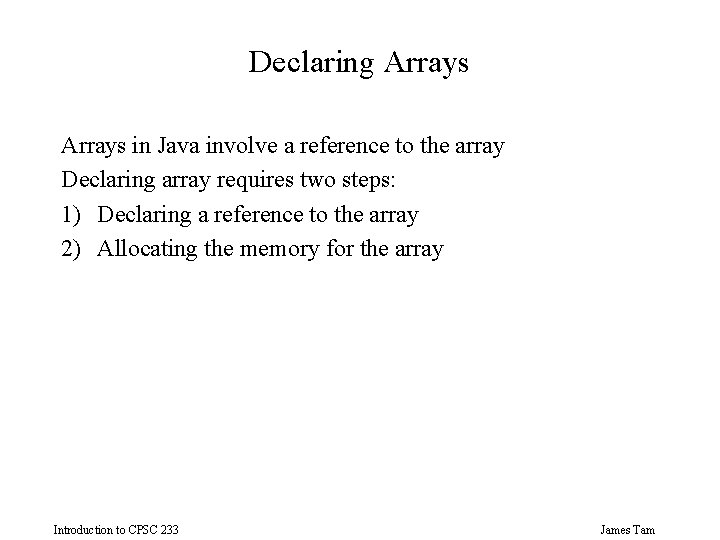
Declaring Arrays in Java involve a reference to the array Declaring array requires two steps: 1) Declaring a reference to the array 2) Allocating the memory for the array Introduction to CPSC 233 James Tam
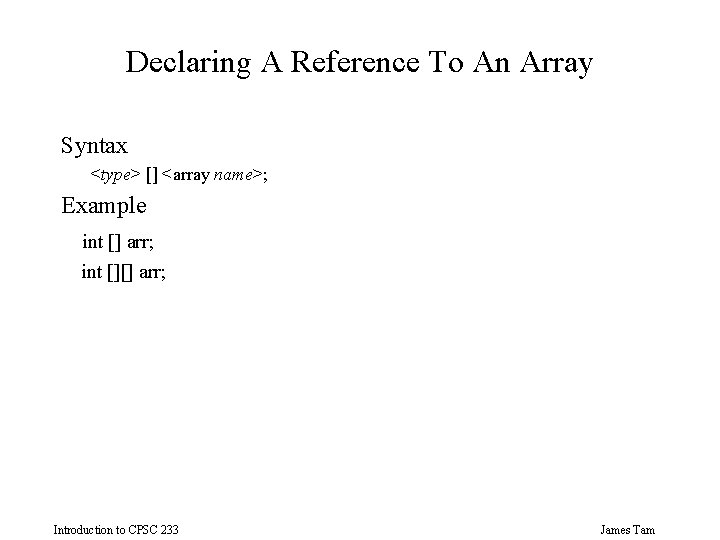
Declaring A Reference To An Array Syntax <type> [] <array name>; Example int [] arr; int [][] arr; Introduction to CPSC 233 James Tam
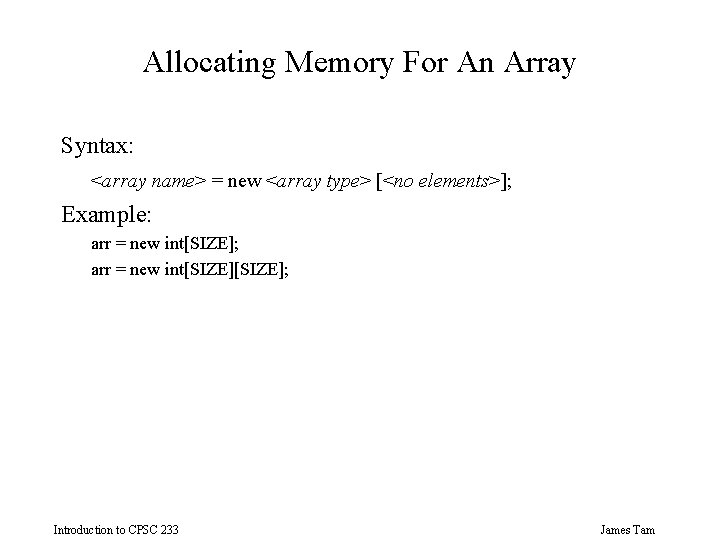
Allocating Memory For An Array Syntax: <array name> = new <array type> [<no elements>]; Example: arr = new int[SIZE]; Introduction to CPSC 233 James Tam
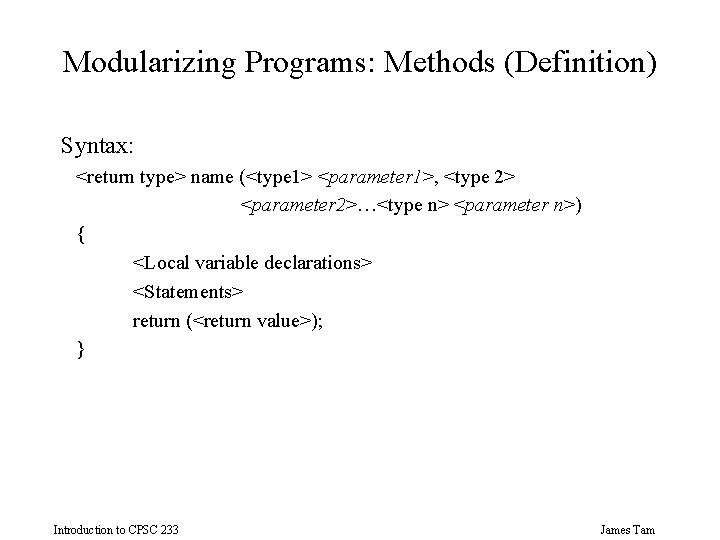
Modularizing Programs: Methods (Definition) Syntax: <return type> name (<type 1> <parameter 1>, <type 2> <parameter 2>…<type n> <parameter n>) { <Local variable declarations> <Statements> return (<return value>); } Introduction to CPSC 233 James Tam
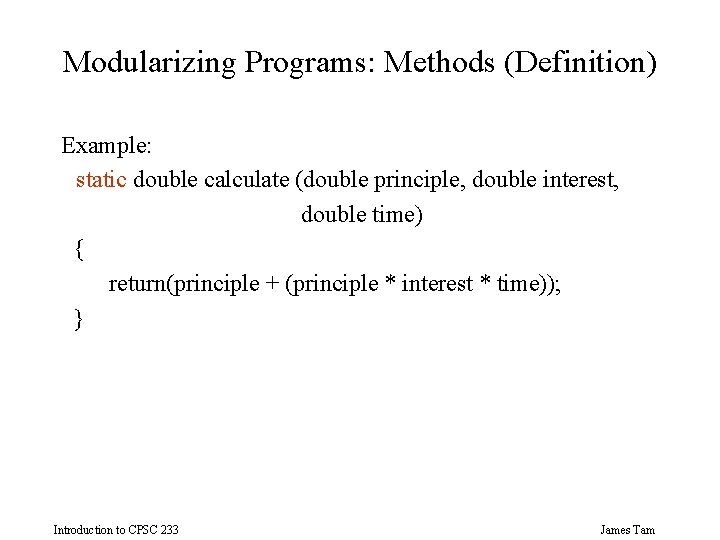
Modularizing Programs: Methods (Definition) Example: static double calculate (double principle, double interest, double time) { return(principle + (principle * interest * time)); } Introduction to CPSC 233 James Tam
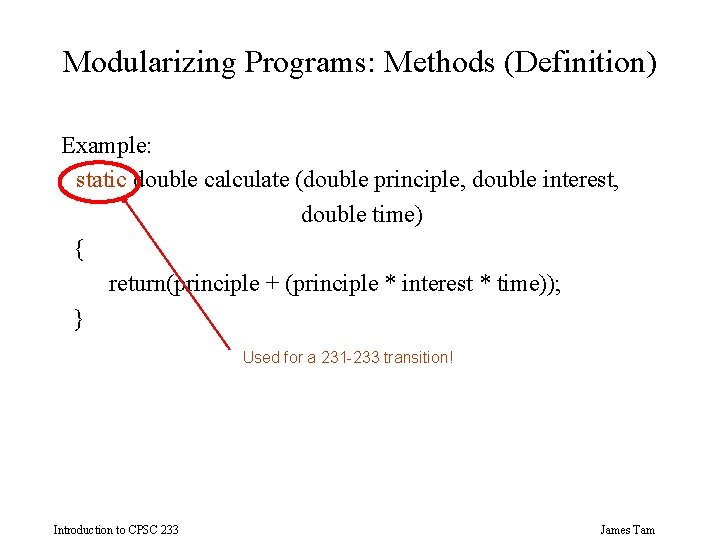
Modularizing Programs: Methods (Definition) Example: static double calculate (double principle, double interest, double time) { return(principle + (principle * interest * time)); } Used for a 231 -233 transition! Introduction to CPSC 233 James Tam
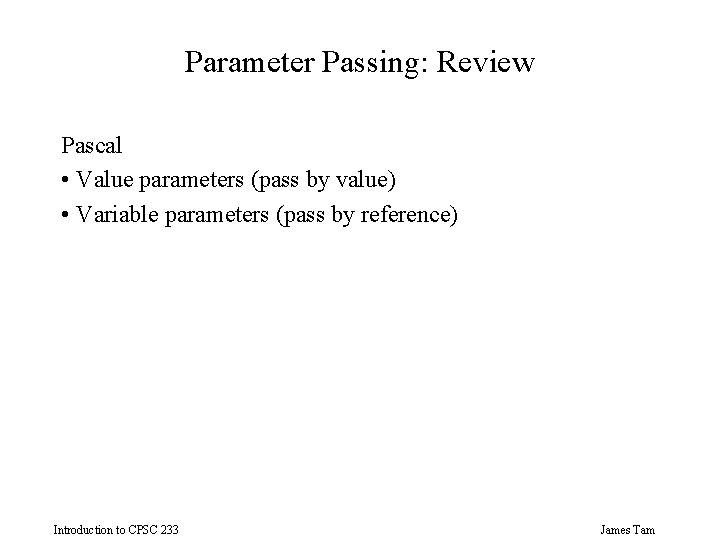
Parameter Passing: Review Pascal • Value parameters (pass by value) • Variable parameters (pass by reference) Introduction to CPSC 233 James Tam
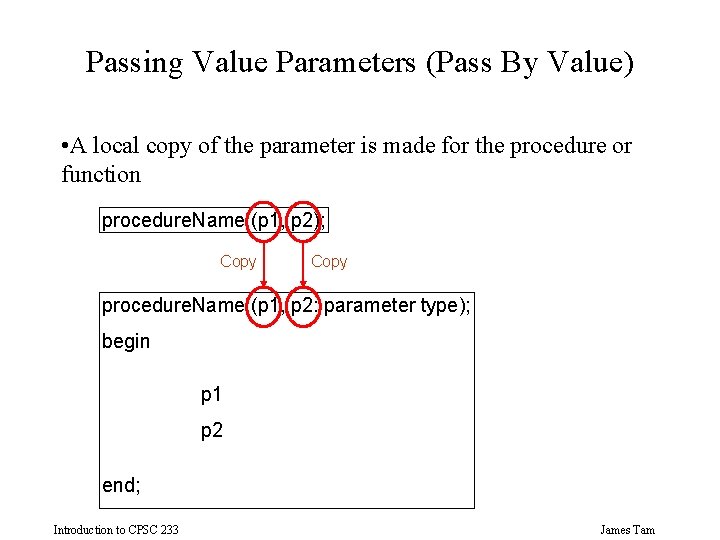
Passing Value Parameters (Pass By Value) • A local copy of the parameter is made for the procedure or function procedure. Name (p 1, p 2); Copy procedure. Name (p 1, p 2: parameter type); begin p 1 p 2 end; Introduction to CPSC 233 James Tam
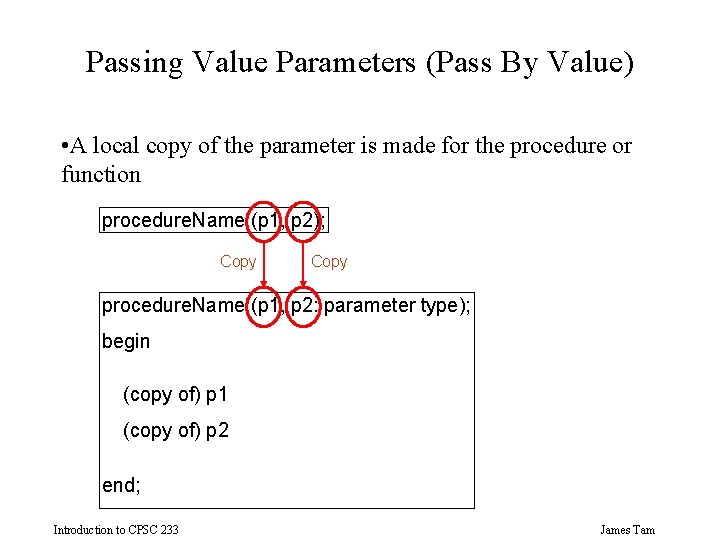
Passing Value Parameters (Pass By Value) • A local copy of the parameter is made for the procedure or function procedure. Name (p 1, p 2); Copy procedure. Name (p 1, p 2: parameter type); begin (copy of) p 1 (copy of) p 2 end; Introduction to CPSC 233 James Tam
Passing Variable Parameters (Pass By Reference) • Changes made to the parameter inside the function or procedure will be retained outside of that module. • This is done by passing a pointer to the parameter (refer to the parameter in the module and the pointer is automatically dereferenced in order to refer to the original parameter passed in) Introduction to CPSC 233 James Tam
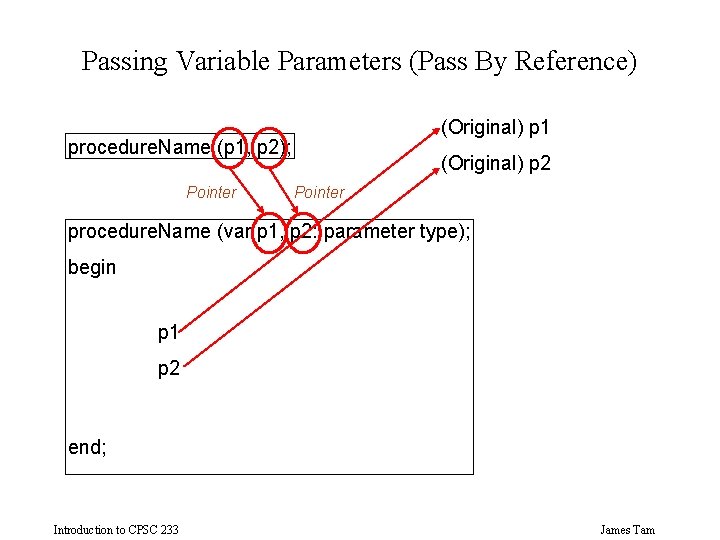
Passing Variable Parameters (Pass By Reference) (Original) p 1 procedure. Name (p 1, p 2); Pointer (Original) p 2 Pointer procedure. Name (var p 1, p 2: parameter type); begin p 1 p 2 end; Introduction to CPSC 233 James Tam
Parameters To Methods In Java Allowable parameters include: • Simple type (boolean, char, integer etc. ) • Programmer defined types. Simple types can only be passed by value in Java (copy passed in) Composite types (arrays, objects) have a copy of a reference passed in (not exactly pass by reference because the net effect is the same as with simple types) Introduction to CPSC 233 James Tam
Method Return Types In Java Any simple type (boolean, char, integer etc. ) Cases where no value is returned (void) Programmer defined types (objects) Introduction to CPSC 233 James Tam
Passing Arrays As Parameters Syntax: <method return type> <method name> (<array type> [] <name>) Example: void fun (int [] arr) void fun (int arr []) Introduction to CPSC 233 James Tam
Methods In Java: Putting It All Together See the example in Unix under: /home/profs/tamj/233/examples/intro/Modules. java Introduction to CPSC 233 James Tam
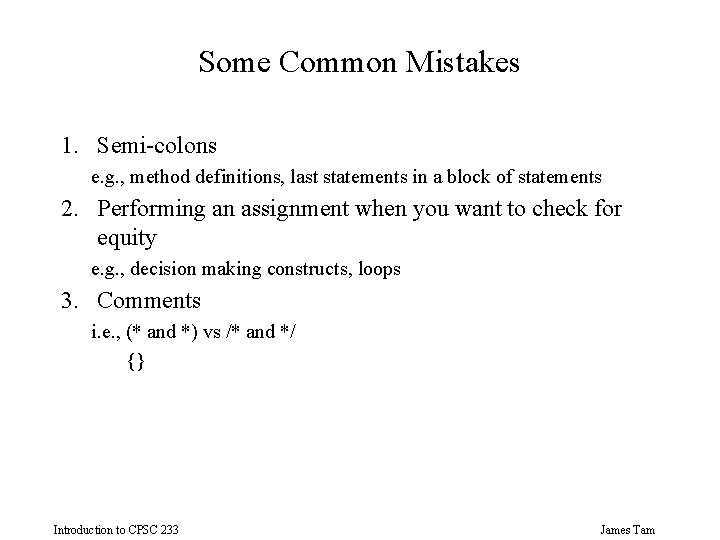
Some Common Mistakes 1. Semi-colons e. g. , method definitions, last statements in a block of statements 2. Performing an assignment when you want to check for equity e. g. , decision making constructs, loops 3. Comments i. e. , (* and *) vs /* and */ {} Introduction to CPSC 233 James Tam
- Slides: 61