
PASADENA STREETCAR FEASIBILITY STUDY Executive Summary Project Background
PASADENA STREETCAR FEASIBILITY STUDY Executive Summary
Project Background § Study initiated August 2009 § Addresses streetcar alignment concepts and financial feasibility § Streetcar hoped to address challenges: § Improving non-auto circulation between districts § Increasing retail competitiveness § Reducing parking needs Sponsors: Pasadena Center Operating Company City of Pasadena Old Pasadena Management District Playhouse District Association South Lake Avenue Business District Paseo Colorado Holdings, Ltd.
Consultant Team Firm Expertise Strategic Economics Urban economic analysis Shiels Obletz Johnsen Streetcar construction, funding, and operations Reconnecting America Transit-oriented development research and technical assistance Moule & Polyzoides Urban design/planning and local context Iteris Transportation analysis/engineering and local context
Study Components § An evaluation of current and future demographics in the Central § § § § District Evaluation of retail market conditions, hotel/conference/tourism conditions, employment in the Central District, and development opportunities Summaries of potential funding mechanisms Case studies of other streetcar cities A preliminary evaluation of system construction and operating costs and design issues that included parking and transportation An assessment of potential economic benefits of the streetcar An economic value analysis of the cost to properties proximate to the route Recommendations for financial strategies to fund the streetcar
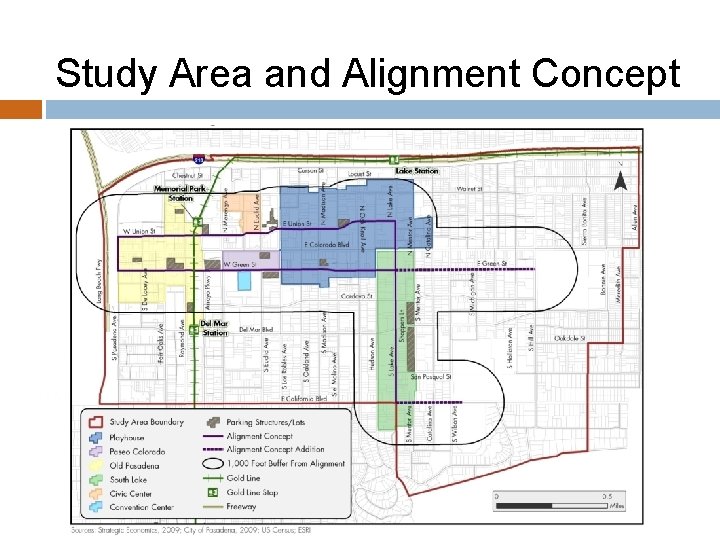
Study Area and Alignment Concept
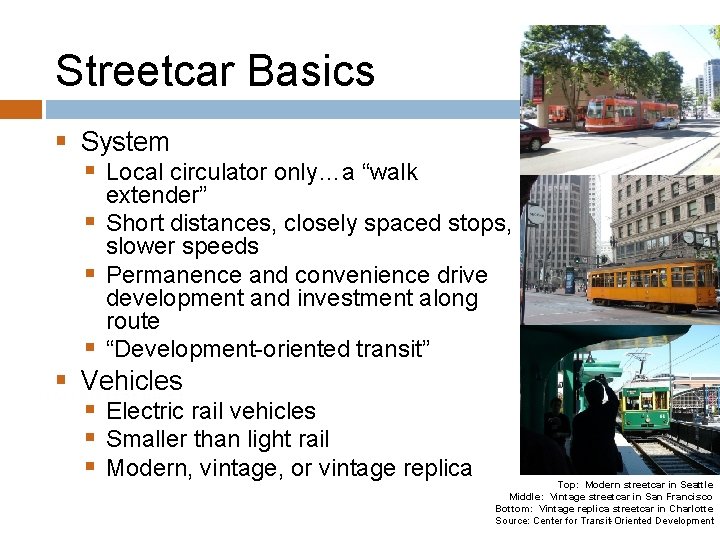
Streetcar Basics § System § Local circulator only…a “walk extender” § Short distances, closely spaced stops, slower speeds § Permanence and convenience drive development and investment along route § “Development-oriented transit” § Vehicles § Electric rail vehicles § Smaller than light rail § Modern, vintage, or vintage replica Top: Modern streetcar in Seattle Middle: Vintage streetcar in San Francisco Bottom: Vintage replica streetcar in Charlotte Source: Center for Transit-Oriented Development
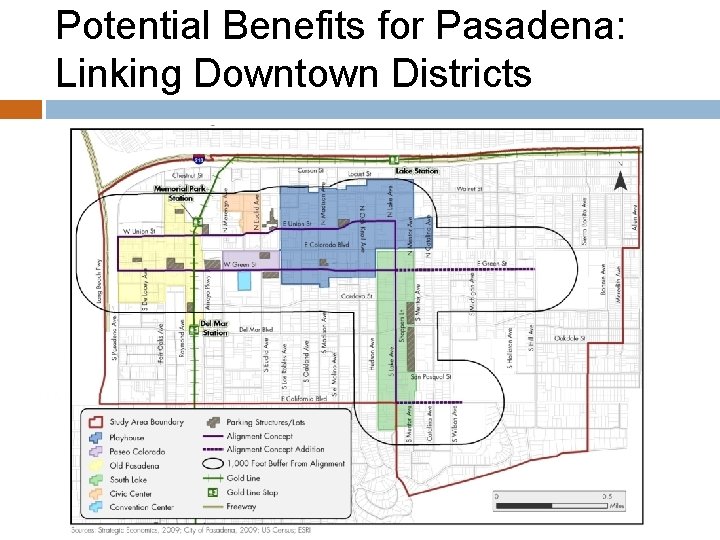
Potential Benefits for Pasadena: Linking Downtown Districts
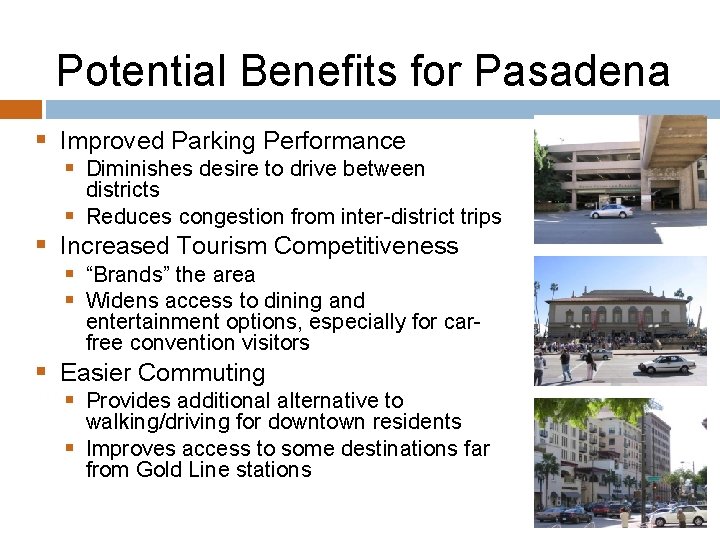
Potential Benefits for Pasadena § Improved Parking Performance § Diminishes desire to drive between districts § Reduces congestion from inter-district trips § Increased Tourism Competitiveness § “Brands” the area § Widens access to dining and entertainment options, especially for carfree convention visitors § Easier Commuting § Provides additional alternative to walking/driving for downtown residents § Improves access to some destinations far from Gold Line stations
Potential Benefits for Pasadena § Increased Retail Competitiveness § Unifies Downtown shopping and entertainment § § districts, encourages cross-shopping Creates larger mass of retail to compete against regional competitors Lends iconic branding to Downtown Enhances access to lunchtime shopping/dining for workers in Downtown Proposed alignment creates additional visibility and foot traffic on relatively underperforming blocks north and south of Colorado Boulevard
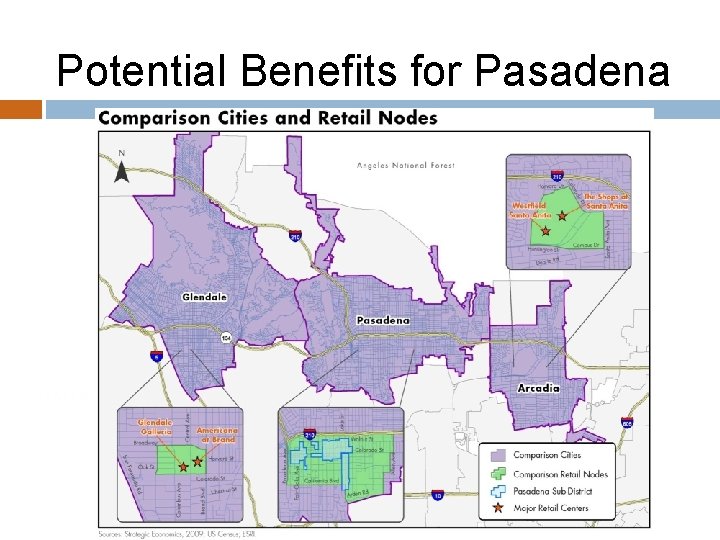
Potential Benefits for Pasadena
Potential Benefits for Pasadena § Boosts Development Potential § Streetcar proximity increases sales, rents, and property sales prices § Higher attainable prices/rents increase development potential § Reduced parking need allows higher density § Frees space and expensive construction costs
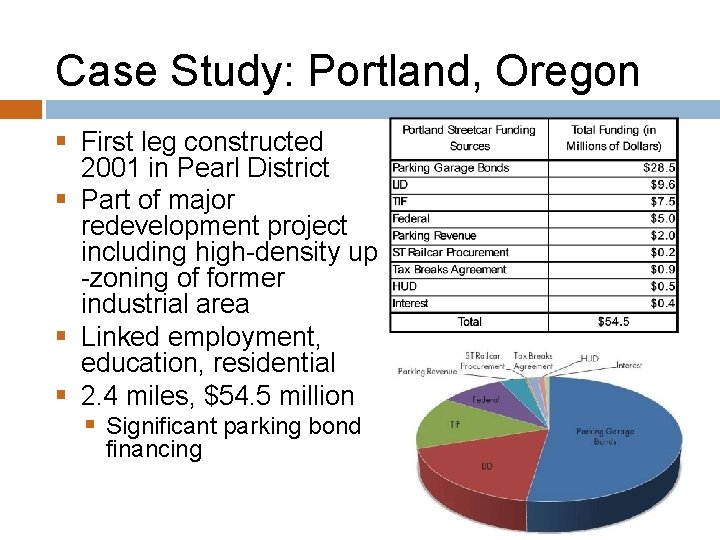
Case Study: Portland, Oregon § First leg constructed 2001 in Pearl District § Part of major redevelopment project including high-density up -zoning of former industrial area § Linked employment, education, residential § 2. 4 miles, $54. 5 million § Significant parking bond financing
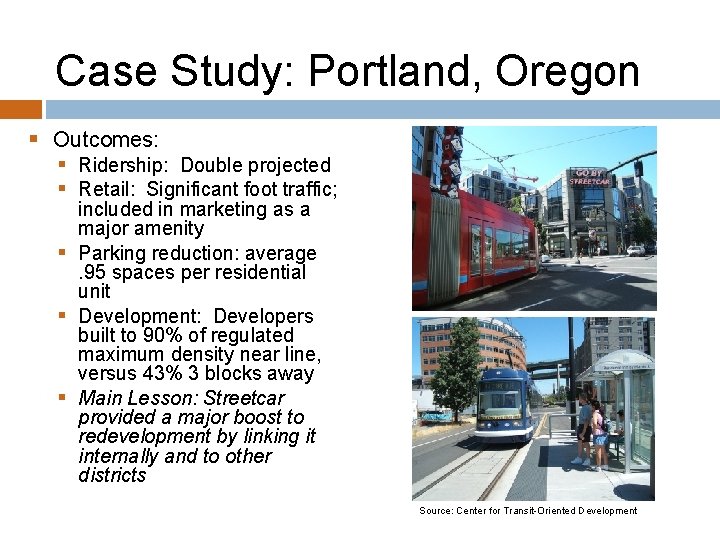
Case Study: Portland, Oregon § Outcomes: § Ridership: Double projected § Retail: Significant foot traffic; included in marketing as a major amenity § Parking reduction: average. 95 spaces per residential unit § Development: Developers built to 90% of regulated maximum density near line, versus 43% 3 blocks away § Main Lesson: Streetcar provided a major boost to redevelopment by linking it internally and to other districts Source: Center for Transit-Oriented Development
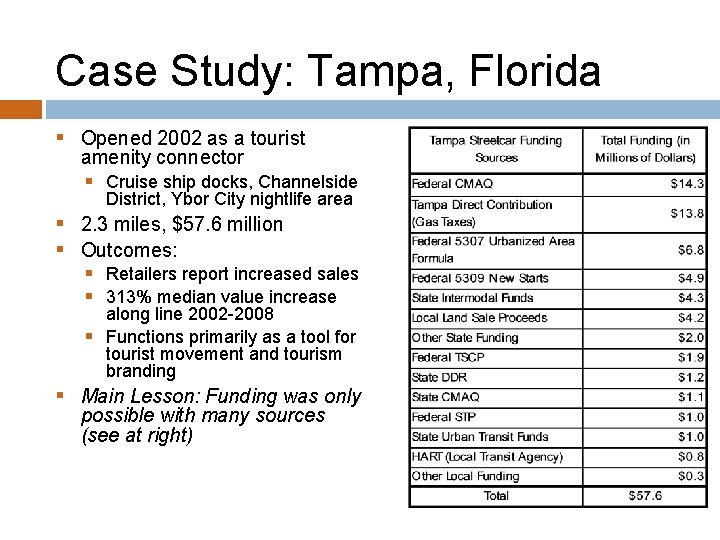
Case Study: Tampa, Florida § Opened 2002 as a tourist amenity connector § Cruise ship docks, Channelside District, Ybor City nightlife area § 2. 3 miles, $57. 6 million § Outcomes: § Retailers report increased sales § 313% median value increase along line 2002 -2008 § Functions primarily as a tool for tourist movement and tourism branding § Main Lesson: Funding was only possible with many sources (see at right)
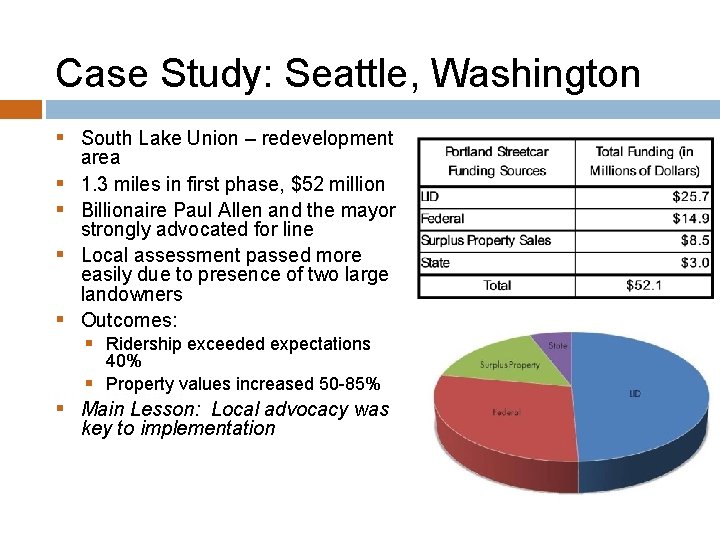
Case Study: Seattle, Washington § South Lake Union – redevelopment § § area 1. 3 miles in first phase, $52 million Billionaire Paul Allen and the mayor strongly advocated for line Local assessment passed more easily due to presence of two large landowners Outcomes: § Ridership exceeded expectations 40% § Property values increased 50 -85% § Main Lesson: Local advocacy was key to implementation
Case Study Lessons Learned § Implementation requires powerful, interested § § advocates and property owner enthusiasm In most instances local funding came from multiple sources Value boosts – and local funding capture – are easiest to achieve when opportunity exists for new development Streetcar benefits are strongest within 2 -3 blocks of line Positive but uneven impacts occurred in all cities for ridership, retail, tourism, parking needs, and real estate development
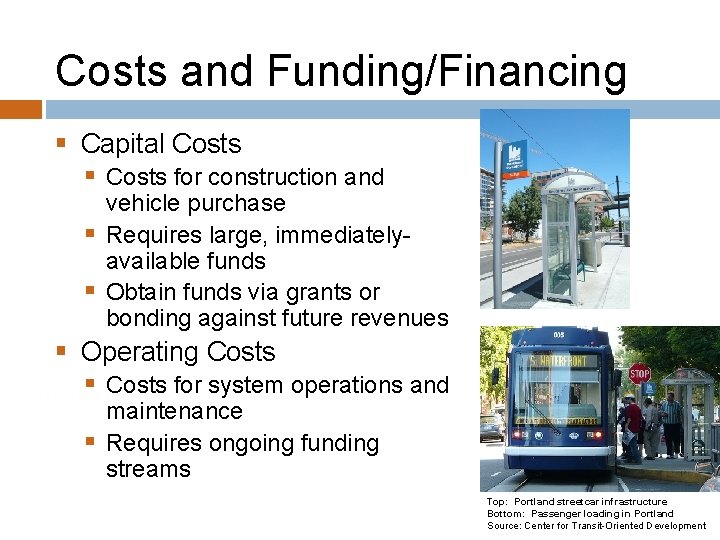
Costs and Funding/Financing § Capital Costs § Costs for construction and vehicle purchase § Requires large, immediatelyavailable funds § Obtain funds via grants or bonding against future revenues § Operating Costs § Costs for system operations and maintenance § Requires ongoing funding streams Top: Portland streetcar infrastructure Bottom: Passenger loading in Portland Source: Center for Transit-Oriented Development
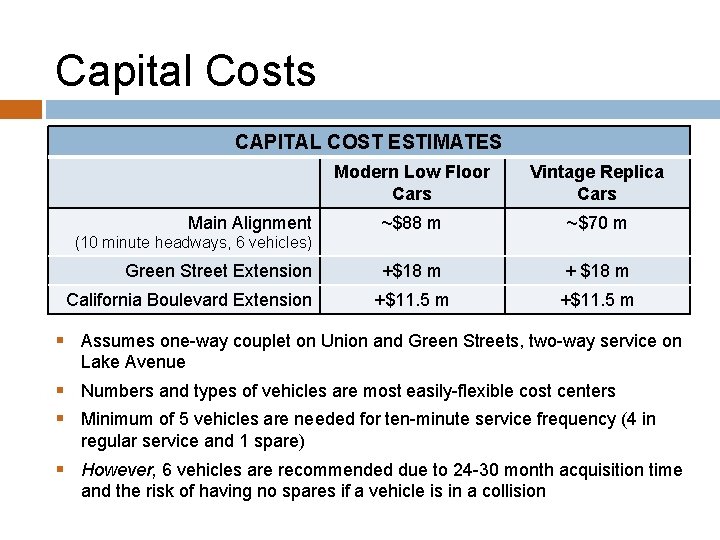
Capital Costs CAPITAL COST ESTIMATES Main Alignment Modern Low Floor Cars Vintage Replica Cars ~$88 m ~$70 m +$18 m +$11. 5 m (10 minute headways, 6 vehicles) Green Street Extension California Boulevard Extension § Assumes one-way couplet on Union and Green Streets, two-way service on Lake Avenue § Numbers and types of vehicles are most easily-flexible cost centers § Minimum of 5 vehicles are needed for ten-minute service frequency (4 in regular service and 1 spare) § However, 6 vehicles are recommended due to 24 -30 month acquisition time and the risk of having no spares if a vehicle is in a collision
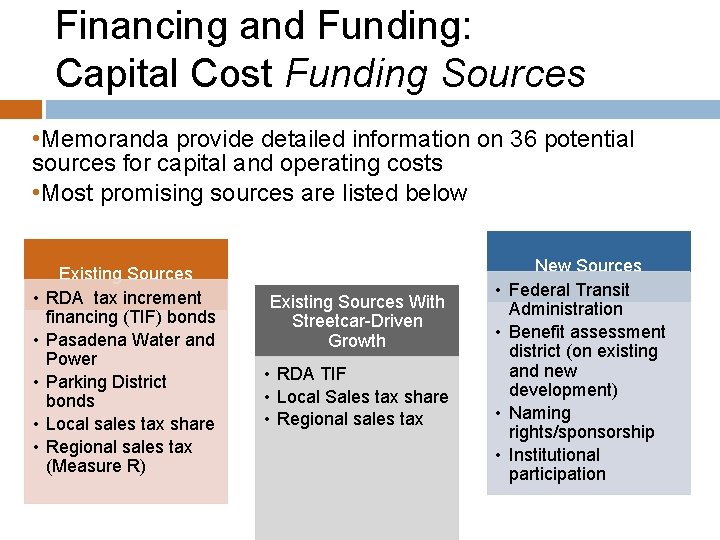
Financing and Funding: Capital Cost Funding Sources • Memoranda provide detailed information on 36 potential sources for capital and operating costs • Most promising sources are listed below • • • Existing Sources RDA tax increment financing (TIF) bonds Pasadena Water and Power Parking District bonds Local sales tax share Regional sales tax (Measure R) Existing Sources With Streetcar-Driven Growth • RDA TIF • Local Sales tax share • Regional sales tax • • New Sources Federal Transit Administration Benefit assessment district (on existing and new development) Naming rights/sponsorship Institutional participation
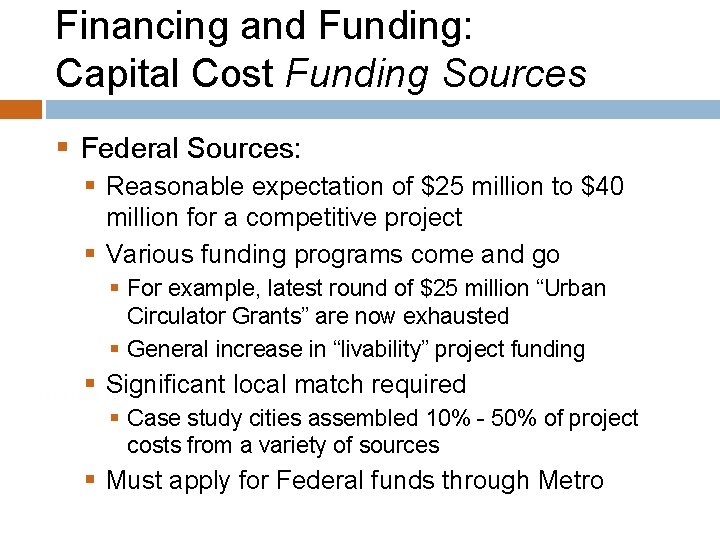
Financing and Funding: Capital Cost Funding Sources § Federal Sources: § Reasonable expectation of $25 million to $40 million for a competitive project § Various funding programs come and go § For example, latest round of $25 million “Urban Circulator Grants” are now exhausted § General increase in “livability” project funding § Significant local match required § Case study cities assembled 10% - 50% of project costs from a variety of sources § Must apply for Federal funds through Metro
Financing and Funding: Capital Cost Funding Sources § Local Sources: Value Capture § “Value capture” sources derive revenue from value boosts occurring near the streetcar § Can bond against future revenues § Most typical mechanism is a local “benefit assessment district” § Voted by affected property owners § Community Facilities District or Special Assessment District § Captures a portion of streetcar-driven value boosts § Property values reflect increased rents/sales prices, which reflect increased business sales or residential demand
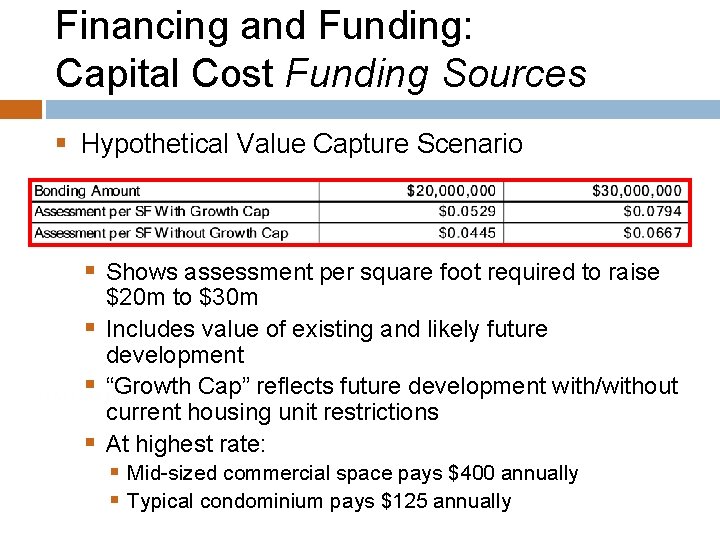
Financing and Funding: Capital Cost Funding Sources § Hypothetical Value Capture Scenario § Shows assessment per square foot required to raise $20 m to $30 m § Includes value of existing and likely future development § “Growth Cap” reflects future development with/without current housing unit restrictions § At highest rate: § Mid-sized commercial space pays $400 annually § Typical condominium pays $125 annually
Financing and Funding: Capital Cost Funding Sources § Other Potential Local Sources: § Redevelopment TIF: If prioritized and approved, § § $10 m to $15 m potential Parking revenue Measure R funds Advertising and naming rights Pasadena Water and Power § Operator, power subsidy, and/or ridership rebates on utility fees § Institutional cooperation/contributions § Etc.
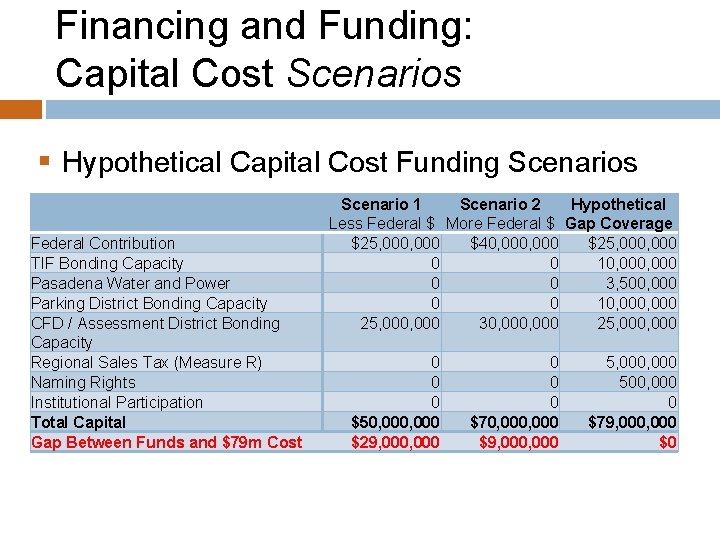
Financing and Funding: Capital Cost Scenarios § Hypothetical Capital Cost Funding Scenarios Federal Contribution TIF Bonding Capacity Pasadena Water and Power Parking District Bonding Capacity CFD / Assessment District Bonding Capacity Regional Sales Tax (Measure R) Naming Rights Institutional Participation Total Capital Gap Between Funds and $79 m Cost Scenario 1 Scenario 2 Hypothetical Less Federal $ More Federal $ Gap Coverage $25, 000 $40, 000 $25, 000 0 0 10, 000 0 0 3, 500, 000 0 0 10, 000 25, 000 30, 000 25, 000 0 0 0 $50, 000 $29, 000 0 0 0 $70, 000 $9, 000, 000 500, 000 0 $79, 000 $0
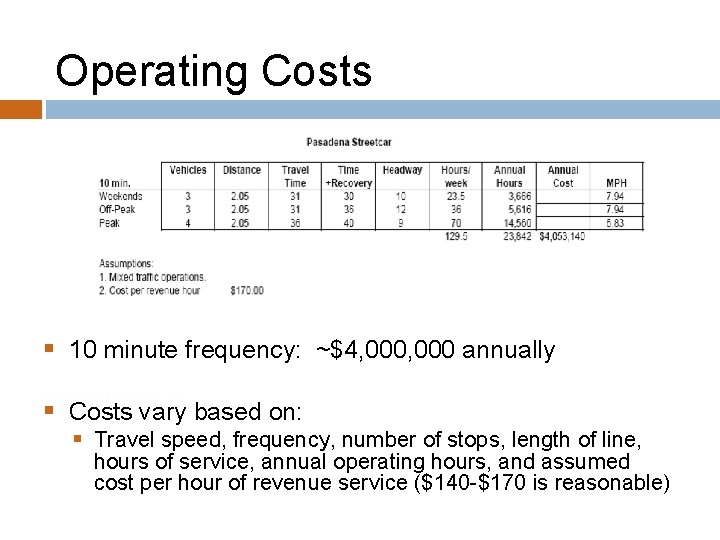
Operating Costs § 10 minute frequency: ~$4, 000 annually § Costs vary based on: § Travel speed, frequency, number of stops, length of line, hours of service, annual operating hours, and assumed cost per hour of revenue service ($140 -$170 is reasonable)
Financing and Funding: Operating Cost Funding Sources § Some operating cost sources overlap with capital cost sources – cannot overload these sources § Must provide ongoing revenue § Most promising sample sources listed below Sources Subject to Streetcar-Driven Growth • Business Improvement District • Transient-Occupancy Tax Other Sources • Farebox collection • Pasadena Water and Power (PWP) • Parking District Revenue • Advertising Revenue • Institutional participation
Recommended Next Steps § Determine whether to pursue § Form a structure for moving project forward… § …others have used a non-profit corporation § Comprehensively gauge property and business owner support § Identify highest-potential local funding sources § Confirm availability of funding § Apply for Federal funding as available
PASADENA STREETCAR FEASIBILITY STUDY Executive Summary
- Slides: 28