
Party Politics in the New Republic 1790 s1850
Party Politics in the New Republic, 1790 s-1850 s, and their Impact on American Citizenship I. Three Enduring, Divisive Tensions A. Will Federal or State Governments Be Stronger? B. Will Slavery Grow or Diminish? C. Will a Semi-Subsistence or Market Economy Prevail? II. The Emergence of the American Party System A. Founding Fathers Opposed Parties B. Yet by the mid-1790 s, Political Parties Were in Place III. The Rise of the “Common Man” and Popular Politics after 1824 Andrew Jackson as Transformative Figure First vs. Second Generations of Presidents Widening Suffrage for White Men Increasing Restrictions on Non-Whites
Basic U. S. History Timeline, 1775 -1789 1775 -1783: American Fight War Against England to Achieve Independence 1777: Vermont Becomes First Northern Colony/State to Emancipate Slaves. By 1804, most other northern states have followed suit, some proceeding “gradually. ” By 1810, “free blacks” made up roughly 13% of all African Americans. 1781 -1787: American States or Republics Coexist under the Articles of Confederation (which were drafted in 1777 but only ratified by 1781) which create a rather loose confederation of the 13 states 1785, 1787: Under the Articles, the national government gets substantial powers for dealing with western territories (i. e. , those lands not yet admitted to the union as states) in the 1785 Land Ordinance and 1787 Northwest Ordinance. The latter ordinance outlaws slavery in the Northwest and makes it relatively easy for immigrants there to become naturalized. 1787 -1789: The U. S. Constitution is drafted and ratified, creating a stronger union of the 13 states, i. e. a more powerful central government. However, the exact balance of power between state and federal power remains contested, and Americans are citizens of both their respective states and the nation.
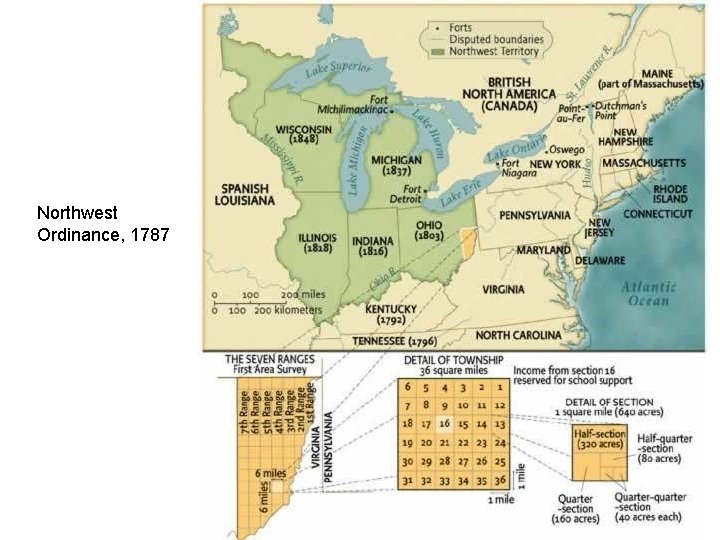
Northwest Ordinance, 1787
FEDERALISM (I) Federalism is a political concept in which a group of members is bound together by covenant (Latin: foedus, covenant) with a governing representative head Wikipedia
FEDERALISM (II) The term "federalism" is also used to describe a system of government in which sovereignty is constitutionally divided between a central governing authority and constituent political units (such as states or provinces). Wikipedia
FEDERALISTS (I) VS. ANTI-FEDERALISTS (opponents regarding ratification of the Constitution during the late 1780 s) Federalists were people who tended to support the ratification of the Constitution, and to support the creation of a stronger central government. Anti-Federalists tended to oppose the Constitution, and advocated for a weaker, smaller central government and for more powers to be reserved to the states.
Economic Patterns in the late-18 th-century United States Semi-subsistence economy (more Anti-Federalist) more rural, more isolated, more bartering, less cash and speculation Commercial or market economy (more Federalist) more urban (port cities especially), more focused on production for commerce and profit rather than subsistence, more comfortable with credit and borrowing, less isolated These two patterns actually overlapped a great deal. In general, though, the tendency was for the market economy to expand gain ground at the expense of the semisubsistence economy
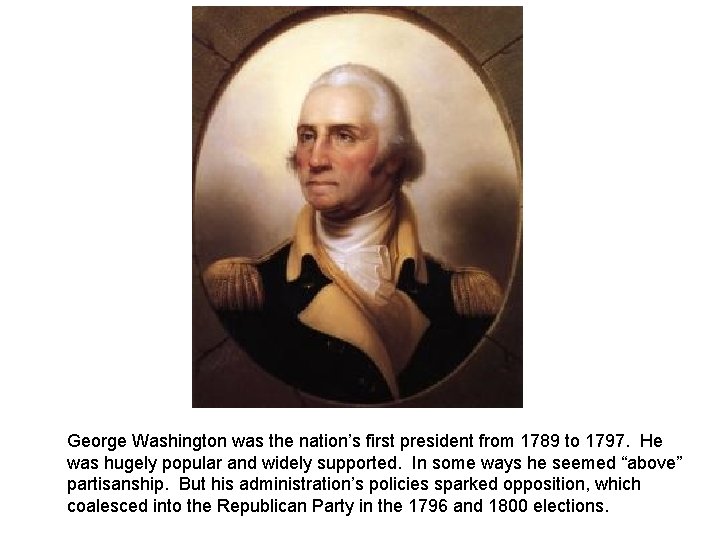
George Washington was the nation’s first president from 1789 to 1797. He was hugely popular and widely supported. In some ways he seemed “above” partisanship. But his administration’s policies sparked opposition, which coalesced into the Republican Party in the 1796 and 1800 elections.
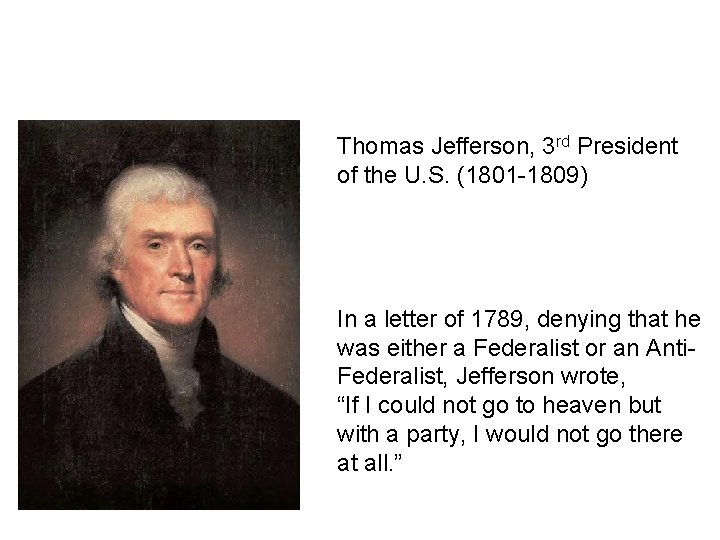
Thomas Jefferson, 3 rd President of the U. S. (1801 -1809) In a letter of 1789, denying that he was either a Federalist or an Anti. Federalist, Jefferson wrote, “If I could not go to heaven but with a party, I would not go there at all. ”
The Three Party Systems in U. S. Government since 1790 Federalists (II) vs. Republicans, 1796 -1815 Key Federalists: George Washington & John Adams Key Republicans (or Democratic-Republicans): Thomas Jefferson, James Madison, James Monroe Federalists endorsed a stronger national government and the market economy. Republicans advocated for states’ rights. Democrats vs. Whigs, 1824 -1856 Key Democrats: Andrew Jackson (claimed descent from Republican Jefferson) and Martin Van Buren Democrats vs. Republicans, 1860 Key Republican: Abraham Lincoln
FEDERALISTS (II) vs. REPUBLICANS During the 1790 s the U. S. developed its first system of political parties. The two parties were called the Federalists and the Republicans. The Federalists tended to be the people in power from 1789 to 1801 (including Presidents George Washington and John Adams). The Republicans tended to be in control after 1800 and included President Thomas Jefferson and his successors. The Federalists tended to be associated with a stronger central government, but that was hardly the only issue that divided the two parties
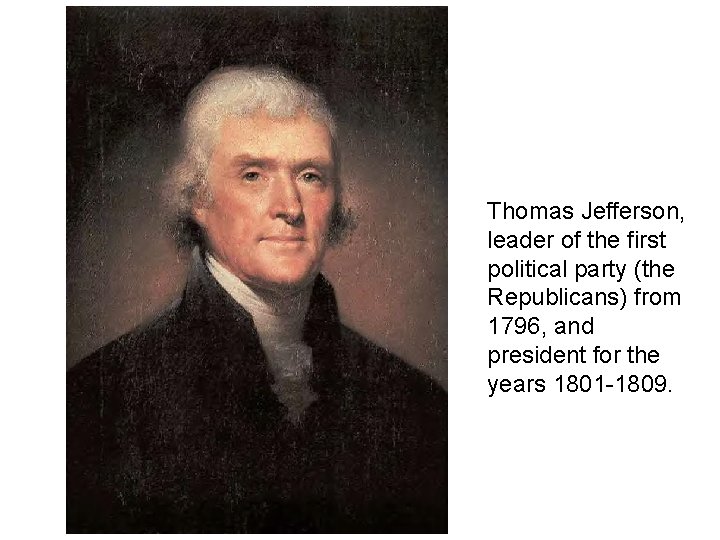
Thomas Jefferson, leader of the first political party (the Republicans) from 1796, and president for the years 1801 -1809.
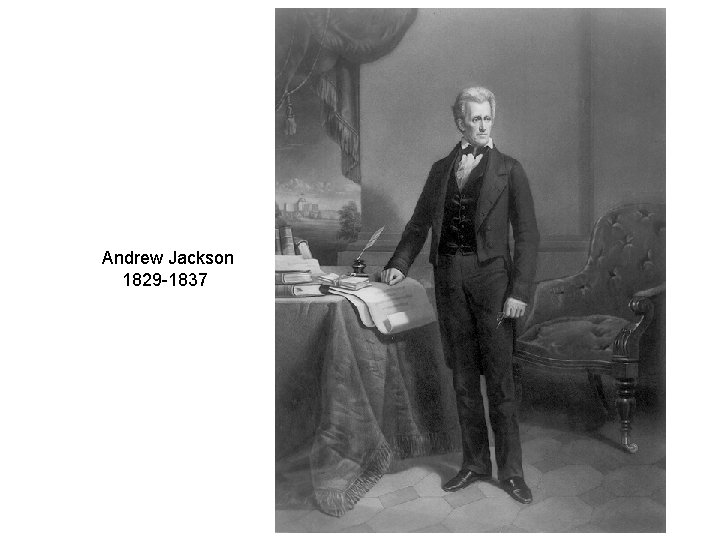
Andrew Jackson 1829 -1837
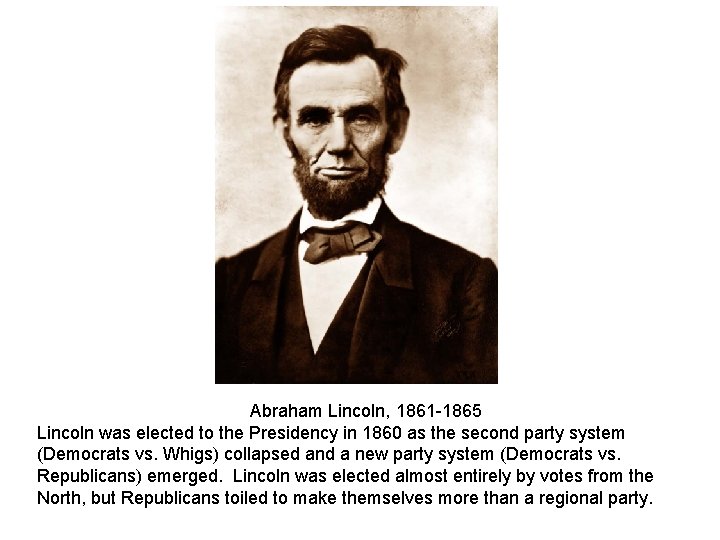
Abraham Lincoln, 1861 -1865 Lincoln was elected to the Presidency in 1860 as the second party system (Democrats vs. Whigs) collapsed and a new party system (Democrats vs. Republicans) emerged. Lincoln was elected almost entirely by votes from the North, but Republicans toiled to make themselves more than a regional party.
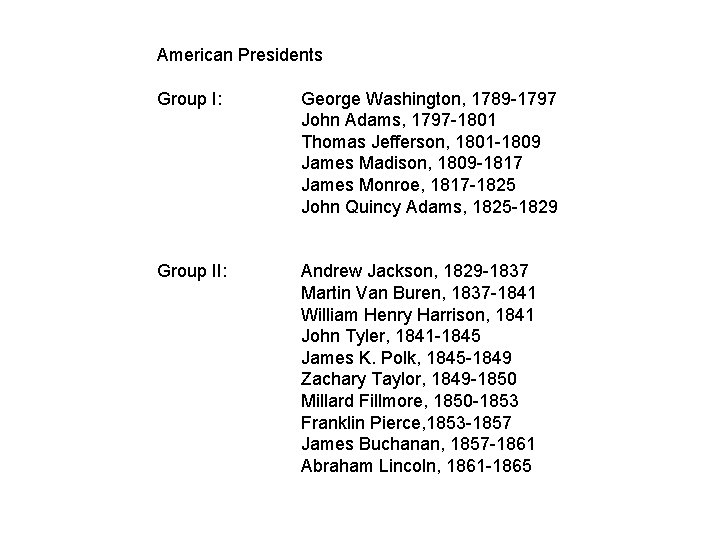
American Presidents Group I: George Washington, 1789 -1797 John Adams, 1797 -1801 Thomas Jefferson, 1801 -1809 James Madison, 1809 -1817 James Monroe, 1817 -1825 John Quincy Adams, 1825 -1829 Group II: Andrew Jackson, 1829 -1837 Martin Van Buren, 1837 -1841 William Henry Harrison, 1841 John Tyler, 1841 -1845 James K. Polk, 1845 -1849 Zachary Taylor, 1849 -1850 Millard Fillmore, 1850 -1853 Franklin Pierce, 1853 -1857 James Buchanan, 1857 -1861 Abraham Lincoln, 1861 -1865
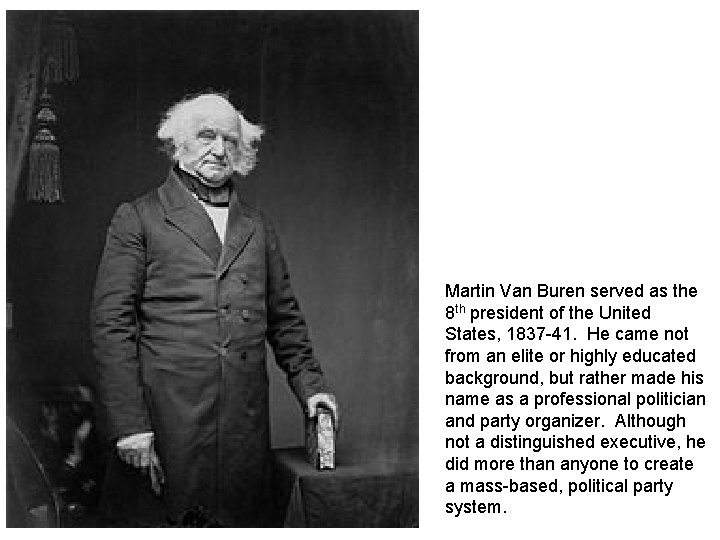
Martin Van Buren served as the 8 th president of the United States, 1837 -41. He came not from an elite or highly educated background, but rather made his name as a professional politician and party organizer. Although not a distinguished executive, he did more than anyone to create a mass-based, political party system.
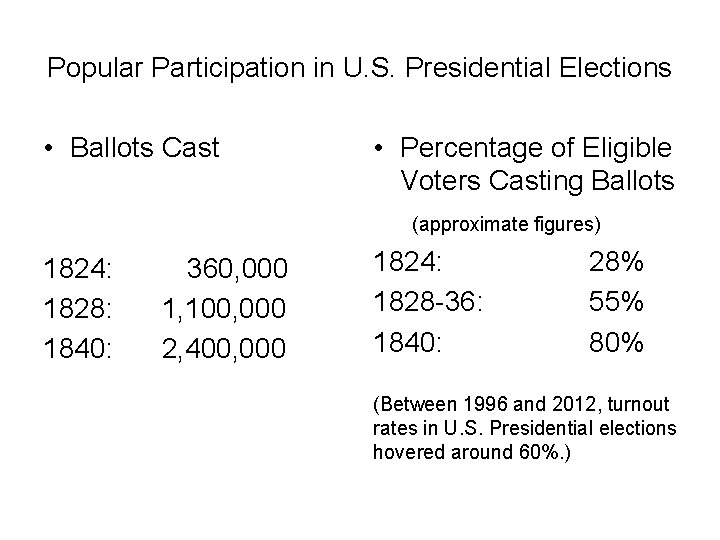
Popular Participation in U. S. Presidential Elections • Ballots Cast • Percentage of Eligible Voters Casting Ballots (approximate figures) 1824: 1828: 1840: 360, 000 1, 100, 000 2, 400, 000 1824: 1828 -36: 1840: 28% 55% 80% (Between 1996 and 2012, turnout rates in U. S. Presidential elections hovered around 60%. )
- Slides: 17