
Parts of the Face The Eye Structure sphere
- Slides: 17
Parts of the Face
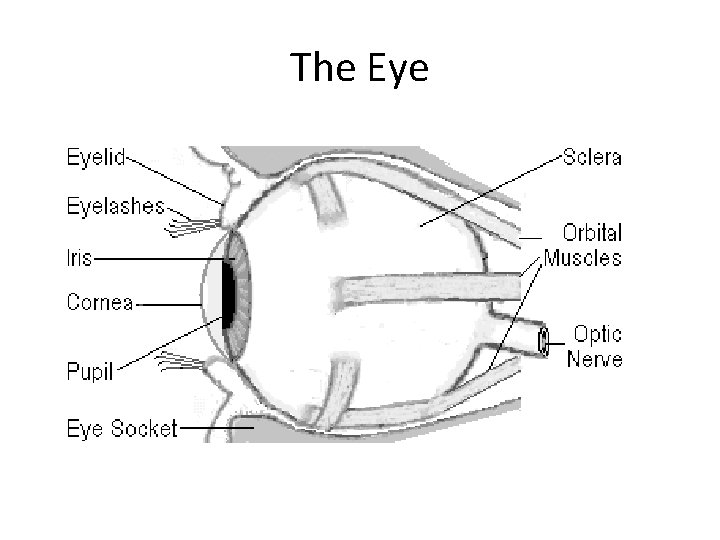
The Eye
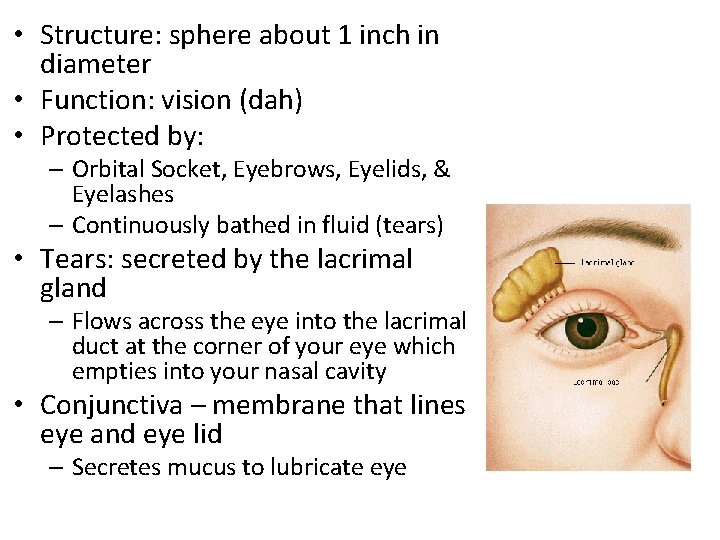
• Structure: sphere about 1 inch in diameter • Function: vision (dah) • Protected by: – Orbital Socket, Eyebrows, Eyelids, & Eyelashes – Continuously bathed in fluid (tears) • Tears: secreted by the lacrimal gland – Flows across the eye into the lacrimal duct at the corner of your eye which empties into your nasal cavity • Conjunctiva – membrane that lines eye and eye lid – Secretes mucus to lubricate eye
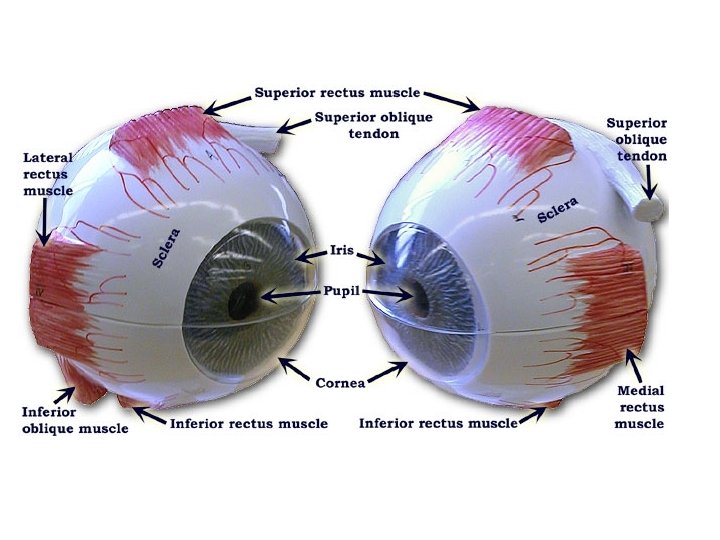
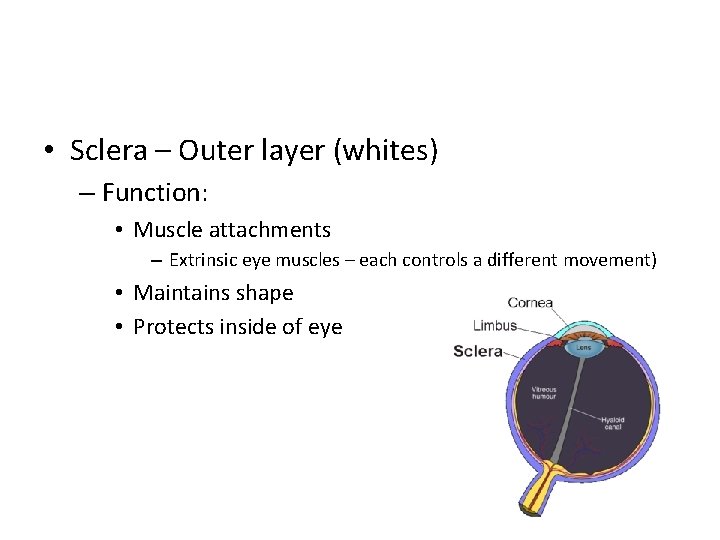
• Sclera – Outer layer (whites) – Function: • Muscle attachments – Extrinsic eye muscles – each controls a different movement) • Maintains shape • Protects inside of eye
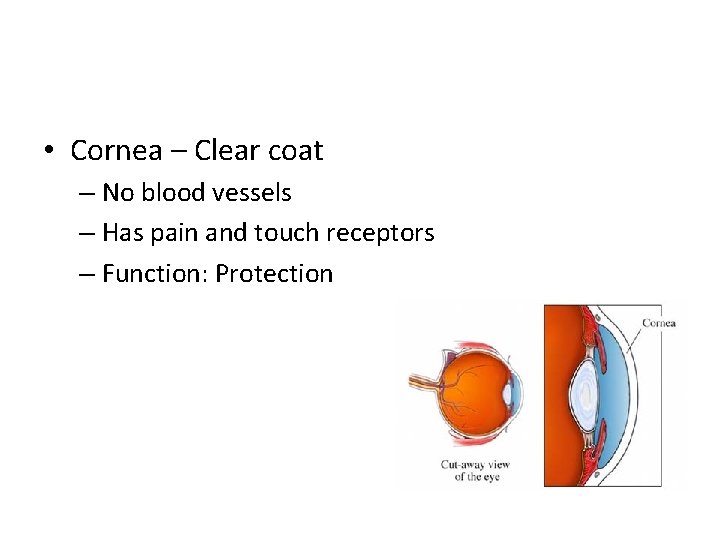
• Cornea – Clear coat – No blood vessels – Has pain and touch receptors – Function: Protection
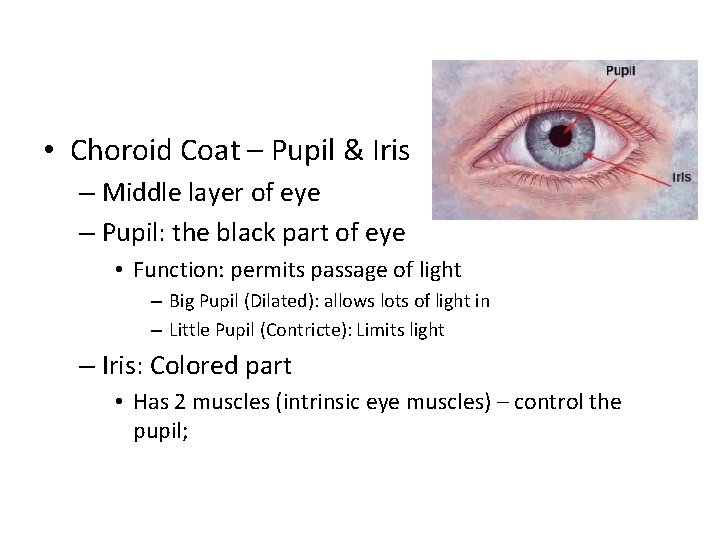
• Choroid Coat – Pupil & Iris – Middle layer of eye – Pupil: the black part of eye • Function: permits passage of light – Big Pupil (Dilated): allows lots of light in – Little Pupil (Contricte): Limits light – Iris: Colored part • Has 2 muscles (intrinsic eye muscles) – control the pupil;
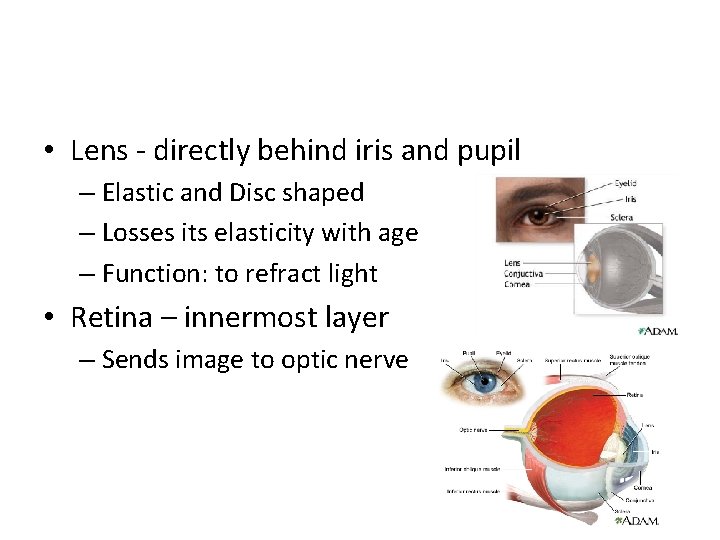
• Lens - directly behind iris and pupil – Elastic and Disc shaped – Losses its elasticity with age – Function: to refract light • Retina – innermost layer – Sends image to optic nerve
The Ear
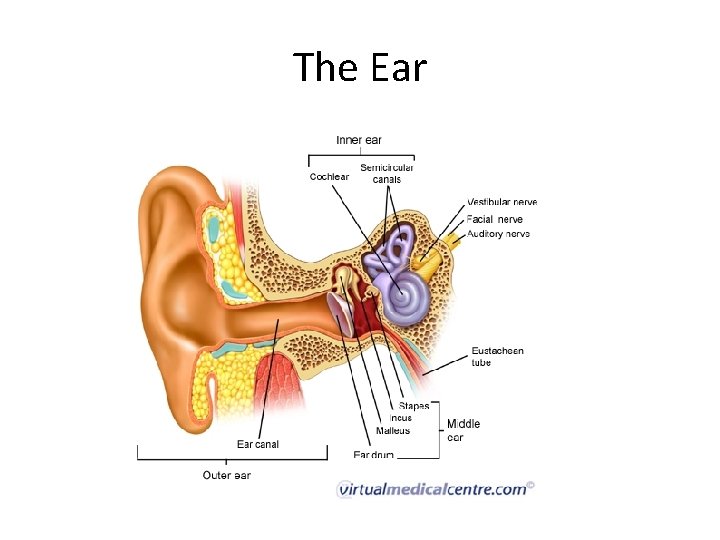
• Function: Hearing & balance (equilibrium) – Consists of 3 parts • Outer – collect sounds • Middle – collect sounds • Inner – analyze sounds waves and maintain balance
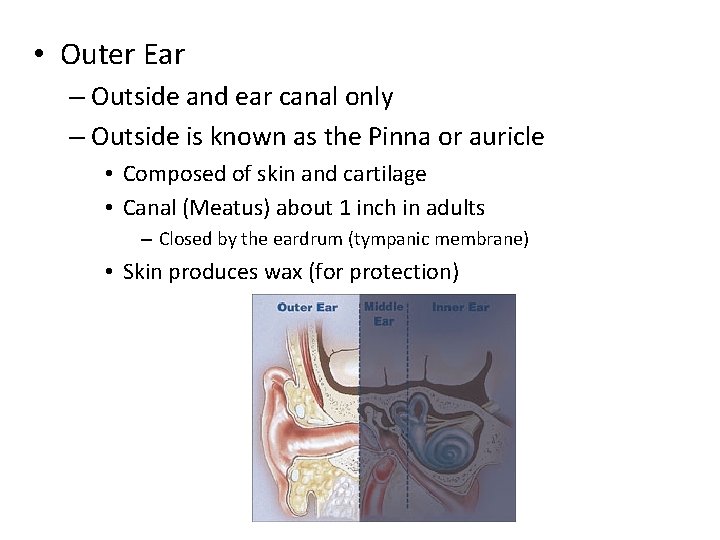
• Outer Ear – Outside and ear canal only – Outside is known as the Pinna or auricle • Composed of skin and cartilage • Canal (Meatus) about 1 inch in adults – Closed by the eardrum (tympanic membrane) • Skin produces wax (for protection)
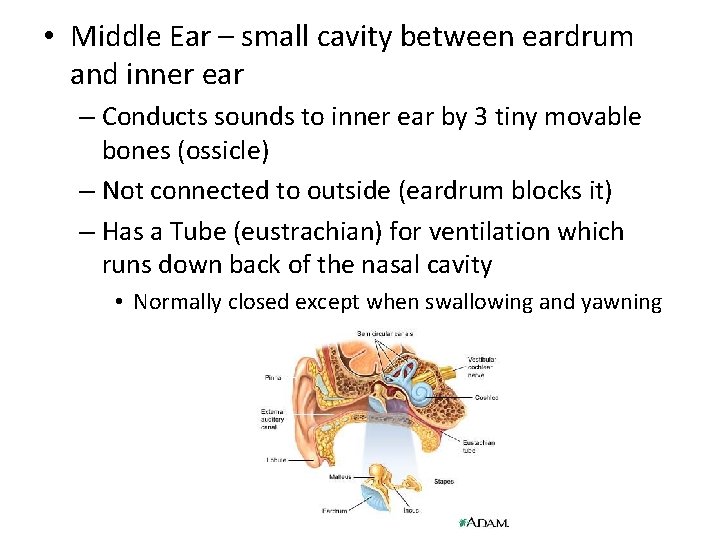
• Middle Ear – small cavity between eardrum and inner ear – Conducts sounds to inner ear by 3 tiny movable bones (ossicle) – Not connected to outside (eardrum blocks it) – Has a Tube (eustrachian) for ventilation which runs down back of the nasal cavity • Normally closed except when swallowing and yawning
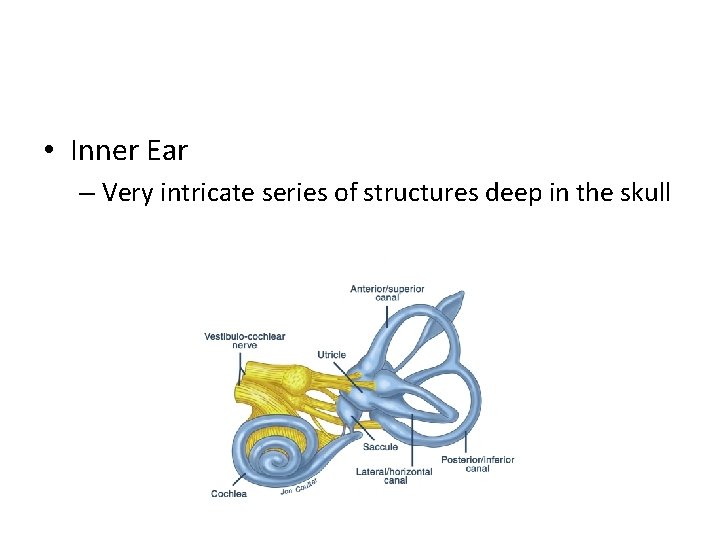
• Inner Ear – Very intricate series of structures deep in the skull
The Nose
• Composed of bone, cartilage and skin • Function: air passage & sense of smell – Warms, moistens and filters air before it travels to the lungs – Can detect 10000 different smells – Smell accounts for about 90% of what we think of as taste
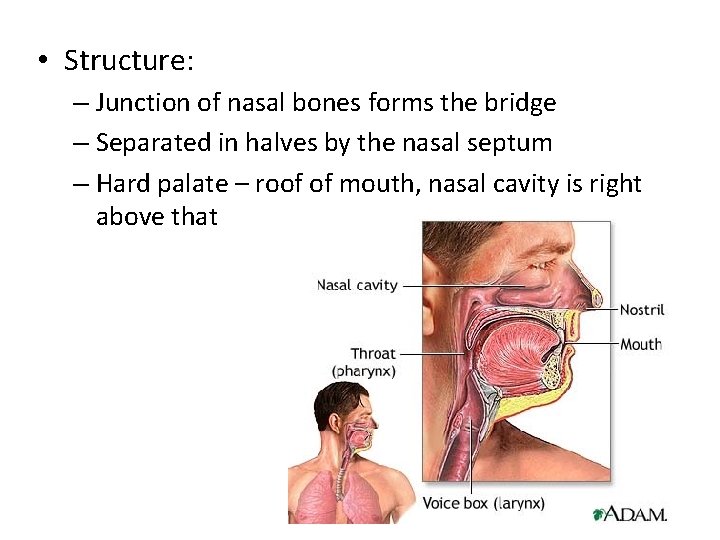
• Structure: – Junction of nasal bones forms the bridge – Separated in halves by the nasal septum – Hard palate – roof of mouth, nasal cavity is right above that
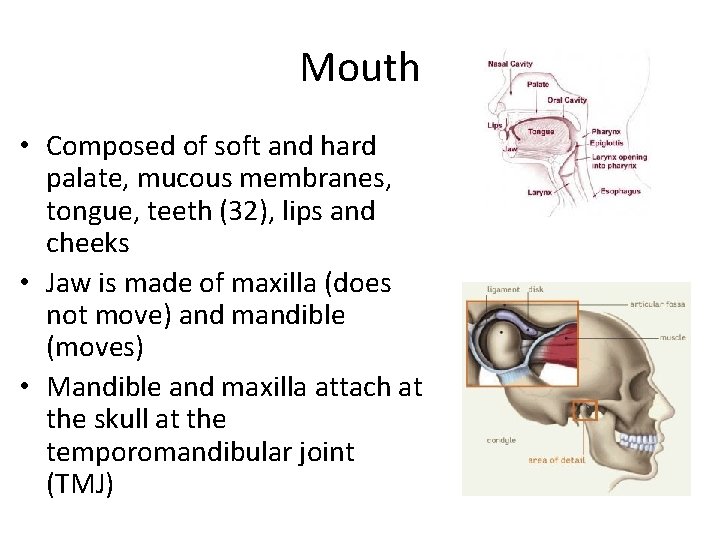
Mouth • Composed of soft and hard palate, mucous membranes, tongue, teeth (32), lips and cheeks • Jaw is made of maxilla (does not move) and mandible (moves) • Mandible and maxilla attach at the skull at the temporomandibular joint (TMJ)