
Parts of Speech and Functions of Words Part
- Slides: 26
Parts of Speech and Functions of Words
Part of Speech: NOUN Nouns name – – Person Place Thing Abstraction • Idea • Emotion Kinds of nouns – Common – Proper
Function of NOUN in Sentence Subject: – Jack jumped over the candlestick. Direct object: – Mary had a little lamb. – Jack sent Mary an invitation. Indirect object: – Jack sent Mary an invitation. Object of the preposition: – Jack jumped over the candlestick.
Noun function Noun in direct address: – Jack, will you help me? Appositive: – Mr. Smith, the grocer, rang up my bill. Predicate nominative or subject complement: – Mr. Smith is a grocer. Possessive: – Jack’s pail has a hole in it. – The boys’ game was cancelled. – The men’s game was cancelled.
Part of Speech: PRONOUN Pronouns replace nouns: stand-in for a person, place thing or abstraction. The noun replaced by the pronoun is known as the antecedent
Function of PRONOUN in Sentence Pronouns have all the same functions as nouns.
Kinds of PRONOUNS Personal pronouns – replace noun – 1 st person singular: I, me, my, mine – 1 st person plural: we, us, our – 2 nd person : you, your (thou, thee, thine) – 3 rd person singular: He, she, it; him, her, it; his, hers, its ( Note the possessive its has no apostrophe! it’s = it is ) – 3 rd person plural: They, them, their Interrogative pronouns – ask questions
Kinds of Pronouns Indefinite pronouns – do not require an antecedent: – Singular: another, any, each, nothing, one, anyone, everybody, everything, someone, something, either, neither – Plural: few, many, some, all Relative pronouns -- create a dependent clause by introducing a noun or adjective clause – The man, who hit my car, did not give me his license number. – who, whom, whose, whoever, which,
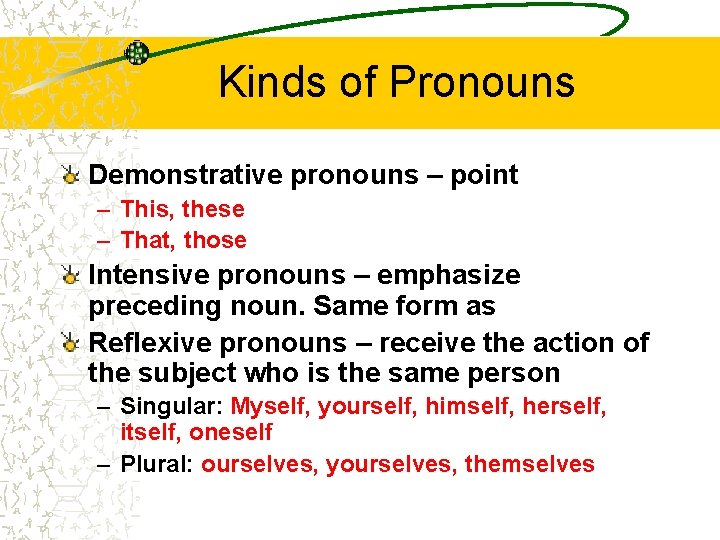
Kinds of Pronouns Demonstrative pronouns – point – This, these – That, those Intensive pronouns – emphasize preceding noun. Same form as Reflexive pronouns – receive the action of the subject who is the same person – Singular: Myself, yourself, himself, herself, itself, oneself – Plural: ourselves, yourselves, themselves
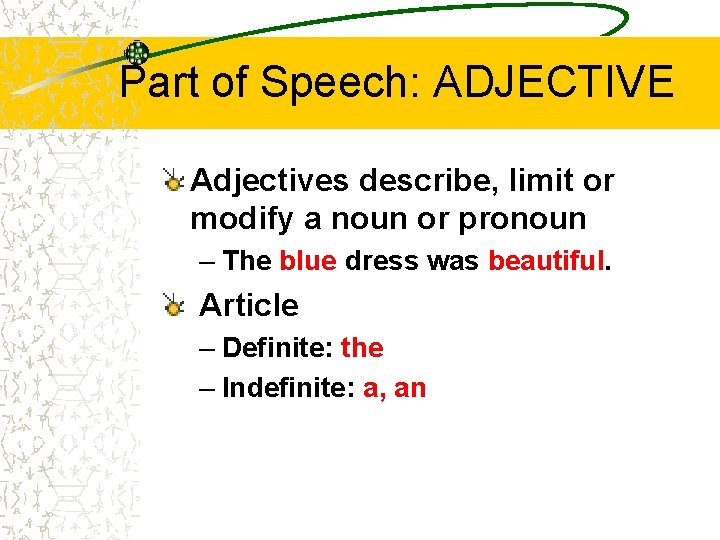
Part of Speech: ADJECTIVE Adjectives describe, limit or modify a noun or pronoun – The blue dress was beautiful. Article – Definite: the – Indefinite: a, an
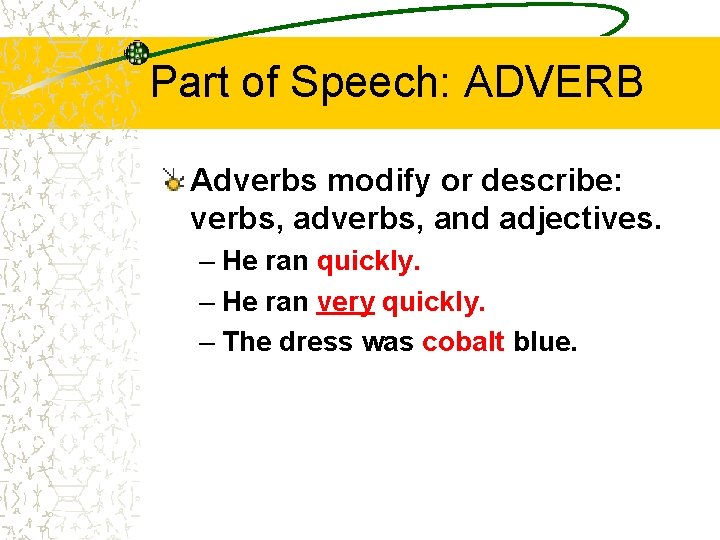
Part of Speech: ADVERB Adverbs modify or describe: verbs, adverbs, and adjectives. – He ran quickly. – He ran very quickly. – The dress was cobalt blue.
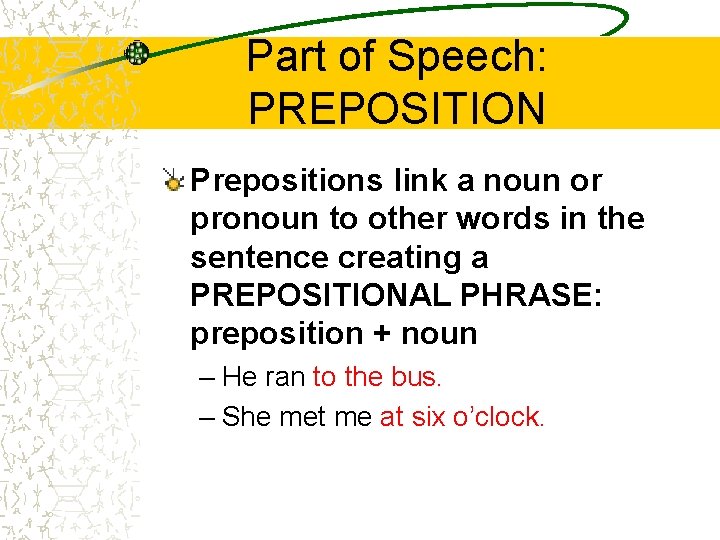
Part of Speech: PREPOSITION Prepositions link a noun or pronoun to other words in the sentence creating a PREPOSITIONAL PHRASE: preposition + noun – He ran to the bus. – She met me at six o’clock.
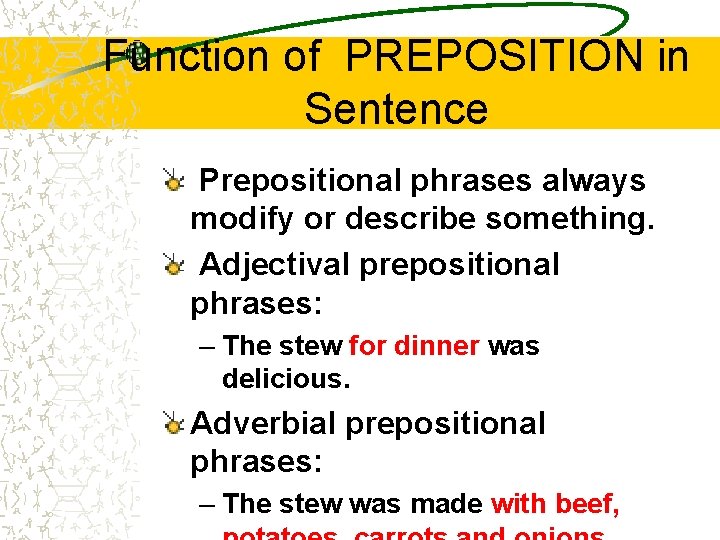
Function of PREPOSITION in Sentence Prepositional phrases always modify or describe something. Adjectival prepositional phrases: – The stew for dinner was delicious. Adverbial prepositional phrases: – The stew was made with beef,
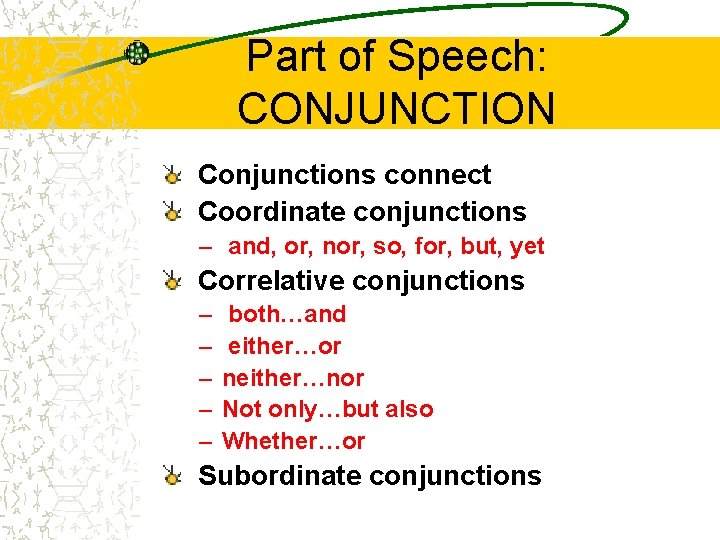
Part of Speech: CONJUNCTION Conjunctions connect Coordinate conjunctions – and, or, nor, so, for, but, yet Correlative conjunctions – – – both…and either…or neither…nor Not only…but also Whether…or Subordinate conjunctions
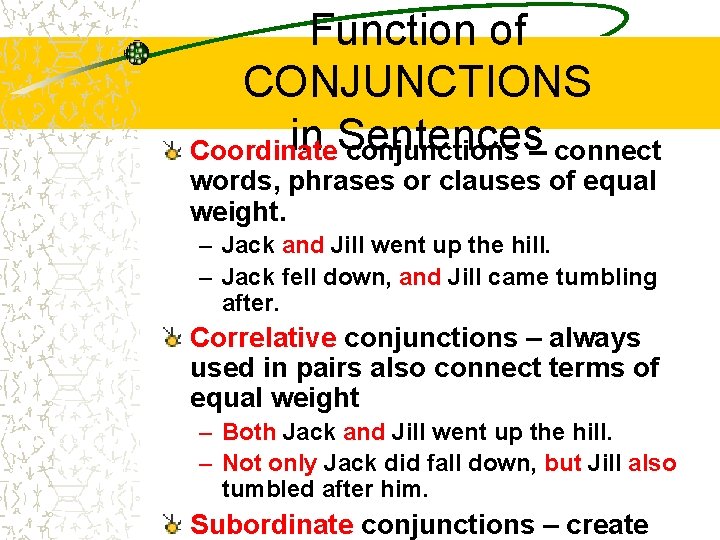
Function of CONJUNCTIONS in Sentences Coordinate conjunctions -- connect words, phrases or clauses of equal weight. – Jack and Jill went up the hill. – Jack fell down, and Jill came tumbling after. Correlative conjunctions – always used in pairs also connect terms of equal weight – Both Jack and Jill went up the hill. – Not only Jack did fall down, but Jill also tumbled after him. Subordinate conjunctions – create
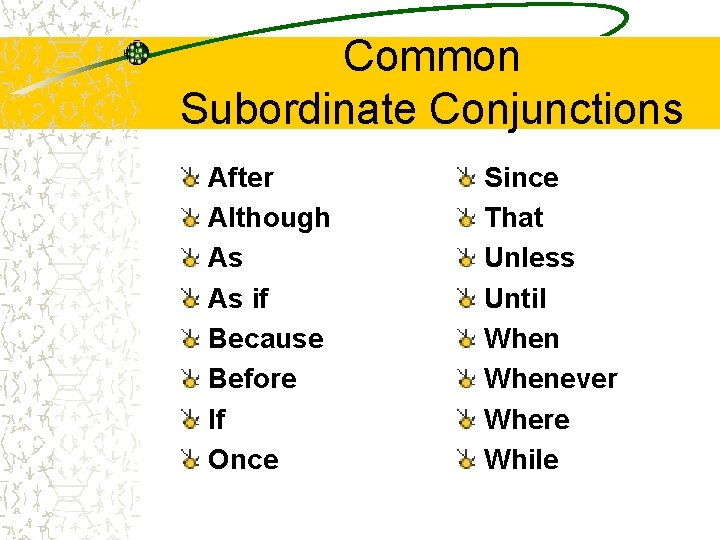
Common Subordinate Conjunctions After Although As As if Because Before If Once Since That Unless Until Whenever Where While
Part of Speech: INTERJECTION Interjections exclaim or express emotions – Ouch – Alas – Oh – All those words you curse with
Part of Speech: VERB Verbs express action, state of being or condition
Function of VERB in Sentence Main verbs – Action: walk, sing, fly – State of being or linking: is, feel Auxiliary (helping) verbs – combine with main verbs to create verb phrases – Be: am walking, was sung – Have: had flown
Principal Parts of Verbs Infinitive: to be 3 rd person present tense: is 3 rd person past tense: was Past participle: been to have, has, had to walk, walks, walked to sing, sings, sang, sung to fly, flies, flew, flown
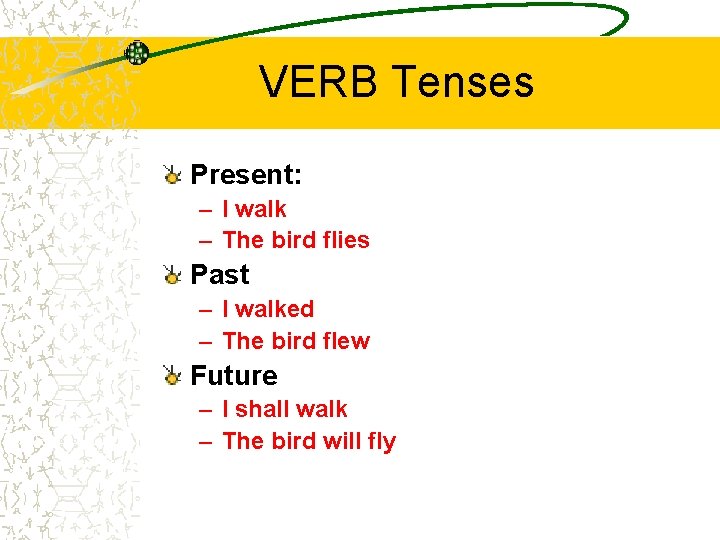
VERB Tenses Present: – I walk – The bird flies Past – I walked – The bird flew Future – I shall walk – The bird will fly
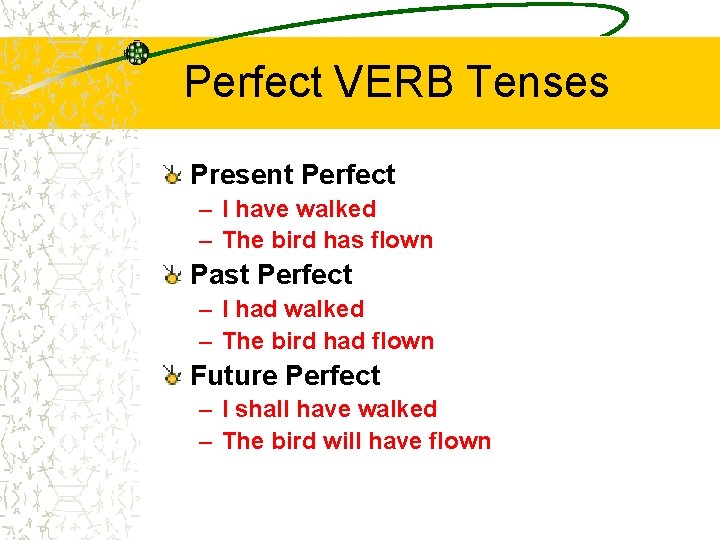
Perfect VERB Tenses Present Perfect – I have walked – The bird has flown Past Perfect – I had walked – The bird had flown Future Perfect – I shall have walked – The bird will have flown
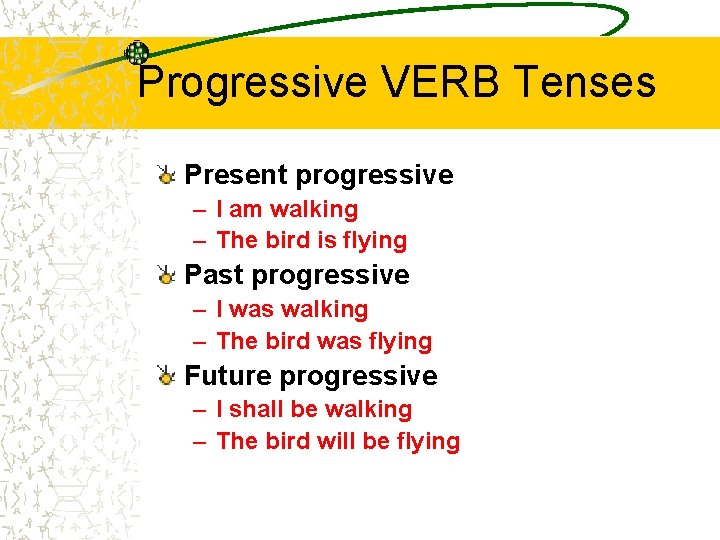
Progressive VERB Tenses Present progressive – I am walking – The bird is flying Past progressive – I was walking – The bird was flying Future progressive – I shall be walking – The bird will be flying
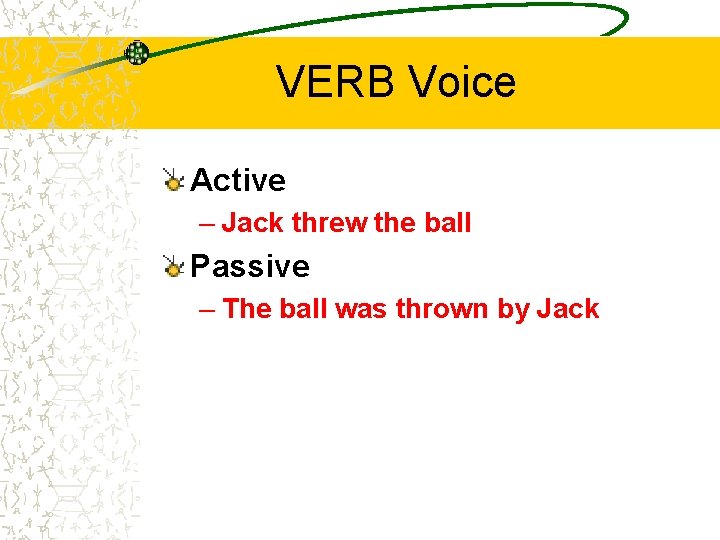
VERB Voice Active – Jack threw the ball Passive – The ball was thrown by Jack
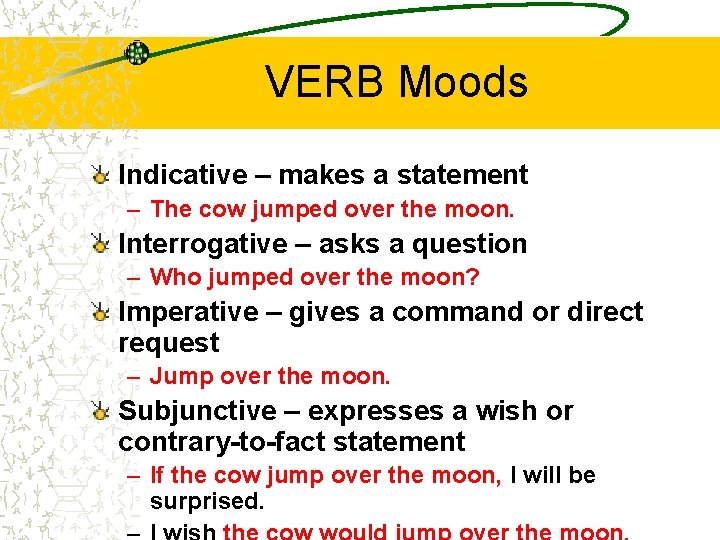
VERB Moods Indicative – makes a statement – The cow jumped over the moon. Interrogative – asks a question – Who jumped over the moon? Imperative – gives a command or direct request – Jump over the moon. Subjunctive – expresses a wish or contrary-to-fact statement – If the cow jump over the moon, I will be surprised.
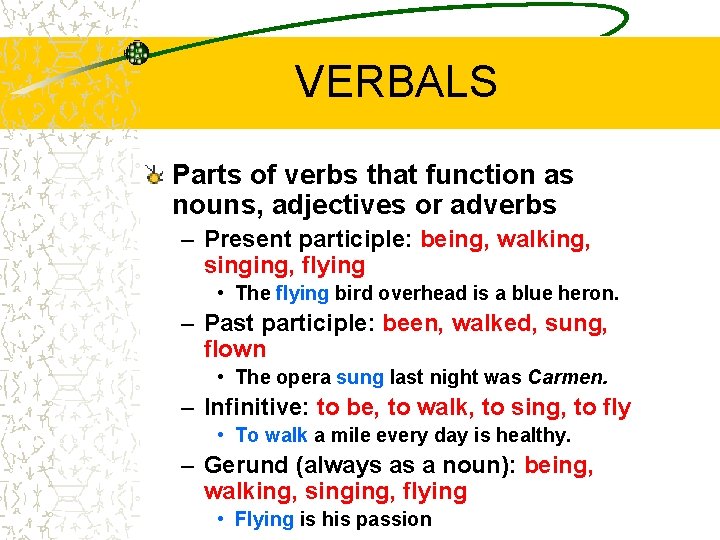
VERBALS Parts of verbs that function as nouns, adjectives or adverbs – Present participle: being, walking, singing, flying • The flying bird overhead is a blue heron. – Past participle: been, walked, sung, flown • The opera sung last night was Carmen. – Infinitive: to be, to walk, to sing, to fly • To walk a mile every day is healthy. – Gerund (always as a noun): being, walking, singing, flying • Flying is his passion