
Parts of an Ecosystem and Population Dynamics Ecology


- Slides: 59
Parts of an Ecosystem and Population Dynamics
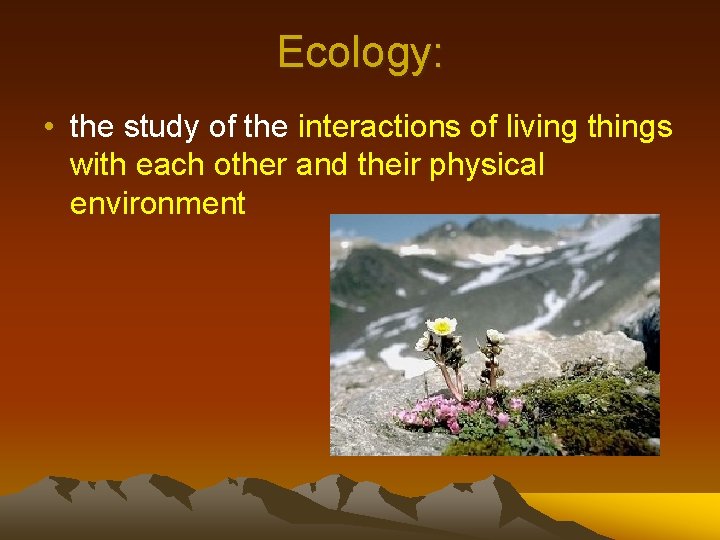
Ecology: • the study of the interactions of living things with each other and their physical environment
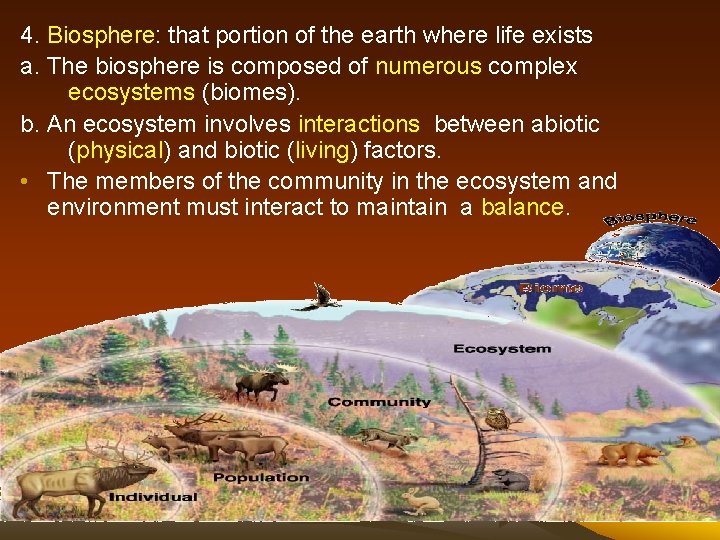
Ecological Organization: 1. Population: all the members of a species inhabiting a given location 2. Community: all the interacting populations in a given area 3. Ecosystem: the living community and physical environment function together and is self-sustaining if the following requirements are met: 1. A constant source of energy and a living system capable of incorporating this energy into organic molecules. 2. A cycling of materials between organisms and their environment.
4. Biosphere: that portion of the earth where life exists a. The biosphere is composed of numerous complex ecosystems (biomes). b. An ecosystem involves interactions between abiotic (physical) and biotic (living) factors. • The members of the community in the ecosystem and environment must interact to maintain a balance.
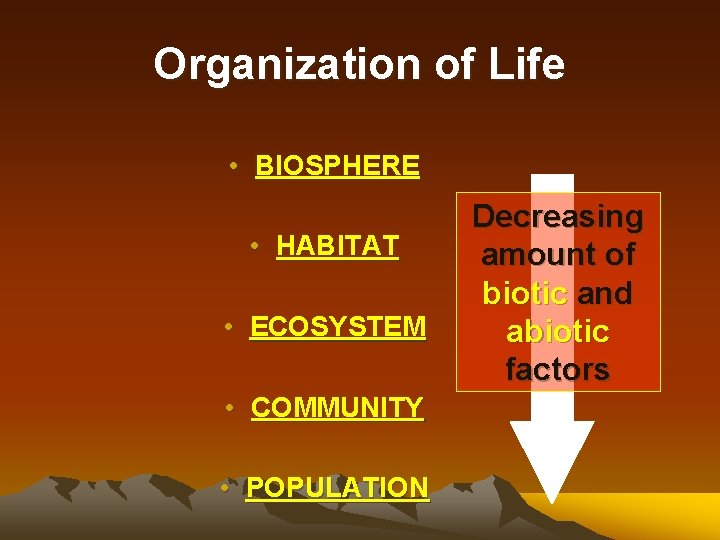
Organization of Life • BIOSPHERE • HABITAT • ECOSYSTEM • COMMUNITY • POPULATION Decreasing amount of biotic and abiotic factors
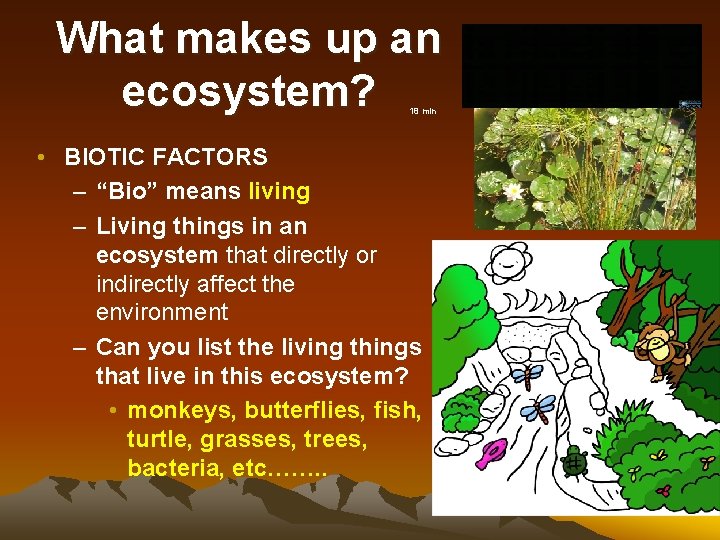
What makes up an ecosystem? 18 min • BIOTIC FACTORS – “Bio” means living – Living things in an ecosystem that directly or indirectly affect the environment – Can you list the living things that live in this ecosystem? • monkeys, butterflies, fish, turtle, grasses, trees, bacteria, etc……. .
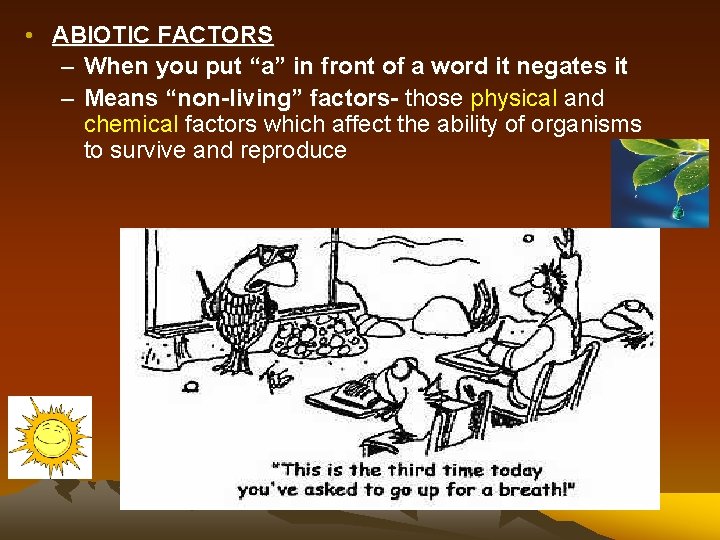
• ABIOTIC FACTORS – When you put “a” in front of a word it negates it – Means “non-living” factors- those physical and chemical factors which affect the ability of organisms to survive and reproduce
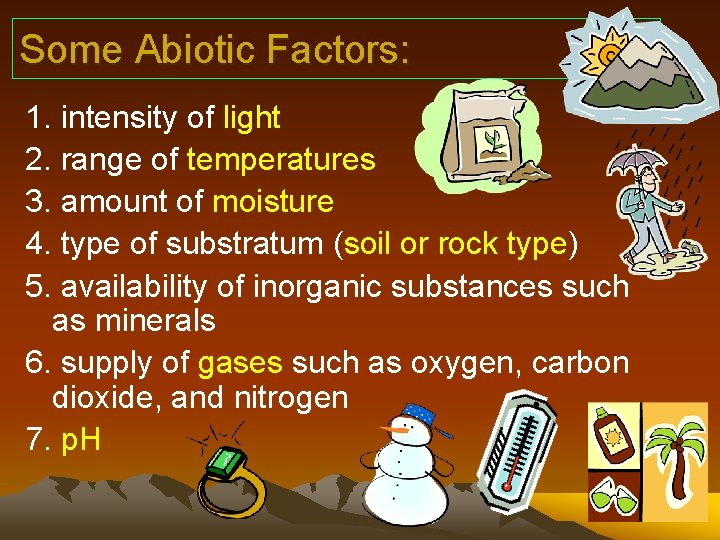
Some Abiotic Factors: 1. intensity of light 2. range of temperatures 3. amount of moisture 4. type of substratum (soil or rock type) 5. availability of inorganic substances such as minerals 6. supply of gases such as oxygen, carbon dioxide, and nitrogen 7. p. H
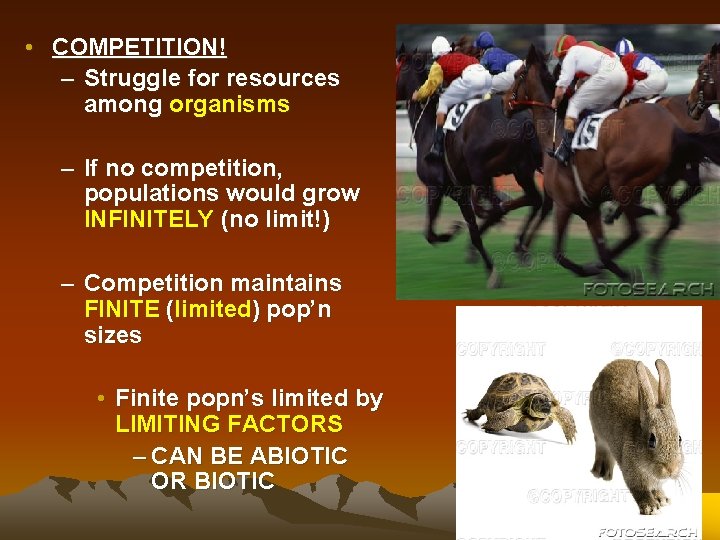
• COMPETITION! – Struggle for resources among organisms – If no competition, populations would grow INFINITELY (no limit!) – Competition maintains FINITE (limited) pop’n sizes • Finite popn’s limited by LIMITING FACTORS – CAN BE ABIOTIC OR BIOTIC
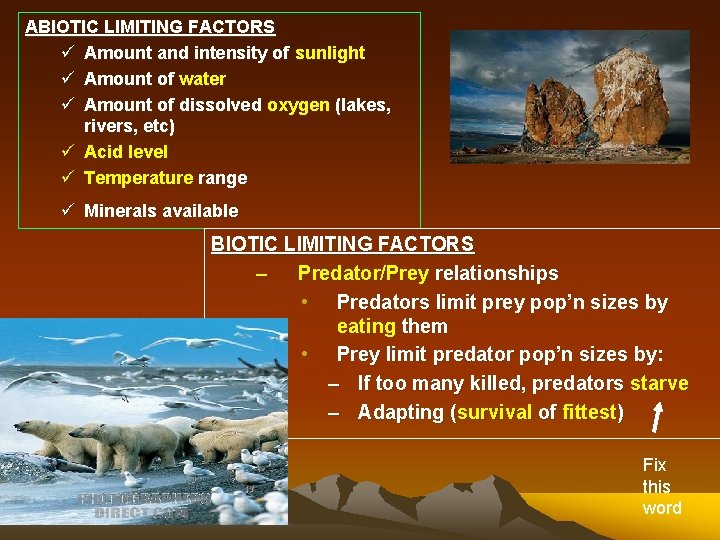
ABIOTIC LIMITING FACTORS ü Amount and intensity of sunlight ü Amount of water ü Amount of dissolved oxygen (lakes, rivers, etc) ü Acid level ü Temperature range ü Minerals available BIOTIC LIMITING FACTORS – Predator/Prey relationships • Predators limit prey pop’n sizes by eating them • Prey limit predator pop’n sizes by: – If too many killed, predators starve – Adapting (survival of fittest) Fix this word
What do we call it when a species reaches its limit? • EVERY population in an ecosystem has a CARRYING CAPACITY (K) – The # of organisms of a single species an ecosystem can support – Determined by biotic and abiotic factors • EX: a fox pop’n is affected by how much it has to eat (biotic) and also temperature (abiotic) – Once CC is reached, pop’n will remain stable unless major changes in biotic and abiotic factors
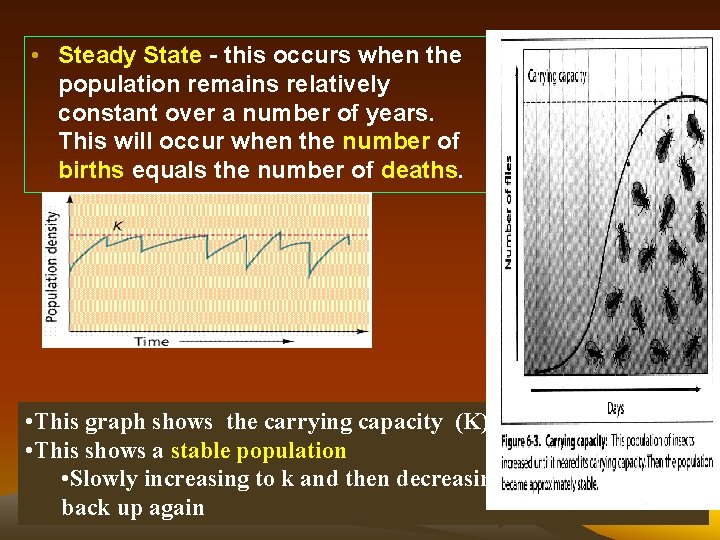
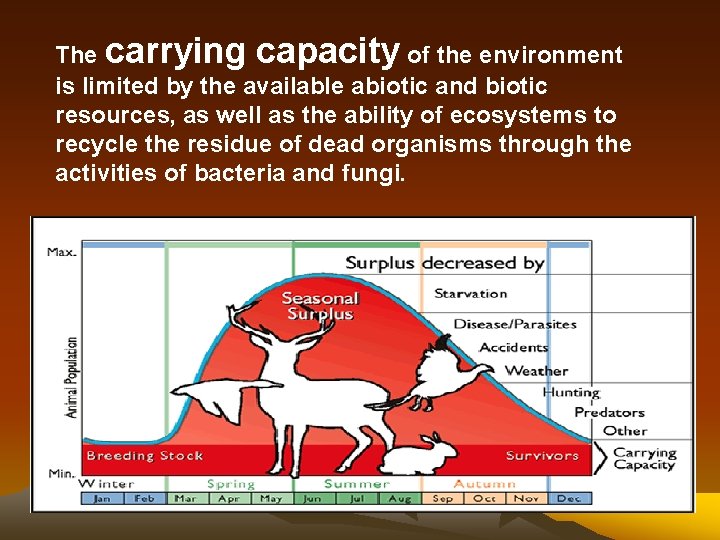
• Steady State - this occurs when the population remains relatively constant over a number of years. This will occur when the number of births equals the number of deaths. • This graph shows the carrying capacity (K) of an organism • This shows a stable population • Slowly increasing to k and then decreasing once it hits k and back up again
The carrying capacity of the environment is limited by the available abiotic and biotic resources, as well as the ability of ecosystems to recycle the residue of dead organisms through the activities of bacteria and fungi.
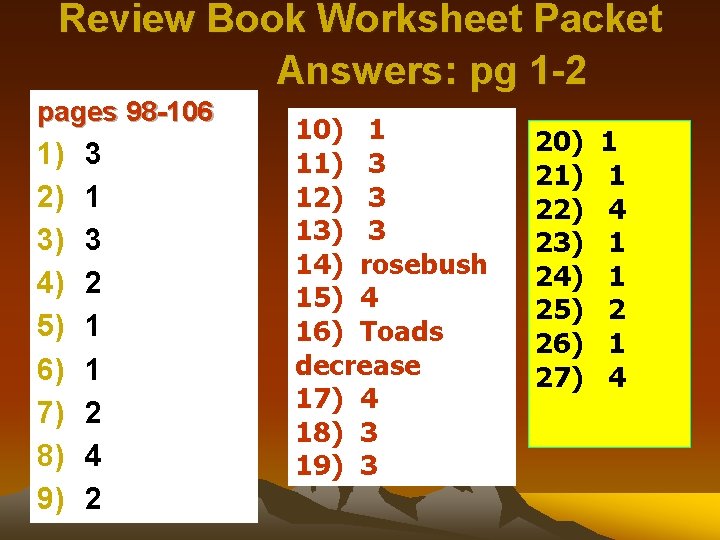
Review Book Worksheet Packet Answers: pg 1 -2 pages 98 -106 1) 3 2) 1 3) 3 4) 2 5) 1 6) 1 7) 2 8) 4 Friday, 2 June 6, 11: 34: 32 9) AM 10) 1 11) 3 12) 3 13) 3 14) rosebush 15) 4 16) Toads decrease 17) 4 18) 3 19) 3 20) 21) 22) 23) 24) 25) 26) 27) 1 1 4 1 1 2 1 4
POPULATION INTERACTIONS How organisms interact in an ecosystem!
What does it mean to have a role in an ecosystem? • NICHE: – The role an organism plays in its ecosystem – Only one species can occupy a niche at a time • Leads to competition if more than one species wants role • Similar species can coexist as long as they have different niches! • Niches are defined by how organisms obtain their food – EX: p 102 in RB – WARBLERS!
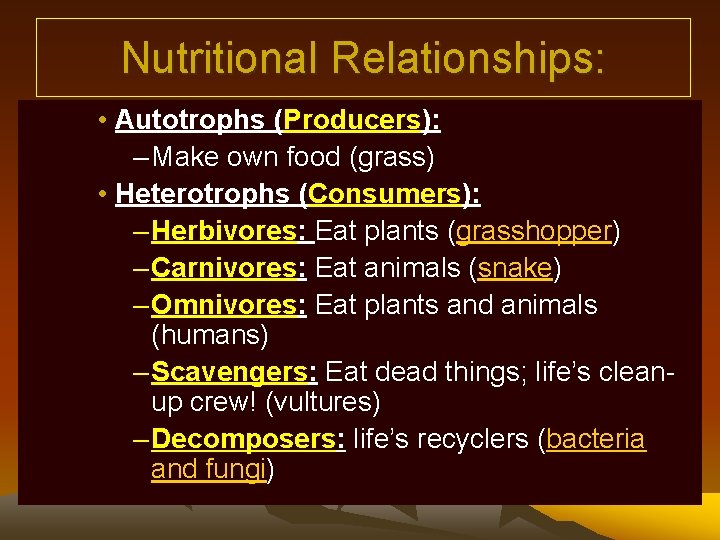
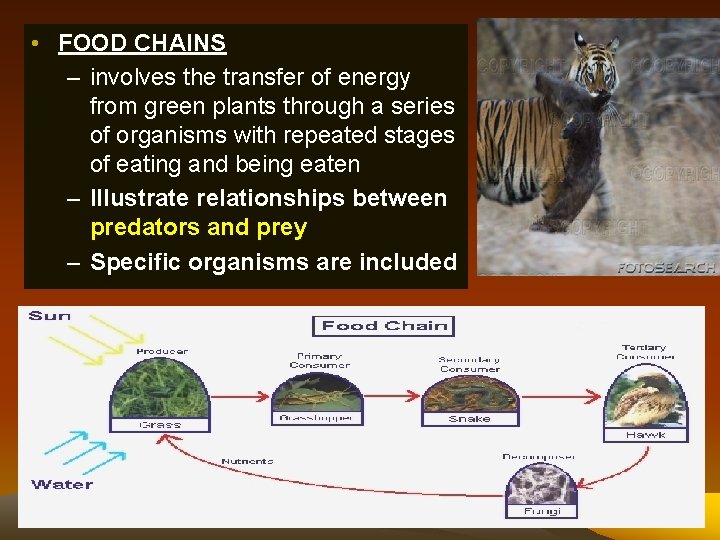
Nutritional Relationships: • Autotrophs (Producers): – Make own food (grass) • Heterotrophs (Consumers): – Herbivores: Eat plants (grasshopper) – Carnivores: Eat animals (snake) – Omnivores: Eat plants and animals (humans) – Scavengers: Eat dead things; life’s cleanup crew! (vultures) – Decomposers: life’s recyclers (bacteria and fungi)
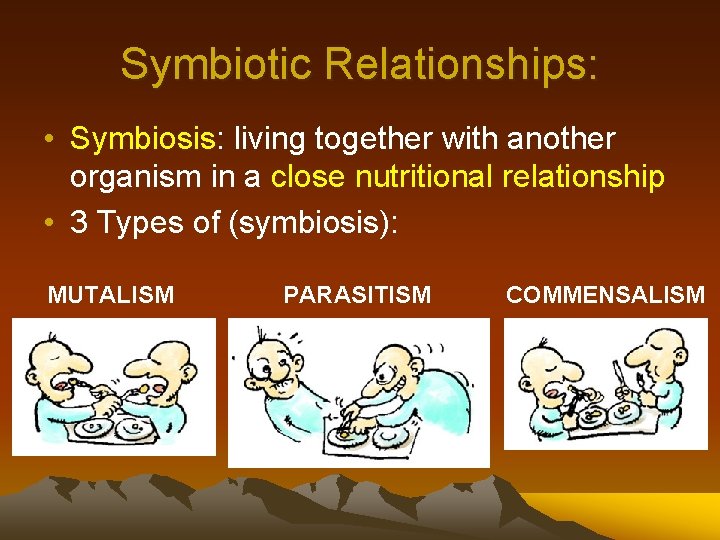
Symbiotic Relationships: • Symbiosis: living together with another organism in a close nutritional relationship • 3 Types of (symbiosis): MUTALISM PARASITISM COMMENSALISM
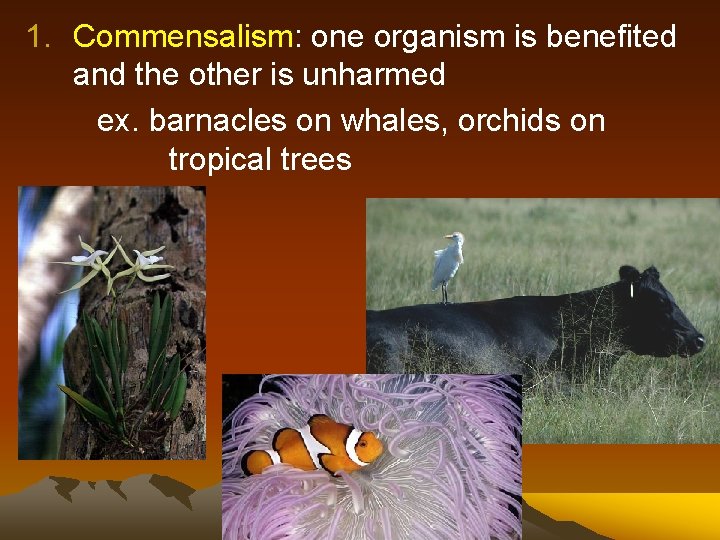
1. Commensalism: one organism is benefited and the other is unharmed ex. barnacles on whales, orchids on tropical trees
2. Mutualism: both organisms benefit from the association ex. nitrogen-fixing bacteria on legume nodules, certain protozoa within termites (also ruminants)
3. Parasitism: the parasite benefits at the expense of the host ex. athlete's foot fungus on humans, tapeworm and heartworm in dogs
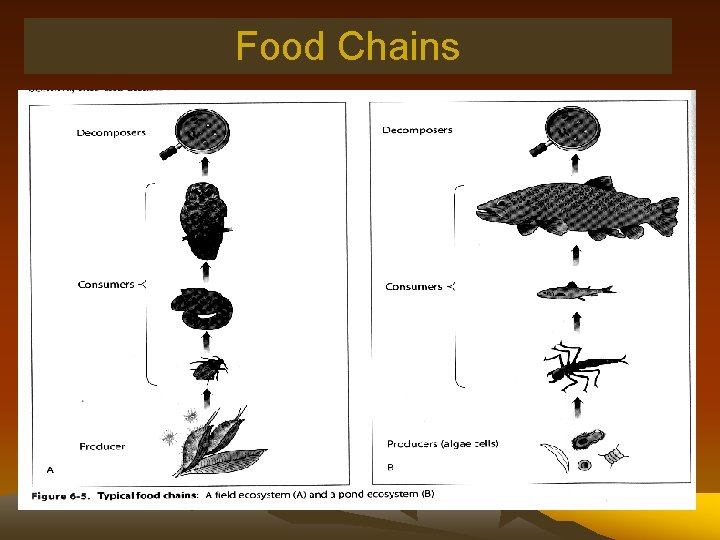
Food Chains and Webs • If an ecosystem is to be self-sustaining it must contain a flow of energy. • Those life activities that are characteristic of living organisms require an expenditure of energy. • The pathways of energy through the living components of an ecosystem are represented by food chains and food webs. • Producers convert the radiant energy of the sun into the chemical energy of food.
• FOOD CHAINS – involves the transfer of energy from green plants through a series of organisms with repeated stages of eating and being eaten – Illustrate relationships between predators and prey – Specific organisms are included
Food Chains
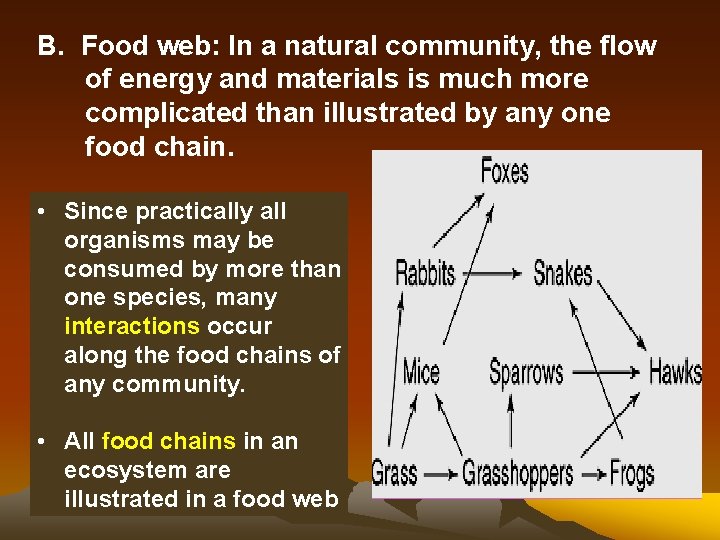
B. Food web: In a natural community, the flow of energy and materials is much more complicated than illustrated by any one food chain. • Since practically all organisms may be consumed by more than one species, many interactions occur along the food chains of any community. • All food chains in an ecosystem are illustrated in a food web
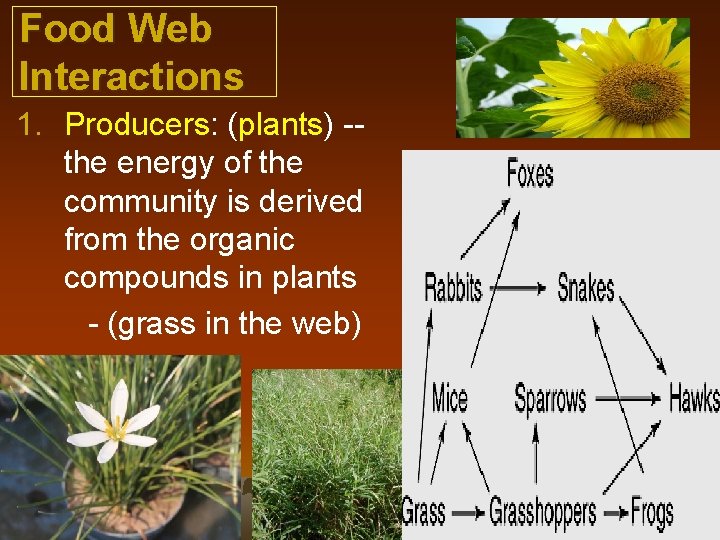
Food Web Interactions 1. Producers: (plants) -the energy of the community is derived from the organic compounds in plants - (grass in the web)
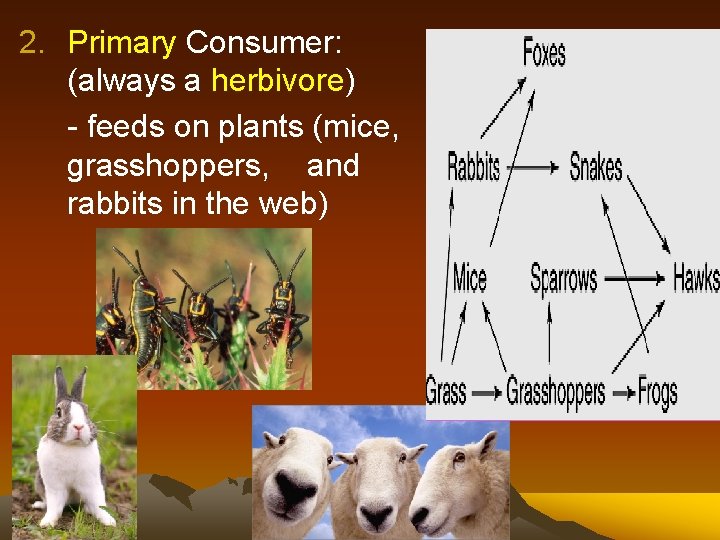
2. Primary Consumer: (always a herbivore) - feeds on plants (mice, grasshoppers, and rabbits in the web)
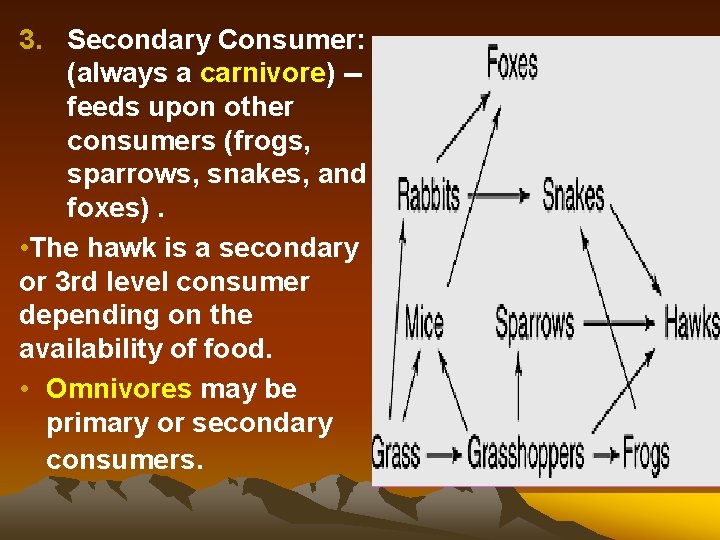
3. Secondary Consumer: (always a carnivore) -feeds upon other consumers (frogs, sparrows, snakes, and foxes). • The hawk is a secondary or 3 rd level consumer depending on the availability of food. • Omnivores may be primary or secondary consumers.
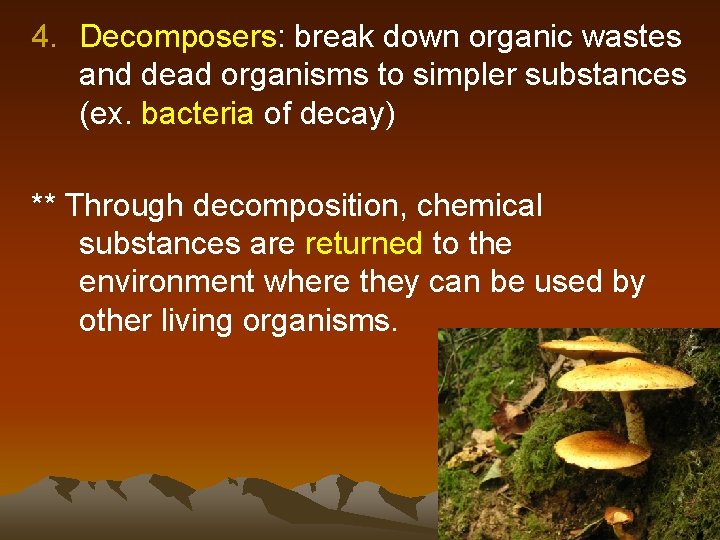
4. Decomposers: break down organic wastes and dead organisms to simpler substances (ex. bacteria of decay) ** Through decomposition, chemical substances are returned to the environment where they can be used by other living organisms.
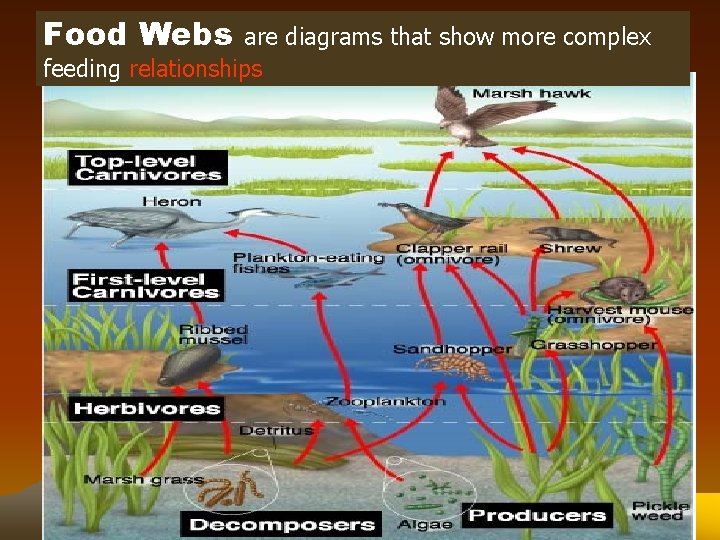
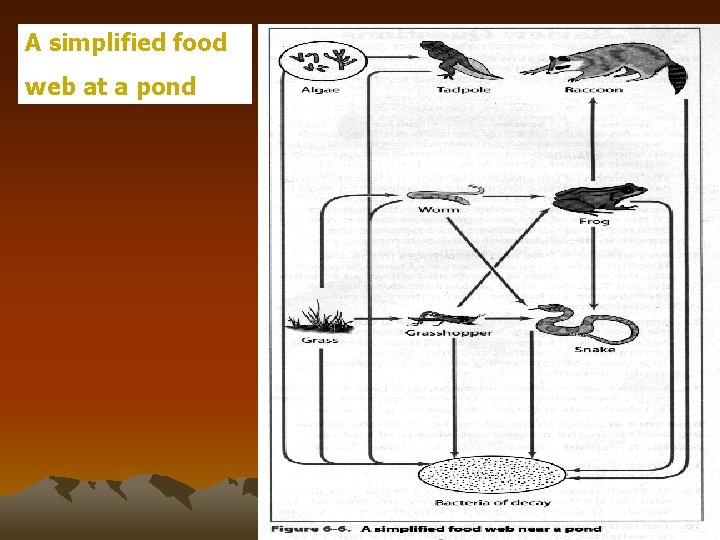
Food Webs are diagrams that show more complex feeding relationships Friday, June 6, 11: 34: 32 AM
A simplified food web at a pond
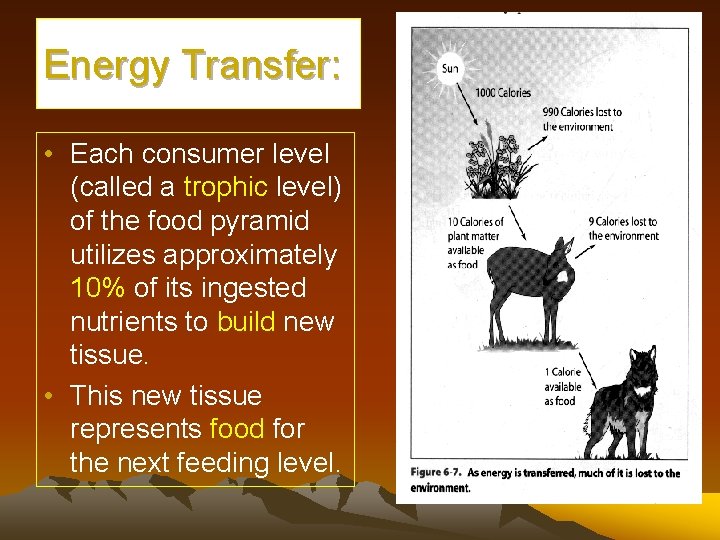
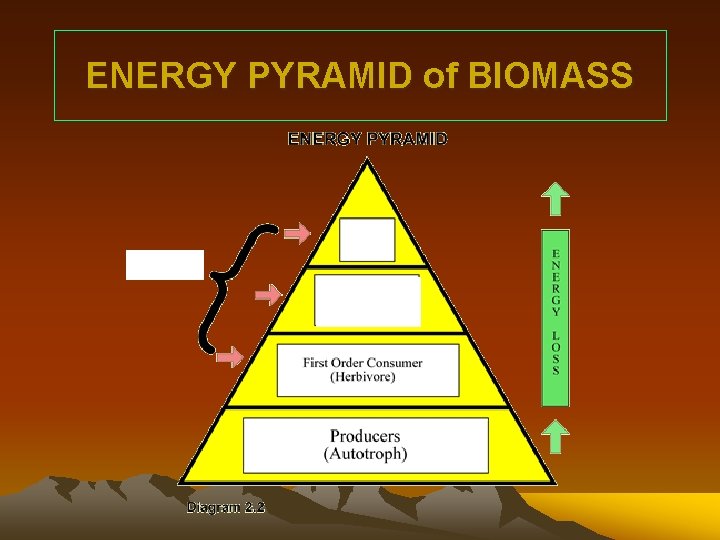
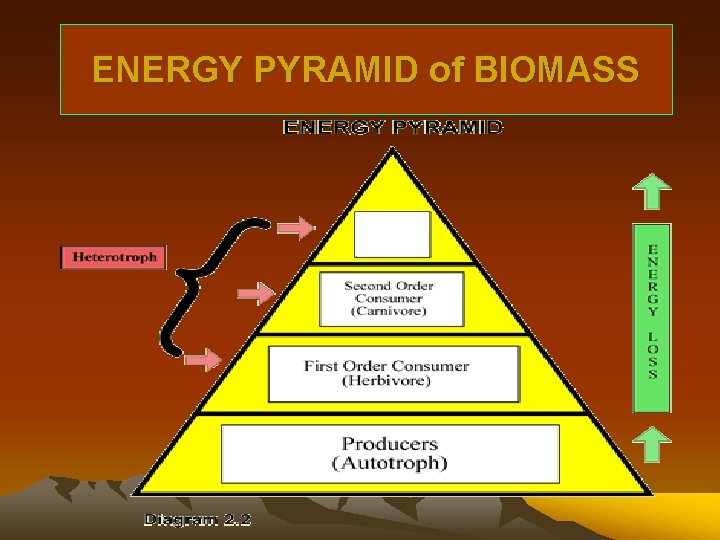
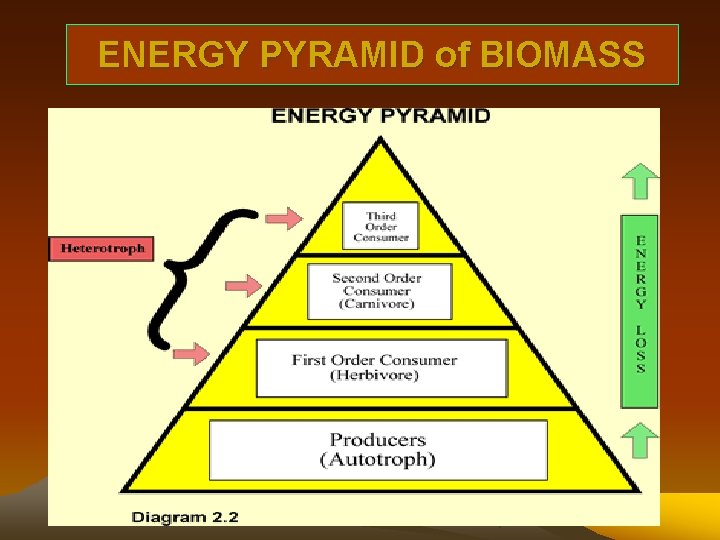
Energy Transfer: • Each consumer level (called a trophic level) of the food pyramid utilizes approximately 10% of its ingested nutrients to build new tissue. • This new tissue represents food for the next feeding level.
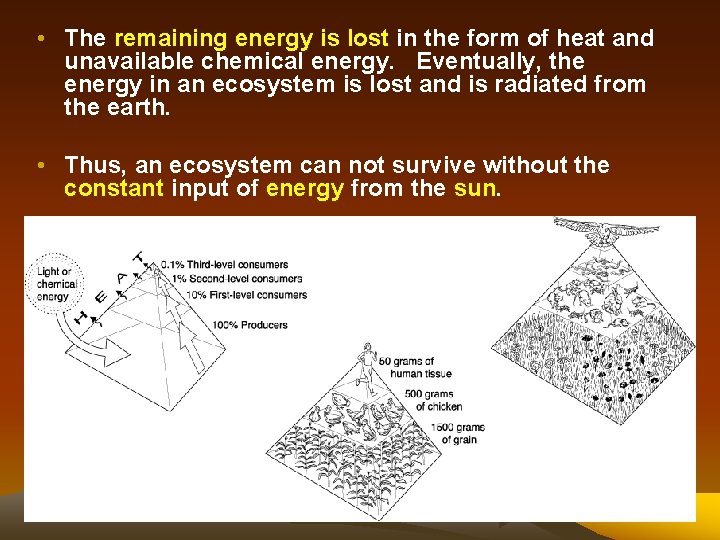
• The remaining energy is lost in the form of heat and unavailable chemical energy. Eventually, the energy in an ecosystem is lost and is radiated from the earth. • Thus, an ecosystem can not survive without the constant input of energy from the sun.
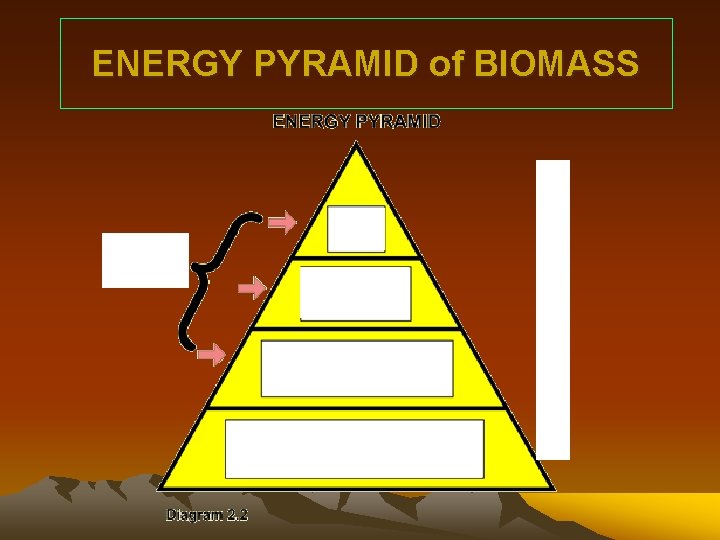
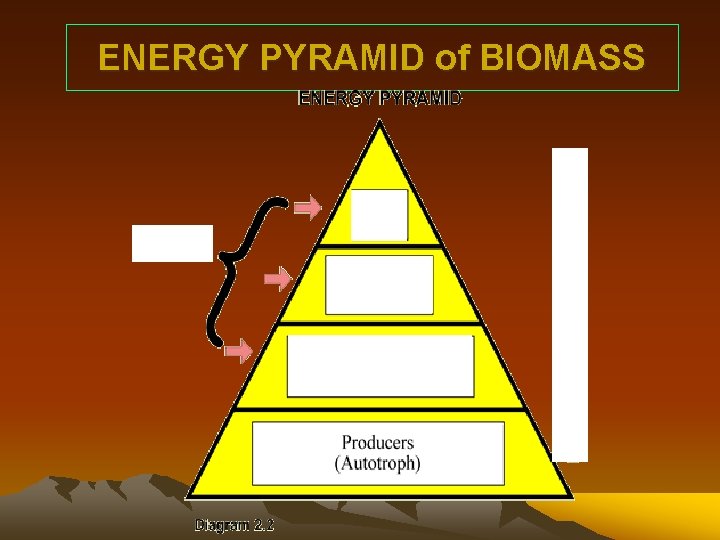
What happens to energy in an ecosystem? • Every organism uses energy to carry out life processes • If an organism is eaten, it will give less energy to the predator • THEREFORE, ENERGY DECREASES AS YOU MOVE UP A FOOD CHAIN! • WE USE AN ENERGY PYRAMID of BIOMASS TO SHOW THIS!
ENERGY PYRAMID of BIOMASS
ENERGY PYRAMID of BIOMASS
ENERGY PYRAMID of BIOMASS
ENERGY PYRAMID of BIOMASS
ENERGY PYRAMID of BIOMASS
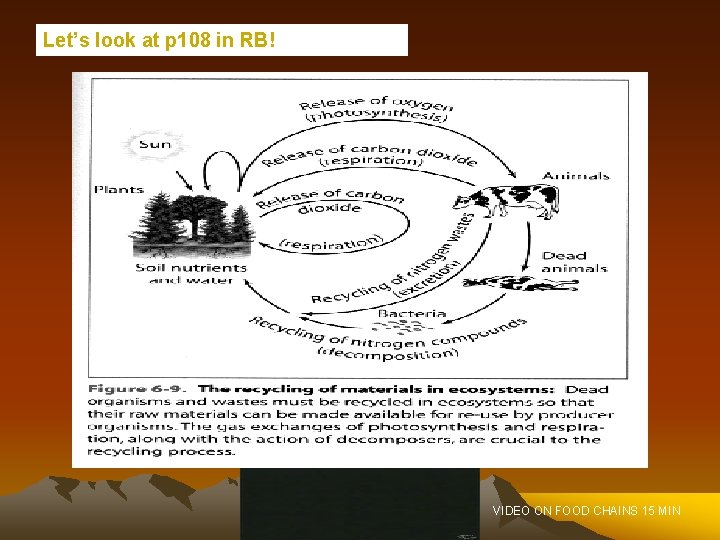
RECYCLING NUTRIENTS • Decomposers extract what little nutrients are left • They return raw materials (nitrogen) back to soil • Other organisms continually recycling carbon dioxide, oxygen, and nitrogen • ENERGY IS NEVER RECYCLED!
Let’s look at p 108 in RB! VIDEO ON FOOD CHAINS 15 MIN
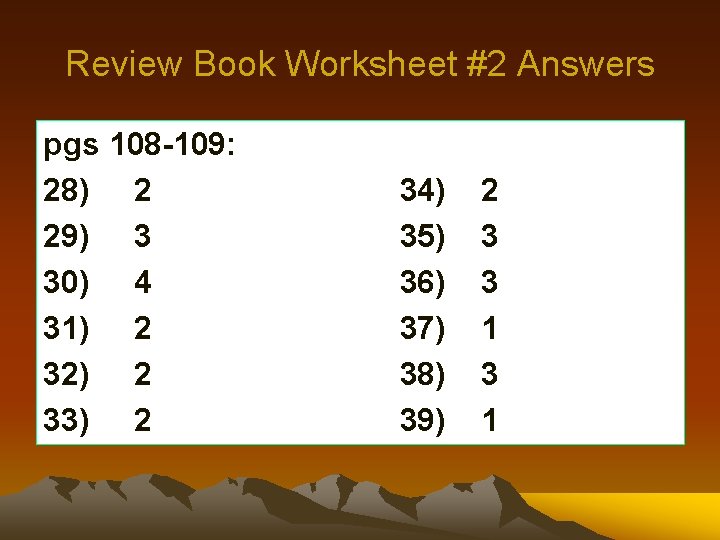
Review Book Worksheet #2 Answers pgs 108 -109: 28) 2 29) 3 30) 4 31) 2 32) 2 33) 2 34) 35) 36) 37) 38) 39) 2 3 3 1
Biodiversity and Succession Evolutionary processes have resulted in a diversity of organisms and a diversity of roles in ecosystems.
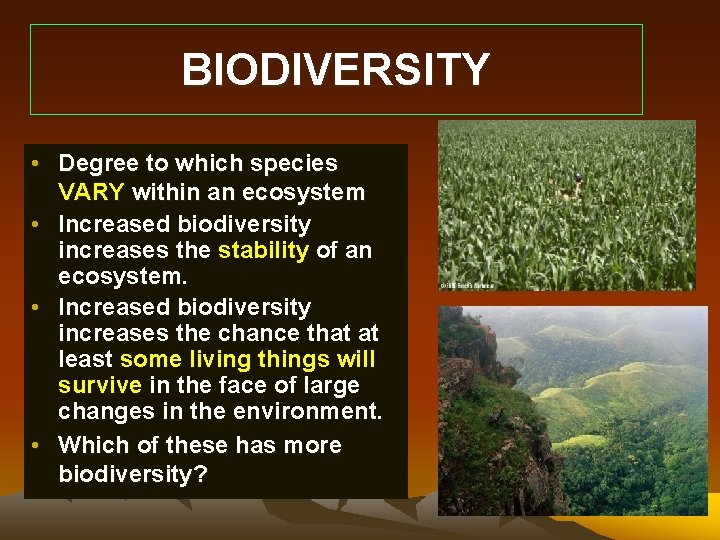
BIODIVERSITY • Degree to which species VARY within an ecosystem • Increased biodiversity increases the stability of an ecosystem. • Increased biodiversity increases the chance that at least some living things will survive in the face of large changes in the environment. • Which of these has more biodiversity?
WHY IS BIODIVERSITY SO IMPORTANT? • The Back-up plan: – “Backup” orgs if one species due to disease, there is one to fill the niche • Maintains stable ecosystem: – If lots of orgs, every niche can be filled! Therefore, stable ecosystem! • Benefits Humans!: – Ensures a variety of genetic material – Vast rainforests may hold cures, medicines and other useful resources!
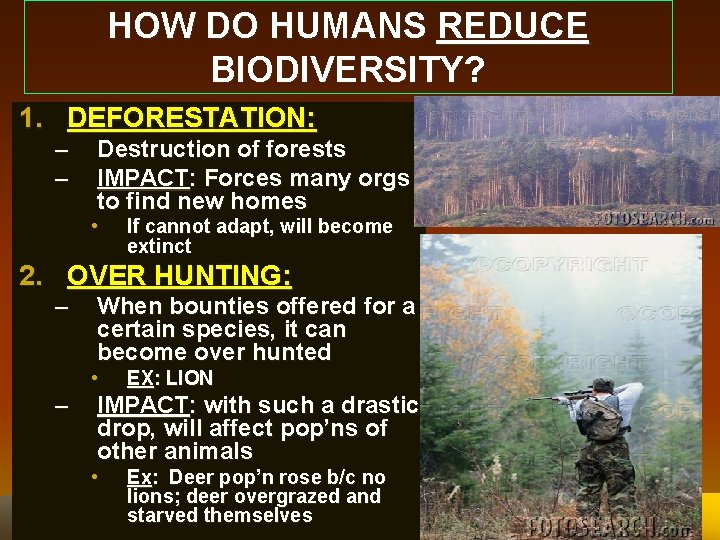
HOW DO HUMANS REDUCE BIODIVERSITY? 1. DEFORESTATION: – – Destruction of forests IMPACT: Forces many orgs to find new homes • If cannot adapt, will become extinct 2. OVER HUNTING: – When bounties offered for a certain species, it can become over hunted • – EX: LION IMPACT: with such a drastic drop, will affect pop’ns of other animals • Ex: Deer pop’n rose b/c no lions; deer overgrazed and starved themselves
3. Clearing land for farming and space: – Replacing a diverse ecosystem with one or two crops – IMPACT: Taking away resources for ourselves and other species 4. DIRECT HARVESTING: – Taking species out of natural habitat for our benefit (wanting unusual pets or plants) – IMPACT: We are reducing the # of those species in their natural habitat
5. IMPORTED SPECIES : – When a species is imported and released into a new environment – IMPACT: New species may adapt well and drive out existing species • EX: Rabbits in Australia – IMPACT: New species often become pests because they have NO NATURAL PREDATORS • EX: Zebra mussels in NY waterways
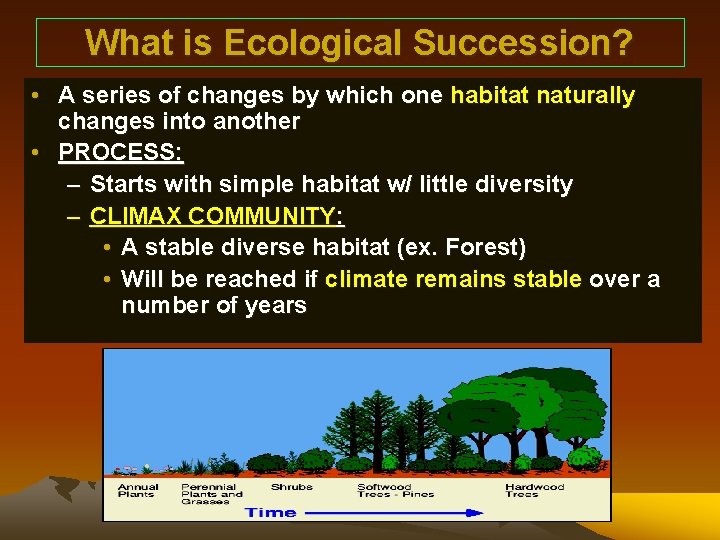
What is Ecological Succession? • A series of changes by which one habitat naturally changes into another • PROCESS: – Starts with simple habitat w/ little diversity – CLIMAX COMMUNITY: • A stable diverse habitat (ex. Forest) • Will be reached if climate remains stable over a number of years
When does Succession occur? 1. When environment becomes suitable for another community: – Grasses grow in shallow soil, but add nutrients as they live and die – Soil then becomes suitable for shrubs – Shrubs shade out the grasses and take over – Over time, shrubs will be shaded out by trees 2. When natural disasters occur that alter stable ecosystems – Fires, overgrazing, etc……. – Altered ecosystems will need many successions to recover
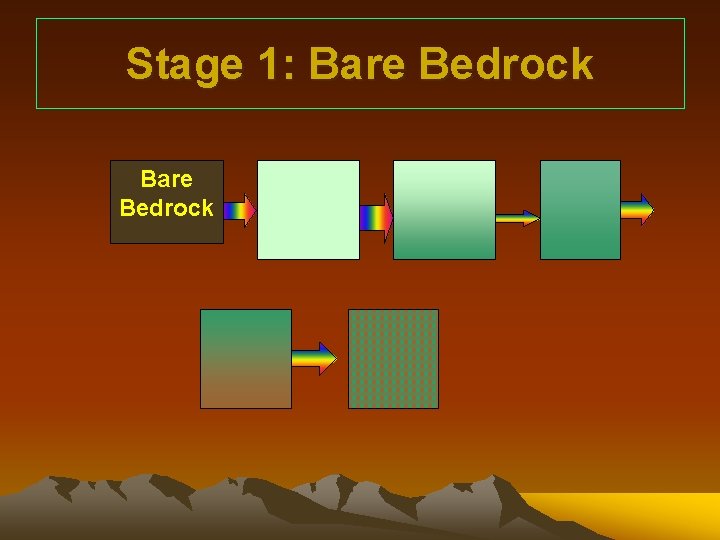
Stage 1: Bare Bedrock
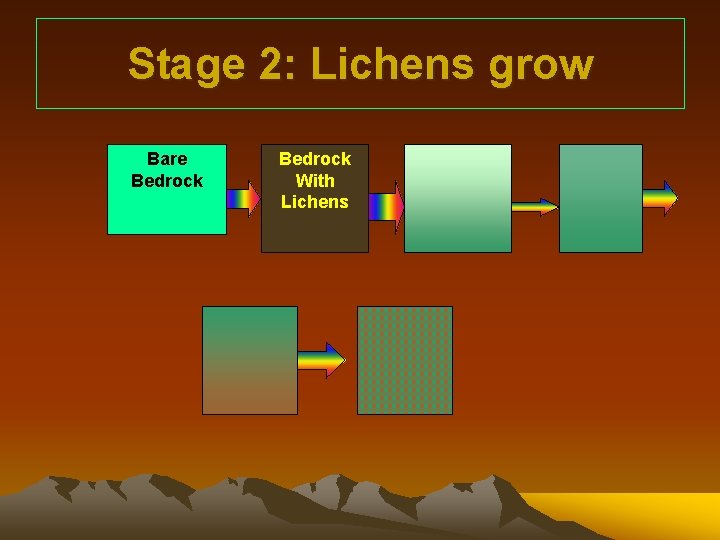
Stage 2: Lichens grow Bare Bedrock With Lichens
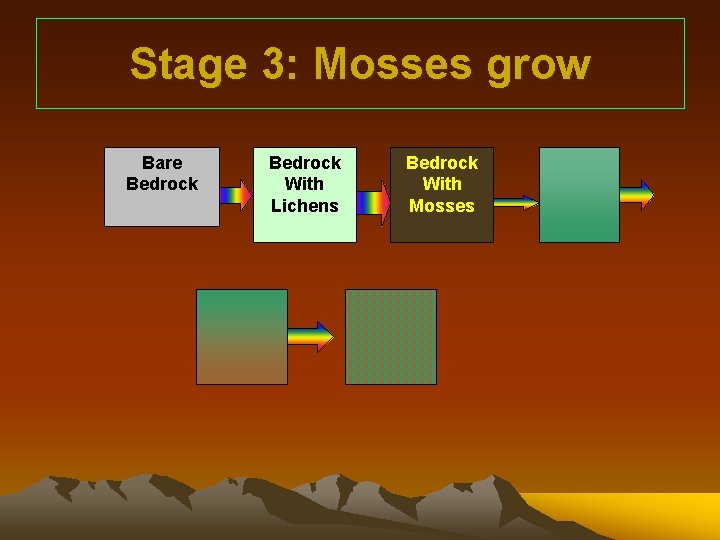
Stage 3: Mosses grow Bare Bedrock With Lichens Bedrock With Mosses
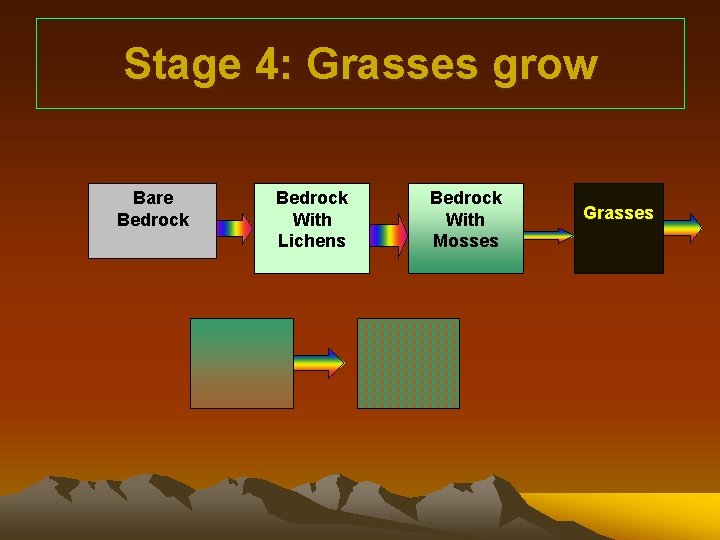
Stage 4: Grasses grow Bare Bedrock With Lichens Bedrock With Mosses Grasses
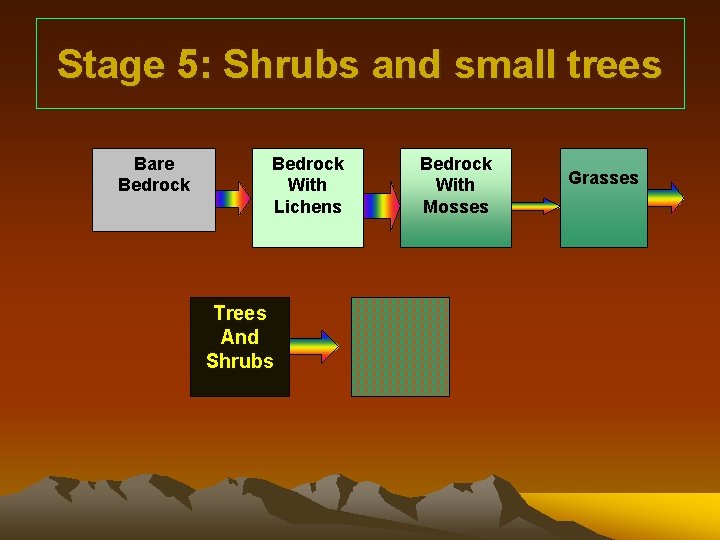
Stage 5: Shrubs and small trees Bare Bedrock With Lichens Trees And Shrubs Bedrock With Mosses Grasses
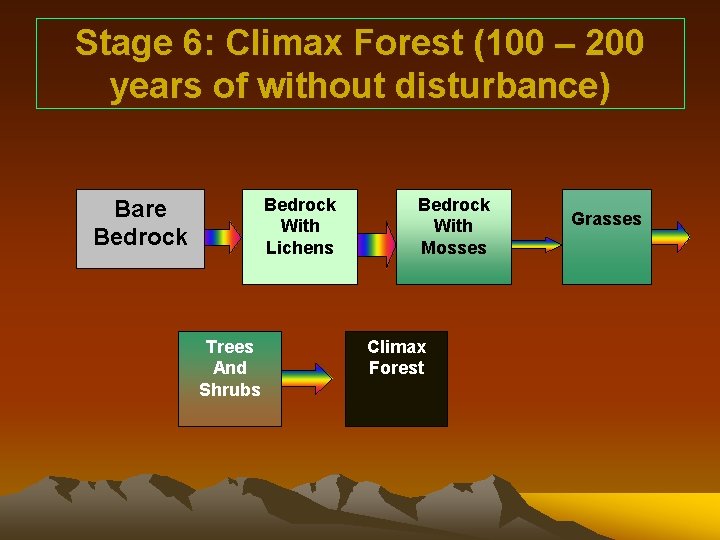
Stage 6: Climax Forest (100 – 200 years of without disturbance) Bedrock With Lichens Bare Bedrock Trees And Shrubs Bedrock With Mosses Climax Forest Grasses
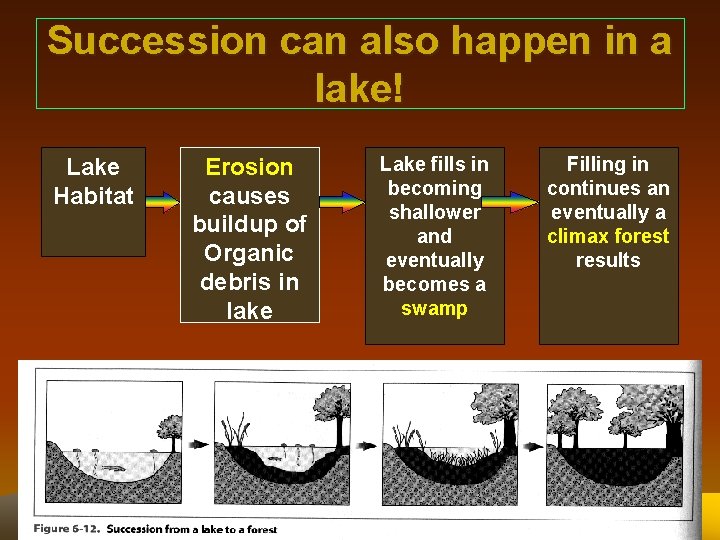
Succession can also happen in a lake! Lake Habitat Erosion causes buildup of Organic debris in lake Lake fills in becoming shallower and eventually becomes a swamp Filling in continues an eventually a climax forest results
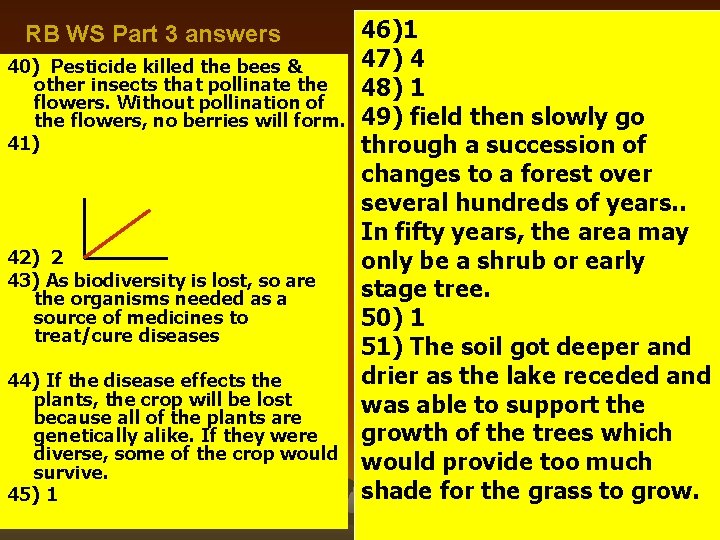
RB WS Part 3 answers 40) Pesticide killed the bees & other insects that pollinate the flowers. Without pollination of the flowers, no berries will form. 41) 42) 2 43) As biodiversity is lost, so are the organisms needed as a source of medicines to treat/cure diseases 44) If the disease effects the plants, the crop will be lost because all of the plants are genetically alike. If they were diverse, some of the crop would survive. 45) Friday, 1 June 6, 11: 34: 32 AM 46)1 47) 4 48) 1 49) field then slowly go through a succession of changes to a forest over several hundreds of years. . In fifty years, the area may only be a shrub or early stage tree. 50) 1 51) The soil got deeper and drier as the lake receded and was able to support the growth of the trees which would provide too much shade for the grass to grow.
52) 2 53) 4 54) 3 55) 4 56) as more soil accumulated, plants with deeper root systems could live there and shade the other plants -or – Ecological succession 57) Cutting the forest –or – clearing the land for crops – or – a forest fire – or - pollution 58) Soil depth will increase & trees will be present –or- soil will change in composition and so will the plant species 59) 3