
Parts of a Financial Statement 1 Statement of
- Slides: 14
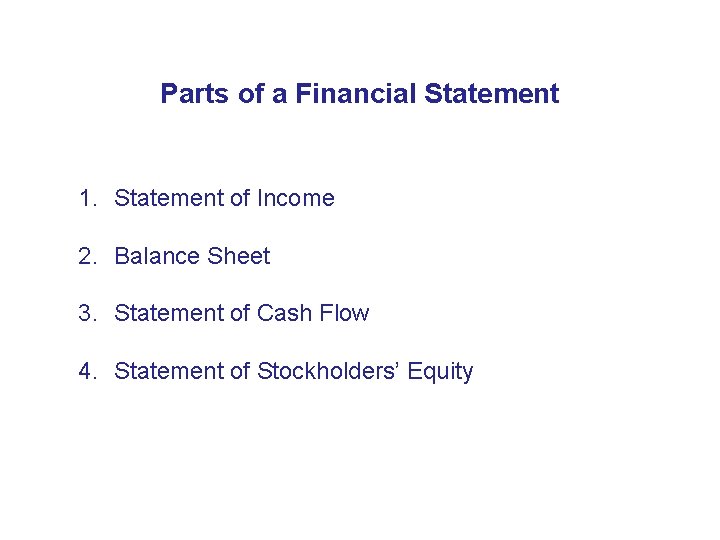
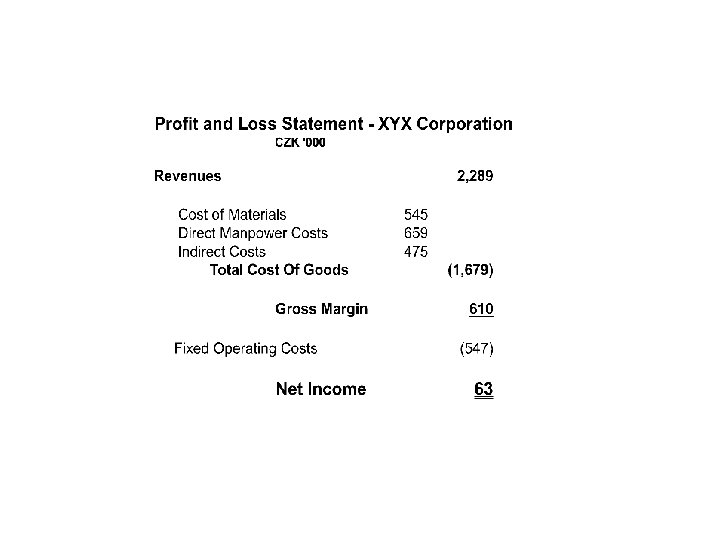
Parts of a Financial Statement 1. Statement of Income 2. Balance Sheet 3. Statement of Cash Flow 4. Statement of Stockholders’ Equity
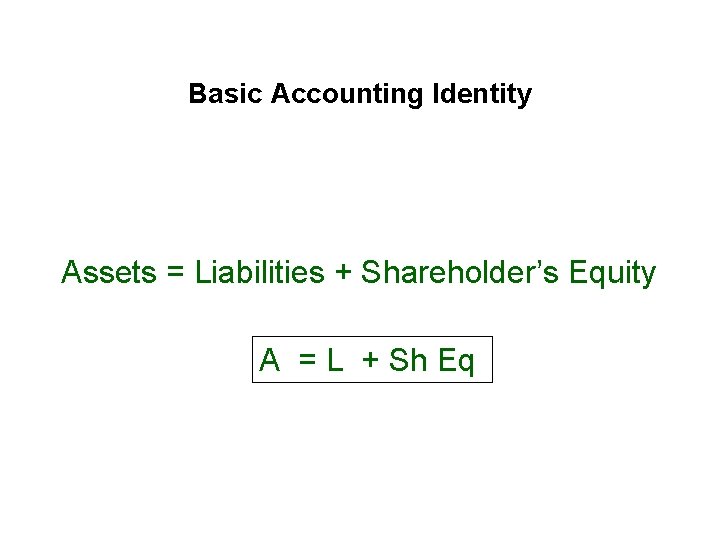
Basic Accounting Identity Assets = Liabilities + Shareholder’s Equity A = L + Sh Eq
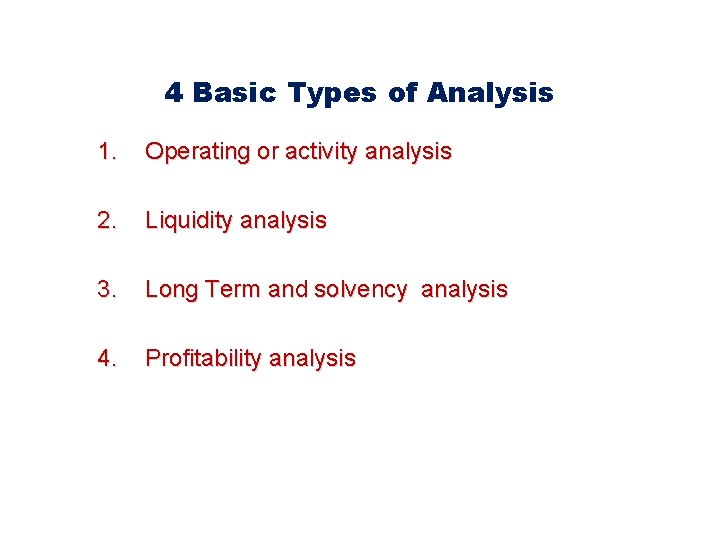
4 Basic Types of Analysis 1. Operating or activity analysis 2. Liquidity analysis 3. Long Term and solvency analysis 4. Profitability analysis
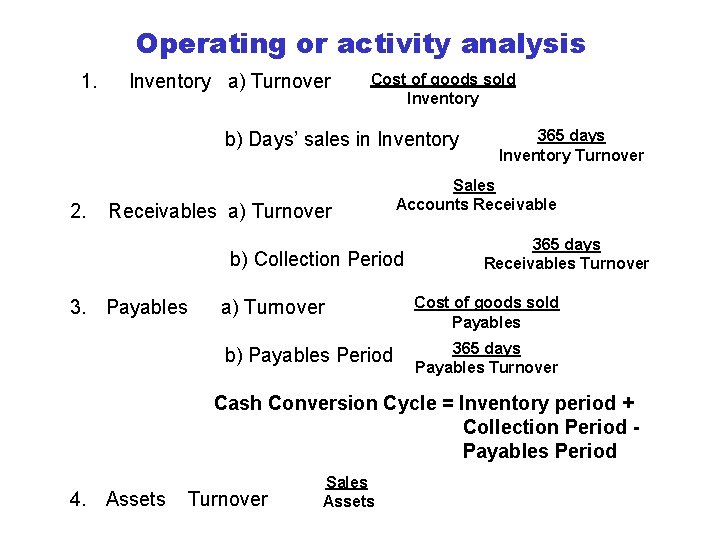
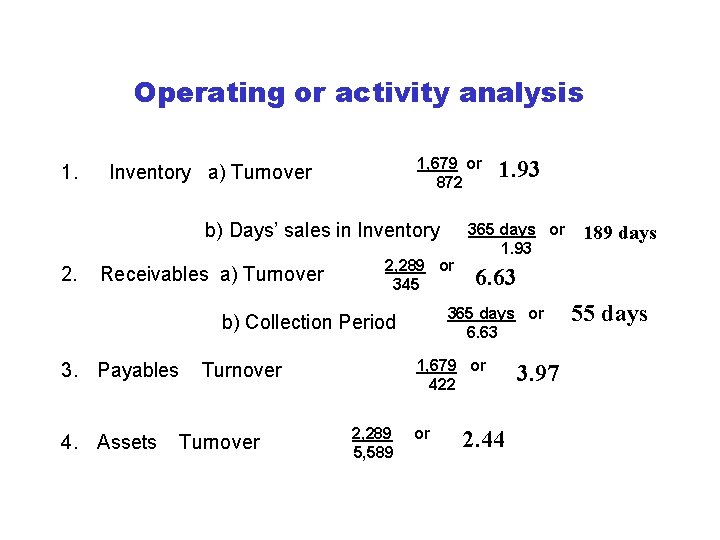
Operating or activity analysis 1. Inventory a) Turnover Cost of goods sold Inventory b) Days’ sales in Inventory 2. Receivables a) Turnover Sales Accounts Receivable b) Collection Period 3. Payables 365 days Inventory Turnover 365 days Receivables Turnover a) Turnover Cost of goods sold Payables b) Payables Period 365 days Payables Turnover Cash Conversion Cycle = Inventory period + Collection Period Payables Period 4. Assets Turnover Sales Assets
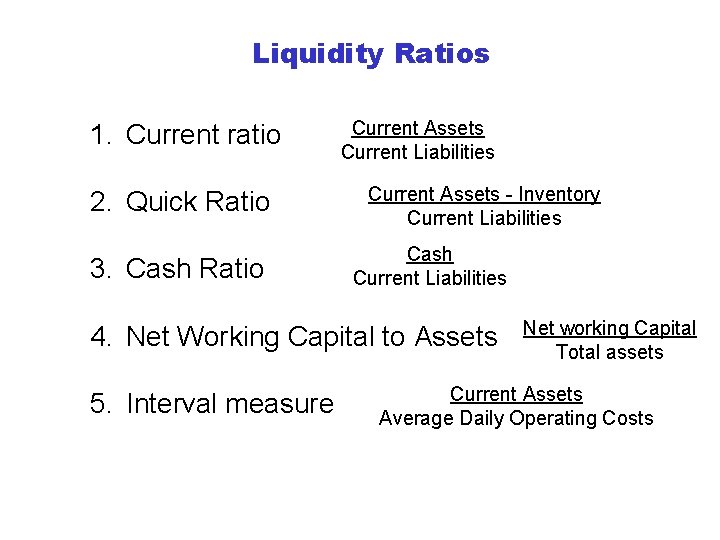
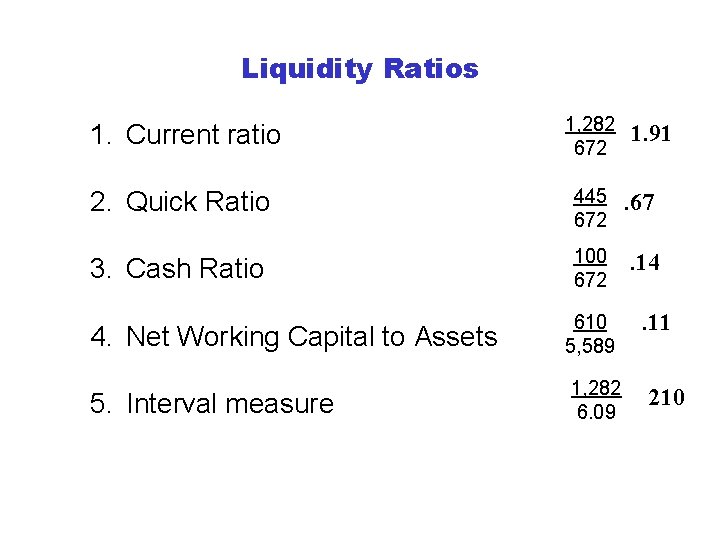
Liquidity Ratios 1. Current ratio 2. Quick Ratio 3. Cash Ratio Current Assets Current Liabilities Current Assets - Inventory Current Liabilities Cash Current Liabilities 4. Net Working Capital to Assets 5. Interval measure Net working Capital Total assets Current Assets Average Daily Operating Costs
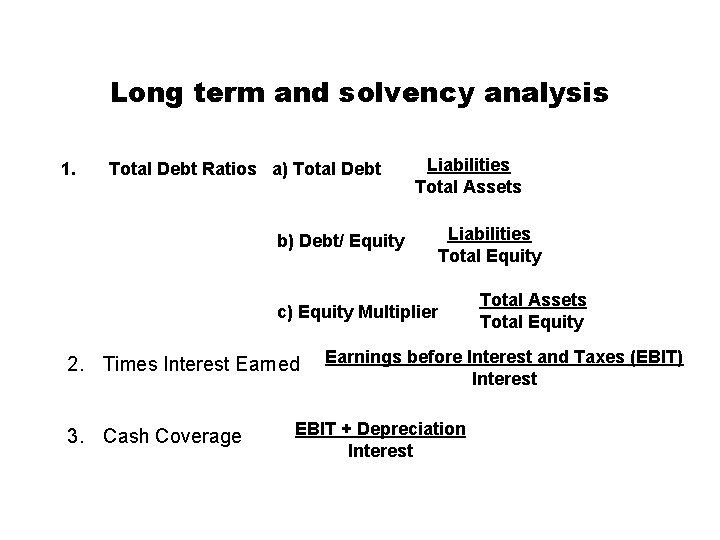
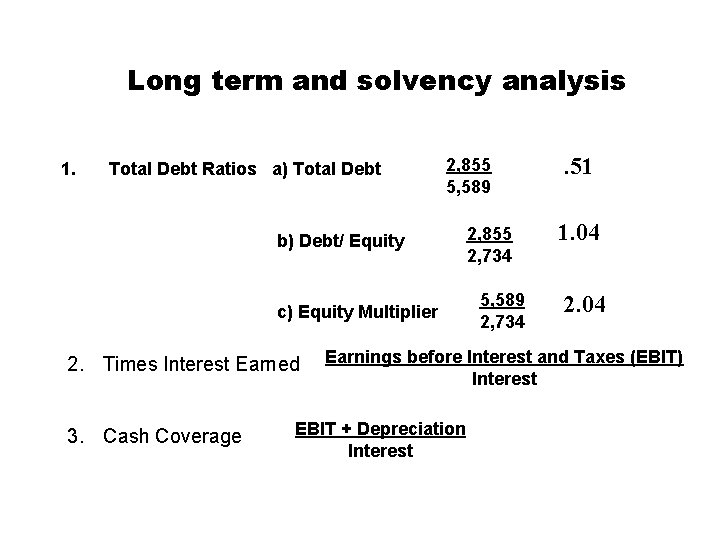
Long term and solvency analysis 1. Total Debt Ratios a) Total Debt b) Debt/ Equity Liabilities Total Assets Liabilities Total Equity c) Equity Multiplier 2. Times Interest Earned 3. Cash Coverage Total Assets Total Equity Earnings before Interest and Taxes (EBIT) Interest EBIT + Depreciation Interest
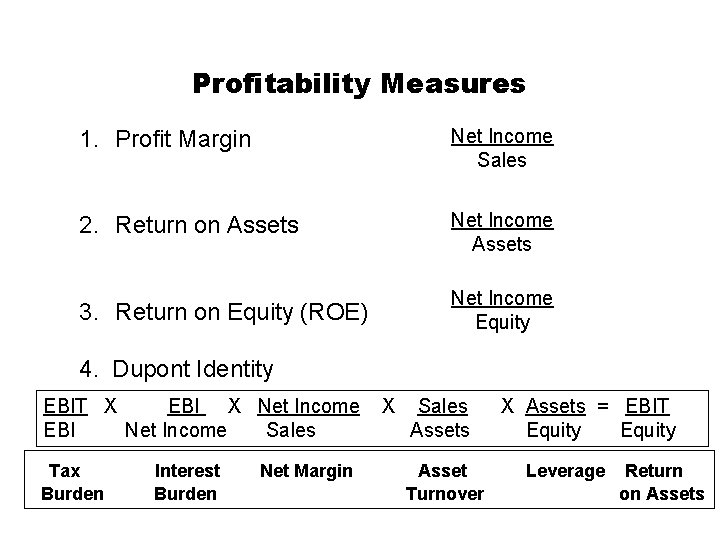
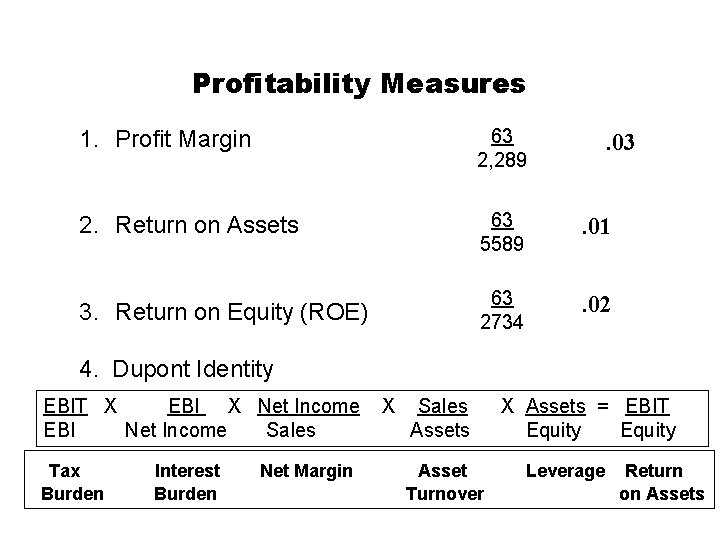
Profitability Measures 1. Profit Margin Net Income Sales 2. Return on Assets Net Income Assets 3. Return on Equity (ROE) Net Income Equity 4. Dupont Identity EBIT X EBI X Net Income EBI Net Income Sales Tax Burden Interest Burden Net Margin X Sales Asset Turnover X Assets = EBIT Equity Leverage Return on Assets
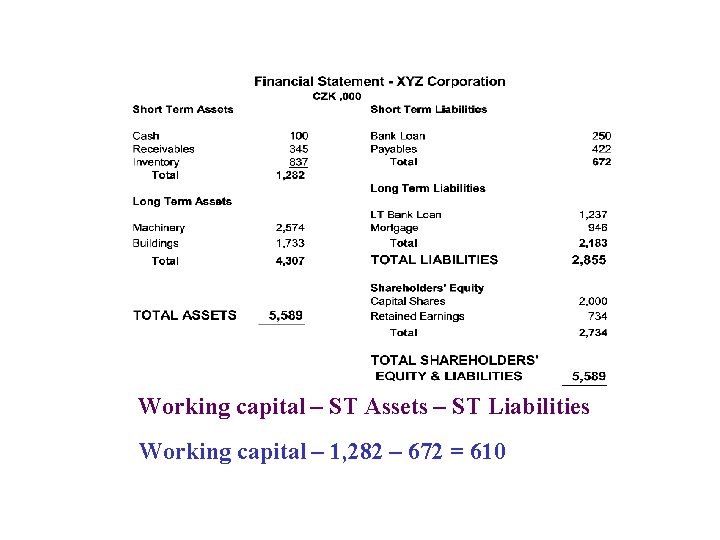
Working capital – ST Assets – ST Liabilities Working capital – 1, 282 – 672 = 610
Operating or activity analysis 1. 1, 679 or 872 Inventory a) Turnover b) Days’ sales in Inventory 2. Receivables a) Turnover 2, 289 or 345 4. Assets 2, 289 5, 589 or 189 days 6. 63 1, 679 or 422 Turnover 365 days or 1. 93 365 days or 6. 63 b) Collection Period 3. Payables 1. 93 2. 44 3. 97 55 days
Liquidity Ratios 1. Current ratio 1, 282 672 2. Quick Ratio 445 672 . 67 3. Cash Ratio 100 672 . 14 4. Net Working Capital to Assets 610 5, 589 5. Interval measure 1, 282 6. 09 1. 91 . 11 210
Long term and solvency analysis 1. Total Debt Ratios a) Total Debt 2, 855 5, 589 b) Debt/ Equity c) Equity Multiplier 2. Times Interest Earned 3. Cash Coverage 2, 855 2, 734 5, 589 2, 734 . 51 1. 04 2. 04 Earnings before Interest and Taxes (EBIT) Interest EBIT + Depreciation Interest
Profitability Measures 1. Profit Margin 63 2, 289 2. Return on Assets 63 5589 . 01 3. Return on Equity (ROE) 63 2734 . 02 . 03 4. Dupont Identity EBIT X EBI X Net Income EBI Net Income Sales Tax Burden Interest Burden Net Margin X Sales Asset Turnover X Assets = EBIT Equity Leverage Return on Assets