
PartonHadron Transition duality in Structure Functions Ioana Niculescu
- Slides: 25
Parton-Hadron Transition (duality) in Structure Functions Ioana Niculescu James Madison University April 28, 2005 ØIntroduction ØProton (unpolarized) ØNuclei ØProton and deuteron (polarized) ØSemi-inclusive electroproduction 04 -28 -2005
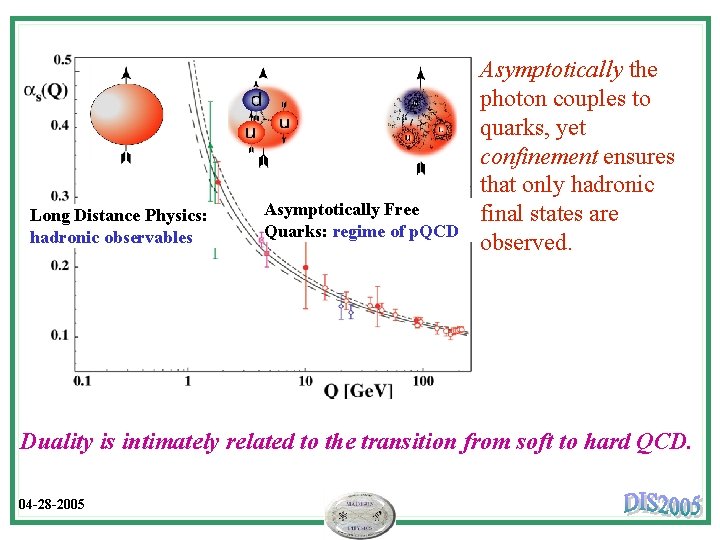
Long Distance Physics: hadronic observables Asymptotically Free Quarks: regime of p. QCD Asymptotically the photon couples to quarks, yet confinement ensures that only hadronic final states are observed. Duality is intimately related to the transition from soft to hard QCD. 04 -28 -2005
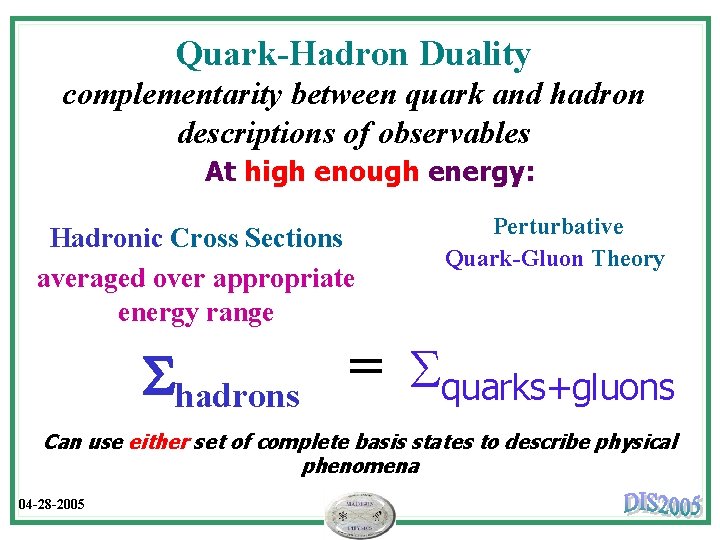
Quark-Hadron Duality complementarity between quark and hadron descriptions of observables At high enough energy: Hadronic Cross Sections averaged over appropriate energy range Perturbative Quark-Gluon Theory Shadrons = quarks+gluons Can use either set of complete basis states to describe physical phenomena 04 -28 -2005
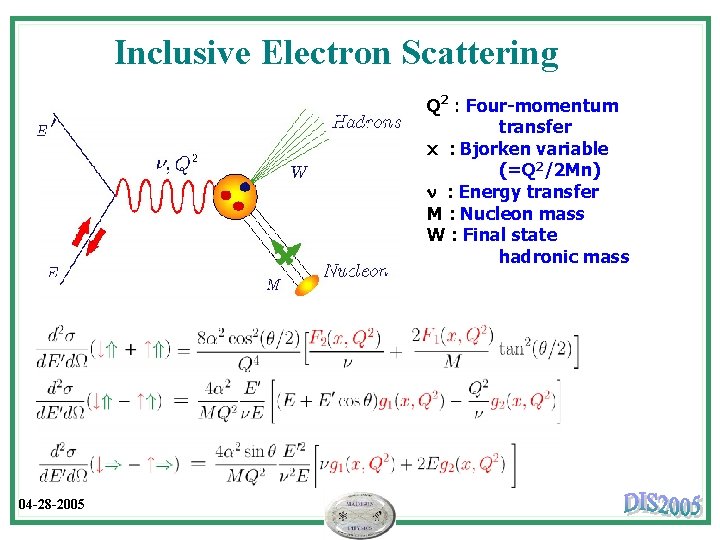
Inclusive Electron Scattering Q 2 : Four-momentum transfer x : Bjorken variable (=Q 2/2 Mn) : Energy transfer M : Nucleon mass W : Final state hadronic mass 04 -28 -2005
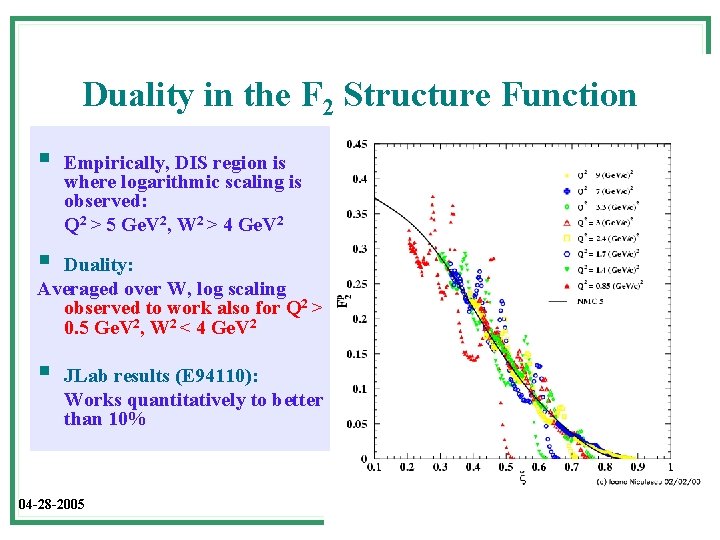
Duality in the F 2 Structure Function § Empirically, DIS region is where logarithmic scaling is observed: Q 2 > 5 Ge. V 2, W 2 > 4 Ge. V 2 § Duality: Averaged over W, log scaling observed to work also for Q 2 > 0. 5 Ge. V 2, W 2 < 4 Ge. V 2 § JLab results (E 94110): Works quantitatively to better than 10% 04 -28 -2005
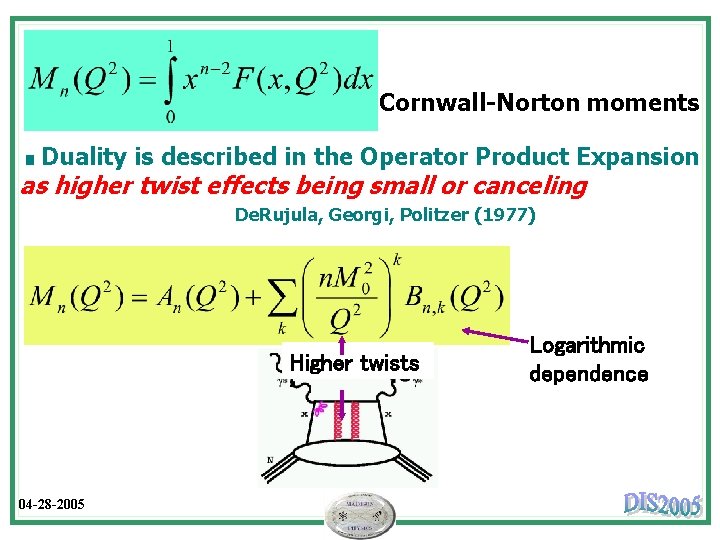
. Cornwall-Norton moments Duality is described in the Operator Product Expansion as higher twist effects being small or canceling De. Rujula, Georgi, Politzer (1977) Higher twists 04 -28 -2005 Logarithmic dependence
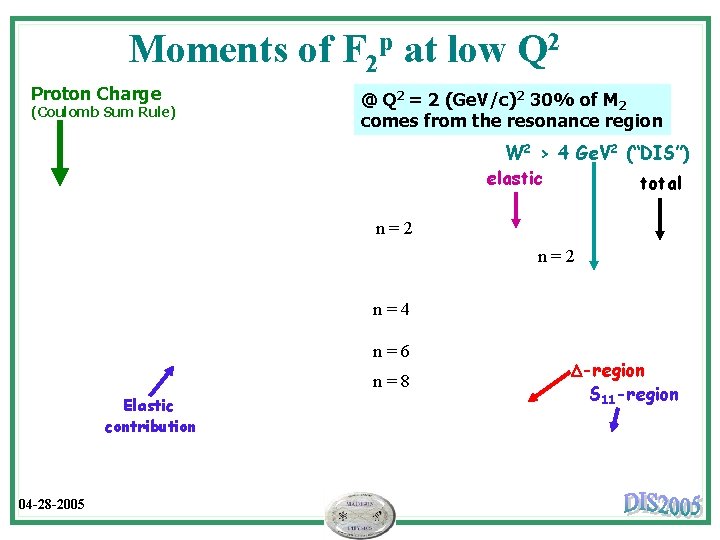
Moments of F 2 p at low Q 2 Proton Charge (Coulomb Sum Rule) @ Q 2 = 2 (Ge. V/c)2 30% of M 2 comes from the resonance region W 2 > 4 Ge. V 2 (“DIS”) elastic total n=2 n=4 n=6 n=8 Elastic contribution 04 -28 -2005 D-region S 11 -region
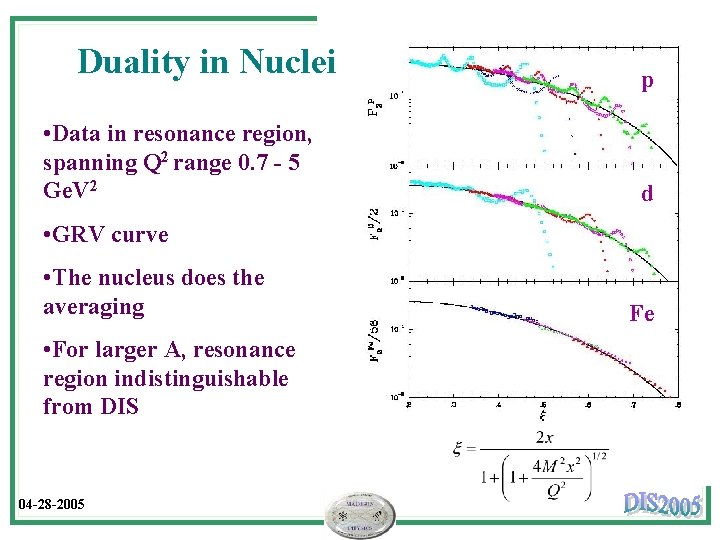
Duality in Nuclei • Data in resonance region, spanning Q 2 range 0. 7 - 5 Ge. V 2 p d • GRV curve • The nucleus does the averaging • For larger A, resonance region indistinguishable from DIS 04 -28 -2005 Fe
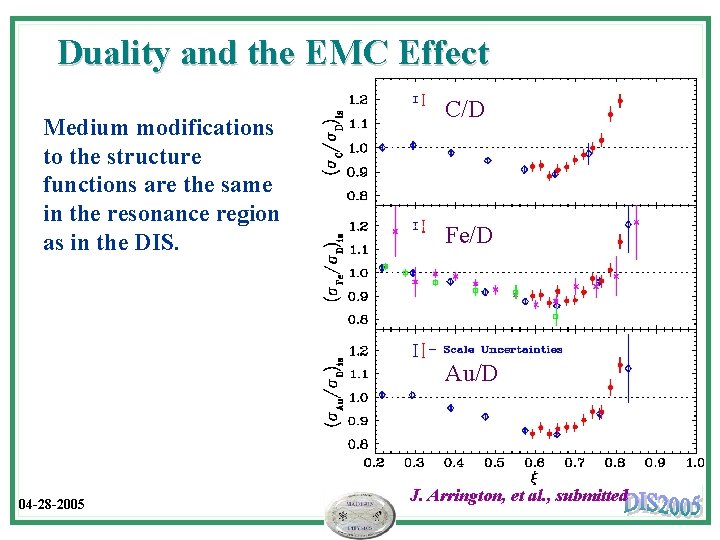
Duality and the EMC Effect Medium modifications to the structure functions are the same in the resonance region as in the DIS. C/D Fe/D Au/D 04 -28 -2005 J. Arrington, et al. , submitted
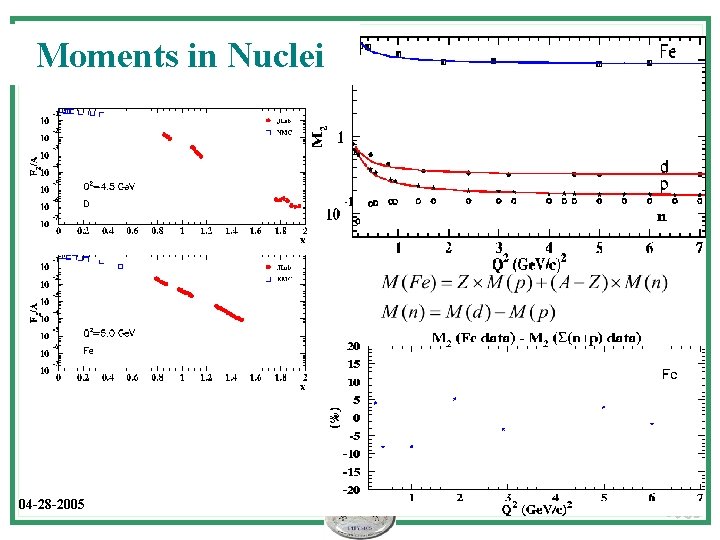
Moments in Nuclei 04 -28 -2005
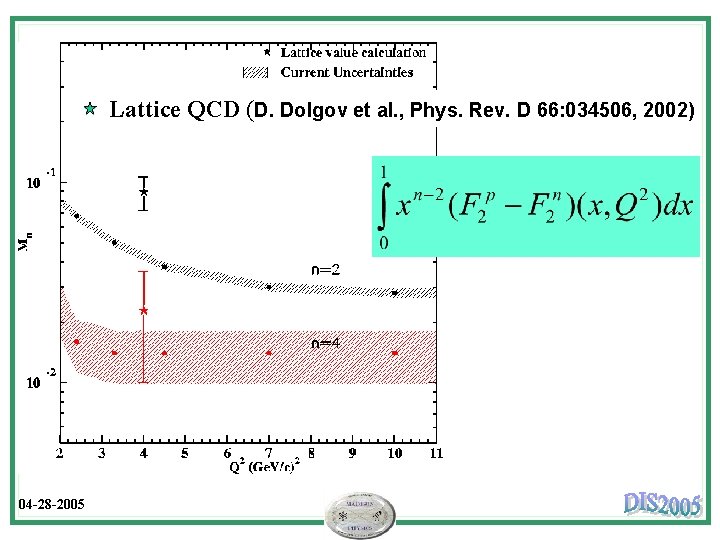
Lattice QCD (D. Dolgov et al. , Phys. Rev. D 66: 034506, 2002) 04 -28 -2005
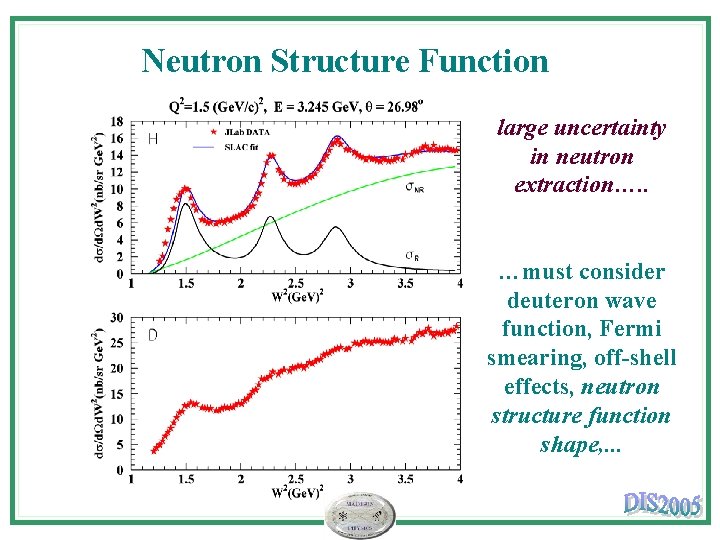
Neutron Structure Function large uncertainty in neutron extraction…. . …must consider deuteron wave function, Fermi smearing, off-shell effects, neutron structure function shape, . . .
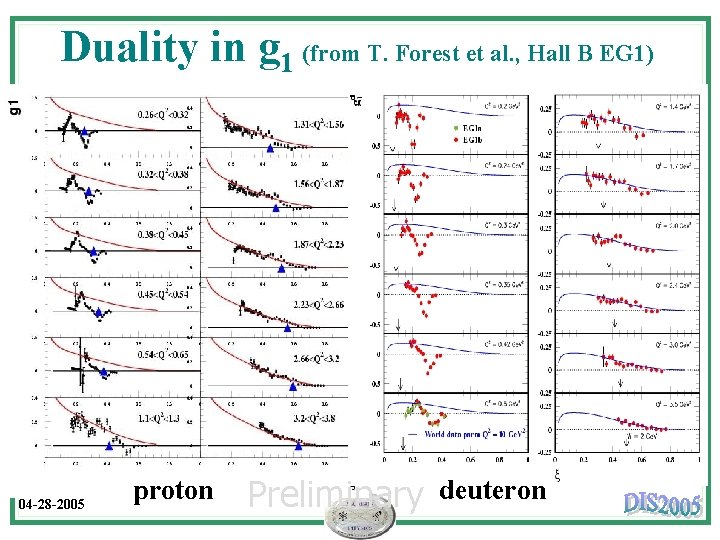
Duality in g 1 (from T. Forest et al. , Hall B EG 1) 04 -28 -2005 proton Preliminary deuteron
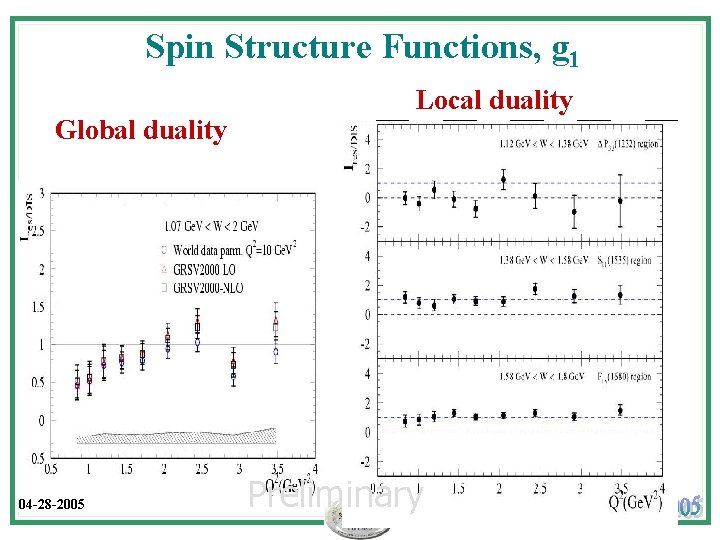
Spin Structure Functions, g 1 Global duality 04 -28 -2005 Local duality Preliminary
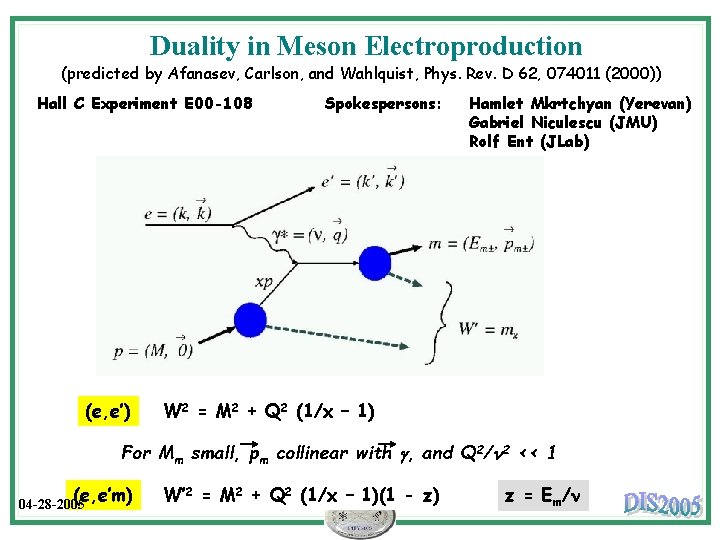
Duality in Meson Electroproduction (predicted by Afanasev, Carlson, and Wahlquist, Phys. Rev. D 62, 074011 (2000)) Hall C Experiment E 00 -108 (e, e’) Spokespersons: Hamlet Mkrtchyan (Yerevan) Gabriel Niculescu (JMU) Rolf Ent (JLab) W 2 = M 2 + Q 2 (1/x – 1) For Mm small, pm collinear with g, and Q 2/n 2 << 1 (e, e’m) 04 -28 -2005 W’ 2 = M 2 + Q 2 (1/x – 1)(1 - z) z = Em/
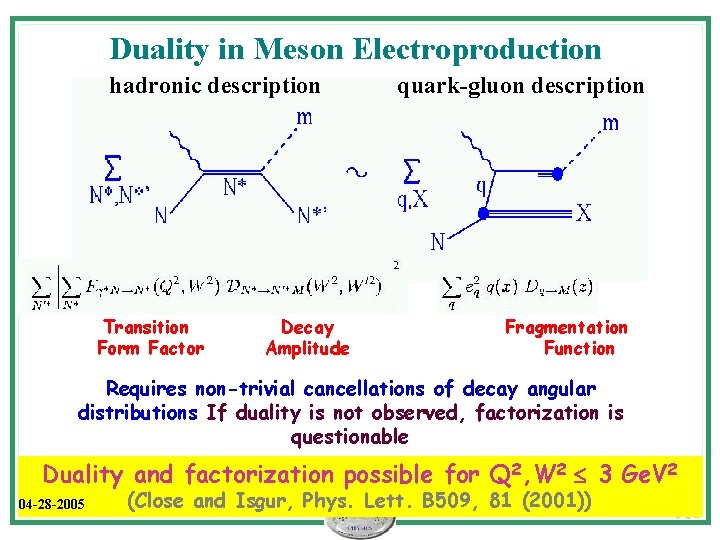
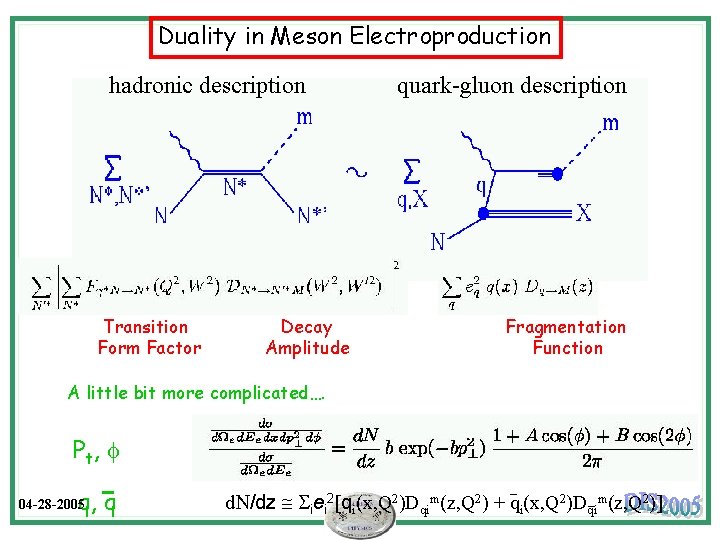
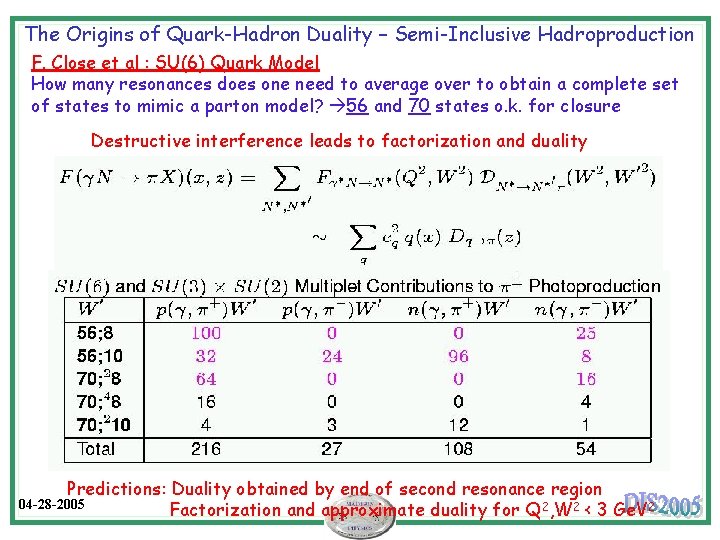
Duality in Meson Electroproduction hadronic description Transition Form Factor Decay Amplitude quark-gluon description Fragmentation Function Requires non-trivial cancellations of decay angular distributions If duality is not observed, factorization is questionable Duality and factorization possible for Q 2, W 2 3 Ge. V 2 04 -28 -2005 (Close and Isgur, Phys. Lett. B 509, 81 (2001))
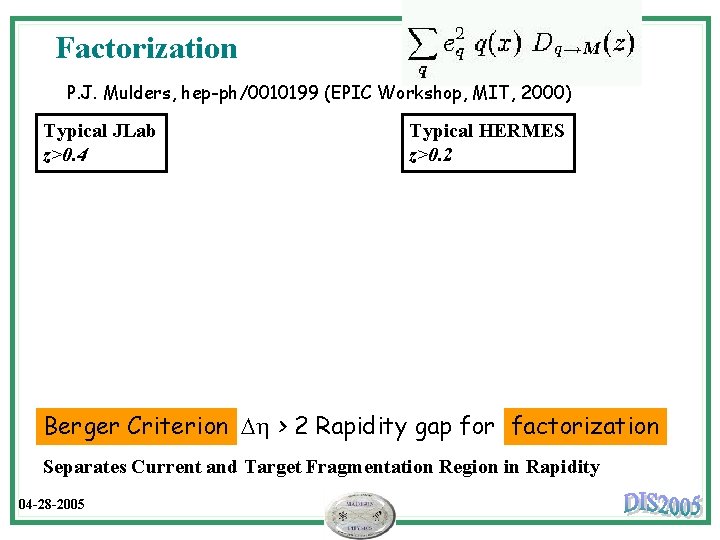
Factorization P. J. Mulders, hep-ph/0010199 (EPIC Workshop, MIT, 2000) Typical JLab z>0. 4 Typical HERMES z>0. 2 Berger Criterion Dh > 2 Rapidity gap for factorization Separates Current and Target Fragmentation Region in Rapidity 04 -28 -2005
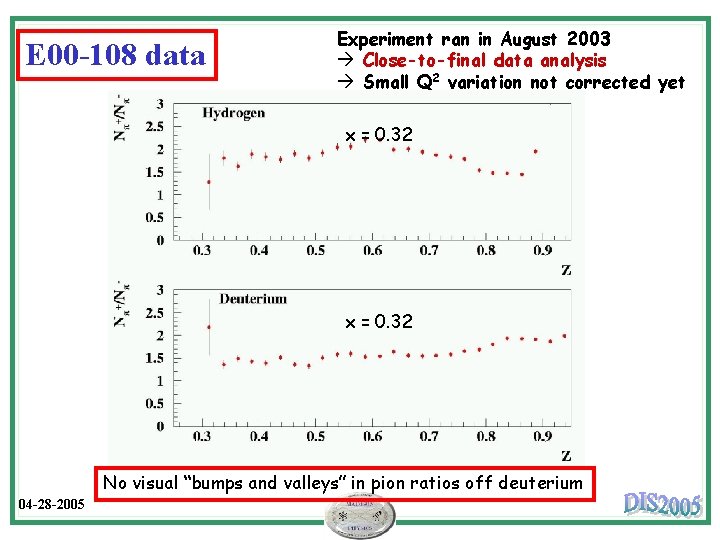
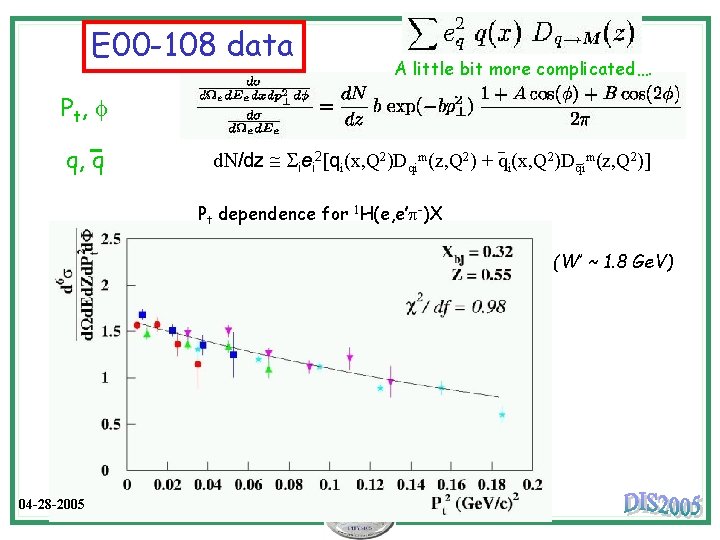
E 00 -108 data Experiment ran in August 2003 Close-to-final data analysis Small Q 2 variation not corrected yet x = 0. 32 No visual “bumps and valleys” in pion ratios off deuterium 04 -28 -2005
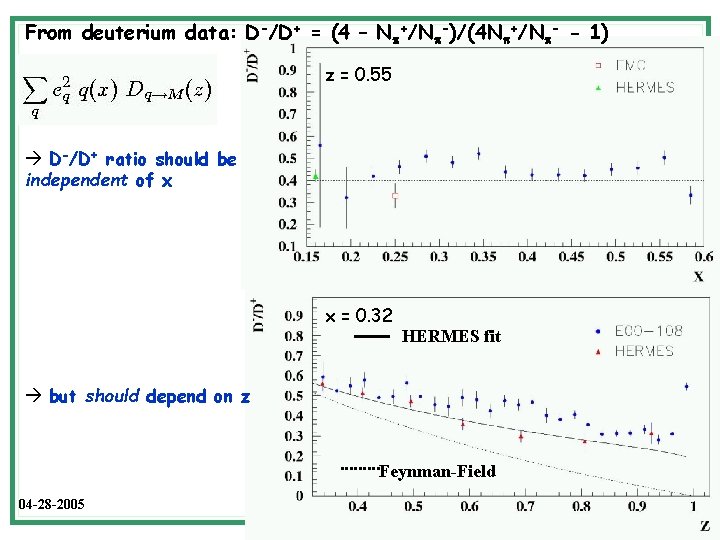
From deuterium data: D-/D+ = (4 – Np+/Np-)/(4 Np+/Np- - 1) z = 0. 55 D-/D+ ratio should be independent of x x = 0. 32 HERMES fit but should depend on z Feynman-Field 04 -28 -2005
Summary • Quark-Hadron Duality – Proton (unpolarized) – Nuclei – Proton and deuteron (polarized) – Semi-inclusive electroproduction 04 -28 -2005
Backup slides 04 -28 -2005
Duality in Meson Electroproduction hadronic description Transition Form Factor Decay Amplitude quark-gluon description Fragmentation Function A little bit more complicated…. P t, f q, q 04 -28 -2005 d. N/dz iei 2 qi(x, Q 2)Dqim(z, Q 2) + qi(x, Q 2)Dqim(z, Q 2)
E 00 -108 data A little bit more complicated…. P t, f q, q d. N/dz iei 2 qi(x, Q 2)Dqim(z, Q 2) + qi(x, Q 2)Dqim(z, Q 2) Pt dependence for 1 H(e, e’p-)X (W’ ~ 1. 8 Ge. V) 04 -28 -2005
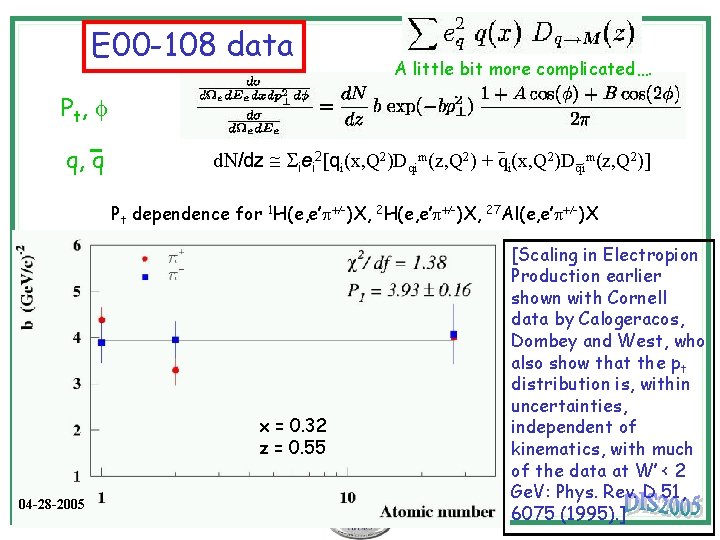
E 00 -108 data A little bit more complicated…. P t, f q, q d. N/dz iei 2 qi(x, Q 2)Dqim(z, Q 2) + qi(x, Q 2)Dqim(z, Q 2) Pt dependence for 1 H(e, e’p+/-)X, 2 H(e, e’p+/-)X, x = 0. 32 z = 0. 55 04 -28 -2005 27 Al(e, e’p+/-)X [Scaling in Electropion Production earlier shown with Cornell data by Calogeracos, Dombey and West, who also show that the pt distribution is, within uncertainties, independent of kinematics, with much of the data at W’ < 2 Ge. V: Phys. Rev. D 51, 6075 (1995). ]
The Origins of Quark-Hadron Duality – Semi-Inclusive Hadroproduction F. Close et al : SU(6) Quark Model How many resonances does one need to average over to obtain a complete set of states to mimic a parton model? 56 and 70 states o. k. for closure Destructive interference leads to factorization and duality Predictions: Duality obtained by end of second resonance region 04 -28 -2005 Factorization and approximate duality for Q 2, W 2 < 3 Ge. V 2